Kent Academic Repository
Full text document (pdf)
Copyright & reuse
Content in the Kent Academic Repository is made available for research purposes. Unless otherwise stated all content is protected by copyright and in the absence of an open licence (eg Creative Commons), permissions for further reuse of content should be sought from the publisher, author or other copyright holder.
Versions of research
The version in the Kent Academic Repository may differ from the final published version.
Users are advised to check http://kar.kent.ac.uk for the status of the paper. Users should always cite the published version of record.
Enquiries
For any further enquiries regarding the licence status of this document, please contact:
If you believe this document infringes copyright then please contact the KAR admin team with the take-down information provided at http://kar.kent.ac.uk/contact.html
Citation for published version
Bai, Lu and Yeung, Chris and Efstratiou, Christos and Chikomo, Moyra (2019) Motion2Vector:
Unsupervised Learning in Human Activity Recognition Using Wrist-Sensing Data. In: CPD
2019: THE 2nd Workshop on Combining Physical and Data-Driven Knowledge in Ubiquitous
Computing, in conjunction with Ubicomp'19, 9 Sep 2019.
DOI
Link to record in KAR
https://kar.kent.ac.uk/76275/
Document Version
Motion2Vector: Unsupervised Learning in Human
Activity Recognition Using Wrist-Sensing Data
Lu Bai∗ [email protected] Ulster University Belfast, UK Chris Yeung Shearwater Systems Ltd Canterbury, UK [email protected] Christos Efstratiou University of Kent Canterbury, Kent [email protected] Moyra Chikomo University of Kent Canterbury, Kent [email protected] ABSTRACT
With the increasing popularity of consumer wearable devices augmented with sensing capabilities (smart bands, smart watches), there is a significant focus on extracting mean-ingful information about human behaviour through large scale real-world wearable sensor data. The focus of this work is to develop techniques to detect human activities, utilis-ing a large dataset of wearable data where no ground truth has been produced on the actual activities performed. We propose a deep learning variational auto encoder activity recognition model - Motion2Vector. The model is trained us-ing large amounts of unlabelled human activity data to learn a representation of a time period of activity data. The learned activity representations can be mapped into an embedded activity space and grouped with regards to the nature of the activity type. In order to evaluate the proposed model, we have applied our method on public dataset - The Heterogene-ity Human ActivHeterogene-ity Recognition (HHAR) dataset. The results showed that our method can achieve improved result over the HHAR dataset. In addition, we have collected our own lab-based activity dataset. Our experimental results show that our system achieves good accuracy in detecting such ac-tivities, and has the potential to provide additional insights in understanding the real-world activity in the situations where there is no ground truth available.
Permission to make digital or hard copies of all or part of this work for personal or classroom use is granted without fee provided that copies are not made or distributed for profit or commercial advantage and that copies bear this notice and the full citation on the first page. Copyrights for components of this work owned by others than the author(s) must be honored. Abstracting with credit is permitted. To copy otherwise, or republish, to post on servers or to redistribute to lists, requires prior specific permission and/or a fee. Request permissions from [email protected].
UbiComp/ISWC ’19 Adjunct, September 9–13, 2019, London, United Kingdom
© 2019 Copyright held by the owner/author(s). Publication rights licensed to ACM.
ACM ISBN 978-1-4503-6869-8/19/09. . . $15.00 https://doi.org/10.1145/3341162.3349335
CCS CONCEPTS
•Human-centered computing→Ubiquitous and mo-bile computing.
KEYWORDS
human activity recognition, deep learning, variational auto encoder
ACM Reference Format:
Lu Bai, Chris Yeung, Christos Efstratiou, and Moyra Chikomo. 2019. Motion2Vector: Unsupervised Learning in Human Activ-ity Recognition Using Wrist-Sensing Data. InAdjunct Proceedings of the 2019 ACM International Joint Conference on Pervasive and Ubiquitous Computing and the 2019 International Symposium on Wearable Computers (UbiComp/ISWC ’19 Adjunct), September 9–13, 2019, London, United Kingdom.ACM, New York, NY, USA, 6 pages. https://doi.org/10.1145/3341162.3349335
1 INTRODUCTION
With the increasing popularity of consumer wearable devices augmented with sensing capabilities (smart bands, smart watches), there is a significant focus in extracting mean-ingful information about human behaviour through large scale real-world wearable sensor data [13]. Human activ-ity recognition (HAR) through wearable devices is recently considered a vital tool for future healthcare applications, especially in support for elderly people and patients with certain long-term conditions [2–4]. HAR can help patients with continuous care and rehabilitation needs at home and provides clinicians with additional insight of the patients’ performance.
Traditional approaches in developing HAR systems, rely on the collection of properly labeled training datasets, where the actual activities of the users are captured accurately ei-ther through controlled experiments, or through self reports [1, 12, 14]. These approaches however suffer from scalabil-ity issues as the process of collecting ground truth through self-report cannot be employed on a large scale and over
UbiComp/ISWC ’19 Adjunct, September 9–13, 2019, London, United Kingdom L.Bai et al.
long periods of time. In order to progress with the wider application of HAR systems there is a need for developing techniques were human activity classifiers can be developed with minimum need for accurate ground truth from the par-ticipants.
In this work we aim to explore the development of an unsupervised model to infer what people do from wearable sensor data. Our focus is on the use of large scale wearable datasets, which do not contain any prior labeling of the ac-tivities that users perform. Interpreting and using such data imposes significant challenges in developing appropriate hu-man activity recognition techniques, without the need for accurately labelling data to produce a training dataset.
Specifically, we focus on the analysis of a large dataset of activities captured through wearable wrist-bands (Microsoft Band 2) as part of the Innovate UK funded project "Epilepsy Networks". The dataset was produced by a cohort of 37 pa-tients suffering from epilepsy, using wearable wrist-bands during their daily lives, for a long period of time (approxi-mately 6500 days in total, with an average of 112 days per participant). The dataset consists of raw accelerometer, gyro-scope readings along with physiological data (i.e. heart rate) as captured by the wearable device. During the deployment the participants were not required to submit any ground truth about their daily activities.
Our aim is to develop a technique to detect the daily ac-tivities of participants through this unlabeled dataset. To do this we propose an approach based on an auto-encoder deep learning model, called Motion2Vector, which is developed through unsupervised training on this large dataset. The pur-pose of the model is to convert a time period of activity data into a movement vector embedding within a multidimen-sional space, as a representation of a certain activity type. That representation helps us group similar activities together within the embedded space. The technique can help iden-tify when and for how long similar activities take place, but the actual meaning/context for such activities requires lim-ited knowledge of ground truth. We evaluate the approach through public dataset - HHAR and our own lab-based ac-tivity dataset. The core contribution of this work includes:
• We propose a variational autoencoder (VAE) deep learn-ing technique to train a model uslearn-ing a large wrist-band dataset of real-world activities, without labelling. The proposed model enables movement embedding utilis-ing the raw input from wearable sensor data.
• We deploy our data collection system and collect the datasets in lab-based session in order to evaluate our trained model. The lab-based session is accurately la-belled by the researcher who is carrying out the exper-iment.
• We validate our trained model on both public datasets and our collected datasets.
2 RELATED WORK
Significant work in HAR focuses on the use of inertial sensor to detect human activities [10, 16, 18]. This is motivated pri-marily by the wide availability of such sensors on consumer devices such as smartphones and smart watches. Most of these systems rely heavily on well labeled training datasets, generated mostly through controlled lab experiments. The development and training of appropriate machine learning classifiers typically involves the extraction of hand-crafted features from the raw data before being used to train an ap-propriate classifier. Manual extraction of features from raw data typically requires appropriate domain knowledge on the type of activity that should be detected, or would require extensive human observation.
With the increased popularity in deep learning models in machine learning, there has been also a shift in applying deep learning techniques in HAR [13]. In [17], a CNN model is used to automate the feature extraction under the supervi-sion of output labels. [5], a LSTM-RNN model is created in order to explore the time dependencies of the human motion data. Supervised deep learning models can save development time in creating the appropriate features, however, it still requires accurately labelled datasets to train the model. Semi-supervised models aim to integrate the Semi-supervised learning and unsupervised learning. They generally rely on small amounts of labelled data [6, 8]. However, in situations where the collection of ground truth is not realistic or possible, semi-supervised models are still not feasible solutions.
When considering scenarios where sensor data has been collected already, but without any prior ground truth, ex-ploring unsupervised learning techniques is the only viable approach. In unsupervised learning there is no requirement for labelled data. The purpose is to find hidden patterns within the data, and identify groups of similar activities [11]. Evaluating an unsupervised model is challenging when no labeled data is available. In our work, we exploit a small set of labeled activity dataset as part of the evaluation of the produced model.
3 DEEP LEARNING ARCHITECTURE
Our objective is to develop a HAR system that is trained on a large unlabeled dataset of sensor data captured by smart wrist bands. The purpose of the HAR system is to be able to group similar activities together. In order to achieve this we first need to train a model to encode raw inertial sensor data into a vector that represents the movement characteristics captured by the sensor data.
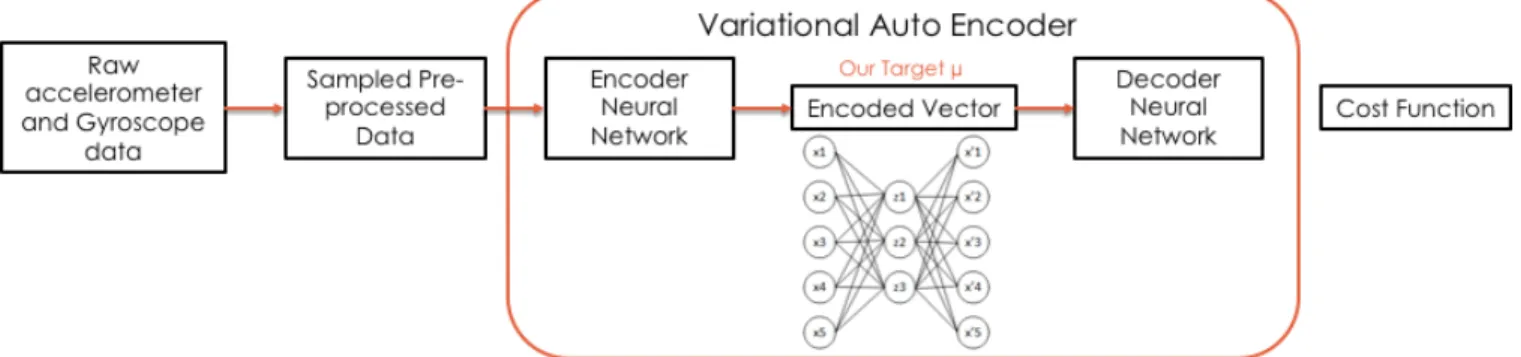
Figure 1: Deep learning architecture
Model Overview
The deep learning model used in this study is inspired by the variational autoencoder proposed by Hu et.al [7] which is applied in generating sketch drawings in a vector format using a recurrent neural network (RNN). In our work, we have made certain modifications to make the deep learn-ing architecture fit with the context of our problem. Figure 1 shows this deep learning architecture. Raw sensor data is pre-processed and fed into an encoder neural network. The hidden layer is N-dimensional encoded vector which is used as the representation of the activity. The decoder neural network decodes the encoded vector and creates an output which has the exact same size as the input. The cost function is trying to minimize the difference between the input and output. The details of the deep learning network are described in the following subsections. After the model has been trained, the encoded vector is used as a good repre-sentation of the blocks of activity in the embedded space. Input Data Preparation
The input data for the training model, and the validation dataset, consist of raw accelerometer and gyroscope data captured from the wearable wrist band. These datasets are pre-processed as described below.
Accelerometer and Gyroscope Sensors.In processing the sen-sor data, our aim is to convert every sensen-sor data point with raw accelerometer and gyroscope data, into a data point that represents the relative change of the position and orienta-tion of the sensing device. Essentially each data point is to be converted into a vector M=(∆Px,∆Py, ∆Pz, gx, gy, gz) where∆Px,y,zrepresent the change in position, and gx,y,z represent change in orientation. Activity within a short time period is composed of a set of points.
Calculating the relative change of position.Extracting gravity from the raw data is used to identify a global reference frame. Extracting gravity from accelerometer data can be done using
a low-pass / moving average filter:∆G =G·α+(1−α) ·
Accinput· (x)
The relative change of position is to calculate the position relative to the previous position with respect to the global reference frame. In order to calculate the 3D relative posi-tion, the first step is to compute the linear acceleration from raw acceleration and the second step is to double integrate the linear acceleration. The input data to the auto encoder consists of a time window of multiple sensor data points (M1,
M2,. . . , Mn).
Auto Encoder
The auto encoder consists of an encoder model that “com-presses” the input data into a vector representation, and a decoder that uses the generated vector to “decompress” the data to its original form. The auto encoder is trained using a cost function that evaluate how well the encoding-decoding process works.
For our encoder, we use a bidirectional Long Short-Term Memory (LSTM) to encode the input blocks of pre-processed data.
UbiComp/ISWC ’19 Adjunct, September 9–13, 2019, London, United Kingdom L.Bai et al.
As seen in Figure 2, two hidden stateshf andhb are gen-erated. Then the concatenation of these hidden states will be used to generate two embedded vectors through a fully connected layer.
The embedded vectorµis our target in this study, it is a 128 dim vector and it is considered an appropriate representation of the input movement within a particular time period.
As part of the training process, theµvector is used by the decoder which is responsible for regenerating the input data. In order to prepare the inputs for the decoder, a random vectorυis created usingµandδfollowing a unit normalised distribution. The decoder takes the created vectorνand all the inputs to generate the outputs.
Cost function and training details
Our model is trained through a combination of two parts of loss - content loss and KL-divergence loss [9]. As described in Equation 1, the content loss is to minimize the difference between the input M and output M’.
Lc =N1 N
Õ
i=1
(M′−M)2 (1) The KL divergence loss is described in the Equation 2 below: LK L=− 1 2N N Õ i=1 (1+lnσi−µi2−σi) (2) The final loss is the optimisation of the content loss and the KL-divergence loss (Equation 3).
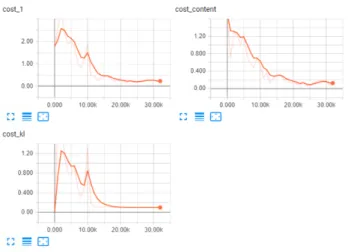
L=Lc+γ LK L (3) Annealing technique is used to adjust the latent lost: 0.1<γ<1. The training result is shown in Figure 3. In each subplot, the x-axis is the number of the training iterations and y-axis is the value of training loss.
4 EVALUATION Training Dataset
The training data has been captured as part of an Innovate UK funded project. The aim of the project was to provide support for people suffering from epilepsy, and it included a large deployment of wrist-worn devices to patients. During the study, each of the participants was given a Microsoft Band 2 and installed a mobile app able to log data from their wearable device. The app was also designed to collect the patients’ self-reports on potential epileptic seizures; how-ever, no other ground truth was captured regarding the daily activities of the participants. Wristband sensor data has been collected on 37 patients from May 2017 until August 2018.
Figure 3: Loss graph for our model trained using our large cohort of data
Sensor data included tri-axis accelerometer and tri-axis gy-roscope data, sampled at 31Hz. In this study, we use this dataset as our training datasets.
Figure 4: The system structure of the wearable data collec-tion system
Evaluation Dataset
In evaluating our trained model, we needed wearable data with ground truth so as to evaluate the accuracy of the trained model. We relied on a combination of public HAR datasets, and in lab experiments.
Public Dataset.In order to evaluate our model, we selected the public HHAR dataset [15], a dataset collected from 9 par-ticipants. It contains data from 4 different models of smart-watches (2 LG smart-watches, 2 Samsung Galaxy Gears). The sensor readings contain both accelerometer and gyroscope. Data collection.Most of the public available datasets are focused in collecting general motion of the human during walking, running, cycling, sitting, etc. However, since our
Figure 5: Data collection details for lab-based data collection
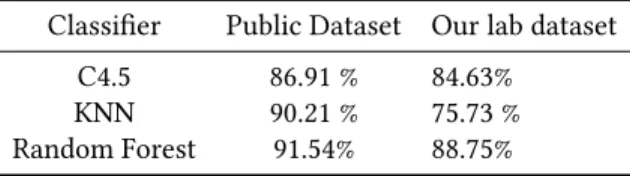
Table 1: The F1 Performance of different Datasets
Classifier Public Dataset Our lab dataset
C4.5 86.91 % 84.63%
KNN 90.21 % 75.73 %
Random Forest 91.54% 88.75%
wrist sensor is worn by the participant all the time, we are able to track some finer motion of the hand activity including drinking, waving hand, typing, etc. In order to explore a wider range of activities we generated our own labeled data, through a controlled experiment. 10 participants were invited for a 15 mins lab-based session where they were asked to perform certain tasks wearing a wristband.
The lab-based session experiment was carried out in a research room at the University of Kent. During this experi-ment session, the participants were asked to complete a range of different human daily activity including walking, running, typing, writing, etc. Figure 5 shows the experimental flow of the lab-based session. The ground truth was captured by the pad operated by the observer researcher. The app developed for capturing the activity was able to record the start and end time of each of the specific activities.
Evaluation Methods
For each dataset, through applying the trained model, we have gained 128 dimensional encoded vectors. One method to evaluate the performance is to use 128 dimension vectors as features. Three different classifiers have been used and the classification results are presented using F1 score. A comparison has been made with other researcher’s work on the same dataset using hand crafted features.
Table 2: Activity recoginition Performance based on embed-ding dictionary
Performance Public Dataset Our lab dataset
Precision 87% 73%
Recall 88 % 73%
F1-Score 87% 72 %
Additionally, another method based on the Euclidean dis-tance have been proposed to evaluate the results of the Em-bedding. 30% of data is used to create the word embedding dictionary, and the Euclidean distance is calculated using Equation (4) below for the distance between the test dataset and the embedding dictionary. The activity predicted on the test dataset is estimated as the activity of the closest vector in terms of Euclidean distance.
D= v t n Õ i=1 (xi −yi)2 (4) Results
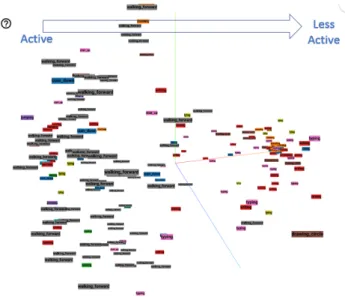
Results Visualisation.In Figure 6, a visualisation of the Em-bedded space has been presented. Different activities are grouped together in the space and from the left to right, the activity type is less active. t-NSE is applied to reduce the dimenstions and visulise the 128 dimension vectors in the embeded space.
Classifier Validation.For both datasests, we have implement the first evaluation method using the embedded 128 dimen-sion vectors as the features. We train 3 different classifiers and the performance F1 score is presented in Table 1. It is noted that the classifiers trained by using the embedded vec-tors as the features outperform the standard approaches with the handcrafted features from a previous study where the F1 scores of KNN and Random Forest are all below 90% while the F1 score of C4.5 is less than 85%. The F1 score of the lab-based dataset is slightly lower than that of the Public Dataset due to the fact that our collected lab-based dataset is much more noisy and contains more activities.
Euclidean Distance Validation.For both datasets, we have also implemented the evaluation using the Euclidean based method as described in the above Evaluation Methods sec-tion. The results of the performance are presented in Table 2 for two different datasets.
5 CONCLUSIONS
In this paper, we present a deep learning model for unsu-pervised activity recognition. The model has been trained using a large dataset from epileptic patient activity data. The
UbiComp/ISWC ’19 Adjunct, September 9–13, 2019, London, United Kingdom L.Bai et al.
Figure 6: Visualisation of resutls in Embedded Space
experiments on public datasets and our collected datasets demonstrate the proposed model performance. In particu-lar when limited labeled data is available, our model can achieve higher performance than traditional classification techniques, using hand-crafted features. In a fully unsuper-vised mode, our model can achieve accuracy of higher than 87% when tested on public datasets.
ACKNOWLEDGMENTS
This research was partially supported by Innovate UK (KTP-10829)
REFERENCES
[1] Ling Bao and Stephen S Intille. 2004. Activity recognition from user-annotated acceleration data. InInternational conference on pervasive computing. Springer, 1–17.
[2] Franco Cicirelli, Giancarlo Fortino, Andrea Giordano, Antonio Guerri-eri, Giandomenico Spezzano, and Andrea Vinci. 2016. On the design of smart homes: A framework for activity recognition in home envi-ronment.Journal of medical systems40, 9 (2016), 200.
[3] Christian Debes, Andreas Merentitis, Sergey Sukhanov, Maria Niessen, Nikolaos Frangiadakis, and Alexander Bauer. 2016. Monitoring activi-ties of daily living in smart homes: Understanding human behavior.
IEEE Signal Processing Magazine33, 2 (2016), 81–94.
[4] Bruce H Dobkin. 2017. A rehabilitation-internet-of-things in the home to augment motor skills and exercise training.Neurorehabilitation and neural repair31, 3 (2017), 217–227.
[5] Marcus Edel and Enrico Köppe. 2016. Binarized-blstm-rnn based human activity recognition. In2016 International Conference on Indoor Positioning and Indoor Navigation (IPIN). IEEE, 1–7.
[6] Donghai Guan, Weiwei Yuan, Young-Koo Lee, Andrey Gavrilov, and Sungyoung Lee. 2007. Activity recognition based on semi-supervised learning. In13th IEEE International Conference on Embedded and Real-Time Computing Systems and Applications (RTCSA 2007). IEEE, 469– 475.
[7] David Ha and Douglas Eck. 2017. A neural representation of sketch drawings.arXiv preprint arXiv:1704.03477(2017).
[8] HM Hossain, MD Al Haiz Khan, and Nirmalya Roy. 2018. DeActive: scaling activity recognition with active deep learning.Proceedings of the ACM on Interactive, Mobile, Wearable and Ubiquitous Technologies
2, 2 (2018), 66.
[9] Diederik P Kingma and Max Welling. 2013. Auto-encoding variational bayes.arXiv preprint arXiv:1312.6114(2013).
[10] Narayanan C Krishnan and Sethuraman Panchanathan. 2008. Analysis of low resolution accelerometer data for continuous human activity recognition. In2008 IEEE International Conference on Acoustics, Speech and Signal Processing. IEEE, 3337–3340.
[11] Yongjin Kwon, Kyuchang Kang, and Changseok Bae. 2014. Unsu-pervised learning for human activity recognition using smartphone sensors.Expert Systems with Applications41, 14 (2014), 6067–6074. [12] David Minnen, Thad Starner, Jamie A Ward, Paul Lukowicz, and G
Troster. 2005. Recognizing and discovering human actions from on-body sensor data. In2005 IEEE International Conference on Multimedia and Expo. IEEE, 1545–1548.
[13] Henry Friday Nweke, Ying Wah Teh, Mohammed Ali Al-Garadi, and Uzoma Rita Alo. 2018. Deep learning algorithms for human activity recognition using mobile and wearable sensor networks: State of the art and research challenges. Expert Systems with Applications105 (2018), 233–261.
[14] Ekaterina H Spriggs, Fernando De La Torre, and Martial Hebert. 2009. Temporal segmentation and activity classification from first-person sensing. In2009 IEEE Computer Society Conference on Computer Vision and Pattern Recognition Workshops. IEEE, 17–24.
[15] Allan Stisen, Henrik Blunck, Sourav Bhattacharya, Thor Siiger Prentow, Mikkel Baun Kjærgaard, Anind Dey, Tobias Sonne, and Mads Møller Jensen. 2015. Smart devices are different: Assessing and mitigatingmobile sensing heterogeneities for activity recognition. InProceedings of the 13th ACM Conference on Embedded Networked Sensor Systems. ACM, 127–140.
[16] Shuangquan Wang, Jie Yang, Ningjiang Chen, Xin Chen, and Qinfeng Zhang. 2005. Human activity recognition with user-free accelerome-ters in the sensor networks. In2005 International Conference on Neural Networks and Brain, Vol. 2. IEEE, 1212–1217.
[17] Ming Zeng, Le T Nguyen, Bo Yu, Ole J Mengshoel, Jiang Zhu, Pang Wu, and Joy Zhang. 2014. Convolutional neural networks for human activ-ity recognition using mobile sensors. In6th International Conference on Mobile Computing, Applications and Services. IEEE, 197–205. [18] Jakob Ziegler, Henrik Kretzschmar, Cyrill Stachniss, Giorgio Grisetti,
and Wolfram Burgard. 2011. Accurate human motion capture in large areas by combining IMU-and laser-based people tracking. In2011 IEEE/RSJ International Conference on Intelligent Robots and Systems. IEEE, 86–91.