Precision laser spectroscopy experiments on antiprotonic
helium
MasakiHori1,⇤
1Max-Planck-Institut für Quantenoptik, Hans-Kopfermann-Strasse 1, D-85748 Garching, Germany
Abstract.At CERN’s Antiproton Decelerator (AD) facility, the Atomic Spec-troscopy and Collisions Using Slow Antiprotons (ASACUSA) collaboration is carrying out precise laser spectroscopy experiments on antiprotonic helium (pHe+ ⌘ p
+He2+ +e−) atoms. By employing bu↵er-gas cooling
tech-niques in a cryogenic gas target, samples of atoms were cooled to tempera-tureT =1.5–1.7 K, thereby reducing the Doppler width in the single-photon
resonance lines. By comparing the results with three-body quantum electro-dynamics calculations, the antiproton-to-electron mass ratio was determined as Mp/me = 1836.1526734(15). This agreed with the known proton-to-electron mass ratio with a precision of 8⇥10−10. Further improvements in the exper-imental precision are currently being attempted. The high-quality antiproton beam provided by the future Extra Low Energy Antiproton Ring (ELENA) fa-cility should further increase the experimental precision.
1 Introduction
The metastable antiprotonic helium (pHe+⌘p+He2++e−) atom is an exotic long-lived sys-tem made of a helium nucleus, an electron in the ground state, and an antiproton occupying a Rydberg state of principal and orbital angular momentum quantum numbersn⇠`−1⇠38 [1–3]. The unusual longevity of the atom allows us to measure its transition frequencies by laser spectroscopy. By comparing the values with the results of three-body quantum elec-trodynamics (QED) calculations, the antiproton-to-electron mass ratio Mp/me can in
prin-ciple be determined with a relative precision of⇠ 10−11 [4–6]. This corresponds to the best determinations of the proton-to-electron mass ratioMp/meobtained from Penning trap
experiments [7–11], or laser spectroscopy of HD+molecular ions [12–14]. ThepHe+ exper-iments also provide a consistency test of CPT symmetry [15], which may be complementary to the spectroscopy experiments on antihydrogen atoms [16–18]. It provides experimental constraints on any exotic fifth force that may exist at the⇠1 Å length scale [19–22].
The atoms can be readily synthesized via the reaction, p+He ! pHe++e−, by allow-ing an antiproton beam [23] to come to rest in a helium gas target [24–26]. The transition frequencies of pHe+spanning the infrared to ultraviolet range have been calculated [4–6] to a relative precision of⇠ 10−10 by evaluating the quantum electrodynamics (QED) cor-rections up to orderme↵7 in atomic units. Hereme and↵respectively denote the electron
mass and the fine structure constant. These calculations used the International Council for ⇤e-mail: [email protected]
Figure 1.Experimental layout [3] used to synthesizepHe+and cool them to temperatureT =1.5–1.7 K (top). Laser system used for single-photon spectroscopy (bottom).
Science Committee on Data for Science and Technology (CODATA) 2010 recommended val-ues of the fundamental constants [27], including the fine structure constant↵, the3He- and 4He-to-electron mass ratios, the Bohr radius, and the Rydberg constant. The corrections to
the transition frequencies that arise from the finite charge radii of the helium nucleus (4 to 7 MHz) and of the antiproton [28] (<1 MHz) are small because the spatial overlap between the Rydberg antiproton orbital and the nucleus is relatively small, and because the antiproton is polarized away from the 1selectron in the atom.
2 Buffer gas cooling of
p
He
+atoms
The thermal motions ofpHe+in the experimental target at temperatureT broadens the width of the measured single-photon laser resonances by a factor,⌫p8kBTlog 2/Mc2. Here⌫
de-notes the transition frequency,kBthe Boltzmann constant,Mthe atom’s mass, andcthe speed
of light. This loss in the spectral resolution limited [29, 30] the precision of determining the resonance centroid to around 10−7–10−8. One way to reach a precision beyond this Doppler
limit was provided by two-photon spectroscopy [2, 31], in which thepHe+was irradiated by two counterpropagating ultraviolet laser beams.
An alternative method involved cooling some 2⇥109 pHe+atoms to a temperatureT = 1.5–1.7 K, by allowing thepHe+to undergo elastic collisions with cryogenic helium gas [3]. This cooling behavior is in contrast to some other kinds of hadronic exotic atoms, such as pionic hydrogen [32], which was found to be heated by collisions with H2 molecules that
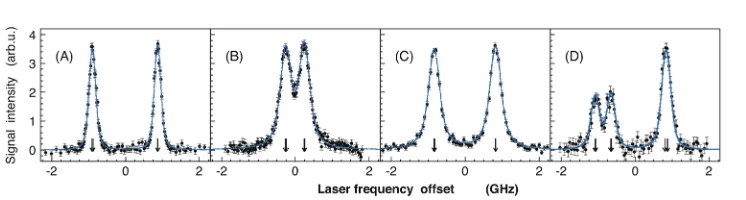
Figure 2. The resonance profiles of the single-photon transitions (A) (n, `) =(37,35)!(38,34), (B)
(n, `) = (39,35)!(38,34), and (C) (n, `) = (38,35)!(39,34) of bu↵er-gas cooledp4He+
. (D) The resonance profile (36,34)!(37,33) ofp3He+. Thex-abscissa indicates the o↵set of the laser frequency
relative to the resonance centroid. Solid curves indicate the best fit of an ab initio model based on the optical Bloch equation. From Ref. [3].
few hundred or more cooling collisions. It was then interrogated by the resonant laser beam. The 1selectron protected a significant fraction of the pHe+from annihilation during this cooling.
The experiment (Fig. 1) was carried out by utilizing the pulsed beam of AD that contained between 2⇥107and 3⇥107antiprotons with a kinetic energyE =5.3 MeV and repetition
rate f =0.01 Hz. Some of the antiprotons were slowed down toE =75 keV by allowing them to traverse a 3 m long radiofrequency quadrupole decelerator [29, 33]. This setup was also recently used to attempt to measure the annihilation cross sections of antiprotons that traversed some thin target foils [34–38]. The emerging 75-keV antiprotons were transported by a beamline and allowed to enter the cryogenic helium gas target. The target was in thermal contact with an open-cycle Joule-Thomson cryocooler at temperatureT =1.3 K. The pHe+ were irradiated by∆t=40 to 100 ns long laser pulses [39] with peak powersP=0.5 to 10 kW and wavelengthsλ=264 to 841 nm, which were generated by Ti:Sapphire and dye laser systems.
The spectra in Figs. 2 (A)–(C) show the resonance profiles of the transitions (n, `) = (37,35)!(38,34), (39,35)!(38,34), and (38,35)!(39,34) of p4He+
. They were obtained by plotting the intensities of the antiproton annihilation signals which were induced at mul-tiple laser frequencies between−1 and 1 GHz around the resonance centroid. The arrows indicate the positions of the four hyperfine sublines that arise from the spin-spin interaction between the antiproton and electron in p4He+
. The single photon resolution seen here ex-ceeds those of sub-Doppler two-photon spectroscopy experiments using higher-temperature atoms [2] described above; this is due to the lowT =1.5–1.7 K temperature of the atoms. Fig. 2 (D) shows the profile of thep3He+
resonance (n, `)= (36,34)!(37,33). The three-peak structure arises from the eight unequally spaced hyperfine sublines caused by the interactions between the3He nuclear, electron, and antiproton spins. The spin-independent transition
fre-quencies were determined by fitting the profiles with a theoretical line shape (indicated by blue lines). The line shapes were obtained by solving the optical Bloch equations [31] that model the single-photon transition. The experimental uncertainties in the determinations of the pHe+frequencies include contributions from the statistical uncertainty (±1 MHz) that arises from the limited number of measured atoms, and the systematic uncertainty of 0.4–3 MHz caused by the fitting function. The dye and Ti:Sapphire lasers used to excite the atoms contain a spurious frequency modulation. These were measured with a precision of 0.4–1.0 MHz. The ac Stark e↵ects induced by the lasers, and magnetic Zeeman shifts due to residual magnetic fields, caused systematic e↵ects of<0.1 MHz and<0.2 MHz, respectively.
Figure 3.(A) Comparison of experimental and calculated transition frequencies, showing the fractional di↵erences between the experimental (open circles) and theoretical (squares) values of 13 transition fre-quencies of cooledp4He+
andp3He+
atoms. (B) Proton-to-electron mass ratios measured in Penning traps and laser spectroscopy of HD+molecular ions, compared with the antiproton-to-electron mass ra-tio determined by spectroscopy ofpHe+. The shaded area represents the CODATA 2010 recommended value. From Ref. [3].
Eight transition frequencies ofp4He+
atoms and five frequencies ofp3He+
were measured with relative uncertainties between 2.5⇥10−9 and 15⇥10−9. The frequencies⌫
exp (Fig.
3A, open circles with error bars) agree with theoretical⌫th values (filled squares). Due to
the cooling techniques described here, this agreement is a factor of 1.4 to 10 times better than previous single-photon experiments [30] of pHe+. The uncertainties for most of the theoretical frequencies⌫tharise from QED contributions of orders higher thanme↵7 which
have not been calculated yet.
When the antiproton-to-electron mass ratioMp/meused in the calculations was changed
by 1⇥10−9, the theoreticalpHe+frequencies⌫
thchanged by 2.6⇥10−9to 2.7⇥10−9. The
mass ratio was determined as, Mp/me = 1836.1526734(15), by minimizing the di↵erence
between the frequencies⌫expand⌫th. The one-standard deviation uncertainty in the
paren-thesis includes the three contributions 9⇥10−7, 11⇥10−7, and 3⇥10−7of the experimental
statistical and systematic uncertainties, and the theoretical uncertainty, respectively.
in a magnetic field and the precession frequency of the electron spin was then measured, and the results compared with the latest QED calculations of its g-factor [40]. From this and the proton mass which was recently measured in a separate measurement involving a Pen-ning trap [11] from the same collaboration, the proton-to-electron mass ratio was determined as, Mp/me = 1836.152673346(81). In Fig. 3(B), the latest Mp/me mass ratios are shown
together with the previous experimental values that were determined by comparing the cy-clotron frequencies of protons and electrons in a Penning trap [7], laser spectroscopy of cold HD+molecular ions [12], and the CODATA 2010 recommended value [27]. These recent high-precision values are in good agreement with the Mp/meratio determined from pHe+.
The TRAP and BASE experiments of CERN have compared the cyclotron frequencies of antiprotons and H−ion pairs confined in a Penning trap [41–43]; a limit of 5⇥10−10was set
[3, 44] on any deviation between the antiproton and proton masses and charges by combining the results with thepHe+spectroscopic data.
The p4He+
transition (n, `) =(40,36)!(41,35) was also studied by laser spectroscopy [45]. A stimulated first-order Raman scattering process in a H2gas cell was utilized to
gen-erate the 7 ns long laser pulses of wavelengthλ=1154.9 nm needed to excite this transition. The measurements revealed that most of the metastable populations are concentrated into states of principal quantum numbern ≥40, whereas the statesn >41 contain very few an-tiprotons. A laser-microwave-laser triple resonance method was used to study the hyperfine structure of the (n, `)=(36,34) state ofp3He+[46].
3 Future perspectives
Currently the precision on the calculations ofpHe+energies are more than an order of mag-nitude higher than the experimental uncertainties. Further improvements in the theoretical precision are expected in the next 5 years. The Extra Low Energy Antiproton Ring (ELENA) facility due to begin operation in 2021 will provide a high-quality, cooled antiproton beam of energy E = 100 keV. Samples of pHe+would then be formed in a smaller volume, so that lasers of lower power and higher spectral resolution could be used in the experiments. The high stability of the antiproton beam should ensure an improved signal-to-noise ratio on the pHe+spectral lines. This may allow us to resolve weak atomic transitions between metastable states of smaller natural width, which can be measured with a higher precision. Intensive e↵orts are currently underway to achieve this goal.
Metastable pionic helium (⇡He+) is a three-body atom [47–49] consisting of a helium nucleus, an electron in the 1sground state, and a negative-charged pion in a Rydberg state of quantum numbersn⇠`−1⇠16. The spectral lines of these atoms have never been directly observed, and so the existence of⇡He+is so far hypothetical. Laser spectroscopy of⇡He+is currently being attempted at the 590 MeV ring cyclotron facility of the Paul Scherrer Institute. By comparing the experimental frequencies with those derived from QED calculations, the ⇡−mass can in principle be determined with a fractional precision of 10−8to 10−6.
References
[1] R.S. Hayano, M. Hori, D. Horváth, E. Widmann, Rep. Prog. Phys.70, 1995 (2007) [2] M. Horiet al., Nature475, 484 (2011)
[3] M. Horiet al., Science371, 610 (2016)
[4] V.I. Korobov, L. Hilico, J.-P. Karr, Phys. Rev. Lett.112, 103003 (2014) [5] V.I. Korobov, L. Hilico, J.-P. Karr, Phys. Rev. A89, 032511 (2014) [6] M-H. Huet al., Chem. Phys. Lett.654, 114 (2016)
[7] D.L. Farnham, R.S. Van Dyck Jr., P.B. Schwinberg, Phys. Rev. Lett.75, 3598 (1995) [8] T. Beieret al., Phys. Rev. Lett.88, 011603 (2002)
[9] J. Verdúet al., Phys. Rev. Lett.92, 093002 (2004) [10] S. Sturmet al., Nature,506, 467-470 (2014) [11] F. Heißeet al., Phys. Rev. Lett.119, 033001 (2017) [12] J. Biesheuvelet al., Nat. Commun.7, 10385 (2016)
[13] J.C.J. Koelemeij, B. Roth, A. Wicht, I. Ernsting, S. Schiller, Phys. Rev. Lett.98, 173002 (2007)
[14] S. Alighanbari, M.G. Hansen, V. Korobov, S. Schiller, arXiv:1802.03208 (2018) [15] V.A. Kostelecký, A.J. Vargas, Phys. Rev. D92, 056002 (2015)
[16] M. Ahmadiet al., Nature541, 506 (2017) [17] M. Ahmadiet al., Nature548, 66 (2017)
[18] G. Gabrielseet al., Phys. Rev. Lett.108, 113002 (2012)
[19] E.J. Salumbides, W. Ubachs, V.I. Korobov, J. Mol. Spect.300, 65 (2014) [20] J. Murata, S. Tanaka, Class. Quantum Grav.32, 033001 (2015)
[21] P. Brax, S. Fichet, G. Pignol, arXiv:1710.00850 (2017) [22] F. Ficeket al., arXiv:1801.00491 (2018)
[23] M. Hori, J. Walz, Prog. Part. Nucl. Phys.72, 206 (2013) [24] K. Sakimoto, Phys. Rev. A91, 042502 (2015)
[25] V.I. Korobov, Z.-X. Zhong, Q.-L. Tian, Phys. Rev. A92, 052517 (2015) [26] A. Adamczak, D. Bakalov, Phys. Rev. A90, 054501 (2014)
[27] P.J. Mohr, B.N. Taylor, D.B. Newell, Rev. Mod. Phys.84, 1527 (2012) [28] R. Pohlet al., Nature466, 213 (2010)
[29] M. Horiet al., Phys. Rev. Lett.91, 123401 (2003) [30] M. Horiet al., Phys. Rev. Lett.96, 243401 (2006) [31] M. Horiet al., Phys. Rev. A81, 062508 (2010) [32] A. Badertscheret al., Phys. Lett. B392, 278 (1997)
[33] A.M. Lombardiet al., 2001 First operating experience with the CERN decelerating RFQ for antiprotons.Proc. Part. Acc. Conf.Chicago, USA
[34] H. Aghai-Khozaniet al., Eur. Phys. J. Plus127, 125 (2012) [35] M. Corradiniet al., Nucl. Instrum. Methods A711, 12 (2013) [36] A. Sótéret al., Rev. Sci. Instrum.85, 023302 (2014)
[37] K. Todorokiet al., Nucl. Instrum. Methods A835, 110 (2016) [38] H. Aghai-Khozaniet al., Nucl. Phys. A970, 366 (2018) [39] M. Hori, A. Dax, Opt. Lett.34, 1273 (2009)
[40] K. Pachucki, A. Czarnecki, U.D. Jentschura, V.A. Yerokhin, Phys. Rev. A72, 022108 (2005)
[41] G. Gabrielseet al., Phys. Rev. Lett.82, 3198 (1999)
[42] J.K. Thompson, S. Rainville, D.E. Pritchard, Nature430, 58 (2004) [43] S. Ulmeret al., Nature524, 196 (2015)
[44] R.J. Hughes, B.I. Deutch, Phys. Rev. Lett.69, 578 (1992)
[45] T. Kobayashiet al., J. Phys. B: At. Mol. Opt. Phys.46, 213 (2013) [46] S. Friedreichet al., J. Phys. B: At. Mol. Opt. Phys.46, 125003 (2013) [47] M. Hori, A. Sótér, V.I. Korobov, Phys. Rev. A89, 042515 (2014)
[7] D.L. Farnham, R.S. Van Dyck Jr., P.B. Schwinberg, Phys. Rev. Lett.75, 3598 (1995) [8] T. Beieret al., Phys. Rev. Lett.88, 011603 (2002)
[9] J. Verdúet al., Phys. Rev. Lett.92, 093002 (2004) [10] S. Sturmet al., Nature,506, 467-470 (2014) [11] F. Heißeet al., Phys. Rev. Lett.119, 033001 (2017) [12] J. Biesheuvelet al., Nat. Commun.7, 10385 (2016)
[13] J.C.J. Koelemeij, B. Roth, A. Wicht, I. Ernsting, S. Schiller, Phys. Rev. Lett.98, 173002 (2007)
[14] S. Alighanbari, M.G. Hansen, V. Korobov, S. Schiller, arXiv:1802.03208 (2018) [15] V.A. Kostelecký, A.J. Vargas, Phys. Rev. D92, 056002 (2015)
[16] M. Ahmadiet al., Nature541, 506 (2017) [17] M. Ahmadiet al., Nature548, 66 (2017)
[18] G. Gabrielseet al., Phys. Rev. Lett.108, 113002 (2012)
[19] E.J. Salumbides, W. Ubachs, V.I. Korobov, J. Mol. Spect.300, 65 (2014) [20] J. Murata, S. Tanaka, Class. Quantum Grav.32, 033001 (2015)
[21] P. Brax, S. Fichet, G. Pignol, arXiv:1710.00850 (2017) [22] F. Ficeket al., arXiv:1801.00491 (2018)
[23] M. Hori, J. Walz, Prog. Part. Nucl. Phys.72, 206 (2013) [24] K. Sakimoto, Phys. Rev. A91, 042502 (2015)
[25] V.I. Korobov, Z.-X. Zhong, Q.-L. Tian, Phys. Rev. A92, 052517 (2015) [26] A. Adamczak, D. Bakalov, Phys. Rev. A90, 054501 (2014)
[27] P.J. Mohr, B.N. Taylor, D.B. Newell, Rev. Mod. Phys.84, 1527 (2012) [28] R. Pohlet al., Nature466, 213 (2010)
[29] M. Horiet al., Phys. Rev. Lett.91, 123401 (2003) [30] M. Horiet al., Phys. Rev. Lett.96, 243401 (2006) [31] M. Horiet al., Phys. Rev. A81, 062508 (2010) [32] A. Badertscheret al., Phys. Lett. B392, 278 (1997)
[33] A.M. Lombardiet al., 2001 First operating experience with the CERN decelerating RFQ for antiprotons.Proc. Part. Acc. Conf.Chicago, USA
[34] H. Aghai-Khozaniet al., Eur. Phys. J. Plus127, 125 (2012) [35] M. Corradiniet al., Nucl. Instrum. Methods A711, 12 (2013) [36] A. Sótéret al., Rev. Sci. Instrum.85, 023302 (2014)
[37] K. Todorokiet al., Nucl. Instrum. Methods A835, 110 (2016) [38] H. Aghai-Khozaniet al., Nucl. Phys. A970, 366 (2018) [39] M. Hori, A. Dax, Opt. Lett.34, 1273 (2009)
[40] K. Pachucki, A. Czarnecki, U.D. Jentschura, V.A. Yerokhin, Phys. Rev. A72, 022108 (2005)
[41] G. Gabrielseet al., Phys. Rev. Lett.82, 3198 (1999)
[42] J.K. Thompson, S. Rainville, D.E. Pritchard, Nature430, 58 (2004) [43] S. Ulmeret al., Nature524, 196 (2015)
[44] R.J. Hughes, B.I. Deutch, Phys. Rev. Lett.69, 578 (1992)
[45] T. Kobayashiet al., J. Phys. B: At. Mol. Opt. Phys.46, 213 (2013) [46] S. Friedreichet al., J. Phys. B: At. Mol. Opt. Phys.46, 125003 (2013) [47] M. Hori, A. Sótér, V.I. Korobov, Phys. Rev. A89, 042515 (2014)
[48] V.I. Korobov, A.K. Bakbaev, D.T. Aznabayev, S.A. Zhaugasheva, J. Phys. B: At. Mol. Opt. Phys.48, 245006 (2015)
[49] B. Obreshkov, D. Bakalov, Phys. Rev. A93, 062505 (2016)
![Figure 1. Experimental layout [3] used to synthesize pHe+ and cool them to temperature T = 1.5–1.7K (top)](https://thumb-us.123doks.com/thumbv2/123dok_us/8043865.1339563/2.482.48.417.70.334/figure-experimental-layout-used-synthesize-phe-cool-temperature.webp)