Asco, Amadeo (2013) Constructive and evolutionary
algorithms for airport baggage sorting station and gate
assignment problems. PhD thesis, University of
Nottingham.
Access from the University of Nottingham repository:
http://eprints.nottingham.ac.uk/13784/1/aascoThesisDec2013.pdf Copyright and reuse:
The Nottingham ePrints service makes this work by researchers of the University of Nottingham available open access under the following conditions.
· Copyright and all moral rights to the version of the paper presented here belong to the individual author(s) and/or other copyright owners.
· To the extent reasonable and practicable the material made available in Nottingham ePrints has been checked for eligibility before being made available.
· Copies of full items can be used for personal research or study, educational, or not-for-profit purposes without prior permission or charge provided that the authors, title and full bibliographic details are credited, a hyperlink and/or URL is given for the original metadata page and the content is not changed in any way.
· Quotations or similar reproductions must be sufficiently acknowledged.
Please see our full end user licence at:
http://eprints.nottingham.ac.uk/end_user_agreement.pdf
A note on versions:
The version presented here may differ from the published version or from the version of record. If you wish to cite this item you are advised to consult the publisher’s version. Please see the repository url above for details on accessing the published version and note that access may require a subscription.
for Airport Baggage Sorting Station and
Gate Assignment Problems
Amadeo Asco Signes, BSc., MSc.
School of Computer Science University of Nottingham
Thesis submitted to the University of Nottingham for the degree of Doctor of Philosophy
Abstract
Correct assignment of airport resources can greatly affect the quality of service which airlines and airports provide to their customers. Good assignments can help airlines and airports to keep to published schedules, by minimising changes in these schedules and reducing delays. Given the expected increases in civil air traffic, the complexities of resource scheduling and assignment continue to increase. For this reason, as well as the dynamic nature of the problems, scheduling and assignment are becoming increasingly more difficult.
The assignment of baggage sorting stations to flights is one of the resource assign-ment problems at an airport, and like many other real world optimisation problems, it naturally has several objectives, which conflict with each other. A model of the problem is presented, different approaches to obtaining good solutions are looked at and studied to gain an insight into their qualities. Furthermore, algorithms are stud-ied to improve the already good solutions obtained by the approaches considered and their performance is studied where some characteristics of the problem change, such as the number of baggage sorting stations or the topology of the airport.
Changes to the flight schedule on the day of operation may invalidate previous assignments of flights to resources. These perturbations may not only affect the disrupted flights but also other flights already assigned. Some existing approaches are looked at, and others are suggested to take account of these potential perturbations at the time the assignments are generated with the aim of mitigating their detrimental effect on the day of operation.
The constructive search algorithms and robustness methods are potentially impor-tant in a wider variety of problems other than the Airport Baggage Sorting Station Assignment Problem (ABSSAP). By way of illustration, the same techniques are applied to the widely studied Airport Gate Assignment Problem (AGAP).
Acknowledgements
I am grateful to my supervisors, Dr. Jason A. D. Atkin, Prof. Edmund K. Burke and Associate Prof. Dario Landa-Silva whose encouragement, guidance and support from the start has enabled me to develop an understanding of the subject. Also to NATS, especially John Greenwood, for the opportunity to take this PhD and their continuous support.
In addition to the technical and instrumental assistance above, I received equally important assistance from family and friends. My partner, Dennis Latham, who provides me with on-going support throughout the whole process, as well as technical assistance critical for advancing the project in a timely manner. My parents who instilled in me, from an early age, the desire and attitude to excel, and for their continuous support and belief in me.
Contents . . . i
Glossary . . . iv
Glossary iv List of Figures . . . viii
List of Tables . . . xiii
1 Introduction 1 1.1 Background and motivation . . . 1
1.2 Aims . . . 3
1.3 Summary of the contributions of this thesis . . . 3
1.4 Overview of this thesis . . . 4
1.5 Publications . . . 5
2 Literature Review 7 2.1 Overview . . . 7
2.2 Scheduling flight arrivals . . . 8
2.3 Ground movement . . . 12
2.4 Scheduling and assignment of flights to stands . . . 17
2.5 Scheduling of baggage sorting stations to flights . . . 21
2.6 Scheduling flight departures . . . 22
2.7 Evolutionary Algorithms . . . 24
2.8 Conclusions . . . 33
3 Problem Description 34 3.1 Overview . . . 34
3.2 Airport Layout . . . 36
3.3 Airport Baggage Sorting Station Assignment Model . . . 37
3.4 Conclusions . . . 55
CONTENTS ii
4 Constructive Algorithms for the Airport Baggage Sorting Station
Assignment Problem 57 4.1 Overview . . . 57 4.2 Algorithms . . . 59 4.3 Problem Data . . . 64 4.4 Results . . . 67 4.5 Conclusions . . . 90
5 Evolutionary Algorithms for the Airport Baggage Sorting Station 92 5.1 Overview . . . 92
5.2 Steady State Evolutionary Algorithm . . . 94
5.3 Selectors . . . 97
5.4 Operators . . . 101
5.5 Tabu Search . . . 110
5.6 General Experiments Information . . . 111
5.7 Results . . . 113
5.8 Conclusions . . . 141
6 Robustness in Assignment of Airport Baggage Sorting Stations 144 6.1 Overview . . . 145
6.2 Buffer Time . . . 147
6.3 Robustness Approaches . . . 148
6.4 Results . . . 167
6.5 Conclusions . . . 181
7 Airport Gate Assignment Problem 183 7.1 Overview . . . 183 7.2 Model . . . 186 7.3 Problem Representation . . . 187 7.4 Constraints . . . 189 7.5 Objectives . . . 192 7.6 Constructive Algorithms . . . 195 7.7 Problem Data . . . 198 7.8 Fitness . . . 202
7.9 Results of the Constructive Algorithms . . . 204
8 Evolutionary Algorithms for the Airport Gate Assignment Problem210
8.1 Overview . . . 210
8.2 Steady State Evolutionary Algorithm . . . 211
8.3 Results for the Steady State Evolutionary Algorithm . . . 212
8.4 Robustness . . . 223
8.5 Robustness Results . . . 224
8.6 Conclusions . . . 227
9 Conclusions and Future Directions 230 9.1 Contributions . . . 231
9.2 Extensions and future directions . . . 236
References 239 A Data for Heathrow 254 A.1 Stands . . . 254
A.2 Airlines Gate Preferences . . . 255
A.3 Handlers Gate Preferences . . . 258
B Statistics for the Airport Baggage Sorting Stations Assignment Prob-lem 259 B.1 Constructive Algorithms . . . 259
B.2 Steady State Evolutionary Algorithms . . . 274
B.3 Results for the Number of Iterations in a Generation . . . 297
B.4 Results Index for ISxES . . . 332
B.5 Probability Single Multi Operator . . . 355
B.6 Results Robustness . . . 375
C More AGAP Results 377 C.1 Constructive Algorithms . . . 377
Glossary
A-CDM Airport Collaborative Decision-Making AAP Average Assignment Point
ABSSAP Airport Baggage Sorting Station Assignment Problem ABSSAP Airport Baggage Sorting Station Problem
ACO Ant Colony Optimisation
AGAP Airport Gate Assignment Problem AGAP Airport Gate Assignment Problem AOA Airport Operators Association ARS Area of Reduction in Service ASP Activity Selection Problem ATC Air Traffic Control
ATM Air Traffic Management
ATRS Act Tangent Reduction in Service B&B Branch and Bound
B&C Branch and Cut
BA British Airways
BAA British Airports Authority
BILP Binary Integer Linear Programming BSARS Base Sub-Area Reduction in Service BSS baggage sorting station
BSS Baggage Sorting Station
BSSAA Baggage Sorting Station Assignment Algorithm BSSS Baggage Sorting Station Selection
C1P 1-point crossover C2P 2-point crossover
CDA Continuous Descent Approach CGA Canonical Genetic Algorithm
CnP n-point crossover
DSEMO Dummy Single Exchange Mutation Operator DSMMO Dummy Single Move Mutation Operator
EA Evolutionary Algorithm
ECJ Evolutionary Computation Java library
EDD Earliest Due Date First
ERS Exponential Ranking Selection
ES Evolutionary Strategy
ES Elitist Selection
F&R Fix and Relax
FAA Federal Aviation Administration
FBT Flexible Buffer Times
FCFS First Come First Serve
FIFO First In First Out
GA Genetic Algorithm
GMC Ground Movement Control
GRASP Greedy Randomised Adaptive Search Procedure ICAO International Civil Aviation Organization
ILP Integer Linear Programming
ILS Instrument Landing System
IS1ES Index Selection with Elitist Selection and a group size of 1 IS1SUMS Index Selection with Stochastic Universal Modified Sampling
and group size of 1
ISPEA2 Improved Strength Pareto Evolutionary Algorithm 2 ISxES Index Selection with Elitist Selection
ISxSUMS Index Selection with Stochastic Universal Modified Sampling
ISxy Index Selection
LIFO Last In First Out
LMAP Lower Maximum Assignment Point
LMAPp Lower Maximum Assignment Point with Parking
LRS Linear Ranking Selection
MA Memetic Algorithm
MEBPFNRn Multi Exchange By Pier between a Fixed Number of Resources MEBPFNR3 Multi Exchange By Pier between a Fixed Number of 3
Glossary vi
MEBPRNRn Multi Exchange By Pier between a Random Number of Re-sources
MEBPRNR10 Multi Exchange By Pier between a Random Number of 10 Resources
MEBPRRNRxy Multi Exchange By Pier between a Range Random Number of Resources
MEFNRn Multi Exchange between a Fixed Number of Resources MEFNR3 Multi Exchange between a Fixed Number of 3 Resources MERNRn Multi Exchange between a Random Number of Resources MERRNRxy Multi Exchange between a Range Random Number of
Re-sources
MILP Mixed Integer Linear Programming
MIP Mixed Integer Programming
MOEGA Multi-Objective Evolutionary Genetic Algorithm
MOOP Multi-Objective Optimisation Problem
NSGA Nondominated Sorting Genetic Algorithm
NSGA-II Elitist Nondominated Sorting Genetic Algorithm II
OBT Order Between Times
OBTLI Order Between Times Lookahead and Improvement
ODT Order by Departure Time
ODTLI Order by Departure Time Lookahead and Improvement
OS Operating System
OST Order by Starting Time
PAES Pareto Archived Evolution Strategy PCBG Probability of Conflict Based on the Gap
PDMOEA Primal-Dual Multiobjective Optimisation Algorithm
PSI Particle Swarm Intelligence
PSMO Probability Single Multi Operator
RAM Random Access Memory
RDEAMO Remote Dummy Exchange All Mutation Operator
RDMAMO Remote Dummy Move All Mutation Operator
RDSEMO Remote Dummy Single Exchange Mutation Operator
RHC receding horizon control
RISxyz Range Index Selector
RITA Research and Innovative Technology Administration
RMEBPFNRn Range Multi Exchange By Pier between Fixed Number of Re-sources
RMEBPRNRxy Range Multi Exchange By Pier between Range Random Num-ber of Resources
RMEFNRn Range Multi Exchange between Fixed Number of Resources RMEFNR2 Range Multi Exchange between Fixed Number of 2 Resources RMERNRn Range Multi Exchange between Random Number of Resources RMERRNRxy Range Multi Exchange between Range Random Number of
Resources
RNC Reduction in the Number of Conflicts
RSS Remainder Stochastic Sampling
RWMS Roulette Wheel Member Selection
SA Simulated Annealing
SARS Sub-Area of Reduction in Service
SC1P 1-point serial crossover
SC1P(2) 1-point serial crossover generating two children
SESAR Single European Sky ATM Research
SMC Surface Movement Control
SO Sequential Operator
SPEA Strength Pareto Evolutionary Algorithm
SSEA Steady State Evolutionary Algorithm
SSEA1 Steady State Evolutionary Algorithm with ℓ= 1
STAR Standard Terminal Arrival Route
SUMS Stochastic Universal Modified Sampling
SUS Stochastic Universal Sampling
TMA Terminal Manoeuvring Area
TMS Tournament Member Selection
TRS Total Reduction in Service Time
TS Tabu Search
UESRS Unsupervised Estimated Stochastic Reduction in Service
UMAP Upper Maximum Assignment Point
UMAPp Upper Maximum Assignment Point with Parking
List of Figures
2.1 Overview of an airport departures and arrivals with stacks approach. . 9
2.2 Position shifting (PS) base on aircraft separation. . . 10
2.3 London Heathrow airport grounds and taxi ways. . . 13
2.4 Engine thrust. . . 14
2.5 London Heathrow airport Terminal 1 with gate location. . . 17
2.6 Overview of airport baggage system with storage. . . 21
2.7 London Heathrow airport holding areas for RWY 27R. . . 23
2.8 Examples of phenotype and genotype. . . 26
2.9 Flowchart of the Canonical Genetic Algorithm (CGA). . . 27
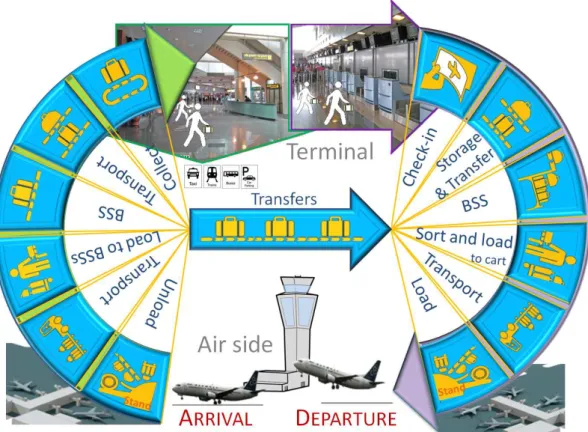
3.1 General view of the overall process in an airport. . . 35
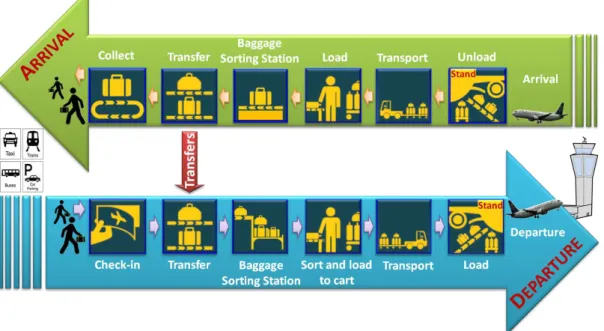
3.2 Arrival/departure baggage system. . . 36
3.3 Example of airport topologies with one terminal. . . 37
3.4 Representations of the terminal topology used. . . 38
3.5 Baggage System. . . 39
3.6 General view of the baggage process in an airport. . . 40
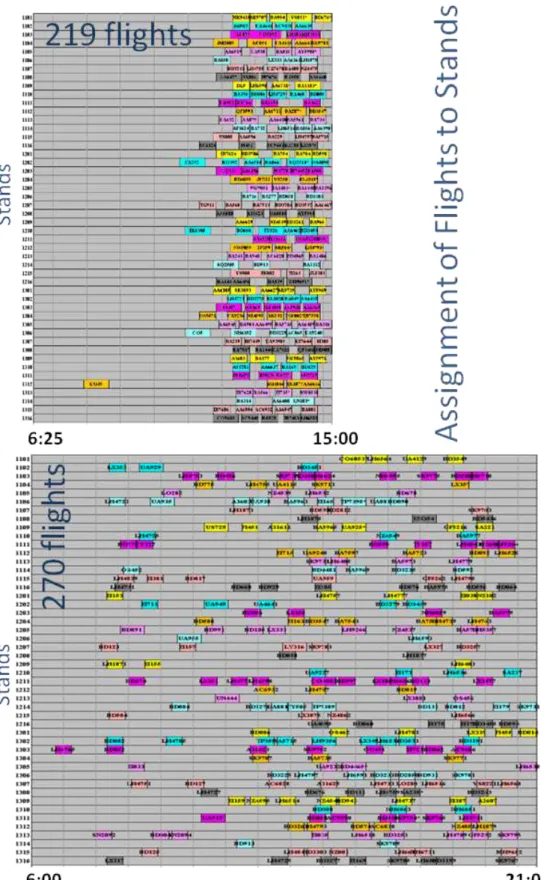
3.7 A random assignment of flights to stands for the data sets taken from the British Airports Authority (BAA)’s website. . . 42
3.8 View of the time taken to service a flight. . . 45
3.9 Example of assignments of flights withPj = 1∀j ∈[1. . . M] to baggage sorting station 3. . . 46
3.10 Flights service distribution for the data sets obtained from the BAA’s website. . . 46
3.11 Flight distance to sorting stations. . . 52
4.1 London Heathrow airport Terminal 1. . . 65
4.2 London Heathrow airport Terminal 1. . . 65
4.3 BAA’s website data sets for London Heathrow airport. . . 66
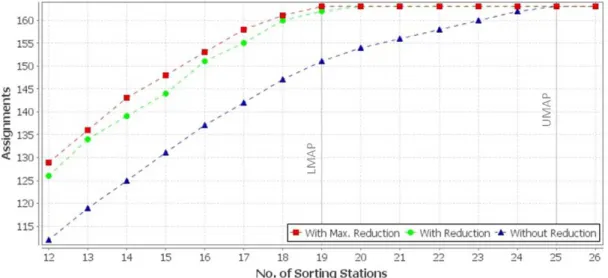
4.4 NATS data sets for London Heathrow airport. . . 66 4.5 Number of sorting stations assigned, Order by Starting Time (OST)
ordering and LIFO selection method for a 3-pier topology and 163 flights. 69
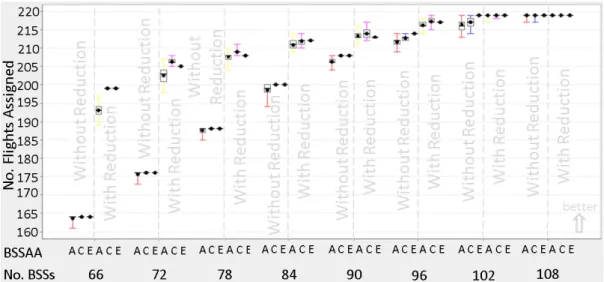
4.6 Number of assignments for 219 flights (BAA’s website), ODTLI and
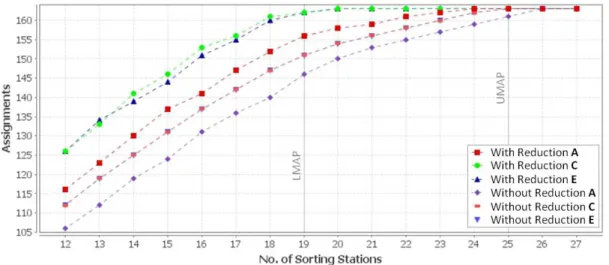
LIFO, with and without permitting reductions in service. . . 71
4.7 Number of assignments for 270 flights (BAA’s website), ODTLI and LIFO, with and without permitting reductions in service. . . 71
4.8 Number of assignments, OST ordering method, Algorithm ‘E’ and LIFO selection method, for a 3-pier topology and 163 flights. . . 72
4.9 Example of assignments achieved by OST and Order by Departure Time (ODT). . . 73
4.10 Number of assignments for LIFO selection method with different or-dering methods and selection methods, for 3-pier topology and 163 flights. . . 73
4.11 Total reduction in service time in seconds for NATS data set 1st March 2010, 3-pier topology and Algorithm ‘E’. . . 75
4.12 Mean reduction in service time in seconds for NATS data set 1st March 2010, 3-pier topology and Algorithm ‘E’. . . 75
4.13 Total distance with ‘Closest’ selection method. . . 76
4.14 Mean distance with ‘Closest’ selection method. . . 77
4.15 Fair workload and Algorithm ‘E’ (no restriction). . . 78
4.16 Assignments for 194 flights with reduction of service, a 3-pier topology, LIFO and OBT. . . 80
4.17 Assignments for 194 flights with reduction of service, a 3-pier topology, LIFO, OBT and algorithms ‘A’, ‘C’ and ‘E’. . . 80
4.18 Order Between Times (OBT) assignments for NATS data sets of 194 flights with service reduction, a 3-pier topology and LIFO for a reduced range of number of baggage sorting stations (BSSs). . . 81
4.19 OBT and Order by Departure Time Lookahead and Improvement (ODTLI) assignments for NATS data sets of 194 flights with service reduction of service, a 3-pier topology and LIFO for a reduced range of number of BSSs. . . 81
4.20 Constructive Algorithms and CPLEX percentage improvement in fit-ness for 219 flights and a 3-pier topology. . . 83
4.21 CPLEX percentage improvement in fitness for 219 flights and a 3-pier topology. . . 84
4.22 Percentage improvement in fitness for 194 flights and a 3-pier topology for Constructive Algorithms and CPLEX solutions. . . 86
4.23 Percentage improvement in fitness for 194 flights and a 3-pier topology for CPLEX solutions for different initial solutions. . . 86
LIST OF FIGURES x
4.25 Fitness for 194 flights, a 3-pier topology and 48 stands for Canonical
Genetic Algorithm (CGA) and some constructive algorithms. . . 88
4.26 Fitness for 163 flights, a 3-pier topology and 48 stands for CGA and some constructive algorithms. . . 88
4.27 Fitness for 194 flights, a 3-pier topology and 48 stands for some con-structive algorithms and CGA for different initial population. . . 89
4.28 Fitness for 163 flights, a 3-pier topology and 48 stands for some con-structive algorithms and CGA for different initial populations. . . 89
5.1 An example of encoding for a 3 BSSs and 8 flights. . . 93
5.2 Steady State Evolutionary Algorithm (SSEA) flow chart. . . 96
5.3 Example of multi exchange between 3 BSSs. . . 102
5.4 Example of range multi exchange between 3 BSSs. . . 104
5.5 2-point crossover. . . 105
5.6 1-point crossover. . . 106
5.7 Crossover representations where ‘s’ refers to the start and ‘e’ to the end.106 5.8 All children for 2-point crossover and 3 parents. . . 107
5.9 1-point serial crossover. . . 108
5.10 Example of 1-point crossover and 1-point serial crossover. . . 109
5.11 Progress for a 3-pier topology, 48 stands, 78 BSSs and 219 flights (H1T091216). . . 114
5.12 Progress for a 3-pier topology, 48 stands, 78 BSSs for 219 flights (H1T091216) and different heuristics. . . 114
5.13 Average fitness for a 4-pier topology, 46 stands for 194 flights (H1T091216) and different heuristics. . . 115
5.14 Progress in fitness of solutions when run with and without a initial random population for SSEA1, a 3-pier topology, 78 BSSs, 48 stands and 219 flights (H1T091216). . . 116
5.15 Progress in fitness of solutions when run with and without initial ran-dom population for Gurobi, a 3-pier topology, 78 BSSs, 48 stands and 219 flights for 1 hour. . . 117
5.16 Average run-time for a 4-pier topology, 194 flights (H1T091216), Dummy Single Exchange Mutation Operator (DSEMO) and different popula-tion sizes. . . 123
5.17 Average run-time for a 4-pier topology, 194 flights (H1T091216) for some mutation operators and different population sizes. . . 124
5.18 Average run-time for a 4-pier topology, 194 flights (H1T091216), crossover and different population sizes. . . 125
5.20 ISxESx∈ {1,2,3,5,10,15}, mutation operators for H1T091216 and a 4-pier topology. . . 129 5.21 Last solution found for SSEA1, 1-point and 2-point crossovers for 194
flights (H1T091216) and a 3-pier topology for 800,000 total iterations. 136 5.22 Trade-offs between objectives for 4-pier topology, 194 flights, 27 BSSs
and SUMS for the operators MEBPFNRn, MEBPRNR10, MEFNRn, MERNR10, RMEFNRn, RMERNR10, C1P, C2P and DSEMO with n∈[2. . .10]. . . 141 6.1 Flight delays for December 2011 to November 2012,Source: Research and
Innovative Technology Administration (RITA). . . 145 6.2 Example of conflict between two flights originally assigned to the same
BSS. . . 147 6.3 Simple example of two schedules, with the same flights, where one is
obviously more robust in respect of perturbations than the other. . . . 149 6.4 Simple example of a more robust schedule of four flights and two sorting
stations using the reduction in buffer time. . . 150 6.5 Representation of uijp, j < l, yijp = yilq = 1, j, l ∈ [1. . . M], p ∈
[1. . . Pj] andq ∈[1. . . Pl]. . . 151
6.6 Cost of the Reduction in Service. . . 152 6.7 Examples of a range of idle times for different solutions, where solution
‘a’ is clearly better than solution ‘b’ for Formula 6.8. . . 153 6.8 Examples of a range of idle times for different solutions using Formula
6.8. . . 154 6.9 An example of the capacity to absorb reassignments. . . 154 6.10 An example of border assignments in baggage sorting stations. . . 155 6.11 Flight distributions with Lower Maximum Assignment Points (LMAPs)
and Upper Maximum Assignment Points (UMAPs) for 194 flights on 16th December 2009 at Terminal 1 of London Heathrow airport. . . 157
6.12 Flight distributions with LMAPs and UMAPs for 163 flights on 1st
March 2010 at Terminal 1 London Heathrow airport. . . 157 6.13 Distribution of flights over time and Area Reduction in Service Objective.158 6.14 Sub-Area Reduction in Service Objective. . . 159 6.15 Example of distributions with the same LMAP and UMAP. . . 160 6.16 Overlap between two flightsj and kassigned to the same BSS. . . 161 6.17 Penalty for different unsupervised estimation functions based on the
gap between assignments. . . 162 6.18 Penalty for different unsupervised estimation functions based on the
LIST OF FIGURES xii
6.19 The probability of a conflict for two consecutive flights assigned to the same BSS based on the intervening gap modelled with Folded Normal distributions of a zero mean and standard deviation σ. . . 166 6.20 Probability of a conflict between two consecutive flights based on the
intervening gap. . . 167 7.1 Assignment of flights to stands when towing is required. . . 186 7.2 Different stand assignments for group j. . . 188 7.3 Example of two stands (i∈ {1,2}) of different sizes and two aircraft
(j∈ {1,2}) where aircraft 1 is too large to fit in stand 2 (x21= 0). . . 191
7.4 Example of two stands (i∈ {1,2}) and one combined fictitious stand (i= 3) for three aircraft (j∈ {1,2,3}) where aircraft 3 is too large to fit in either stands 1 and 2 but both aircraft 1 and 2 fit any of the stands.192 7.5 Example: two solutions for the same problem with different assignments.195 7.6 General view of London Heathrow airport Terminal 4 composed of
three piers. . . 200 7.7 Comparison of results for the first objective for the OST ordering
method, the four selection methods and three assignment algorithms, for 3-pier and 23 stands. . . 206 7.8 Comparison of results for the second and third objectives for the OST
ordering method, the four selection methods and three assignment al-gorithms, for 3-pier and 23 stands. . . 207
3.1 List of the constants and input values for the ABSSAPs model. . . 44
3.2 List of the decision variables used in this ABSSAPs model. . . 45
5.1 Default parameter values. . . 112
5.2 CPLEX none default parameter values used. . . 114
5.3 Parameter values used with 30 runs per experiment. . . 114
5.4 Statistical fitness significance for a significance level of 0.05, Steady State Evolutionary Algorithm with ℓ = 1 (SSEA1) with fit initial so-lutions and initial random soso-lutions for the data sets provided by NATS.118 5.5 Summary of the results of the Mann-Whitney test for significance level of 0.05, different population sizes and replacement strategies. . . 120
5.6 Overall summary of the best ℓof each operator, data set and topology considered and significance level of 0.05. . . 126
5.7 Overall summary of the Mann-Whitney statistical significance tests for index in ISxES and significance level of 0.05. . . 130
5.8 Summary for SSEA1 with a single operator, 30 population size, 800000 iterations, a 4-pier topology for 194 flights (H1T091216) and a signifi-cance level of 0.05. . . 132
5.9 Summary for SSEA1 with a single operator 30 population size, 800000 iterations, a 4-pier topology for 163 flights (H1T100301) and a signifi-cance level of 0.05. . . 133
5.10 Summary for SSEA1 with a single operator 30 population size, 800000 iterations, a 4-pier topology for 163 flights (H1T100301) and a signifi-cance level of 0.05. . . 134
5.11 Summary for SSEA1 with a single operator 30 population size, 800000 iterations, a 3-pier topology for 194 flights (H1T091216) and a signifi-cance level of 0.05. . . 135
5.12 Summary for SSEA1 with a single operator 30 population size, 800000 iterations, a 3-pier topology for 194 flights (H1T091216) and a signifi-cance level of 0.05. . . 136
LIST OF TABLES xiv
5.13 Number of occurrences which cannot be said to be statistically signif-icantly less fit than the other for the single multi operator with two base operators and a significance level of 0.05. . . 138 5.14 Number of occurrences which cannot be said to be statistically
signif-icantly less fit than the other probability single multi operator with three operators for a significance level of 0.05. . . 139 5.15 Summary of the number of occurrences which cannot be said to be
statistically significantly less fit than the others for a significance level of 0.05. . . 140 6.1 Robustness approaches used with their parameter values. . . 171 6.2 Number of instances with significantly statistically lower conflicts in
each range of numbers of BSSs for disruptions of standard deviation delays of σ = 10min. . . 172 6.3 Number of instances with significantly statistically lower number of
conflicts in each range of numbers of BSSs for disruptions with standard deviation delays ofσ = 20min. . . 173 6.4 Number of instances with significantly statistically lower number of
conflicts in each range of numbers of BSSs for disruptions with standard deviation delays ofσ = 30min. . . 173 6.5 Number of instances with significantly statistically lower number of
conflicts in each range of number of BSSs for disruptions with standard deviation delays ofσ = 10min and Unsupervised Estimated Stochastic Reduction in Service (UESRS) approach for a significance level of 0.05. 174 6.6 Number of instances with a significantly statistically lower number of
conflicts in each range of numbers of BSSs for disruptions with standard deviation delays of σ = 20min and UESRS approach for a significance level of 0.05. . . 175 6.7 Number of instances with a significantly statistically lower number
of conflicts in each range of numbers of BSSs for disruptions with a standard deviation delays σ = 30min and UESRS approach for a sig-nificance level of 0.05. . . 175 6.8 Number of instances with a significantly statistically lower number of
conflicts in each range of numbers of BSSs for disruptions with standard deviation delays of σ = 10min and Total Reduction in Service Time (TRS) + UESRS approaches with a significance level of 0.05. . . 176
6.9 Number of instances with a significantly statistically lower number of conflicts in each range of numbers of BSSs for disruptions with standard deviation delays of σ = 20min and TRS + UESRS approaches with a significance level of 0.05. . . 176 6.10 Number of instances with a significantly statistically lower number of
conflicts in each range of numbers of BSSs for disruptions with standard deviation delays of σ = 30min and TRS + UESRS approaches with a significance level of 0.05. . . 176 6.11 Number of instances significantly statistically lower number of conflicts
in each range of number of BSSs for disruptions of standard deviation delays of σ = 10min and all approaches which make use of the buffer time for significance level of 0.05. . . 178 6.12 Number of instances with a significantly statistically lower number of
conflicts in each range of numbers of BSSs for disruptions with standard deviation delays of σ = 20min and all approaches which make use of the buffer time with a significance level of 0.05. . . 178 6.13 Number of instances with a significantly statistically lower number of
conflicts in each range of numbers of BSSs for disruptions with standard deviation delays of σ = 30min and all approaches which make use of the buffer time with a significance level of 0.05. . . 178 6.14 Number of instances with a significantly statistically lower number of
conflicts in each range of numbers of BSSs for disruptions with a delay standard deviation of σ= 10min) and all the approaches presented in Section 6.3 with a significance level of 0.05. . . 180 6.15 Number of instances with a significantly statistically lower number of
conflicts in each range of numbers of BSSs for disruptions with a delay standard deviation of σ= 20min) and all the approaches presented in Section 6.3 with a significance level of 0.05. . . 180 6.16 Number of instances with a significantly statistically lower number of
conflicts in each range of numbers of BSSs for disruptions with a delay standard deviation of σ= 30min) and all the approaches presented in Section 6.3 with a significance level of 0.05. . . 180 7.1 List of the constants and input values for the AGAP model. . . 189 7.2 List of the decision variables which are used in this AGAP model. . . 189 7.3 Valid values for xij and yijk for the example in Fugure 7.4. . . 191
7.4 Summary of the components of the constructive algorithms. . . 197 7.5 Stand codes for London Heathrow airport (provided by BAA). . . 198
LIST OF TABLES xvi
7.6 Data set information provided by BAA for London Heathrow airport
Terminal 4. . . 199
7.7 Generated data sets information with an extra 37 groups. . . 202
7.8 Changes in objectives (‘fitness’) for an extra assignment. . . 203
7.9 List of weights. . . 204
8.1 Summary of the general data used in the experiments conducted. . . . 212
8.2 Summary of the algorithm parameters used in the experiments con-ducted. . . 213
8.3 SSEAℓ single operators which provide statistically significantly fitter solutions for the data sets from 6th to 12thSeptember 2010, where the ‘Index Selectors’ remove all duplicates. . . 215
8.4 SSEAℓ single operators which provide statistically significantly fitter solutions for data sets from 6th to 12th September 2010. . . 216
8.5 Tabu Search (TS) summary of statistical significance of fitness with a significance level of 0.005 and different ‘tabu list’ sizes for the data sets of September 2010. . . 218
8.6 CGA summary of statistically significant fitness with a significance level of 0.005, 1-point (C1P) and 2-point (C2P) crossover, mutation operators and different population sizes. . . 219
8.7 Summary of algorithms which provide statistically significantly fitness solutions for the data sets from 6th to 12th September 2010 and both models. . . 221
8.8 TS with a single operator which provides statistically significantly fit-ness solutions for the data sets from 6th to 12th September 2010 and both models. . . 222
8.9 SSEAℓsingle operator with significantly statistically fitter solutions for data sets generated from original date sets from 6th to 12th Sept 2010 and 23 gates. . . 222
8.10 CGA significantly statistically fitter solutions for data sets generated from original date sets for 6th to 12th September 2010 and 23 gates. . 223
8.11 Weights for the different robustness approaches considered with SSEA1.225 8.12 Summary of statistical significance of AGAP robustness (significance level 0.05) using perturbed schedules generated from normal distribu-tions of 10, 20 and 30 min standard deviadistribu-tions (x), data sets H4T1009dd and SSEA1 (Appendix C.2.3). . . 226
8.13 Summary of statistical significance of AGAP robustness (significance level = 0.05) using perturbed schedules generated from normal distri-butions of 10, 20 and 30 min standard deviations (x) and SSEA1 for new data sets N4T1009dd with 37 extra groups each (Appendix C.3). 227
1
Chapter 1
Introduction
1.1
Background and motivation
The Federal Aviation Administration (FAA) predicted that, in spite of all of the chal-lenges suffered during the last few years and from which we are still recuperating, the number of passengers travelling continues to grow over the long term, showing the im-portance of air transportation (Federal Aviation Administration (2010) and Federal Aviation Administration (2012)). The predicted growth in airport traffic will further increase the already high density of operations in some airports, especially large hub airports. These increases urge to consider the problem from different points of view, from the optimisation of the different individual areas to the analysis and study of the overall air traffic problem. Different initiatives currently exist directed at tackling some of the problems identified in a global view, for example the Single European Sky ATM Research (SESAR) (Commission (2010)) project which includes the Airport Collaborative Decision-Making (A-CDM) initiative. iFly (Keinrath et al (2008)) for en-route traffic aims to develop an advanced airborne self-separation design for Eu-ropean airspace. Similarly in the USA the NextGen-Airspace project (Swenson et al (2006)) intends to integrate the currently increasing optimal assignment of ground and air automation technologies.
A series of assignment problems must be solved before aircraft can arrive at or depart from an airport such as baggage sorting stations (BSSs) and gates, in addition to the performance of the multiple intermediate activities linked to these operations. Many parties are involved, each planning their own schedule. This leads to uncer-tainty and unreliability which may result in suboptimal solutions for the operations required to run an airport successfully. Airport partners set up schedules without knowing exactly where and when such resources as gates, baggage systems or aircraft,
are going to be available. Some may later have technical difficulties or meteorolog-ical changes could occur, which are aggravated by the interdependency between the different airports in which the disturbed services operate. Creating a revised sched-ule using input from all stakeholders could potentially reduce the time required to recuperate from disruptions and provide more accurate departure times and a better view of available ground resources. This in turn emphasises the need to share data in order to improve decisions based on more accurate information.
According to Mueller and Chatterji (2002), only 16% of the air traffic delays are attributed to the point at which an aircraft is airborne, with 26% from taxi-out and 8% from taxi-in, the remaining delays derive from delays when the aircraft are at a gate (50%), which shows a greater potential for improvement in those operations assigned around an aircraft when it is at the gate (stand). This indicates that 84% of the delay relates to ground operations, which are defined as those operations performed on and around the ground in an airport.
Even where many different resources are involved in the daily operation of an airport, most of the research to date has been concentrated on a few types of re-source, with the assignment of gates to flights being one type. Whereas the Airport Gate Assignment Problem (AGAP) has been widely studied the same cannot be said of the Airport Baggage Sorting Station Assignment Problem (ABSSAP) which also contributes to the successful operation of an airport, having a particularly significant influence on the satisfaction and opinion of passengers.
The mishandling of airport baggage in airports has been one of the more important issues for passengers for several years, both in Europe and the USA. It was ranked third in complaints after cancellations and delays in the report of the Air Transport Users Council (2009) and its importance was further emphasized in the April 2010 report of the Office of Aviation Enforcement and Proceedings (U.S. Department of Transportation (2010)), where over a hundred thousand baggage reports were logged, ranking baggage complaints as the second most common complaint. The expected increases in civil air traffic which are predicted by ICAO (2010) and the Federal Aviation Administration (2010) will continue to increase the complexity and difficulty of these problems.
I have studied both the ABSSAP and the AGAP, where planning and scheduling may contribute significantly to a reduction in airport delays. The aims are not merely to provide optimal or near optimal plans and schedules, but to ensure that these can cope with disruptions at the time of their implementation, removing or reducing the impact of such disruptions upon the daily operations at an airport.
1.2. AIMS 3
1.2
Aims
The Aviation Network Management is expected to be an important element in im-proving the En-Route Air Traffic Services for which NERL (NATS En-route plc) is responsible in the UK, and Air Traffic Management (ATM) ‘Network Management’ is also strongly relevant to airport operations, since the airport operations occur prior to take-off, where more options for Network Planning exist. Related work in Europe, such as in the Eurocontrol Airport-CDM Initiative (A-CDM, No¨el et al (2009)), sug-gests that airport operations should be considered as a whole, and that improvements in Air Traffic Control (ATC) will be limited if they merely cover the period following the pilot’s calls for push and start.
This thesis considers the development of methods for co-ordinating land-side (pas-sengers, baggage and gates) and airside (aircraft and tugs) planning in a collaborative decision-making airport system, i.e. the Eurocontrol Airport-CDM Initiative. Key goals are to develop techniques for building and maintaining plans, and investigating potential improvements to departure time predictions. The effect of sharing informa-tion, specifically during the arrival and departure processes, has already been studied by Andersson et al (2000), B¨ohme et al (2007) and Burgain et al (2009) which followed the same philosophy as in the A-CDM.
Given the above, it is advisable that the assignment of both resources, namely BSSs and gates (stands), be incorporated in the solution. The expectations are; minimising the deviation from identified ideal values such as Companies Aims (eco-nomic, statutory, image, etc.), Customers Expectations (satisfaction, price, etc.) and Employees Objectives (Satisfaction, fairness, pride, etc.).
1.3
Summary of the contributions of this thesis
The contributions of this thesis are summarised below.
Firstly, this thesis presents new models for both the ABSSAP and AGAP, which are used throughout the thesis. Whereas the AGAP and models have already been presented in the literature, my models represent a new approach which considers towing operations with extra constraints.
Secondly, the thesis provides insight into the differing behaviour of some construc-tive algorithms for these resource assignment problems, particularly where service time reduction is permitted. This allows for the generation of improved initial solu-tions when used with perturbative algorithms, enhancing the solution quality they can reach within a very limited search time.
Thirdly, a Steady State Evolutionary Algorithm has been designed to search the space of solutions in order to find solutions of high quality, which may be used in single objective or multi-objective resource assignment problems. New operators have been designed which generate feasible solutions at a high speed, providing improvement over those solutions obtained when using tools such as CPLEX, Gurobi and meta-heuristics such as Tabu Search (TS) and the Canonical Genetic Algorithm (CGA) for the problems considered. Additionally, the solutions reached have been shown to be of a higher quality than the initial solutions and good quality when compared with the Upper Bound provided by CPLEX. New replacement strategies were designed to improve on the solutions obtained, and these are shown to assist the search signifi-cantly in reaching statistically signifisignifi-cantly fitter solutions when compared with other standard selectors. There is potential for combining all of these components in order to further improve the solutions reached from the point of view of both fitness and search speed. Insights into the effects of the different components of this algorithm are presented, and the way in which they affect the search is shown.
Fourthly, the thesis presents new approaches to taking account of the detrimental effects of delays within the solutions obtained on the day of operation. The grade in which the reduction of such detrimental effects is achieved on the day of operation is an indication of the robustness of the assignments. These approaches are then compared with other methods typically used in resource assignment problems, thus providing an insight into a wider range of approaches and their characteristics.
1.4
Overview of this thesis
Chapter 2 introduces some of the ground operation problems and the approaches which has been used in the literature, providing an overview of recent contributions in the various fields. Special attention is paid to the assignment of flights to gates which, together with the assignment of baggage sorting stations to airport flights, is presented in more detail in the following chapters.
Chapter 3 provides a detailed description of the ABSSAP studied and introduces the mathematical model which underpins the approaches presented in this thesis. The assignment of flights to baggage sorting stations within an airport is presented and the similarities and differences between this and the AGAP are also likewise presented.
Chapter 4 presents some constructive algorithms belonging to the group of exact methods which consider the topology of the airport in different situations. This is followed by an investigation of the results obtained when using the constructive
1.5. PUBLICATIONS 5
algorithms to generate solutions for the airport baggage sorting station problem and their contribution to the different objectives of the problem.
Chapter 5 develops an evolutionary algorithm for solving resource assignment problems. New operators and selectors are presented to search the space of solutions and others are modified for use with the model already presented in Chapter 3. The algorithm is compared with other heuristic algorithms and the results from applying CPLEX and Gurobi solvers to an Integer Linear Programming (ILP) model of the problem, the results of which are summarised in the final section of the chapter.
Chapter 6 presents some approaches to building robust assignments for the prob-lems studied. These approaches are compared amongst themselves and also with some initially disrupted schedules.
Chapter 7 provides a detailed description of the AGAP studied and introduces the mathematical model which is used in the following chapter. A variant of the constructive algorithms which were initially presented in Chapter 4 is presented and their applicability to the related problem of flight assignment to airport gates is considered. This is followed by an investigation of the results obtained when using the constructive algorithms to generate solutions for the airport baggage sorting station problem and their contribution to the different objectives of the problem.
Chapter 8 extends the proposed evolutionary algorithm presented in Chapter 5 and the robustness approaches presented in Chapter 6 to the AGAP, and considers their applicability to the related problem of flight assignment to airport gates. The modified evolutionary algorithm is studied and compared with other heuristic algo-rithms. Similarly, the robustness approaches are compared amongst themselves and also with some initially disrupted schedules. Finally all of the results are summarised in the final section of the chapter.
Chapter 9 presents the conclusions, lists the contributions and summarises the problem-specific results. Suggestions and recommendations for future research then follow.
1.5
Publications
The work in this thesis has previously been presented in the following full papers, abstracts and posters.
Full papers
• Amadeo Asc´o, J. A. D. Atkin, E. K. Burke. The airport baggage sorting station allocation problem. In: Proceedings of the 5th Multidisciplinary
In-ternational Scheduling Conference (MISTA), Phoenix, Arizona, USA. MISTA, August 2011.
• Amadeo Asc´o, J. A. D. Atkin, E. K. Burke. An evolutionary algorithm for the over-constrained airport baggage sorting station assignment problem. In: 9th Intl. Conf. on Simulated Evolution And Learning, SEAL2012, Lecture Notes in Computer Science, vol. 7673, pp. 3241. Springer Berlin Heidelberg. Hanoi, Vietnam, December 2012.
• Amadeo Asc´o, J. A. D. Atkin, E. K. Burke. An analysis of constructive algorithms for airport baggage sorting station assignment. Submitted to the Journal of Scheduling, resubmit prior to VIVA 2013.
Abstracts, posters and presentations
• Amadeo Asc´o, J. A. D. Atkin, E. K. Burke. Resource Allocation at Airports and Dispatching Rules. 2nd Student Conference on Operational Research. Not-tingham, UK, April 2010.
• Amadeo Asc´o, J. A. D. Atkin, E. K. Burke. A comparison of constructive algorithms for baggage sorting station allocation. In: Proceedings of the 24th European Conference on Operational Research. Lisbon, Portugal, July 2010. • Amadeo Asc´o. Poster for the LANCS Initiative Advisory Board Meeting.
Cumberland Lodge, Windsor Great Park, November 2011.
• Amadeo Asc´o, J. A. D. Atkin, E. K. Burke. Airport resource allocation using constructive algorithms. In: Proceedings of the Operational Research 53 Annual Conference, Nottingham, UK, September 2011.
• Amadeo Asc´o, J. A. D. Atkin, E. K. Burke. Over-constrained Airport Bag-gage Sorting Station Assignment Problem. 3rd Student Conference on Opera-tional Research. Nottingham, UK, April 2012.
Chapter 2
Literature Review
This chapter starts with a non-technical introduction to the different operations which are considered at an airport. The non-technical introduction is followed by a review of the literature on the different identified areas in an airport operations, from when an aircraft arrives at the airport to when it departs. The content covered in this chapter provides the reader with the necessary background to put into context the problems considered and to better understand the work presented in this thesis.
2.1
Overview
The overall civil aviation problem is composed of the en-route, airport ground oper-ations and airline problems. The en-route problem covers the time during which the aircraft is airborne and away from the airport vicinity. The airline problem consists of scheduling the flights and fleets. On the other hand, Airport Ground operations are those operations which are performed on and around the airport grounds, usually at the stand/gate, on the taxi ways, or at the runways. A stand is an area on the ground where aircraft are parked, with stands next to the airport gates, normally also called gates. The Airport Ground Operations Problem has been approached in many different ways to date, and has been subdivided into different subproblems in order to simplify the complexity and assist in achieving a solution, especially as different companies solve different parts of it.
The overall airport problem begins when an aircraft leaves the en-route phase, in the vicinity of an airport, where the Standard Terminal Arrival Route (STAR) starts (a STAR normally covers the phase of a flight that connect the cruise or en-route of a flight and the final approach to a runway for landing). The Air Traffic Control (ATC) guides the aircraft through both this and the approach phase until it lands
safely. Once the aircraft has landed, it is guided through the taxi ways by the Ground Controllers until the aircraft reaches its assigned gate where the passengers disembark. Ground Controllers are responsible of the movement on the airport ground, such as taxiways, runways, holding areas and intersections. The passengers’ baggage is then unloaded and transported to the assigned baggage sorting stations ready to be collected by their owners or transferred to their owners next flight. During the time the aircraft is at the gate, it is cleaned, re-supplied with fuel and food, and the appropriate safety checks are also successfully carried out. Near the time when the aircraft is due to depart, the baggage belonging to the next passengers is transported from the baggage sorting stations to the aircraft, where it is loaded. The passengers embark before the aircraft is permitted to leave the gate and join the departure sequencing, through which the aircraft will progress until it reaches the entrance to the runway ready to depart. Finally, the aircraft leaves the airport and it is guided by the Air Traffic Management (ATM) until it leaves the airport airspace.
Some approaches consider the overall airport in a more general way, for example in Janic (2007) where the allocation of airport runway capacity to expected demand is studied using a heuristic based upon a greedy algorithm, which was designed to minimise the cost of arrival and departure flight delays. Janic (2007) simple approach seems to have potential, as it provided sufficiently close empirical results to those obtained when using already established optimisation methods based on integer linear programming, although there are some concerns given the limited number of scenarios considered.
An overview of some of the ground operations and approaches used for each of these problems is presented in the following sections.
2.2
Scheduling flight arrivals
At an airport the arrivals of aircraft within the STAR have to ensure safe separation by controlling the speed, height and length of routing prior to the aircraft turning for its final approach, which is directed by the ATC onto the Instrument Landing System (ILS) when landing commences (Arrivals fact sheet Heathrow (2010)). It is required to take account of safety constraints maintaining standards by considering aircraft separation and controller workload. An aircraft generates wake vortices (turbulence) which may affect the aerodynamic stability of the following aircraft depending on the distance between them. This distance depends on the aircraft weight class and its speed, which have recently been extended to take account of the wing configuration (Tittsworth et al (2012), Administration (2012)). When the airport is busy and
2.2. SCHEDULING FLIGHT ARRIVALS 9
approach delays are expected, aircraft arriving may be held by ATC in ‘holding stacks’ before being instructed to make their final approach, Figure 2.1. Aircraft in the ‘holding stack’ circle at different heights until the way is clear for them to commence their final approach, or to move to a lower cycle ready to land. Nevertheless a Continuous Descent Approach (CDA) is preferred, given its advantages in that it provides a reduction in noise and fuel consumption, thereby reducing costs, cutting emissions, and providing overall environmental benefits, Clarke et al (2004) and Alam et al (2010). Thus the traffic movements have to be carefully planned to limit peaks of activity and assure smooth operations, but even so a CDA does not always happen (Arrivals fact sheet Heathrow (2010)).
Figure 2.1: Overview of an airport departures and arrivals with stacks approach. Hansen (2004) extended the study conducted in Cheng et al (1999) which used Genetic Algorithms (GAs) with two ways of representing the problem of scheduling arriving aircraft to available runways: one genome and the multiple genomes to define a complete runway assignment, sequencing and scheduling, to minimise delays satis-fying safety constraints. The problem was simplified by sub-dividing it into arriving groups or banks of flights within which the problem is solved, so the solution may be optimal within a bank of flights but may not be so on the overall day of operation. Coverage of the arriving flight by the bank of flights may be increased by enlarging it which will in turn increase the time consumed in finding solutions, but means that results approximate more closely to those for the overall arrival problem. The results in Hansen (2004) corroborated the original suggestions in Cheng et al (1999), high-lighting the potential of GAs in solving this problem. Hu and Chen (2005) introduced the concept of a receding horizon control (RHC) to the problem of scheduling and sequencing arrivals, and investigated the effects on airborne delays and computational
burdens. Similarly as with the bank of flights, the RHC solves the problem for all flights entering the STARs, in this case, within a time window which is shifted for-ward and the process repeated until the overall problem time period is covered, i.e. all of the flights have been sequenced and scheduled. For simplicity, aircraft waiting to land are classified in a relatively small number of distinct categories, according to speed, capacity, weight, and other technical characteristics which are then used to perform position shifting (PS) with the main objective of minimising total airborne delays, Figure 2.2. One of the important parameters in establishing this approach is the size of the horizon considered, which has a direct effect on the speed of the approach, and is very important for online systems. Furthermore, the online updat-ing of information, which is then fed back into the followupdat-ing horizon calculations, improves the decision-making and increases the robustness of the solutions obtained. This approach is equally applicable to both problems studied in this thesis: the Air-port Baggage Sorting Station Assignment Problem (ABSSAP) and the AirAir-port Gate Assignment Problem (AGAP), in order to reduce the computational time required to reach potentially good solutions.
Figure 2.2: Position shifting (PS) base on aircraft separation.
Xiangwei et al (2010) suggested a GA where chromosomes are constructed as a permutation of the categories of aircraft arriving, reducing the encoding space such that the search speed is improved when compared with an aircraft order based GAs, but this only considers the static problem and one runway.
Relying on the stack delaying mechanisms described previously, a set of time windows in which landing is possible can be associated with each aircraft entering the airport airspace. These windows were used by Artiouchine et al (2008) in their Mixed Integer Linear Programming (MILP) representation of the runway sequencing using a fixed window size for the whole problem, which gave good results, and it was extended to consider different window sizes using a hybrid algorithm with a Branch and Cut (B&C) mechanism. A MILP corresponds to the minimisation or maximisation of a problem with linear objectives and subject to linear constraints where some variables
2.2. SCHEDULING FLIGHT ARRIVALS 11
in the model are real and some of the variables are integer. B&C involves running a Branch and Bound (B&B) algorithm and using cutting planes. B&B is an exact approach to find the optimal solution to a problem, where the entire set of feasible solutions is divided by partitioning it into smaller and smaller subsets, and the best possible solution of a subset of solutions is computed. When the provably best possible solution in a sub–tree is found then there is no need to further branch that sub-tree, which speeds the search, and a further description may be found in Wolsey (1998) and Burke and Kendall (2005). This thesis uses the B&B algorithm for the ABSSAP, which uses my Integer Linear Programming (ILP) representation of the problem.
Capr`ı and Ignaccolo (2004) considered both arrival and departure scheduling in both the static and dynamic problems when using a GA, and B¨ohme et al (2007) looked at the co-ordination of airport arrival and departure management when apply-ing mixed mode operations, where a runway is used for both arrivals and departures, using an algorithm based on fuzzy rules, and moving from a minimum separation sequencing for arrivals to a time-based scheduling. B¨ohme et al (2007) experimen-tal results for Frankfurt Airport indicated that the toexperimen-tal throughput of aircraft was enhanced and, in the case of departures, increased in punctuality with only a minor extension of flight arrival times.
It is widely agreed that given the cost involved in flying an aircraft, which greatly depends on the time expended in the air, it would be preferable to keep it at the original airport gate rather than keep it in the air (stacks) waiting to land, which would in turn facilitate the implementation of the CDA. In order to achieve this, good communications are required and data shared between airports, which would improve decisions, improve the airports efficiency and reduce airspace congestion which are some of the main objectives of the overall problem.
The increase in the time flights stay at their assigned gate or are delayed in reaching that gate may have detrimental effects for the remaining flights assigned to the same gates, and may also have a potential effect on other resources, such as baggage sorting stations (BSSs). Flights which require a considerable extension of their stay on the ground awaiting permission to depart may be moved to remote stands or holding areas where they can await clearance to depart without affecting other flights and resources. Nevertheless, those flights which extend their stay at the gate originally assigned to them or which arrive late may have detrimental effects on other flights and resources. Any uncertainty as to arrival time may also have a potential effect on the other assignments, such as those of flights to gates and BSSs. Thus, it would be advantageous if these instances could in some way be taken into
account in their assignment so that where they occur these such detrimental effects are reduced or completely removed. Such assignments are in this thesis said to be robust. Robustness is studied in Chapter 6 for the ABSSAP, and also Section 8.4 for the AGAP.
2.3
Ground movement
Ground movement concerns the movement of vehicles, particularly aircraft, on the ground around the airport, Figure 2.3. This generally includes all holding areas, taxi-ways, inactive runtaxi-ways, and some intersections and transitional aprons where aircraft arrive, having vacated the runway or stands. Any bottleneck in the aircraft flow on the taxiways could therefore increase the ground delays and decrease the airport capacity. The Ground Movement Control (GMC), also called Surface Movement Con-trol (SMC), is responsible for the strategic assignment of aircraft to a runway, with the main aim being a reduction in delays, whilst operating within regulations and constraints based on traffic volume and weather conditions. Some of the regulations and constraints refer to the aircraft ground movements in taxiways, such as aircraft separation, cross points occupancy and procedural constraints, as used in Capozzi (2003). Different areas of potential economic and environmental interest have been identified in ground movement by Gelinas and Fan (1979) and Miller and Clarke (2004). An overview, categorisation and critical examination of previous research in ground movement is presented in Atkin et al (2010).
An overview of some of the ground movement operations and approaches used are presented in the following subsections, starting with Taxiing, followed by the scheduling and routing of trucks, de-icing/anti-icing machines and finishing with a short view of other ground movement operations.
2.3.1 Taxiing
Taxiing relates to the routing of flights from their entrance point via the airport ground infrastructure to their assigned stand (either local stands at a gate or remote stands on an apron) and back to the departure area. As such it links together the main airport operations.
Some research has taken place on understanding and solving the ground prob-lem, examples of which are throughput, congestion and terminal volume (amount of traffic), an example of this being the CSD (1999). Objectives evaluated were how to reach the destination as swiftly as possible, meet safety requirements and maximise
2.3. GROUND MOVEMENT 13
Figure 2.3: London Heathrow airport grounds and taxi ways.
utilization of the taxi ways while avoiding conflicts. Similarly more recently, Roussos and Kyriakopoulos (2009) presented an approach using a 3D aircraft collision avoid-ance system implementation, which uses repulsion fields, which could be adjusted for airport taxiing. I nevertheless anticipate some concerns regarding the time taken in solving the taxiing problem, since the potential fields have to be calculated per air-craft, and where the potential movements of an aircraft take account of other aircraft. An opportunity to use concurrency arises when obtaining the fields, and some speed is expected to be gained when passing from the original 3D problem to a 2D problem. Clare and Richards (2009) showed that in average taxi times can be reduced when using RHC approach compared to a First Come First Serve (FCFS) approach. Got-teland and Durand (2003) used GA for the minimisation of taxiing time, and Marn (2006) used B&B and Fix and Relax (F&R) methodologies for the aircraft routing and scheduling on the airport ground.
The importance of robustness when assigning flights to gates is emphasised by the fact that ground movement links together arrivals/departures runway sequencing with gate assignment, such that uncertainty and disruptions at these stages are likely to propagate to the gate assignments with potential undesirable consequences such as reassignment of flights to other gates or even cancelation of flights.
2.3.2 Scheduling and Routing of towing trucks
A stand is an area in the airport grounds where aircraft are parked, with a remote stand being one which is not located immediately beside the airport buildings, whereas gates correspond to those stands which are located at the airport terminal buildings. Aircraft need to travel from their assigned stand to the departure holding areas ready for departure. This operation may be executed by using the aircraft’s engines or by towing trucks. Whereas many aircraft are now able to move backwards on the ground using reverse thrust, the jet blast from the engines may cause damage to the terminal building and equipment, with the added hassle provided by engines close to the ground which may blow sand and debris forward and then suck it back, causing damage to the engine, Figure 2.4b. This does not happen when using normal thrust given that the air flow enters the front of the engine and leaves from the rear, whereas in reverse thrust the air also enters from the front but leaves from the lateral parts of the engine, Figure 2.4. This makes the towing trucks a preferable alternative to pushback when moving from gates to the departure holding areas. Additionally, the high price of fuel and an increase in environmental concerns has revitalised interest in using different means of reducing these factors, rendering previous research especially relevant such as Gelinas and Fan (1979); Fan (1990); Miller and Clarke (2004). This trend has been confirmed by the UK Airport Operators.
On 30thJune 2010 the Airport Operators Association (AOA) launched new
guide-lines to reduce aircraft ground emissions, which amongst other initiatives, outlined aims to increase taxiing with no engine, which may increase the use of towing trucks during taxiing. Merlin (1983) and UNIQUE (2005) both considered the use of towing for taxiing aircraft as a means of reducing contamination. However the following disadvantages, which were mentioned by controllers, were not considered:
a Forward thrust. b Reverse thrust. Figure 2.4: Engine thrust.
2.3. GROUND MOVEMENT 15
own propulsion systems, thus increasing congestion on the ground.
• The propulsion system of an aircraft requires reaching a specified temperature before take-off, which means that when it reaches the departure sequencing point the aircraft has to start its engines and wait until the engine take-off temperature is reached. This may entail some extra work for the GMC in the instruction to start engines, and introduce uncertainty as to when the aircraft is ready for take-off. Any uncertainty may affect current flight assignments to BSSs and gates.
The assignment of towing trucks (also called tugs) to aircraft is pre-calculated, based upon the planned stand allocations and arrival/departure times. Perturbation in the flight arrival sequences may affect their stand allocations which may therefore have to be re-allocated. It is believed that towing truck assignment may not always be re-allocated in these circumstances, i.e. the stand allocation moves but the tow plan does not. One area of investigation is the effect of this lack of re–planning. Importantly, how often does stand re-planning mean that the departure times for these towed aircraft are no longer achievable?
Other points for consideration at London Heathrow airport are presented below. • Towing truck teams are qualified in specific aircraft types, so there are issues if
they are re-allocated.
• Towing trucks which are not towing aircraft control themselves (driver), with the responsibility of keeping out of the way of other aircraft.
• Towing trucks which are towing respond to instructions from the tower, GMC. • There are eleven handling agents and over ninety airlines involved at London
Heathrow airport.
• Aircraft from remote stands normally do not require towing.
No previous work directly related to scheduling and routing of towing trucks was found, although various scheduling papers could be relevant, such as Du et al (2008) which considered the assignment of flights to oil tank trucks that may have different fuel capacities and Kolischa and Hartmann (2006) investigated heuristics for the resource constrained project scheduling. The scheduling presents similarities to and has interdependencies with the AGAP and ABSSAP, while the routing has similarities to the routing of taxiing aircraft. The model for the AGAP presented in Chapter 7 considers the use of towing trucks. Also the minimisation of the number of
towing operations is one of the objectives in the AGAP model presented in Chapter 7.
2.3.3 Scheduling and Routing of de-icing/anti-icing machines
The predictions of cooler winters in the UK, Lockwood et al (2010); Seidenkrantz et al (2009), have prompted some airport operators to order more de-icing machines revealing an increasing influence of these resources on the ground operations of air-ports in the UK. Norin et al (2007) describe a decision tool for the de-icing process which uses a Greedy Randomised Adaptive Search Procedure (GRASP) whereas in Norin et al (2009) an optimisation algorithm to schedule de–icing trucks is developed which is integrated within a simulation model in which the results show a reduction in flight delays and waiting times.
Flights needing de–icing/anti–icing require this operation to be scheduled, which is normally conducted at the gate, but may also be executed in a remote location. In both cases, these operations need to be considered when assigning flights to gates as they may affect the assignment and length of time the flight needs to spend at the gate.
2.3.4 Other ground operations
Several operations need to be completed at the gate before a flight is ready to start its departure process. Aircraft may be fuelled by oil tankers or underground pipelines. Aircraft located at gates without pipelines have to be fuelled by oil tankers which may have different fuel capacities. Du et al (2008) presented an Ant Colony Optimisation (ACO) algorithm with Max-Min and Rank-based Ant System with an heuristic called Earliest Due Date First (EDD) to solve the multi-objective assignment problem of oil tankers to flights with a minimisation of the number of oil tankers required, the total start time for servicing flights, and the total flow time of oil tankers. Similarly, flight catering requires vehicles to transport and place the required supplies next to the aircraft in readiness for its next flight. These operations increase the airport ground traffic, and if they were to be considered in conjunction with the other operations presented in this thesis, will in turn further increase the complexity of the overall problem.
2.4. SCHEDULING AND ASSIGNMENT OF FLIGHTS TO STANDS 17
2.4
Scheduling and assignment of flights to stands
Many parking positions are located beside the airport buildings, next to the gate from which passengers will board the aircraft. There are often other parking posi-tions off the terminal (on the apron) which are also called stands, where aircraft may be parked for longer periods, but when used to embark passengers then they must be transported by mobile lounge or bus, thus increasing the congestion on the ground. Gates, however, correspond to those stands which are located in the airport terminal buildings, as shown in Figure 2.5 numbered in blue. Those stands not located im-mediately by the airport buildings are called remote stands. The gates provide extra services to those that are provided at a remote stand. A description of the AGAP and a model is presented in Chapter 7.
Figure 2.5: London Heathrow airport Terminal 1 with gate location.
According to Mueller and Chatterji (2002) whereas only 16% of the air traffic delays are attributable to the point at which the aircraft is airborne with 26% from taxi-out and 8% from taxi-in, the remaining delays may be derived from delays where the aircraft are at a gate (50%), which reveals the gates to be of considerable impor-tance in reducing overall airport delays.
The assignment of gates is planned in advance for seasonal flight schedules, which equates to the static problem, whereas the stand planners prepare and modify plans on the day of operation, which plans are frequently updated to accommodate disruptions and delays on the day, when the time available to achieve good changes is greatly limited. This is sometimes called “dynamic scheduling” and frequently results in