NBER WORKING PAPER SERIES
TRUST AND SOCIAL COLLATERAL
Markus Mobius
Adam Szeidl
Working Paper 13126
http://www.nber.org/papers/w13126
NATIONAL BUREAU OF ECONOMIC RESEARCH
1050 Massachusetts Avenue
Cambridge, MA 02138
May 2007
E-mails: [email protected], [email protected]. We thank Attila Ambrus, Antoni Calvó-Armengol,
Pablo Casas-Arce, Rachel Kranton, Avinash Dixit, Drew Fudenberg, Andrea Galeotti, Sanjeev Goyal,
Daniel Hojman, Matthew Jackson, Andrea Prat, Tanya Rosenblat, Fernando Vega-Redondo and seminar
participants for helpful comments. Markus Mobius is particularly grateful to Tanya Rosenblat for many
discussions on trust in social networks over a number of years. The views expressed herein are those
of the author(s) and do not necessarily reflect the views of the National Bureau of Economic Research.
© 2007 by Markus Mobius and Adam Szeidl. All rights reserved. Short sections of text, not to exceed
two paragraphs, may be quoted without explicit permission provided that full credit, including © notice,
is given to the source.
Trust and Social Collateral
Markus Mobius and Adam Szeidl
NBER Working Paper No. 13126
May 2007
JEL No. D02,D23
ABSTRACT
This paper builds a theory of informal contract enforcement in social networks. In our model, relationships
between individuals generate social collateral that can be used to control moral hazard when agents
interact in a borrowing relationship. We define trust between two agents as the maximum amount
that one can borrow from the other, and derive a simple reduced form expression for trust as a function
of the social network. We show that trust is higher in more connected and more homogenous societies,
and relate our trust measure to commonly used network statistics. Our model predicts that dense networks
generate greater welfare when arrangements typically require high trust, and loose networks create
more welfare otherwise. Using data on social networks and behavior in dictator games, we document
evidence consistent with the quantitative predictions of the model.
Markus Mobius
Harvard University
Department of Economics
Littauer 327
Cambridge, MA 02138
and NBER
[email protected]
Adam Szeidl
UC, Berkeley
Department of Economics
549 Evans Hall #3880
Berkeley, CA 94720-3880
[email protected]
Lending a valuable asset such as money or a car usually exposes the lender to moral hazard, but can also create substantial social surplus. To realize this surplus, many developed economies rely on formal contracts enforced by the legal system. For example, in most OECD countries renting a car is a simple process involving a temporary charge on one’s credit card. However, as Dixit (2004) reminds us, low-cost legal contract enforcement is historically a relatively new phenomenon and still absent in most developing countries: “In all countries through much of their history, the apparatus of state law was very costly, slow, unreliable, biased, weak, or simply absent. In most countries this situation still prevails.”
When legal contract enforcement is unavailable or costly, economic agents turn to informal arrangements. As we document in Section 1, such arrangements often rely on social networks which facilitate trust between contracting parties. For example, Singerman (1995) shows that among the lower class of Cairo, knowing the leader of an informal savings association (called the gam’iyyaat) is generally necessary to obtain a loan; in fact, social links are often deliberately built through marriage to maximize access to resources. The social network can be used to secure borrowing in advanced countries as well: the best way to …nd temporary accommodation in Paris might be to have a friend or a friend of a friend who owns an apartment there.
These observations suggest that the structure of the social network can be an important de-terminant of trust and economic outcomes. Our paper provides theoretical support for this view by developing a model of informal contract enforcement in the social network. In our model, di-rect relationships between agents generate value which can be used associal collateral to facilitate informal borrowing arrangements. This collateral role of the social network can be interpreted as one aspect of social capital (Coleman 1988, Putnam 2000). We de…netrust between two agents as the amount that they can borrow from each other, and derive a simple reduced form expression for trust as a function of the network structure. We then use this reduced form to explain a number of stylized facts about trust and social capital and to derive additional empirical implications.
The basic connection between the social network and enforceable borrowing arrangements can be seen with the examples in Figure 1. In these examples, agents would like to borrow an asset, like a car, from agent t, in an economy with no centralized means of contract enforcement. Begin with Figure 1a, where the network consists of three agents: s, t and their common friend u. Let the value of the friendship between sand u be 3, and that between u and tbe 4. In our model, t
path connectingsandt. To see the logic, imagine thatschooses not to return the car. Thenu will threaten to stop providing friendship services tos. This threat can enforce a payment of up to 3, the value of the connection between sand u. For tto receive this payment, he must have enough leverage overuas measured by the value of their friendship, explaining the role of the weakest link in determining the borrowing limit. Now consider Figure 1b, where agents sand thave a second common friendv. Let the value of the friendship between sand v be2, and that between v and t
be 1. Here, the borrowing limit increases to min [2;1] + min [3;4] = 4, wheremin [2;1] = 1 is the weakest link on the second path between s and t. Trust is now higher because both intermediate agents can vouch for part of the value of the car.
Our main theoretical result is that in general networks, the level of trust equals the sum of the weakest link values over all disjoint paths connecting borrower and lender. This quantity is called the maximum network ‡ow, a well-studied concept in graph theory.1 Intuitively, the maximum ‡ow is the highest amount that can ‡ow from borrower to lender along the edges of the network respecting the capacity constraints given by link values. The proof of our main result builds on the maximum ‡ow-minimum cut theorem (Ford and Fulkerson 1956), a famous characterization result for network ‡ows. We show that network ‡ows can be used to characterize borrowing in two more general environments as well: in economies with multiple borrowers and lenders, and in the presence of cash- or time-constraints on agents’ability to make payments.
The characterization of trust in terms of network ‡ows provides a simple and intuitive reduced form which we then use in three applications. First we explore the comparative statics of trust with respect to changes in network structure. We …nd that increasing the number or strength of links provides greater leverage between unconnected agents and hence leads to more trust, supporting Putnam’s (1995) argument that "networks of civic engagement (...) encourage the emergence of social trust.”We also show that greater heterogeneity in link strength leads to lower average trust. This is because trust is determined by the value of the weakest link along certain paths, which is on average reduced when heterogeneity increases. Our model predicts that societies with greater ethnic or racial heterogeneity should exhibit lower trust, consistent with empirical …ndings by Alesina and La Ferrara (2002) and others.
As a second application we explore the connection between our trust measures and standard network statistics. When we restrict attention to informal arrangements that only involve agents who are not too distant from the borrower in the social network, our trust measures are functions of
three common network statistics:2 1) the number of friends of an agent; 2) the clustering coe¢ cient of an agent, which is a measure of local network density; 3) the number of common friends of two agents. It follows that our trust measures can be computed in many cases even with limited network data, increasing their potential applicability in empirical work. In addition, our results can be viewed as microfoundations for common network statistics in terms of trust and social collateral. In a third application, we use our model to address a debate in sociology about the relative ad-vantage of di¤erent network structures. Coleman (1988) stresses the importance of dense networks, referred to as network closure, which can facilitate the enforcement of cooperation. In contrast, Burt (1995) emphasizes structural holes, i.e., agents who bridge otherwise disconnected networks, and argues and that loose networks are better because they provide greater access to information and other resources. In our model, the relative bene…t of these network structures depends on the type of assets borrowed. Closure is more attractive when the assets borrowed are highly valuable, because closure maximizes the level of trust among a small number of individuals. This is in line with Coleman’s example of diamond dealers in New York City, who exchange highly valuable stones and form a tight network of friendship, family, and religious ties. In contrast, when the network is mainly used to exchange assets of small value like information, large and loose neighborhoods are better because they maximize the probability of access to these assets.
At the end of the paper, we present evidence on the relationship between network ‡ow measures of trust and trusting behavior in practice. We use experimental and survey data collected from Harvard undergraduates, and compute ‡ow measures of trust using self-reported data on their social network. Adopting the approach of Glaeser, Laibson, Scheinkman, and Soutter (2000), we measure trusting behavior by observing subjects’play in dictator game experiments. Our network-based measures of trust are strongly correlated with trusting behavior in dictator games, even after controlling for demographics and various proxies for social distance. These results suggest that our measures of trust can be of additional use in applied work.
This paper builds a theory of trust that arises from contract enforcement. As Karlan, Mobius, and Rosenblat (2006) discuss, other mechanisms can also generate trust between socially close agents. For example, a lender might feel more altruistic towards, or know more about the type (e.g., reliability), of a friend than a stranger. While these mechanisms are important sources of trust in practice, we abstract away from them to better focus on trust arising from contract enforcement. Our model is related to the literature on cooperation in repeated interactions in the absence of
formal institutions. Kandori (1992), Greif (1993) and Ellison (1994) develop models of community enforcement where deviators are punished by all members of society. More related is Dixit (2003), who studies cooperation with local enforcement among agents in a …xed circle network; in contrast, we explore the e¤ect of di¤erent network structures. In related work, Bloch, Genicot, and Ray (2005) build a model of informal insurance in social networks. Our paper also builds on research in economics on social capital and the measurement of trust. Glaeser, Laibson, and Sacerdote (2002) construct an economic model of social capital but do not study networks. Glaeser, Laibson, Scheinkman, and Soutter (2000) show using trust game experiments that trust is higher between agents who are closer socially.
The rest of the paper is organized as follows. Section 1 collects motivating evidence on the role of networks in informal arrangements. Section 2 develops the model and derives the reduced form expression for trust. A reader more interested in applications might wish to skip ahead to Section 3, where we derive comparative statics, compute trust from standard network statistics, and address the debate on closure versus structural holes. Section 4 presents new evidence about social collateral and trusting behavior, and Section 5 concludes. All proofs are given in the Appendix.
1
Social networks and informal arrangements: Evidence
This section presents evidence that people rely on their social network in a variety of exchanges. In many of these exchanges, the social network provides two related services: (1) access to the asset that is to be exchanged; (2) trust between the parties. The mechanism by which the social network performs these services can be illustrated using an example originally due to Wechsberg (1966), which we take from Coleman (1990). This example is about a prominent Norwegian shipowner who was in need of a ship which had undergone repairs in an Amsterdam shipyard. However, “the yard would not release the ship unless a cash payment was made of 200,000 pounds. Otherwise the ship would be tied up for the weekend, and the owner would lose at least twenty thousand pounds.” The shipowner was in trouble, because he did not have access to 200,000 pounds to be delivered immediately in Amsterdam. To solve this problem, he called a London banker at Hambros, who presumably had contacts in Amsterdam. After hearing the situation, “the Hambros man looked at the clock and said, ‘It’s getting late but I’ll see whether I can catch anyone at the bank in Amsterdam ... stay at the phone.’ Over a second phone he dictated to a secretary in the bank a telex message to the Amsterdam bank: “Please pay 200,000 pounds telephonically to (name)
shipyard on understanding that (name of ship) will be released at once.”
In this example, the shipowner borrowed 200,000 pounds on immediate notice from an Amster-dam bank that he had no direct connection with. He accomplished this using two business relations: his connection with the London banker, and the connection between the London and Amsterdam banks. In Coleman’s (1990) terminology, the London banker acted as a “trust intermediary”: he provided access and created trust between two individuals who did not know each other. If the shipowner were to default, the Amsterdam bank could ask the London banker to pay compensa-tion or risk jeopardizing their relacompensa-tionship. Similarly, the London banker could presumably extract money from the shipowner if necessary. Thus, the two business relations were used as collateral to secure borrowing.
More generally, Table 1 documents evidence, drawn from a number of sources, that people use their social network in many informal exchanges. In each row we report the proportion of individuals who would or do rely on their social network in a particular exchange. Panel A focuses on borrowing. According to the …rst row, 55% of subjects in the 1995 General Social Survey (GSS), when asked whom they would turn to if they needed to borrow a large sum of money, chose persons who are in their direct social network, including family members, relatives and close friends.3 The next two rows show that in less developed countries, borrowing by small enterprises also frequently relies on social networks.4
Panel B documents evidence of network use in the purchases of valuable assets. For such purchases, particularly when there is asymmetric information about the good, trust between buyer and seller can be important for a successful transaction. As the table reports, in 40% of home purchases by subjects in the 1996 GSS, there is a direct or indirect network connection between the buyer and either the seller or the realtor. Similarly, 44% of used car purchases involve a direct or indirect network connection between the buyer and the seller. Finally, Panel C shows that networks play an important role in job search: e.g., data from the 1991 and 1992 Current Population Surveys indicates that 23% of unemployed workers used friends and relatives to search for jobs.5
Taken together, this evidence suggests that social networks matter for facilitating arrangements and generating trust. We now develop a model where networks build trust through social collateral,
3
See the data appendix for question wording and other details for all environments.
4Indirect evidence on the use of social networks for borrowing, gifts, and transfers can be found in the literature on consumption smoothing in developing countries, including Townsend (1994), Fafchamps and Lund (2003), Angelucci and De Giorgi (2006) and Karlan (2006).
5In job referrals, trust can play a role to the extent that the referring agent “vouches” for the quality of the employee towards the employer.
which in turn improves economic e¢ ciency.
2
Theory
This section presents a game-theoretic model of informal borrowing in social networks and shows that the value of an asset a borrower can obtain from a lender is bounded above by themaximum network ‡ow (ortrust ‡ow) between borrower and lender. In Sections 3 and 4, where we consider applications and evidence, we only make use of this reduced form characterization of trust.
2.1 Model setup
In our model, a borrower needs an asset of a lender to produce social surplus. The asset might represent a factor of production, such as a farming tool, a vehicle or an animal in an agricultural economy; it could also be an apartment, a household durable good or simply a cash payment. In this economy, there is no formal contract enforcement that would prevent the borrower from stealing the asset after using it. As a result, the lender will be reluctant to lend unless some informal arrangement can be used to guarantee the return of the asset. In our model, the social network allows agents to provide informal contract enforcement: connections in the network have consumption value, which can be used as collateral to secure lending.
Formally, a social network G= (W; E) consists of a set W of agents (vertices) and a set E of edges, where an edge is an unordered pair of distinct vertices. Each edge in the network represents a friendship or business relationship between the two parties involved. We formalize the strength of relationships using an exogenously given capacityc(u; v).
De…nition 1 A capacity is a function c : W W ! R such that c(u; v) > 0 if (u; v) 2 E and c(u; v) = 0 otherwise.
The capacity measures the utility bene…ts agents derive from their relationships. For ease of presentation, we assume that the strength of relationships is symmetric, so that c(u; v) =c(v; u)
for all u andv.
Our model consists of …ve stages, as depicted in Figure 2. We begin by describing the model, and then discuss the economic content of our modeling assumptions.
Stage 1: Realization of needs. Two agents s and t are randomly selected from the social network. Agentt, the lender, has an asset which agent s, the borrower, desires. The lender values
the asset at V, and it is assumed thatV is drawn from some prior distribution F over[0;1). The identity of the borrower and the lender as well as the value ofV are publicly observed by all players.
Stage 2: Borrowing arrangement. At this stage the borrower publicly proposes a transfer arrangement to all agents in the social network. The role of the transfer arrangement is to punish the borrower and compensate the lender in the event of default; this will ensure that even in the absence of courts the borrower returns the asset. A transfer arrangement consists of a set of transfer payments h(u; v) for allu and v agents involved in the arrangement. Hereh(u; v) is the amount
u promises to pay v if the borrower fails to return the asset to the lender. Once the borrower has announced the arrangement, all agents involved have the opportunity to accept or decline. If all involved agents accept, then the asset is borrowed and the borrower earns an income!(V), where
!(:) is a non-decreasing function with !(0) = 0. If some agents decline, then the asset is not lent, and the game moves on directly to stage 5.
For large social networks it can be unrealistic to expect the borrower to include socially very distant agents in the borrowing arrangement. To formalize this, letd(u; v)denote the length of the shortest path betweenu and v in the network, and de…ne the distance between an edge(u; v) and a vertex s to be [d(u; s) +d(v; s)]=2.6 We assume that the borrowers can only propose transfers
h(u; v)for those(u; v) links that are at most distanceK away from him in the network. HereK is an exogenous parameter which we call thecircle of trust. We allowK to be in…nite, in which case the borrower can propose to all other agents in the network.7
Stage 3: Repayment. Once the borrower made use of the asset, he can either return it to the lender or steal it and sell it for a price ofV.8 If the borrower returns the asset then the game moves to the …nal stage 5.
Stage 4: Transfer payments. All agents observe whether the asset was returned in the previous stage. If the borrower did not return the asset, then the transfer arrangement is activated. Each agent has a binary choice: either he makes the promised payment h(u; v) in full or he pays nothing. If some agentufails to make a prescribed transferh(u; v)tov, then he loses his friendship with agentv (i.e., the (u; v) link “goes bad”). If an(u; v)link is lost, then the associated capacity is set to zero for the remainder of the game. We let ec(u; v) denote the new link capacities after
6
With this de…nition, the distance betweensand(u; v)is either an integer or an integer divided by two. 7
More generally, we could assume thats can propose transfers over all links in some subgraph Gs. Under this assumption, our main result would change in an intuitive way: the relevant maximum ‡ow would have to be computed inGs. We use the approach withK for ease of notation.
8The model can be extended to the case where the liquidation value of the asset is V with 1. We analyze this more general model in Appendix B.
these changes.
Stage 5: Friendship utility. At this stage, agents derive utility from their remaining friends. The total utility enjoyed by an agent u from his remaining friends is simply the sum of the values of all remaining relationships, i.e., Pvec(u; v).
2.2 Discussion of modeling assumptions
We now turn to discuss some of the assumptions underlying our model.
Cash bonds and borrowing constraints. The model is centered around an agency problem: in the absence of courts, the lender worries that the borrower might steal his asset. One way to solve this agency problem is to have the borrowers post a cash bond to the lender. The lender t
returns the cash bond only ifs returns the asset; otherwise the bond is kept as compensation. In the model, we abstract away from cash bonds and pre-payments by assuming that the borrower is initially completely cash-constrained. However, we do assume that in later stages the borrower and other agents are able to make certain payments. This can be justi…ed if agents work or make investments in the initial stage, and they earn wages or return on their investment in later stages. Alternatively, payments in the game can represent in-kind transfers, e.g., helping out with the harvest, where posting a bond may be ine¢ cient or infeasible.
Circle of trust. In the model, we parameterized the set of agents who can be involved in an informal borrowing arrangement withK, which we call the “circle of trust.”Our motivation for this approach comes from Granovetter (1974), who, in his in‡uential book on labor market networks, argued that job referrals typically involve less than three intermediaries. His …ndings suggest that the empirically relevant range for our circle of trust parameter is0< K 2:5.
Transfer arrangement as social norms. We think of the transfer arrangement in our model as a means of formalizing accepted norms of behavior. While in practice agents may not explicitly agree on transfer payments, often there is an understanding about their responsibilities in the case of default. For example, in Wechsberg’s (1966) analysis of the prominent shipowner discussed in Section 1, there was presumably an implicit understanding between various agents about the course of action to take if the shipowner were to default.
Social sanctions. We model social sanctions by assuming that when an agent fails to make a promised transfer, the associated friendship link automatically goes bad. Loss of a friendship in this setup is not the result of a strategic decision; it is simply an assumption capturing the idea that friendly feelings often cease to exist if a promise is broken. We use this assumption to
simplify the exposition of the model. However, it is possible to provide precise microfoundations for such behavior: failure to make a transfer might signal that an agent no longer values a particular friendship, in which case the former friends might …nd it optimal not to interact with each other in the future. Appendix B develops this idea formally, providing explicit microfoundations for loss of friendship as a social sanction.
2.3 Equilibrium Analysis
For what values of V can borrowing be implemented in a subgame perfect equilibrium? We begin answering this question by studying equilibria where all promises are kept, i.e., where every transfer
h(u; v)is expected to be paid if the borrower fails to return the asset. We later show that focusing on these equilibria is without loss of generality. In any equilibrium where promises are kept, transfers have to satisfy the capacity constraints
h(u; v) c(u; v): (1)
To see why, suppose that the borrower fails to return the asset, so that the transfer arrangement is activated, and consider some(u; v) link. Agent unow has to decide whether to make the payment
h(u; v) to v. The cost of making the payment is just its dollar value, i.e., h(u; v); the cost of not making the payment is c(u; v), because it results in losing a friendship of this value with v. Since we are focusing on equilibria where promises are kept, u must prefer the friendship over the monetary value of the transfer, i.e., (1) must hold.
We now turn to explore how the above capacity constraints lead to a representation of the borrowing limit as the maximum network ‡ow in two simple networks.
Two-agent network. Let the social network consist of just two agents, the borrowers and the lender t, and consider a pure strategy equilibrium implementing borrowing where promises are kept. We …rst show that in any such equilibrium,V h(s; t)must hold. To see why, assume that the borrower s defaults on the equilibrium path. Then the lender receives the transfer payment
h(s; t)instead of the asset; but he must break even to lend, which yieldsV h(s; t). Now suppose instead that the borrower returns the asset on the equilibrium path. In this case, the borrower must weakly prefer not to default, which again requiresV h(s; t).
Now combine V h(s; t) with the capacity constraint (1) to obtain
V c(s; t): (2)
This inequality characterizes the borrowing limit with the maximum network ‡ow in the simple two-agent setup: borrowing can be implemented only if the asset value does not exceed the strength of the friendship c(s; t), which also equals the maximum ‡ow in this network. Intuitively, the collateral value of friendship can be used to elicit payment and solve the agency problem of lending. Conversely, when (2) is satis…ed, it is easy to construct an equilibrium that implements borrowing: just set h(s; t) =V.9
Four-agent network. To gain intuition about the borrowing limit in more general networks, we next consider the network depicted in Figure 3, which consists of four players: the borrower s, the lender t, an intermediate agent u connecting s and t, and agent v who is only connected to the borrowers. We will refer tovas the “cousin”ofs. A natural transfer arrangement that implements borrowing in this network is where agentuacts as an intermediary who elicits and transits payments from s to t in the case of no compliance, and gets zero net pro…ts. In this arrangement, agent v
plays no role. To formalize this arrangement, simply set h(s; u) = h(u; t) = V; that is, in the event of default,s is expected to pay V tou, who then transfers it on to t. For this arrangement to be feasible, it must satisfy the capacity constraint (1) for both links involved: V c(s; u) must hold so that sdelivers the transfer to u, and V c(u; t) is needed to ensure that u passes on the transfer tot. Combining these, the candidate arrangement constitutes an equilibrium if and only if
V min [c(s; u); c(u; t)]: (3)
The content of this result is that the “weakest link” on the path connecting sto tdetermines the maximum borrowing limit. Inequality (3) thus establishes that the maximum ‡ow determines the borrowing limit for this class of transfer arrangements.
However, networks with more than two agents generally admit other transfer arrangements, which can implement borrowing even if (3) fails. To take one example, assume that the borrowers
has a strong link to his cousinv, with a capacity value ofV + 1. The borrower might then propose
9In this equilibrium, all surplus accumulates to the borrower because of our assumption that he proposes the transfer arrangement. In a setup where bargaining power is more evenly distributed, we expect that the surplus would be shared by the agents involved in the transfer arrangements, in a manner similar to Goyal and Vega-Redondo (2004).
an informal arrangement in which he promises to pay his cousin a transfer ofh(s; v) =V+ 1in case he fails to return the asset. This arrangement provides the right incentives to the borrower, and is an equilibrium even if (3) fails. To understand its logic, note that in this arrangement, the borrower essentially makes the following proposal to the lender: “Lend me your asset; if I don’t return it to you, my cousin will be angry with me.” As this interpretation makes it clear, this borrowing arrangement may not be robust to joint deviations where both the borrower and his cousin depart from equilibrium. More concretely, the borrower could circumvent the arrangement by entering a
side-deal with his cousin, in which he steals the asset and shares the proceeds with the cousin (who in equilibrium would otherwise receive nothing). Doe to the possibility of such side-deals, we do not …nd this equilibrium plausible.
A similar potential equilibrium is one where the intermediate agentuprovides incentives to the borrower but promises a zero transfer to the lender. In this case, the lender e¤ectively “outsources” monitoring to the intermediate, trusting that the borrower will always return the asset rather than pay a high transfer tou. This arrangement is again open to side-deals: heresand ucan choose to steal the asset jointly and split the proceeds, leaving the lender with nothing. As in the equilibrium with the cousin, the possibility of a side-deal arises because nobody “monitors the monitorer”: the lender is not fully in control of incentives. When enforcement is outsourced to either the cousin or the intermediary, these agents can “team up” with the borrower and steal the asset.
These examples suggest that when the borrower and other agents can agree to side-deals, it may not be in the interest of the lender to provide the asset. This motivates our focus on equilibria that are immune to such side-deals. The requirement of side-deal proofness will ensure that the lender always maintains full control of incentives if he agrees to lend the asset.
2.4 Side-deal proof equilibrium
Formally, a side-deal consists of an alternative transfer arrangementeh(u; v)o¤ered bysto a subset of agents S W. If a side-deal is accepted, agents in S make transfer payments according to eh, while agents outsideS continue to make payments described byh. In order for the side-deal to be credible to all participating agents, it must be accompanied by a proposed path of play that these agents …nd optimal to follow. This motivates the following de…nition.
De…nition 2 Consider a pure strategy pro…le . A side-deal with respect to is a set of agents S, a transfer arrangementeh(u; v) for allu; v2S, and a set of continuation strategies feuju2Sg
proposed by sto agents in S at the end of stage 2, such that
(i) Uu(eu;eS u; S) Uu( u0;eS u; S) for all 0u and all u2S, (ii) Uu(eS; S) Uu( S; S) for all u2S,
(iii) Us(eS; S)> Us( S; S).
Condition (i) says that all agents u involved in the side-deal are best-responding on the new path of play. This condition implies that the proposed path of play is an equilibrium for all agents inS conditional on all others playing their original strategies S. Condition (ii) says that if any
agent u 2 S denies participating in the side-deal, then play reverts to the original path of play given by . Finally, (iii) ensures that the borrower sstrictly bene…ts from the side-deal.
De…nition 3 A pure strategy pro…le is a side-deal proof equilibrium if it is a subgame perfect equilibrium that admits no side deals.
Side-deal proofness allows us to exclude any equilibrium for the network in Figure 3 where the weakest-link inequality (3) fails. Our main theorem establishes this claim for general networks.10
2.5 Main theorem
We begin by formally de…ning the concept of network ‡ows intuitively discussed above.
De…nition 4 An s!t ‡ow with respect to capacityc is a function f :G G!R which satis…es (i) Skew symmetry: f(u; v) = f(v; u).
(ii) Capacity constraints: f(u; v) c(u; v).
(iii) Flow conservation: Pwf(u; w) = 0 unless u=sor u=t.
The value of a ‡ow is the amount that leaves the borrower s, given by jfj = Pwf(s; w): A
K-‡ow is a ‡ow such that f(u; v) > 0 implies that the distance between the borrower s and the edge(u; v) is at mostK, the circle of trust. LetTKst(c) denote the maximum value among alls!t K-‡ows.11 Our main theorem extends inequalities (2) and (3) to general networks.
1 0Our de…nition of side-deal proof equilibrium does not require side-deals to be robust to further side-deals. This distinction is immaterial in our model: it is easy to show that requiring side-deals to be robust to further side-deals does not change any of the results in this paper.
1 1The maximum exists because ‡ow value is a continuous function and the set ofK-‡ows is a compact subset of a …nite-dimensional Euclidean space.
Theorem 1 There exists a side-deal proof equilibrium that implements borrowing between sand t if and only if the asset value V satis…es
V TKst(c): (4)
This result states that the endogenous borrowing limit equals the value of the maximumK-‡ow between borrower sand lender t. WhenV satis…es this inequality, a side-deal proof equilibrium is easy to construct: by assumption, there exists an s! t ‡ow with value V, and this ‡ow can be used as a transfer arrangement. Flow conservation implies that all intermediate agents break even, con…ning their role to simply extracting and transmitting the paymentV from stotin casesfails to return the asset. Thus the lender e¤ectively controls the provision of incentives; because of this, the equilibrium is easily seen to be side-deal proof.
To show that no side-deal proof equilibrium can implement a higher level of borrowing, we build on the maximum ‡ow-minimum cut theorem (Ford and Fulkerson 1956), which states that the maximum network ‡ow between borrowersand lender tequals the value of the minimum cut. A cut is a disjoint partition of the vertices into two setsG=S[T such thats2S andt2T, and the value of the cut is de…ned as the sum of c(u; v) for all links such that u2S andv2T.
For any borrowing arrangement violating (4), we can construct a side-deal using the set of agents S in a minimum cut. To see the logic, note that the amount transferred betweenS and T
cannot exceed the value of the cut. Given that (4) fails, this implies that it is not possible for the full value V to ‡ow from S to T, and hence agents in S as a group pay less than V in the event of default. But this means that agents in S as a group do not have the right incentives to return the asset; as a result, they can deviate as a group, steal the asset and split the proceeds among themselves.
2.6 Extensions: multiple loans and transfer constraints
In practice, the assumption of a single borrower and a single lender is often restrictive. Similarly, in environments with severe credit constraints, agents might have limits on the total amount of transfers they can make. In this section, we address these problems by considering two extensions of the model: allowing for multiple borrowers and lenders, and introducing constraints on agents’ total transfers. We show that the concept of network ‡ows can be used to characterize borrowing in both extensions: Borrowing limits can be computed as the maximum ‡ow in certain auxiliary
networks. These results show that network ‡ows can be useful for the study of informal contract enforcement in more realistic settings as well.
Multiple borrowers and lenders. Assume that the asset agents wish to borrow from each other is money. Lets1,s2,...,sk be the set of borrowers, and suppose that agentsi would like to borrowVi
dollars. The set of lenders who can supply loans ist1,t2..., tm, where agenttj can lend at mostWj
dollars. Each borrower can borrow from multiple lenders if necessary, and borrowers and lenders do not care about the identity of their counterparts as long as the get the desired loan and are expected to be repaid.12
When can all borrowers simultaneously borrow their desired amounts? To answer this question, we de…ne an auxiliary directed network G0, which is constructed in the following way. We start with the network G, and replace each (u; v) link with a pair of two directed links: an u ! v link with capacity c(u; v); and a v ! u link that also has capacity c(u; v). Next we add two new vertices, denoted by s0 and t0; and for each borrower si, i 1, add a directed link s0 ! si with
capacity c(s0; si) = Vi, and for each lender tj, j 1, add a directed link tj ! t0, with capacity c(tj; t0) =Wj.
As we formally demonstrate in the Appendix, full borrowing can be achieved if and only if the maximum network ‡ow between s0 and t0 in the directed network G0 is at least as high as the
total desired loan amount, V1+:::+Vk. To understand the intuition, note that the neighbors of
the new vertex s0 are the set of borrowers, and the neighbors the new vertex t0 are the set of
lenders. As a result, anys0 !t0 ‡ow can be interpreted as originating in the set of borrowers and
transferring resources to the set of lenders. A maximal s0 !t0 ‡ow can then be used to construct
an equilibrium implementing borrowing: The amount carried from borrower si to lender tj in the
‡ow speci…es how much si will borrow from tj; and the ‡ow values over links de…ne the transfer
payments analogously to the single borrower and single lender setup.
If the maximums0 !t0‡ow has valueV1+:::+Vk, then the above construction clearly satis…es
the aggregate demand for loans. But we still need to verify that each borrower gets his exact desired amount, and also that the resource constraints of lenders are not exceeded. Both of these properties follow from the construction of G0. To see why, note that the capacities of the links originating in s0 are de…ned by the loan demands of the borrowers: link s0 !si has capacity Vi.
This means that the links of s0 have a total capacity of V1 +:::+Vk, and therefore any s0 ! t0
‡ow that carries this amount must use each of these links at full capacity. But then our candidate
1 2In this analysis, we abstract away from the restrictions imposed by the “circle of trust”by assuming thatK=
equilibrium allocates exactly Vi dollars to borrower si. Similarly, the capacity constraint Wj over
thetj !t0 link for each j ensures that no lender provides loans exceeding his available funds, and
hence the candidate equilibrium satis…es all resource constraints.
Transfer constraints. We now return to the single borrower and single lender setup, but intro-duce constraints agents’ total transfers. Suppose that each agent u can transfer at most a total of ku to others in the network, where the “transfer constraints”ku are exogenous. A natural
in-terpretation is that ku represent time constraints. If transfers are in-kind services such as helping
out, then they require time, and available time limits how much agents can transfer. Moreover, the utility gain from an in-kind transfer cannot be easily passed on to another agent, and hence incoming transfers need not relax the time constraint.13
How much borrowing can be implemented in this environment? As above, constructing an auxiliary directed network G00 will help answer this question. We begin by replacing each node u
inG with a pair of two nodes,u1 and u2. Next, we replace each (u; v) link with two new directed
links: an u2 ! v1 link and av2 ! u1 link, both with capacity equal to c(u; v). Finally, for each
agentu we create a newu1 !u2 link with capacity equal to the transfer constraintc(u1; u2) =ku.
The idea is to duplicate all agents u, then point all incoming links of u to u1, have all outgoing
links of u originate in u2, and let the capacity of theu1 ! u2 link be determined by the transfer
constraint ku.
In the Appendix we show that in any side-deal proof equilibrium where promises are kept, the borrowing limit in the presence of transfer constraints equals the value of the maximum s1 ! t1
‡ow in G00. To understand the intuition, consider a maximal ‡ow. As in the basic model, the amounts assigned to links between agents by this ‡ow can be interpreted as the transfer payments in a candidate transfer arrangement. It remains to verify that in this arrangement, no agent u
exceeds his total transfer constraintku. But this follows by construction ofG00. The total amount
of transfers promised by u must be equal to the ‡ow leaving u2 in G00; but by ‡ow conservation,
this must be equal to the value carried over theu1 !u2link, which is bounded by the link capacity
of ku inG00.
1 3Thekucan also be thought of as a reduced from representation of cash constraints. While incoming transfers might relax cash constraints, an extended model where agents have limited cash and transfers fail with small probability can lead to similar reduced form constraints.
3
Applications
We begin with some preliminaries. Theorem 1 established that in our baseline model, the borrowing limit equals the maximum network ‡owTKst(c) between borrowersand lendert. We interpret the borrowing limit as a measure of trust, and refer to the function TKst(c) as the trust map. To see how the trust measure TKst(c) is related to payo¤s, let stK(c) denote the expected payo¤ of sfrom borrowing, conditional on the lender being agent t:
st
K(c) = TKst(c) where (z) =
Z z 0
!(v) dF(v); (5)
because the expected payo¤ of s is just the expectation of !(V) over all values of V that do not exceed the borrowing limit (4). Equation (5) shows that the expected payo¤ from borrowing is a monotone increasing function of trust.14
We now introduce measures of trust at the level of the individual and the community. We de…ne the level of trust enjoyed by a borrowers to be
TKs(c) = X t2W
TKst(c):
This measure is proportional to the average trust ofs,Ts
K(c)=(N 1), which has a natural
inter-pretation as the expected level of trust conditional on s being the borrower who needs the asset of a randomly selected lender. We use the sum rather than the average for expositional reasons. Note that TKs(c) can be large both if s has low pairwise trust with many people, and also if s
has high pairwise trust with fewer people. TKs(c) summarizes the distribution of pairwise trust levels between s and other agents through its mean. In Section 3.3, we explore how higher order properties of this distribution a¤ect welfare.
Analogously, de…ne the community-wide trust embedded in the social network as
TK(c) =
X
s2W
TKs(c):
Community-wide trust is proportional to the average level of trust between a randomly selected borrower-lender pair. Using similar notation, we denote the expected payo¤ from borrowing of an individual sby s
K(c), and the sum of expected payo¤s from loans of all agents by K(c). 1 4
Besides the payo¤ from borrowing stK(c), the borrowers also derives utility from his friends. As a result, the
total utility of the borrowerUs always satis…esUs st K(c).
The theoretically correct measure of welfare generated by borrowing is K(c), which summarizes
the expected utility of agents. However, the trust measure TK(c) has the advantage that it can be
computed using only network data, without knowledge of the distribution functionF and the payo¤ function !. As equation (5) shows, in general there is a distinction between these measures even at the level of borrower-lender pairs. A useful special case when the two measures are equivalent is when the function (z), which maps trust into payo¤s, is linear, i.e., (z) = z for some >0. In thislinear benchmark case, trust and payo¤s are proportional both at the level of the individual and at the level of society.15
Two additional cases of interest are when the linearity assumption is relaxed, but some restric-tions are still placed on the on the curvature of (z). We say that technology favors high asset values if (z)is convex. In this case, more weight is given to assets with relatively high value, in the sense that either (1) they are more probable, or (2) they generate higher surplus !(z). Con-versely, technology favors low asset values if (z) is concave, in which case low asset values have relatively higher probability or associated surplus. With this classi…cation, the linear benchmark case can be viewed as technology being neutral with respect to asset values: low asset values and high asset values have equal weight. We will make use of this classi…cation in the analysis below.
3.1 Comparative statics
Here we explore the comparative statics of trust and payo¤s with respect to changes in the social network. We vary the network structure by changing the capacity c which measures the strength of links between agents. Such changes can also be interpreted as changing the underlying network, because a link with capacity zero is equivalent to having no link at all. To formally analyze comparative statics, let the space of all symmetric capacities on the set of agentsW be denoted by C RW W. ThenTKst(c) can be interpreted as a map TKst :C !R, which computes trust between
sand tfor di¤erent networks. The following result shows that trust is a well-behaved function of the social network.
Proposition 1 [Properties of trust map] The map TKst(c) is nondecreasing and concave in c and nondecreasing in K.
TKst(c) is nondecreasing because a feasible ‡ow cannot be rendered infeasible by increasing the capacities of some links. Concavity follows since the convex combination of feasible ‡ows for
di¤erent capacities is a feasible ‡ow under the convex combination of the capacities.
This proposition leads directly to our main comparative statics results. Before stating the results, we introduce some terminology. We say that the network associated with capacity c1 is more connected than the network associated with capacityc2 if no link has lower capacity underc2
than under c1: that is, c1(u; v) c2(u; v)for all u; v2W. LetCe1 and Ce2 be two capacity-valued
random variables, that is, two random networks. We say that Ce2 is more heterogenous than Ce1
if the probability distribution of Ce1 second-order stochastically dominates that of Ce2. To see the
intuition, note that second order stochastic dominance captures the idea of more uncertainty for random networks the same way as it does for random scalars. In words, Ce2 can be viewed as a
probability distribution with “fatter tails” that assigns greater weight to more heterogenous and extreme networks. For example, if the capacities over links are independent, the random network
e
C2 can be obtained fromCe1 by adding mean-preserving spreads to the capacity of each link.
We are now ready to state our main comparative statics result.
Corollary 1 [Trust comparative statics] For every borrower sand lender tand any K,
(i) [Monotonicity] If a social network with capacity c1 is more connected than the network with capacity c2, then both trust and payo¤ s are higher: TKst(c1) TKst(c1) and stK(c1) stK(c1).
(ii) [Heterogeneity] If a random network Ce1 is less heterogenous than a random network Ce2, then trust is higher: EhTKst(Ce1)
i
EhTKst(Ce2)
i
. Moreover, if technology favors low asset values (i.e., (z) is concave) then expected payo¤ s are higher as well: E
h st K(Ce1) i E h st K(Ce2) i .
This result, which follows immediately from Proposition 1, summarizes the basic comparative statics properties of trust.16 Part (i) shows that networks with more and stronger links generate
higher levels of trust, and consequently higher payo¤s to all agents. This result supports Putnam’s (1995) general argument about the role of social connections in increasing trust. The precise content of part (ii) is that if a network is drawn from a distribution that assigns greater weight to more heterogenous and extreme networks, expected trust falls. This result can be interpreted as stating thaton average, trust levels are lower in more heterogenous societies. The intuition is straightfor-ward: in our model, trust is determined by the strength of the weakest link along certain paths. When heterogeneity increases, the weakest link becomes weaker on average, leading to lower trust.
1 6
In a di¤erent setup, Galeotti, Goyal, Vega-Redondo, and Yariv (2006) explore comparative statics of equilibria in network games where the degree distribution across networks is related by …rst order or second order stochastic dominance.
To connect the result about heterogeneity and trust to stylized facts, it is useful to consider a simple model of ethnic or racial heterogeneity. Fix a social network G, and assume that all links in the network have the same capacity1. Now color each agent in the network independently and with equal probabilities either black or white; and modify the capacities such that the strength of a link between a black and a white agent is now 1 x, while the strength of a link connecting agents of the same color is1 +x. For eachxbetween0and1, this construction generates a random network where the expected capacity of all links is 1. Here x can be interpreted as a measure of heterogeneity: it is easy to see that a higher x results in a more heterogenous network according to our de…nition. As a result, part (ii) of the Corollary can be applied to show that average trust between two agents is monotonically decreasing in heterogeneity x. Note that trust here averages over both pairs of agents with di¤erent color as well as pairs with the same color; any potential increase in trust within a group is more than compensated by the loss of trust across groups.
These theoretical results about social heterogeneity and trust are consistent with existing evi-dence. Alesina and La Ferrara (2002) show that living in a U.S. locality that is racially mixed or displays a high degree of income disparity is correlated with low average trust.17 Putnam (2007) shows in data from the Social Capital Benchmark Survey panel that in ethnically diverse US com-munities there is not only lower trust between people from di¤erent backgrounds but even lower trust between people of the same background. This …nding is compatible with our model if indi-rect links are an important source of trust in a community. Leigh (2006) …nds similar results in Australian survey data. Finally, Knack and Keefer (1997) show that trust is weaker in nations with more income inequality, which is consistent with our results if income inequality results in social strati…cation of the kind represented by the random network example of the previous paragraph.
Due to the distinction between trust and payo¤s, lower trust generated by heterogeneity does not always translate into lower payo¤s; as the Corollary shows, for this result we need technology to favor low asset values. Intuitively, if high asset values were relatively likely, greater heterogeneity could increase expected payo¤s by giving rise to strong paths between borrower and lender with small probability. An extreme example is when asset values are always higher than some threshold. Then, a homogenous network can lead to no borrowing if the network ‡ow between any pair of agents is below the threshold; but in a heterogenous network some connections might be strong enough to make borrowing feasible.
1 7
In related work, Alesina and La Ferrara (2000) show that more heterogenous societies exhibit lower participation rates in social activities.
3.2 Simple trust measures
In this section we explicitly compute the trust ‡owTKst(c) for small values of the circle of trustK, and express the resulting simple trust measures in terms of commonly used network statistics. These results are useful because (1) they show that our simple measures can be computed with limited network data which is often available in existing datasets, and (2) they provide microfoundations for standard network statistics in terms of trust and social collateral.
We begin by introducing some standard network statistics. For any agent s in the network, denote the set of his direct neighbors by Ns and calljNsjthedegree of s. Then the total number
of edgesjEjcan be expressed as jEj= (1=2)PsjNsj. The next three statistics measure the extent
to which the neighborhoods of di¤erent agents overlap. The clustering coe¢ cient s is simply the
number of links betweens’s friends divided by the maximum possible number of such links:
s=
# of links between agents inNs
jNsj(jNsj 1)=2
:
This is a common measure of local network density used in diverse …elds including sociology, physics and economics (e.g. Watts and Strogatz 1998, Albert and Barabasi 2002, Jackson 2005).18 For any two agents sand t, let nst denote the number of common friends that they have, a statistics
used by Glaeser, Laibson, Scheinkman, and Soutter (2000) and De Weerdt (2002) to proxy for the ability to enforce cooperative behavior. Finally, let denote the number of triangles in the social network, a quantity related to a measure of clustering used in sociology called the “fraction of transitive triples” (Wasserman and Faust 1994).19
Before proceeding, we need to introduce one additional variable, that measures the degree to which an agent’s neighborhood is interconnected through third parties. Let Is
uv be an indicator
variable that equals one if u and v have a common friend who is not a friend of s. This variable can be interpreted as measuring the presence of 4-cycles locally around agentsin the network.
The next result expresses trust ‡ows using the network statistics introduced above. In this analysis, we only focus on networks where all links are equally strong, and normalize the capacity of each link to one; this means that c(u; v) = 1 for all (u; v)2E.
Proposition 2 [Simple trust measures] The following are true (i) If K= 0:5 then TKst(c) = 1ft2Nsg, T
s
K(c) =jNsjand TK(c) = 2jEj. 1 8
WhenjNsj 1, we let s= 0.
(ii) If K = 1 then TKst(c) = [1 +nst] 1ft2Nsg, T s K(c) = jNsj(1 + (jNsj 1) s) and TK(c) = 2jEj+ 6 . (iii) If K = 1:5 then TKst(c) = nst + 1ft2Nsg 1 + P u2NsI s ut and TKs(c) = P t2NsjNtj+ P u;v2NsI s uv.
Part (i) states that when K = 0:5, so that the circle of trust only involves direct friends, the trust enjoyed by s is determined by his degree jNsj, and community-wide trust is proportional to
the number of linksjEjin the network. For such smallK, indirect paths do not increase trust, and the average trust of an agent is determined by his “access”measured by the number of his friends. As we raise the circle of trust K to 1, indirect paths begin to matter. Trust between two connected agentss and t now depends on the number of their common friends nst: each common
friend can vouch for the borrower and provide additional leverage, increasing the borrowing limit. Trust enjoyed by an individualTKs(c)depends both on the size of his neighborhood and its density, measured by the clustering coe¢ cient s. A small but densely connected neighborhood can be as
bene…cial as a large number of friends who are not connected to each other. Intuitively, while the likelihood of …nding a lender in small and dense neighborhood is low, the borrowing limit for any potential lender is high. At the population level, trust depends both on the total number of links jEjwhich measure access to resources, and on the total number of triangles which measure the density of connections.
When K = 1:5, all paths of length at most 2 generate one unit of trust. As a result, when s
and t are at distance two from each other, pairwise trust equalsnst, the number of their common
friends. When sand t are also friends, pairwise trust increases for two reasons. First, their direct connection adds one unit of trust; second, there may be a 4-cycle involving bothsandtthat further increases trust. The latter e¤ect is captured by the Iuts terms in the expression for pairwise trust. The total trust enjoyed bysis a function of both the sizes of neighborhoods of his friends and the degree to which these are interconnected through 4-cycles.
The Proposition show that forKsmall, our simple trust measures only depend on the immediate network neighborhood around agent s. This result can be signi…cant for applied research. In practice, complete network data is rarely available, but many existing datasets contain limited information about the immediate network around respondents. For example, the 1985 module of the General Social Survey (GSS) collects data about subjects’ close friends and the relations between those friends. Similarly, sociologists using the “survey-network research design” often
Burt 2006). With such data, our simple trust measures can be computed for both K = 0:5 and
K = 1. This opens the possibility of exploring the relationship between our trust measures and outcomes related to trusting behavior in practice.
The Proposition also provides foundations for common network statistics in terms of social collateral. Our foundations can be used both to interpret and to qualify these network statistics. For example, part (ii) of the Proposition shows that the clustering coe¢ cient s is an imperfect
measure of social collateral. According to our model, one should augment s with the size of the
agent’s neighborhood, because a larger neighborhood, even if it has lower clustering, can increase access and lead to greater social collateral.
Of course, our results have limitations as well. For example, assuming that all friendship capacities are equal might be unreasonable in some applied settings. In such environments, we need information about the strength of relationships (perhaps proxied by the amount of time agents spend with each other) to compute ‡ow measures of trust.
3.3 Closure vs. structural holes
Proposition 2 showed how to compute trust as a function of the network structure. However, as we discussed in Section 3.2, expected payo¤s can vary even if the level of trust is held …xed. In this section, we explore which network structures yield higher payo¤ for a given level of trust.
The sociology literature on networks has two broad views about which types of social networks are better. One view, dating back to Coleman (1988), stresses the importance of dense networks, referred to as network closure. A key element of Coleman’s argument is that closure provides social capital because it facilitates sanctions that make it easier for individuals to trust each other. For example, in his discussion of the wholesale diamond market in New York City, Coleman explains that “If any member of this community defected through substituting other stones or stealing stones in his temporary possession, he would lose family, religious and community ties.” His view can be illustrated with the two network neighborhoods depicted in Figure 4, which are identical to those used in Figure 1 of Coleman (1988). Intuitively, the neighborhood in Figure 4b has higher closure, becauset1andt2are connected to each other. In the context of this …gure, Coleman argues
that higher closure is bene…cial, because if the actions of s need to be constrained, in Figure 4b agents t1 and t2 can “combine to provide a collective sanction, or either can reward the other for
sanctioning.”
otherwise disconnected networks. For example, agent s is a structural hole in Figure 4a, but not in Figure 4b. Burt’s view suggests that loose networks and wide neighborhoods, i.e., low network closure like in Figure 4a, lead to higher performance. He argues that structural holes “broker the ‡ow of information between people, and control the projects that bring together people from opposite sides of the hole” (Burt 2000). A key part of his argument is that loose networks provide easier access to information and other resources.
To evaluate the relative advantage of closure versus structural holes in our model, we …rst need a measure of closure. To construct such a measure, consider Figure 4, let all links have capacity 1, and let K 1:5. Under these assumptions, in our model both neighborhoods in the Figure generate the same trust of 4 for agent s.20 The network in Figure 4a achieves this by providing access to four agents, but only allows agentsto borrow “small assets”of value at most1from any of them. In contrast, the network in Figure 4b generates the same trust by providing access to only two agents, but allowing sto borrow “large assets” of value at most 2 from either of them. This analysis suggests that holding …xed the trust of s, higher closure can be interpreted as s having high pairwise trust with a small number of agents, while lower closure means having low pairwise trust with a large number of agents.
We can formalize these ideas the following way. Assume that the capacity function is integer valued, …x agent s, and consider the distribution of pairwise trust between sand all other agents in the network. Let s(j) denote the number of agents with whom pairwise trust equals j for j = 1;2; :::; N 1. For each j, the contribution of agents with pairwise trust j to the total trust of s is simplyj s(j), which we denote by qs(j). With this notation, the total trust of s can be
decomposed as
TKs (c) =X j
qs(j):
Holding …xed trust TKs (c), changes in the network structure around s are re‡ected in changes in the qs(j) terms. For example, the network in Figure 4a with low closure has qs(1) = 4 and qs(2) = 0, while the network in Figure 4b with high closure hasqs0(1) = 0andq0s(2) = 4. Increasing
closure thus corresponds to moving weight fromqs(j) terms with lowj toqs(j) terms with high j,
i.e., increasing the relative contribution of agents with high pairwise trust to the total trust of s. Viewing theqs function as a (scaled) probability density function, higher network closure can then
be interpreted as moving weight to the right of the distribution, or equivalently, an increase in the
2 0
In Figure 4a, pairwise trustTsti
K (c) = 1for all fourti, which adds up toT s
K(c) = 4. In Figure 4b, pairwise trust
sense of …rst order stochastic dominance. This motivates the following de…nition.
De…nition 5 The neighborhood of s has a higher closure than the neighborhood of s0 if (i) TKs (c) =TKs0(c) so that both neighborhoods generate the same total trust; and
(ii) the probability distribution with densityqs(j)=TKs (c)dominates the distribution with density qs0(j)=TKs0(c) in the sense of …rst order stochastic dominance.
This concept of network closure allows us to evaluate whether high closure or low closure is associated with higher expected payo¤s in our model. The next result shows that the answer depends on the type of assets borrowed in the social network. Recall our de…nition that technology favors low value assets if (z) is concave, which corresponds to assets of smaller value being more probable or generating higher surplus. Conversely, we say that technology favors high value assets if (z) is convex, i.e., if high-value assets are either more likely or have greater surplus.21
Proposition 3 If the technology favors high value assets, then a neighborhood with higher closure leads to a higher expected payo¤ tos. Conversely, if the technology favors low value assets, then a neighborhood with higher closure leads to a lower expected payo¤ to s.
The basic intuition can be understood in terms of a trade-o¤ between access and pairwise trust. When technology favors low asset values, the loose social network in Figure 4a is more pro…table, because this network provides greater access to s: knowing more people directly or indirectly increases the likelihood that he obtains a low-value asset from some other agent. This logic is in line with Burt’s basic argument that structural holes facilitate access to relatively cheap assets, such as information or advice.22 The result also suggests that a more dispersed social network is more advantageous if it is mainly used to exchange small favors, which is consistent with Granovetter’s (1973) argument about the strength of weak ties.
In contrast, when technology favors high asset values, a neighborhood like in Figure 4b leads to higher payo¤. Here, access is reduced because the neighborhood is smaller, but this is more than compensated for by the fact that through his dense connectionsswill be able to borrow even high-valued assets, which are now relatively more attractive. This logic is in line with Coleman’s general
2 1
IfF is di¤erentiable, then 0(z) =f(z)!(z). If is convex thanf(z)!(z)must be increasing inz, meaning that either f(z) or !(z) must be larger for larger z; i.e., more valuable assets are either more likely or generate greater surplus.
2 2Exchange of information is not explicitly incorporated in our model. However, providing information e.g., about a job, is often an activity that has some small cost to the sender. Such information can be interpreted as a favor for which the sender might expect compensation. This logic is consistent with the basic intuition underlying our borrowing model.
argument for network closure, and particularly his example of the wholesale diamond market in New York City, where the exchange of highly valuable stones requires high trust between dealers.23
The results of the Proposition are related to earlier work on social capital in both sociology and in economics. In sociology, Putnam (2000) introduced the ideas of bonding and bridging social capital. In Putnam’s view, bonding social capital is associated with dense social networks and is good for generating reciprocity between agents who know each other well. As an example, Putnam cites ethnic enclaves, who, among other things, provide “start-up …nancing, markets, and reliable labor for local entrepreneurs.” In contrast, the networks underlying bridging social capital are “outward looking and encompass people across diverse social cleavages." Such bridging networks are good for “linkage to external assets and for information di¤usion.” The intuition behind the Proposition is similar to Putnam’s argument: strong links and dense networks facilitate big favors and thus generate bonding social capital, while weak links are good for maximizing access which creates bridging social capital. Our model can thus be interpreted as providing formal foundations for these two aspects of social capital. In economics, Sobel (2002) made a similar point when he argued that “widely scattered weak links are better for obtaining information, while strong and dense links are better for collective action.” We do not formalize the exchange of information, but the intuition behind the Proposition is similar to Sobel’s general point.
4
Social collateral and trust: Evidence from dictator games
In this section, we present new evidence consistent with the quantitative implications of our model. Our data consists of one treatment from a larger web-based experiment with 569 Harvard under-graduates conducted by Markus Mobius and Tanya Rosenblat, analyzed in more detail in Leider, Mobius, Rosenblat, and Do (2006). We consider the behavior of subjects in two-player dictator game experiments, and relate the outcomes to network ‡ow measures of trust.24
Background and estimation framework. In the speci…c dictator game we use, player 1, the allocator, can choose how to distribute a limited budget of tokens between himself and player 2, the recipient. Each token is worth three times as much to the recipient than to the allocator, which implies that the socially e¢ cient action is to give all tokens to the recipient.
When played in isolation, the dictator game has a unique Nash equilibrium in which the allocator
2 3Vega-Redondo (2005) reports a similar …nding in a model of repeated games played in networks: he shows that stability of cooperative behavior depends on a certain measure of network cohesiveness.
keeps all tokens to himself. However, agents who trust each other could achieve a more e¢ cient allocation: e.g., the allocator may expect compensation after the game either through monetary payments or other favors. If agents do expect post-play compensation, then the dictator game experiment closely corresponds to the borrowing model of this paper. The allocator plays the role of a lender, who, by giving some tokens to the recipient, e¤ectively lends a monetary asset. Following the game, the allocator expects compensation, just like the lender does in our model. While the analogue with the model is incomplete in that there is no transfer arrangement signed by the subjects, in practice we expect that social norms of engagement govern subjects’behavior and substitute for explicit transfer arrangements.
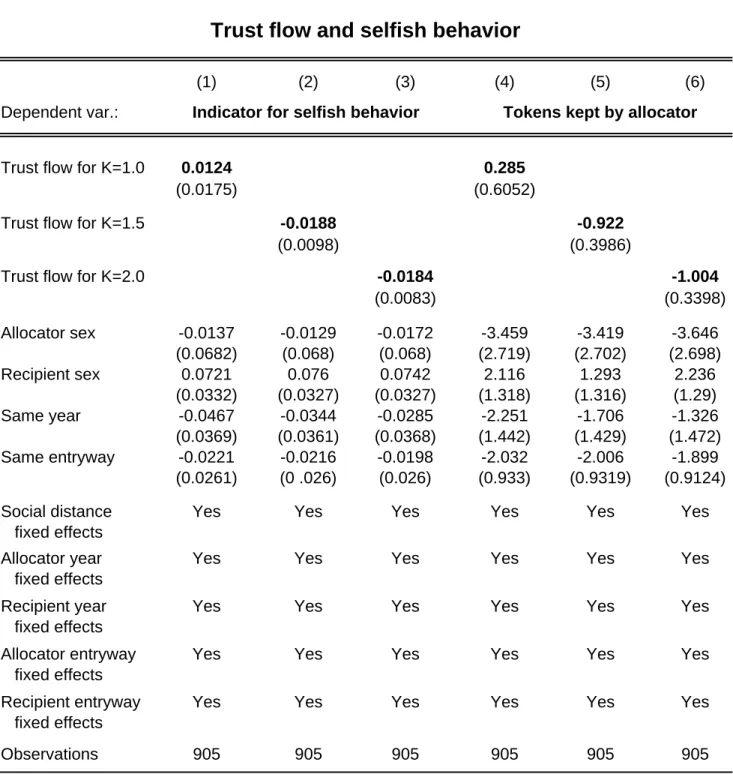
With this interpretation, our model implies a negative relationship between the network ‡ow measure of trust and the number of tokens kept by the allocator. This motivates the estimating equation
sel…sh behaviorst= + trust ‡owst+controls+"st (6)
wheresdenotes the recipient,tdenotes the allocator, sel…sh behaviorst is a measure of the number
of tokens kept by the allocator, and trust ‡owst is the ‡ow measure of trust computed from the
social network for some value ofK. The error term"st captures variation in trusting behavior that
is not related to enforcement, including altruism and information e¤ects.
Below, we provide evidence that estimating equation (6) in ordinary least squares yields <0
as predicted by our theory. One di¢ culty in interpreting the OLS estimate is that the error term "st may be correlated with trust ‡ow. This might happen because the network structure
is endogenous to the pair of agents s and t, and also if other mechanisms for trusting behavior, such as altruism and information, operate more e¤ectively for individuals who are socially closer. We try to address these endogeneity problems by ‡exibly controlling for demographics and various measures of social distance to pick up other mechanisms that can generate trust. However, given these endogeneity problems, we view the results mainly as evidence that ‡ow measures of trust are related to trusting behavior in practice, and not a formal test.
Data description. In December 2003, subjects from two Harvard houses were recruited and asked to provide information on their social network as well as basic demographic data.25 In May 2004 various dictator game treatments were run on these subjects. Within each house an equal number of player 1’s and player 2’s were selected, with player 1’s having the role of the allocator.