Decrypting Live SSH Tra
ffi
c in Virtual Environments
Peter McLaren, Gordon Russell, William J Buchanan and Zhiyuan Tan
School of Computing, Edinburgh Napier University, Edinburgh.
Abstract
Decrypting and inspecting encrypted malicious communications may assist crime detection and prevention. Access to client or server memory enables the discovery of artefacts required for decrypting secure communications. This paper develops the MemDe-crypt framework to investigate they discovery of encrypted artefacts in memory and applies the methodology to decrypting the secure communications of virtual machines. For Secure Shell, used for secure remote server management, file transfer, and tun-nelling inter alia,MemDecryptexperiments rapidly yield AES-encrypted details for a live secure file transfer including remote user credentials, transmitted file name and file contents. Thus,MemDecryptdiscovers cryptographic artefacts and quickly decrypts live SSH malicious communications including detection and interception of data exfiltration of confidential data.
Keywords: network traffic; decryption; memory analysis; IoT; Android; VMI; Secure Shell; SSH; AES; Secure File Transfer; data exfiltration; insider attacks;
1. Introduction
1
Decrypting malicious communications offers opportunities
2
to discover useful information. This could include botnet
com-3
mand and control traffic identifying compromised machines,
4
confidential information that has been extracted and sent or
up-5
loaded to an external location, ransomware keys, or details of
6
criminal activity [1]. This paper focuses on decrypting Secure
7
Shell (SSH) traffic, a potential medium for data exfiltration [2].
8
Realistically useful decryption methods require a knowledge of
9
both the algorithm and the cryptographic artefacts used.
En-10
cryption techniques based only on algorithmic secrecy may be
11
unreliable, as mechanisms such as reverse-engineering enable
12
the algorithm’s functionality to be discovered and furthermore,
13
without extensive independent verification, the robustness of an
14
encryption algorithm may be weak [3]. As a result, publicly
15
known encryption algorithms are commonly used, and key
se-16
crecy thus becomes paramount. Generating sufficiently long
17
random blocks as keys makes decryption unlikely using brute
18
force methods.
19
To decrypt, a framework must discover keys and other
cryp-20
tographic artefacts. When software applications perform
en-21
cryption and decryption, the artefacts reside in program
mem-22
ory at that moment, whether on the program stack, in the heap,
23
or in shared memory. As memory access is important to
foren-24
sic investigations [4] software tools and libraries already exist
25
to support such capability for technologies such as desktops,
26
servers, the Internet of Things (IoT), Android smartphones,
27
and virtualized environments. Mechanisms to discover
cryp-28
tographic artefacts in memory in a manner that allows the
tar-29
get device to continue to operate normally during an
investi-30
gation while remaining undetectable is of particular interest.
31
This paper presents theMemDecryptframework that stealthily
32
decrypts secure communications traffic. Although earlier
re-33
searchers have discovered encryption keys in device memory,
34
other cryptographic artefacts, commonly required to decrypt
35
secure traffic, are not considered. MemDecryptimplements a
36
novel approach to decrypting SSH traffic by analyzing target
37
memory extracts to identify these candidate cryptographic
arte-38
facts (initialization vectors) that, in turn, enable rapid location
39
of candidate keys and the deciphering of payloads in live
ses-40
sions with high probability. This enables malicious SSH
ac-41
tivity in live secure communications sessions to be addressed.
42
The techniques proposed are applicable to a range of device
43
platforms, though the MemDecrypt framework is particularly
44
focused on decrypting communications from within virtual
ma-45
chines.
46
Although plaintext could be obtained by adding an audit
47
function to the binary, this is arguably a different application
48
and has some similarity with a key logger, which may only be
49
acceptable in specific environments. Also, unless all plaintext is
50
captured rather than client input, file contents are not captured.
51
Plaintext could possibly be obtained by extracting on buffer
52
memory writes. However, researchers have found that
monitor-53
ing virtual machine read/write buffers is inefficient. As
mem-54
ory extraction is invasive minimizing the number of extracts is
55
preferable so with buffer memory write triggers, the larger the
56
exfiltrated file, the more extracts. To discover the plaintext of
57
a full session, buffer breaks would need to be in place before
58
the session. In MemDecrypt, memory can be extracted at any
59
stage after the handshake completes to decrypt a captured
net-60
work session. Buffer memory write triggers may be effective
61
with interactive sessions as with exfiltrated data, missing an
ex-62
tract makes decryption problematic. Furthermore, exfiltrating
63
non-ASCII data may be more challenging without certainty of
64
buffer memory locations.
65
The rest of the paper is structured as follows. To provide
framework context, the background to secure communications
67
is provided in Section II. Earlier research in discovering
crypto-68
graphic artefacts is reviewed in Section III. Section IV presents
69
theMemDecryptdesign and Section V the implementation
de-70
tails. Test results are evaluated and discussed in Section VI and
71
conclusions drawn in Section VII.
72
2. Related Work
73
This section provides a summary of symmetric encryption
in-74
cluding block and stream algorithms commonly used in secure
75
communications protocols. Approaches for accessing memory
76
to support cryptographic artefact discovery are also discussed.
77
Although there is no published research into finding
crypto-78
graphic artefacts in Android smartphone and IOT device
mem-79
ory, desktop and server memory has been studied. Entropy
80
measures have frequently been used as a filtering mechanism to
81
discover keys. This approach assisted in searches for AES key
82
schedules after cold-boot attacks [5] as well in finding Skipjack
83
and Twofish algorithm artefacts [6]. These studies focus on
en-84
cryption key discovery in dormant devices and therefore do not
85
decrypt the secure network sessions of live virtual machines.
86
Although malware analysis and detection has been a research
87
focus for monitoring from outside the virtual machine, it has
88
also been applied to analyze secure communications. For
ex-89
ample, SSH session details were obtained from an SSH
hon-90
eypot server customized to extract data when the specific
sys-91
tem calls executed [7]. InTLSkex[8], AES-CBC cryptographic
92
keys were discovered in Linux client virtual machine memory
93
when Change Cipher Spec messages were detected in TLS
net-94
work sessions by searching for bit strings where the counts of
95
0’s and 1’s suggested randomness. TLSkex investigates TLS
96
traffic only so, for example, the uploading of confidential data
97
using SSH is not considered. Furthermore,TLSkexanalysis is
98
restricted to Linux virtual machine so Windows virtual machine
99
activity is excluded. TheMemDecryptframework decrypts
en-100
tire sessions for both SSH and TLS protocols where different
101
encryption algorithms have been applied for Windows clients
102
and Linux servers using a standard entropy measure. Moreover,
103
MemDecryptmemory extractions are independent of message
104
type and discovery of candidate initialization vectors drives the
105
decryption process.
106
Encryption keys can be discovered by intercepting
encryp-107
tion function calls to extract parameters. For example, the
108
Linux ptrace command can attach to the encrypting process
109
enabling identification of keys and other artefacts [9]. This
110
approach may have been used to discover SSH plaintext,
ci-111
phertext, and keys, although implementation details are unclear
112
[10]. These approaches are Linux-specific and are easily
de-113
tectable by virtual machine software. Consequently, they may
114
not be effective against malicious insiders, especially when the
115
target device runs Windows. MemDecrypt decrypts SSH
net-116
work sessions in a stealthy manner by triggering memory
ex-117
tracts only when an unusual event is detected.
118
2.1. Encryption algorithms
119
Encryption algorithms for secure communications are
asym-120
metric or symmetric. For encryption and decryption,
asym-121
metric algorithms use different keys whereas symmetric
algo-122
rithms use the same keys. Asymmetric algorithms attain
se-123
curity through computational complexity, which takes
proces-124
sor time, making them considerably less CPU efficient than
125
symmetric algorithms [11]. Consequently, asymmetric
algo-126
rithms are frequently only used for agreement on symmetric
127
keys, which are then used to encrypt the channel.
Symmet-128
ric encryption algorithms are either stream algorithms, where
129
plaintext is encrypted with either bit-by-bit or block algorithms
130
(where blocks of a specific size are encrypted). Although the
131
Advanced Encryption Standard (AES) block algorithm may be
132
thegold standard, vulnerability and performance concerns have
133
led to the adoption of ChaCha20 stream algorithm with
Poly-134
1305 authentication [12] in secure protocols such as OpenSSH
135
and OpenSSL, as well as being used for Google Chrome related
136
communications on Android smartphones [13].
137
Block and stream algorithms commonly require initialization
138
vectors (IVs) for secure communications. For AES, IVs
incor-139
porated in the encryption process provide defenses against
re-140
play attacks [14]. For example, in AES counter mode
(AES-141
CTR), an IV is encrypted and XORed with the plaintext to
142
produce ciphertext. AES-CTR is the quickest AES mode, and
143
is recommended by security experts [3] [15]. For ChaCha20,
144
the key, IV, and a counter are parameters to keystream creation
145
[12]. The keystream is XORed with the plaintext to produce
ci-146
phertext. Both AES-CTR and ChaCha20 are approved for SSH
147
[16] and TLS protocols. Consequently, encryption keys and
148
IVs must be discovered to decrypt AES-CTR and ChaCha20
149
encrypted SSH and TLS channels.
150
This paper focuses on SSH communications. For SSH in
151
AES-CTR mode, the IV increments by 1 for each outgoing
152
plaintext block [17] so that the difference between the IV for the
153
first plaintext block in packets n+1 and n is the number of
plain-154
text blocks in packet n. Although AES-CTR is the only
rec-155
ommended SSH AES mode [16], AES-CBC is also used. For
156
AES-CBC, each IV after the initial value is the ciphertext of the
157
previous block [17]. Consequently, the IV for each encrypted
158
AES-CBC block is known. ChaCha20 uses the IV to generate
159
key streams. It performs 20 rounds of mathematical operations
160
starting from a base structure consisting of a constant string of
161
16 bytes, a generated 32-byte key, a 4-byte counter, and a
12-162
byte IV, where the counter is typically 0 or 1 for each 64-byte
163
plaintext block [12].
164
SSH enables secure management of remote servers across
165
potentially insecure networks, offering functionality such as
166
client-server file transfer. The protocol is specified in 4 key
167
IETF RFCs: SSH Protocol Architecture (SSH-ARCH) [18],
168
SSH Transport Layer Protocol (SSH-TRANS)[19], SSH
Au-169
thentication Protocol (SSH-AUTH) [20], and the SSH
Connec-170
tion Protocol (SSH-CONNECT) [21]. SSH-TRANS defines
171
the initial connection, packet protocol, server authentication,
172
and the basic encryption and integrity service [22]. Following
173
the TCP handshake, the parties transmit supported SSH
pro-174
tocol versions, and optionally application, which enables the
probable operating systems and library to be inferred. For
in-176
stance, ’SSH-2.0-PuTTY_Release_0.70’ probably signifies that
177
a Windows client is executing the PuTTY application [23].
178
Exchanged ’Key Exchange Initialization; and ’Key Exchange’
179
messages determine the session encryption and authentication
180
algorithm and the material for the generation of the
crypto-181
graphic artefacts. Client New Keys messages advises that all
182
subsequent traffic in the session is encrypted. An example of
183
the handshake process as well as the first encrypted packet is
il-184
lustrated in Figure 1. SSH-AUTH defines authentication
meth-185
ods such aspublic key,password,host basedandnone. After
186
successful authentication, a file transfer requires the
establish-187
ment of a secure channel to support the secure file transfer
pro-188
tocol as defined by. Secure file transfer (SFTP) [24] is an SSH
189
sub-system particularly worthy for investigation as significant
190
potential exists for it to transfer confidential files out of a
sys-191
tem.
192
2.2. Memory Access
193
Memory acquisition tools assist forensic analysis. So, for
194
workstation and server technologies hardware and software
ac-195
quisition methods exist [25]. Hardware acquisition typically
196
involves connecting devices, such as PCMCIA cards or USB
197
sticks, to a target [26] while software acquisition commonly
in-198
volves executing extraction programs such as FTK Imager [27],
199
Memoryze [28], or WinPmem [29] on the target [30]. These
200
solutions may not always be practical in live network session
201
decryption scenarios.
202
Android smartphone volatile memory is accessible. As
203
Androids run Linux, memory acquisition tools such as the
204
Linux Memory Extractor (’LiME’) application [31] may
suf-205
fice. However, LiME depends on compiled kernel modules
206
for the target’s Linux version, support by the smartphone and
207
kernel level execution. The quantity of Linux variations for
208
Android smartphones as well as the installation and execution
209
requirements may be challenging. AMExtractor [32] requires
210
kernel execution privilege but no compilation is required and so
211
is potentially less restrictive. TrustDump [33] may be
appropri-212
ate but minimal testing has been carried out. Commercial tools
213
such as Cellebrite also claim to extract memory from Android
214
devices without target modification although usage is restricted
215
[34].
216
Internet of Things (IoT) devices also commonly run Linux
217
[35]. However, device type and Linux variations pose
po-218
tentially greater challenges than smartphones. Nevertheless,
219
solutions that support live acquisition from Android
smart-220
watches, as well as smartphones, have been proposed [36].
221
IoT device memory may also be acquired by flashing
mem-222
ory, running Linux dump commands, or accessing device
cir-223
cuitry [37]. Furthermore, memory access with commercial
224
tools, such as Cellebrite UFED Physical Analyzer, has also
225
been demonstrated [38]. As IoT devices frequently
commu-226
nicate with cloud-based servers, memory acquisition of
virtual-227
ized machines may present an easier alternative [35].
Virtual-228
ization enables memory access. Virtualization technologies
en-229
able virtual machines to share host computer resources thereby
230
providing an opportunity to discover cryptographic artefacts in
231
virtual machine memory from the physical host. This ensures
232
investigations have reduced the impact on virtual machine
op-233
erations. Furthermore, software programs executing on the
vir-234
tual machine, such as malware, may not detect the
investiga-235
tions. Examples of tools and libraries that support
outsidethe-236
machine monitoring include LibVMI [39] together with PyVMI
237
[40] and Volatility [41], and Rekall [42].
238
3. MemDecrypt Design
239
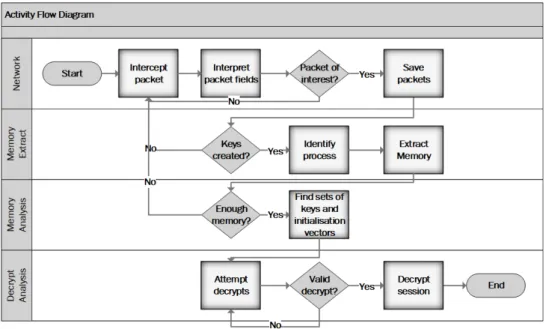
MemDecryptconsists of network and data collection,
mem-240
ory analysis, and decrypt analysis components. Figure 2
illus-241
trates theMemDecryptactivity flow diagram. Each component
242
is described in the following paragraphs.
243
Network and Memory Extract. In MemDecrypt unusual
244
events trigger memory extracts. This approach is less
intru-245
sive than continuous memory monitoring where the
monitor-246
ing and analysis activities of the host may impact target device
247
performance. Furthermore, malware writers script programs
248
to be aware of monitoring activity, which would probably be
249
more obvious with continuous monitoring. The triggers
ap-250
proach is also more precise than obtaining memory snapshots
251
on a polled basis. Polling snapshots may miss malicious
activ-252
ity if the polling interval is too large, especially when malware
253
uses counter analysis techniques. The quantity and timing of
254
memory extraction events depend on the target device, the
se-255
cure protocol, and the encryption algorithm. Where memory is
256
classifiable, the read/write memory of the encryption program
257
is extracted for size minimization, with consequent reduced
im-258
pact on target performance and faster subsequent analysis.
259
Memory analysis. Candidate encryption keys and IVs are
260
identified in the memory extracts. Although largely protocol
261
specific, there are common features. In particular, candidate IV
262
locations are discovered first with approaches that encompass
263
an analysis of memory extracts, network packets or both
net-264
work packets and memory extracts. As keys and IVs are
crypto-265
graphic artefacts, the distance between their respective memory
266
locations may be small If program memory extracts are taken
267
when the same activity is being performed, such as the
trans-268
mission of outgoing messages, memory blocks containing IVs
269
change, while other blocks remain static.
270
Key randomness makes it different from many other types of memory regions. Key randomness means that the sequence of bits cannot be easily predicted. The randomness of keys can be evaluated using entropy, a measure of the amount of informa-tion in a key. This paper uses Shannon’s entropy measure for discrete variables [43] in preference to cryptographically use-ful alternatives such as guessing entropy and min-entropy [44] because smaller candidate key sets are produced:
H=−
n
X
i=1
p(i) log2p(i) (1)
where p(i) is the normalized frequency of theith byte in the
271
message i.e. p(i)= f(i)/n. So, segments of high entropy user
272
memory are more likely to contain the key. In contrast with
273
IVs, keys do not generally change during a session. So, static,
Figure 1: SSH Handshake Example
Figure 2: MemDecryptActivity Flow Diagram
high-entropy contents are candidate encryption keys. This
ob-275
servation assists in improving memory analysis performance.
276
Decrypt analysis. Candidate keys and IVs identified in
277
memory analysis are used in decrypting network packets until
278
a valid key and IV combination has been found. Decrypt
vali-279
dation uses information derived from specific encrypted fields.
280
SSH encrypted data blocks are of the following format:
281
Packet Length (4 bytes) Padding Length (1 byte) Payload
282
(variable bytes) Padding (variable bytes) MAC
283
The packet length is the sum of the padding length size, the
284
payload, and padding fields. So, equation (2) is a good decrypt
285
test for many SSH messages as 2(8∗4−21)valid packet length
de-286
crypts are possible. The minimum SSH block size is 21 bytes
287
comprising a packet length of 4 bytes, a padding length of 1
288
byte, and the payload and padding which is at least one block.
289
So, the probability of an incorrect decrypt producing the correct
290
header data is 1-in-4,294,967,275. Reassembly is undertaken
291
when the SSH packet size exceeds the network packet size.
292
Equation (2) is sound during the authentication, channel, and
293
sub-service setup stages when SSH packet sizes are generally
294
small and a modified version is used for reassembled SSH
pack-295
ets. An additional test evaluates whether the decrypted padding
296
length meets Equation (3) as required by SSH-TRANS. Correct
297
decrypts are parsed to obtain SSH and SFTP fields.
298
packet data length =
decrypted packet length+ size(packet length f ield)+ size(MAC f ield)
(2)
4<=padding length<=255 (3)
4. MemDecrypt Implementation
299
This paper focuses on SSH decryption using AES-CTR and
300
AES-CBC in virtualized environments usingMemDecrypt. The
301
following paragraphs present implementation and evaluation
302
details. The framework is implemented on the Xen
hypervi-303
sor [45]. Xen’s small trusted computing base makes it
poten-304
tially less prone to vulnerabilities than hypervisors with larger
305
footprints. Furthermore, the LibVMI library (“LibVMI,” n.d.)
306
for Xen enables efficient memory access to live memory of
Windows or Linux virtual machines. As the Xen hypervisor
308
has minimal functionality a privileged virtual machine (Dom0)
309
manages the hypervisor and provides network and virtual disk
310
device access to other virtual machines. Network access for
311
the virtual machines is through a Dom0 virtual software bridge.
312
TheMemDecryptcomponents either all run on, or are initiated,
313
from Dom0.
314
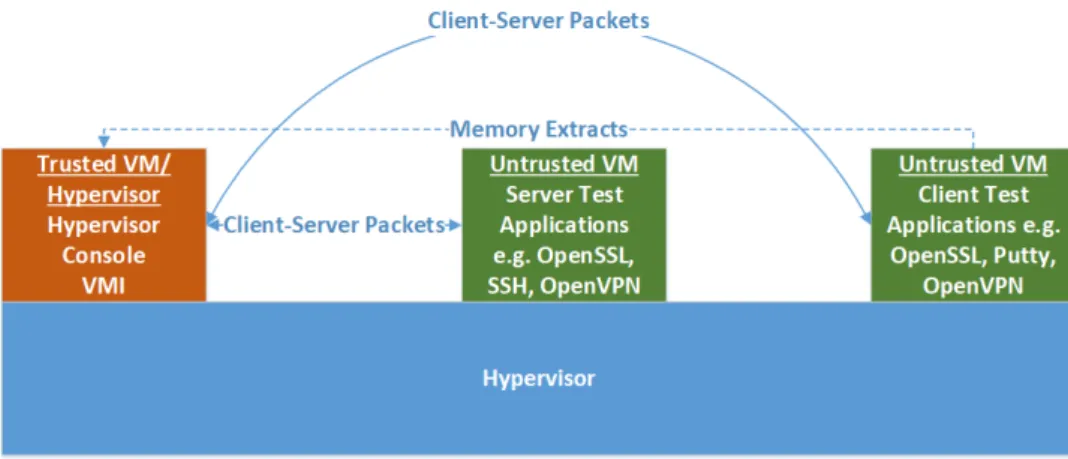
TheMemDecryptimplementation architecture for virtualized
315
environments is illustrated in Figure 3. An isolated hypervisor
316
supports two unprivileged virtual machines, shown in the
cen-317
tre and right of the figure, and one privileged virtual machine
318
shown on the left. Test client applications execute on the virtual
319
machine on the right, targeting server applications executing on
320
the virtual machine, shown in the centre.
321
4.1. Data Collection
322
For virtualized environments, virtual machine network traffic
323
is inspected by redirecting each packet to a local queue using
324
an iptables rule and NetFilterQueue 0.8.1 [46], and analyzing
325
protocol fields using Scapy 2.3 [47]. When unusual activity is
326
detected, the component stores the network packet and
decon-327
structs the message. Memory is extracted for any 2 outgoing
328
SSH messages after aNew Keysmessage. Linux memory
ex-329
traction uses PyVMI and LibVMI libraries, whereas Windows
330
extraction applies Volatility framework user plugins.
331
MemDecryptobtains useful data from the SSH initialization
332
stage. Client and server versions, and application if available
333
are obtained from the protocol version exchange. The
encryp-334
tion algorithm is determined from the “Key Exchange”
mes-335
sages. Also, if initialization has completed, i.e. the “New Keys”
336
has been transmitted, user-level read/write program memory
337
extraction is triggered for two outgoing packets in the network
338
session. Memory extracts are not required for consecutive
pack-339
ets or to be immediately after the “New Keys” message.
340
4.2. Memory Analysis
341
Analysis approaches vary according to encryption mode and
342
operating system. For AES-CTR, two steps are required to
dis-343
cover candidate IVs and keys in memory, whereas AES-CBC
344
requires only key discovery. For Windows, discovery is
per-345
formed by iteratively analyzing multiple memory files extracted
346
at different times, whereas, for Linux, a single heap file is
ana-347
lyzed.
348
For AES-CTR, candidate IVs are discovered first. As IVs
349
increase but are likely to be located at the same memory address
350
over different extracts, memory blocks that change is subject
351
to further analysis. If the 16-byte value at a memory address
352
increments by the number of encrypted blocks in the previous
353
packet, then the address contents are a candidate IV. Supposing
354
that value at location p in captureyat the timeais compared
355
with the value at location pin captureyat timeb. Then, if the
356
values are IVs and represented byIVpyaandIVpybrespectively, 357
thenIVpyb=IVpya+n, wherenis the number of AES encrypted 358
network blocks that have been sent between the timeaandbin
359
that session. For example, if the value of a 16-byte memory
360
block is 123456 and two network packets with, say, 10 and 5
361
encrypted blocks are sent and captured, then a value of 123471
362
at the same position in the later extract identifies a candidate
363
AES-CTR IV. Algorithm 1 shows the process.
364
Data:extract folders f ldra, f ldrband packetspkta,pktb
Result:Z=candidate IVs
delta :=blocks[pkta:pktb];
forfile f1in f ldrado
f2=match (f1, f ldrb);
if f1<> f2then
fori=0 to size( f1) inc 4do
ifval( f2[i:i+16]) - val( f1[i:i+16])=deltathen
Z+= f1[i:i+16];
end end end end
Algorithm 1:AES-CTR IV Memory Analysis
To discover AES candidate keys for CTR and
AES-365
CBC, the memory extract files are analysed. Key segment
en-366
tropies are calculated for key length segment sizes. If an
en-367
tropy exceeds a threshold, the segment is compared with the
368
equivalent segment in a later extract, and if the segments are
369
identical, the segment is a candidate encryption key. For
exam-370
ple, a 256-bit key length, a 32-byte memory segment entropy
371
of 4.9, and a 32-byte AES threshold of 4.65 determines the
seg-372
ment to be of interest. An identical match to the segment at
373
the same location in a later memory extract identifies a
candi-374
date key. The identified candidate IVs and keys provide input
375
to the decrypt analysis stage. Heuristic testing determined that
376
AES entropy thresholds of 4.65 for 256-bit keys, 4.0 for 192-bit
377
keys, and 3.4 for 128-bit keys ensured the inclusion of all keys
378
in candidate sets while minimizing set size.
379
4.3. Decrypt Analysis
380
The component iterates through each candidate key for each
381
candidate IV until decrypts are validated. The first ciphertext
382
block is decrypted for each combination with pycrypto 2.6.1
383
[48]. For a correct decrypt the first four plaintext bytes are
384
the packet length and Equation (2) holds. For additional
val-385
idation, the decrypted padding length is checked with Equation
386
(3). With a valid key and IVs,MemDecryptdecrypts each block
387
and deconstructs the SSH plaintext stream. For SSH
authoriza-388
tion requests, the ’password’ type plaintext yields the remote
389
user credentials and for SSH connection requests, the channel
390
type, and channel request decrypts. For SFTP, all plaintext is
391
produced includinginitialization,file attribute,file open,write
392
andclosemessage types fields. All plaintext is written to file
393
for evaluation.
394
4.4. Testbed
395
The physical environment is a Core 2 Duo Dell personal
396
computer with 40 GB of disk storage and 3 GB of RAM. It hosts
397
the hypervisor, a Dom0 privileged virtual machine, an untrusted
Figure 3: MemDecryptVirtualization Architecture
Windows virtual machine, and an untrusted Ubuntu virtual
ma-399
chine. The hypervisor is Xen Project 4.4.1 and the Dom0
hy-400
pervisor console is Debian release 3.16.0-4-amd64 version 1.
401
Tests run on Windows client and Linux server virtual
ma-402
chines. One client runs a standard Windows 7 SP1 operating
403
system with 512 MB of allocated memory and 30 GB of disk
404
space. Another client runs a Windows 10 (10.0.16299)
oper-405
ating system with 2 GB of memory and 40 GB of disk.
Win-406
dows operating systems support a number of SSH clients [49].
407
The selected PuTTY suite [23] is widely used [49] so may be
408
used by suspect actors. However, other SSH client
applica-409
tions should produce similar results. The untrusted Linux server
410
virtual machine runs an Ubuntu 14.04 build (“Trusty”) with
411
512 MB of allocated memory and 4 GB of disk storage. SSH
412
server functionality is provided by openssh-server. To remove
413
unnecessary communications with external agents, thednsmasq
414
package is installed and configured to respond to DNS requests
415
with the server virtual machine IP address.
416
5. Evaluation
417
MemDecrypt is evaluated by running a sequence of
experi-418
ments. The experimental set-up is described followed by the
419
presentation and review of results. Possible countermeasures to
420
MemDecryptresults are discussed.
421
5.1. Experimental Set-up
422
Experiments are performed with variable file sizes, key
423
lengths, modes of operation, operating systems, and operating
424
system versions. In each instance, the ’pscp’ program is
425
executed from the Windows command line using requests of
426
the form:
427
428
pscp -P nnnn filename name@ipaddress:/home/name
429
430
where nnnn is the target port, filename is the file being
431
transmitted,nameis a user account on the target Ubuntu server,
432
ipaddressis the target server IP address and/home/nameis the
433
Ubuntu server target folder for the transmitted file. An Ubuntu
434
service is started from the bash command line to listen to client
435
SSH messages with requests of the form:
436
437
/usr/sbin/sshd -f/root/sshd_config -d -p nnnn
438
439
where nnnn is the service receiving port number and
440
sshd_configcontains configuration details such as encryption
441
algorithms supported by the server.
442
Sets of experiments investigate decrypting SSH traffic
en-443
crypted with AES under different conditions. One set evaluates
444
decrypt effectiveness for Windows 7 and Windows 10 clients.
445
A second set evaluates the effectiveness of 128-bit, 192-bit and
446
256-bit keys on Windows 10 clients in AES-CTR mode. A third
447
set evaluates MemDecrypt effectiveness with 256-bit keys in
448
AES-CBC and AES-CTR modes on Windows 10 clients. To
449
evaluate file invariability, a fourth set uploads 30 files in text,
450
pdf, Excel, and executable formats between 1 KB and 500 KB
451
for Windows clients in AES-CTR mode using 256-bit keys.
Ex-452
periments also assess decrypt effectiveness with Ubuntu server
453
for AES-CBC and AES-CTR with 256-bit keys.
454
5.2. Test Results
455
In each experiment, encryption keys, and for AES-CTR
456
initialization vectors, were discovered and valid plaintext
457
produced for all SSH and SFTP fields. For example,
458
with a client command of ’pscp -P 2222 plaintext.txt
pe-459
[email protected]:/home/peter’ and plaintext.txt of ’An
out-460
cropping of limestone beside the path that had a silhouette. . . ’
461
, the interesting decrypted fields are depicted in Figure 4.
462
MemDecrypt also produces other SSH fields such as request
463
identifiers, and file offsets. As observed earlier, the probability
464
of an incorrect combination generating a packet length meeting
465
Equation (2) is 0.00000002% (1 in 4,294,967,275).
MemDe-466
cryptdecrypts SSH traffic with a high degree of certainty.
467
Analysis durations for producing correct plaintext
deter-468
minesMemDecrypt’s usefulness. For example, if plaintext is
469
produced during the network sessionMemDecryptcan assist in
470
the prevention of further malicious activity, perhaps by
drop-471
ping packets or hijacking the session.
472
The first experiment compares the relative performance of
473
Windows 7 and Windows 10 client virtual machines. For
Figure 4: SSH Decrypt Output
AES-CTR, two memory extracts are required for the analysis
475
whereas, for CBC, one extract suffices. Memory analysis
typ-476
ically executes for approximately nine seconds for Windows 7
477
clients and 16 seconds for Windows 10 clients with a maximum
478
of 25.1 seconds. Decrypt analysis durations varied between
479
0.2 and 34.1 seconds averaging at 4.5 seconds. The variance
480
is linked to the candidate IV set size and the ordinality of the
481
correct IV within the file set.
482
The second experiment compares analysis time durations for
483
different CTR key sizes on Windows 10 clients. Shorter key
484
lengths require lower entropy thresholds, so more candidate
en-485
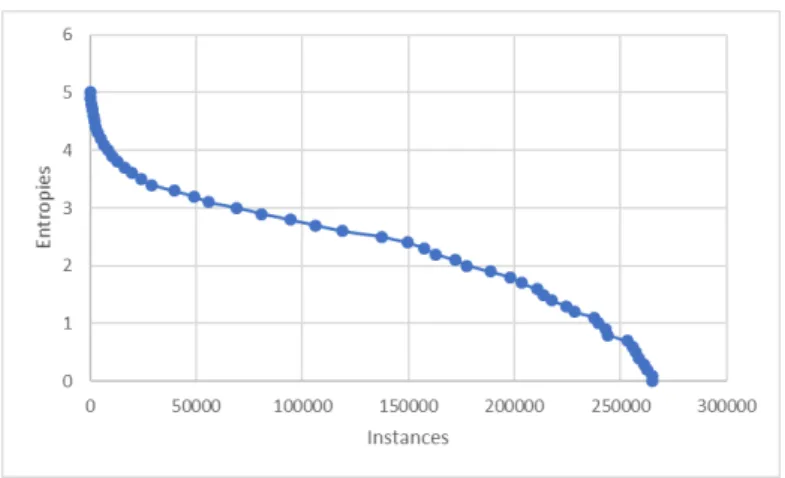
cryption keys are discovered in-memory analysis. Figure 5
il-486
lustrates a typical distribution of 32-byte entropy segments in
487
read/write memory. This maps the count of memory segments
488
exceeding an entropy with an entropy levels so that for
exam-489
ple whereas out of 264,813 segments exceeding 0.0 entropy,
490
188,602 (i.e. 72.1%) exceed 2.0, 2,628 (i.e. 0.99%) exceed 4.5.
491
So, for example, in one test sequence memory analysis yielded
492
candidate key set sizes of 272 for 256-bit key lengths, 1123 for
493
192-bit key lengths, and 5658 for 128-bit key lengths. With
494
these set sizes, decrypt analysis durations are longer for shorter
495
key lengths as illustrated in Figure 6.
496
The third experiment compares analysis time durations on
497
Windows 10 clients for 256-bit key sizes in AES-CTR and
498
AES-CBC. The CBC memory analysis takes approximately 16
499
seconds which is similar to CTR. However, the CBC decrypt
500
analysis duration is faster with a minimum of 0.07 seconds as
501
iterating through potential IVs is not required.
502
For experiments accessing Ubuntu server memory with the
503
default encryption algorithm, i.e. AES with 256-bit key length
504
and CTR mode, all client and server packets are correctly
de-505
crypted. The data collection component obtains process lists
506
and extracts process heap from the Ubuntu virtual machine in
507
0.3 seconds. Memory analysis finds approximately 320 keys
508
and 3 initialization vectors in 6 seconds, and decrypt analysis
509
decrypts the session successfully in 37 seconds.
510
MemDecryptperformance may suffice when extracts are
ob-511
tained for Windows clients or Ubuntu servers. Nevertheless,
512
strategies to enhance performance include improving memory
513
extraction for Windows clients, pre-testing with known SSH
514
client and server applications, pipelining, multi-threading, and
515
implementing in a low-level language instead of Python. A
516
custom extract engine using PyVMI and LibVMI libraries to
517
replace Volatility plugins improves Windows memory
extrac-518
tion performance. Pre-testing SSH client and server
applica-519
tions may determine the distance between key and IV memory
520
locations. Cryptographic libraries generally request memory
521
to hold crypto data structures (’malloc’) when algorithms are
522
agreed which occurs after the handshake so data is usually on
523
the heap. The data structures can include fields such as
en-524
cryption/decryption flag, key size, keys etc so for an algorithm,
525
AES-CTR with 256 bit keys, the data structures may be
invari-526
ant. For example, with PuTTY ’pscp’, distances are 968 bytes
527
for 256-bit and 192-bit keys and 728 bytes for 128-bit-keys and
528
are invariant with operating system version or transmitted file
529
size. Where the distance is known, and the program identified
530
from the SSH version message, memory analysis and decrypt
531
analysis components take one second. Multi-threading
sup-532
ports simultaneous analysis of multiple files and decrypts while
533
pipelining between components enables analysis to terminate
534
when the correct plaintext is obtained.
535
So,MemDecryptdecrypts SSH sessions with high
probabil-536
ity independent of file size, operating system type or version,
537
key length, or mode. Furthermore, with SSH application
pre-538
testing, analysis and decrypt decryption completes in 1 second.
539
With unknown SSH applications, the plaintext is produced in
540
under 60 seconds for 192-bit and 256-bit keys. Although in
ex-541
periments, MemDecrypt decrypts sessions with exfiltrated files
542
of 100 bytes, the risk exists that extracts are not acquired in
543
terse SSH sessions. The risk might be mitigated by pausing the
544
virtual machine. Decrypting sessions with SSH key rotation
545
[50] is not currently implemented but the planned MemDecrypt
546
approach is considering each rotation as a separate session with
547
its own candidate keys and IVs.
548
5.3. Countermeasures
549
Countermeasures may prevent or delayMemDecrypt
discov-550
ery of cryptographic artefacts. Invalid assumptions can
invali-551
date the methodology. Candidate encryption keys are assumed
552
to be high entropy, static for a network session, and in the same
553
memory location. For entropy, less randomness, i.e. lower
en-554
tropy, makes key regions less evident but key unpredictability
555
is an essential requirement. For key staticity,MemDecrypt
re-556
quires two extractions for AES-CTR, key changes would be
re-557
quired between each outgoing packet which could cause
ex-558
cessive transmission delays. Key location changes could delay
559
decryption. However, tests on a Linux heap extract produced
560
delays of less than 0.5 seconds. MemDecryptassumes
candi-561
date AES-CTR IVs are located at the same memory locations
562
in each extract and values to increment by the sum of payload
563
blocks in the previous packets. As with keys, tests where IV
564
memory addresses changed induced delay of 0.5 seconds. As
Figure 5: Typical Memory Segment Entropy Distribution
Figure 6: Key Length Analysis Durations
a result, the measure may not suffice. AES-CTR IVs
incre-566
ments make them detectable when storedin the clearin
mem-567
ory. Another delaying measure is encrypting artefacts with an
568
additional key. However, this key may be discoverable, and
569
furthermore, the additional encryption and decryption for each
570
packet, or block, may have an unacceptable performance
im-571
pact. Obfuscation the artefacts may be more effective. For
572
example, splitting key and IV strings and interpolating
vari-573
able data between splits will limitMemDecrypt performance,
574
and possibly effectiveness. This technique is faster and less
de-575
tectable than an additional encryption layer. .A more effective
576
counter-measure is preventing memory access to artefacts. For
577
example, Intel [51] and AMD [52] may develop virtual
ma-578
chine encryption where encryption keys are absent from virtual
579
machine memory. Although this can offer privacy, malicious
580
behaviour is then hidden so administrators may seek to disable
581
the feature.
582
6. Conclusions and Future Work
583
The MemDecrypt framework rapidly discovers
crypto-584
graphic artefacts and decrypts SSH communications in
virtual-585
ized environments. This can assist in detecting, and preventing
586
insider attackers from extracting and encrypting confidential
in-587
formation to external locations. MemDecryptcan be extended
588
to technologies where memory acquisition of live secure
ses-589
sions is enabled. Decrypting SSH sessions may be illegal
with-590
out approval so cryptographic artefact sets could be retained
591
with the associated network traffic for decryption once approval
592
is obtained. High performance makes the framework applicable
593
so future work should apply multithreading and pipelining
tech-594
niques before being extended to other non-virtualized use cases,
595
secure protocols, encryption algorithms, and malware that use
596
encrypted communications channels.
597
References
598
[1] S. Khandelwal, ““How Dutch Police Decrypted BlackBerry PGP
599
Messages For Criminal Investigation,” The Hacker News,” https://
600
thehackernews.com/2017/03/decrypt-pgp-encryption.html, 2017,
[On-601
line; accessed 29-Jan-2019].
602
[2] A. Duncan, S. Creese, and M. Goldsmith, “An overview of insider
at-603
tacks in cloud computing,”Concurrency and Computation: Practice and 604
Experience, vol. 27, no. 12, pp. 2964–2981, 2015.
605
[3] N. Ferguson, B. Schneier, and T. Kohno,Cryptography engineering: de-606
sign principles and practical applications. John Wiley & Sons, 2011.
607
[4] N. Zhang, R. Zhang, K. Sun, W. Lou, Y. T. Hou, and S. Jajodia, “Memory
608
forensic challenges under misused architectural features,”IEEE Transac-609
tions on Information Forensics and Security, vol. 13, no. 9, pp. 2345–
610
2358, 2018.
611
[5] J. A. Halderman, S. D. Schoen, N. Heninger, W. Clarkson, W. Paul, J. A.
612
Calandrino, A. J. Feldman, J. Appelbaum, and E. W. Felten, “Lest we
613
remember: cold-boot attacks on encryption keys,”Communications of 614
the ACM, vol. 52, no. 5, pp. 91–98, 2009.
[6] C. Maartmann-Moe, S. E. Thorkildsen, and A. Årnes, “The persistence
616
of memory: Forensic identification and extraction of cryptographic keys,”
617
digital investigation, vol. 6, pp. S132–S140, 2009.
618
[7] S. Sentanoe, B. Taubmann, and H. P. Reiser, “Virtual machine
introspec-619
tion based ssh honeypot,” inProceedings of the 4th Workshop on Security 620
in Highly Connected IT Systems. ACM, 2017, pp. 13–18.
621
[8] B. Taubmann, C. Frädrich, D. Dusold, and H. P. Reiser, “Tlskex:
Har-622
nessing virtual machine introspection for decrypting tls communication,”
623
Digital Investigation, vol. 16, pp. S114–S123, 2016.
624
[9] Y. Nakano, A. Basu, S. Kiyomoto, and Y. Miyake, “Key extraction attack
625
using statistical analysis of memory dump data,” inInternational Confer-626
ence on Risks and Security of Internet and Systems. Springer, 2014, pp.
627
239–246.
628
[10] B. Hay and K. Nance, “Circumventing cryptography in virtualized
envi-629
ronments,” inMalicious and Unwanted Software (MALWARE), 2012 7th 630
International Conference on. IEEE, 2012, pp. 32–38.
631
[11] D. Puthal, S. Nepal, R. Ranjan, and J. Chen, “A dynamic prime number
632
based efficient security mechanism for big sensing data streams,”Journal 633
of Computer and System Sciences, vol. 83, no. 1, pp. 22–42, 2017.
634
[12] Y. Nir and A. Langley, “Chacha20 and poly1305 for ietf protocols,” Tech.
635
Rep., 2018.
636
[13] Ianix, ““ChaCha Usage & Deployment,” Ianix,” https://ianix.com, 2019,
637
[Online; accessed 29-Jan-2019].
638
[14] T. Aura, “Strategies against replay attacks,” inComputer Security Foun-639
dations Workshop, 1997. Proceedings., 10th. IEEE, 1997, pp. 59–68.
640
[15] P. Rogaway, “Evaluation of some blockcipher modes of operation,” Cryp-641
tography Research and Evaluation Committees (CRYPTREC) for the 642
Government of Japan, 2011.
643
[16] M. Bellare, T. Kohno, and C. Namprempre, “The secure shell (ssh)
trans-644
port layer encryption modes,” Tech. Rep., 2005.
645
[17] M. Dworkin, “Recommendation for block cipher modes of
opera-646
tion. methods and techniques,” NATIONAL INST OF STANDARDS
647
AND TECHNOLOGY GAITHERSBURG MD COMPUTER
SECU-648
RITY DIV, Tech. Rep., 2001.
649
[18] T. Ylonen and C. Lonvick, “The secure shell (ssh) protocol architecture,”
650
Tech. Rep., 2005.
651
[19] ——, “The secure shell (ssh) transport layer protocol,” Tech. Rep., 2005.
652
[20] ——, “The secure shell (ssh) authentication protocol,” Tech. Rep., 2005.
653
[21] ——, “The secure shell (ssh) connection protocol,” Tech. Rep., 2005.
654
[22] D. J. Barrett, D. J. Barrett, R. E. Silverman, and R. Silverman,SSH, the 655
Secure Shell: the definitive guide. " O’Reilly Media, Inc.", 2001.
656
[23] S. Tatham, ““PuTTY”,” https://www.chiark.greenend.org.uk/~sgtatham/
657
putty/latest.html, 2019, [Online; accessed 29-Jan-2019].
658
[24] J. Galbraith and O. Saarenmaa, “Ssh file transfer protocol,” Work in 659
Progress, 2006.
660
[25] S. Vömel and J. Stüttgen, “An evaluation platform for forensic memory
661
acquisition software,”Digital Investigation, vol. 10, pp. S30–S40, 2013.
662
[26] S. Vömel and F. C. Freiling, “A survey of main memory acquisition and
663
analysis techniques for the windows operating system,”Digital Investiga-664
tion, vol. 8, no. 1, pp. 3–22, 2011.
665
[27] AccessData, “"FTK Imager",” http://marketing.accessdata.com/
666
ftkimager4.2.0, 2018, [Online; accessed 29-Jan-2019].
667
[28] "FireEye", ““Memoryze”,” https://www.fireeye.com/services/freeware.
668
html, 2018, [Online; accessed 29-Jan-2019].
669
[29] M. Cohen", ““WinPMEM”,” https://github.com/google/rekall/tree/
670
master/tools/windows/winpmem, 2018, [Online; accessed 29-Jan-2019].
671
[30] F. Freiling, T. Groß, T. Latzo, T. Müller, and R. Palutke, “Advances in
672
forensic data acquisition,”IEEE Design&Test, vol. 35, no. 5, pp. 63–74,
673
2018.
674
[31] J. Sylve", ““LiME Linux Memory Extractor”,” https://github.com/
675
504ensicslabs/lime, 2019, [Online; accessed 29-Jan-2019].
676
[32] H. Yang, J. Zhuge, H. Liu, and W. Liu, “A tool for volatile memory
acqui-677
sition from android devices,” inIFIP International Conference on Digital 678
Forensics. Springer, 2016, pp. 365–378.
679
[33] H. Sun, K. Sun, Y. Wang, and J. Jing, “Reliable and trustworthy memory
680
acquisition on smartphones,”IEEE Transactions on Information Foren-681
sics and Security, vol. 10, no. 12, pp. 2547–2561, 2015.
682
[34] "Cellebrite", ““Advanced Extraction Service”,” https://www.cellebrite.
683
com/en/services/advanced-extraction-services, 2018, [Online; accessed
684
29-Jan-2019].
685
[35] A. Case and G. G. Richard III, “Memory forensics: The path forward,”
686
Digital Investigation, vol. 20, pp. 23–33, 2017.
687
[36] S. J. Yang, J. H. Choi, K. B. Kim, R. Bhatia, B. Saltaformaggio, and
688
D. Xu, “Live acquisition of main memory data from android smartphones
689
and smartwatches,”Digital Investigation, vol. 23, pp. 50–62, 2017.
690
[37] B. P. Kondapally", ““What is IoT Forensics and
691
How is it Different from Digital Forensics?”,” https:
692
//securitycommunity.tcs.com/infosecsoapbox/articles/2018/02/27/
693
what-iot-forensics-and-how-it-different-digital-forensic, 2018, [Online;
694
accessed 29-Jan-2019].
695
[38] S. Alabdulsalam, K. Schaefer, T. Kechadi, and N.-A. Le-Khac,
“In-696
ternet of things forensics: Challenges and case study,”arXiv preprint 697
arXiv:1801.10391, 2018.
698
[39] "LibVMI Project", ““LibVMI”,” http://libvmi.com/, 2013, [Online;
ac-699
cessed 29-Jan-2019].
700
[40] B. D. Payne", ““pyvmi – A Python adapter for LibVMI”,” https://github.
701
com/libvmi/libvmi/tree/master/tools/pyvmi, 2013, [Online; accessed
29-702
Jan-2019].
703
[41] "The Volatility Foundation", ““The Volatility Foundation - Open Source
704
Memory Forensics”,” http://www.volatilityfoundation.org/, 2017,
[On-705
line; accessed 29-Jan-2019].
706
[42] M. Cohen", “Rekall Memory Forensic Framework”,” http://www.
707
rekall-forensic.com/, 2017, [Online; accessed 29-Jan-2019].
708
[43] C. E. Shannon, “A mathematical theory of communication,”Bell system 709
technical journal, vol. 27, no. 3, pp. 379–423, 1948.
710
[44] C. Cachin, “Entropy measures and unconditional security in
cryptogra-711
phy,” Ph.D. dissertation, ETH Zurich, 1997.
712
[45] "Xen Project", “Xen Project Software Overview”,” https://wiki.
713
xenproject.org, 2018, [Online; accessed 27-Nov-2018].
714
[46] Kerkhoff Technologies, “NetFilterQueue,” https://pypi.org/project/
715
NetfilterQueue, 2017, [Online; accessed 29-Jan-2019].
716
[47] P. Biondi", “Scapy”,” https://scapy.readthedocs.io/en/latest/, 2017,
[On-717
line; accessed 29-Aug-2018].
718
[48] D. C. Litzenberger", “Python Cryptography Toolkit (pycrypto)”,” http:
719
//www.rekall-forensic.com/, 2013, [Online; accessed 29-Jan-2018].
720
[49] "SSH Communications", “SSH Client for Windows - Comparison”,”
721
https://www.ssh.com/ssh/client, 2018, [Online; accessed 29-Jan-2018].
722
[50] T. Ylonen, P. Turner, K. Scarfone, and M. Souppaya, “Security of
inter-723
active and automated access management using secure shell (ssh),” Tech.
724
Rep., 2015.
725
[51] B. Patel", “Intel Releases New Technology Specification for
Mem-726
ory Encryption”,” https://software.intel.com/en-us/blogs/2017/12/22/
727
intel-releases-new-technology-specification-for-memory-encryptio,
728
2017, [Online; accessed 15-Oct-2018].
729
[52] S. Nichols", “Epyc fail? We can defeat AMD’s virtual machine
en-730
cryption, say boffins,”,” https://www.theregister.co.uk, 2017, [Online;
ac-731
cessed 15-Oct-2018].