Procedia Computer Science 48 ( 2015 ) 387 – 393
1877-0509 © 2015 The Authors. Published by Elsevier B.V. This is an open access article under the CC BY-NC-ND license (http://creativecommons.org/licenses/by-nc-nd/4.0/).
Peer-review under responsibility of scientific committee of International Conference on Computer, Communication and Convergence (ICCC 2015) doi: 10.1016/j.procs.2015.04.198
ScienceDirect
International Conference on Intelligent Computing, Communication & Convergence
(ICCC-2014)
Conference Organized by Interscience Institute of Management and Technology,
Bhubaneswar, Odisha, India
Comparative analysis of the Prevention Techniques of Denial of
Service Attacks in Wireless Sensor Network
Ashish Patil
1,Rahul Gaikwad
2ME Student,G.C.O.E.,Jalgaon,Maharashtra,India Assistant Professor,G.C.O.E.,Jalgaon,Maharashtra,India
Abstract
Wireless ad-hoc sensor network is gaining popularity in all organization and it is basic means for communication. Wireless ad-hoc sensor network is vulnerable to Denial of Service (DOS) attack.DOS attack make the network resources is unavailable to users. In DOS attack it makes the node to consume more battery power and degrades the network performance. Various techniques are used for detection and prevention of DOS attack such as spread spectrum, packet leash, lightweight Secure Mechanism and energy weight monitoring system but DOS attack cannot fully prevented using this techniques. This paper reviews various types of DOS attacks and its Detection techniques.
© 2014 The Authors. Published by Elsevier B.V.
Selection and peer-review under responsibility of scientific committee of Missouri University of Science and Technology.
Keywords::Ad-hoc network, Denial of Service, Wireless security, Wireless networks.
© 2015 The Authors. Published by Elsevier B.V. This is an open access article under the CC BY-NC-ND license (http://creativecommons.org/licenses/by-nc-nd/4.0/).
Peer-review under responsibility of scientific committee of International Conference on Computer, Communication and Convergence (ICCC 2015)
we see various types of Denial of service attack and its Detection techniques.
Generally Denial of service (DOS) attack is an attempt to make a machine or network resource unavailable to its intended users. There are various types of DOS attack such as jamming the signal, power exhaustion and flooding with useless traffic. In jamming adversary sending a strong signal to destruct the message for external model[5]. In internal model adversary add the busty data in to the packet and make packet corrupt. In SYN flood attack adversary sends succession of SYN request to target system to consume enough server resources and to make the system unresponsive. Path based DOS attack is based on SYN flood messages. In wormhole adversary is attack on the network and change the routing information of the node. So packet is traversed in longest path and causes DOS attack. Power exhaustion is also causes DOS attack. In power exhaustion adversary is attacks on the node and consumes more battery power of the node. Vampire attack is one of the type of power exhaustion attack. Vampire attack is combination of carousel attack and stretch attack. In carousel attack adversary sends the packet in routing loop and in stretch attack adversary sends the packet in longest possible path so that it consumes more battery power of the node [1].
In this paper we see the various types of DOS attack and its detection techniques. Section 2 Describes various types of DOS attacks. Detection techniques for the DOS attacks are describe in section 3. Section 4 gives discussion about comparative analysis of the various DOS attacks.
2. DOS Attacks
In wireless sensor networks there are two ways to attempt Denial of service attack by Jamming the signal and power exhaustion. In jamming sending a strong signal enough to destruct message in Wireless sensor networks and it causes DOS attack. In power exhaustion it consumes more battery power of the node, then node becomes inactive. Such inactive node degrades network performance and causes Denial of service attack. There are various types of Denial of service attack discuss as follows:
2.1 Denial of sleep attack
Denial of sleep attack is one of the type of DOS attack. In Denial of sleep attack it targets the node’s power
Consumption. In Denial of sleep attack adversaries have knowledge of MAC layer protocol and it have an ability to bypass authentication and encryption protocols.MAC protocol designed for wireless sensor network. It saves battery power of node by placing radio in low power modes when node not actively sending and receiving data.MAC protocol is an ability to overcome radios primary sources of energy loss such as collision, overhearing and control packet overhead.
2.2 Path Based DOS attack
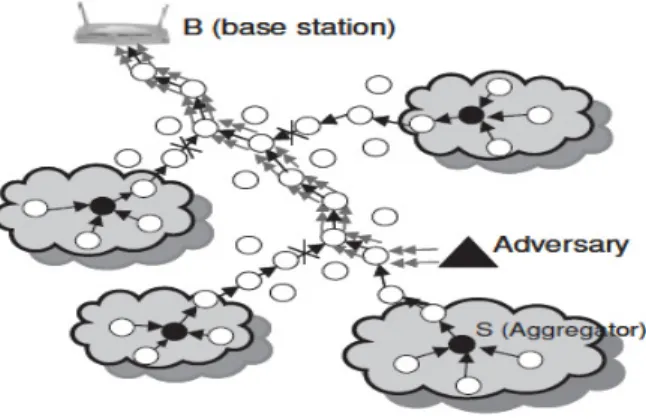
In path based DOS attack adversaries attacks on network by flooding the data packet along multi hop end to end communication path. Path based DOS attack is easy to launch and disabling large portion of wireless sensor network. Above fig 1 shows the Aggregator node, Base station and member node. Aggregator nodes process and summarize the data from member nodes, and send the aggregated result to a base station via a multi-hop, end-to end communication path. In fig 1 adversaries are launch DOS in wireless sensor network by flooding data packet along multi hop path which quickly exhaust the limited energy, communication bandwidth and memory.
Fig 01: PDOS attack in End to End Communication in WSN
2.3 Jamming
Jamming is one of the type of DOS attack. There are two types of jamming attack such as Jamming under external threat model and internal threat model. In External threat model jammer is not a part of network and jammer is continuously or randomly transmits high power interference signal. In internal threat model any sophisticated adversary who is aware of network secretes and implementation details of protocol of the network launching selective jamming attack[5]. In selective jamming attack massage with high importance are targeted.
2.4 Wormhole
In wormhole attack adversary record the packet or individual bit of packet at one location. After recording the packet tunnel it to the other location and then replays them in to the networks from that point. This tunnel distance is longer than normal wireless transmission range of single hop. It is simple for attacker to make tunneled packet arrive sooner than other packets transmitted over a normal multihop route. Wormhole places the attacker in strong position for gain unauthorized access, disrupt routing and perform a Denial of-Service (DoS) attack[4].
2.5 Vampire Attack
Vampire attack is one of the type of Denial of Service attack. In vampire attack transmission of a message causes more energy consumed by the network node. After consuming more energy, node can be discharge and it can be disconnected from the network. Vampire attacks are not protocol-specific i.e. they do not rely on any specific protocol.
Vampire attack constitutes of two different types of attacks called Stretch and Carousel attack. These two mainly focuses on reducing the energy of the nodes.
2.5.1 Carousel attack
Fig 02: Carousel attack
In Carousel attacks, an adversary sends the packets in routing loop as shown in fig 2. in above fig packet is sending from source to sink. If we send packet from source to sink then shortest path is from source - node f-node E-Sink. But here packet is not follows shortest path and adversary composes the packet in loops. Packet is repeatedly
network. in these attack it increases packet path length. An example illustrated in above fig 03. in above, packet
Fig 03: Stretch Attack
sending from source to sink. shortest path for forwarding packet is source-node F-node E-Sink.but here in Stretch attack, an adversaries forward packet in longest path as shown by dark line in above fig 3. so it increases energy usage by the network. It increases energy usage by as much as a factor of 10.5 per message over the honest scenario, with an average increases in energy consumption of 2.67±2.49.As carousel attack are depend on position of attackers. Stretch attack achieves more effectiveness and these attack are independent on attackers position relative to the destination.
The impact of these attacks can be further increased by combining both Carousel and Stretch attack and increasing the number of adversarial nodes in the network. Although network does not employ authentication or network use only end-to-end authentication. so here adversary can replace routes in any overhead packets.
3. Detection Techniques
3.1 Detection of Denial of Sleep attack
In denial of Sleep attack adversary is knowledge of MAC layer protocol and ability to bypass authentication and encryption protocols.MAC layer protocol designed for wireless sensor network and use various algorithm to save battery power by placing radio in low power mode. In this paper divide MAC protocol in four types i.e. Sensor MAC(S-MAC), Timeout MAC (T-MAC), Berkeley MAC (B-MAC), and Gateway MAC (G-MAC).We analyze all these MAC protocol in detail as follows:
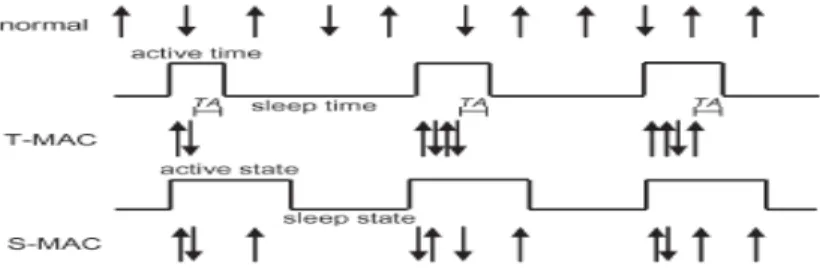
S-MAC frame is divided in to listening and Sleep period. The listening period is divided in to synchronization and transfer period. In Synchronization period all the nodes announce their sleep schedule for correcting network time out. Synchronization their sleep time to form virtual cluster with the same active listen and sleep period. It is used
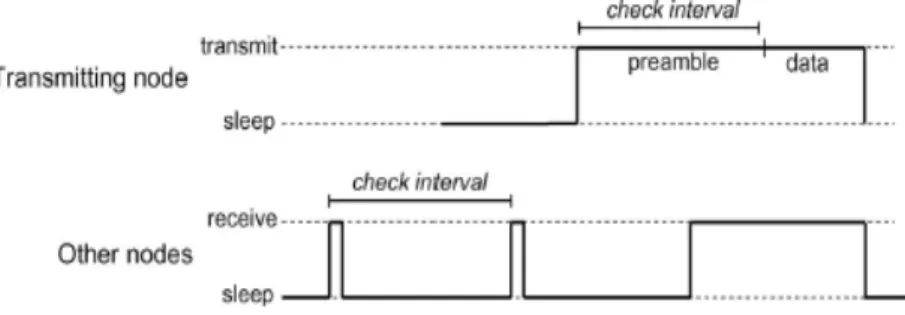
Fig 05: B-MAC low power listening
fixed duty cycle with a default 10%.If a node overhears two SYNC messages, it will adapt both duty cycles to maintain network and enhance network lifetimes. T-MAC is an improvement in the S-MAC protocol by concentrating all traffic at the beginning of the duty period, as shown in Fig 04 The arrows in the figure indicate transmitted and received messages. T-MAC uses the same SYNC mechanism to form virtual clusters as S-MAC.T-MAC uses adaptive timeout (TA) mechanism allows nodes to transition to sleep mode when there is no more traffic in the cluster. T-MAC is shown to increase in network lifetime over S-MAC.B-MAC is does not attempt to synchronize sleep schedules. B-MAC uses the low-power listening (LPL) to reduce the energy consumption. In LPL node is walk for fixed interval and check wireless sensor network for valid preamble byte that indicate the pending data transmission of another node. A node sends the pending data and preamble. If it is longer than interval between receiver samples to ensure that all near nodes have the opportunity to receive the preamble and subsequent data message.
In denial-of-sleep attack adversary broadcasting unauthenticated traffic into the network. This unauthenticated traffic reduces network lifetime of the node which uses S-MAC and T-MAC protocol. To enhance network lifetime use G-MAC protocol. In G-MAC protocol requests to broadcast traffic must be authenticated by the gateway node before the traffic can be sent to other nodes. Therefore, only the gateway suffers power loss due to unauthenticated broadcast.
3.2 Detection of Path Based DOS attack
In this path based DOS attack is launched by flooding data packet along multi hop end to end path. To defend against path based DOS attack an intermediate node must able to detect spurious packet or replayed packet and then reject them. For the detection of spurious packet use lightweight secure mechanism to defend against path based DOS attack. in this mechanism configures one way hash chain along a path enabling each intermediate node to detect a Path based DOS attack and prevent propagation of spurious or replayed packet. Every packet sent by end point includes new one way hash chain number which is used for message authentication. Different hash chain number is used for each time slot and intermediate node forward packet only if new hash chain number is verified. this process of verification by each intermediate node is continue and each time slot it verify new hash chain number. if number is not validate then the drop the packet.
3.3 Detection of Jamming attack
In jamming attack adversary attack in the network under external and internal threat model. In the external threat model jammer is not part of the network. In external model jammer is continuously or randomly transmits high power interference signals. For the prevention of jamming attack from external jammer spread-spectrum communications technique used. Spread Spectrum techniques provide bit-level protection by spreading bits according to a secret pseudo noise (PN) code known only to the communicating parties. These methods can only protect wireless transmissions under the external threat model. In the jamming under internal thread model any sophisticated adversary who is knowledge of network protocol can launch selective jamming attack. To launch
selective jamming attack adversary must be capable of implementing “classify then jam” strategy before completion
of wireless transmission. After classification, the adversary must introduce a sufficient number of bit errors so that the packet cannot be recovered at the receiver. For the prevention of jamming attack from internal thread model use packet hiding method. In packet hiding method before classification of the packet by adversary we hide the packets.
Hence adversary can’t add bit error in to the packet and it is securely transmits. For the packet hiding method use commitment methods and cryptographic puzzle. In commitment method sender commits the packet and it is verify by the verifier. In the cryptographic puzzle packet m is encrypted with a randomly selected symmetric key k of a
possible radio range, receiver will reject the communication with Sender node.
3.5Detection of Vampire attack
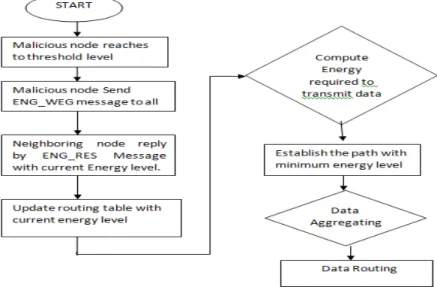
In this Vampire attack can be prevent by using energy weight monitoring algorithm(EWMA).In this algorithm energy of the node is consider for find out threshold level of the node. for find out malicious node in the network every node is add the test field while receiving the packet and forward packet to next node. then test field is check for each node. if the test field is correct then normal operation is continue and if the test field is wrong then create an alarm packet. then alarm packet is broadcast and announce that node is malicious so that it avoid for further communication. That malicious node reaches its threshold level.This algorithm is divided in two phases such as communication phase and network configuring phase.
In network configuring phase establish optimum routing path from source to destination. Attacked node consumes more energy and reaches threshold energy level. In this phase the node with threshold level energy (attacked node) sends ENG_WEG message to all its surrounding nodes. After receiving the ENG_WEG packets the surrounding nodes sends the ENG_REP message that encapsulates information regarding their geographical position and current energy level. The node upon receiving this stored in its routing table to facilitate further computations. Now the node is establishes the routing path from source to destination. The source nodes select the node which is less distance from source and require minimum energy to transmit the packet.
In communication phase avoid same data packet transmitted repeatedly through same node. These repeatedly transmission of same packet through same node depletes more battery power of the node and degrade the network performance. The process of repeating the packet is eliminated by aggregating the data transmitting within forwarding node. In data aggregation copy the content of the packet which is transmitting through the node. This copied content compare with the data packet transmitting through the node. If the transmitted packet is same as the copied packet then stop the packet transmitted through them. In this way it avoids the redundant packet transmitting through the same node and protect from the vampire attack.
4. Discussion
Type of DOS attack Detection technique Features Disadvantages Denial of Sleep MAC Protocol Prevent the node from
entering the sleep cycle
It consider attacks only at the Medium Access Control(MAC)
Path Based DOS Lightweight Secure Mechanism Adversary cannot generate valid OHC number
It tolerate the packet losses Jamming Attack Spread Spectrum and
Cryptographic puzzle
Archiving strong security and prevention of network performance degradation
Spread Spectrum fails against internal threat model
Wormhole Attack Packet Leash Allow connection between two non-neighbouring malicious node
Solution Comes at high cost and not always applicable
Vampire Attack Energy Weight Monitoring System
It avoid redundant packet transmission or loop and saves power of the nodes
Not offered fully solution for vampire attack during topology discovery phase In above table we compare Detection techniques of Denial of Service attack. For each type of Denial of Service attack detection technique is different. In Denial of sleep use the MAC protocol to prevent node from entering in to the sleep cycle. But this technique considers attacks only at MAC protocol not for other protocols. To avoid wormhole attack use packet leash technique but it is not always applicable and requires high cost. Energy weight monitoring System detects and prevent from the vampire attacks by using threshold level of the nodes. By using the threshold level of the node we also detect and prevent Denial of sleep attack, Path based DOS attack, Wormhole attacks. So the technique which uses threshold level of the node i.e. Energy Weight monitoring System is an effective technique to prevent the Denial of Service attacks.
Conclusion
DOS attack is much easier to launch in ad-hoc wireless sensor network. In this paper we defined types of Denial of service attack(DOS) such as Jamming, power consumption and SYN flood that permanently disables the ad-hoc sensor network. Our aim is to study various types of Denial of service (DOS) attack and its prevention techniques. After developing many prevention techniques wireless ad-hoc sensor network is still vulnerable to DOS attack.DOS attack cause the serious problem to users. In future we improve our techniques to prevent DOS attack which are not able to stop DOS attack fully.
References
1. Eugene Y. Vassermann and Nicholas Hopper “Vampire Attacks: Draining Life from Wireless Ad Hoc Sensor Networks” IEEE Trans.
Mobile Computing, vol. 12, no. 2, pp. 318-332 Feb-2013.
2. Raymond D. R., Marchany R. C., Brownfield M. I., Midkiff S. F., “Effects of Denial-of Sleep Attacks on Wireless Sensor Network MAC Protocols”, IEEE Transactions on Vehicular Technology, Vol. 58, Issue 1, pp. 367-380, January 2009.
3. Jing Deng, Richard Han, and Shivakant Mishra “Defending against Pathbased DoS Attacks in Wireless Sensor Networks” ACM workshop on security of ad hoc and sensor networks, 2005.
4. Yih-Chun Hu, Adrian Perrig and David B. Johnson “Packet leashes: A defense against wormhole attacks in wireless ad hoc networks”, INFOCOM, 2003.
5. Alejandro Proan˜o and Loukas Lazos, “Packet hiding methods for preventing selective jammingattack”, IEEE Transactions on
dependable and secure computing, vol. 9, no. 1, january/february 2012.
6. Anthony D. Wood and John A. Stankovic, “Denial of service in sensor networks”, Computer 35 (2002), no. 10.
7. David R. Raymond and Scott F. Midkiff, “Denial-of-service in wireless sensor networks: Attacks and defenses”, IEEE Pervasive