UC Santa Barbara
UC Santa Barbara Electronic Theses and Dissertations
TitleTensor Network Wavefunctions for Topological Phases
Permalink
https://escholarship.org/uc/item/77h4k8zj
Author
Ware, Brayden Alexander
Publication Date
2017
UNIVERSITY of CALIFORNIA Santa Barbara
Tensor Network Wavefunctions for Topological Phases
A dissertation submitted in partial satisfaction of the requirements for the degree
Doctor of Philosophy
in
Physics
by
Brayden Alexander Ware
Committee in charge:
Professor Chetan Nayak, Co-Chair Dr. Bela Bauer, Co-Chair
Professor David Weld
The dissertation of Brayden Alexander Ware is approved.
David Weld
Bela Bauer, Committee Co-Chair
Chetan Nayak, Committee Co-Chair
Copyright c 2017 by Brayden Alexander Ware
Acknowledgements
This dissertation could only be completed with the support and assistance of many peo-ple. I give my greatest thanks to:
My advisor, Bela Bauer, for his encouragement and guidance. Throughout my grad-uate school career, Bela was there to gently nudge me in the right direction no matter how many times I stubbornly struck off in a different direction.
Chetan Nayak, Roman Lutchyn, Parsa Bonderson, Zhenghan Wang, and Mike Freed-man, for creating the lively and friendly physics enviroment within Station Q. In the Station Q seminar room, new ideas were broken down and discussed until everybody understood them in their own way, practice talks were patiently analyzed and improved point by point from start to finish, and pies were demolished. Additionally, the Station Q postdocs Meng Cheng, Mike Zaletel, Mike Mulligan, and Maissam Barkeshli for many inspiring physics discussions.
My collaborators on the work contained in this thesis: Sid Parameswaran and Itamar Kimchi for inspiring the first project in this thesis and launching me into the field of en-tanglement and topological phases, and Jun Ho Son, Jason Alicea, and Ryan Mishmash for combining their ongoing project with ours to make something greater than the sum of the two parts.
My fellow graduate students, for many long and fruitful physics discussions, especially Jen Cano, Eugeniu Plamadeala, Dominic Else, Alex Rasmussen, Kaushal Patel, Kevin Slagle, Christina Knapp, and Zhen Bi.
Teddy Parker, Keith Fratus, and Kevin Kuns for wide ranging discussions on physics, life, and esoteric facts that challenged me to put my ideas into sound explanations and to rethink what I thought I knew.
Hunter Banks, Thomas Malkowski, Bill Wolf, Sara Sterphone, Eric Rind, Charles de las Casas, Ruwan Senaratne, Zach Geiger, Alex Miller, Sebastian Fischetti, Kurt Fuji-wara, Shankari Rajagopal, and many more, for making Santa Barbara feel like home.
My mom and dad, my brother Taylor, and my sister Caroline for their constant sup-port and encouragement.
Curriculum Vitæ
Brayden Alexander Ware
Education
Ph.D. in Physics, University of California, Santa Barbara, expected June 2017.
M.S. in Physics, University of California, Santa Barbara, 2014.
S.B. in Mathematics and Physics, Massachusetts Institute of Tech-nology, 2011.
Publications
Topological crystalline Bose insulator in two dimensions via entanglement spectrum
B. Ware, I. Kimchi, S. Parameswaran, B. Bauer Phys. Rev. B 92, 195105 (2015)
Ising Anyons in Frustration-Free Majorana-Dimer Models B. Ware, J.H. Son, M. Cheng, R.V. Mishmash, J. Alicea, B. Bauer Phys. Rev. B 94, 115127 (2016)
Featureless quantum insulator on the honeycomb lattice
P. Kim, H. Lee, S. Jiang,B. Ware, C-M. Jian, M. Zaletel, J. Han, Y. Ran
Phys. Rev. B 94, 064432 (2016)
Talks and Posters
Commuting Projector Models for Fermionic Symmetry Protected and Topological Phases
Talk at Symmetry, Topology, and Quantum Phases Program, KITP, Santa Barbara CA, December 2016
Majorana-dimer models and fermionic topological phases
Talk at Synthetic Quantum Matter Program, KITP, Santa Barbara CA, September 2016
Symmetry-enriched topological invariants from tensor network represen-tations
Talk at APS March Meeting, Baltimore MD, March 2016. Non-trivial edge physics in a featureless Mott insulator Talk at APS March Meeting, San Antonio TX, March 2015. Featureless Bosonic Insulators
Poster at TOPO2015, Carg`ese, France, September 2015.
Professional Development
California Summer Workshop on Advanced Research in Mate-rials
University of California Irvine, June 2016.
Topological Phases in Condensed Matter and Cold Atoms Sys-tems(TOPO2015)
Institut d’Etudes Scientifiques de Carg`ese, September 2015
Station Q Semiannual Meeting
Station Q, Santa Barbara CA, June 2016, December 2015 and June 2015
Workshop on Tensor Networks and Simulations
Simons Institute, Berkeley CA, April 2014
Pfaffians!: Dimer Models and Majorana Fermions
Talk for UCSB Many Body Journal Club, Februrary 2016 Parton mean-field constructions of spin liquids
Talk for Seminar on Spin Liquids, October 2015 Haah’s Code: Fractal-like excitations from ring theory Talk for Seminar on Topological Phases, April 2015 Loop model construction forSU(2)k anyon theories
Talk for Seminar on Topological Phases, October 2014 Time-Reversal and Fermion Parity symmetric states in 1D Talk for Seminar on Topological Phases, September 2014
Introduction toZ2 Gauge Theory
Talk for UCSB Many Body Journal Club, May 2013
A Quantum Algorithm to Compute the Jones Polynomial at q =e2kπi Course Paper for Quantum Information & Quantum Computation, Win-ter 2013
Teaching Experience
Teaching Assistant for graduate courses:
Statistical Mechanics, Concepts of Condensed Matter Physics
Teaching Assistantfor special topics course: Group Theory for Physi-cists
Teaching Assistant for undergraduate courses:
Quantum Mechanics I and II, Electromagnetism, Advanced Electromag-netism, Thermodynamics and Waves, Basic Astronomy, Introductory Physics Labs
Abstract
Tensor Network Wavefunctions for Topological Phases
by
Brayden Alexander Ware
The combination of quantum effects and interactions in quantum many-body systems can result in exotic phases with fundamentally entangled ground state wavefunctions – topological phases. Topological phases come in two types, both of which will be studied in this thesis. In topologically orderedphases, the pattern of entanglement in the ground state wavefunction encodes the statistics of exotic emergent excitations, a universal in-dicator of a phase that is robust to all types of perturbations. In symmetry protected topological phases, the entanglement instead encodes a universal response of the system to symmetry defects, an indicator that is robust only to perturbations respecting the protecting symmetry.
Finding and creating these phases in physical systems is a motivating challenge that tests all aspects - analytical, numerical, and experimental - of our understanding of the quantum many-body problem. Nearly three decades ago, the creation of simple ansatz wavefunctions - such as the Laughlin fractional quantum hall state, the AKLT state, and the resonating valence bond state - spurred analytical understanding of both the role of entanglement in topological physics and physical mechanisms by which it can
arise. However, quantitative understanding of the relevant phase diagrams is still chal-lenging. For this purpose, tensor networks provide a toolbox for systematically improving wavefunction ansatz while still capturing the relevant entanglement properties.
In this thesis, we use the tools of entanglement and tensor networks to analyze ansatz states for several proposed new phases. In the first part, we study a featureless phase of bosons on the honeycomb lattice and argue that this phase can be topologically protected under any one of several distinct subsets of the crystalline lattice symmetries. We discuss methods of detecting such phases with entanglement and without.
In the second part, we consider the problem of constructing fixed-point wavefunctions for intrinsically fermionic topological phases, i.e. topological phases contructed out of fermions with a nontrivial response to fermion parity defects. A zero correlation length wavefunction and a commuting projector Hamiltonian that realizes this wavefunction as its ground state are constructed. Using an appropriate generalization of the minimally entangled states method for extraction of topological order from the ground states on a torus to the intrinsically fermionic case, we fully characterize the corresponding topolog-ical order as Ising×(px−ipy). We argue that this phase can be captured using fermionic
Contents
0 Introduction 1
0.1 Topologically Ordered Phases . . . 3
0.2 Symmetry Protected Topological Phases . . . 8
0.3 Detecting Topological Phases with Entanglement . . . 11
1 Tensor Networks for Crystalline SPTs 13 1.1 Construction of the featureless boson insulator . . . 17
1.1.1 PEPS representation . . . 19
1.1.2 Representation on infinite cylinders . . . 23
1.2 Correlation functions . . . 24
1.3 Entanglement spectrum . . . 28
1.3.1 Conformal field theory description of the edge . . . 32
1.4 Symmetry protection . . . 36
1.4.1 Overview . . . 36
1.4.2 Symmetry protection of the HFBI . . . 37
1.4.3 Results of symmetry calculation . . . 42
1.4.4 Tight-Binding Restriction . . . 49
1.5 Quasi-local parent Hamiltonian and perturbations . . . 50
1.5.1 Parent Hamiltonians for the W = 1 cylinder and equivalence to the Haldane insulator . . . 52
1.5.2 Perturbing the state on theW = 3 cylinder . . . 53
1.6 Boson-Vortex Duality . . . 55
1.7 Concluding Remarks and Discussion . . . 57
1.8 From the AKLT to the W = 1 HFBI . . . 60
1.9 Variants on the HFBI wavefunction . . . 65
1.9.1 Tuning soft-core bosons to hard-core . . . 65
1.9.2 Interpretation as a Fermionic Wavefunction . . . 66
1.9.3 Inversion Protected Phase . . . 67
2 Fermionic Topological Phases with Majorana Dimers 75 2.1 Introduction . . . 75
2.3.1 Majorana-Dimer Configurations . . . 83
2.3.2 Fermion Parity . . . 87
2.3.3 Phase Consistency and Ground-State Degeneracy . . . 89
2.3.4 Majorana Loop Model on a Honeycomb Lattice . . . 92
2.3.5 Majorana-Dimer Model on a Triangular Lattice . . . 98
2.4 Identifying Topological Order . . . 102
2.4.1 Ising topological quantum field theory review . . . 102
2.4.2 Ground-State Degeneracy on Closed Surfaces . . . 105
2.4.3 Fully Gapped Boundary to Vacuum . . . 106
2.4.4 Modular Matrices . . . 108
2.5 Generalizations to multiple Majoranas per site: 8-fold way . . . 116
2.6 Conclusion . . . 120
2.7 Fermion Parity Details: Clockwise-Odd Rule and State Counting . . . 124
2.8 Majorana-Dimer Model with Open Boundary Conditions . . . 125
2.9 Fermionic Plaquette Operators on the Fisher Lattice . . . 129
2.9.1 Matrix Elements of the Fermionic Plaquette Operator . . . 129
2.9.2 Commutation Relations of Plaquette Operators . . . 131
Chapter 0
Introduction
The classical understanding of many-body physics involves local order parameters and their thermal and quantum fluctuactions. After the discovery of the fractional Quantum Hall effect in 1982, it was realized that there exist a variety of phases of matter with fluc-tuations remaining at zero temperature and with no local order parameters. These so called topological phases were outside the purview of the existing Landau theory, and they brought a number of surprising new features to the study of many body physics, such as emergent collective excitations with fractional charge and statistics and backscattering-free edge states. These exotic phenomena attracted a great amount of research interest, in part driven by the hope of applications to new generations of electronics and super-conductors. More importantly, this new field has transformed our understanding of the quantum many-body problem by shifting the focus from correlations to quantum entan-glement. The fractionalized excitations and edge states are ultimately consequences of
patterns of entanglement in the ground state that exist independently from local corre-lations, and moreover that cannot be modfied by local perturbations. For this reason, topological phases could also be useful for applications in quantum computing.
The most striking aspect of topological phenomena was that macroscopic and unpris-tine electronic systems adhered to rather simple predictions with unprecedented preci-sion, such as in the fractional Quantum Hall effect, where the Hall conductance becomes pinned to quantized values
σH = p q ×
e2
h
with precision better than several parts in 108 [3] – a measurement so precise that it is
used to define the value of eh2. [78] The explanation for this extraordinary robustness is in the existence of an energy gap above the ground state – which implies that the ground state wavefunction changes continuously for small perturbations in the Hamiltonian – and in topological protection, i.e the existence of distinct classes of wavefunctions that cannot be connected continuously. The key to unlocking analytical and computational understanding of topological phases is the ability to produce wavefunctions in the ap-propriate topological class. In the study of the fractional Quantum Hall effect alone, the ability to write down such a wavefunction (the Laughlin wavefunction [93]) spurred the development of the low-energy field theory descriptions of this phase [19, 53] and elucidated the essential flux attachment mechanism behind the phenomena. The com-putational study of microscopic Hamiltonians for the fractional quantum Hall effect was also bolstered; a Hamiltonian whose ground state is exactly the Laughlin state and thus
known to realize the appropriate phase was found [66], followed by numerical evidence to show that it could be continously connected to more realistic Hamiltonians[65].
This thesis is concerned with how to identify these distinct topological classes of wavefunctions with their corresponding gapped phases of quantum matter using the tools of entanglement and symmetry. Additionally, we’d like to have good classes of variational wavefunctions for the purpose of efficient numerical simulations. Both of these problems have been largely solved in one dimension, so the scenarios we investigate will be in two dimensions.
0.1
Topologically Ordered Phases
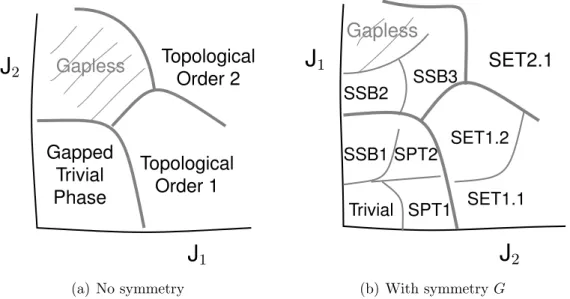
Unentangled quantum phases distinguished by patterns of spontaneous symmetry break-ing generically lose their sharp distinctions when perturbations breakbreak-ing the symmetry are allowed. This motivates the consideration of a coarser notion of phase involving no symmetry, or in other words, phases that are completely stable to all types of perturba-tions. This notion can be formalized via the notion of gapped quasi-adiabatic evolution or via low depth quantum circuits[72, 29]. Under this definition, there is precisely one phase with an unentangled ground state (since any two different unentangled ground states can be continuously connected). The other phases are the topologically ordered phases, which by definition have global patterns of entanglement that cannot be gen-erated locally. This situation is illustrated in Fig. 1(a). While we generally can break all symmetries by considering arbitrary perturbations, one exception must be made for
J
1J
2 Gapped Trivial Phase Topological Order 1 Topological Order 2 Gapless (a) No symmetryJ
2J
1 Trivial SPT1 SPT2 SET1.1 SET1.2 SSB1 SSB2 SSB3SET2.1
Gapless
(b) With symmetryGFigure 1: Generic phase structure in phase diagrams with and without symmetry. With-out symmmetry, gapped phases are distinguished only by topological order or, for the single short ranged entangled phase, lack of topological order. With symmetry, short range entangled phases can be distinguished both by symmetry breaking patterns and by symmetry protected topological (SPT) order. Distinctions between phases with the same topological order also appear; these are denoted SET, for symmetry enriched topo-logical order.
fermion parity, since local Hamiltonians can’t break fermion parity. In what follows, we consider phases made of bosonic degrees of freedom only unless specifically specified: phases made of fermions will be discussed separately in Chapter 2.
With symmetry considerations removed, the key property distinguishing various topo-logical orders in two dimensions is the emergence of anyons, point-like excitations with statistics differing from the usual bosons and fermions. These excitations also exhibit mutual braiding statistics, universal Berry phases that occur for adiabatic processes that wind the excitations around each other. An extensive physical and mathematical frame-work has been developed for the understanding the self- and mutual- braiding statistics
of anyon systems [85, 20]. For the purpose of numerical simulations, it is often more con-venient to work with the ground states than with the excitations and to consider periodic boundary conditions. Topological order with emergent anyons guarantees the existence of degenerate ground states. The argument goes as follows: for each anyona, there is an operatorWa
x that creates a pair of anyons a and ¯a, drags them around thexcycle of the
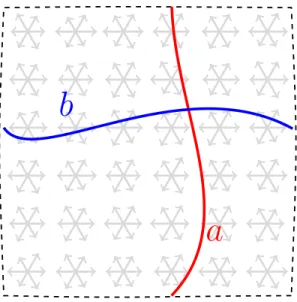
torus, and reannihilates the pair on the other side. Since no excitations are left at the end, this operator commutes with the Hamiltonian and maps ground states to ground states. Similarly, the same operators exist for the other cycle y of the torus. These operators don’t commute when a and b are excitations with mutual braiding statistics
θab:
Wa
xWyb =eiθabWybWxa,
as illustrated in Fig. 0.1. For the ground states to carry an action of this non-commutative algebra, there must be multiple ground states. The minimal allowed number is given by exactly the number of distinct anyon types, where anyons a and ˜a are considered to be the same type if their braiding with other anyons is the same:
θab=θ˜ab for all anyons b =⇒ a ≡˜a.
The degeneracy in these ground states cannot be split by local operators in the ther-modynamic limit. Intuitively, the braiding phases could be measured using anyons far separated in terms of correlation length from each other and from any given local
dis-a
b
Figure 2: An illustration of Wa
x Wyb acting on a ground state. The operations don’t
commute, as switching the order is differs by a braid of a and b.
turbance. Given one ground state |1i, a basis for the full set of ground states is given by
{Wxa|1ifor each anyon type a}.
In finite size systems, perturbations generically cause small energy splittings between the ground states via processes that tunnel between ground states as illustrated in Fig. 3. Due to the one-dimensional support of the operator that tunnels between ground states, the finite size splitting scales as
∆E ∼e−L/ξ,
in contrast with the
∆E ∼e−(L/ξ)2
(a) in symmetry breaking phases a b
a
¯
a
(b) in topological phasesFigure 3: The degenerate ground states under periodic boundary conditions are useful for distinguishing phases. In spontaneous symmetry breaking phases, in order for a ground state with one value of the local order parameter to tunnel to a different ground state, a domain must form and spread over the whole system, as shown in (a). In topologically ordered phases, an anyon tunneling around a cycle will take you to a different ground state, as shown in (b).
While this argument shows that emergent anyons lead to protected degeneracy, it is believed that the argument reverses: 2D systems with robust degenerate ground states in periodic boundary conditions have as many anyon types as degenerate ground states. Furthermore, it is believed that topological order is completely characterized by anyonic statistics along with a measure of edge modes called the chiral central charge [152]. (This additional allowance is for the one known 2D topological order without anyons, known as the E8 bosonic Quantum Hall state and copies of it [102].)
While formally topological order is about quantum phases in the absence of symmetry, the question of how to find topological order in physical systems – in strongly correlated electron systems, frustrated quantum magnets, cold atomic gases, or elsewhere - is often
intertwined with symmetry considerations, as the anyon excitations will ultimately be made up of microscopic constituents that have conserved spin, charge, or particle num-ber and that exist in a background potential with approximate crystalline symmetries. Notably, since anyon excitations can only be created in pairs (more precisely, can only be created in sets that fuse to the vacuum) the individual excitations do not have to come in linear representations of the symmetry. This allows for symmetry fractionalization; for example, quasiparticles in the fractional Quantum Hall effect carry electrical charge that is a fraction of the charge of an electron. When these symmetries are restored to generic phase diagrams, the broad groupings of topological phases split into distinct phases, each with a unique pattern of symmetry fractionalization. These patterns are referred to as symmetry enriched topological orders, or SETs. This situation is illustrated in Fig. 1(b).
0.2
Symmetry Protected Topological Phases
There can also be symmetry enforced distinctions between phases that are topologically trivial and contain no symmetry breaking. The experimental discovery [91] of topo-logical band insulators that cannot be adiabatically continued to the atomic limit as long as time-reversal invariance is preserved [126, 69] has spurred the exploration of a broad array of phases where symmetries protect subtle, non-local features that dis-tinguish them from trivial, unentangled insulators. These phases, collectively known as symmetry-protected topological (SPT) phases [27], have by now been observed in several experimental realizations in one, two and three dimensions and an extensive
g
=
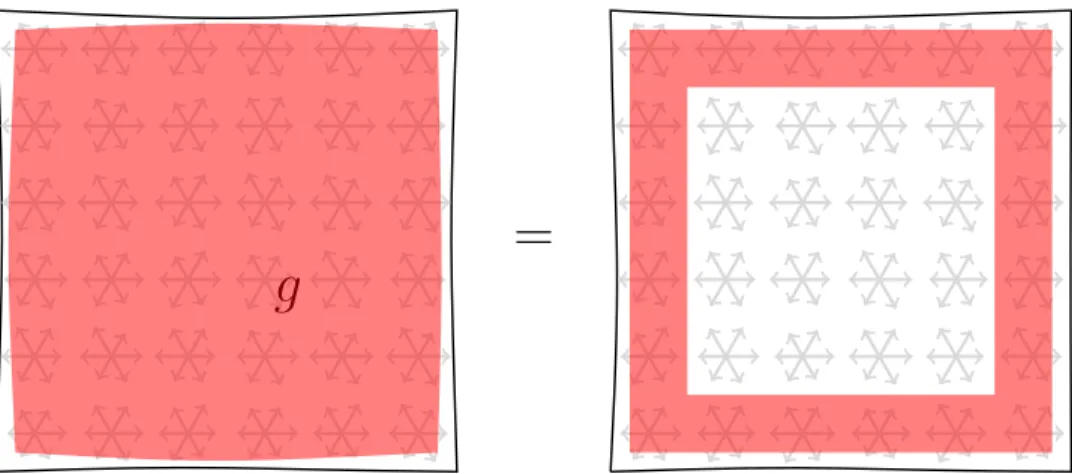
Figure 4: For a symmetric phase, applying the action of the symmetry in the bulk leaves the wavefunction invariant. In open boundary conditions, a nontrivial SPT phase has low energy states with that carry anomalous symmetry action.
mathematical framework has been developed for their characterization and classifica-tion [133, 30, 137, 132, 28, 151, 150].
Unlike topologically ordered phases, these phases are often only subtly distinguished from a trivial insulator in the bulk. Instead, the topological properties can be observed by focusing on the boundary of a finite system. In many cases, the boundary exhibits gap-less features such as the localized Majorana zero modes at the ends of one-dimensional topological superconductors [84], the helical edge states of the quantum spin Hall ef-fect [67, 81, 18] and the protected Dirac cones on the surface of three-dimensional Z2
topological insulators [56]. The unifying theme of these disparate edge phenomena is anomalous symmetry action, a generalization of symmetry fractionalization to extended objects [41].
In one dimensional phases, this can be illustrated simply with the AKLT chain, an exactly solvable model of spin-1s [1]. The exact ground state wavefunctions in this
Figure 5: AKLT chain and charicature of 1D SPTs. An SO(3) symmetric and local perturbation cannot couple the remaining spin-1/2s, the gapless edge states remain.
model can be formed by using a splitting of the spin-one on each site into a pair of spin-1/2s, then by pairing the spin-1/2s into singlets between sites of the chain. When the chain is cut open, dangling spin-1/2 edge states appear at the boundaries. This pair of spin-1/2s represent a Hilbert space of size 4 and are the only remaining degrees of freedom accessible below the energy gap – in the bulk, all the spins are paired. Due to the integer spin representation of the spin at each site, these states as a collection are SO(3) symmetric. However, in the low-energy Hilbert space represented by the boundary modes, the symmetry action can only be recognized linearly by combining both boundaries together. When the edges are far apart and the system has an energy gap, local perturbations cannot effect both edge spins simultaneously. Thus, either the edge perturbation breaks the symmetry or the spin-1/2 doublet at each edge remains degenerate up to splittings exponentially small in the system size.
Considering not only local symmetries but also symmetries that relate the physical locations of degrees of freedom, such as the spatial symmetries of rotation or reflection, can lead to an even richer panoply of phases [54, 140, 39, 17, 120, 139]. This has been well explored for the case of band insulators whose non-trivial structure is protected by crystal symmetries [75, 142], which are referred to as non-interacting topological crystalline insulators. However in these cases, the boundary modes often do not appear,
for a simple reason: any possible physical boundary of the system may break the relevant symmetry. In order to distinguish these phases, we will turn to entanglement in the ground state wavefunction.
0.3
Detecting Topological Phases with Entanglement
It has been shown that the features of topological order and symmetry protected topologi-cal order manifest in the entanglement properties of the ground state wavefunctions. This was first noted in studies of the entanglement spectrum of fractional Quantum Hall trial wavefunctions, which generally take the form of gapless spectra that mirror the gapless modes on a boundary. [97] In one dimensional SPT phases, the entanglement spectrum features protected degeneracies that signify entanglement that cannot be removed while preserving the symmetry, and can thus be used to establish that the phases are funda-mentally distinct from trivial, non-entangled insulators. While the entanglement spectra can signal non-triviality, additional work has shown that entanglement properties beyond the spectra can be used to extract the precise symmetry fractionalization in one dimen-sional SPT phases [121] and the precise braiding statistics of two dimendimen-sional topological phases [80].
Additionally it was shown in the case of one dimensional SPT phases [121] protected by spatial inversion that the non-trivial features can still be extracted from the entangle-ment spectrum, even though the boundary degeneracy is not guaranteed. This suggests that entanglement can be used for the complete (numerical) identification of topological
phases generally, even when a necessary ingredient for the topological protection is a non-local symmetry operation.
In this thesis, we will explore some problems related to this identification for wave-functions in two dimensions. For this purpose, we developed numerical tools using the framework of tensor network states, a memory efficient way of representing quantum ground states. In Chapter 1, we study a featureless phase of bosons on the honeycomb lattice and argue that this phase can be topologically protected under any one of several distinct subsets of the crystalline lattice symmetries. We discuss methods of detecting such phases with entanglement and without.
In Chapter 2, we consider the problem of constructing wavefunctions for intrinsically fermionic topological phases, i.e. topological phases contructed out of fermions with a nontrivial response to fermion parity defects. A zero correlation length wavefunction and a commuting projector Hamiltonian that realizes this wavefunction as its ground state are constructed. Using an appropriate generalization of the minimally entangled states method for extraction of topological order from the ground states on a torus to the intrinsically fermionic case, we fully characterize the corresponding topological order as Ising×(px−ipy).
Chapter 1
Tensor Networks for Crystalline
SPTs
In this Chapter, we compute the entanglement properties of an insulating state of inter-acting bosons on the honeycomb lattice, and show that it constitutes a topological phase protected by lattice symmetries. In particular, we show that the non-trivial entanglement is not related just to the group formed by the lattice symmetries, but becomes tied to the specific realization as a honeycomb lattice. Combined with the symmetry, this enforces a non-trivial short-range entanglement structure.
The wavefunction we consider is an insulator of interacting bosons on the honeycomb lattice at a filling of one boson per unit cell, or half filling per site. It forms one example of a class of insulators that require a non-Bravais lattice, i.e. a lattice with multiple sites per unit cell. The necessity for such a non-trivial unit cell arises due to higher-dimensional
generalizations [115, 114, 70, 71] of the Lieb-Schultz-Matthis (LSM) theorem [99],which forbids the existence of a featureless state — a state that neither spontaneously breaks a symmetry, nor displays intrinsic topological order, nor has power-law correlations and is thus “gapless” — in systems with a fractional filling per unit cell. While such a featureless state at half-filling per site is allowed on the honeycomb lattice, the explicit construction is challenging. Symmetry guarantees that a free-fermion spectrum is gapless at certain high-symmetry points, and there is thus no basis of localized, symmetric and orthogonal Wannier states. This implies that a featureless state on the honeycomb lattice cannot be constructed by filling a permanent of localized Wannier orbitals [117], and any construction of a quantum state thus must involve interactions. Ref. [83] pursued an approach of constructing a permanent wavefunction by filling local and symmetric orbitals that are not orthogonal and it was argued that that the resulting wavefunction is indeed featureless. In particular, using numerical simulations it was found that the state exhibits isotropic and exponentially decaying correlations, and arguments were presented that it is not topologically ordered.
Here while we confirm the featureless bulk of the state, including the absence of intrin-sic topological order, we show that nevertheless the entanglement of the state cannot be removed while preserving certain symmetries — it is symmetry-protected. The relevant symmetry is a combination of charge conservation and lattice symmetries, which together protect universal features in the entanglement spectrum. In particular, we show that the low-lying entanglement spectrum is to great accuracy described by that of a conformal
field theory with central charge c = 1, and that there is an exact double degeneracy throughout the entanglement spectrum for certain geometries, which is protected by the symmetries of the state and thus serves as a topological invariant identifying the SPT order. Since lattice symmetry is involved crucially, this provides one of the first examples for an SPT of interacting bosons protected by lattice rather than on-site symmetries. To further substantiate the robustness of these features, we obtain parent Hamiltoni-ans for the phase in certain quasi-one-dimensional geometries and study the effect of weak symmetry-preserving and -breaking perturbations on the ground states of these Hamiltonians.
All of these features become accessible through a description of the state as a projected entangled-pair state (PEPS) [73, 111, 57, 143]. These states form a specific class of tensor network states that corresponds to a generalization of the well-known matrix-product state (MPS) [153, 43, 116, 136] framework to higher dimensions. PEPS have been shown to be a powerful description of many classes of gapped systems, including topologically ordered and SPT phases. Here, we have an exact description of the state as a PEPS, allowing us to extract properties such as the entanglement spectrum and the topological invariants exactly on certain geometries; we emphasize that these properties of the state are not accessible to other numerical methods.
The topological invariants extracted here form examples of a broad class of invari-ants that provably must be constant throughout the phase. These differ from the order parameters that measure local symmetry breaking in that they are not related to the
expectation values of local operators. Early examples of topological invariants for SPT phases are the string order parameter for the one-dimensional AKLT phase [1, 2, 37, 120], and the spin Chern number for the quantum spin Hall effect [138]. The invariants we con-sider here measure how the action of the symmetry is implemented on the physical edge states of open systems or on the Schmidt states of an entanglement decomposition [122]. These invariants feature heavily in the classification of SPT phases with on-site symmetry, and similar invariants that apply to free-fermion states have been used for topological crystalline insulators [55, 75]. In contrast, topological invariants for interacting states protected by lattice symmetries in more than one dimension are poorly understood. We will discuss the action of the symmetry on the edge of the state and progress towards the goal of finding a topological invariant to identify the corresponding phase.
The rest of this chapter is structured as follows: in Section 1.1, we review the honey-comb featureless boson insulator (HFBI) state, and introduce its PEPS representation. In Section 1.2, we discuss results for the correlation functions of this state. In Section 1.3, we discuss the entanglement spectra that we obtain numerically from the PEPS repre-sentation and discuss in detail their connection to the spectrum of a free boson conformal field theory. In Section 1.4, we describe the symmetry-protected topological invariants that allow us to identify the symmetries that protect certain entanglement properties of the state in quasi-one-dimensional geometries. Section 1.5 discusses the effect of weak perturbations to a parent Hamiltonian in the same quasi-one-dimensional setup, and Section 1.6 introduces a different perspective on the phase from the point of view of a
boson-vortex duality.
1.1
Construction of the featureless boson insulator
In the honeycomb lattice, each unit cell is associated with exactly one hexagon plaquette, which respects the lattice point group symmetries. As shown in Ref. [83], this provides an explicit construction of a bosonic insulator on the honeycomb lattice that is completely featureless in the bulk, henceforth referred to as honeycomb featureless boson insulator (HFBI). The state is succinctly described by the following expression:
|ψi=Y 7 X i∈7 b†i ! |0i. (1.1)
Here, 7 denotes the elementary hexagons of the honeycomb lattice. Despite the de-ceivingly compact expression, this many-body bosonic state is strongly correlated and requires concrete computation for its properties to be unveiled.
We focus on two closely related variants of this state: a version of soft-core bosons where b†i creates a boson on site i and obeys the usual bosonic commutation relations, and a hard-core version of the same state where b†i also creates a boson but (b†i)2 = 0.
In either case, the operator P
i∈7b†i creates exactly one boson per hexagon; as there is
one hexagon per unit cell of two sites of the lattice, the state has one boson per unit cell, or half a boson per site, thus allowing the existence of a featureless state. In the case of soft-core bosons, the maximum number of bosons per site is three.
In the soft-core case, ground-state correlations were mapped to those of a classical loop model on the triangular lattice. A Monte Carlo analysis thereof revealed that the boson Green’s function hb†ibji decays exponentially – thereby ruling out the possibility that the many-body wavefunction describes a superfluid – and further, that the correlation functions of a variety of neutral operators (e.g., those describing charge- or bond-density order) remained short-ranged. This loop model mapping also included a variational parameter,m, that tunes the the soft-core boson wavefunction on the honeycomb lattice into that of a trivial Mott insulator on a triangular lattice of fictitious sites placed at the center of each hexagon. The absence of a transition under this perturbation was taken as evidence that the ground state would remain unique on manifolds of nontrivial topology, thereby ruling out the possibility that the wavefunction describes a topologically ordered phase. For the case of hard-core bosons, a different quantum-classical mapping enabled the efficient calculation of boson number correlations. This directly revealed that the hard-core projection did not induce any long-range correlations in the neutral sector. Although working in the number basis precludes direct access to ‘charged’ correlators such as the boson Green’s function, on general grounds, the algebraic decay characteristic of classical 2D superfluids 1 is expected to also infect density-density correlations, and thus their exponential decay provides indirect evidence that the hard-core boson wavefunction also lacks superfluid order. We note that none of these quantum-classical mappings can readily provide insights into the entanglement properties of the wavefunction.
1Note that the quantum-classical mappings described map quantum correlations to classical onesin
A
A
A
B
B
B
A
A
A
B
B
B
A
A
A
B
B
B
A
A
A
B
B
B
A
A
A
B
B
B
A
A
A
B
B
B
A
A
A
B
B
B
A
A
A
B
B
B
A
A
A
B
B
B
A
A
A
B
B
B
A
A
A
B
B
B
A
A
A
B
B
B
Figure 1.1: Honeycomb lattice PEPS and zig-zag entanglement cut. In this PEPS of rank-4 tensors, the top and bottom edges are identified, forming a cylinder with circumference
W = 3 unit cells. A one-dimensional MPS representation is constructed by contracting the tensors in each cylinder slice (region marked by dotted lines). The entanglement cut used (either one of the dotted lines) passes through the hexagon mid-points, preventing the tight-binding lattice from gaining additional sites as long as crystalline symmetries are preserved.
1.1.1
PEPS representation
In order to go beyond the properties accessible via these quantum-classical mappings of the HFBI, and in particular in order to be able to study its edge properties, we now derive a representation as a projected entangled pair state (PEPS). Importantly, this PEPS description will respect all of the relevant symmetries of Eq. (1.1).
To obtain a PEPS construction, we first choose a local basis |ni of boson occupation numbers, i.e. b†b|ni = n|ni. The PEPS will thus describe the coefficients of |ψi in this basis, hn1. . . nL|ψi. The PEPS representation is most easily obtained in a two-step
W
W
W
W
W
W
W
W
W
W
W
W
W
D
D
D
D
D
D
W
D
D
D
D
D
D
W
D
D
D
D
D
D
W
D
D
D
D
D
D
W
D
D
D
D
D
D
W
D
D
D
D
D
D
W
D
D
D
D
D
D
W
D
D
D
D
D
D
W
D
D
D
D
D
D
W
D
D
D
D
D
D
W
D
D
D
D
D
D
W
D
D
D
D
D
D
W
D
D
D
D
D
D
W
D
D
D
D
D
D
W
D
D
D
D
D
D
W
D
D
D
D
D
D
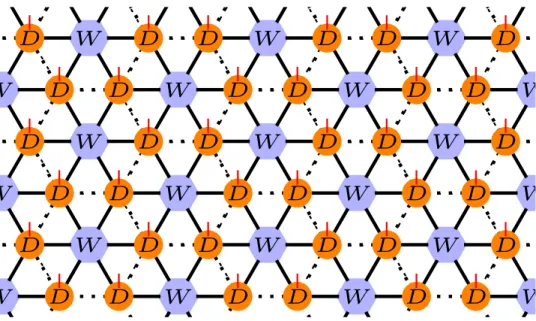
Figure 1.2: Intermediate tensor network for HFBI state. Here, the tensors labeled D
are located on the sites of the honeycomb lattice, while the tensors labeledW are located on the centers of each hexagon. Dotted lines thus represent the physical lattice, while the solid lines indicate auxiliary bonds over which the tensor network is contracted.
labeled W =Wn1...n6, which is placed in the center of each hexagon, is a rank-6 tensor
given by Wn1...n6 = ( 1 : P i ni = 1 0 : else , (1.2) where each ni ∈ {0,1}.
This tensor describes the coefficients of a so-calledW-state in the occupation number basis, i.e. Wn1...n6 =hn
1. . . n6|P6i=1b†i|0i. We note that this tensor is symmetric under
permutations of its indices.
On the sites of the physical lattice, we have placed a rank-4 tensor denoted as D, shown in panel (a) of Fig. 1.3(a), which connects the W tensors from three adjacent hexagons, and as fourth index has a physical index p. For a state of soft-core bosons,
where p= 0,1,2,3, this tensor is given by Dsc p,i0i1i2 = √ p! : p=i0+i1 +i2 0 : else . (1.3)
We can also encode a state of hard-core bosons by replacing D by
Dp,ihc0i1i2 =
1 : p=i0+i1+i2 ≤1
0 : else . (1.4)
Other values for the D and W tensors that respect the charge and lattice symmetries can also give rise to featureless insulators. Some of these variants are described in Ap-pendix 1.9.
This tensor network wavefunction manifestly respects all the translational and point group symmetries of the honeycomb lattice, since the tensors W and D are invariant under rotations of their virtual indices in the plane. One can also check that the wave-function isU(1) invariant with charge 1 per plaquette.
In order to convert the tensor network of Fig. 1.2 into a PEPS representation, we first factor the W-tensor into a matrix-product state of six tensors as shown in Fig. 1.3(b). We choose a form of the MPS that breaks the rotational symmetry of the W-state (which appears as translational symmetry of the MPS). This allows us to obtain an MPS de-scription with a small bond dimension ofM = 2; a fully symmetric choice would require bond dimension 6. Since these states are physically equivalent, all physical quantities are unaffected by this choice. One possible decomposition is given by
Wi1i2i3i4i5i6 = X α1...α5 Vi1 α1W i2 α1α2. . . W i5 α4α5X i6 α5 (1.5)
D
i
j
k
p
(a) D tensor W=
(b) W-tensor and factored form
D D D D D D D D D D D D D D D D D D D D D D D D D D D D D D D D D D D D D D D D D D D D D D D D D D D D D D D D D D D D D D D D D D D D D D D D D D D D D D D D D D D D D D D D D D D D D D D D D D D D D D D D D D D D D D D D D D D D D D D D D D D D D D D D D D D D D D D D D D D D D D D D D D D D D D D D D D D D D D D D D D D D D D D D D D D D D D D D D D D D D D D D D D D D D D D D D D D D D D D D D D D D D D D D D D D D D D D D D D D D D D D D D D D D D D D D D D D D D D D D (c) A tensor D D D D D D D D D D D D D D D D D D D D D D D D D D D D D D D D D D D D D D D D D D D D D D D D D D D D D D D D D D D D D D D D D D D D D D D D D D D D D D D D D D D D D D D D D D D D D D D D D D D D D D D D D D D D D D D D D D D D D D D D D D D D D D D D D D D D D D D D D D D D D D D D D D D D D D D D D D D D D D D D D D D D D D D D D D D D D D D D D D D D D D D D D D D D D D D D D D D D D D D D D D D D D D D D D D D D D D D D D D D D D D D D D D D D D D D D D D D D D D D D (d) B tensor D D D D D D D D D D D D D D D D D D D D D D D D D D D D D D D D D D D D D D D D D D D D D D D D D D D D D D D D D D D D D D D D D D D D D D D D D D D D D D D D D D D D D D D D D D D D D D D D D D D D D D D D D D D D D D D D D D D D D D D D D D D D D D D D D D D D D D D D D D D D D D D D D D D D D D D D D D D D D D D D D D D D D D D D D D D D D D D D D D D D D D D D D D D D D D D D D D D D D D D D D D D D D D D D D D D D D D D D D D D D D D D D D D D D D D D D D D D D D D D D
(e) PEPS tensor network for F.B.I. state
Figure 1.3: Construction of PEPS for HFBI state. The site tensors (shown in panels (c), (d)) are constructed using the factors of the plaquette tensor W (panel (b)) combined with the original vertex tensorD (panel (a)). The red line in panel (e) shows where the entanglement cut considered in this chapter crosses the network.
where Vi1 α1 =δi1,α1,X i6 α5 =δi6,α5+1+δi6,α5−1, and Wij0i1 = ( 1 :i0+j =i1 0 : else ,
where each index takes values in{0,1}. Applying this to eachW-tensor yields the state as shown in Fig. 1.3(e). By contracting the four tensors in each shaded region together, we obtain a PEPS in the regular form as shown in Fig. 1.1. The resulting PEPS has a bond dimension of M = 2 on the horizontal bonds, and a bond dimension of M = 4 on all other bonds. While it superficially breaks the rotational symmetry of the lattice, it is an exact representation of the FBI state and does not break any symmetries after contracting the indices.
This decomposition respects the physicalU(1) charge conservation symmetry in that all tensors are separately U(1)-invariant [14]. To make this manifest, we have indicated in Fig. 1.3 arrows on each bond that show the flow of charge.
1.1.2
Representation on infinite cylinders
For the calculations presented in this manuscript, we consider the state|ψion a cylinder of infinite length, but finite circumference of W unit cells. In Fig. 1.1, we have indi-cated the choice of boundary conditions for the cylinder used in this chapter. For many practical purposes, the PEPS on an infinite cylinder can be represented as an infinite, translationally invariant matrix-product state of bond dimension χ = 2W and physical
dimension p= 42W (p= 22W) for the soft-core (hard-core) case. The MPS is created by
With each cylinder slice blocked together and considered as an MPS, the procedures we use for computing both correlation functions and entanglement properties are in principle identical to those used previously in MPS [34, 122]. Due to the exponential increase in the MPS bond dimension, this numerically exact approach scales exponentially in the circumference of the cylinder. It is however computationally advantageous to exploit the additional structure present in the PEPS transfer operator; by doing so, we can compute correlation functions and the entanglement spectrum for the cut shown in Figure 1.3(e) for the HFBI state on cylinders of circumference up to W = 10. These computations are presented in the following Sections 1.2 and 1.3.
1.2
Correlation functions
In Ref. [83], certain real-space correlation functions of the featureless boson insulator state were studied using a mapping to a particular classical statistical mechanical system which was sampled using Monte Carlo techniques. Here, we go beyond this by employing PEPS calculations on infinite cylinders that allow us to measure a broader class of correlation functions and, in particular, allow us establish a strict upper bound on the exponential decay of all two-point correlation functions for an infinite cylinder of given width.
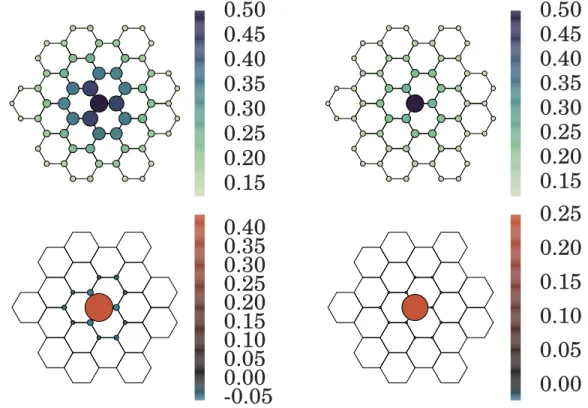
In Fig. 1.4, we show both density-density and off-diagonal short-range correlation functions for a cylinder of circumference W = 8. Comparing these to the Monte Carlo results of Ref. [83], which have been computed for a different geometry, we find good qualitative agreement. Crucially, while the boundary conditions we choose break the
0.15
0.20
0.25
0.30
0.35
0.40
0.45
0.50
0.15
0.20
0.25
0.30
0.35
0.40
0.45
0.50
-0.05
0.00
0.05
0.10
0.15
0.20
0.25
0.30
0.35
0.40
0.00
0.05
0.10
0.15
0.20
0.25
Figure 1.4: Short distance correlation functionshb†0bxi(top panels) andh(n0−12)(nx−12)i
(bottom panels) for the soft-core HFBI (left panels) and the hard-core HFBI (right panels) on theW = 8 cylinder. The magnitude of the correlation function at sitexis proportional to the radius of the corresponding circle.
rotational symmetry by making the system periodic in one direction and infinite in the other, the short-range correlations for distances up to half of the cylinder circumference appear unaffected by this.
It is a well-known result that PEPS can, in the thermodynamic limit, exhibit power-law correlation functions [144], while the correlation functions in an MPS of finite bond dimension decay exponentially. The long-range correlations of an MPS are encoded in its transfer operatorT, which for an MPS of bond dimensionM is a matrix of sizeM2×M2.
Denoting the spectrum ofT asλi with|λ0| ≥ |λ1| ≥. . ., we can normalize the state such
thatλ0 = 1. If the largest eigenvalue is found to be non-degenerate,λ1 < λ0, we have that
all correlation functions of operators Oi that are supported on a finite number of sites
centered around a siteidecay ashOiOji−hOiihOji ∼e−|i−j|/ξO. Crucially, the correlation
lengthξO for any operatorOis bounded from above by−1/log|λ1|[135]. In the following,
we thus evaluate the spectrum of the transfer operator of our PEPS along cylinders of varying circumference W to establish an upper bound on the correlation length for each circumferenceξ(W) Note that the possibility of having power-law correlations in a PEPS can be reconciled with the above consideration if the correlation lengthξ(W) diverges as
W → ∞; we will thus need to carefully consider the scaling of ξ(W).
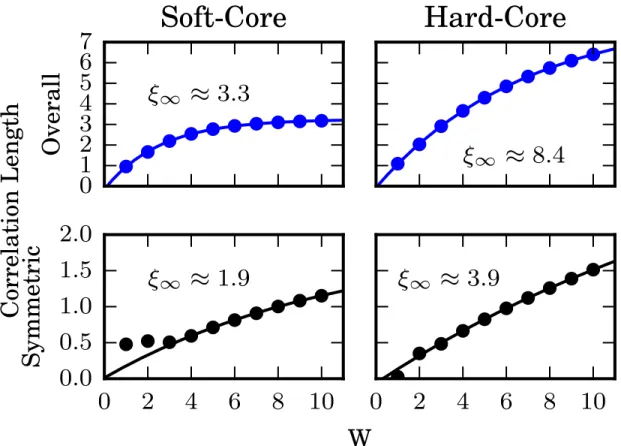
Our results for the correlation bounds ξ(W) are shown in Fig. 1.5. Here, we show the upper bound for the case of soft-core and hard-core bosons, and in each case consider the spectrum of the full transfer operator as well as Sz = 0 sector, which encodes
0
.
0
0
.
2
0
.
4
0
.
6
0
.
8
1
.
0
W
0
.
0
0
.
2
0
.
4
0
.
6
0
.
8
1
.
0
Correlation
Length
0
1
2
3
4
5
6
7
Overall
ξ
∞≈
3
.
3
Soft-Core
ξ
∞≈
8
.
4
Hard-Core
0
2
4
6
8 10
0
.
0
0
.
5
1
.
0
1
.
5
2
.
0
Symmetric
ξ
∞≈
1
.
9
0
2
4
6
8 10
ξ
∞≈
3
.
9
Figure 1.5: Bound on the correlation length of all operators andU(1) symmetric operators respectively for the soft-core and hard-core states vs. cylinder circumference W. Fits of the form ξ =ξ∞−Ae−W/B were used to extract the correlation lengths. These bounds
correlations). We find that in each case, the largest eigenvalue of the transfer operator is non-degenerate. Furthermore, we find that the correlation length approaches a finite constant as we increase W, as shown in Figure 1.5.
1.3
Entanglement spectrum
Here, the entanglement spectrum εi is defined through the spectrum ρi of the reduced
density matricesρL/R obtained for a bipartition of the state, where we haveεi =−logρi.
The corresponding eigenvectors of the reduced density matrices are referred to as Schmidt states |ψL/R(i) i. The Schmidt decomposition
|ψi=X i √ρ i|ψ(Li)i|ψ (i) Ri (1.6)
relates the Schmidt states to the original wavefunction.
The quasi-1D cylinder geometry is convenient for calculating the entanglement spec-trum for entanglement cuts transverse to the long direction of the cylinder. To extract the entanglement spectrum exactly, we use a method proposed in Ref. [34]. In the setup given here, the exact representation of the HFBI state as a PEPS of fixed bond dimension implies an upper bound on the number of non-zero ρi; for the cut shown in Fig. 1.3(e),
this upper bound is χ= 2W.
Upon computation of the entanglement spectrum, we find that this bound is satu-rated, so that there are precisely 2W contributing terms in Eq. 1.6. This fact can be
simply understood without reference to the PEPS representation: Each of the w plaque-ttes on the cut can contribute its one boson either to the left or the right of the cut, and
this is the complete source of the uncertainty of the state on one half of the cut when ignoring the state on the other half.
We can form a set of 2W vectors |σ
1, . . . , σW) that correspond to the choices for
the auxiliary degrees of freedom of the PEPS across the cut, where σi ∈ {0,1} is the
number of bosons contributed by the i’th hexagon the left of the cut. The PEPS defines a map from these boundary vectors to physical states in the bulk of the semi-infinite cylinder, which we denote as |ψ(σ1,...,σW)
L i; on the subspace of physical states spanned by
Schmidt states with non-vanishing contribution to the reduced density matrix, this map is invertible and can be computed explicitly.
Translation around the cylinder acts in the natural way on the states |ψ(σ1,...,σW)
L iby
permuting the values of σi, σi → σi+1. Although the boson number on the half-infinite
cylinder is infinite, we can define for each basis element a U(1) charge corresponding to the number of bosons to the left of the cut relative to a uniform background charge,
QL= X i (σi− 1 2). (1.7)
Only relative charges between states will be important for our conclusions, and the precise way in which background charge is accounted for does not matter. Each state is paired with a corresponding state on the right half of the cylinder with opposite charge. We can block-diagonalize the reduced density matrix for a half-infinite cylinder in both the U(1) charge and transverse momentum quantum numbers, allowing us to perform more efficient calculations. In addition, we can assign quantum numbers to both the Schmidt states and the entanglement spectrum. This property is generically true for
U(1)-symmetric and translationally invariant PEPS on a cylinder, although not in general true for arbitrary symmetry groups. This point is elaborated on in Section 1.4.2.
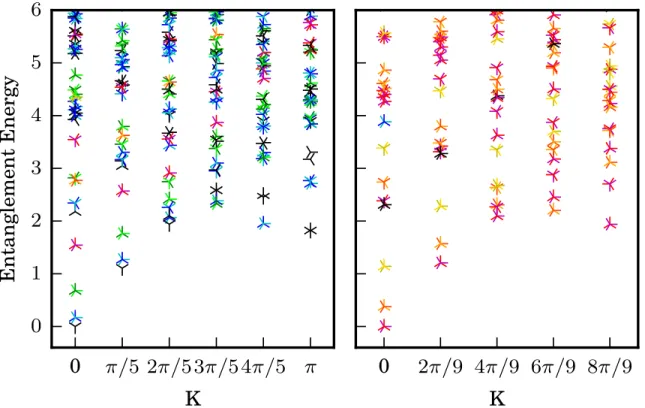
The entanglement spectra for the HFBI on cylinders with even and odd width cir-cumferences are shown in Fig. 1.6, plotted against the transverse momentum eigenvalue and colored by the U(1) charge eigenvalue of the corresponding Schmidt states. All the numerical results in this section are obtained for the soft-core boson variant of the state. We find that the entanglement spectrum looks like it has a gapless edge mode with linear dispersion near momentum zero. To further substantiate this, we compare the lowest en-tanglement energies for several cylinder widths and quantum number sectors in Fig. 1.7. The finite-size scaling confirms in all cases that the entanglement gap closes as 1/W, as one would expect for a gapless mode with linear dispersion.
The gapless edge is suggestive of the state having either topological or SPT order. While topological order was already ruled out in Ref. [83], our PEPS representation gives us additional tools to substantiate this assertion. In particular we can calculate the entanglement between the two parts of the cylinder as a function of circumferenceS(W) and check for a subleading term to the area law by performing a fit toS(W) =αW+S0.
In a topological phase and in one of the minimally entangled states (MES) [159], one would expect the subleading term to correspond to the topological entanglement entropy,
S0 = −γ [88, 95, 80]. In a non-minimally entangled state, one would instead measure
other values ofS0 >−γ. However, since each MES exhibits long-range order of a specific
0
π/
5 2
π/
53
π/
54
π/
5
π
K
0
1
2
3
4
5
6
Entanglement
Energy
0
2
π/
9 4
π/
9 6
π/
9 8
π/
9
K
Figure 1.6: Entanglement spectrum on the zig-zag edge of a cylinder of circumference
W = 10 (left panel) and W = 9 (right panel), as function of transverse momentum Ky.
1 ∞ 14 1 6 1 8 1 10 1 W
0
.
0
0
.
5
1
.
0
1
.
5
2
.
0
2
.
5
3
.
0
Entanglement
Gap
Figure 1.7: The lowest five states above the ground state in Figure 1.6 show gapless 1/W scaling behavior. In this plot, fits for the entanglement energy versus 1/W (of the forma+ b
W + c
W2) to extract the gap are consistent with a gap value of 0.
ordering patterns and can thus be detected via a degeneracy of the largest eigenvalue of the transfer matrix. Our results for the entropy are shown in Fig. 1.8. We find results that are consistent with S0 = 0, which together with the fact that we also find that the
transfer matrix to be nondegenerate rules out topological order.
1.3.1
Conformal field theory description of the edge
In addition to the gapless behavior, we find that the low energy entanglement spectrum can be completely described by the finite-size spectrum of a conformal field theory (CFT).
0
2
4
6
8
10
W
−
1
0
1
2
3
4
5
6
7
8
Entanglement
Entropy
S
α
= 0
=
αW
.
77
−
γ
γ
= 0
.
099
Data
Fit
Figure 1.8: The constant correction to the entanglement entropy, which measures the topological entanglement entropy γ when the state is minimally entangled, is consistent with 0.
Given the U(1) symmetry of the state, the simplest possible conformal field theory we might expect to appear at the edge is that of a single free bosonic field - and indeed, this is the CFT that matches the entanglement spectrum. We briefly review the relevant properties of this CFT [49].
The free boson CFT is created from the Lagrangian
L= g 2 Z dt W Z 0 dx (∂tφ)2−(∂xφ)2 (1.8)
with the compactified field identification
and placed on a circle of circumferenceW with periodic boundary conditions
φ(x)≡φ(x+W).
The family of free-boson CFTs is parametrized by a single parameter κ = πgR2, also known as the Luttinger liquid parameter [49, 58].
Upon canonical quantization, we find that the set of energy eigenstates consists of
U(1) Kac-Moody primaries |e, mi, with integers e, m labeling the U(1) charge and the winding number of the bosonic field respectively, and level n,n¯ descendants of each primary for non-negative integers n,n¯, which we will collectively label |e, m;n,n¯i. The number of level (n,n¯) descendants of a given primary, all of which are degenerate in the thermodynamic limit, isZ(n)Z(¯n), whereZ(n) is the number of partitions of the integer
n.
The energies and momenta for the states |e, m;n,n¯i are given below on a finite size system of circumference W: P= 2π W(em+n−¯n) H= 2π W( e2 4κ +κm 2+n+ ¯n) +. . . (1.9)
Here, the ellipsis (. . .) denotes further subleading contributions due to coupling to irrel-evant operators.
By rescaling the energy and momentum, we find a system-size independent pattern that can be matched to the low-energy, linearly dispersing part of the entanglement
spectrum from Figure 1.6:
P∝(em+n−¯n)
H∝e2+ 4κ2m2+ 4κ(n+ ¯n) +. . . (1.10)
The results of this match are shown in Figure 1.9. An estimate forκ can be obtained from the energy of the first descendent |0,0; 1,0i, which gives κ ≈ 1.6. The label e, which measures the U(1) charge, is integer for even W and half-integer for odd W. The degeneracy pattern 1,1,2, ... for the level-(n,0) descendents along the edge of the cone matches the prediction.
The states with odd winding numberm, such as|0,±1i, do not appear at the energy and momentum predicted by the above formula. Instead, the primary states|e, m =±1i can be found centered around momentumK =π. The identification of these states in the spectrum is shown in Figure 1.10. Although the larger-m states are too high in energy to be reliably distinguished at this system size, a natural conjecture is that all primaries with odd m will appear around momentum π. (This is a standard side-effect of lattice regularization.)
Given the PEPS representation, we can express the entanglement Hamiltonian HL
for the left semi-infinite cylinder, defined via ρL = exp(−HL), as a Hamiltonian acting
on the auxiliary degrees of freedom of the PEPS crossing the cut, which we have denoted as |σ1, . . . , σW). We expect this Hamiltonian to encode the universal properties of the
state is (up to normalization) given as |Ψ0) = X σ1,...,σW hΨ(σ1,...,σW)|Ψ(0) L i|σ1, . . . , σW). (1.11)
In Fig. 1.11, we show the bipartite von Neumann entanglement entropy of this state for a cut intol and W−l sites, which confirms the central charge c= 1 of the edge CFT. A similar construction was considered in [101].
1.4
Symmetry protection
1.4.1
Overview
While the gapless entanglement spectrum observed above is consistent with a symmetry-protected topological phase, it does not by itself guarantee the presence of such a robust phase, and does not allow us to infer which symmetries are protecting the topological properties of the phase. A key observation that allows us to make progress on these crucial questions is that many points in the entanglement spectrum are degenerate. In particular, we find that for cylinders of odd circumference, the entire spectrum is doubly degenerate.
In this section, we will discuss how the corresponding degenerate Schmidt states are related through the action of a symmetry of the HFBI wavefunction. As discussed in Ref. [122] and reviewed in the Section 1.4.2, this symmetry action can be used to di-agnose one-dimensional symmetry protected topological order, for which the degeneracy throughout the entire entanglement spectrum is a robust feature. We will demonstrate
that the odd circumference cylinders, considered as quasi-one-dimensional states, are in-deed SPTs protected by a combination of lattice inversion and charge parity symmetries.
1.4.2
Symmetry protection of the HFBI
While the Schmidt eigenstates are uniquely defined for non-degenerate eigenvalues of the reduced density matrix, they are not unique when the spectrum is degenerate and any choice of orthonormal states in the degenerate subspace represents a valid choice of Schmidt states. Applying a unitary transformation Vji, which respects P
iVji(Vki)∗ = δjk, on the left Schmidt states must be accompanied by an appropriate transformation
(Vji)∗ applied to the right Schmidt states.
In particular, this allows the action of an on-site symmetry (or more generally, any symmetry which commutes separately with the reduced density matrices for the left and right half) to mix Schmidt states corresponding to degenerate eigenvalues. The action of such a symmetry operator Ug takes the form
Ug|ψ(Li)i= X j |ψL(j)iVgji Ug|ψ(Ri)i= X k |ψR(k)i Vgki∗ , (1.12) where theVji
g are unitary matrices that only act on degenerate blocks of Schmidt states.
Crucially, Ref. [122] describes a numerical procedure to calculate Vg for an on-site
sym-metry g within the MPS formalism, which we review in Section 1.4.2.
hthat swaps the cylinder sides and squares to the identity, which we will call an inverting symmetry. These satisfy a modification of Eq. (1.12):
Uh|ψL(i)i= X j |ψ(Rj)iVhji Uh|ψR(i)i= X k |ψ(Lk)i Vhki∗ . (1.13)
Note here that the left and right Schmidt states are exchanged in the transformation. We can introduce a map S that acts as
S|ψ(Ri)i=|ψL(i)i. (1.14) Since a change in phase|ψR(i)i →eiϕ|ψ(i)
R imust be accompanied by the complex conjugate
|ψL(i)i →e−iϕ|ψ(i)
L i to preserve the Schmidt decomposition,S is antiunitary.
Combining the above, we see that
UhS|ψR(i)i=
X
j
|ψ(Rj)iVhji (1.15) defines the action of the operatorUhSon the right Schmidt states (of course an equivalent
action can be defined on the left Schmidt states). Since S is anti-unitary, the combined action of UhS is also anti-unitary. Together with the requirement that the symmetry
squares to the identity, one finds that (where K represents complex conjugation in the canonical basis)
VhVh∗ = (VhK)2 =eiφhI =±I, (1.16)
that is the inverting symmetry forms an anti-unitary projective representation of Z2.
The collection of Vg for on-site symmetries sometimes fail to satisfy the group
representation, where group multiplication laws are obeyed up to phases ω(g1, g2), i.e.
Vg1Vg2 =ω(g1, g2)Vg1g2. Certain combinations of these phases, such as
eiφg1,g2 ≡ ω(g1, g2)
ω(g2, g1)
(1.17)
whenever [g1, g2] = 0, are symmetry protected topological invariants, which take discrete
values and hence cannot be changed continuously. Thus, φg1,g2 6= 0 signifies that the
entanglement degeneracy cannot be removed without breaking the symmetry or going through a phase transition. Similarly, for the inverting (anti-unitary) symmetries h, the phase φh = π in Eq. (1.16) signifies that the degeneracy cannot be removed without
breaking the symmetry [122].
Projective Representations on the edge of MPS
We can use the formalism of matrix-product states to determine the action of physical symmetries on the Schmidt states. First, this will lead to the assignment of charge and translation (which both act on-site in the MPS representation) quantum numbers to the Schmidt states and corresponding entanglement spectrum as labeled in, e.g., Fig. 1.6. Secondly, this will be used to numerically extract the topological invariants discussed in Section 1.4. We now review this formalism briefly, including a discussion of the method that allows us to numerically determine the symmetry action of inversion symmetry on the Schmidt states. Both of these discussions follow Ref. [122].
as detailed in Refs. [145, 147]:
|ψi=X {pi}
. . .ΛΓp0ΛΓp1ΛΓp2Λ. . .|...p0p1p2...i. (1.18)
This canonical form provides the Schmidt decomposition at each site in the lattice. Here, each physical leg of the MPS represents all 2W physical sites on a cylinder slice, and each virtual leg represents all virtual indices that connect cylinder slices; the bond dimension of the MPS is thus 2W. The change of basis to canonical form generally mixes the Hilbert spaces from these virtual legs, so the resulting basis won’t be local around the circumference of the cylinder.
For each on-site symmetry of the wavefunction Ug = ⊗iuig, with Ug|ψi = eiΘg|ψi,
there is an operator Vg that acts on the virtual leg of the MPS and satisfies the equation
(1.19)
U
gΓ
=
e
iθ
gV
gΓ
V
g† .This equation can be rewritten and solved as an eigenvector problem; for an MPS with a nondegenerate largest transfer matrix eigenvalue, this equation is guaranteed have a unique solution where the eigenvalue eiθg is the largest eigenvalue of the eigenvector problem. These solutions Vg have two important properties: they are only defined up to
a phase, and they are guaranteed to commute with the diagonal matrix Λ of Schmidt weights.
multiplication laws, i.e. one could find situations where
VgVh =ω(g, h)Vgh. (1.20)
It is not always possible to absorb these phases into the definitions of the Vg; in those
cases, the Vg do not form a linear representation of the group but rather a projective
representation. The set of equivalent classes of phases ω(g, h) under redefinitions Vg → α(g)Vg is called H2(G, U(1)), the second group cohomology with U(1) coefficients.
For all the groups discussed in this chapter, the group cohomology classes are labeled by elements of a discrete abelian group. These discrete classes cannot be connected to each other continuously without undergoing a bulk phase transition or breaking the symmetry. Additionally, the classification of projective representations for the on-site symmetry group U(1) × ZW representing charge and translation around the cylinder
is trivial. Thus, these edge symmetries can be taken to act linearly, and all Schmidt states can always be simultaneously assigned charge and momentum eigenvalues, as in Figure 1.6.
The second property guarantees that the Vg only mixes exactly degenerate Schmidt
states. The action of Vg must have the same phases ω(g, h) on each degenerate block
of Schmidt states, so the projective representation can be nontrivial on any block only if every Schmidt state throughout the entire spectrum is degenerate. The degeneracy will be protected by the symmetry if and only if the Vg form a nontrivial projective
representation. Therefore this 1D SPT analysis can only potentially give a nontrival answer for the oddW states of the HFBI, where this exact degeneracy is seen throughout
the spectrum.
The MPS analysis of inversion symmetry proceeds similarly. We will consider in general any symmetry h of the wavefunction that squares to the identity and that can be written in the MPS as the product of an on-site symmetry action Uh and a transpose
of the site tensor. This will include an inversion of the honeycomb lattice - equivalent to a 180 degree rotation about the center of any plaquette, which we label I = IyIx,
and the combination of inversion with on-site symmetries. In addition, by blocking two site-tensors together, we can write the reflection symmetry Iy in this form as