
Rahimian, Erfan and Akartunali, Kerem and Levine, John (2017) A hybrid
integer programming and variable neighborhood search algorithm to
solve Nurse Rostering Problems. European Journal of Operational
Research, 258 (2). 411–423. ISSN 0377-2217 ,
http://dx.doi.org/10.1016/j.ejor.2016.09.030
This version is available at
https://strathprints.strath.ac.uk/58402/
Strathprints is designed to allow users to access the research output of the University of Strathclyde. Unless otherwise explicitly stated on the manuscript, Copyright © and Moral Rights for the papers on this site are retained by the individual authors and/or other copyright owners. Please check the manuscript for details of any other licences that may have been applied. You may not engage in further distribution of the material for any profitmaking activities or any commercial gain. You may freely distribute both the url (https://strathprints.strath.ac.uk/) and the content of this paper for research or private study, educational, or not-for-profit purposes without prior permission or charge.
Any correspondence concerning this service should be sent to the Strathprints administrator: [email protected]
The Strathprints institutional repository (https://strathprints.strath.ac.uk) is a digital archive of University of Strathclyde research outputs. It has been developed to disseminate open access research outputs, expose data about those outputs, and enable the
A Hybrid Integer Programming and Variable Neighbourhood
Search Algorithm to Solve Nurse Rostering Problems
Erfan Rahimian, Kerem Akartunalı
Dept. of Management Science, University of Strathclyde, Glasgow, G4 0GE, UK, [email protected], [email protected]
John Levine
Computer And Information Sciences, University of Strathclyde, Glasgow, G1 1XH, UK, [email protected]
The Nurse Rostering Problem (NRP) is defined as assigning a number of nurses to different shifts during a specified planning period, considering some regulations and preferences. This is often very difficult to solve in practice particularly by applying a sole approach. In this paper, we propose a novel hybrid algorithm combining the strengths of Integer Programming (IP) and Variable Neighbourhood Search (VNS) algorithms to design a hybrid method for solving the NRP. After generating the initial solution using a greedy heuristic, the solution is further improved by employing a Variable Neighbourhood Descent algorithm. Then IP, deeply embedded in the VNS algorithm, is employed within a ruin-and-recreate framework to assist the search process. Finally, IP is called again to further refine the solution during the remaining time. We utilize the strength of IP not only to diversify the search process, but also to intensify the search efforts. To identify the quality of the current solution, we use a new generic scoring scheme to mark the low-penalty parts of the solution. Based on the computational tests with 24 instances recently introduced in the literature, we obtain better results with our proposed algorithm, where the hybrid algorithm outperforms two state-of-the-art algorithms and Gurobi in most of the instances. Furthermore, we introduce 11 randomly generated instances to further evaluate the efficiency of the hybrid algorithm, and we make these computationally challenging instances publicly available to other researchers for benchmarking purposes.
Key words: Timetabling; Nurse Rostering; Hybrid Algorithm; Integer Programming; Variable Neighbourhood Search.
1.
Introduction
Nurse Rostering (also referred to as Nurse Scheduling) is the process of creating a schedule by assigning some nurses to different shift types, e.g. day, and night, during a predetermined planning horizon, where many limitations such as hospital regulations and employee contracts as well as
management and individual preferences are taken into account. The output of this process is a roster of working shifts for all the involved nurses, which is expected to result in an increase of job satisfaction and staff utilization while reducing stress and outsourcing cost [8, 17, 16]. Real-world nurse rostering problems are very difficult to solve and comprise many challenges for the people involved in the preparation process, e.g. personnel managers, and head nurses [16].
Many studies have been accomplished for the Nurse Rostering Problem (NRP) over the last few decades, with a variety of methods and algorithms applied to solve this problem in real-world settings. The proposed approaches are mainly based on meta-heuristic algorithms [3, 37, 18], which are straightforward and effective for many practical problems. These range from Variable Neighbourhood Search [14, 36] and Tabu Search [5] to Genetic Algorithms [1] and tailor-made heuristics [38, 29]. However, meta-heuristic algorithms are not as efficient for problem instances where the structure of the problem is very complex, making it challenging to find a good-quality (or even a feasible) solution in a reasonable runtime. On the other hand, there is also some research employing exact approaches such as Integer Programming (IP) [2, 15] and Constraint Programming (CP) [4, 11], which are very powerful at dealing with complex structures. Nevertheless, they are not efficient enough for solving many medium- to large-scale problem instances in practice, even though there are some very powerful and mature commercial solvers applying these methods such as Gurobi [19] and IBM CP Optimizer [26]. Having said that, in recent years, some researchers have focused on combining these two approaches to utilize their complementary strengths in order to solve highly-constrained real-world NRPs efficiently [33, 36, 9, 31].
In this paper, we propose a novel hybrid Integer Programming and Variable Neighbourhood Search (VNS) algorithm to solve the Nurse Rostering Problem in modern hospital environments. We employ IP not only to diversify the search process, but also to improve the quality of the obtained solutions from the VNS algorithm in a creative way. First, a greedy heuristic is used to generate an initial solution, and then the generated solution is further improved using a VNS algorithm until a stopping criterion is met. To further enhance the efficiency of the VNS algorithm, IP is employed iteratively during the running of the algorithm as a neighbourhood structure to improve the quality of the incumbent solution using a ruin-and-recreate framework [36]. In this framework, the high-penalty components of the solution are destroyed according to a generic scoring scheme, and then they are created again by an IP solver. Finally, IP is applied once more to the best-found solution to improve it globally as much as possible until the overall time limit is reached. The proposed algorithm is designed to perform efficiently when only short computational times are available, so that many practical problems can be tackled.
The novelty of our approach is to embed IP as a neighbourhood structure through a ruin-and-recreate framework in the VNS algorithm to improve the quality of the obtained solution and diversify the search process at the same time. Our method of hybridization is entirely different from the similar algorithms reported in the literature [31, 9, 36]. In fact, there are various hybridization schemes in order to combine different approaches together [35]. For example, [31] applied CP to generate an initial solution by decomposing the problem to various sub-problems, and then applying VNS to improve the generated solution. [36] applied an Iterated Local Search framework for generating an initial solution and employed VNS and CP in order to improve the solution and diversify the search process, respectively. [9] employed IP to generate a solution satisfying all hard constraints, and then improve it using VNS to satisfy the remaining soft constraints. In most of the mentioned approaches, IP or CP is used to generate a solution satisfying some constraints of the problem (or parts of the problem), and then a meta-heuristic algorithm is applied to further improve the generated solution. However, in our approach, we employ VNS as the main local search framework and then embed IP as a neighbourhood structure to intensify and diversify the search process in an iterative manner considering all the constraints. Indeed, we use IP through a ruin-and-recreate strategy to escape from local optima and at the same time, improve the quality of the obtained solution. Having said that, incorporating IP in our hybrid algorithm, we also allow the search process to traverse the infeasible space by allowing all the constraints to be violated in order to find out the latent feasible solutions. Moreover, we hybridize IP through VNS in a lower level compared with the approaches reported in the literature [37] and therefore we exploit the complementary strengths of both methods in a more sophisticated and effective way. In addition, we have applied a scoring scheme to evaluate the quality of the obtained solution according to the associated underlying elements such as nurses or days, which empower the hybrid algorithm to focus on parts of the solution having the most likelihood of gaining a better solution. The proposed algorithm also works with a pre-determined time limit in which the algorithm tries to generate the best solution.
The rest of this paper is organized as follows. We first describe the studied Nurse Rostering Problem and present the relevant IP formulation in Section 2. Next, we elaborate on the solution method and different components of the proposed hybrid algorithm in Section 3. Finally, in Section 4 and 5, we present our computational results, and draw some conclusions and potential future research directions, respectively.
2.
Problem Description and IP Formulation
In this section, we provide a brief description of the studied problem and the relevant constraints, and present a mathematical formulation. For further information regarding the problem, we refer interested readers to [12], where the detailed description of the problem as well as some instances are presented.
The NRP is defined as assigning a number of nurses to different shifts (e.g. early, late) during a specified planning period, where some regulations (e.g. employee contracts) and preferences (e.g. individual requested days off) are taken into account. Most NRPs including the studied problem are N P-hard [10, 30] and computationally challenging, and have a very complex structure even when the problem size is relatively small. Tackling this problem in real-world settings, the constraints of the problem are often classified as hard and soft constraints. Hard constraints are necessary to be satisfied under any circumstances, and therefore, make a problem feasible when they are met. Soft constraints, on the other hand, are those we would prefer to be met (but are not crucial), and define the quality of a generated roster according to the degree to which they are satisfied. Therefore, the objective is to reduce the number of violations associated with the soft constraints as much as possible, i.e. increase the quality of the roster. In the following, the hard and soft constraints of the problem (denoted by prefixesHC and SC, respectively) are explained:
• HC1: nurses cannot be assigned more than one shift on a day.
• HC2 [Shift rotations]: the shift assignment of nurses on two consecutive days must comply with the pre-defined set of shift patterns (rotations). The shift patterns prevent forbidden shift sequences.
• HC3 [Maximum number of shifts]: the maximum number of shift types that can be assigned to each nurse within the planning period.
• HC4 [Maximum total minutes]: the maximum amount of total time in minutes that can be assigned to each nurse within the planning period.
• HC5 [Minimum total minutes]: the minimum amount of total time in minutes that can be allocated to each nurse within the planning period.
• HC6 [Maximum consecutive shifts]: the maximum number of consecutive shifts, which are allowed to be worked within the planning period.
• HC7 [Minimum consecutive shifts]: the minimum number of consecutive shifts, which are allowed to be worked within the planning period.
• HC8 [Minimum consecutive days off]: the minimum number of consecutive days off, which are allowed to be assigned within the planning period.
• HC9 [Maximum number of weekends]: the maximum number of worked weekends (a weekend is defined as being worked if there is a shift on Saturday or Sunday) within the planning period.
• HC10 [Requested days off]: shifts must not be assigned to a specified nurse on some specified days.
• SC1 [Shift on/off requests]: a shift assignment to a specific nurse should comply with a pre-defined set of preferences. The penalty associated with this constraint is equal to the total number of all violated assignments multiplied by the specified relevant weight defined in the problem data.
• SC2 [Coverage]: the required number of nurses assigned to a specified day for a specified shift should be within a particular range. The penalty associated with this constraint is equal to the total amount of violated coverage multiplied by the specified relevant under- or over-weight defined in the problem data.
For constraints HC2 and HC6, it is assumed that the last day of the previous planning period and the first day of the next planning horizon are days off. Furthermore, for constraint HC7, it is assumed that there are an infinite number of consecutive shifts assigned at the end of the previous planning period and at the start of the next planning period. For constraint HC8, a similar arrangement applies with days off.
Based on the problem definition, we will present the associated IP formulation, in a similar fashion to the formulation given in [12], which will be crucial for the IP components of our proposed hybrid algorithm. This IP model helps us to facilitate the search process with an IP solver in order to have better exploration and exploitation. Next, we present our notations before presenting the formulation.
Sets and parameters:
D set of days in the planning horizon.
I set of nurses.
T set of shift types.
Rt set of shift types that cannot be assigned immediately after shift typet∈T.
Ni set of days that nursei∈I cannot be assigned a shift on.
lt length of shift typet∈T in minutes.
mmaxit maximum number of shifts of type t∈T that can be assigned to nurse i∈I.
bmin
i , bmaxi minimum and maximum number of minutes that nursei∈I must be assigned.
cmin
i , cmaxi minimum and maximum number of consecutive shifts that nursei∈I must
work. cis the index of possible number of consecutive shifts.
omin
i minimum number of consecutive days off that nursei∈I can be assigned. b is
the index of possible number of consecutive days off.
amaxi maximum number of weekends that nurse i∈I can work.
qidt the incurred penalty if shift typet∈T is not assigned to nursei∈I on day
d∈D.
pidt the incurred penalty if shift type t∈T is assigned to nursei∈I on dayd∈D.
udt preferred total number of nurses to whom is assigned shift type t∈T on day
d∈D.
wmin
dt , wdtmax under-weight and over-weight relevant to the total coverage of shift typet∈T
on day d∈D.
Decision variables:
xidt = 1 if nursei∈I is assigned to shift type t∈T on day d∈D, = 0 otherwise.
kiw = 1 if nursei∈I works on weekendw∈W, = 0 otherwise.
ydt total number of nurses below the preferred coverage for shift typet∈T on
day d∈D.
zdt total number of nurses above the preferred coverage for shift typet∈T on
day d∈D.
vidt total incurred penalty relevant to shift on/off requests of nursei∈I for shift
type t∈T on day d∈D. Constraints: X t∈T xidt ≤1, ∀i∈I, d∈D (HC1) xidt+xi(d+1)u ≤1, ∀i∈I, d∈ {1. . .|D| −1}, t∈T, u∈Rt (HC2) X d∈D xidt ≤mmaxit , ∀i∈I, t∈T (HC3) bmin i ≤ X d∈D X t∈T ltxidt ≤bmaxi , ∀i∈I (HC4, HC5) d+cmaxi X j=d X t∈T
X t∈T xijt+ c−1− d+c X j=d+1 X t∈T xijt + X t∈T xi(d+c+1)t≥0, (HC7) ∀i∈I, c∈ {1. . . cmini −1}, d∈ {1. . .|D| −(c+ 1)} 1−X t∈T xijt ! + d+b X j=d+1 X t∈T xijt+ X t∈T xi(d+b+1)t≥0, (HC8) ∀i∈I, b∈ {1. . . omini −1}, d∈ {1. . .|D| −(b+ 1)} kiw ≤ X t∈T xi(7w−1)t+ X t∈T xi(7w)t≤2kiw, ∀i∈I, w∈W, (HC9) X w∈W kiw ≤amaxi , ∀i∈I xint= 0, ∀i∈I, n∈Ni, t∈T (HC10)
qidt(1−xidt) +pidtxidt =vidt, ∀i∈I, d∈D, t∈T (SC1)
X i∈I xidt−zdt+ydt =udt, ∀d∈D, t∈T (SC2) xidt, kiw ∈ {0,1}, ydt, zdt, vidt ∈Z, ∀i∈I, d∈D, t∈T, w∈W Objective function: minX i∈I X d∈D X t∈T vidt+ X d∈D X t∈T wmindt ydt+ X d∈D X t∈T wdtmaxzdt
It is also assumed that all weeks start on Monday and the planning horizon consists of a whole number of weeks. We will discuss some statistics relevant to the studied instances based on the presented IP model in Section 4.
3.
Hybrid Approach
In this section, we describe a hybrid method combining Variable Neighbourhood Search and In-teger Programming techniques (aka. a pseudo-exact or matheuristic [34]) to solve modern Nurse Rostering Problems. The schematic overview of the proposed hybrid algorithm is demonstrated in Algorithm 1. After generating an initial solution using a greedy heuristic (GreedyHeuristic()), a Variable Neighbourhood Descent (VND) algorithm (VNDSearch()) using a set of distinct neighbour-hoods tries to improve the generated initial solution until no more improvements can be obtained by cycling through all the neighbourhoods. Then the best solution obtained from the VND algorithm is employed by an IP solver by fixing low-penalty parts of the solution, where it tries to generate a better-quality (exploitation) and a different-structured (exploration) solution. In fact, in this step, the best solution obtained so far is partially destroyed and again recreated aiming to have a higher-quality, and at the same time, a different solution in terms of the underpinning structure (a ruin-and-recreate strategy). In other words, the IP solver is applied as a shaking neighbourhood within the VNS, aiming to change the structure and at the same time to improve the quality of the obtained solution. All this process is accomplished in theIPRuinAndRecreate()block. To ensure a sufficient diversification through the search process, and therefore, not being stuck in local optima, some low-penalty parts of the solution might also be destroyed and recreated randomly (e.g. within therandom configuration, which will be explained later). The final obtained solution is again im-ported to the VND search algorithm and this process continues until some stopping criteria are met. Ultimately, the attained solution is further improved by applying IP to the whole problem instance to ensure a global search until the overall time limit is reached (IPImprove()).
x∗←x←GreadyHeuristic(); repeat x←V N DSearch(x); x←IP RuinAndRecreate(x); if x < x∗ then x∗←x; end
until some stopping criteria are met;
x∗←IP Improve(x∗); return [x∗]
Algorithm 1:The overall pseudo code of the hybrid algorithm
Next, we elaborate on each of the main components of the hybrid algorithm, i.e. initial solution construction in GreedyHeuristic() block, VND search algorithm in VNDSearch() block, and IP
ruin-and-recreate framework inIPRuinAndRecreate()block.
3.1 Initial Solution Construction
In this block, a greedy heuristic search is employed to generate an initial solution for the VND algorithm. Empirically, we have observed that having a high-quality initial solution reduces the efficiency of the VNS algorithm subsequently. For the same reason, a random initialization often results in poor performance due to the very low-quality of the generated solution. Therefore, we decide to apply a simple greedy heuristic algorithm. The pseudo-code of this algorithm is depicted in Algorithm 2. After pre-processing of the problem data and creating required data structures, an empty solution (roster) is created. Starting from a randomly selected nurse, at the first step, we set all the pre-defined days off for the current nurse in SetDaysOff() block. In the next step, we randomly mark all the working days to which a specific shift needs to be assigned later (AssignWorkDays()), and then we assign a randomly selected shift to those days accordingly (AssignShifts()). Assigning shifts to the nurses within two different levels, i.e. first assigning working and non-working days, and then assigning shifts to the working days, helps us to only check the constraints related to each level independently, and hence, reducing the complexity of the constraint conflict resolution process. Having said that, in the first level, only the maximum number of working days, and the minimum and maximum number of consecutive shift types including day off shifts are checked. Therefore, in the next level, we only need to check the maximum number of shift types and avoid assigning shifts where a forbidden pattern is matched.
Finally, to ensure satisfying the remaining constraints, i.e. the maximum number of worked weekends, and the minimum and maximum total times of assigned shifts, we calculate the asso-ciated incurred penalties (indicated as p1 and p2, computed within the EvaluateWeekend() and EvaluateWorkload()blocks, respectively). If there is any associated penalty, we destroy the current schedule for the current nurse by unassigning all the allocated shifts using theDestroy()block, and repeat the process until a feasible solution is obtained. This process is iterated for all the nurses until all the required shifts are assigned to all the days within a schedule, while satisfying all the hard constraints. According to our experiments, the greedy heuristic is able to produce a feasible solution for all the problem instances in up to 100 cycles per nurse. Finally, the generated feasible solution is returned to the VND algorithm for further improvement.
Pre-process problem data;
Create an empty solution x={xi, i∈I};
foreach i∈I do
while xi is not feasible do
xi←SetDaysOf f(xi); xi←AssignW orkDays(xi); xi←AssignShif ts(xi); p1=EvaluateW orkload(xi); p2=EvaluateW eekend(xi); if p1+p2 >0 then xi←Destroy(xi); end end end return [x]
Algorithm 2:The pseudo code of the greedy heuristic algorithm to generate an initial solution
3.2 Variable Neighbourhood Descent
When there is an initial solution, either generated using the greedy heuristic algorithm in the
GreedyHeuristic() block or passed from the previous cycle of the hybrid algorithm to the current one (in Algorithm 1), the Variable Neighbourhood Descent (VND) algorithm is applied to refine the solution locally according to a set of distinct neighbourhoods [21]. In the VND search algorithm, a best-improvement descent local search algorithm is applied through cycling a set of neighbourhoods until no improvement can be found in all the neighbourhood structures, or when the total number of iterations is reached a certain maximum value. The reason to choose VND is that it is capable of exploring a variety of different-structured solutions throughout the search space due to applying a set of different neighbourhoods, which makes it a very suitable candidate for solving highly-constrained problems such as NRPs. Apart from the successful implementation of VND in the relevant literature [9, 36], it is very easy to incorporate sophisticated neighbourhood structures such as our ruin-and-recreate framework, which is needed to successfully implement the hybrid algorithm.
VNS as a generalized VND approach is a relatively recent meta-heuristic approach based on the simple idea of systematically changing neighbourhoods both to escape from the areas which contain local optima and within a local search to identify better local optima [20, 21]. It has been applied to many N P-hard problems including NRPs [9, 36]. In a simple VNS scheme, a local search is applied to the incumbent solution using a neighbourhood structure until certain criteria such as the total number of iterations are met. Then the local search is restarted using a different
neighbourhood structure, trying to improve the best solution obtained from the previous iterations. This process continues until there is no more improvement gained from any of the neighbourhood structures. The neighbourhood structures in a VNS are often selected to drive the search process towards different desired objectives, or to investigate different structures of the obtained solution in order to diversify the search process, and therefore, to avoid being stuck in local optima. In Algorithm 3, the pseudo code of the applied VND algorithm is presented.
Define a set of neighbourhood structuresNk, k= 1, . . . , kmax;
Create an initial solution x; Set k←1;
while k < kmax do
Explore the neighbourhood Nk of x;
Find the best solutionx′ in Nk;
if x′ < xthen Set x←x′; Set k←1; else Set k←k+ 1; end end
return [the best solution found]
Algorithm 3:The pseudo code of the VND algorithm
The following neighbourhoods are applied to the VND block of the hybrid algorithm ( VND-Search()):
1. 2-Exchange: this neighbourhood consists of all moves, where two shifts are swapped between two different nurses on the same day.
2. 3-Exchange: it includes all moves, where three (or more) shifts are exchanged between three (or more) different nurses on the same day.
3. Double-Exchange: it includes all moves that swap two shifts between two different nurses on two different days. In fact, this neighbourhood is made from two different 2-Exchange
neighbourhoods applying on two consecutive days.
4. Multi-Exchange: this neighbourhood is very similar to Double-Exchange but three (or more) shifts are swapped between two different nurses on three (or more) different days. In-deed, this neighbourhood is made from three (or more) different2-Exchange neighbourhoods, which are not necessarily applied on consecutive days.
5. Block-Exchange: this neighbourhood includes all moves where a specific number of consec-utive shifts is swapped between two different nurses within the planning period.
Apart fromMulti-Exchange neighbourhood, which is our new neighbourhood structure, the rest of the defined neighbourhoods are used in many local search algorithms in the literature [9, 36]. The
Multi-Exchange neighbourhood is defined to overcome the complex structure of the problem, and therefore, to overcome the potential complicated local optima by applying some simple2-Exchange
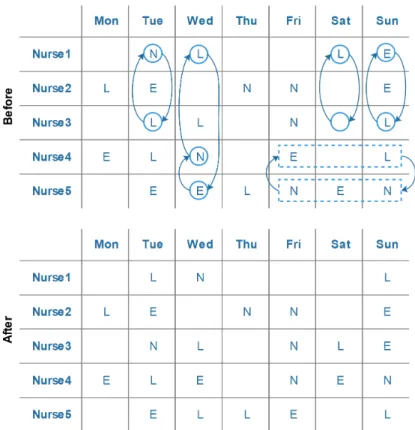
moves simultaneously. In fact, on the one hand, this neighbourhood helps to break complicated structures for a number of constraints such as HC7 and HC8. On the other hand, it is helpful to move good shift patterns from one nurse to another. Experimentally speaking, this neighbourhood structure gives better performance rather than a simple 2-Exchange or Double-Exchange. The defined neighbourhoods are illustrated on a weekly roster for five nurses in Figure 1, where E,
L, and N indicate early, late, and night shifts, respectively, and all blank shifts are days off. In this figure, the swaps of shifts between nurses 1 and 3 are examples of 2-Exchange (Tue), Multi-Exchange(Tue, Sat, and Sun), andDouble-Exchange(Sat and Sun) neighbourhoods. As an example of 3-Exchange neighbourhood, the three shifts between nurses 1, 4, and 5 on Wednesday can be sequentially swapped. Moreover, swapping the blocks of shifts from Friday to Sunday between nurses 4 and 5 can be an instance of a Block-Exchange neighbourhood.
3.3 IP Ruin-and-Recreate Framework
If the VND search algorithm could not find any better solutions by cycling through the set of neighbourhoods or reaches a maximum number of iterations, the incumbent solution is passed to an Integer Programming solver as a perturbation neighbourhood structure within the VNS. The IP solver searches for a better alternative solution based on the IP model of the problem introduced in Section 2, by fixing the low-penalty parts of the solution and exploring all the remaining possibilities to find a higher-quality solution in an iterative manner (ruin-and-recreateframework). Throughout this process, two possible outcomes may happen: 1) the IP solver can find a better solution, which can be a different solution in terms of the underlying structure in comparison with the last one. In this case, the IP solver helps the VND algorithm both in terms of intensification and diversification. 2) the IP solver cannot produce a better-quality solution (and in some cases, even produce a worse-quality solution) due to the timeout criterion or due to the non-existence of a better alternative. In this case, the IP solver may produce a solution with a different structure, and hence, helps the search process only in terms of diversification. In either case, the role of the embedded IP component in the hybrid algorithm is essential, where solving the problem only using a pure heuristic approach often
Figure 1: Examples of 3-Exchange (Nurses 1, 4, & 5 on Wed), Block-Exchange (Nurses 4 & 5 from Fri to Sun), Multi-Exchange (Nurses 1 & 3 on Tue, Sat, and Sun), 2-Exchange (Nurses 1 & 3 on Tue), and Double-Exchange (Nurses 1 & 3 on Sat and Sun) neighbourhoods applied in the VND algorithm
results in poor performance. It is noteworthy to mention that by destroying parts of the solution and repairing it again, there is no guarantee of the quality and structure of the new solution. In terms of diversification, generating a solution with a different structure is crucial. The structure of the solution is different, if it cannot be obtained by searching through the defined neighbourhoods of the current solution and some nearby solutions. Indeed, a solution is different from the other solutions in terms of the underlying structure, if we cannot generate it by iteratively applying the defined neighbourhoods for a sufficient number of iterations. In the literature, a ruin-and-recreate strategy either by IP or CP is mostly employed in order to diversify the search process and to perturb the obtained solution. For example, [36] have applied this strategy by destroying parts of the solution and then using CP to rebuild it. [27] have also used this strategy by the evolutionary elimination of parts of the solution and subsequently repairing it by using a greedy heuristic. A more advanced ruin-and-recreate based algorithm is also reported in [28], where the authors applied a stochastic modelling and Markov chain analysis. Nonetheless, in the proposed hybrid algorithm, we apply this strategy not only for the diversification purpose but also for improving the quality of
the obtained solution, i.e. intensification. This is the main reason that we select IP for ruin-and-recreate framework compared with CP and other heuristics, which is able to improve the current solution, and at the same time, investigate many areas within the search space. Moreover, we have empirically observed that destroying parts of the solution is more effective than using sophisticated neighbourhoods or similar techniques.
Another novel aspect of our ruin-and-recreate framework is due to applying a flexible generic scoring scheme to evaluate different parts of the solution, which allows us to adaptively focus on those areas of the solution, which has a higher probability to generate a better solution, if they are changed. In order to fix some parts of the solution, we apply a scoring scheme by assigning a value to each cell within the roster, where each cell is an intersection of one particular day and one particular nurse. In fact, using the scoring scheme, the total penalty associated with the current solution can be broken down to the fundamental elements of the problem. It means a shift can be assigned to each cell and if so, there is an associated penalty according to the objective function and the constraints that are involved. In other words, each cell can be designated by a value, which is the proportion of (an assignment to) that cell of the total number of violations respecting to the current solution. We call this estimated value ascell penalty. Cell penalties can be easily aggregated to different dimensions, therefore providing an insightful tool to analyse and discriminate different parts of the solution. For example, inRandom configuration which we explain later in this section, this value is used as a weight in a simple linear weighted random function, where a random cell is selected in order to be destroyed later.
Next, we demonstrate how to calculate a cell penalty, which is calculated based on the total incurred violations of the constraints involved defined in Section 2. It should be noted that although this calculation is not accurate in general, it is sufficient for our purpose. Here, we consider all the constraints either hard or soft, which might be violated throughout the search process using the hybrid algorithm, and hence, we also define the violations associated with hard constraints. To determine the relevant weights of hard constraints, a significant value (here, 1000 for constraints
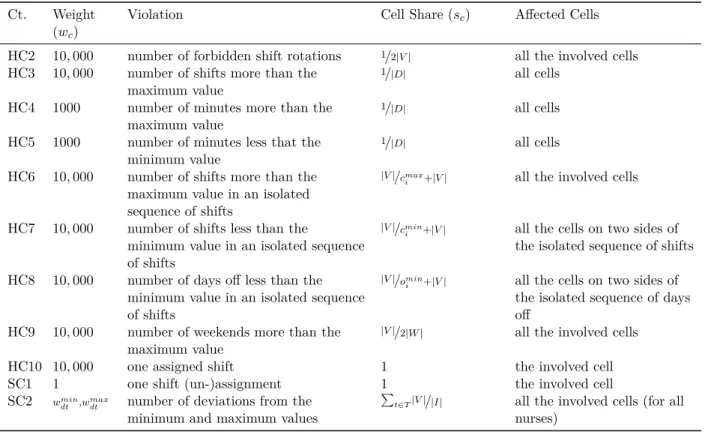
HC4 and HC5 and 10,000 for the remaining hard constraints) is selected to ensure that the final solution is feasible by directing the algorithm to feasible regions. Table 1 shows for each constraint the assigned weight (wc), the relevant violation of the constraint, cell share, i.e. the relevant
proportion of the constraint violation for all the affected cells (sc), and the affected cells associated
with the violation, respectively. In this table, |D|, |V|, |W| and |I| denote the total number of days within the planning period, the total number of violations relevant to a constraint, the total number of weekends, and the total number of nurses, respectively. All the other parameters are
already defined in Section 2.
To calculate the cell penalty (pcell) for a particular cell, we need to multiply the amount of cell
share (sc) with the relevant weight (wc) for each constraint (c∈C) for a particular day and nurse.
Hence, the total penalty allocated to each cell can be calculated using the following equation:
pcell =
X
c∈C
scwc
For example, for constraintHC2, assuming that we have only one violated rotation for a specific nurse occurred on Tuesday and Wednesday in the first week of a roster, the calculated penalty for each of the two cells involved in the violated rotation is equal to 5000. It should be noted that for constraintSC2, because the minimum and maximum number of shifts per day are given, we need to sum up the total number of violations for all shifts (t∈T) in order to calculate the cell penalty. It is noteworthy to mention that the penalty evaluation is quite fast since it is done using a delta function (i.e., we only calculate the difference of total penalties between two solutions according to the violated constraints) and highly optimized data structures.
Table 1: The required information to calculate cell penalties for all the constraints
Ct. Weight (wc)
Violation Cell Share (sc) Affected Cells
HC2 10,000 number of forbidden shift rotations 1/2|V| all the involved cells
HC3 10,000 number of shifts more than the maximum value
1/|D| all cells
HC4 1000 number of minutes more than the maximum value
1/|D| all cells
HC5 1000 number of minutes less that the minimum value
1/|D| all cells
HC6 10,000 number of shifts more than the maximum value in an isolated sequence of shifts
|V|/cmax
i +|V| all the involved cells
HC7 10,000 number of shifts less than the
minimum value in an isolated sequence of shifts
|V|/cmin
i +|V| all the cells on two sides of
the isolated sequence of shifts HC8 10,000 number of days off less than the
minimum value in an isolated sequence of shifts
|V|/omin
i +|V| all the cells on two sides of
the isolated sequence of days off
HC9 10,000 number of weekends more than the maximum value
|V|/2|W| all the involved cells
HC10 10,000 one assigned shift 1 the involved cell
SC1 1 one shift (un-)assignment 1 the involved cell
SC2 wmin dt ,w
max
dt number of deviations from the
minimum and maximum values
P
t∈T|V|/|I| all the involved cells (for all
Calculating and estimating cell penalties in a schedule, we are also able to accumulate them over different dimensions such as nurses and days in the schedule. In fact, by accumulating the cell penalties, we can elicit more information, which gives us more insights into the destroying and recreating processes. Having said that, we use the followingaggregation settings to configure the IP solver in order to fix different parts of the solution during the search process. In Section 4, we will test the hybrid algorithm by combining the following settings together within different configurations in order to identify the best efficient one.
1. Nurses: by accumulating cell penalties within the planning horizon for each nurse, we are able to identify the contribution of each nurse in the total penalty respecting to the current solution. Therefore, we can recognize nurses who have the most contributed penalties among the others.
2. Days: in this setting, cell penalties are accumulated for all the nurses within each day. Therefore, similar to Nurses setting, we can identify the days with the most contributed penalties.
3. Weeks: analogous to the other settings, here cell penalties are accumulated for all nurses and all days within each week.
4. Random: in this setting, there is no accumulation indeed. Instead, cells are selected ran-domly according to their relevant contributed penalty. For this purpose, a simple linear weighted random function is used, where cells with a higher penalty have more chance to be selected.
For illustration purposes, Figure 2 shows the first week of a roster, in which the cell penalties are calculated for all the involved constraints. It can be seen that for some cells, there are not any associated penalties (blank cells), which means they are not contributed to the total incurred penalty of the current solution. For the cell at the intersection ofMondayandNurse5, the calculated cell penalty is 150, which is the highest value among all the cells. Therefore, in the Random aggregation setting, this cell is very likely to be selected and unassigned afterwards. If we aggregate the cell penalties for all the nurses and days as calculated in the last column and row of the weekly roster, it is realized thatMonday and Nurse2 (shown as underlined style) have the greatest contributions to the total penalty associated with the roster. Therefore, using the Nurses and Days aggregation settings,MondayandNurse2 are selected for being destroyed. Consequently, it can be
Figure 2: The associated cell penalties calculated for the first week of a roster
seen that much useful information can be extracted from a solution after calculating the relevant cell penalties.
When the candidate cells required to be fixed (or to be destroyed) are identified, the IP solver solves the problem using the incumbent solution, where the integer variables associated with the fixed cells (xidt) are set before starting the search process. Next, considering all constraints as
soft except HC1, the IP solver produces another solution which can be different from the current solution in terms of quality and the underlying structure. In either case, the generated solution is passed to the next iteration of the VND algorithm as an initial solution. It is noteworthy to mention that because a significant number of variables in the IP model is fixed, particularly those which are involved in more constraints, the IP solver can easily solve the problem even when the scale of the problem instance is relatively large. Therefore, according to our experiments, in most cases, the IP solver can produce a solution even in a very short timeout condition.
Ultimately, after running the VND search algorithm and the IP ruin-and-recreate blocks in order to find a better solution, there is still a chance of being stuck in a local optimum. In fact, due to not having any global picture throughout the search space, there can be another solution close to the current local optimum, but not detectable due to the complex structure of the problem. To resolve this issue, another IP solver improves the best-found solution at the end of the hybrid algorithm to solve the problem in the remaining time, and then the final solution is reported to the user. This IP solver employs the same IP model introduced in Section 2 including all the constraints, but it starts from the best-found solution thus far. To configure the IP solver to start from the current best solution rather than a randomly generated roster, the appropriate parameter (e.g. MIPFocus
parameter in Gurobi) is set before starting the search process. It should be noted that the final IP solver is also useful to provide some insights to the optimality of the current solution, which makes
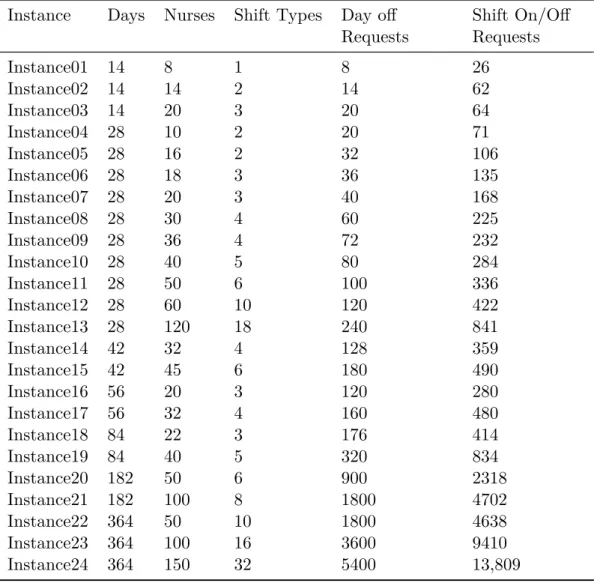
Table 2: The characteristics of the first set of benchmark instances
Instance Days Nurses Shift Types Day off
Requests Shift On/Off Requests Instance01 14 8 1 8 26 Instance02 14 14 2 14 62 Instance03 14 20 3 20 64 Instance04 28 10 2 20 71 Instance05 28 16 2 32 106 Instance06 28 18 3 36 135 Instance07 28 20 3 40 168 Instance08 28 30 4 60 225 Instance09 28 36 4 72 232 Instance10 28 40 5 80 284 Instance11 28 50 6 100 336 Instance12 28 60 10 120 422 Instance13 28 120 18 240 841 Instance14 42 32 4 128 359 Instance15 42 45 6 180 490 Instance16 56 20 3 120 280 Instance17 56 32 4 160 480 Instance18 84 22 3 176 414 Instance19 84 40 5 320 834 Instance20 182 50 6 900 2318 Instance21 182 100 8 1800 4702 Instance22 364 50 10 1800 4638 Instance23 364 100 16 3600 9410 Instance24 364 150 32 5400 13,809
the hybrid algorithm a pseudo-exact method.
4.
Computational Results
We tested the proposed hybrid algorithm on 24 instances that have been recently introduced by [12], and then on 12 randomly public generated instances introduced in this paper [32], which will be explained later. Table 2 summarizes the characteristics of the first set of benchmark instances. Despite other extensively studied instances in the literature [7], which are based on models and as-sumptions that are different than ours, and are mostly easy to solve, these instances are emphasized to be challenging for the state-of-the-art algorithms. Moreover, these instances are varied in terms of complexity and size, which makes them an appropriate benchmark for the proposed algorithm.
The variety of the benchmark instances with different characteristics and structures allows us to test the hybrid algorithm thoroughly. Generally speaking, moving fromInstance01 toInstance24, the computational difficulty of the problem instances increases, which often requires spending more time and computer memory. In particular, the last five instances are computationally challenging due to their huge sizes. Having said that, the number of days off and shift on/off requests (columns 5 and 6 in Table 2) can be appropriate indicators for the difficulty of the problem instances. In general, according to our experiments, the more the number of requests, the more difficult to deal with a problem instance both in IP and heuristic algorithms.
We conducted our tests on a PC (Intel Core-i5 3.4 GHz with 4 GB RAM) running Windows 7. We implemented the hybrid algorithm in Java 1.7 and employed Gurobi [19] 5.6 as the IP solver. We also made a concerted effort to optimize the implemented code using the latest software technologies and code optimization practices. For example, we used efficient hash algorithms and appropriate data structures similar to the ones available in Boost C++ libraries, and generic programming to minimize performance overheads. In all the experiments, the algorithm was run three times and the best-obtained solution is reported. Moreover, we run all our experiments on one CPU core to have a fairer and more accurate comparison. After extensive testing of the algorithm using different settings, the following parameters were set. We dedicate 70% of the total allowed runtime to the VNS algorithm (VND and IP ruin-and-recreate components), and the rest, to the final IP block. For VND stopping criteria, we set the maximum number of iteration to 50,000 and the maximum number of non-improvement iterations to 5. We also employed the neighbourhoods 2-Exchange, Double-Exchange, Multi-Exchange with the length of 3, Block-Exchange with the length of 4, and 3-Exchange with the length of 3 in order.
Three experiments were carried out to test the proposed algorithm: first, we investigate different aggregation settings through the ruin-and-recreate framework to understand how they affect the performance of the algorithm, and then we analyse the performance of different components of the hybrid algorithm. Second, we compare the hybrid algorithm with two state-of-the-art algorithms, which currently generate the best results for the studied instances and most existing instances in the literature, and the Gurobi IP solver. Third, due to the unavailability of a benchmark dataset in the literature which would have allowed us to compare the hybrid algorithm with another similar method [9], we create 11 randomly generated instances to further benchmark the hybrid algorithm against.
In the first experiment, in order to examine the best combination of aggregation settings defined in Section 3 for the IP ruin-and-recreate component, we ran the algorithm with a variety of
com-binations. For each combination, we define a selection range, i.e. the total percentage of available candidates in each aggregation setting which is selected in decreasing order to be destroyed and recreated. According to our non-exhaustive preliminary tests on a variety of combinations using the benchmark instances in Table 2, in the following, we present the best three identifiedconfigurations
and the relevant selection ranges:
• [Config1]: Use only Nurses aggregation setting with the selection range of at least 20%. • [Config2]: Apply Nurses, Days, and Weeks aggregation settings in order, with the selection
ranges of at least 20%, 50%, and 60%, respectively.
• [Config3]: Apply Nurses, Days, Weeks, and Random aggregation settings in order, within the selection ranges of [10%, 30%], [10%, 40%], [10%, 50%], and [30%, 50%], respectively. For each setting, the minimum value in the relevant range is increased by 10% (the increment rate) after each VNS iteration (e.g. [10%, 30%] is changed to [20%, 30%]).
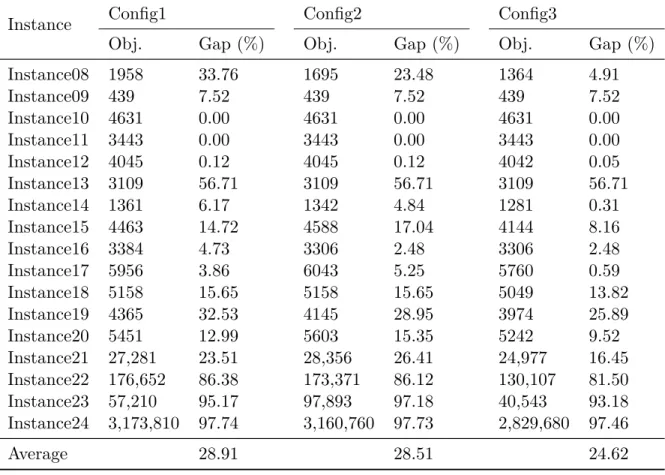
Table 3 shows the results of the benchmarked configurations for instances 8 to 24, where the algorithm is run for 10 minutes. We do not report the results for the first seven instances, since they are not very complicated for the proposed hybrid algorithm, and hence, it returns the same results for all the mentioned configurations. In this table, the objective function value and its difference to the best-known lower bound in percentage (denoted as Gap (%)) according to [12] are shown for each configuration and instance. One can see that running the algorithm with the third configuration generally results in better solutions in average. The reason for the superiority of the third configuration is due to the comprehensive investigation of the solution space by using different ruin-and-recreate strategies, and as a result, facilitating the hybrid algorithm to escape from a variety of local optima. In fact, in this configuration, we re-evaluate the current solution through four different dimensions after being stuck in each local optimum. Moreover, changing the selection ranges incrementally, equips the hybrid algorithm to behave adaptively during the search progress. It means, the more the hybrid algorithm advances within the search process, the more parts of the solution are selected to be changed, i.e. the diversification rate is being increased.
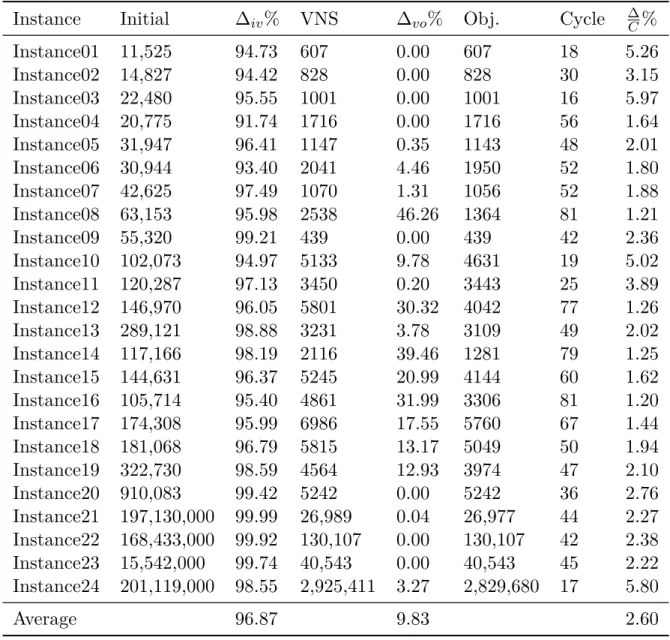
Using the third configuration (i.e. Config3), we run the algorithm for all the benchmark in-stances for 10 minutes computational time. The detailed results of this test are shown in Table 4, where the initial solution generated by the greedy heuristic algorithm, the improved solution by the VNS, and the final solution further improved by the IP solver are reported in average, respectively. In this table, ∆iv%, and ∆vo% denote the percentage of improvement achieved using
Table 3: Results of the hybrid algorithm by applying different configurations of aggregation settings
Instance Config1 Config2 Config3
Obj. Gap (%) Obj. Gap (%) Obj. Gap (%)
Instance08 1958 33.76 1695 23.48 1364 4.91 Instance09 439 7.52 439 7.52 439 7.52 Instance10 4631 0.00 4631 0.00 4631 0.00 Instance11 3443 0.00 3443 0.00 3443 0.00 Instance12 4045 0.12 4045 0.12 4042 0.05 Instance13 3109 56.71 3109 56.71 3109 56.71 Instance14 1361 6.17 1342 4.84 1281 0.31 Instance15 4463 14.72 4588 17.04 4144 8.16 Instance16 3384 4.73 3306 2.48 3306 2.48 Instance17 5956 3.86 6043 5.25 5760 0.59 Instance18 5158 15.65 5158 15.65 5049 13.82 Instance19 4365 32.53 4145 28.95 3974 25.89 Instance20 5451 12.99 5603 15.35 5242 9.52 Instance21 27,281 23.51 28,356 26.41 24,977 16.45 Instance22 176,652 86.38 173,371 86.12 130,107 81.50 Instance23 57,210 95.17 97,893 97.18 40,543 93.18 Instance24 3,173,810 97.74 3,160,760 97.73 2,829,680 97.46 Average 28.91 28.51 24.62
the VNS component and the final IP block, respectively. Furthermore, the number of cycles and the average improvement obtained throughout each cycle (denoted as ∆C%) are reported in the last two columns of Table 4. As it can be seen, the VNS algorithm is able to improve the generated initial solution by the greedy heuristic by 97%, which then is further optimized by the final IP block by 10% in average. Moreover, it is observed that the final IP solver is not able to improve the generated solution for a number of instances. For example, forInstance02, the IP solver is only employed to prove the optimality of the obtained solution by the VNS algorithm. However, for some instances such asInstance23, the IP solver does not manage to produce any better solutions due to the limited computational time. Nevertheless, the role of the final IP solver as the last component of the hybrid algorithm in order to improve the output of the VNS algorithm is crucial, where the attained improvement can be even reached more than 30% for some instances.
In the second experiment, in order to benchmark the efficiency of the proposed algorithm with the current state-of-the-art algorithms, we compared it with the results published in [12], where the authors report the results of two algorithms from [6], i.e. a branch-and-price and an ejection chain heuristic. All the published benchmark results were run on Intel Core2 Duo 3.16 GHz with 8 GB RAM. Unfortunately, we could not find any other benchmark results, and to the best of our knowledge, at this time the two benchmark algorithms produce the best results [6] for the studied problem instances and most existing instances in the relevant literature. To have a fair comparison, the algorithm is run only on one core of CPU and employs the same version of Gurobi solver. All our experiments are given a computational time of 10 minutes, since the hybrid algorithm is particularly designed to perform well in short computational times, and also it is common to use short times, as seen in the relevant literature and the nurse rostering competition [22]. However, to have a comprehensive comparison with the available results and the benchmark algorithms, we also run the proposed algorithm for a longer time, i.e. 60 minutes. Table 5 presents the best results from the ejection chain method, Gurobi IP solver with default settings, and our hybrid algorithm using the third configuration (Config3 in Table 3) running for the limited computational time of 10 and 60 minutes, respectively. The results for the branch-and-price (B&P) algorithm without any time limits are also presented. In this table, “-” indicates that the algorithm does not generate any feasible solutions within the allocated time limit.
As we can see in Table 5, within the 10 minutes computational time, from the total of 24 in-stances, the hybrid algorithm outperforms the ejection chain method for 23 inin-stances, and produces the same results forInstance01. In comparison with the Gurobi IP solver, the algorithm performs better in 14 instances and generates the same results for the remaining 10 instances, where 9 of
Table 4: Detailed results of the hybrid algorithm by applying the third configuration for 10 minutes
Instance
Initial
∆
iv%
VNS
∆
vo%
Obj.
Cycle
∆C%
Instance01
11,525
94.73
607
0.00
607
18
5.26
Instance02
14,827
94.42
828
0.00
828
30
3.15
Instance03
22,480
95.55
1001
0.00
1001
16
5.97
Instance04
20,775
91.74
1716
0.00
1716
56
1.64
Instance05
31,947
96.41
1147
0.35
1143
48
2.01
Instance06
30,944
93.40
2041
4.46
1950
52
1.80
Instance07
42,625
97.49
1070
1.31
1056
52
1.88
Instance08
63,153
95.98
2538
46.26
1364
81
1.21
Instance09
55,320
99.21
439
0.00
439
42
2.36
Instance10
102,073
94.97
5133
9.78
4631
19
5.02
Instance11
120,287
97.13
3450
0.20
3443
25
3.89
Instance12
146,970
96.05
5801
30.32
4042
77
1.26
Instance13
289,121
98.88
3231
3.78
3109
49
2.02
Instance14
117,166
98.19
2116
39.46
1281
79
1.25
Instance15
144,631
96.37
5245
20.99
4144
60
1.62
Instance16
105,714
95.40
4861
31.99
3306
81
1.20
Instance17
174,308
95.99
6986
17.55
5760
67
1.44
Instance18
181,068
96.79
5815
13.17
5049
50
1.94
Instance19
322,730
98.59
4564
12.93
3974
47
2.10
Instance20
910,083
99.42
5242
0.00
5242
36
2.76
Instance21
197,130,000
99.99
26,989
0.04
26,977
44
2.27
Instance22
168,433,000
99.92
130,107
0.00
130,107
42
2.38
Instance23
15,542,000
99.74
40,543
0.00
40,543
45
2.22
Instance24
201,119,000
98.55
2,925,411
3.27
2,829,680
17
5.80
Average
96.87
9.83
2.60
Table 5: The benchmark results for the hybrid algorithm in comparison with the best current algorithms including branch-and-price and ejection chain heuristic [6], and Gurobi IP solver [19] running for 10 and 60 minutes
Instance Hybrid Algorithm Ejection Chain Gurobi Hybrid Algorithm Ejection Chain Gurobi B&P 10 min 60 min Instance01 607 607 607 607 607 607 607 Instance02 828 923 828 828 837 828 828 Instance03 1001 1003 1001 1001 1003 1001 1001 Instance04 1716 1719 1716 1716 1718 1716 1716 Instance05 1143 1439 1143 1143 1358 1143 1160 Instance06 1950 2344 1950 1950 2258 1950 1952 Instance07 1056 1284 1056 1056 1269 1056 1058 Instance08 1364 2529 8995 1344 2260 1323 1308 Instance09 439 474 439 439 463 439 439 Instance10 4631 4999 4631 4631 4797 4631 4631 Instance11 3443 3967 3443 3443 3661 3443 3443 Instance12 4042 5611 4045 4040 5211 4040 4046 Instance13 3109 8707 500,410 1905 3037 3109 -Instance14 1281 2542 1482 1279 1847 1280 -Instance15 4144 6049 78,144 3928 5935 4964 -Instance16 3306 4343 3521 3225 4048 3233 3323 Instance17 5760 7835 6149 5750 7835 5851 -Instance18 5049 6404 7950 4662 6404 4760 -Instance19 3974 6522 29,968 3224 5531 5420 -Instance20 5242 23,531 - 4913 9750 - -Instance21 26,977 38,294 - 23,191 36,688 - -Instance22 130,107 - - 32,126 516,686 - -Instance23 40,543 - - 3794 54,384 - -Instance24 2,829,680 - - 2,281,440 156,858 -
-them are optimal solutions (shown as underlined style). In overall, the proposed algorithm out-performs the ejection chain method and Gurobi IP solver within 10 minutes computational time for 14 instances (shown as bold style), and produces the same or better results for the rest of the instances. It should be noted that the ejection chain method and Gurobi IP solver could not solve the last 3 and 5 instances, respectively. Having said that, obtaining the reported solutions for these instances, which are very hard to solve and huge in size, make the hybrid algorithm an appropriate candidate to tackle such instances even in a very short runtime.
Running our benchmarks for the longer runtime of 60 minutes, the hybrid algorithm outperforms the ejection chain method for 22 instances and does not generate a better result only forInstance24. The reason of obtaining a poor-quality solution forInstance24 might be the inherent nature of the hybrid algorithm as a pseudo-exact method (matheuristic). Since this instance is huge in size, it is a challenge for the algorithm to solve it in comparison with a meta-heuristic approach like ejection chain method. Moreover, it might have a particular structure which cannot be exploited using the current setting of the proposed algorithm, but easy to be identified by the ejection chain method. Similarly, in comparison with Gurobi IP solver, the hybrid algorithm is able to generate better results for 13 instances and obtains the same results for the remaining 10 instances. For
Instance08, the IP solver outperforms the hybrid algorithm for only a slight difference. In overall, the hybrid algorithm attains better solutions for half of the instances (shown as bold style), which makes it a successful candidate even for longer computational times.
Comparing with branch-and-price (B&P) algorithm without any time limit, the hybrid algo-rithm is outperformed only for Instance08, where B&P takes more than 197 minutes to generate the solution. Apart from the 11 instances, for which B&P cannot produce any results, the hybrid algorithm beats B&P for 5 instances and achieves the same results for the rest of the instances.
In the third experiment, we try to compare the hybrid algorithm with a similar approach re-ported in [9], in which IP and VNS are hybridized in a pipeline fashion, i.e. running sequentially. The authors also developed a decomposition technique for handling constraints, and evaluated their hybrid VNS using the studied decomposition. Unfortunately, after making inquiries from the rel-evant authors, it is found out that the benchmarked dataset including 12 instances is lost except one of them, i.e. the first instance for January. Being unsuccessful in obtaining the benchmarked instances and willing to further evaluate the efficiency of the hybrid algorithm, we randomly gen-erated 11 instances (instead of the 11 extinct ones) attempting to make them similar to the sole existing instance we already have. These instances are made publicly available [32] to facilitate other researchers to benchmark their algorithms. The problem description regarding the
remain-ing available instance called ORTEC01 is accessible in [7], and the associated IP formulation is reported in [33]. As we tried to generate instances resembling the only available instance as closely as possible, we made the following assumptions:
1. Since the lost instances belong to a yearly dataset extracted from a real hospital over 12 months, we assumed that all the staff contracts are not changed and fixed during the planning year.
2. Considering the yearly nature of the dataset, we assumed that there is not any change in the hospital regulations, number of shifts, and number of nurses (i.e. no hiring or firing occurs). 3. Considering the yearly nature of the dataset, we assumed that there should not be any major
changes in the coverage and shift on/off requests.
4. We assumed that the coverage data for the weekend days follow a similar pattern to the coverage data of the available instance.
Based on these assumptions, we only generate random instances by changing the coverage and shift on/off requests constraints. For generating coverage data, for all the weekdays and for all the shifts except night, we use a weighted uniform random function within the range of [2, 4], by considering the associated weights of 0.25, 0.5, 0.25 for the included numbers within the range. For night shifts, we use a uniform random function to generate the coverage data within the range of [1, 2]. To have similar coverage data compared with the available data, we also try to keep the difference between the total sum of all the coverages during the planning horizon less than 40 for generated instances and the available instance. Thus, we ensure that the generated coverage data are similar to the available instance with only very slight perturbation.
For generating shift on/off requests, first, we use a uniform random function to generate some request data including the involved employees, the requested shifts consist of days off, the requested days, and the associated weights, while considering ranges of [0, total number of employees], [0, total number of shifts + 1], [0, total number of days], and the set of {100, 1000, 10,000}, respectively. Then we use a uniform random function again to generate the required number of shift on/off requests within the range of [0, 5] independently. Finally, knowing the total number of shift on/off requests, first we pick the number of shift on requests and then the number of shift off requests from the generated request data, if any.
We use an identical random seed for the whole generation of the instances, and we repeat the process until we obtain a feasible problem instance. It is noteworthy to mention that although
Table 6: The characteristics of the generated random instances (second set of benchmark instances) and results of standard Gurobi IP solver for 10 minutes
Instance IP Statistics Gurobi
Constraints Variables RR Iterations Obj. LB Gap (%)
ORTEC01 20,611 21,954 7280 1410 145 89.72 ORTEC02 20,581 21,924 7426 15,500 570 96.32 ORTEC03 20,580 21,923 10,732 31,741 200 99.37 ORTEC04 20,586 21,929 9354 15,510 122 99.21 ORTEC05 20,582 21,925 9904 25,495 1300 94.90 ORTEC06 20,582 21,925 10,598 14,855 211 98.58 ORTEC07 20,581 21,924 9804 2911 138 95.26 ORTEC08 20,583 21,926 8358 5660 141 97.51 ORTEC09 20,581 21,924 7526 385 201 47.79 ORTEC10 20,577 21,920 8715 14,940 1130 92.44 ORTEC11 20,583 21,926 10,105 22,863 310 98.64 ORTEC12 20,580 21,923 9265 37,698 110 99.71
we try to generate the instances very similar to the one in hand, due to the complexity of the constraints and the importance of the coverage and shift on/off requests in the structure of the problem, the generated instances are different in terms of computational complexity and even more challenging than the available one as we see next. Table 6 summarizes the characteristics of the generated random instances and the obtained results from the standard Gurobi IP solver for 10 minutes runtime. In the first part of this table, some statistics regarding the IP formulation of the generated instances including the number of constraints, variables, and simplex iterations to solve the root relaxation of the problem instances are presented, respectively. In the second part, the objective function value, lower bound, and the optimality gap resulting from running the IP solver for 10 minutes timeout condition are shown, respectively. The optimality gap is defined as the discrepancy between the value of the current feasible solution (for the primal problem) and the value of the lower bound (feasible for the dual problem). When the optimality gap is zero, the current feasible solution is an optimal solution. It should be noted that in Table 6, the instance ORTEC01 is the instance we had available (shown in italic style), and the rest indicates the instances we generated.
As one can see in Table 6, by observing the results obtained from the IP solver for 10 minutes runtime, all the generated instances are solved to a gap greater than 90% except instanceORTEC09
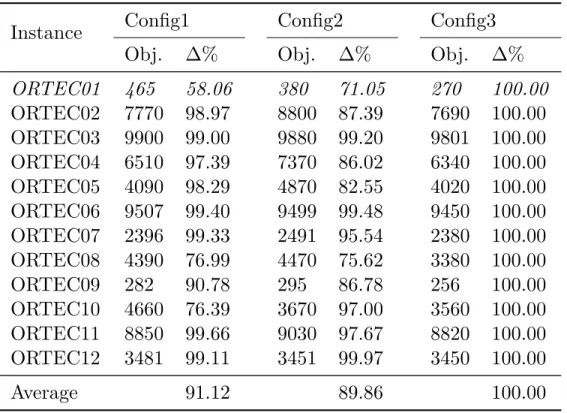
with the gap of 48%. Therefore, it can be seen that apart from the instance ORTEC09, all the other instances are even more difficult to solve rather than ORTEC01. As a result, we can argue that the randomly generated instances are difficult to solve and they can be a suitable benchmark dataset for evaluating the performance of the hybrid algorithm.
We run the hybrid algorithm for 10 minutes using the three configurations introduced in the first experiment. The results are reported in Table 7, where the absolute objective value and the associated normalized percentage (denoted as ∆%) are shown, respectively. Similar to the first experiment, we observe that running the algorithm with the third configuration results in a better solution for all the instances. In order to analyse the performance of the main components of the hybrid algorithm, we run it using the generated new benchmark instances for 10 minutes computational time. The detailed average results are reported in Table 8, where the VNS algorithm improves the initial solution by 94%, which is further enhanced by the final IP block by 14% in average. It should be noted that for generating the initial solution, a similar IP solver is run for 20 seconds, since employing a greedy heuristic similar to the one explained in Section 3.1 often results in infeasible solutions. To compare the performance of the hybrid algorithm with Gurobi IP solver and the hybrid VNS algorithm reported in [9], we run our hybrid algorithm using the third configuration and report the results in Table 9, where the hybrid algorithm and IP solver are run for 10 and 60 minutes, and the hybrid VNS (shown as IPVNS) is run for 60 minutes computational time.
To have a fairer and more accurate comparison, we simulate the computational environment of IPVNS algorithm (Pentium 2.0 GHz PC) by running the hybrid algorithm on a different PC with an Intel Core-i7 1.6 GHz CPU but only using one core of the CPU. Having said that, the first reported value for instance ORTEC01 is the one similar to the other instances by running on our regular benchmark PC, and the second one is relevant to the less-powerful PC used only for comparing with IPVNS algorithm. As we can see in Table 9, compared with the results obtained by the IP solver, the hybrid algorithm finds better solutions for all the instances. In particular, for instance
ORTEC01, when we compare the results with IPVNS, the algorithm reaches the objective value of 315, which is 31% better than the one obtained by IPVNS, i.e. 460 on a similar computational environment. Running the algorithm on our regular benchmark PC, the objective value is slightly improved and reaches the value of 270 known as the optimal solution, which might be due to using a more powerful PC.
Considering instanceORTEC01, we also benchmark the algorithm against the winner of Person-nel Scheduling track of CHeSC hyper-heuristic competition [25, 23], where the authors developed a
Table 7: Results of the hybrid algorithm by applying different configurations of aggregation settings for the second set of benchmark instances
Instance
Config1
Config2
Config3
Obj.
∆%
Obj.
∆%
Obj.
∆%
ORTEC01
465
58.06
380
71.05
270
100.00
ORTEC02
7770
98.97
8800
87.39
7690
100.00
ORTEC03
9900
99.00
9880
99.20
9801
100.00
ORTEC04
6510
97.39
7370
86.02
6340
100.00
ORTEC05
4090
98.29
4870
82.55
4020
100.00
ORTEC06
9507
99.40
9499
99.48
9450
100.00
ORTEC07
2396
99.33
2491
95.54
2380
100.00
ORTEC08
4390
76.99
4470
75.62
3380
100.00
ORTEC09
282
90.78
295
86.78
256
100.00
ORTEC10
4660
76.39
3670
97.00
3560
100.00
ORTEC11
8850
99.66
9030
97.67
8820
100.00
ORTEC12
3481
99.11
3451
99.97
3450
100.00
Average
91.12
89.86
100.00
Table 8: Detailed results of the hybrid algorithm by applying the third configuration for 10 minutes for the second set of benchmark instances
Instance
Initial
∆
iv%
VNS
∆
vo%
Obj.
Cycle
∆C%
ORTEC01
74611
98.27
1291
79.09
270
55
1.81
ORTEC02
70863
89.12
7711
0.27
7690
50
1.78
ORTEC03
76169
87.02
9886
0.86
9801
50
1.74
ORTEC04
127870
95.01
6380
0.63
6340
41
2.32
ORTEC05
87018
95.35
4050
0.74
4020
53
1.80
ORTEC06
89815
89.35
9561
1.16
9450
53
1.69
ORTEC07
67417
96.44
2401
0.87
2380
54
1.79
ORTEC08
91082
96.23
3431
1.49
3380
58
1.66
ORTEC09
70700
98.07
1368
81.29
256
33
3.02
ORTEC10
82975
95.63
3625
1.79
3560
63
1.52
ORTEC11
111571
92.08
8840
0.23
8820
51
1.81
ORTEC12
88373
96.04
3501
1.46
3450
57
1.69
Average
94.05
14.16<

![Table 5: The benchmark results for the hybrid algorithm in comparison with the best current algorithms including branch-and-price and ejection chain heuristic [6], and Gurobi IP solver [19]](https://thumb-us.123doks.com/thumbv2/123dok_us/531691.2562656/25.918.110.809.386.890/benchmark-results-algorithm-comparison-algorithms-including-ejection-heuristic.webp)

![Table 9: The benchmark results for the hybrid algorithm in comparison with Gurobi IP solver [19]](https://thumb-us.123doks.com/thumbv2/123dok_us/531691.2562656/31.918.131.792.177.523/table-benchmark-results-hybrid-algorithm-comparison-gurobi-solver.webp)
