i
INNOVATIVE TECHNIQUES FOR THE
IMPLEMENTATION OF ADAPTIVE MOBILE
LEARNING USING THE SEMANTIC WEB
Samir E. Hamada
Under the Supervision of Dr. Khaled Elleithy
DISSERTATION
SUBMITTED IN PARTIAL FULFILMENT OF THE REQUIREMENTS FOR THE DEGREE OF DOCTOR OF PHILOSOPHY IN COMPUTER SCIENCE
AND ENGINEERING THE SCHOOL OF ENGINEERING
UNIVERSITY OF BRIDGEPORT CONNECTICUT
iii
INNOVATIVE TECHNIQUES FOR THE IMPLEMENTATION
OF ADAPTIVE MOBILE LEARNING USING THE SEMANTIC
WEB
iv
INNOVATIVE TECHNIQUES FOR THE IMPLEMENTATION
OF ADAPTIVE MOBILE LEARNING USING THE SEMANTIC
WEB
ABSTRACT
Adaptive Mobile Learning has constantly faced many challenges in order to make course learning more adaptive. This research presents a conceptual framework for using the Semantic Web to obtain students’ data from other educational institutions, enabling the educational institutions to communicate and exchange students’ data. We then can use this information to adjust the students’ profiles and modify their learning paths. Semantic Web will create a more personalized dynamic course for each student according to his/her ability, educational level, and experience.
Through the Semantic Web, our goal is to create an adaptive learning system that takes into consideration previously completed courses, to count the completed topics, and then adjust the leaning path graph accordingly to get a new shortest path.
We have applied the developed model on our system. Then, we tested the students on our system and a control system to measure the improvements in the students’ learning. We also have analyzed the results collected from the AML Group and the Control Group. The AML system provided a 44.80% improvement over the Control System. The
v
experimental results demonstrate that Semantic Web can be used with adaptive mobile learning system (AML) in order to enhance the students’ learning experience and improve their academic performance.
vi
ACKNOWLEDGEMENTS
My thanks are wholly devoted to God who has helped me all the way to complete this work successfully. I dedicate this humble work to the spirit of my dear mother and the spirit of my dear father. I owe a debt of gratitude to my family especially my wife for understanding and encouraging me. I would like to express my deep gratitude to Professor Prof. Khaled Elleithy, my research supervisor, for his patient guidance, enthusiastic encouragement, and useful critiques of this research work. My grateful thanks are also extended to Dr. Ausif Mahmood, Dr. Navarun Gupta, Dr. Prabir Patra, Dr. Joanna Badara, Dr. Saeid Moslehpour and Dr. Tarek M. Sobh for their valuable comments. Many thanks to my friend, Ibrahim Alkore Alshalabi, for working with me on the research and developing the algorithm and papers that we published together. Last but not least, I would like to thank the entire staff of the School of Engineering for their support that made my study at the University of Bridgeport a wonderful and exciting experience.
vii
TABLE OF CONTENTS
ABSTRACT ... iv
ACKNOWLEDGEMENTS ... vi
TABLE OF CONTENTS ... vii
LIST OF TABLES ... ix
LIST OF FIGURES ... x
CHAPTER 1 : INTRODUCTION ... 1
1.1 Research Problem and Scope ... 1
1.2 Motivation behind the Research ... 4
1.3 Learning Management Systems (LMS) ... 5
1.3.1 Blackboard ... 5
1.3.2 Canvas ... 6
1.3.3 Google Classroom ... 6
1.4 Potential Contributions of the Proposed Research ... 6
CHAPTER 2 : RELATED WORK ... 8
2.1 Introduction ... 8
2.2 Linked Data ... 25
2.3 ASP.NET MVC ... 31
CHAPTER 3 : RESEARCH PLAN ... 33
3.1 Introduction ... 33
3.2 Implementing dotNetRDF [7, 47, 48] ... 40
3.3 Proposed Conceptual Framework ... 42
viii
CHAPTER 4 : EXPEREMENTS AND RESULT ... 47
4.1 Introduction ... 47
4.2 Analysis ... 47
4.3 Hypothesis Testing ... 48
4.4 AML Group Calculations ... 51
4.4.1 Results including Pre-Quiz ... 52
4.4.2 Results excluding Pre-Quiz ... 52
4.5 Control Group Calculations ... 53
4.5.1 Results including Pre-Quiz ... 54
4.5.2 Results excluding Pre-Quiz ... 54
4.6 Calculate the t-value ... 54
4.6.1 Results including Pre-Quiz ... 54
4.6.2 Results excluding Pre-Quiz ... 56
4.7 Improvements ... 57
4.7.1 Improvements Charts ... 58
4.8 AML System Charts and Calculations for the t-value ... 60
CHAPTER 5 : CONCLUSION ... 65
REFERENCES ... 67
APPENDIX A ... 80
ix
LIST OF TABLES
Table 2.1 Relational Database and Ontology 30
Table 3.1 Result of query from Figure 3.9 39
Table 3.2 Result of query from Figure 3.10 39
Table 4.1 AML Group Results 49
Table 4.2 Control Group Results 50
Table 4.3 AML Group Calculations 51
Table 4.4 AML Group Descriptive Statistics 52
Table 4.5 Control Group Calculations 53
Table 4.6 Control Group Descriptive Statistics 53
Table 4.7 AML Group Improvement 58
x
LIST OF FIGURES
Figure 1.1 Scope of Study 4
Figure 1.2 Learning Management Systems 5
Figure 2.1 Old Version of Bloom's Taxonomy 18
Figure 2.2 New Version of Bloom's Taxonomy 18
Figure 2.3 24 iPad apps to support Bloom’s Taxonomy 19
Figure 2.4 Learning Path Graph 29
Figure 2.5 ASP.NET MVC 32
Figure 3.1 Resource Description Framework (RDF) Triple 34
Figure 3.2 Resource Description Framework (RDF) Triple Example 34
Figure 3.3 Parts of the Triple in Turtle format. 34
Figure 3.4 Student’s Properties 35
Figure 3.5 Course Properties 36
Figure 3.6 Course Module 36
Figure 3.7 RDF Triple Relations 36
Figure 3.8 Student file in Turtle Format 38
Figure 3.9 SPARQL Query for students in CT 39
Figure 3.10 Query for students in city=Stratford and state=CT 39
Figure 3.11 Loading the Turtle files to memory 40
Figure 3.12 A SPARQL query on the files that are loaded in Figure 3.11 40
xi
Figure 3.14 Evaluating the Query result from Figure 3.12 41
Figure 3.15 System Diagram 43
Figure 3.16 Querying Students with GPA > 3.5 46
Figure 4.1 Distribution of the Results of AML Group and Control Group 57
Figure 4.2 AML Group Improvement 59
Figure 4.3 Control Group Improvement 60
Figure 4.4 Best & Worst Units’ Chart 60
Figure 4.5 Best & Worst Units’ Data 61
Figure 4.6 Best & Worst Students’ Chart 61
Figure 4.7 Best & Worst Students’ Data 61
Figure 4.8 AML and Control Group Chart 62
Figure 4.9 Descriptive statistics calculation for the AML Group using the AML system
62
Figure 4.10 Descriptive statistics calculation for the Control Group using the AML system
63
Figure 4.11 Calculations of the t-value and the critical t-value using the AML system along with the system decision
1
CHAPTER 1
: INTRODUCTION
1.1 Research Problem and Scope
Throughout the most recent decades, various research studies have examined the possibilities of changing the educational instructional model from the customary one-size-fits-all model to a more adaptive and customized learning model.
Most of the techniques calculate the optimal learning path based on the characteristics of the student’s profile to make the course more personalized. However, we have not seen any technique that updates profiles dynamically using the Semantic Web to exchange information between educational institutions.
The student profile contains information about the student such as first name, last name, address, course units that have been completed, and grades of those course units.
This current model can be applied for mobile leaning and eLearning at community colleges as well as in a typical graduate or under graduate programs at the university level for any course. Students can benefit from and personalize their college experience, graduate, and complete their requirements earlier. “eLearning is learning utilizing electronic technologies to access educational curriculum outside of a traditional classroom. In most cases, it refers to a course, program or degree delivered completely online.” [1].
However, this model does not apply to K-12 students because they are outside the scope of our research.
2
Adaptive learning is an educational method that aids students in the learning process according to their needs. In addition, Adaptive learning assists instructors in conveying course content to their students in a personalized manner based on the students’ ability and background. Furthermore, from the developers’ point of view adaptive learning is a technique using computers and other resources to assist in producing a better learning experience.
According to our proposed system, at the time of course registration, the students complete their profile information. If there is a claim that the student has successfully completed a course unit at another educational institution, the proposed system will run a query against the Semantic Web files which will be performed by using the SPARQL (SPARQL Protocol and RDF Query Language) where (RDF) The Resource Description which “is a general-purpose language for representing information in the Web.” [2]. For the purposes of our research, we run the query against Turtle files (“Terse RDF Triple Language, a concrete syntax for RDF” [3]) on another website to simulate the other educational institution, and we are able to obtain the students’ profiles and grades in that course unit.
When students sign up and complete their profiles’ information during the sign-up process, they include the completed course units from different educational institutions. The system will then query the Semantic Web files (Turtle) of that institution to get the student’s profile, verify the student’s grade and determine if the student has passed the course unit according to the passing grades imposed by the subject matter expert of each educational institution using our system. If there is no result to ensure that
3
the student has passed the course unit, the student must take a quiz to evaluate his/her knowledge in this course unit (it is a computerized quiz provided by the system). If the student passes the quiz, the course unit will be marked as completed. Otherwise, the student has to go through that course unit’s materials, and then re-take the quiz in that course unit in order to complete that unit.
In this dissertation, we propose a technique using ASP.Net MVC, dotNetRDF, Turtle, and the Semantic WEB to show how we can exchange information between educational institutions in order to update student profiles in terms of the course units that have been completed and then calculate the shortest path for other course units. Student profiles contain information such as student name, completed course units, and grades in each course unit.
Consequently, students do not have to repeat the same course unit more than once. Meanwhile, we have introductory modules at the beginning of the course, in which we introduce essential notions/concepts assumed to have been learned elsewhere.
To take care of the common problem of students forgetting previously learned content over time, the system starts by reviewing previously learned concepts and modules and then teaches the student the newly required content in order to finish the course.
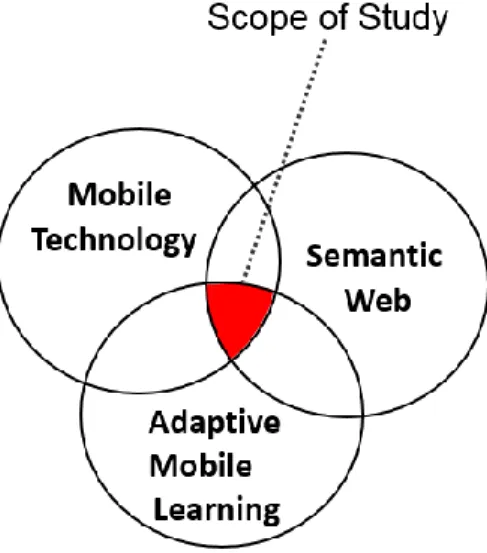
Figure 1.1 illustrates the scope of study of our research that encompasses the entities of Mobile Technology, Adaptive Learning, and Semantic Web.
4 1.2 Motivation behind the Research
Distance Learning, eLearning and Mobile Learning have progressed in the last decade because of the progress and advancement in mobile technology, smartphones, and tablets. This advancement has caught the attention of programmers, engineers, and researchers involved in the Adaptive Mobile Learning community.
One of the most challenging tasks for adaptive mobile learning is to create an adaptive course. Several researchers have used different techniques in order to make the course adaptive in terms of the course content and units. To the best of our knowledge, there is no research that attempts to make the course adaptive in terms of previously completed materials from the student while at another educational institution by using the Semantic Web to communicate directly with various educational institutions systems to acquire the students’ profiles.
5
This research demonstrates how to optimize an Adaptive Mobile Learning System by using the Learning Path Graph (LPG). Furthermore, we will exhibit how to customize the students’ profiles by using the Semantic Web to credit the students for the topics completed at other accredited educational institutions.
1.3 Learning Management Systems (LMS)
Figure 1.2, demonstrates some LMS systems.
1.3.1 Blackboard
Blackboard regulates the release of specific content to the users based on rules related to the following variables [4]:
1. Date
2. Membership 3. Grade
4. Review Status
The features provided by Blackboard do not satisfy the requirements of adaptive learning according to our definition.
6 1.3.2 Canvas
Canvas does not have all of Blackboard’s Adaptive Release features [5], but content release scenarios can be created by combining availability dates and settings on:
1. Files/Folders in the File Area of the course. 2. Assignments and Quizzes.
3. Discussions. 4. Pages. 5. Modules.
The features provided by Canvas do not satisfy the requirements of adaptive learning according to our definition.
1.3.3 Google Classroom
We contacted Google in November of 2015, to check Google Classroom, they responded that: an adaptive feature or conditional branching is currently not available in Classroom.
1.4 Potential Contributions of the Proposed Research
This research shows how to optimize an Adaptive Mobile Learning System by using the Learning Path Graph (LPG).
Furthermore, we will demonstrate how to customize the students’ profiles by using the Semantic Web in order to provide credit to students for the topics completed in other accredited educational institutions.
7
The interesting point in this research is the ability to use the Semantic Web to exchange the student’s information among the educational institutions and to credit the students for the topics that they have already completed.
This feature may have the potential to boost the efficiency of the adaptive learning systems and increase the chance for the students’ success.
8
CHAPTER 2
: RELATED WORK
2.1 Introduction
According to Alshalabi and Hamada et al. [6], students come to class with different backgrounds, skills, and ability. In the classic way of teaching, the students are taught the same content regardless of their academic progress. These approaches are not adaptive to the student. In this research, we will demonstrate the Learning Path Graph, which is a proficient representation of online courses in the computer based usage of an educational framework. This adaptive learning system is displayed as weighted directed graphs where each course unit is represented by a node in the graph. The Learning Path Graph represents the structure of domain knowledge, learning goals, and all available learning paths. In this research, we implemented an optimal adaptive learning path algorithm utilizing learner’s information from the learner's profile to enhance specific end goals of the Educational Institution to give suitable content sequence in a dynamic structure for every learner as stated by.
When students register and complete their profile information in our proposed system, if there is a claim that the student has successfully completed a topic at another accredited educational institution, the system will query the Semantic Web files of that institution to obtain the student’s profile and grades in that course unit. If it is in the range of the accepted grade to pass this topic, the student will be considered as passing this topic otherwise the student is presented with a quiz. If the student successfully passes the quiz, the topic will be considered as completed. Otherwise, the student must go through
9
the topic’s learning materials again and then re-take the quiz until successfully completing the topic.
The query will be done by using The SPARQL (SPARQL Protocol and RDF Query Language), which is a set of W3C standards for querying and updating data conforming to the RDF (Resource Description Framework) model [7, 8].
In 2014, Iddir and Rashid [9] in their research paper titled “Information retrieval in educational structured documents adapted to learners needs” stated that the Web is progressively moving towards organizing and considering semantics, especially with XML and Ontology. Moreover, access to data obliges the utilization of Web devices for data recovery Information Retrieval. Numerous techniques from conventional Information Retrieval reaches out to structured documents. Then again, methodologies have been proposed to respect particular semantics in structured documents by utilizing outer semantic assets while collecting original documents. This process is important in order to determine how semantic similarities measure a specific end goal to perform correlations between concepts. Most of the past adaptive learning methodologies did not consider the relationship between concepts and are not customized to the specific needs of the students. In their paper, a semantic Information Retrieval arrangement of organized instructive records is proposed, and the records are adjusted to the needs and learner preferences. This methodology takes into account a representation of the query of the document’s tree through the semantic vectors of these concepts. Multiple tests demonstrate the effectiveness of this proposed methodology.
10
In 2014, Francois and Lanthony [10] in their paper titled, “Work-in-progress: Collaborative platform for systems engineering: Active learning to train engineer students through projects,” stated that the Collective Platform for Systems Engineering is a project financed by the French National Agency for Research under The Investments for the Future Program. This program began in September 2012, and is managed by the Collegium Ile-de-France (composed of three engineering schools). This substantial scale project advances active learning and educating through industrial, worldwide, and distance collaborative projects, done by engineering students. Since its beginning, it has grown in maturity because of new students' projects, new partners, and an additional advancement of new tools like a future learning platform. This learning platform includes a distributed learning environment, semantic and social web 3.0, and an implementation of a toolbox for teachers to assess skills and knowledge in project-based learning, with a project called the European Region Action Scheme for the Mobility of University Students (Erasmus+). The program was launched in 1987, for the purpose of promoting the exchange among higher education institutions in the European Union Community by facilitating the mobility of the teaching staff at the university and students. The Erasmus+ aims to support actions in the fields of Education, Training, Youth and Sport for the period of 2014-2020[8, 9]) in parallel. The goal is to involve teachers and students in new teaching practices such as project-based learning, problem-based learning, and small private online courses that are essential for the implementation of different options to the traditional setup courses/directed work/pragmatic classes. The main objective of this project is to train students to become classic engineers who have studied using the current learning methods for engineers, so that they are able to understand multi-specialties and
11
industrial issues. In addition, this project will enable students to work in teams with people from different backgrounds, be participants in their curricula, and gain the ability to advance in the present and future industrialized world.
In 2014, Kumar and Chaudhary [11] in their paper titled “Heavy weight ontology learning using text documents” stated that Ontology plays an essential role, not just for data processing in knowledge-based frameworks, but also provides interoperability in heterogeneous environments and lays the foundation of the Semantic Web innovation. The required technology is utilized for knowledge representation as a part of OWL/RDF format and speedier access of ideas in the domain of interest. “Ontology Advancement permits new understanding of the interaction of organisms in their ecological context” [12]. Kumar and Chaudhary explained that it is seemingly an endless job and can use too much of an expert’s time and knowledge. Although different tools and techniques for lightweight Ontology learning exists, full automation of heavyweight Ontology learning is hard to achieve. The authors proposed a system for learning heavyweight Ontology by utilizing English based language text documents proven to be effective in its initial experiments.
In 2014, Adda and Amar [13] in their research titled “Enrichment of learner profile through the semantic analysis of the learner's query on the Web” stated that Learning systems are mainly designed for learning about a specific subjects.
Therefore, it is important to evaluate the learner’s knowledge in an area prior to adjusting the learning procedure. The authors are interested in obtaining the semantic analysis of the learners by querying the WEB using the domain of Ontology. The reason
12
for this analysis is to recognize the domain concepts that are most asked on the WEB and to keep them in the learner's model as ideas not well mastered. The authors assume that the information obtained from the search engines are considered to be poorly acquired knowledge by the learner. Therefore, they suggest more attention and consideration should be used by the tutor for the educational monitoring of the learners on those concepts and then restructure the course to enrich the educational content that articulates these concepts previously identified.
In 2014 Romero et al. [14] in their paper titled “Towards semantically enriched e-learning assessment: Ontology-based description of learning objects” they stated the progress in the development of an Ontology network that conceptualizes the e-assessment domain and supports the semi-automatic generation of assessment. This paper focuses on an Ontology-based depiction of evaluation as an educational asset, including the mappings between metadata standard specifications. This work properly describes the evaluation of resources, its location and retrieval by teachers, students, and software systems.
In 2014, Dalipi et al. [15] in their work “On integration of ontologies into e-learning systems” explained that Ontologies represent a fantastic opportunity by introducing great advantages to eLearning systems. Their execution is seen as a superior answer for organizing and picturing instructive learning and for this information to be shared and reused by diverse educational applications. This paper proposes a framework that focuses on the integration of ontological principles with eLearning standards. The authors propose a prototype that integrates with the Ontology and gives a semantic
13
representation of learning contents by adding to each learning resource semantic notations. The Ontology is utilized for recognizing the structure of a learning module and characterizing the required vocabulary for the student to conceptualize the learning modules. Another distinctive Ontology is presented by learning materials that are situated at the frameworks’ metadata. Here, the authors additionally included the framework’s access options, enrolling results and its communications.
In 2015, Gaeta et al. [16], in their paper titled “S-WOLF: Semantic workplace learning framework,” explained that workplace learning can be imagined as the arrangement of procedures identified with learning and preparing actions at work. Normally, work environment learning incorporates formal, casual, and non-formal learning actions. Having control of the learning procedure of every worker is difficult. They needed to adjust individual learning paths, actual workers' necessities (for example regarding the projects and tasks to finish), career plans, and other organizational needs to activate knowledge flows. In order to accomplish a specific end goal, an extensive framework is required. Their paper provides the meaning of the previously stated framework by exploiting semantic advancements, keeping in mind that the end goal by using Ontologies is that the information can be shared, represented, requested, and extracted among organizations. They also stated that in spite of the fact that the proposed system permits an extensive variety of working environmental learning encounters, it focuses on informal learning (It occurs as a side effect of the work experience). This way can continue through the usage of the organizational resources. It also has the ability to bind individual learning and organizational learning in the context of a knowledge model
14
to achieve an acceptable flow of knowledge on a wide scale for socialization, externalization, composition, and internalization.
In 2012, Krutil et al. [17], in their paper “Web page classification based on Schema.org collection,” explained that the Internet is a library containing a huge amount of information, and there is a requirement to classify its content based on the web page classification in order to improve web search and its accuracy. The utilization of an automatic strategy for website page characterization can simplify the entire process and help the search engine obtain more relevant results. Today, most of the information on the web is organized and designed in an informal manner. Search engines including Bing, Google, Yahoo! and Yandex formed a collection of schemas within Schema.org to bolster website pages, semantics, and enhance their search results.
In 2011, Bhatia and Jain [18] in their paper titled “Semantic Web Mining: Using Ontology Learning and Grammatical Rule Inference Technique” showed that the Semantic Web is an augmentation of the current Web, in which data are characterized to empower computers and individuals to work with better coordination.
This coordination will help in our research as we will communicate with various educational institutions in order to verify student claims.
In 2014, Grivokostopoulou et al. [19] in their paper titled “Using Semantic Web technologies in a Web based system for personalized learning AI Course”, the authors introduce a semantic electronic versatile instructive framework that is created to help the students in taking the testing subjects of the Artificial Intelligence course. Semantic Web
15
Based Educational Systems (SWBEs) depends on semantic web technologies and turn out to be more astute and customized to the students adapting needs. It is in the core of our research to adapt the system to the student needs.
In 2014, Jelled and Khemaja [20] in their paper titled “Using an SWS based integration approach for learning management systems adaptation and reconfiguration” propose a methodology for coordinating and integrating external tools into Learning Management Systems by using the Semantic Web Services (SWS) and Enterprise Service Bus (ESB)s., The main point of this approach can be applied to any scenario based on the integration of eLearning.
In 2014, Alimam et al. [21], in their paper titled “Building profiles based on ontology for career recommendation in E-Learning context” explains the semantic classification coordinated within Ontology in order to help the framework to create student profiles. The suggestion of an Intuitive Learning Environment (ILE) requires that the Learners' specificities be among other items that should be considered. With the rise of new information innovations, the development of learners' profiles applies new methods in order to personalize the “ILE”.
In 2015, Piedra et al. [22] in their paper titled “Towards a learning analytics approach for supporting discovery and reuse of OER an approach based on Social Networks Analysis and Linked Open Data” stated that it is a challenge for the Open Educational Resources movement to handle distributed heterogeneous digital repositories. Currently, search engines are based on keywords queries and do not provide enough solutions for answering the queries that allow OER (Open Educational
16
Resources) materials. To discover OER on the Web today, clients should first be well informed of which OER repositories possibly contain the information they need and what information model depicts these datasets before utilizing this data in order to create structured queries. Learning analytics do not require more than only the retrieval of useful information about the educational resources along with the processes of learning and the relations between the learning agents but also the need to transform the gathered data into an actionable interoperable information. Linked Data is considered as a standout model approach among the best choices for making worldwide shared data spaces; it has turned into an intriguing methodology for finding and advancing open instructive assets information. In addition, it accomplishes semantic interoperability and re-use between numerous OER repositories. The view of Semantic Web innovations, the Linked Data rules, and Social Network Analysis strategies are proposed as a principal approach in describing, analyzing and picturing information sharing on OER activities.
In 2015, Dodero et al. [23] in their paper titled “Learning Technologies and Semantic Integration of Learning Resources” explains that today, virtual learning situations are produced as computerized ecosystems taking into account existing assets, applications, and web administrations. Regardless of the fact that they are not facilitated in a concentrated course of administration framework, they are normally exceptionally coupled. It is possible to decouple the existing resources, applications, and web services. In order to build an eLearning web ecosystem improved with an instructive data, as indicated, the students and teachers are provided with a common user interface. This approach has been implemented in the ASCETA project.
17
In 2015, D'Aniello et al. [24] in their paper titled “Sustaining self-regulation processes in seamless learning scenarios by situation awareness” stated that to solve the problem of expanding the familiarity with learners, as well as entire learning procedures, the end goal to support their abilities to adapt such procedures must be kept in mind. The idea is to create models and methodologies for Situation Awareness already embraced in different fields. In order to do so, human learning domain should be characterized by a system that can be started in a wide variety of seamless learning situations. Being aware of the learning circumstances in which learners can settle on choices to adjust their practices and control their procedures. Particularly, the methodology has the capacity to recognize learning path types by exploiting the illustration of bubbles, which represent sets of ideas effectively obtained by learners. It is conceivable to distinguish the circumstances, in which learners are included by considering the path in which such bubbles emerge, develop, and join together. Ultimately, this work gives a picture and an early assessment of the created software model.
In 1956, Benjamin Bloom [25] created a classification of levels of intellectual conduct essential for learning. Lorin Anderson one of Bloom's students, in the 1990's updated the scientific categorization reflecting pertinence to 21st-century work by representing a new web page connected with the long commonplace Bloom's scientific categorization. Note the change from Nouns to Verbs to portray the distinctive levels of the scientific categorization.
18
Figure 2.1 and Figure 2.2 illustrate the old and new versions of Bloom’s Taxonomy.
In 2013, Laura Devaney [26] stated that Bloom’s Taxonomy, which was presented in the 1950s as a system to arrange learning objectives into a pyramid, traditionally has started with creating at the top and followed by evaluating, analyzing, applying, understanding, and remembering.
Figure 2.1 Old Version of Bloom's Taxonomy
19
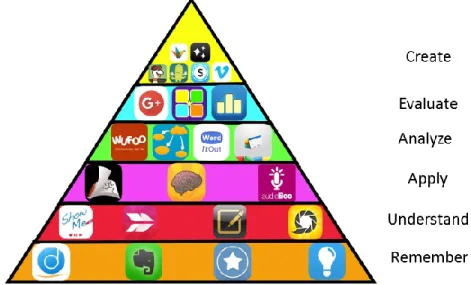
Kathy Schrock, during an edWeb.net webinar, presented some iPad apps that can boost the student’s engagement and collaboration. Furthermore these apps can also be used to teach and learn in accordance to Bloom’s Taxonomy as illustrated in Figure 2.3.
This is important because we claim that our system supports all of the six levels of the Bloom’s Taxonomy. Through the implementation of our system, we have a pre-quiz to test the previous knowledge of the students, either formal, from taking classes at the university level or informal, from learning as a side effect from work experience. The students go through the course units according to the shortest path algorithm, and then they take a quiz after successfully completing each course unit. When the students finsh the targeted modules to complete the course, they are presented with three questions to cover the top three levels of the Blooms Taxonomy (Higher Order Thinking Skills: Analyze, Evaluate, and Create). The multiple choice questions and the true and false questions cover the lower level of Blooms Taxonomy (Lower Order Thinking Skills: Remember, Understand, and Apply).
20
In 2014, Khemaja [27] in the research paper titled “Using Semantic Web Services technology for simulating collaborative learning activities: An approach based on Intelligent Tutoring Systems and E-Learning standards extension” stated that today the joint effort between peers in any learning environment is progressively turning into an important issue because it permits deeper learning and accomplishment of higher levels of learning results. Then again, amid powerful execution of a learning procedure, there is no assurance that successful coordinated effort between peers will happen as intended by the teacher. This research methodology takes into account Semantic Web Services technology to wisely recreate collective learning activities. This methodology considers previous, current, and planned learner context by characterizing the collective state of the environment as well as the learning levels of learners as a consequence of Bloom’s taxonomy.
Hoever and Muehlhaeuser [28] in their research paper titled “Using Learning Analytics in Linked Open Online Courses” stated that the learners’ activities along with the learning process are moving more toward the environments of decentralized learning in the cloud. The progressing of MOOC (Massive Open Online Course) platforms demonstrate an excellent example for this continuing evolution. However, most learning applications utilize exclusive data models. Learners today do not utilize just one eLearning offering; they rely on multiple offerings. As well, the analysis of learner activities occurs in decentralized and heterogeneous learning environments. They provide three learning applications, and they show the possibility of applying Semantic Web technologies.
21
In 2014, Hoever and Muehlhaeuser [29] in their research paper titled “LOOCs - Linked Open Online Courses: A Vision” state that because of diverse data models, MOOCs (Massive Open Online Courses) are frequently monolithic and closed creations, which complicates the task of exchanging, reusing, and obtaining learning resources of different MOOCs. MOOCs must be also LOOCs (Linked Open Online Courses) for enabling the interoperability and interlinking data. When the Semantic Web is used the MOOC (Massive Open Online Courses) applications become an LOOC (Linked Open Online Courses).
In 2014, Shaikh and Khoja [30] in their research paper titled “Towards Guided Personal Learning Environments: Concept, Theory, and Practice” stated that Guided Personal Learning Environment Concept (gPLEc) is a new PLE (Personal Learning Environment) building strategy that tries to satisfy developing adaptive learning for the learner through joining teachers’ direction component in learners' PLE-building action. Utilizing Social Semantic Web (SSW) and Recommender System (RS) advances the gPLEc coordinates teachers’ PLE-based learning skills and learners' social web and association historical data to create customized recommendations for every learner. The outcomes, accomplished in this way, affirm the significance of the teachers’ guidance component for effective execution of the PLE vision. The normal result of this exploratory research is to pick up knowledge to build customized eLearning frameworks.
In 2014, D'Aniello et al. [31] in their paper titled “A Dialogue-Based Approach Enhanced with Situation Awareness and Reinforcement Learning for Ubiquitous Access to Linked Data” stated that the fundamental obstruction to a standard adoption of the
22
Semantic Web and Linked Data is the difficulty for users to seek and recover the needed data in this gigantic network of data. A new methodology is the Ubiquitous Browsing and Searching Linked Data. The proposed methodology depends on a calculated communication model, in particular, Interactive Alignment, for disambiguating both users’ expectations and demands in the connection of an information searching dialogue between humans and machines. The arrangement between people's aims and machine cognizance is enhanced by recognizing circumstances that users are involved in and considering users’ situated preferences. Circumstance Awareness systems are utilized to recognize and handle recognitions about occurring circumstances, and Reinforcement Learning algorithms are exploited so as to elicit and obtain part of the user’s mental model regarding the users established preferences. Interactive alignment of human and computer has been handled by an ISU-based Dialog System Architecture. In addition, this paper proposes a case study, in which users are clients in U-commerce situations, and they are searching for items or services to purchase.
In 2014, Orciuoli [32] in the paper titled “Supporting Seamless Learning with Semantic Technologies and Situation Awareness” stated that the utilization of Linked Data (realized by a method for the Semantic Web Stack) and Situation Awareness strategies with a specific end goal bolster the Seamless Learning situations. Linked Data and Semantic Web technologies and strategies are viewed as extremely valuable to model and support the coherence of the consistent experience crosswise over heterogeneous (in quality, time, and space) learning activities. Besides, Situation Awareness and specifically regarding Situation Recognition techniques can be exploited to manage
23
enhanced forms of omnipresent access to learning assets and services which empower the improvement of the learning environment by utilizing context-specific elements.
In 2014, Badie et al. [33] in their paper titled “A Fuzzy Knowledge Representation Model for Student Performance Assessment” stated that the models for representing Information takes into account Fuzzy Description Logics (DLs) and is able to establish reasoning in intelligent learning environments. While essential DLs are suitable for expressing crisp concepts and binary relationships, Fuzzy DLs are equipped for preparing degrees of truth/ completeness about obscure or inaccurate information. The problem of representing fuzzy classes using OWL2 as a part of a dataset that describes the Performance Assessment Results of Students (PARS).
In 2013, Hadi et al. [34] in their paper titled “A Machine Learning Algorithm for Searching Vectorised RDF Data,” state that the Internet has changed the way we are collecting, accessing and delivering information. In their paper, they expressed that the methodology of executing RDF queries against the Semantic Web information requires an exact match between the inquiry structure and the RDF content. They addressed this problem by converting RDF content into a matrix of features and treated queries as classification problems. They effectively built up a working model framework that exhibits the appropriateness of their methodology. This approach might help in our research as we will use RDF queries against the Semantic Web data.
In 2006, Aroyo et al. [35] in their paper titled “Interoperability in personalized adaptive learning”, state that customized adaptive learning requires semantic-based and context-aware frameworks to deal with the Web knowledge effectively and, in addition,
24
to accomplish semantic interoperability between heterogeneous data resources and services. The technological and theoretical contrasts can be bridged either by a method for benchmarks or by means of methodologies in view of the Semantic Web. The issue of semantic interoperability of educational contents on the Web is to consider the reconciliation of learning standards, Semantic Web, and adaptive innovations to meet the prerequisites of learners. The discussion is based on cutting edge information and the principle challenges in this field, which include metadata, getting to and outlining issues that are identified as being a part of adaptive learning.
In 2013, Soualah et al. [36] in their paper titled “A Context-Based Adaptation In Mobile Learning” stated that new technical capacities exist in the area of learning because of the improvements to mobile phones and wireless technologies. They expressed that mobile learning (mLearning) is a natural extension of eLearning; mLearning has the ability to make learning available on a wide scale because of the rapid advancements in wireless technologies and the broad utilization of mobile devices. They also stated that learners have different backgrounds and objectives and are located in different learning environments (heterogeneity of time, learning time, visual support, ambient noise, etc.).
So by having more information about the learners, we can adjust the learning strategies to satisfy every learner’s needs.
Their approach consisted of two levels:
1. The semantic level aimed to express semantic characteristics of learning contents and learner context
25
2. The behavioral level provided users with only the most relevant information. Their approach made use of learning practices already deployed in eLearning systems and adapts them to mLearning. It is this idea that is fundamental to current work since the new technical capacities provide a greater number of possible tools for enhancing learning.
2.2 Linked Data
Though the Linked Data concept is newer than the Semantic Web concept, it is easier to visualize the Semantic Web by constructing on Linked Data ideas. Linked Data is a set of best practices that provides data infrastructure to facilitate the sharing of data across the Internet.
In 2014 Kang et al. [37], in their paper titles “LRBM: A Restricted Boltzmann Machine Based Approach for Representation Learning on Linked Data,” showed that Linked Data consists of two elements Node attributes and Links Node attributes which represent (preferences, posts, and degrees) while Links describe the connections between nodes.
They have been used widely for the representation of numerous network systems, including social networks and biological networks. Discovering the knowledge on Linked Data is very important to recent applications. One of the major challenges of learning Linked Data is how to extract useful information from both node attributes and links in Linked Data in an efficient and effective manner.
26 Current studies on this topic either use:
1. Selected topological statistics to represent network structures, this approach may miss critical patterns in network structure
2. Linearly map node attributes and network structures share latent feature space, this approach may not be sufficient to capture the non-linear characteristics of nodes and links.
In this proposal, a deep learning method that learns from Linked Data is proposed. Using the LRBM (A Restricted Boltzmann Machine Based Approach for Representation Learning on Linked Data) to extract the latent characteristics of each node from network structure and node attributes then non-linearly map each pair of nodes to the links and control the mapping via hidden units. These experiments have proven that the LRBM is effective. The details about how to utilize the LRBM on Linked Data for prediction and node classification has been shown.
Ontology as a term is derived from the Greek words onto, which means being, and the word logia, which means written or spoken discourse. Ontology means different things to different people. In philosophy, it represents the study of the existence and nature of being. In the Semantic Web, ontologies are formal definitions or representations of vocabularies or knowledge that allows the user to define resource classes, resource properties, and relationships between resource class members [7, 38].
Eisenstadt and Vincent [39] in their book titled “The knowledge web: Learning and collaborating on the net” said that “An ontology is a partial specification of a conceptual
27
vocabulary to be used for formulating knowledge-level theories about a domain of discourse.”
Walia et al. [40] in their research titled “A Novel E-Learning Approach to Add More Cognition to Semantic Web” stated that the Semantic Web approach to eLearning provides relevant and meaningful information to the learner. This is because the human mind develops its own cognitive structure based on personal experiences and background, the mind is usually ambiguous and inconsistent. It is not difficult to learn and secure semantically associated information when the domain of knowledge is huge and well-connected. In this method of eLearning the Semantic Web becomes clear by adding the human conceptual representation and has a mechanism to use the learner profile and experience.
Providing relevant and meaningful information to the learner is fundamental to our research.
As previously mentioned, various related works have contributed to foundation of our research. The following studies address security issues of the Semantic Web that are relevant to our research, since we have to secure sensitive data.
In 2003, Kagal et al. [41], in their paper titled "A policy based approach to security for the semantic web," concluded in their research that in order to secure the Semantic Web, the following two fundamental parts are required: (1) a semantic strategy that characterizes security necessities, (2) a distributed policy management approach. Furthermore, in distributed policy management, each entity can determine its own
28
particular strategy for security and privacy. It is essential for Web entities to have the capacity to clearly express their security. In order to achieve this end goal, they utilize a policy language according to a semantic language to markup security information for Web entities. Kagal et al., also developed two security frameworks: one for distributed environments, and one for supply chain management.
In 2003, Thuraisingham [42], in his study titled "Security issues for the semantic Web," provided an overview of the Semantic Web and discusses security issues. Furthermore, he stated that security must apply to all of the Semantic Web layers. Thuraisingham suggests that security of the Semantic Web should start at the beginning of the project. In addition, he concludes that there are situations in which 100% security should be guaranteed; however, he acknowledged that there are situations that do not require 100% security.
At this stage we have not incorporated any security policy because it is not within the scope of our research. However, we intend to incorporate a security policy in a future study.
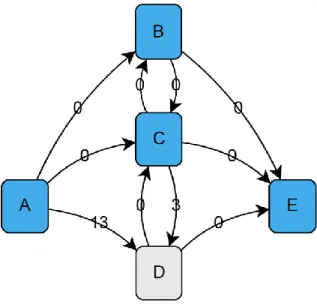
In 2015, Alshalabi and Hamada [6] demonstrated the learning path graph (LPG), which is a good representation of online courses in a computer based usage of an educational framework. This adaptive learning system is displayed as weighted directed graphs, where each course unit is represented by a node on the graph. The Learning Path Graph represents the structure of domain knowledge, learning goals, and all available learning paths as shown in
29
Figure 2.4 Learning Path Graph
In this research project, we implemented an optimal adaptive learning path algorithm utilizing learner information from the learner's profile to enhance specific end goals. This algorithm provides a suitable content sequence in a dynamic structure for all learners to accomplish their learning goals in the most effective manner. The optimal path is calculated using our algorithm, which was designed to obtain the shortest cost between the two course units on the path. This cost is determined by the subject matter expert. Cost factors include, but are not limited to, the difficulty level of course units and estimated time required to complete the unit. This study shows how to optimize an adaptive mobile learning system by using the LPG.
Furthermore, we will demonstrate how to customize student profiles by using the Semantic Web in order to provide online credit to students for the course units completed in other accredited educational institutions. We also describe the conceptual framework of an adaptive mobile learning system and how student profiles are used to adjust the learning path, thereby making the learning path more dynamic. This means that when
30
students learn a course unit, there will be an adjustment to their learning path and a new optimal path will be generated by the system. The interesting point in this study is the ability to use the Semantic Web to exchange student information among educational institutions and to credit students for the course unit that they have already completed. This feature may have the potential to boost the efficiency of the adaptive learning systems and increase the chance for student success.
There are several advantages of ontologies including: 1. Publishing data using common vocabulary and grammar 2. Preserving data semantic descriptions in ontologies 3. Data are ready for inference
4. Better visibility
5. Improves Extensibility 6. Flexibility
7. Ability to add new properties at any time without breaking compatibility [43, 44].
Table 2.1 shows a rough interpretation of terms used to describe relational databases and ontologies. The language that is used to query ontologies is SPARQL.
Table 2.1 Relational Database and Ontology [43]
Relational database Ontology
Row subject
Column predicate
31 2.3 ASP.NET MVC
MVC stands for (Model-View-Controller); it is a design pattern that divides this software into three basic sections: Model, View and Controller to enhance Web development.
MVC is very useful in developing a program in a loose coupling approach. The user interface is done by the View that is only responsible for filling the application template with the data transferred from the controller; The model describes application's business objects, it is responsible for realizing the data logic of application; The controller contains a set of processing functions that are used to respond to user input. In addition to the interaction situations, it also handles all the requests and selects a model that can be used in addition to deciding the kind of view to be generated as shown in Figure 2.5 ASP.NET MVCASP.NET MVC [45].
ASP.NET MVC framework is very helpful in developing a program in loose coupling way. Model-view-controller (MVC) is a software architecture modeling pattern which isolates the representation of data from the user’s actions.
• The model consists of all classes that handles information and business logic, for example, database tables, imperatives, and acceptances.
• The view presents to the screens the client’s access. The perspective uses information from the model to give data to the client. Once the information
32
handling is finished, the controller makes a reaction to the client by sending the outcomes to a View who then creates HTML to be rendered in the browser. • Controller does the data processing utilizing model classes to handle requests
sent in by the user and figures out what actions should be made by the application [45, 46].
33
CHAPTER 3
: RESEARCH PLAN
3.1 Introduction
We are going to use the following items: • RDF
• RDF Triple
• TURTLE
• SPARQL
RDF means “Resource Description Framework”
The query will be done by using The SPARQL. SPARQL is a set of W3C standards for querying and updating data conforming to the model. SPARQL will query the turtle files located on other educational institution’s websites. Turtle: An increasingly popular RDF serialization format based on N3 [3, 7].
RDF Triple:
The basic data structure of RDF.
The three-part combination of the subject, predicate, and object are combined to express a single statement such as:
“The book with ISBN 006251587X has a title of ‘Weaving the Web’.” [7]. Figure 3.1 illustrates the Resource Description Framework (RDF) Triple.
34
For example, as shown in Figure 3.2, the triple "(John) (Knows) (Jane)," (John) is the subject, (Knows) is the predicate, and (Jane) is the object.
Using TURTLE syntax, it can be written as in Figure 3.3
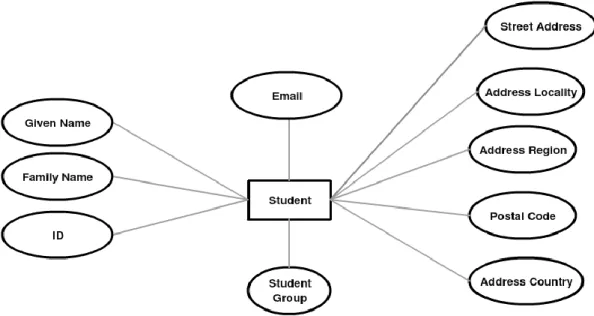
Figure 3.4, illustrates the student’s properties which are as follows: 1. ID
2. Given Name 3. Family Name 4. Email 5. Street Address
Figure 3.1 Resource Description Framework (RDF) Triple
Figure 3.2 Resource Description Framework (RDF) Triple Example
35 6. Address Locality 7. Address Region 8. Postal Code 9. Address Country 10. Student Group
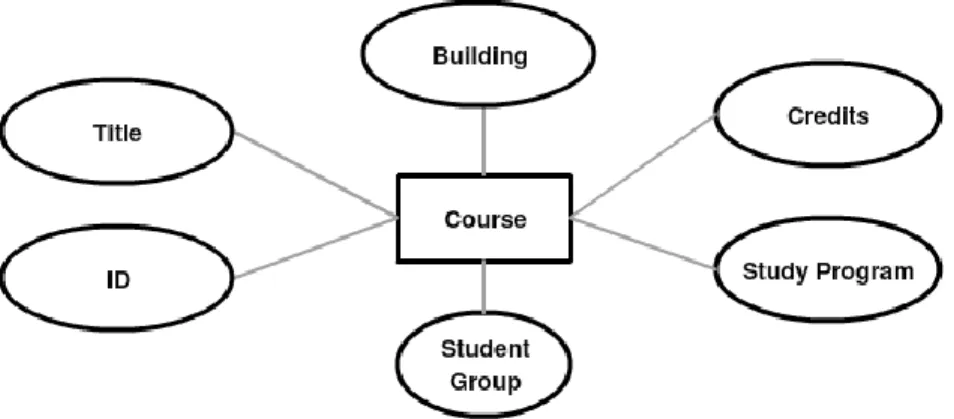
Figure 3.5, illustrates the course’s properties which are as follows: 1. ID 2. Title 3. Credits 4. Study Programs 5. Student Group 6. Building
36
Figure 3.6, illustrates the course module’s properties which are as follows: 1. ID
2. Title
As we can see in Figure 3.7, the files will have relations such as:
Figure 3.7 RDF Triple Relations Figure 3.5 Course Properties
37
The following is some vocabulary from different schemas: @prefix d: <http://adaptivemobilelearning.com/ns/data#> @prefix person:<http://schema.org/Person>
@prefix address: <http://schema.org/> @prefix place: <http://schema.org/Place/>
@prefix aiiso: <http://purl.org/vocab/aiiso/schema#> @prefix contains:<http://schema.org/hasPart>
@prefix teach: <http://linkedscience.org/teach/ns#> @prefix completed: https://schema.org/Completed
Those are the available schemas that we were able to map to our data files; they might not be an exact match, but this study was about a demonstration of how to be able to get student results from another educational institution using the Semantic Web.
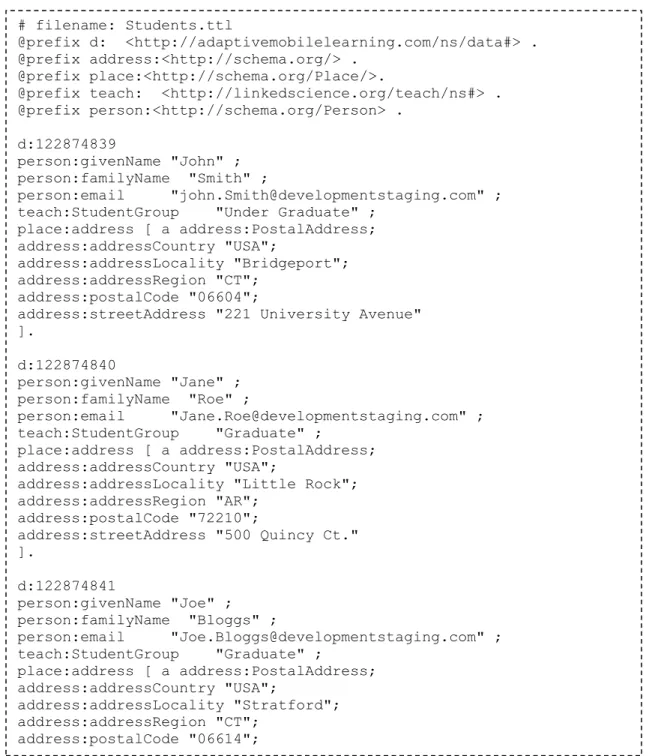
In Figure 3.8, there is a sample of the students’ file that we are going to use to demonstrate how we can communicate with another Educational institution. Then in Figure 3.9, we are going to use the SPARQL query to select students in “CT”. As can be seen in Table 3.1 two students are in Connecticut, John Smith and Joe Bloggs. Later, we will add one more condition for the city to be equal to “Stratford” as shown in Figure 3.10. The only student who lives in “Stratford” in our student’s Turtle file is Joe Bloggs, and the result of running the query confirmed that as we can see in Table 3.2
38
# filename: Students.ttl
@prefix d: <http://adaptivemobilelearning.com/ns/data#> . @prefix address:<http://schema.org/> .
@prefix place:<http://schema.org/Place/>.
@prefix teach: <http://linkedscience.org/teach/ns#> . @prefix person:<http://schema.org/Person> .
d:122874839
person:givenName "John" ; person:familyName "Smith" ;
person:email "[email protected]" ; teach:StudentGroup "Under Graduate" ;
place:address [ a address:PostalAddress; address:addressCountry "USA";
address:addressLocality "Bridgeport"; address:addressRegion "CT";
address:postalCode "06604";
address:streetAddress "221 University Avenue" ]. d:122874840 person:givenName "Jane" ; person:familyName "Roe" ; person:email "[email protected]" ; teach:StudentGroup "Graduate" ; place:address [ a address:PostalAddress; address:addressCountry "USA";
address:addressLocality "Little Rock"; address:addressRegion "AR"; address:postalCode "72210"; address:streetAddress "500 Quincy Ct." ]. d:122874841 person:givenName "Joe" ; person:familyName "Bloggs" ; person:email "[email protected]" ; teach:StudentGroup "Graduate" ; place:address [ a address:PostalAddress; address:addressCountry "USA"; address:addressLocality "Stratford"; address:addressRegion "CT"; address:postalCode "06614";
address:streetAddress "9000 Chapel Street" ].
39
Table 3.1 Result of query from Figure 3.9
Last First City State Bloggs Joe Stratford CT
Smith John Bridgeport CT
Table 3.2 Result of query from Figure 3.10
Last First City State Bloggs Joe Stratford CT
SELECT ?Last ?First ?City ?State WHERE {
?student person:givenName ?First ; person:familyName ?Last ; place:address ?postalAddress . ?postalAddress address:addressLocality ?City; address:addressRegion ?State; address:addressRegion ? 'CT' }
Figure 3.9 SPARQL Query for students in CT
SELECT ?Last ?First ?City ?State WHERE {
?student person:givenName ?First ; person:familyName ?Last ; place:address ?postalAddress . ?postalAddress address:addressLocality ?City; address:addressRegion ?State; address:addressRegion ? 'CT'; address:addressLocality ? 'Stratford'; }
40
3.2 Implementing dotNetRDF [7, 47, 48]
The dotNetRDF project aimed to create an open source .Net library using the latest versions of the .Net framework for providing a powerful and easy-to-use API to work with RDF (resource description framework), SPARQL, and the Semantic Web. The primary goal is to provide an efficient method for working with reasonable amounts of RDF in .Net. Using dotNetRDF is extremely simple. Reading Turtle files can be done as follows. The following snippet loads the Turtle files to memory as a structured graph as shown in Figure 3.11.
In Figure 3.12 the SPARQL query that is going to be executed on the graph g is shown:
SELECT ?First ?Last ?topic WHERE {
?student person:givenName ?First ; person:familyName ?Last ; person:givenName '" + firstName + @"' ; person:familyName '" + lastName + @"' ; completed:Completed ?ct . ?ct aiiso:Module ?topic ; aiiso:Module '" + topic + @"' . }
Figure 3.12 A SPARQL query on the files that are loaded in Figure 3.11
using VDS.RDF; using VDS.RDF.Parsing; (...)
//Create a Symantic Web Graph Graph g = new Graph();
UriLoader.Load(g, new Uri("http://xyz.com/sparql/Faculty.ttl")); UriLoader.Load(g, new Uri("http:// xyz.com/sparql/Courses.ttl")); UriLoader.Load(g, new Uri("http:// xyz.com/sparql/Students.ttl")); UriLoader.Load(g, new Uri("http:// xyz.com/sparql/StudentsCourses.ttl")); UriLoader.Load(g, new Uri("http:// xyz.com/sparql/CourseModules.ttl")); UriLoader.Load(g, new Uri("http:// xyz.com/sparql/StudentsModules.ttl")); UriLoader.Load(g, new Uri("http:// xyz.com/sparql/Courses_CourseModules.ttl")); UriLoader.Load(g, new Uri("http:// xyz.com/sparql/FacultyCourses.ttl"));
41
The query is going to display last name, first name and course unit where first name equals firstName variable, last name equals lastName variable, and the course unit equals
topic variable.
The SPARQL queries can be executed with ExecuteQuery method, as shown in Figure 3.13
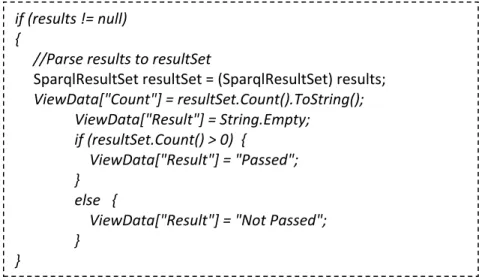
The ExecuteQuery method runs the query against a loaded ontology. In the code shown in Figure 3.14, we will verify that the query executed results are not null and then parse them to a SparqlResultSet. The SparqlResultSet consists of a number of SparqlResults. Each SparqlResult corresponds to a single fetched "row" [47].
We also will get the count of records and then store it into the ViewData["Count"], which will be displayed in the view.
We then will create a ViewData["Result"] in which we store the value “Passed” if the record count is greater than zero otherwise we will store “Not Passed”.
//Query the data with SPARQL
Object results = g.ExecuteQuery(query);
Figure 3.13 Executing Query in Figure 3.12
if (results != null) {
//Parse results to resultSet
SparqlResultSet resultSet = (SparqlResultSet) results; ViewData["Count"] = resultSet.Count().ToString(); ViewData["Result"] = String.Empty; if (resultSet.Count() > 0) { ViewData["Result"] = "Passed"; } else {
ViewData["Result"] = "Not Passed"; }
}
42
We can then use the results from executing the query to update the students’ profile. 3.3 Proposed Conceptual Framework
3.3.1 Development of the Framework
We have performed some tests on the system using ASP.Net MVC and the Turtle files: 1. CourseModules.ttl 2. Courses.ttl 3. Courses_CourseModules.ttl 4. Faculty.ttl 5. FacultyCourses.ttl 6. Students.ttl 7. StudentsCourses.ttl 8. StudentsModules.ttl
We are able to obtain student information regarding the completed course units by suppling the parameters, first name, last name and course unit to the controller via the view and then the controller queries the loaded Turtle files and obtain the result either passed the course unit or not.
This information can be used to update the student’s profile, and then adjust the learning path to make it more adaptive according to Figure 3.15 System Diagram.
In Figure 3.15 when the student registers and completes the questionnaire, the student generates outstanding claims connected with course completion. This will trigger
43
the system to query the Turtle files located at the particular institution’s website in order to verify the student’s completed course units. Once the claim is verified, the course unit will be marked as completed. Then, the system will check to see if the required course units were completed. The system will then mark the course as completed. Otherwise, the student must select one of the available course units and go through its materials and then take a quiz; upon passing it successfully, the course unit will be marked as completed. Then the system will check to determine if the course units’ requirements were fulfilled. Upon completion, the course will be marked as completed.
44
Appendix B illustrates the relationship between the following Turtle files and a student’s completed course units:
1. CourseModules.ttl 2. Courses.ttl 3. Courses_CourseModules.ttl 4. Faculty.ttl 5. FacultyCourses.ttl 6. Students.ttl 7. StudentsModules.ttl
The students’ file in Figure 3.8 shows that the student has the following attributes: ID =122874839
Given Name ="John" Family Name = "Smith"
Email = "[email protected]" Student Group = "Under Graduate"
Postal Address:
45 Address Locality = "Bridgeport" Address Region = "CT"
Postal Code = "06604" Country = "USA"
John Smith has completed the following course units: 1. Introduction
2. Arrays
The Introduction and Arrays are parts of course 390, which has the following attributes:
1. Study Program = "CPSC"
2. Course Title = "Programming Pact" 3. Building = "Main Campus"
4. ects “Credits” = "6"
5. Student Group = "Undergraduate" This course has five modules:
1. "Introduction" 2. "If Statement" 3. "Arrays"
46 4. "Loops" 5. "Sorting Algorithms"
This course has an instructor with the following attributes: 1. Given Name = "Jane"
2. Family Name = "Roe";
3. Email = "[email protected]" 4. Teacher = "course"
Another study demonstrated how we can query the grade in a specific acceptable range as described in The Semantic Web: Real-World Applications from Industry Book to using RUD (University Resource Descriptor), SUD (Student University Descriptor), RQL (RDF Query Language), RDQL (RDF Data Query Language), SWRL (Semantic Web Rule Language) or Buchingae and SPARQL as in Figure 3.16 [49]
SELECT ?x,?c,?z WHERE (?x <http://apus.uma.pt/RUD.owl#HasGPA> ?y), (?x <http://apus.uma.pt/RUD.owl#Studies> ?c), (?y <http://apus.uma.pt/RUD.owl#Value> ?z) AND ?z>3.5
47
CHAPTER 4
: EXPEREMENTS AND RESULT
4.1 Introduction
We have developed an adaptive mobile learning system that uses the students’ profiles. The system obtains the shortest, most dynamic, optimal path for each student according completed course units. In addition to verifying students’ claims about completed course units from another educational institution the then gives credit to students for those course units. The framework uses ASP.net MVC design pattern along with SPARQL queries and Turtle files.
4.2 Analysis
We suggest that the use of AML enhances the learning process, when compared to the classical methods of learning. This section summarizes the statistical analysis performed with the goal of testing the alternative hypothesis for the experiment.
The statistical test is defined as the probability that the null hypothesis will be rejected by the test when the null hypothesis is false, and it confirms the alternative hypothesis when the alternative hypothesis is true [50][50][52]. The two opposing hypotheses are stated as follows:
Null Hypothesis H0 (µ ≤ µ0) Alternate Hypothesis Ha (µ > µ0) where:
48
µ is the Test Group mean. µ0 is the Control Group mean.
The test will have one of two conclusions: either to accept H0 or to reject H0. We will use the two-tailed test.
The significance of an observed difference is determined by the selected Level of Significance (α), which commonly is either 5% (0.05) or 1% (0.01).
Table 4.1 shows the AML Group Results and Table 4.2 shows the Control Group Results.
The parameters in section 4.3 are computed in order to decide whether to accept or reject the hypotheses H0.
4.3 Hypothesis Testing
Null hypothesis (H0): 𝑋̅𝐴𝑀𝐿 ≤ 𝑋̅𝐶𝑜𝑛𝑡𝑟𝑜𝑙 𝐺𝑟𝑜𝑢𝑝 These two groups have the same
outcome.
Alternative hypothesis (Ha): 𝑋̅𝐴𝑀𝐿> 𝑋̅𝐶𝑜𝑛𝑡𝑟𝑜𝑙 𝐺𝑟𝑜𝑢𝑝 These two groups do not have the same outcome.
where:
𝑋̅𝐴𝑀𝐿 is the AML Group mean.
49
Table 4.1 AML Group Results
No. Pre-Quiz Quiz 1 Quiz 2