An instructional design framework for authentic learning environments
Jan Herrington and Ron Oliver
Edith Cowan University, Perth, Western Australia
Herrington, J., & Oliver, R. (2000). An instructional design framework for authentic learning environments. Educational Technology Research and Development, 48(3), 23-48.
Abstract
The instructional technology community is in the midst of a philosophical shift from a behaviorist to a constructivist framework, a move that may begin to address the growing rift between formal school learning and real-life learning. One theory of learning that has the capacity to promote authentic learning is that of situated learning.
The purpose of this three part study was firstly, to identify critical characteristics of a situated learning environment from the extensive literature base on the subject; secondly, to operationalise the critical characteristics of a situated learning environment by designing a multimedia program which incorporated the identified characteristics; and thirdly, to investigate students’ perceptions of their experiences using an multimedia package based on a situated learning framework.
The learning environment comprised a multimedia program for preservice teachers on assessment in mathematics, together with recommended implementation conditions in the classroom. Eight students were observed and interviewed to explore their perceptions of the situated learning environment. Findings suggest that the use of the situated learning framework appeared to provide effective instructional design guidelines for the design of an environment for the acquisition of advanced knowledge.
Introduction
The separation between knowing and doing has traditionally been the hallmark of school and university learning (Resnick, 1987). The emphasis in school and university has been on extracting essential principles, concepts and facts, and teaching them in an abstract and decontextualised form. The inadequacies of this approach abound in everyday experience, for example: the driver with a physics degree, attempting to dig the car out of sand instead of partially deflating the tyres. In cases such as this, there is a failure to access knowledge which is clearly relevant to solve the problem in hand. Information has been stored as facts rather than as tools (Bransford, Sherwood, Hasselbring, Kinzer, & Williams, 1990), is ‘welded’ to its original occasion of use (Brown, 1997), or as Whitehead (1932) suggested, the knowledge has remained ‘inert’.
These studies suggest that much of the abstract knowledge taught in schools and universities is not retrievable in real-life, problem-solving contexts, because this approach ignores the
interdependence of situation and cognition. When learning and context are separated, knowledge itself is seen by learners as the final product of education rather than a tool to be used dynamically to solve problems. Cole (1990) contends that traditional education overemphasises the acquisition of facts and procedures, a situation that Entwhistle, Entwhistle and Tait (1993) argue is bolstered by the nightly quiz shows on television which ‘publicize and reward ... incremental,
decontextualized knowledge’ (p. 335). There is no contention that formal instruction should be abandoned in favour of context-dependent strategies that are learnt ‘on the job’. Rather, the
implication is to determine the pedagogical significance of the findings and to promote appropriate and effective classroom techniques and practices to foster meaningful learning.
There have been several attempts to use the findings of the research into contextualised learning to design a model of instruction. For example, Resnick (1987) pre-empted later models by proposing that ‘bridging apprenticeships’ be designed to bridge the gap between the theoretical learning in the formal instruction of the classroom and the real-life application of the knowledge in the work environment. However, it was Brown, Collins and Duguid (1989b) who developed a focus for the theory of situated cognition or situated learning and produced a proposal for a model of instruction that has implications for classroom practice. Collins (1988) defines situated learning as: ‘the notion of learning knowledge and skills in contexts that reflect the way the knowledge will be useful in real life’ (p. 2).
A critical aspect of the situated learning model is the notion of the apprentice observing the ‘community of practice’. Lave and Wenger (1991) propose that participation in a culture of practice can, in the first instance, be observation from the boundary or ‘legitimate peripheral participation’. As learning and involvement in the culture increase, the participant moves from the role of observer to fully functioning agent. Legitimate peripheral participation enables the learner to progressively piece together the culture of the group and what it means to be a member. ‘To be able to participate in a legitimately peripheral way entails that newcomers have broad access to arenas of mature practice’ (p. 110). Lave and Wenger (1991) propose that the main functions of legitimate peripheral participation are to enable the learning of the language and stories of a community of practice, and to learn how to speak both within and about the practice, and yet this opportunity is denied students in many learning environments (Kirk & Macdonald, 1998).
While the publication of the model of situated learning met with much interest and acclaim, it has also been widely challenged, debated and questioned. Many of the criticisms of attempts to use situated learning as a model of instruction have been based on how closely the learning
environment resembles, not a cognitive apprenticeship, but a traditional apprenticeship. For
example, Tripp (1993) presented a narrow set of criteria to define situated learning, which equated very much with a standard apprenticeship. In a response to the original Brown, Collins and
Duguid article in 1989, Wineburg (1989) argued that the abstract representation of knowledge was at least as effective as the situated learning approach and much more readily implemented in the classroom.
However, the principal theorists of situated learning have consistently argued that their model, when further researched and developed, would be a model for teaching with practical classroom applications (Brown, Collins, & Duguid, 1989a; Brown et al., 1989b; Collins, 1988; Collins, Brown, & Newman, 1989). For those who question the appropriateness of the situated learning framework in conventional classrooms, the application of the model to computer-based learning is a further step removed from the traditional apprenticeship role. For example, Hummel (1993) described a distance education course on Soil and Environment which was based on ideas from situated learning theory. Hummel rejected the idea that the program was true situated learning by virtue of the fact that it was computer-based: ‘Instructional designers who apply situated learning theory by implementation in electronic media should realize that they take an important step away from this theory ... courseware becomes the learning environment and not the authentic situation’ (p. 15). Similarly, Tripp (1993) contended that computer-based simulations are not sufficient and reiterated that ‘true expertise is learned by being exposed to experts’ (p. 75).
There is increasing agreement, nonetheless, that computer-based representations and ‘microworlds’ do provide a powerful and acceptable vehicle for the critical characteristics of the traditional apprenticeship to be located in the classroom environment. Reeves (1993a) considers that one of the major benefits of a well-designed multimedia environment is its ability to include
‘opportunities for simulated apprenticeships as well as a wealth of learning support activities’ (p. 107). Many of the researchers and teachers exploring the model of situated learning have accepted that the computer can provide an alternative to the real-life setting, and that such technology can be used without sacrificing the authentic context which is such a critical element of
the model. McLellan (1994) summarised these approaches by pointing out that while knowledge must be learned in context according to the situated learning model, that context can be: the actual work setting, a highly realistic or ‘virtual’ surrogate of the actual work environment, or an
anchoring context such as a video or multimedia program (p. 8).
The research aims
The purpose of this research was to determine the possibility of applying a model of instructional design based on the theory of situated learning to the design of a multimedia learning environment for university students, and to investigate students’ responses to that learning environment. The research was designed to be conducted in several interrelated stages:
Part 1: Definition of critical characteristics of situated learning and development of framework
The first stage of the research was to identify the critical characteristics of a situated learning model from the research, debates and discussion generated in the extensive body of literature.
Part 2: Design and production of the multimedia package
A complete instructional package was designed to incorporate the critical elements of a situated learning environment (determined in Part 1). A multimedia program for CD-ROM was developed in the area of assessment strategies for mathematics teachers of grades K-12, together with planned strategies for implementation in a second year tertiary mathematics-method class for preservice teachers. The program was then used with students in subsequent parts of the study.
Part 3: The implementation of the multimedia program as a situated learning environment
Part 3 of the research investigated students’ perceptions of their experiences using a multimedia package based on a situated learning framework in a university classroom environment.
These three parts to the study were part of a larger, more complex and comprehensive study which included investigation of students’ navigation through the program, an analysis of higher order thinking and a transfer study.
Part 1: Definition of critical characteristics of situated learning and
development of framework
LeCompte and Preissle (1993) contended that: ‘The purpose of theories is to help us sort out our world, make sense of it, guide how we behave in it, and predict what might happen next (p. 120). The critical question was one pre-empted by the principal proponents of situated learning: ‘One of the most persistent educational questions following discussions of situated learning has been: How can these situated theories be operationalised?’ (Brown & Duguid, 1993, p. 10). In multimedia development, Park and Hannafin (1993) argued that technological capacity and the intuition of designers drive the design of multimedia rather than research and theory. Brown, Collins and Duguid (1989b), in their original article presented a nascent theory of situated learning which has the potential to provide a theoretical basis for a new framework for multimedia design and development. From the start they suggested that their model was the beginning of the process of developing a theoretical perspective for successful learning that cognitive science had, to date, not been able to explain. The challenge put to researchers was to identify the critical aspects of
situated learning to enable it to translate into teaching methods which could be applied in the classroom.
In response to this challenge, a practical framework for the design of learning environments was produced. Essentially, current literature suggests that useable knowledge is best gained in learning environments which feature the following characteristics. Situated learning environments:
1. Provide authentic contexts that reflect the way the knowledge will be used in real life 2. Provide authentic activities
3. Provide access to expert performances and the modelling of processes 4. Provide multiple roles and perspectives
5. Support collaborative construction of knowledge
6. Promote reflection to enable abstractions to be formed
7. Promote articulation to enable tacit knowledge to be made explicit 8. Provide coaching and scaffolding by the teacher at critical times 9. Provide for authentic assessment of learning within the tasks.
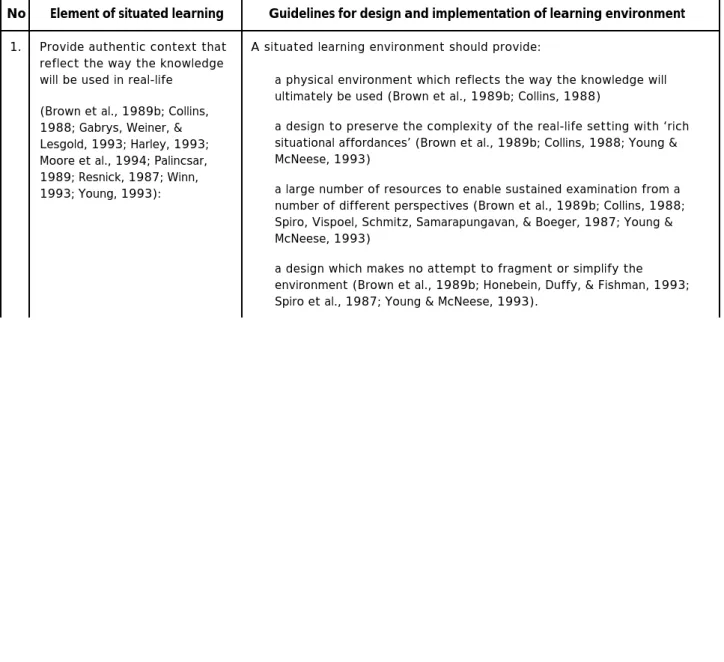
Table 1 provides a checklist of guidelines for the instructional design of a learning environment which enables the situated elements to be operationalised, together with supporting authors, researchers and theorists.
Table 1: Elements of situated learning with supporting authors and guidelines for implementation
No Element of situated learning Guidelines for design and implementation of learning environment
1. Provide authentic context that reflect the way the knowledge will be used in real-life
(Brown et al., 1989b; Collins, 1988; Gabrys, Weiner, & Lesgold, 1993; Harley, 1993; Moore et al., 1994; Palincsar, 1989; Resnick, 1987; Winn, 1993; Young, 1993):
A situated learning environment should provide:
r
a physical environment which reflects the way the knowledge will ultimately be used (Brown et al., 1989b; Collins, 1988)r
a design to preserve the complexity of the real-life setting with ‘rich situational affordances’ (Brown et al., 1989b; Collins, 1988; Young & McNeese, 1993)r
a large number of resources to enable sustained examination from a number of different perspectives (Brown et al., 1989b; Collins, 1988; Spiro, Vispoel, Schmitz, Samarapungavan, & Boeger, 1987; Young & McNeese, 1993)r
a design which makes no attempt to fragment or simplify the environment (Brown et al., 1989b; Honebein, Duffy, & Fishman, 1993; Spiro et al., 1987; Young & McNeese, 1993).No Element of situated learning Guidelines for design and implementation of learning environment
2. Provide authentic activities (Brown et al., 1989b; Cognition and Technology Group at Vanderbilt [CTGV], 1990a; Griffin, 1995; Harley, 1993; Resnick, 1987; Tripp, 1993; Winn, 1993; Young, 1993):
r
activities which have real-world relevance (Brown et al., 1989b; Cognition and Technology Group at Vanderbilt [CTGV], 1990a; Jonassen, 1991; Resnick, 1987; Winn, 1993; Young, 1993)r
ill-defined activities (Brown et al., 1989b; CTGV, 1990a; Winn, 1993; Young, 1993)r
a single complex task to be investigated by students (Bransford, Vye, et al., 1990; CTGV, 1990b; Jonassen, 1991)r
an opportunity for students to define the tasks and sub-tasks required to complete the activity (Bransford , Vye, et al., 1990; CTGV, 1990b; Collins et al., 1989; Young, 1993)r
a sustained period of time for investigation (Bransford et,Vye, et al., 1990; CTGV, 1990b)r
the opportunity to detect relevant versus. irrelevant information, (CTGV, 1990a; Young, 1993)r
the opportunity to collaborate (Young, 1993)r
tasks which can be integrated across subject areas (Bransford, Sherwood, et al., 1990; Bransford , Vye, et al., 1990; Jonassen, 1991) 3. Provide access to expertperformances and the modelling of processes
(Collins, 1988; Collins et al., 1989; Lave & Wenger, 1991; Resnick, 1987)
r
access to expert thinking and modelling processes (Collins, 1988; Collins et al., 1989)r
access to learners in various levels of expertise (Collins et al., 1989)r
opportunity for the sharing of narratives and stories (Brown et al., 1989b; Brown & Duguid, 1993; Lave & Wenger, 1991)r
access to the social periphery or the observation of real-life episodes as they occur (Brown et al., 1989b; Brown & Duguid, 1993; Lave & Wenger, 1991)4. Provide multiple roles and perspectives
(Bransford, Sherwood, et al., 1990; Brown et al., 1989b; CTGV, 1990a; CTGV, 1993; Collins et al., 1989; Lave & Wenger, 1991; Spiro, Feltovich, Jacobson, & Coulson, 1991a; Spiro, Feltovich, Jacobson, & Coulson, 1991b; Young, 1993)
r
different perspectives on the topics from various points of view (Bransford , Sherwood, et al., 1990; Brown et al., 1989b; CTGV, 1990a; CTGV, 1993; Collins et al., 1989; Lave & Wenger, 1991)r
the opportunity to express different points of view through collaboration (Honebein et al., 1993)r
the opportunity to criss cross the learning environment by providing more than one investigation within a resource sufficiently rich to sustain repeated examination, (Spiro et al., 1991a; Spiro et al., 1991b; Young, 1993)5. Support collaborative construction of knowledge (Bransford , Sherwood, et al., 1990; Brown et al., 1989b; CTGV, 1990a; Collins et al., 1989; Resnick, 1987; Young, 1993)
r
tasks which are addressed to a group rather than an individual (Alessi, 1996; Brown et al., 1989b; Collins et al., 1989; Hooper, 1992; Resnick, 1987; Young, 1993)r
classroom organizationinto pairs or small groups (Hooper, 1992)r
appropriate incentive structure for whole group achievement (Hooper, 1992).No Element of situated learning Guidelines for design and implementation of learning environment
6. Promote reflection to enable abstractions to be formed (Brown et al., 1989b; CTGV, 1990a; Collins, 1988; Collins et al., 1989; Resnick, 1987)
r
authentic context and task (Brown et al., 1989b; Norman, 1993)r
the facility for students to return to any element of the program if desired, and to act upon reflection (Boud, Keogh, & Walker, 1985; Collins & Brown, 1988; Kemmis, 1985)r
the opportunity for learners to compare themselves with experts (Collins, 1988; Collins & Brown, 1988; Collins, Brown, & Holum, 1991)r
the opportunity for learners to compare themselves with other learners in varying stages of accomplishment (Collins et al., 1989)r
collaborative groupings of students to enable reflection with aware attention (Kemmis, 1985; Knights, 1985; von Wright, 1992) 7. Promote articulation to enabletacit knowledge to be made explicit
(Bransford, Sherwood, et al., 1990; Collins, 1988; Collins et al., 1989)
r
a complex task incorporating inherent, as opposed to constructed, opportunities to articulate (Bransford , Sherwood, et al., 1990; Collins, 1988; Collins et al., 1989; Edelson, Pea, & Gomez, 1996)r
collaborative, groups to enable social then individual understanding (Mercer, 1996; Vygotsky, 1978)r
public presentation of argument to enable articulation and defence of learning (Lave & Wenger, 1991; Pea, 1991)8. Provide coaching by the teacher at critical times, and scaffolding and fading of teacher support (Collins, 1988; Collins et al., 1989; Griffin, 1995; Harley, 1993; Resnick, 1987; Young, 1993)
r
a complex, open-ended learning environment (Collins, 1988; Collins et al., 1989; Resnick, 1987)r
no attempt to provide intrinsic scaffolding and coaching (Collins & Brown, 1988; Dreyfus & Dreyfus, 1989; Greenfield, 1984; Reeves, 1993b; Wilson & Welsh, 1991)r
collaborative learning, where more able partners can assist with scaffolding and coaching (Collins, 1988; Collins et al., 1989; Young, 1993)r
recommendations that the teacher implementing the program is available for coaching and scaffolding assistance for a significant portion of the period of use (Collins, 1988; Griffin, 1995; Harley, 1993; Young, 1993)9. Provide for integrated assessment of learning within the tasks
(McLellan, 1993; Young, 1993; Young, 1995).
r
fidelity of context (Meyer, 1992; Reeves & Okey, 1996; Wiggins, 1993)r
the opportunity for students to be effective performers with acquired knowledge, and to craft polished, performances or products (Wiggins, 1989; Wiggins, 1990; Wiggins, 1993)r
significant student time and effort in collaboration with others (Kroll, Masingila, & Mau, 1992; Linn, Baker, & Dunbar, 1991)r
complex, ill structured challenges that require judgement, and a full array of tasks (Linn et al., 1991; Torrance, 1995; Wiggins,1993)r
the assessment to be seamlessly integrated with the activity (Reeves & Okey, 1996; Young, 1995,)r
multiple indicators of learning (Lajoie, 1991; Linn et al., 1991)r
validity and reliability with appropriate criteria for scoring varied products (Hooper, 1992; Lajoie, 1991; Resnick & Resnick, 1992; Wiggins, 1990; Young, 1995)Part 2:
Design and production of the multimedia package
Once the critical characteristics for a situated learning environment and guidelines for their
implementation were established, a multimedia program was developed which operationalised the critical elements. While the content area for the development of the program was not critical, the domain of mathematics education was chosen and proved to be particularly appropriate. Some writers have expressed concern that despite the emphasis in teacher education courses on
‘reformist’ methods of teaching mathematics, teachers frequently revert to methods derived solely from their own experiences as students (Lampert & Ball, 1998; Lampert & Ball, 1990). Others have noted that preservice teachers’ experiences in classrooms during their professional practice have proved inadequate because students observe teaching ‘driven by texts and tests’, or they are ill equipped to detect the subtle differences between high quality and mediocre teaching (Mousley & Sullivan, 1995). The situated learning framework could be used to produce a resource to address these concerns. The resource would focus on assessment strategies in mathematics classrooms (K-12), and it would be designed primarily for a target group of undergraduate preservice teachers (see Figure 1 for an annotated graphic of the main interface).
Figure 1: The main interface of the assessment program
Drawing upon the characteristics of a situated learning environment, and the requirements of the content area of assessment, the media elements that comprise the multimedia program are:
• Video clips of teachers using various assessment techniques within their classrooms in order to show an authentic example of particular assessment strategies being used in a real classroom;
• Video clips of teachers’ comments on the strategies, to present the teachers’ own reflections on the strengths and weaknesses of each approach;
• Video clips of children’s comments on the strategies to present their thoughts on each approach; • Interviews with experts in the field to provide theoretical perspectives;
• Reflections by third year preservice teachers to provide practical advice from the perspective of students whose experience is more advanced than the students who would use the resource;
• Text descriptions of each assessment category to provide a simple description of each strategy together with practical advice on its implementation in different classroom situations;
• Work samples from teachers and children to enable students to scrutinise work and resources presented in the scenarios;
• An electronic notebook within the program to enable students to copy text from files and to write their own reflections and ideas;
• Investigations to enable the students to examine the resource within authentic tasks.
Authentic activities were incorporated into the program to provide sustained and complex tasks for students to complete as they used the program. The tasks are presented to the student realistically, such as in a memo or letter, rather than simply a list of possible activities, and they included genuine constraints such as deadlines and time allowances. Activities assume that students will be working in pairs or small groups, and require them to examine the resource from a variety of perspectives (Figure 2 presents the activity used in the research).
Figure 2: The activity presented to students
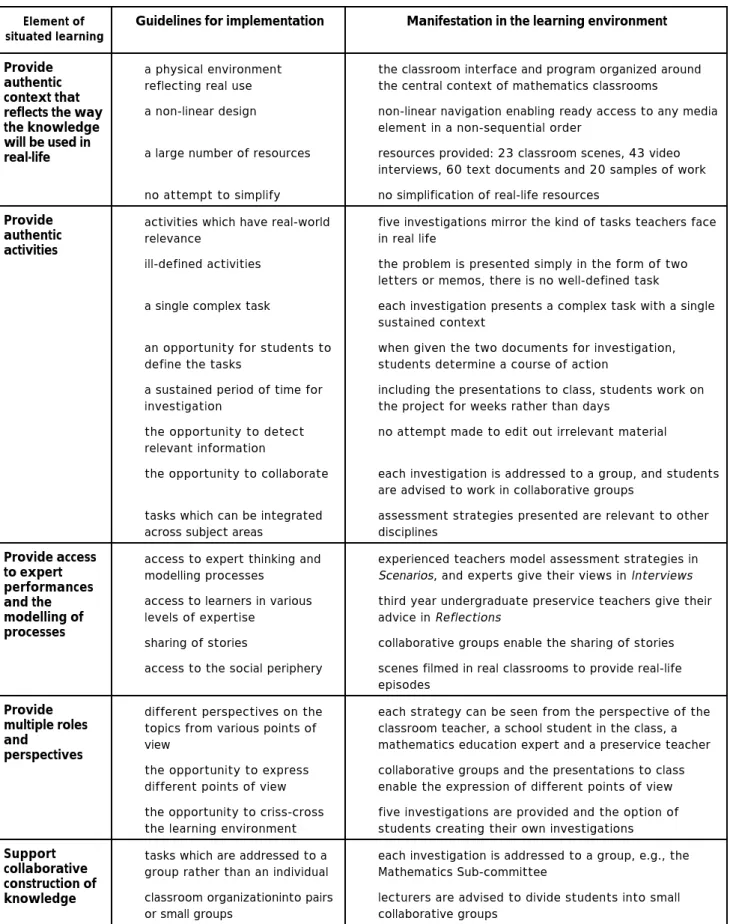
Care was taken to ensure that all the guidelines for a situated learning environment, defined in Table 1, were operationalised within the software where appropriate. An instruction manual for facilitators and students was produced to provide guidance on how to use and implement the
resource and to provide advice on the situated learning elements that were not included in the program itself (such as collaboration and articulation). Table 2 summarises the manifestation of the situated learning elements, both within the software itself and in its recommended
implementation.
Table 2: Manifestation of critical elements of situated learning in the learning environment
Element of situated learning
Guidelines for implementation Manifestation in the learning environment
Provide authentic context that reflects the way the knowledge will be used in real-life
r
a physical environment reflecting real user
a non-linear designr
a large number of resourcesr
no attempt to simplifyr
the classroom interface and program organized around the central context of mathematics classroomsr
non-linear navigation enabling ready access to any media element in a non-sequential orderr
resources provided: 23 classroom scenes, 43 video interviews, 60 text documents and 20 samples of workr
no simplification of real-life resourcesProvide authentic activities
r
activities which have real-world relevancer
ill-defined activitiesr
a single complex taskr
an opportunity for students to define the tasksr
a sustained period of time for investigationr
the opportunity to detect relevant informationr
the opportunity to collaborater
tasks which can be integrated across subject areasr
five investigations mirror the kind of tasks teachers face in real lifer
the problem is presented simply in the form of two letters or memos, there is no well-defined taskr
each investigation presents a complex task with a single sustained contextr
when given the two documents for investigation, students determine a course of actionr
including the presentations to class, students work on the project for weeks rather than daysr
no attempt made to edit out irrelevant materialr
each investigation is addressed to a group, and students are advised to work in collaborative groupsr
assessment strategies presented are relevant to other disciplines Provide access to expert performances and the modelling of processesr
access to expert thinking and modelling processesr
access to learners in various levels of expertiser
sharing of storiesr
access to the social peripheryr
experienced teachers model assessment strategies inScenarios, and experts give their views in Interviews
r
third year undergraduate preservice teachers give theiradvice in Reflections
r
collaborative groups enable the sharing of storiesr
scenes filmed in real classrooms to provide real-life episodesProvide multiple roles and
perspectives
r
different perspectives on the topics from various points of viewr
the opportunity to express different points of viewr
the opportunity to criss-cross the learning environmentr
each strategy can be seen from the perspective of the classroom teacher, a school student in the class, a mathematics education expert and a preservice teacherr
collaborative groups and the presentations to class enable the expression of different points of viewr
five investigations are provided and the option of students creating their own investigationsSupport collaborative construction of knowledge
r
tasks which are addressed to a group rather than an individualr
classroom organizationinto pairs or small groupsr
appropriate incentive structure for whole group achievementr
each investigation is addressed to a group, e.g., the Mathematics Sub-committeer
lecturers are advised to divide students into small collaborative groupsr
grades for class presentations and written reports are given for a group effort, not individuallyElement of situated learning
Guidelines for implementation Manifestation in the learning environment
Promote
reflection
r
authentic context and taskr
non linear navigationr
opportunity for learners to compare with expertsr
opportunity for learners to compare with other learnersr
collaborative groupings of studentsr
real classroom context and taskr
non-linear navigation enabling ready access to any media element in a non-sequential orderr
students can compare their thoughts to an experienced classroom teacher and mathematics education expertsr
students can compare their thoughts to a preservice teacher in the third year of their teacher training courser
collaborative groups recommended to enable reflection with aware attentionPromote
articulation
r
a complex task incorporatinginherent opportunities toarticulate
r
groups to enable articulationr
public presentation of argument to enable defence of learningr
the complexity of the investigation affords a necessity to articulate to complete the task, rather than in response to cues built into the programr
collaborative groups recommendedr
articulation and defence of findings in oral presentation to the classProvide coaching and scaffolding
r
a complex, open-ended learning environmentr
a non-linear multimedia designr
guidelines for the use of the program in a variety of contextsr
collaborative learningr
recommendations that the lecturer is available for coachingr
classroom context and open-ended complex task with no simplification of proceduresr
non-linear design with no program feedbackr
suggestions on ways to implement the program in the classroom provided in the Manual for facilitatorsr
collaborative groups recommended, where more ablepartners can assist with scaffolding and coaching
r
suggestions provided in the Manual for facilitators on the scaffolding and coaching roleProvide for authentic assessment of learning within the tasks
r
fidelity of contextr
the opportunity for students to craft polished, performances or productsr
significant student time and effort in collaborationr
complex, ill structured challengesr
assessment to be seamlessly integrated with the activityr
multiple indicators of learningr
validity and reliability with appropriate criteria for scoring varied productsr
classroom contextr
students are required to present a formal written report and a public presentation to class (details oforganizationare presented in the Manual for facilitators)
r
complex investigation requires significant time (2-3 weeks recommended)r
open-ended complex task with no simplification of procedures, requiring written and oral responsesr
students are assessed on the results of the investigation, there are no separate testsr
indicators of learning comprise a formal written report and an oral presentationr
assessment is based on results of investigation not formal tests; peer assessment is recommended for the presentationsPart 3:
The implementation of the multimedia program as a situated
learning environment
The research sought to investigate the nature of a purposely-designed learning environment based on situated learning, and to explore students’ perceptions of learning environment in depth. The use of a qualitative methodology was considered most suitable for this purpose because of its compatibility with the theoretical framework and the nature of the research aims. The methodology was guided by the principles of interpretive inquiry outlined by researchers such as Eisner (1991), Miles and Huberman (1994), and LeCompte and Preissle (1993).
The participants
The participants were eight second year preservice secondary teachers studying mathematics method. The sampling choice was made on conceptual grounds, not representative, and focused on the ‘typical case’ as selected by the regular lecturer (LeCompte & Preissle, 1993; Miles &
Huberman, 1994). Students formed into pairs of their own choosing prior to selection to maximise collaborative interactions. The lecturer using the program with the class was one of the content experts who contributed to the development of the multimedia program on assessment. The study was conducted with the researcher in the role of ‘observer-as-participant’ (as defined by Gold, 1969) and was introduced to the group as a researcher with no involvement in the activities in the classroom beyond observation and data collection.
Procedure
The study was conducted within a normal program of instruction at the University. The lecturer introduced the subject of assessment, and the multimedia program and its capabilities to the class. All students in the class used the program on assessment (Herrington, Sparrow, Herrington, & Oliver, 1997) to complete the activity (Figure 2) over a period of 5 hours (2 weeks lecture time). The activity required the pairs of students to assume the identity of new teachers in a school given responsibility to prepare a report to staff on assessment strategies.
The pairs of students worked on the program, with their lecturer available for the entire period, with the lecturer providing assistance to the students as required. In the third week, the lecturer invited the students to a ‘staff meeting’ to present their findings. Each pair was asked to present a report to the remainder of the class, and these reports were evaluated by their peers according to four criteria: effectiveness of argument, the proposal’s practicality, how well the arguments were supported and presentation skills. The lecturer collected the evaluations at the conclusion of the class, and used the marks to assign a group mark for each presentation, which was used as part of their unit assessment.
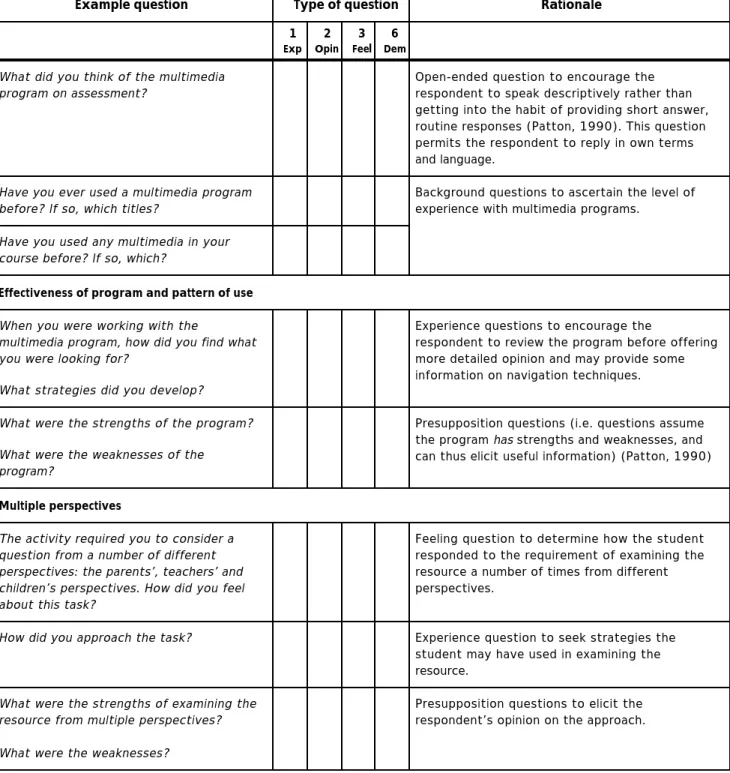
In order to consolidate and expand on the information gained from observing the students using the multimedia program, interviews were conducted individually with the students. An interview schedule of over 40 questions was designed according to Patton’s (1990) classification of interview questions. The majority of the questions were opinion and feeling questions. There were some
experience and demographic questions but no knowledge or sensory questions. No attempt was made to question students about their overt knowledge of assessment strategies during the interviews (as this data was to be collected by other means in another part of the research) nor was it felt
necessary or appropriate to elicit any sensory information. Questions were designed to elicit students’ perceptions of the learning environment as a whole, with particular reference to the nine situated learning design elements. Table 3 gives examples of the types of questions used, together with a brief rationale. The eight students were interviewed separately for 45-60 minutes each, and at their conclusion the tapes were transcribed for analysis.
Table 3: Example of schedule, classification and rationale of interview questions
Example question Type of question Rationale
1 Exp 2 Opin 3 Feel 6 Dem
What did you think of the multimedia program on assessment?
4 Open-ended question to encourage the respondent to speak descriptively rather than getting into the habit of providing short answer, routine responses (Patton, 1990). This question permits the respondent to reply in own terms and language.
Have you ever used a multimedia program before? If so, which titles?
4 Background questions to ascertain the level of
experience with multimedia programs.
Have you used any multimedia in your course before? If so, which?
4
Effectiveness of program and pattern of use
When you were working with the
multimedia program, how did you find what you were looking for?
What strategies did you develop?
4 Experience questions to encourage the
respondent to review the program before offering more detailed opinion and may provide some information on navigation techniques.
What were the strengths of the program? What were the weaknesses of the program?
4 Presupposition questions (i.e. questions assume
the program has strengths and weaknesses, and can thus elicit useful information) (Patton, 1990)
Multiple perspectives
The activity required you to consider a question from a number of different perspectives: the parents’, teachers’ and children’s perspectives. How did you feel about this task?
4 Feeling question to determine how the student responded to the requirement of examining the resource a number of times from different perspectives.
How did you approach the task? 4 Experience question to seek strategies the student may have used in examining the resource.
What were the strengths of examining the resource from multiple perspectives?
What were the weaknesses?
4 Presupposition questions to elicit the respondent’s opinion on the approach.
Data analysis and results
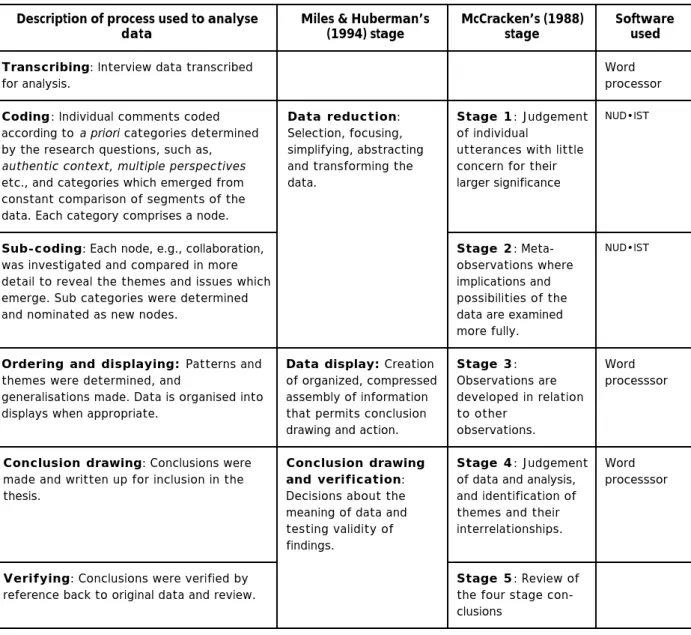
Techniques of qualitative analysis recommended by Miles and Huberman (1994), Eisner (1991) and McCracken (1988) were used to analyse the interview data collected from the study. The analysis involved the three step process proposed by Miles and Huberman: data reduction, data display, and conclusion drawing and verification. The analysis was done with the assistance of NUD•IST (Qualitative Solutions & Research, 1997), a computer-based qualitative analysis program. The process of coding data in several stages was conducted in a manner similar to that described by McCracken (1988). Data from the transcripts were coded into categories (or nodes) according to their relevance to the a priori categories for analysis—the nine elements of a situated learning environment, together with sub-themes that emerged within these categories. The method
of analysis employed the qualitative analysis processes of constant comparative analysis (Glaser & Strauss, 1967; LeCompte and Preissle, 1993) and comparative pattern analysis (Patton, 1990), which was facilitated well by the NUD•IST software. The process of coding the data is summarised in Table 4, together with Miles and Huberman’s stages, McCracken’s stages, and the computer software used.
Table 4: Stages of analysis of data Description of process used to analyse
data
Miles & Huberman’s (1994) stage
McCracken’s (1988) stage
Software used
Transcribing: Interview data transcribed for analysis.
Word processor Coding: Individual comments coded
according to a priori categories determined by the research questions, such as,
authentic context, multiple perspectives
etc., and categories which emerged from constant comparison of segments of the data. Each category comprises a node.
Data reduction: Selection, focusing, simplifying, abstracting and transforming the data.
Stage 1: Judgement of individual
utterances with little concern for their larger significance
NUD•IST
Sub-coding: Each node, e.g., collaboration, was investigated and compared in more detail to reveal the themes and issues which emerge. Sub categories were determined and nominated as new nodes.
Stage 2: Meta-observations where implications and possibilities of the data are examined more fully.
NUD•IST
Ordering and displaying: Patterns and themes were determined, and
generalisations made. Data is organised into displays when appropriate.
Data display: Creation of organized, compressed assembly of information that permits conclusion drawing and action.
Stage 3: Observations are developed in relation to other observations. Word processsor
Conclusion drawing: Conclusions were made and written up for inclusion in the thesis.
Conclusion drawing and verification: Decisions about the meaning of data and testing validity of findings.
Stage 4: Judgement of data and analysis, and identification of themes and their interrelationships.
Word processsor
Verifying: Conclusions were verified by reference back to original data and review.
Stage 5: Review of the four stage con-clusions
The analysis of the data enabled some insight into how these students perceived the situated learning environment. These findings are discussed in more detail below, with student names substituted with pseudonyms.
Authentic context
The authentic context presented to students using the assessment package was one of a physical and conceptual structure of a classroom which users were free to explore. A sufficiently rich and complex knowledge base was necessary to enable students to solve realistic problems. Students had access to more than 140 media elements, but the complexity of the program was not
something with which they had difficulty. The predominant feature of the context of the program was that students appreciated the real-life relevance of the material they were using. They
frequently pointed out the contrast between the authentic context presented in the program and a decontextualised approach.
It was like a real thing. It wasn’t like academics discussing relative theories and things like that, which is what we get lot of at uni. It was actually teachers showing how they’d implemented it and discussing it afterwards. (Interview with Glen)
Authentic context is the corner-stone of the situated learning model, the fundamental premise upon which the theory rests. The findings in this section suggest that authentic context is valued by students as an element of a multimedia learning environment. Learning within a realistic classroom situation provides a useful real-life context for the students and compares favourably to their views of the alternative pedagogical methods they frequently encounter at university.
Authentic activities
An authentic activity was designed for students to complete as they used the program to
incorporate the characteristics of real-life tasks. The activity was ill-defined and unstructured, and it required sustained thinking over a number of hours to complete. While the investigation met the criteria for authenticity proscribed by several theorists and researchers in the area (such as Young & McNeese, 1993), it did not require the students to use assessment strategies in a classroom situation. The investigation exemplified a less typical but more reflective activity of a teacher that enabled students the opportunity to compare the assessment strategies, and reflect upon the strengths and weaknesses of each.
The students accepted that the task was an authentic one, although there was some scepticism that as neophyte teachers they would be assigned such a responsible assignment, or indeed that their recent experience with learning theory would be valued by school communities. Students were provided with no more than a copy of a letter of complaint from a parent, together with a memo from the Principal requesting a proposed plan of action to remedy the problem (Figure 2). The task was ill-defined. There was no summarising question or topic for the investigation, simply the presentation of the two documents. Students’ needed to work out exactly what they were required to do. Collins (1988) has pointed out that students often invoke ‘suboptimal schemes’ for
remembering information and coping with the day-to-day demands of school learning. For example, arithmetic students might conclude that any word problems including the word ‘left’ (How many did she have left?) are subtraction problems. One student revealed the ‘suboptimal scheme’ she normally used for ‘finding the question’:
We had to read it four or five times to get out what it was asking us to do... because the actual question was in the middle, it wasn’t at the bottom and it wasn’t at the top (Interview with Debra) This comment reveals that the student’s standard procedure of looking at the beginning or end of an activity for the ‘actual question’ did not work in this case. Several students commented on the complexity of the question and its lack of direction on exactly what had to be done. The students spent considerable time not only identifying the requirements of the task, but also in breaking that global task into sub-tasks. Another student, when asked his opinion of the activity, pointed out that it had no defined scope or boundaries:
It was a bit broad really ... Where could you start? Where could you stop? (Interview with Carlo). The assessment program was designed to allow students access to a range and diversity of
material, which would allow them to explore topics in depth and to apply sustained thinking on a single topic over a lengthy period of time. Given the curriculum and the unit content, three weeks was considered a suitable amount of course time to be devoted to the subject of assessment strategies. However, when questioned about the appropriateness of the time allowed for the investigation, students generally agreed that the time was insufficient. This indicates that the resource was sufficiently complex to withstand a sustained examination.
One of the characteristics of authentic activity is that tasks need to be able to integrate across subject areas (e.g., Bransford, Vye, Kinzer & Risko, 1990; Jonassen, 1991a). The program evaluated
here was designed to meet the faculty requirements of semester units in mathematics education, which limited its applicability across subject domains. In spite of this, several of the students mentioned the possible transfer of skills to other subject areas. For example, one student pointed out how useful some of the assessment strategies were in other subject areas:
It’s based on maths … but I would probably think that it could be applied to anything. I found myself using some of these techniques in my other classes, like English. I thought they helped if you look at them in a general view, not just for maths. (Interview with Louise)
Authentic activity was defined as a critical component of a situated learning model. The findings suggest that an authentic activity provides students with a meaningful purpose for exploration of a complex multimedia resource provided it is ill-defined, that students define the pathway and the steps to take, and that it is complex enough to enable a sustained investigation of the resource.
Expert performances
The assessment strategies program gave students access to expert performances in three ways. Firstly, the video clips of the scenarios were generally performed by experienced teachers who were well acquainted with the use of each strategy. Secondly, students had access to the commentaries provided by ‘experts’ in mathematics education and assessment strategies in the Interviews drawer of the filing cabinet. Thirdly, students were able to read the reflections and advice provided by third year student-teachers who were just one year more experienced than the students using the program.
The students were generally very positive about the exemplary teaching provided in the scenario videos and focused strongly on the videos as demonstrations of the assessment technique in a realistic context. The contrast between the expert performance demonstration in context and the decontextualised instruction students frequently receive was also highlighted in some responses. Students frequently spoke about identifying with, or imagining themselves in, the same situation, and how they might approach a particular strategy differently if they were to do it themselves. Interestingly, some of the students commented on the incidental peripheral learning that is possible from an apprenticeship-like learning situation and revealed the ‘window onto practice’ (Brown & Duguid, 1993), or the social or cultural insights into classroom life that the video scenes allowed. For example, one student commented that watching the teachers in action taught her some things she should not attempt, and also ways of interacting with students:
I think you always learn something from looking at teachers at work. Sometimes it is even what you shouldn’t do, but I think from most of these, it was pretty good. I thought they were teaching you even relationships with their kids. (Interview with Louise)
The third drawer of the filing cabinet allowed students to access the reflections and advice of third-year teacher education students studying mathematics methods. These comments provided anecdotes and suggestions on the use of strategies, based on the third year students’ professional teaching practice in schools, and allowed students to compare their own understanding with someone whose experience was very close to their own. Only one student responded positively to the third year students’ comments. The remainder were either neutral or dismissive, but all used the preservice teachers’ comments in the reflective way envisaged by Collins (1989), comparing their own performance to others in various stages of development.
The fourth drawer of the filing cabinet provided access to the thoughts of acknowledged experts in the field of mathematics education and assessment. When pressed for time, students accessed these less frequently than the other items. It is interesting to surmise, in the light of students’ earlier comments about decontextualised learning at university, that expert comment is something to which students have grown accustomed. Their university life revolves around expert comment, and this was reflected in one student’s comment:
To be honest, I didn’t really pay that much attention to the experts ... I suppose you can just go to the library and get things out of the books. (Interview with Rowan)
The findings suggest that students learn not only specific skills from videotaped demonstrations, but they also learn peripheral knowledge about the culture and conduct of the mathematics classroom. The preservice teachers’ reflections served as a useful measure against which the students could gauge their own understanding of the issues. Expert comment, however, was found to be not as accessible or attractive to students, who in their university careers are exposed to a surfeit of ‘expert comment’.
Multiple perspectives
Multiple perspectives were provided within the learning environment in three distinctly different ways: firstly, that each strategy was shown from each player’s point of view; secondly, students were required to work in pairs and so each participant brought a unique perspective to the discussion; and thirdly, students frequently accessed different perspectives by viewing the material several times with different questions in mind.
One student failed to see any value in having alternative perspectives and saw each media element in the multimedia program as simply repetitive. Most, however, saw a value in the different
perspectives that they were unable to find in other more traditional methods of learning, and they appreciated the sometimes subtle differences in perspectives. One student, comparing the program to a traditional lecture, indicated that the multiple perspectives provided many ‘avenues to
understanding’:
In a lecture you can’t click onto the video and get the video to play. When you’ve got a huge lecture situation, the lecturers can’t keep stopping and going ... Whereas with this it gives you so many avenues to understand it from. You may not understand the theory side but you can understand the scenario side and then find out what the teacher thought. There’s just so many different ways of looking at that one strategy. (Interview with Debra)
Students were required to work collaboratively, an arrangement that inherently provided for the sharing of each participant’s unique perspective. Several students pointed out that the
arrangement of students into collaborative pairs was in itself a way of exploring alternative perspectives, because inevitably different people approach tasks differently. For example, the following comment was typical:
You can get two different perspectives and different ideas and sometimes you just get something completely wrong and the other person can bring you back into line. (Interview with Rowan) The task students were set as an investigation required them to present a report that included implications for three different groups. It was envisaged that this requirement would prompt the students to view the material separately from each perspective, in effect ‘criss-crossing’ the
resource in a manner enabling them to access the same element from many different points of view. Not all groups completed the different perspectives required in this task beyond recommending a suggested assessment plan for the school. Three of the four groups admitted to trying to assess each perspective simultaneously. For example, one student summed up the approach taken by most groups:
We did it all in one go. It was a matter of finding some advantages of this, and I suppose you break it down as you are thinking about it, but just go ‘What advantages have we got for the teacher?’ and ‘What advantages have we got for the students?’ but just do it all at once. (Interview with Rowan) In spite of this failure to consider the three perspectives required in the task, there was much evidence to suggest that students viewed the material several times, in different ways, and used ‘alternative routes of traversal ... criss-crossing a topic in many directions’ (Spiro et al., 1987, p. 188). Students rarely used a linear or regularly systematic approach in searching the media
elements. Several students spoke of looking at items more than once if necessary, going back over items, and investigating individual elements in greater depth. The following comment indicates the importance the student placed on revisiting the material in order to be able to reflect upon it and make appropriate links:
We were not really given enough time to go through it and interpret our results properly, because ... we have only really gone through say once or twice at the most ... Really, you like to go through it and be able to make links between this and that, and to think about it. (Interview with Carlo)
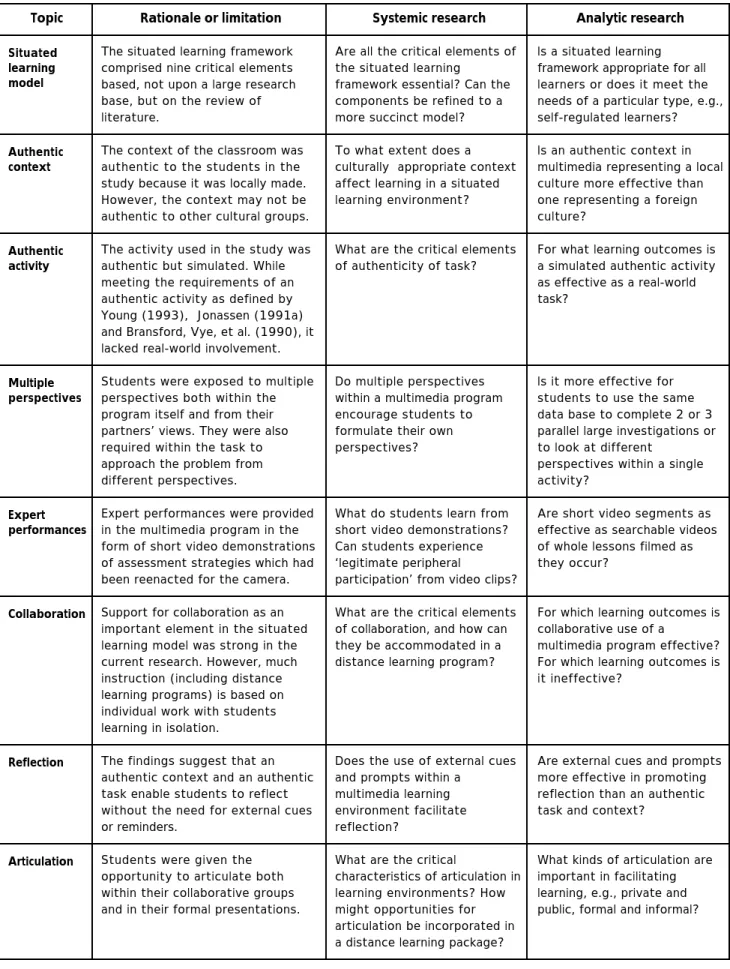
One student suggested the potential value of completing more than one investigation (there are five in the program) in order to provide the opportunity to look at the same strategies from a different angle. This is consistent with the techniques used by the Cognition and Technology Group at Vanderbilt (1990b), who provide parallel investigations using different contexts and details, but which essentially develop the same skills. Such an approach is arguably a more authentic way to provide students with opportunities to gain multiple perspectives on any given strategy, and would be worthy of further research. An interesting question would be whether the resource base was robust enough to withstand a third or fourth investigation without inducing a feeling of over-exposure to the individual media elements, as suggested by Young (1993).
Collaboration
While using the program on assessment, students worked in small collaborative pairs. All but one of the student were positive about the collaborative arrangements, and wholeheartedly endorsed the fact that they could choose their own partners. When questioned about their opinions of the group work done on the assessment program, the students perceived many clear advantages in working collaboratively. Several students pointed out that the completion of the task benefited from collaboration with another person, essentially the view that ‘two heads are better than one’.
You get two perspectives ... if you’re working on your own you think ‘What’s that word?’ and you just can’t think, but if you’ve got somebody else, it’s like having two vocabularies, and two memories. (Interview with Glen)
This comment encapsulates the view that each person brings their own experiences and learning to the situation and that each is capable of contributing to the completion of the task in his or her own unique way. In so doing, all the groups engaged in collaboration, not simply cooperation, as distinguished by Katz and Lesgold (1993). No group employed a simple division of labour, and all worked synchronously to create a product that could not have been completed independently by either individual.
As Bruner noted: ‘All meaning is negotiated; all knowledge is transactional’ (quoted in Latchem, 1993). The students in the study were well aware that a process of negotiation was necessary in collaborative learning groups. One student described negotiation as a relatively simple process:
I asked him what structure he thought we should do it in and if I agreed I just did it, and if I didn’t agree I told him so. I think we worked together. (Interview with Debra)
The same student also pointed out some of the difficult aspects of negotiation on a common task: I suppose sometimes if you don’t agree on how something’s to be done you just grin and bear it. There’s two of you and there’s no point arguing because you’re just not going to get anything done. Because there’s a lot of times I suppose where you’ve got your own idea, ‘I want to do it this way and I don't want to do it any other way’. We didn’t really do it that way, but on occasions it could happen, especially formulating a plan like that. Somebody may have a different way of going about it and they might get into an argument and have a clash of personalities, and then your learning experience wouldn’t be all that crash hot if that happened. (Interview with Debra)
The issues and potential problems raised in this student’s response—coercion, compliance, conflict and discomfort—are all possible processes and outcomes of a collaborative learning arrangement. Apart from one group which adopted a fairly heated, albeit affected, confrontational style—in Zoe’s words ‘We just start yelling at each other’—none of the groups in the study appeared to experience any of these problems in their working relationships.
The findings confirm that the program fostered collaboration. The students were generally very positive about working collaboratively and saw many benefits, such as joint-problem solving, the necessity to negotiate their learning, and a product which is of better quality than one done individually.
Reflection
In order to provide a learning environment that would promote reflection, the assessment program was designed primarily with an authentic context and an authentic activity to enable students to engage with the program and to reflect upon it in a meaningful manner. The observation of the students confirmed Kemmis’ (1985) belief that reflection is a social process, as one student commented:
You’re not just thinking to yourself. You’re thinking aloud to somebody else, and if they have anything to say to you they will. (Interview with Debra)
Boud, Keogh and Walker (1985) define reflection as: ‘those intellectual and affective activities in which individuals engage to explore their experiences in order to lead to new understandings and appreciations’ (p. 19), principally comprising three closely related stages: returning to the experience (recollecting the salient features of the experience, recounting them to others); attending to feelings (accommodating positive and negative feelings about the experience); and re-evaluating the experience (associating new knowledge, integrating new knowledge into the learner’s conceptual framework).
There was much evidence in the transcripts of students reflecting in the first stage of Boud. et al.’s (1985) definition of the process of reflection. The students frequently returned to the experience, recollecting the important considerations and relating them to their partners. Awareness of this process, regardless of whether the students recognised it as reflection, was evident in their comments. For example, Rowan pointed out that a single perusal of the material is inadequate:
We ended up looking at a lot of things twice. Which is quite reassuring when you look it at the second time around and then you get ... a better understanding ... If I have looked at it a couple of times, it is a lot easier. Everything I associate with it is a lot easier. (Interview with Rowan)
The assistance of the student’s partner—an ‘appropriate reflector’ (Knights, 1985)—in aiding reflection was also a strong feature of this stage of the reflective process. For example, Carlo explained that the collaborative process facilitated his reflection, with each person contributing his or her experiences and anecdotes, in effect to ‘enlighten each other’. Another student also pointed out that this stage of the process was not confined to the computer laboratories in the scheduled classes, but that it spilled over into their own time. Such a suggestion is also reminiscent of Csikszentmihalyi’s (1992) notion of flow where, in this case, the sense of interest and engagement with a project is not bounded by the restraints of formal exercises and classes.
The second stage of the reflective process (Boud et al., 1985) was also evident in the students’ use of the assessment program. In this stage, students accommodate positive and negative feelings about the learning experience, and they frequently use anecdotes and stories in their discussion in this process. For example, in the following comment, Rowan at one level described the process of working with the resource, but in so doing he also described the way he and his partner attended to positive and negative feelings about their learning:
We roughly defined the task first ... and then we set out rewording things ... so that we understood our own terms. And then we went through and made sure that we agreed with everything we had down because there was some that we just didn’t think really suited. We would leave one or two out but we would include most of them. And we just made some sort of sense out them that way, and gave an explanation, advantages, disadvantages and a few other bits and pieces down the bottom to do with problem solving, just some ideas that we came up with. (Interview with Rowan)
The re-evaluation of the experience and the integration of new knowledge, the final stage of the reflective process (Boud et al., 1985) was also well represented in the students’ talk as they used the multimedia on assessment. One student also pointed out that reflection had given her a whole new perspective on the subject:
We have been talking about assessment in the past but I look at it in a different light now. I have reflected on it and looked at it a lot differently than I have in the past. (Interview with Evie) The principal design features to embody reflection as an element of situated learning were an authentic context and an authentic task to enable students to reflect in an engaging and captivating learning environment rather than as a response to external cues or reminders. The findings suggest that the learning environment did allow students to reflect freely on their learning by enabling them to return to experiences, attend to feelings and to re-evaluate the experience. The students were able to share their reflections with each other and use the notebook facility to conveniently record them. The learning environment may have enabled new knowledge to be integrated into students’ existing conceptual frameworks and to move from a concrete to an abstract way of thinking.
Articulation
Students articulated their understanding of assessment strategies in two ways in the formal report to the staff meeting and in their discussion with their partner as they used the program. Students were very much aware of the value of formally articulating their learning in the presentation of reports to their classmates, or as Pea (1991) describes it ‘creating rich conversational artefacts for discussion and presentation’ (p. 65). Students were surprisingly positive and comfortable with the prospect of presenting a report to a larger group (given that fear of public speaking is often ranked more highly than fear of death in popular surveys). The reactions of the audience could also be useful, according to several students, in gauging the effectiveness of the presentation. David mentioned that questions from the audience serve to ‘challenge our understanding’ and give students the opportunity to publicly defend their understanding.
The opportunity for students to articulate their understanding of assessment, as defined in the situated learning model, was provided by a social learning situation in which students discussed the task in collaborative groups and then presented a formal report to the class. The findings suggest that the opportunity to verbalise their thoughts in pairs enabled students to be aware of their learning and to make appropriate links to incorporate it into their cognitive frameworks. The formal presentation to the class was a valuable opportunity to articulate and defend their
understanding of assessment strategies.
Coaching and scaffolding
The teacher of the class was thoroughly familiar with the program and its possibilities and with the requirements of the coaching and scaffolding role. He was available to students at all
scheduled class times when they were using the program, and he responded to student’s requests for assistance. The majority of instances of support provided by the teacher were procedural in nature: on content (e.g., ‘Is it meant to be a written report?’), software (e.g., ‘There’s no sound on this video’) and equipment (e.g. ‘Our mouse isn’t working very well’). The role of the teacher was seen by the students as clarifying issues. It was important because it saved time, it enabled the students to proceed with the knowledge that their efforts were ‘on the right track’, and it provided support precisely at the point they needed it.
For procedural problems, the teacher generally fixed the problem himself as quickly as possible. However, for higher order problems, the teacher was asked not to provide assistance to students by supplying the solution, but by giving just enough guidance—the ‘scaffolding’—to take them to the next stage. In the lessons observed, however, students rarely consulted the teacher on higher-order questions related to the task.
The arrangement of students into pairs, meant that each student’s partner could also provide a coaching and scaffolding role. In procedural matters, such as clarifying the requirements of the task, the students were not able to determine precisely what to do. They offered suggestions to each other but could not decide without the assistance of the teacher. However, in dealing with the content of the multimedia program, they assisted each other considerably in both the mathematics that was presented in the segments and also the assessment strategies. The students were aware of the influence of their interactions with their partners on the depth of their learning. For example, when asked to describe the advantages of working in pairs, Glen showed considerable
understanding of the concept of scaffolding and how it related to his own learning:
If you’ve got somebody else ... you scaffold a bit. Like when you go ‘Oh cool, this is what it means’ and the other person, who might not have even considered it goes ‘Oh yes’ and then takes it a step further and you end up doing more indepth thinking about it. (Interview with Glen)
The scaffolding role provided by the student partner was frequently fundamental to the learning process, and provided considerable higher-order support in completing the task. In contrast to this, the role provided by the teacher was principally related to procedural matters of both content and software. The teacher did not take an intentional role in providing conceptual or metacognitive scaffolding, but provided support when it was requested. In this sense, the findings do not rule out a potentially powerful and effective scaffolding role by the teacher within a situated learning environment, but the design of the present study did not allow this role to be fully explored.
Authentic assessment
The assessment program included an activity which required students to propose new assessment strategies for the mathematics department in a school. It was this one activity which they
investigated for the entire three week period, and it was this activity upon which they were assessed. Students were required to give both an oral and a written report of their proposal. The students appreciated the opportunity to be assessed in a real-life, if simulated, context. They generally felt that it was the kind of task they might be required to perform as teachers, and they saw it as good practice for that event. The form of assessment gave them the opportunity to be effective performers with acquired knowledge and to present polished performances. They had the opportunity to spend a significant amount of time of the project and the preparation of their response, yet interestingly six of the eight students felt that the time allocation was insufficient. In spite of the fact that two of the students expressed the view that they felt more comfortable with more traditional forms of assessment, such as essays and tests, they responded well to the complex and ill-structured challenge of the authentic assessment. The task the students were required to complete and the assessment of that task were integrated seamlessly into their working practice and provided multiple indicators of whether the students were successful in completing the task. Students were given the opportunity to use peer assessment on the presentations given to the staff meeting and were given appropriate criteria for scoring performances. In spite of the fact that the suggestion was made that this process could be unfair, there was a surprising consistency in scores across the groups.
The findings suggest that authentic assessment can be used successfully in multimedia, albeit not encapsulated with the software itself, but as part of the learning environment.
Discussion
Patton (1990) points out that the analysis of qualitative data is ‘heavily shaped’ by the theoretical framework in which the study is conducted, and this was borne out in the current study. The framework was tested with second year university students who were assigned a complex and ill-defined task ideally suited to the model. As Collins (1991) pointed out with regard to the cognitive apprenticeship model: ‘If the targeted goal of learning is a rote task, [it] is not an appropriate model of instruction. Cognitive apprenticeship is a useful instructional paradigm when a teacher needs to teach a fairly complex task to students’ (p. 45). These comments are equally applicable to situated learning as defined here, which appears to be an effective instructional paradigm when used to guide the learning of an appropriately complex task, described by Jonassen (1991) as ‘advanced knowledge acquisition’ (p. 32).
One of the most interesting findings of the situated learning study was the important role
collaboration plays in the situated learning model, not only in its own right but as a vehicle for the operationalisation of many other elements of the model. While it is acknowledged that individual construction of meaning is important in learning (Resnick, 1996), the role of the collaborative partnership appeared to provide a multitude of advantages for students working in a complex learning environment. A number of researchers have described the difficulties of working collaboratively (e.g., Hooper, 1992), and while several students alluded to these types of problems, few were evident in the study. The findings suggest that students benefit from the opportunity to articulate, reflect and scaffold with a partner, and that they will seek these opportunities covertly if they are not available by design.
Another interesting finding was the import that students placed upon the authentic context provided by the program on assessment. The students’ comments revealed their perception that university education is relatively impoverished of authentic context, where they are required to absorb factual information provided in a ‘transmission’ style of delivery largely devoid of any authenticity. The students perceived a void between theory and practice, where theory was seen as a relatively unimportant aspect confined to their university classes, and practice was the critical experience they received in professional practice in schools. They appreciated the blurring of the two in the program, where theory and practice were combined.
The effectiveness of the authentic activity in testing the students’ previously used procedures for dealing with such activities was another interesting finding. As Kroll, Masingila, and Mau (1992) have pointed out, the activity should ‘present a new situation for which the students neither know an answer, nor have a previously established procedure for finding an answer’ (p. 621). The activity used in the study was sufficiently complex and sufficiently grounded in uncertainty, to challenge the students’ regular procedures and ‘sub-optimal schemes’ for dealing with such problems.
The instructional technology field abounds with arg