Published online in Wiley InterScience (www.interscience.wiley.com). DOI: 10.1002/smr.474
Quality indicators on global software development projects:
does ‘getting to know you’ really matter?
Olly Gotel
1,∗,†, Vidya Kulkarni
2, Moniphal Say
3, Christelle Scharff
1and
Thanwadee Sunetnanta
41Pace University,New York,NY, U.S.A. 2University of Delhi,Delhi, India
3Institute of Technology of Cambodia, Phnom Penh,Cambodia 4Mahidol University, Bangkok,Thailand
SUMMARY
While the payback from technical training is largely undisputed, and a cost that many organizations are prepared to incur, the benefits of socialization training on global software development projects remains an area of debate. This paper begins to explore whether getting to know those you are working with really matters when it comes to the quality of the software that is produced in global settings. The paper describes how five student teams were put in competition to develop software for a Cambodian client. Each extended team comprised students distributed across a minimum of three locations, drawn from the US, India, Thailand, and Cambodia. Two exercises were conducted with these students during the project, to examine their awareness of the countries of their collaborators and competitors, and to assess their knowledge of their own extended team members. On a weekly basis, the stress levels of the students, along with the communication patterns of each development team, were also recorded. The quality of each team’s eventual software product was measured through a final product selection process. The paper reports on the results of these two exercises, examined in conjunction with these additional data, and implications for practice and future studies are discussed. Copyright q 2010 John Wiley & Sons, Ltd.
Received 19 August 2009; Revised 13 January 2010; Accepted 28 April 2010
KEY WORDS: communication; global software development; leading quality indicators; project stress monitor; socialization; software quality
1. INTRODUCTION
The number of studies examining the communication patterns, techniques, and tools of global software development projects continue to grow to reflect the critical role of collaboration and
coordination on such projects [1, 2]. Recent attention has involved exposing the social networks
underpinning a project to gain an understanding of, for example, who is exchanging data with
whom, with what intensity, and where the initiators and receivers of these exchanges lie [3, 4].
Such information can be used to inform team organization, logistics and tooling, to gauge the
distributed awareness of a project’s requirements and even to predict likely failures[5, 6].
However derived, be it through a record of e-mails, meetings or access to shared artifacts in a project repository, evidence of data exchange or sharing between two parties does not say anything
∗Correspondence to: Olly Gotel, Pace University, New York, NY, U.S.A. †E-mail: [email protected]
about the effectiveness of the communication. While it is often feasible to record the number of exchanges and accesses, these need to be correlated with the impact on the software development process over time and with the quality of the end product, a far more challenging proposition.
At a crude level, one may anticipate a number of indicators that could be examined to assess whether or not communicative exchanges are likely to happen on a project, be effective and lead to improved software quality. For example, if we accept that ‘solidarity’ is a prerequisite
for collaboration to happen [7], then we would be interested in identifying all those factors that
encourage teams to come together with a single purpose. While there are likely to be many such factors, one would assume that familiarity with one another among team members and knowledge of basic locale information would be a building block for initiating and sustaining communication, particularly when teams are distributed across geographies and cultures. In this paper, we begin to investigate these leading quality indicators in the context of a student global software development project. In synopsis, our findings indicate that increased levels of knowledge about global team members leads not only to an enhanced project experience when collaborating, but also to the development of a higher quality end product.
The paper is organized as follows. Section 2 establishes the context for this work. It provides the motivation and outlines related work in the area. Section 3 details our specific global software development project and its research questions. It summarizes the project set-up and its five competing development teams. Sections 4 and 5 then describe the two exercises that we undertook to explore the project participants’ awareness of places and faces in our project, and reports on the findings. Section 6 explains how we monitored the stress levels of all the students on the project and provides a comparative summary across the five development teams. Section 7 explains how the communications were recorded and highlights the key statistics. Section 8 describes how the quality of the end software products was ultimately determined and summarizes the results of the competition. The research questions are re-examined in light of these data in Section 9, and initial implications for practice and future research are given.
2. MOTIVATION AND RELATED WORK
India has traditionally attracted the Lion’s Share of globally sourced services and Information
Technology (IT) projects [8]. According to the 2009 report of the National Association of
Soft-ware and Service Companies (NASSCOM) on the Indian IT-BPO industry, the domestic market experienced growth of 21% during the 2008–2009 financial year, driving a 16.3% growth in the
export market[9]. In addition, projections for continued growth in 2009–2010 have been estimated
at 15–18% domestically and 4–7% for export.
As a result of this growth, the demand for qualified software engineers in India continues to increase. However, and according to a second NASSCOM report, the Indian IT industry faces
a potential shortfall of 500 000 professionals by 2010 [10]. The report states that, regardless of
the large numbers of graduating students, only 10% are considered employable in the Indian IT industry, mostly due to a lack of requisite soft skills. This projection is reiterated in a viewpoint
article that notes a lack of emphasis on teaching such skills in the Indian education system[11].
It claims that, largely unchanged for two decades, Indian education still focuses predominantly on the memorization of technical knowledge.
Consequently in India, most of the large IT organizations provide training programs for their new employees. The top five software companies of Infosys, Wipro, TCS, HCL Technologies, and Satyam invested $430 million dollars in 2008 to train more than 100 000 engineers, with a focus
on the training of entry-level hires[12]. Many Indian IT companies have even established their
own training institutes, a representative example being Wipro, which has its own training campus
where it can train more than 5000 employees simultaneously[11].
Whereas Indian offshore outsourcing organizations are facing the immediate need and hence setting the trend, the training provided by such organizations typically focuses upon the conven-tional technical knowledge required by employees, such as the programming languages, operating
systems, networks and data communications, information security, and software development tools to be used. Behavioral training is also provided, to some extent, to address topics, such as etiquette in business settings, interaction with clients, teamwork, and written and oral communication. However, very few of these organizations seem to provide the kind of socialization training that
is considered essential for offshore outsourced software development[13].
Several educational initiatives have been undertaken to study the facets of global teamwork in software development settings. For example, researchers from Carnegie Mellon University in the US have found that, even with the abundance of distributed collaboration tools, coordination in distributed and large-scale software development projects remains problematic for many organiza-tions because working from a distance brings increased coordination overhead, reduced richness
in communication media and incurs more substantive delays[14]. The authors report that, while
traditional organization theories suggest that teams coordinate explicitly via task organization and team communication, more recent theories suggest that collaborators coordinate implicitly as they develop familiarity with the task and the team. How a globally distributed team establishes such familiarity, and its role with respect to eventual software quality, is obviously a topic in need of further study.
An educational initiative, undertaken by Uppsala University in Sweden and Grand Valley State University in the US, studied the software development performance in distributed student teams
spread across two universities and two countries[15]. The team members were encouraged to get
to know each other by completing a team building exercise and by placing the results on the web. Twelve categories were also used for classifying the contents of the e-mails exchanged between team members. The study reported that the student who received the highest grade in each team was not only the student who posted the most frequently in the team, but also the student whose
messages had the highest number of ‘Social/Get to Know’ phrases classified within them. This
would appear to suggest a correlation between socialization and performance.
A further study conducted by Carnegie Mellon University, this time in conjunction with the German Technische Universit¨at M¨unchen, placed students in a single team to design, build and
deliver a complex software system for a real client[16]. The study reports on how the reduction
or absence of synchronous communication, and the differences in culture, language, and local idiosyncrasies, all contributed to create small project crises that degenerated into catastrophes. Getting to know each other, via face-to-face communication and travel to other sites, was suggested as crucial to avoid these types of crises. The issue with student projects, as with many industrial projects, is that virtual travel and electronic face-to-face sessions are often the only viable option. Yet, the cost-effectiveness of these practices as a substitute often remains uncertain.
In the text ‘Principles for Effective Virtual Teamwork’ [17], nine principles are provided to
help designers, managers, and virtual team members to improve their teamworking effectiveness. In particular, the third principle is: ‘Design activities that cause people to get to know each other’.
The text, ‘Managing Virtual Teams’ [18], suggests some specific activities for team building,
including having each team member produce a personal page or wiki, playing games that require team members to reveal part of their personality, and conducting trivia challenges to familiarize the team with the organization.
While it is clear that attention to socialization can promote the smooth running of a global team, and hence undertaking activities to encourage socialization matter, it can still be a hard sell to convince organizations to invest in and attend to these ‘softer’ skills, as evidenced by the leading players in India. Questions remain as to how much investment should be paid to this area and whether this investment actually pays off when it comes to software quality.
3. PROJECT AND RESEARCH QUESTIONS
Since 2005, we have been running an annual global software development project experience for
students[19–22]. One important theme of our work has been socialization; we have been concerned
other, but to also get to know about each other’s countries and cultures. For instance, we have encouraged students to exchange gifts, photographs, and postcards, and we have facilitated their creation of video documentaries to introduce themselves, their universities and their home cities to the other students. Additionally, we have hosted electronic sessions to introduce the students to each other and scheduled numerous electronic meetings for them.
Through our efforts, we attempted to replicate the benefits of a face-to-face project kick-off meeting and ongoing interaction. This was something that we could not achieve physically, but assumed was necessary to provide an essential foundation for establishing trust and promoting smooth communications on the project. We consequently directed much effort on this dimension in the past, but we did little to assess whether this was an assumption on which it was worth spending so much time and energy. In 2008, and following the industry findings on the training
reported in[13], we decided to explore our assumption more carefully.
Our hypothesis was that the more the students knew about the countries of those other students they were working with, and the more effort that they spent in learning who their extended team members actually were, the stronger the foundations would be for effective communications: general knowledge on holidays and customs would inform expectations for setting deadlines and smooth interactions, while being able to put faces and names to team members would render them more approachable for communications. We anticipated that more communications would be instigated and reciprocated among global team members if they knew each other better. Further, that the stress levels of the team members would be lower if they felt comfortable communicating with each other, enhancing distributed team performance and resulting in higher quality end products.
In 2008, our project set-up involved five institutions, four countries, and seven distinct geograph-ical sites. We established five student development teams: one each based in Cambodia (at the Institute of Technology of Cambodia in Phnom Penh), India (at the University of Delhi) and Thailand (at Mahidol University in Bangkok), and two based in the US (one at the New York City campus of Pace University and one at its campus located 35 miles north of the city in Pleasantville, New York). Each development team was put in competition to develop software for the same Cambodian client. The software to be developed was a library system for the Cambo-dian school. One software system would be selected from among the five teams and deployed in Cambodia.
The client-side of the project comprised a team of five students based in Cambodia (also at the Institute of Technology of Cambodia), who acted as proxies for the ultimate client and end users of the software. We henceforth refer to this team as the client in this paper. Each member of the client team was responsible for sponsoring one of the five development teams. The development
team and its client sponsor form an extended team. A dedicated quality-driver team provided
an additional support network for each of these extended teams. This comprised five software engineering graduate students: a client-side coach and a development-side coach (graduate students from New York City), along with a team of three auditors (banking professionals and also graduate students who were taught in a second location within New York City).
The overall project involved 60 students and seven professors, and lasted for 19 weeks. Selection of the winning software took place after 14 weeks and the stress levels of the five teams and their communication patterns were monitored to this point. The remaining five weeks of the project were dedicated to on-site deployment of the winning software. More extensive details on the project
set-up can be found in a previous publication[22].
During the course of the 2008 project, we only paid attention to encouraging explicit socialization activities within the Pleasantville development team. Given that we had two competing US-based teams, Pleasantville acted as the experimental team and New York City acted as the control team. Two students based at a second university in Cambodia (at the Royal University of Phnom Penh) ‘met’ with the Pleasantville team on a regular basis to talk about the pre-selected Cambodian-specific topics. The topics discussed included Cambodian history, culture, society, and its movies. The expectation was that this immersion would facilitate the Pleasantville development team’s communication with the Cambodian client. These interactions took place in the Second Life virtual
world environment due to the assumption that this emerging and more visual technology would have a positive and fun impact on the team’s socialization experience. The details of this experience
and study are described in a separate paper [23]. This current paper focuses specifically on the
quality outcomes. All the remaining students in the project received no explicit instruction to get to know anything about each other.
4. COUNTRY AWARENESS
To assess the student awareness of the countries involved in this project, an exercise was designed for all the students to complete in a class session. This exercise was undertaken four weeks into the project and following the release of version one of the requirements specification. Given that this was the most intensive data gathering and analysis period on the project, and required much interaction between the development teams, client-side team and the support networks, it was assumed that curiosity would have led to personal exchanges and broader learning. Also,
the project wiki [24] had been in existence for one month and included a map of the world,
flags of the participating countries, time zone clocks, and basic country information. It was assumed that all the students would have accessed the wiki since it was the backbone for all the project data.
For the exercise, all the students were provided with a map of the world, with no countries labeled, and a set of images: flags for the US, Cambodia, India, and Thailand; famous landmarks for each country (the Statue of Liberty, Angkor Wat, the Taj Mahal, and the Royal Palace); and signature dishes for each country (Burger and Fries, Amok, Samosa, and Pad Thai). Each student was then asked to:
• place an ‘X’ on the locations of New York, Phnom Penh, New Delhi, and Bangkok (labeling
each);
• select the appropriate flag for each country, label it and attach it correctly to the map;
• label the dishes and landmarks, and associate them with the correct country by affixing them
to the map; and
• assume it is 2:00 pm in Cambodia and write down the time in the other three countries.
The results are summarized in Figure 1. Where the results are blank in this figure, the question was accidentally omitted or altered by the professor who was administering the exercise.
All of the professors reported that the students enjoyed this exercise and, in the case of the US graduate students (coaches and auditors), their poor performance was humbling given that they were the most senior participants in the project. It resulted in pledges to learn more about these other countries from that point forward on the project. Both the undergraduate and graduate US students, in general, had some curious map positioning: Delhi being placed in Saudi Arabia, France, Myanmar, and Brazil; Phnom Penh being placed in China, Iran, Australia, and Indonesia; and Bangkok being placed in Iraq, Taiwan, and Europe. Many US students also struggled to identify the flags, dishes, and landmarks, with the exception of the Pleasantville students who gained 100% accuracy with the Cambodian knowledge (US-PLV on Figure 1). The Thai students gained almost 100% accuracy on all the challenges, while the Cambodian and Indian students had a good working knowledge of any country-specific information that had been provided explicitly on the project wiki.
There was more general difficulty in answering the time zone questions among all the students participating in this project, despite clocks having been provided on the project wiki since the start of the project. However, each member in each development team knew his or her time difference from the client in Cambodia.
We failed to differentiate the Cambodian clients from the Cambodian developers in this exercise, but it can be seen that the entire Cambodian student contingent had taken the time to learn about the countries involved in the project of their own volition, irrespective of their project role.
Figure 1. Consolidated results for country awareness.
5. EXTENDED TEAM AWARENESS
To assess the student awareness of their extended team members, a ‘who’s who’ exercise was undertaken by all the students in another class session. This took place approximately 10 weeks into the project, one month before the final software delivery was due. The requirements were now frozen and the development teams were undertaking iterative development with testing cycles involving the clients, coaches, and auditors. It was assumed that, this late into the project, the students would know exactly whom they were working with having interacted with them quite intensively for weeks. Furthermore, names, roles, and photographs had been visible on the project wiki for 10 weeks and this wiki had been used to coordinate all the tasks and to disseminate all the work products to date.
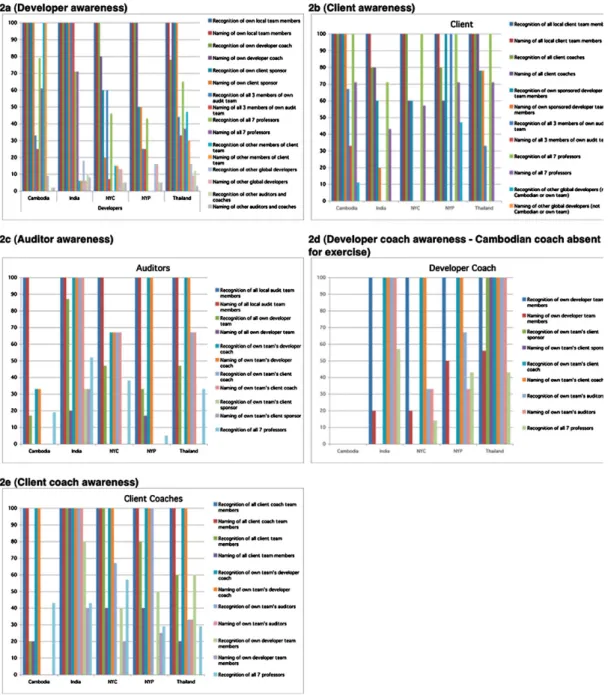
For the exercise, each student was given photographs of all the participants in the global project and asked, based on their own role, to circle and name their extended team members and any other faces they recognized. The results are shown by role in Figure 2.
• Cambodian/Thai/Indian/US developers: To identify the other developers on their team, their
US-based developer coach, the Cambodian client sponsoring their project and their three US-based auditors (Figure 2(a)).
• Cambodian clients: To identify the other clients of the side team, their US-based
client-side coaches and the whole development team they were sponsoring (Figure 2(b)).
• Auditors: To identify the other auditors on their three-person team, their SQA manager, the
development team they were auditing, the US-based developer and client coaches for that development team, and its client project sponsor in Cambodia (Figure 2(c)).
• Developer coach: To identify the development team they were coaching, the auditors for that
team, and the client-side sponsor and coach for that team (Figure 2(d)).
• Client coach: To identify the full client-side team, the development team their client was
involved with and its US-based developer coach and auditors (Figure 2(e)).
The results indicate that the Cambodian, Indian, and Thai development teams had the most extended team awareness. These team members all knew the name and face of their client sponsor in
Figure 2. Role-based results for extended team awareness: (a) developer awareness; (b) client awareness; (c) auditor awareness; (d) developer coach awareness—Cambodian
coach absent for exercise); and (e) client coach awareness.
Cambodia. The Cambodian clients, however, were most familiar with members of the Cambodian and Thai extended development teams. In contrast, the US-based development teams could not all identify and name the clients they were working for and the Cambodian clients could not name any of the US-based developers.
Within the US-based support networks, extended team awareness was highest with the Indian and Thai auditors, the Thai developer coach and the Indian client coach. These two global teams all seemed to make the effort to know all the global team members they were working with and the quality-driver support network also appeared to work the most effectively in these two cases. Where the development team knew the client team it was working for and its own support network, the other parties in the extended team reciprocated this awareness.
All of the professors reported that the students also enjoyed this exercise and that the students were especially proud when they could identify or name those they had been working with for 10 weeks on a daily basis.
6. STRESS MONITORING
During the course of this project, the students acting in the developer and client roles were all learning about the software development process and the technologies they needed to master to undertake the work. They were concurrently expected to manage their projects and sustain the necessary communications with all their extended team members. Among other school commit-ments, the workload was hence considerable for some of the students and always subject to time pressure. Attempting to acquire new skills, in a challenging context comprising many uncertain factors, can easily overwhelm a student and occasion stress.
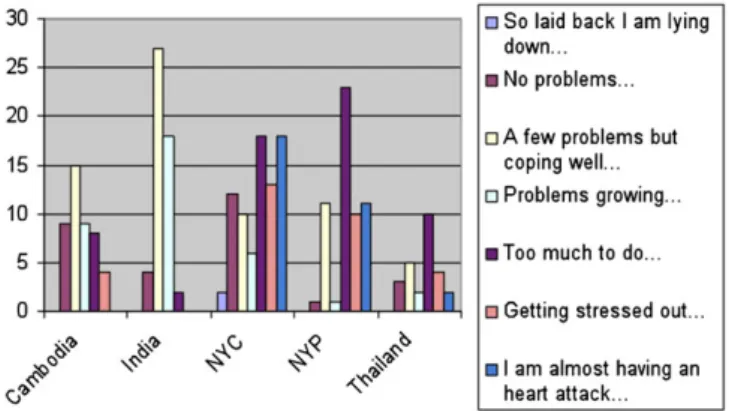
The role of the development team’s coach was critical here. To permit the professors to be aware of any problems arising during the course of the project so as to alert the coaches, we attempted to monitor the stress levels of all the students involved systematically. We did this via a weekly anonymous online survey. The survey comprised a single question designed to model a simple blood pressure monitor. Every week, we asked each student to record how he or she was feeling. We used a seven-point Likert scale recast in terms of every-day phrases that the students could relate to: (1) So laid back I am lying down; (2) No problems; (3) A few problems but coping well; (4) Problems growing; (5) Too much to do; (6) Getting stressed out; and (7) I am almost having a heart attack!
We consolidated the results for each development team every week so that we could monitor their general ‘health’ over time. The overall stress profile for each development team under study is depicted in Figure 3. The results show that the development teams mostly claimed to have ‘A few problems but coping well’ followed by a transition to ‘Problems growing’ and ‘Too much to do’, a typical escalation that we saw over time nearing deadlines. The two US-based development teams reported to be the most stressed out by the project. They were the only teams to answer the survey with significant agreement that ‘I am almost having an heart attack’ (NYC and NYP on Figure 3).
One of the major contributing factors to the stress levels for both of the US-based teams was that contact with the Cambodian client was not easy due to the largest time zone difference of all the teams. Significantly, any responses to queries and the provision of feedback were almost always subject to time delays. A secondary explanation for the degree of stress that the New York City-based developers reported was that they did not engage as well as the other teams with their quality-driver team. This negatively impacted their perception of the effectiveness of the support at key times. For the Pleasantville-based developers, the ‘burden’ of carrying out
additional socialization activities with a second set of Cambodian students over and above their regular development work was perceived to exhaust their limited available meeting time as a team.
7. COMMUNICATION PATTERNS
The use of a project wiki supported the communication of the extended teams and increased team awareness by providing a common repository for all the artifacts produced during the course of the project. Additionally, all the development teams completed two weekly online surveys to maintain a record of their asynchronous and synchronous communications. The survey concerning asynchronous communications comprised a record of all the e-mails sent to the various
project mailing lists (e.g., the number of e-mails sent and the target/source of the e-mails by
project roles). The survey concerning synchronous communications recorded all the online chat sessions that took place, the roles of the participants involved and the duration of the chat and its initiator.
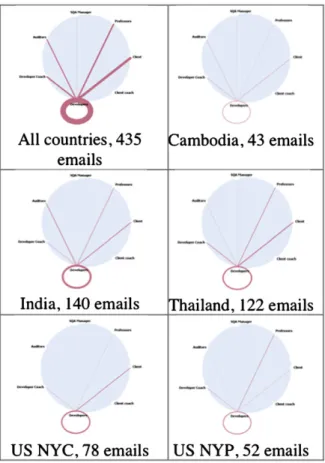
The broad pattern and intensity of the e-mail and chat communications for the five development teams, as extracted from the two weekly surveys on communication, are shown in Figures 4 and 5. While we accept that the students could have omitted some of the communications that took place from the record, it appears that all the development teams privileged asynchronous communications over synchronous communications. Also, the Indian and Thai developers exchanged more e-mails and had more chat sessions within their extended teams than the US and Cambodian developers. The Indian and Thai communications were also more distributed among the various project roles. It is noteworthy that the New York City-based developers did not report synchronous communica-tions with the auditors, developer coaches and client coaches despite their proximity in time (same
Figure 5. Development team synchronous (chat) communications.
time zone) and space (same city). Whether this lack of communication was the trigger for or the result of the initial misunderstandings mentioned in Section 6 is not clear. It is also noteworthy that the Pleasantville-based developers communicated the least among themselves, and they did not report any synchronous communication with the client. On top of their additional socialization activities, these developers struggled to find an appropriate common time to be online together with the clients.
8. QUALITY ASSESSMENT
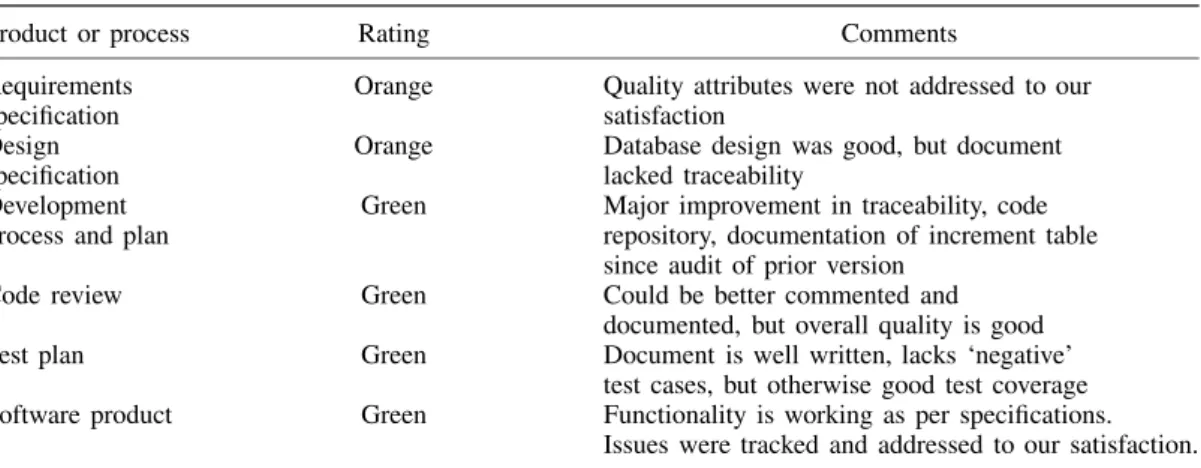
The project included numerous activities designed to promote and assure software quality. These commenced with a thorough auditing of the clients’ requirements specification, leading to subse-quent improved versions. The auditors also attempted to inject quality into each development team’s end product by planning and administering process and product-related audits of the design, implementation, and test plans. Using quality-related checklists, each audit team would alert their respective development team and its developer coach to an external assessment of the project’s health using a traffic-light system, where green reflects good quality practices, orange reflects some quality issues to address and red reflects unacceptable quality. Table I shows a synopsis of the overall project health of the Indian development team, based on aggregating the results from the more detailed underlying audits at a point in time.
With help from their coaches, the Cambodian clients produced a software selection docu-ment based upon the requiredocu-ments specification. The quality of the delivered software was to be
Table I. The project health for the Indian development team at a point in time.
Product or process Rating Comments
Requirements Orange Quality attributes were not addressed to our
specification satisfaction
Design Orange Database design was good, but document
specification lacked traceability
Development Green Major improvement in traceability, code
process and plan repository, documentation of increment table since audit of prior version
Code review Green Could be better commented and
documented, but overall quality is good
Test plan Green Document is well written, lacks ‘negative’
test cases, but otherwise good test coverage Software product Green Functionality is working as per specifications.
Issues were tracked and addressed to our satisfaction.
Figure 6. Correlating the development team distance from the client and the frequency of the developer/client communication.
determined by measuring the total number of requirements demonstrably satisfied (judged either completed, partially completed, or not completed), multiplied by the priority of the requirement concerned. This document was distributed to all the development teams early on in the project life cycle as a guide.
Based on the rubric of this document, the Indian and Thai software products were assessed to be the highest in quality. For fairness, the assessment took place via triangulated testing, hence by considering the test results of the development team and its developer coach, the test results of the audit team, and the test results of the client-side team. The Indian software was ultimately selected for deployment in Cambodia based on the platform they used for development and the long-term maintenance requirements of the Cambodian school.
What is notable is that the two teams that communicated the most with the client electroni-cally, and the two teams that had relatively low levels of stress during the project, were the ones that completed the software to the highest satisfaction of the clients, although they were not the closest teams to the clients when it came to geography. Figure 6 summarizes this relationship of each development team to the Cambodian clients. The figure also highlights that, from among all the development teams, the US teams who were the most geographically distant also stayed the furthest from the clients electronically. The Cambodian development team that was geograph-ically co-located with the clients, and hence able to conduct face-to-face meetings, communicated electronically with the clients the least, but almost on a par with the two US teams.
9. OBSERVATIONS AND IMPLICATIONS
The Cambodian, Indian, and Thai development teams achieved better results than the US-based development teams on general knowledge of all the countries involved in the global project (the country awareness exercise). The Indian and Thai teams also had a better awareness of those students they were working with around the globe, along with greater awareness of additional third parties (the extended team awareness exercise). The Indian and Thai teams exchanged up to twice as many group e-mails than the other three development teams, and these exchanges were more likely to extend to their Cambodian client project sponsor and members of their team’s quality-driver support network (i.e., their US-based auditors and coaches). These two development teams also used more real-time chats to communicate with their extended team members, particularly Thailand. The stress levels of the Indian, Thai, and Cambodian teams were also the lowest throughout the duration of the project.
Given that this is a single study, and that there are obviously many factors that motivate students to work well together or not on a project, it is not possible to make hard claims in this paper. However, it is striking that two of the development teams that scored the highest in both of the socialization exercises communicated more throughout the project, recorded lower stress levels and produced the two software systems deemed to be of highest quality by the clients. We suggest that this is a finding worth exploring more rigorously in further studies as it has implications for the emphasis to place on socialization training and the running of such globally distributed projects in a commercial setting.
Five other observations are relevant in shaping any such future investigation and in informing related initiatives:
1. Socialization activities: The effort expended in educating the Pleasantville students about
the country and culture of the clients did not appear to pay off; it mostly increased their already large workload, impinged on limited available free time for meetings and served to frustrate (and possibly result in) a fractured local team at times. Rather than a discrete and enforced program of activity that gets resented, socialization needs to be a self-directed activity driven by personal and team belief of value. It seems to be the most effective when it is an invisible and implicit part of just doing the job professionally, but important for development in globally distributed settings. Educators and trainers need to find a way to nurture such value systems.
2. Familiarity and trust: Although the Cambodian developers made an effort to learn about
their fellow students, they were not comfortable instigating communications with students overseas; they kept their many technical problems to themselves until the last minute and when raising them was unavoidable. In contrast, the Indian and Thai teams sought assistance from their support networks in the US early on and quite readily. Both had a greater familiarity with their extended team members and communication flowed more readily. It is possible that more attention to familiarization and promoting the value of this relationship would have empowered the Cambodian developers to be more proactive. This potential can be seen with those Cambodian students who acted as clients; the more they knew their client coaches personally, the more likely they were to ask for assistance or raise issues with them. Knowledge of and familiarity with team members overseas appears to be a crucial prerequisite to foster the trust that is so necessary to share concerns and seek assistance without fear of repercussion. There is a need to examine this relationship between familiarity and trust across cultures in more detail if it is to be promoted.
3. Communication preferences and priorities: While the Cambodian clients received more e-mail
from the New York City-based development team, as evident from the online communication survey of the clients, they actually sent more e-mails to the Indian team and chatted the most with the Thai team. One could suggest that this is either coincidental or purely time zone related, but since only the latter two teams shared bi-directional awareness with the clients, this does suggest that cultivating this relationship is a way to get queries answered expediently by remote clients. The clients seemed to ‘prefer’ to respond first to those teams
they knew better or more personally, an observation well worth attending to in any global arena.
4. Stress,cooperation, and quality: The two development teams that did the best when it came
to software quality are the ones that reported to be among the least stressed out during the course of the project, India and Thailand. Note that it is possible that the US-based students were simply more comfortable being vocal about their blood pressure than the other students on the project, skewing the stress data. However, from the supporting project data, it would appear that the development work of the Indian and Thai teams evolved within a more visibly cooperative atmosphere of extended team members. The relationship between stress on a project and ongoing performance is one that can remain hidden in a distributed global setting. Such matters need to be rendered visible if they are to be examined and addressed.
5. Communication quantity and quality: Coincidently, the quantity of the electronic
communi-cation that occurred in this projectdidreflect the eventual quality ranking of the final software
products. Future empirical work on communication patterns and intensity on global soft-ware development projects would benefit from a concomitant examination of the correlation (or otherwise) with quality.
10. CONCLUSIONS
This paper has summarized two exercises that were undertaken within the context of a student global software development project to investigate whether fundamental knowledge of the people you are working with has any impact on the quality of the software that is produced. While we cannot prove a causal relationship, our project demonstrates that ‘getting to know you’ is an activity that pays off if it occurs naturally. Obviously, the students who did better on the two socialization exercises and produced the highest quality software could have had better prior skills and knowledge, more professorial support, superior determination or they simply could have spent more time and effort than the other students on the project due to the course loads. We did not monitor and measure all the possible contributing factors.
The question we posed at the beginning of this paper was ‘does getting to know you really matter on global software development projects?’ This paper has described how there is undoubtedly a benefit to be had by working in a global setting with people you take the time to know and learn a little about, and we suggest that finding a way to measure such knowledge may provide for a leading quality indicator on a global software development project. Further, this seems to play out also in terms of the relative levels of stress and communication to anticipate on a project, quite possibly making for additional leading indicators of the likely project quality.
As educators and trainers, we need to find subtle ways to demonstrate the benefits of getting to know globally distributed project team members and to nurture these predispositions in an integrated rather than forced manner. To pay off, socialization efforts need to be driven by interest and from one’s own volition. Where institutionalized, they can be perceived as an added burden that
detracts from the communication that is essential to the primary task at hand. The costs/benefits
of just enough socialization are deserving of much more empirical study. As a starting point, we propose that simple exercises such as ours are worth replicating and conducting on other global projects. They are not so costly to create and administer, they provide a fun break for the project participants, and sharing the results globally across the project can be quite insightful and prompt small and potentially desirable behavioral changes.
ACKNOWLEDGEMENTS
This work was supported by a National Collegiate Inventors and Innovators Alliance grant (#3465-06), ‘Incubating the Next Generation of Global Software Development Entrepreneurs’ (2006–2008). We thank all 159 students who have been a part of our global software development initiative to date. We also thank the anonymous reviewers of this paper for constructive feedback on an earlier version.
REFERENCES
1. Herbsleb JD. Global software engineering: The future of socio-technical coordination. Proceedings of the 29th International Conference on Software Engineering:The Future of Software Engineering(ICSE-FASE’07). IEEE-CS
Press: Silver Spring MD, May 2007; 188–198.
2. Papers from the Proceedings of the CSCW Workshop on Supporting the Social Side of Large Scale Software Development. Conference onComputer Supported Cooperative Work(CSCW’06). ACM: New York NY, November 2006.
3. Ehrlich K, Valetto G, Helander M. Seeing inside: Using social network analysis to understand patterns of collaboration and coordination in global software teams.Tutorial Description in the Proceedings of the Second International Conference on Global Software Engineering(ICGSE’07). IEEE-CS Press: Silver Spring MD, August 2007; 297–298.
4. Marczak S, Kwan I, Damian D. Social networks in the study of collaboration in global software teams.Poster Presentation of the Second International Conference on Global Software Engineering (ICGSE’07). IEEE-CS
Press: Silver Spring MD, August 2007.
5. Damian D, Marczak S, Kwan I. Collaboration patterns and the impact of distance on awareness in requirements-centred social networks. Proceedings of the 15th International Requirements Engineering Conference (RE’07). IEEE-CS Press: Silver Spring MD, October 2007; 59–68.
6. Meneely A, Williams L, Snipes W, Osborne J. Predicting failures with developer networks and social network analysis. Proceedings of the 16th ACM SIGSOFT International Symposium on the Foundations of Software Engineering(FSE-16). ACM: New York NY, November 2008; 13–23.
7. Denning PJ, Yaholkovsky P. Getting to ‘We’.Communications of the ACM2008;51(4):19–24.
8. Allen D. China, India Vie for Outsourcing Market.Online Asia Times: www.atimes.com,China Business, 2 June 2007. Available at: http://www.atimes.com/atimes/China Business/IF02Cb01.html [13 May 2010].
9. National Association of Software and Service Companies. NASSCOM Press Release: Indian IT-BPO Industry Shows Resilience; to Grow by 4–7 percent in FY09-10, 29 July 2009. Available at: http://www. nasscom.in/Nasscom/templates/NormalPage.aspx?id=57224 [13 May 2010].
10. National Association of Software and Service Companies. NASSCOM Leadership Forum: There’s No Stopping IT. India Knowledge@Wharton, 21 February 2008. Available at: http://knowledge.wharton.upenn.edu/ india/article.cfm?articleid=4261 [13 May 2010].
11. Aggarwal A. Emerging markets: Labor supply in the Indian IT industry. Communications of the ACM 2008;
51(12):21–23.
12. NASSCOM Foundation. NASSCOM-Deloitte Study 2008 Report.Indian IT/ITES Industry: Impacting Economy and Society 2007-08, 2008. Available at: http://www.nasscom.in/Nasscom/templates/NormalPage.aspx?id=53649 [13 May 2010].
13. Kulkarni V, Scharff C, Gotel O. From student to software engineer in the Indian IT industry: A survey of training.
Proceedings of the 23rd Conference on Software Engineering Education and Training (CSEET’10). IEEE-CS
Press: Silver Spring MD, March 2010.
14. Espinosa JA, Lerch JF, Herbsleb JD, Kraut RE, Slaughter SA, Mockus A. Shared mental models and coordination in large-scale, distributed software development.Proceedings of the 22nd International Conference on Information Systems(ICIS’01), December 2001; 513–518.
15. Hause ML, Last MZ, Almstrum VL, Woodroffe MR. Interaction factors in software development performance in distributed student teams in computer science.Proceedings of the Sixth Annual Conference on Innovation and Technology in Computer Science Education(ITiCSE’01). ACM: New York NY, June 2001; 69–72.
16. Dutoit AH, Johnstone J, Bruegge B. Knowledge scouts: Reducing communication barriers in a distributed software development project. Proceedings of the Eighth Asia-Pacific Software Engineering Conference (APSEC’01). IEEE-CS Press: Silver Spring MD, December 2001; 427.
17. Nunamaker Jr JF, Reinig BA, Briggs RO. Principles for effective virtual teamwork.Communications of the ACM
2009;52(4):113–117.
18. Brown MK, Huettner B, James-Tanny C.Managing Virtual Teams: Getting The Most From Wikis,Blogs, and Other Collaborative Tools. Jones and Bartlett Publishers: Sudbury MA, 2007.
19. Gotel O, Scharff C, Seng S. Preparing computer science students for global software development.Proceedings of the 36th Annual Frontiers in Education Conference. Borders: International, Social and Cultural (FIE’06),
October 2006; 9–14.
20. Gotel O, Kulkarni V, Neak L, Scharff C, Seng S. Introducing global supply chains into software engineering education.Proceedings of the First International Conference on Software Engineering Approaches for Offshore and Outsourced Development(SEAFOOD’07)(Lecture Notes in Computer Science, vol. 4716), Meyer B, Joseph M (eds.). Springer: Berlin/Heidelberg, 2007; 44–58.
21. Gotel O, Kulkarni V, Neak L, Scharff C. Working across borders: Overcoming culturally based technology challenges in student global software development.Proceedings of the 21st Conference on Software Engineering Education and Training(CSEET’08), April 2008; 33–40.
22. Gotel O, Kulkarni V, Say M, Scharff C, Sunetnanta T. A global and competition-based model for fostering technical and soft skills in software engineering education. Proceedings of the 22nd IEEE-CS Conference on Software Engineering Education and Training(CSEE&T’09), February 2009; 271–278.
23. Gotel O, Kulkarni V, Phal D, Say M, Scharff C, Sunetnanta T. Impacting global software development through socialization activities in virtual world environments. Proceedings of the Second Hanoi Forum on Information-Communication Technology, December 2008.
24. The GSD 2008 project wiki. Avalaible at: http://atlantis.seidenberg.pace.edu/wiki/gsd2008 [13 May 2010].
AUTHORS’ BIOGRAPHIES
Dr Olly Gotelis an Independent Researcher based in New York City. She obtained her PhD in Computer Science from Imperial College, University of London, UK. Dr Gotel has research interests in the areas of Systems Requirements Engineering, Traceability, Modeling and Visualization, Process Improvement and Global Software Engineering. This Global Software Development project was carried out while at Pace University in New York City.
Vidya Kulkarni is an Associate Professor in the Department of Computer Science, University of Delhi, India. She obtained her Masters in Mathematics from the Univer-sity of Delhi and Masters in Computer Science from McMaster UniverUniver-sity, Canada. Ms. Kulkarni’s research areas include Query Optimization in Databases, Global Software Engineering, Software Testing and Image Processing. She has co-authored two books on Computer Science based on the school curriculum in India.
Moniphal Say is a Lecturer of Computer Science at the Institute of Technology of Cambodia (ITC). She obtained her Masters of Information Technology from the Indian Institute of Technology-Bombay (IIT-B), Mumbai, India. Mrs. Say’s research interests are in E-learning, Software Development and Mobile Computing.
Dr Christelle Scharffis an Associate Professor of Computer Science at Pace University in New York City. She has research interests in Software Quality, Global Software Engi-neering and Mobile Application Development for Social Changes. Dr Scharff obtained her PhD in Computer Science from the Universit´e Henri Poincar´e in Nancy, France.
Dr Thanwadee Sunetnantais an Assistant Professor at the Faculty of Information and Communication Technology, Mahidol University, Thailand. She obtained her PhD in Computer Science from Imperial College, University of London, UK. Dr Sunetnanta’s research interest is in the area of Software Engineering: specifically Requirements Engineering, Web Engineering, Software Process Improvement and Software Engineering Education.