DOCTOR OF BUSINESS
ADMINISTRATION
Evaluating authentic behaviour change in
leadership development programmes
Enric Bernal
2013
Some pages of this thesis
may
have been removed for copyright restrictions.
If you have discovered material in AURA which is unlawful e.g. breaches copyright, (either
yours or that of a third party) or any other law, including but not limited to those relating to
patent, trademark, confidentiality, data protection, obscenity, defamation, libel, then please
read our
Takedown Policy
and
contact the service
immediately
EVALUATING AUTHENTIC BEHAVIOUR
CHANGE IN LEADERSHIP DEVELOPMENT
PROGRAMMES
ENRIC BERNAL
Doctor of Business Administration
ASTON UNIVERSITY
June 2013
© Enric Bernal, 2013
Enric Bernal asserts his moral right to be identified as the author of this thesis. This copy of the thesis has been supplied on condition that anyone who consults it is understood to recognise that its copyright rests with its author and that no quotation from the thesis and no information derived from it may be published without proper acknowledgement.
THESIS SUMMARY
EVALUATING AUTHENTIC BEHAVIOUR CHANGE IN LEADERSHIP DEVELOPMENT PROGRAMMES
ENRIC BERNAL
Doctor of Business Administration ASTON UNIVERSITY
June 2013
The global economic crisis that hit the western countries strongly has emphasised the need to abandon the economic-performance significance of leadership and return to a meaning-making significance. While a lot of research has been done in the field of leadership and management disciplines, little has been done on how to develop lead-ership. This study evaluated the degree in which leadership training in the market-place today was effective at developing authentic leadership and, therefore, at chang-ing individual behaviour.
Since none of the leadership theories address how behavioural change is actually achieved, theories of change were integrated in the current study. A conceptual model combining Authentic Leadership Development (ALD) theory and the Theory of Planned Behaviour (TPB) was proposed. Furthermore, this study explored the rela-tionship between a positive contemplation of change and the actual change observed in individuals after the leadership intervention.
In order to test this conceptualisation, a longitudinal quasi-experimental study was conducted. Leaders were surveyed in this study one month before and one month af-ter the programme. Three complementary questionnaires were distributed to partici-pants in one of four leadership development programmes (two corporate initiatives and two business-school programmes).
Analyses showed that leaders who attended a leadership intervention (as compared to a control group) developed higher levels of authentic leadership, as rated by them-selves and others in their working environment and controlling for baseline scores. The results also indicated that intentions were developed through the interventions and that the development of such intentions translated into changes in authentic be-haviour. Intentions mediated the relationship between attitude and authentic leader-ship. In addition, when contemplation of change was high and attitudes towards au-thentic leadership were positive, the development of intentions was stronger. The im-plications of these findings for the theory and practice of leadership development pro-grammes and the impact on organisational performance are discussed.
Key words: Authentic Leadership Development (ALD), Theory of Planned Behaviour
ACKNOWLEDGEMENTS
This project is the result of hard work and the collaboration of many individuals who assisted me in the development of this research study and the writing of the the-sis.
First of all, I would like to thank my supervisors: Prof. Helen Higson, Prof. Mi-chael West, and Prof. Geoff Thomas for their help, their guidance and their patience with the development of this endeavour. Thank you also to Allan Lee, doctoral re-searcher at the work and organisational psychology for his help during the intense da-ta analysis period.
This research would have not been possible without the collaboration the four organisations from which data was obtained:
Specially, I would like to thank David Jestaz, Head of Corporate University at EDF for his generous funding to my studies and for being the first organisation that agreed to participate in this research.
Thank you to Gene Johnson, former Head of EMEA Talent Management at DELL, which opened the doors of this corporation to this study.
Thank you also to Aline Masuda, co-Head of HR Academic Department and Marjolein Overmars, EMBA Programme Manager at EADA for allowing me to collect data from students at this business school and for providing me with the electronic software to manage surveys on-line.
And thank you to Martin Flash, GMP Programme Manager, CEDEP for agree-ing, last minute, to participate in this research study and for his patience in obtaining aggregated results.
I also would like to thank Ranjit Gil and Jeanette Ikuomola for all administrative assistance and guidance that during these years have provided me.
Lastly, I would like to thank my wife, Kelly Simmons, provided me with the “fami-ly space” to take this project to fruition.
LIST OF CONTENTS
Introduction ... 9 I. Literature Review ... 14 1. Leadership Theories ... 15 2. Leadership Development ... 19 3. Leadership Effectiveness ... 30 4. Theories of Change ... 39II. Theoretical Framework ... 51
1. Authentic Leadership Development (ALD) theory ... 52
2. Theory of Planned Behaviour (TPB) ... 56
3. Positive Contemplation of Change ... 61
4. Putting it all together ... 66
III. Methodology ... 69
1. Methodology and design appropriateness ... 70
2. Procedures and Organisations ... 73
3. Sample ... 83
4. Measures ... 88
IV. Measurement and Results ... 99
1. Data Analyses ... 99
2. Authentic Leadership Development Change ... 104
3. Mediation of Intentions ... 106
4. Moderation of Positive Contemplation of Change ... 111
6. Summary of Results ... 116 V. Discussion ... 117 1. Summary of study ... 117 2. Interpretation of Findings ... 119 3. Theoretical Implications ... 125 4. Practical Implications ... 130 5. Potential Limitations ... 140 6. Future Research ... 145 7. Conclusion ... 148 VI. References ... 151 VII. Appendices ... 168 A. Cover Letters ... 168
B. Authentic Leadership Questionnaire (ALQ) ... 175
C. Theory of Planned Behaviour questionnaire (TPBQ) before CFA ... 176
D. Full Questionnaire (ALQ + TPBQ + PCC, sent before and after) ... 180
LIST OF FIGURES
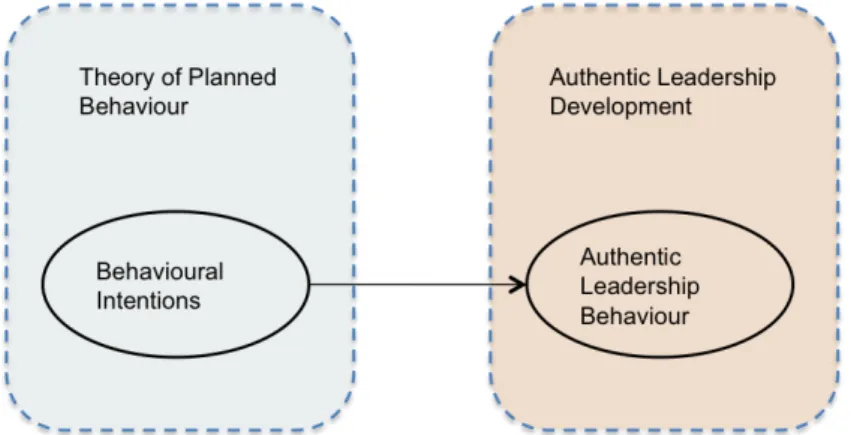
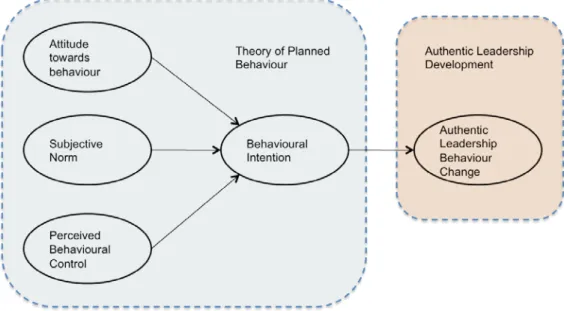
1. Figure 1: Theoretical Framework Relationship between constructs... 51
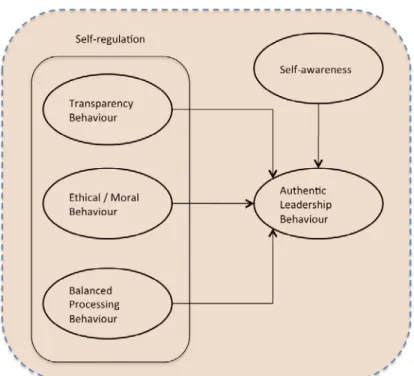
2. Figure 2: Authentic Leadership Behaviour construct... 53
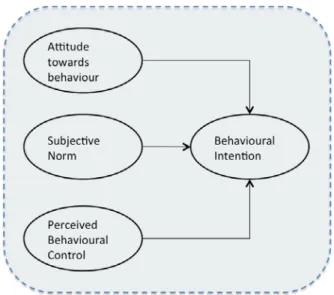
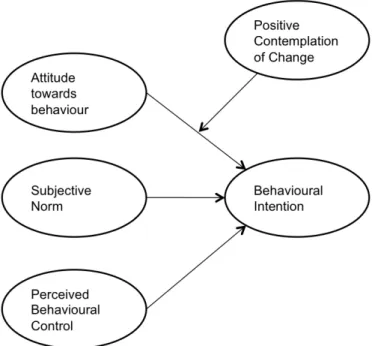
3. Figure 3: Behavioural Intention construct... 57
4. Figure 4: Behavioural Intention construct ... 60
5. Figure 5: Stages of Change... 63
6. Figure 6: Positive Contemplation of Change moderation between attitude and intentions to behave authentically... 66
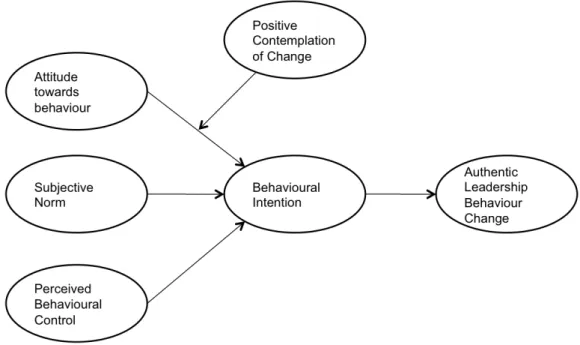
7. Figure 7: Causal relationship between all variables... 67
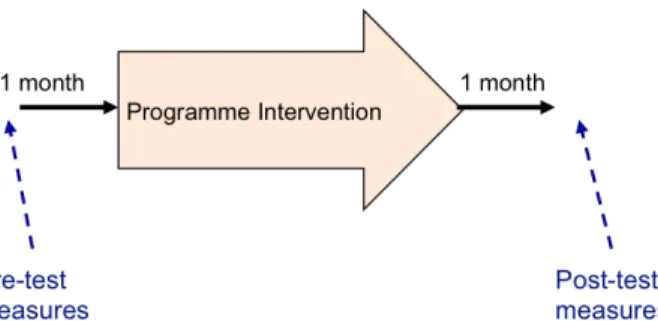
8. Figure 8: Pre-test – Post-test research design ... 71
9. Figure 9: Variable model tested with CFA analysis showing resulting coefficients... 95
10. Figure 10: Change of Authentic Leadership Behaviour (treatment vs. control)... 104
11. Figure 11: Linear regression to test on Intentions, controlling for programme length, gender, age, and experience ... 109
12. Figure 12: Path analysis showing the relations among attitude, intention, and authentic leadership behaviour ... 110
13. Figure 13: The links between intentions to behave authentically and attitude towards authentic leadership, as moderated by readiness to change ... 112
LIST OF TABLES
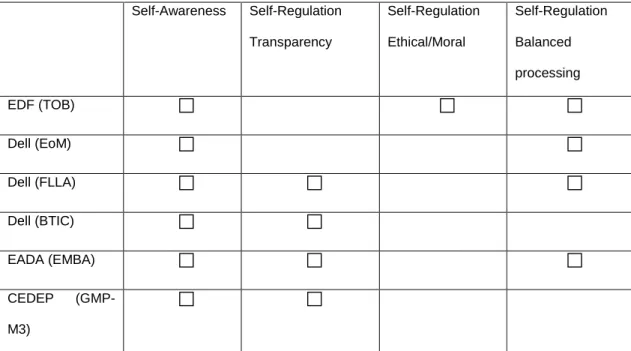
1. Table 1 Comparison table between programmes included in this study and their focus on authentic leadership components... 82 2. Table 2 Summary of programme length, contact days, and time span
between pre-test and post-test measures... 83 3. Table 3 Detail of the split of participants between the four leadership
development interventions and the number of cohorts followed of each type of programme... 84 4. Table 4 Summary of nationalities of the participants in the study who
responded before and after... 84 5. Table 5 Summary of valid responses before the programme (pre-test) and after (post-test)... 87 6. Table 6 Acronyms used to code the variables in the TPB questionnaire... 93 7. Table 7 Confirmatory Factor Analysis (CFA) on TPB Questionnaire... 94 8. Table 8 Reliability scores for TPB Questionnaire... 96 9. Table 9 Correlation matrix within Time 1 (right of the diagonal) and within
Time 2... 101 10. Table 10 Correlation matrix across time (from T1 to T2)... 102 11. Table 11 T-test results for attitude, subjective norm, perceived behavioural
control and intentions (pre- and post-test)... 107 12. Table 12 Summary of the moderated mediation analysis using a general path analytic framework... 115 13. Table 13 Sample proposal for a change stage-based leadership
INTRODUCTION
During the past fifty years, leadership research has shifted from a meaning-making significance of leadership to economic-performance significance, and this shift has been problematic (Glynn & DeJordy, 2010; Podolny, Khurana, & Hill-Popper, 2005). The financial crisis that started in 2008 and evolved into a global economic crisis in 2009 and caused a slowdown of most of the western economies has been called a crisis of values (e.g. Bernal, 2010; Bernal, Cos, & Tarré, 2011; Bernal & Zoggel, 2011; Lüfkens, 2010). This study defends the need to return to meaning making by nurturing value-based leadership theories. Authentic Leadership (Avolio & Gardner, 2005), which is premised around the idea of authenticity, incorporates the morality and ethical values of leaders as a key characteristic of successful leadership in today’s world.
While a lot of research has been done in the field of leadership and management disciplines, little has been done on how to develop leadership (Avolio, 2007). Leadership development is the least explored topic within the field of leadership research and theory (Avolio, Avey, & Quisenberry, 2010; Day, Harrison, & Halpin, 2008). In a meta-analysis of the leadership development research looking at the past 100 years, Avolio and Chan (2008), found that only 200 studies out of 12,500 focused on leadership development and state that “the best leadership development programme is yet to be devised, because our understanding of leadership development is incomplete, and our theories of leadership development are still at an embryonic stage” (p. 227). Day and O’Connor (2003, p.12) called for a “science of leadership development; a theory that provides solutions for improving leadership development instead of only explaining what leadership is or is not”.
Furthermore, executives report that a great part of what leaders use to lead effectively comes from experience more than from formal training (LaHote, Simonetti, & Longenecker, 1999; McCall Jr, 2004; Thomas & Cheese, 2005). Thus, we need to answer key questions like: How effective are leadership development programmes? How can we measure that development? And what do they actually develop? Much research is needed before we can answer all of these questions. The answers will help us to understand how we need to modify training interventions in order to constitute an effective catalyst for leadership development.
The field is starving for empirical research that advances the science of leadership development (Avolio & Chan, 2008; Day, 2001; Murphy & Riggio, 2003), particularly with studies that help us to understand the lasting effects of leadership development programmes, and can begin to show the possible benefits of leadership development for individuals and organisations. As such, we might be better to justify the amount of money and time invested in these programmes. Millions every year are dedicated to the development of leadership (Aguinis & Kraiger, 2009; Avolio et al., 2010; Huselid, Jackson, & Schuler, 1997; Thompson, Koon, Woodwell, & Beauvais, 2002; Training, 2012) as these programmes are seen as a source of competitive advantage (McCall, 1998), yet there are few programmes that measure their real impact on individuals, teams and organisations (Avolio et al., 2010). A key question of this study is whether leadership training in the marketplace today are effective at developing authentic leadership.
In this way, this study contributes to the body of knowledge of the new science of leadership development by measuring the real impact that leadership interventions have on executive learning. Learning is understood as a transformational effect on the individual, resulting in (large or small) noticeable behavioural change. Clark (1993, p. 47) defines transformational learning as a way in which people change: “they are different afterwards, in ways both they and others can recognize”; and as Kegan
(2000) defends, transformational learning is not only about adding new knowledge, but also about increasing self-consciousness. So this study looks at behavioural change that is both recognizable to themselves and others, and is accompanied by increased self-awareness on the part of the leader in question.
Behavioural change has been assumed, however, as a result of leadership development interventions, but we know that long lasting change is a complex process that takes considerable time and effort (Prochaska, Norcross, & Diclemente, 2006) and involves the development of strong intentions towards the new behaviours (Ajzen, 1991). Since none of the leadership theories address how behavioural change is actually achieved, theories of change that can help us to explain how and why individuals change, are integrated in the current study. This research is set to explore how the development of behavioural intentions influence the modification of authentic leadership behaviour, and to what degree leadership development programmes help individual leaders develop these intentions.
The biggest contribution to knowledge of this study within the new science of leadership development is the integration of a leadership development theory (i.e. Authentic Leadership Development -ALD- theory (Avolio & Gardner, 2005)) with a theory of individual behaviour change (Theory of Planned Behaviour – TPB (Ajzen, 1991)). This combination of theories responds to previous research, which highlighted the importance of testing integration and complementarity of existing theories vs. developing new models (Avolio, 2007; Derue, Nahrgang, Wellman, & Humphrey, 2011). In the present study, while ALD theory provides the basis for analysing whether leadership is developed, TPB allows this study to explain why people change, or not, as a result of a leadership development intervention. The development of intentions to behave authentically is posited, therefore to be an antecedent of the actual behaviour. This integration of a theory of leadership and a theory of individual change from health psychology has not been done before and
shows promise of being combined for future research in a more general sense in the leadership development field of study.
Four completely different programmes (two corporate talent development initiatives and two business-school open enrolment programmes), in different European locations, are tested. Hence, this research advances our understanding of how people change, or not, as a result of leadership development interventions. The findings provide insight into how, and for whom these programmes should be designed in order to accelerate leader’s development.
Furthermore, this study explores the relationship between readiness for change and the actual change observed in individuals after the leadership intervention. This is why this study incorporates a behaviour change model to understand better differences in individuals following the same leadership programme. This research explored whether leadership development programmes helped individuals change their authentic leadership behaviour, and if so, how the development of behavioural intentions influence the modification of such behaviour. It also explored the relationship between individual’s readiness for change and the actual change observed in individuals after the leadership intervention. The design of studies testing leadership development with the presence of mediators and moderators has been raised as a gap in previous meta-analytic reviews in the literature (e.g. Judge & Piccolo, 2004).
In addition, this study addresses other gaps raised in the study of this field: the need to use more longitudinal designs, staging away from more pervasive cross-sectional studies (Gardner, Lowe, Moss, Mahoney, & Cogliser, 2010; Webb & Sheeran, 2006); the need to perform more field experiments with control groups (Avolio, Reichard, Hannah, Walumbwa, & Chan, 2009b), developed in business and corporate settings (Hayward & Voller, 2010); the need to evaluate leadership
programmes that are designed to manipulate leadership (Reichard & Avolio, 2005), and that are longer than one day (Avolio & Chan, 2008).
I. LITERATURE REVIEW
This chapter presents a literature review for leadership development and behavioural change. Section 1 provides an overview of the evolution of leadership theories. Section 2 discusses the existing literature on leadership development. Section 3 discusses what do we know about the effectiveness of leadership development interventions. Finally section 4 discusses theories of change, relevant to the measurement of changing behaviour.
This thesis is concerned about whether people change as a result of leadership development programmes and if so, explores reasons why and how individuals are successful at modifying their behaviour. Responding to identified gaps in the literature (e.g. Avolio, 2007; Derue et al., 2011), this study avoids adding to the excessive proliferation of new theories (Avolio, 2007) and integrates existing well researched constructs to test their complementarity and validity together.
Chapter I presents the most relevant literature to situate the reader in the broader context and to justify its choices over the available alternatives and provides the literature review for the research questions and hypotheses that will be developed in Chapter II. Specifically, this literature review focuses on literature that discusses leadership development and theories of individual behaviour change relevant to this study. This chapter presents the effectiveness of leadership development and theories of change separately, whereas chapter II discusses and proposes its integration.
The first section below provides an overview of the evolution of leadership theories to understand better where the development of leadership has historically been, and is, within the different research philosophies and approaches.
1. Leadership theories
Leadership is one of the most studied and debated topics in social sciences (e.g. Bass, 1990; Bennis, 2007). The first two approaches to studying leadership centred on the leader as an individual, trait and behavioural theories.
Trait theories attributed the history of society to the acts of great men (Heifetz, 1994) and began to search for heritable attributes that differentiated leaders from non-leaders and explained individual’s non-leadership effectiveness (Galton & Eysenck, 1869). These theories assume that certain traits or characteristics tend to influence effective leadership (e.g. honesty, integrity, self-confidence, drive, cognitive ability, and knowledge of the business) (Zaccaro, 2007).
While research investigating personality traits showed inconsistent results (Judge, Bono, Ilies, & Gerhardt, 2002) and most researchers have transitioned away from the trait theory, there is recent interest (e.g. Ng, Ang, & Chan, 2008; Oh, Wang, & Mount, 2011) in organizing personality traits in a five-factor model (often termed Big Five) representing the most salient aspects of personality relevant to leadership (Goldberg, 1990). The five dimensions are: Neuroticism, Extraversion, Openness to Experience, Agreeableness, and Conscientiousness. Judge and his colleagues (2002) in a qualitative and quantitative review of personality and leadership found out that, except for Agreeableness, the other factors were useful traits in relation to leadership and that Extraversion was the most important trait of leaders and effective leadership. The authors note however that many situational factors may moderate the validity of personality in predicting leadership.
Extreme interpretations of trait theory consider ‘leadership characteristics’ as innate, and consequently exclude a majority of people from being considered as good leaders, and lend one to question any value in formal leadership development. Recent
research, however, has found that natural leadership qualities are evident early on, and are then developed over their lifespan (Boyatzis, 2008; Doh, 2003). Today, the great majority of leadership researchers seem to agree that leadership is developable to a great extent (e.g. Avolio & Chan, 2008; Doh, 2003). In a study with twins, Arvey, Zhang, Avolio, et al. (2007) found that only 30% of leadership emergence comes from heritage.
Behavioural theories appeared in response to the criticism of trait theory. Scholars approached leadership under the belief that leaders differentiate themselves by observable enduring behaviours. The focus of their research has been in identifying those universal leadership behaviours, with the belief that individuals can develop them with learning and practice (Skinner, 1974). This approach opened the way to create leadership development programmes, even though researchers have identified dozens of different leader behaviours and typologies (Fleishman et al., 1991). The theory today, is questioned by researchers who defend, despite numerous behaviour-based studies, that there is no evidence that a certain list of behaviours would be more important than any other (Yulk, Gordon, & Taylor, 2002).
In the most comprehensive meta-analysis of leadership literature, Derue et al. (2011) review, for the first time, the effectiveness of both trait and behavioural theories combined. The authors proposed an integrative model that spans across and compares both leadership paradigms and call for further integration in leadership research theory. One of the overall conclusions of their meta-analytic review indicates that leader behaviours had a greater impact on leadership effectiveness than did leader traits.
Situational and contingency theories of leadership appeared when scholars, seeking also alternatives to trait theory, shifted the focus away from the leader and
toward the followers and/or the specific situation in which these leaders were leading. In contrast to trait and behavioural theories, contingency theory assumes that leadership can vary across situations. Their research found that different situations call for different leadership characteristics and behaviours, therefore, no single optimal psychographic profile of a leader exists. Perrow (1970), specifically argued that the real causes of effective and ineffective organisational leadership reside in structural features (of the organisation) rather than the characteristics of the people who lead those organisations. Despite the importance of situational theories in the literature and the general acceptance that leaders in one situation will not necessarily be perceived as leaders in another situation (Fiedler, 1967; Hersey, Blanchard, & Johnson, 2008; Stogdill, 1974), contingency approaches lack more empirical support (Graeff, 1997; Vroom & Jago, 2007).
The above approaches (i.e. trait, behavioural, and situational) are referred to as
traditional leadership theories (Antonakis & House, 2002; Avolio et al., 2009b; Bryman, 1992). They spawned a broader understanding that leadership is both a natural trait and a developable competency and that leadership is much more than the leader itself, including the follower, and the context.
After this, newer theories of leadership, which consider the leader as a change agent (Bass, 1985), emerged and explained leadership effectiveness by: leader-follower relationship, leader charisma, leader focus on ethics, on its transformational effect on followers, etc. Some authors suggest that these newer positive forms of leadership (e.g. transactional, charismatic, authentic) are more effective at influencing follower attitudes, behaviours, and performance (Avolio et al., 2009b), than traditional forms of leadership.
Currently the trend is toward a more holistic study of leadership, (Avolio, Walumbwa, & Weber, 2009c) and there is a growing interest in constructs such as
collective leadership (also called shared or collaborative leadership), which considers leadership as an impersonal process, and focuses on the “relationship between people, their interdependency, and their ability to act upon a shared vision” (Hannum, Martineau, & Reinert, 2007, pgs. 5-6). An extreme view of this would describe leaders as mere puppets of the system, where the structure and the larger conditions, such as the social forces, give the leader no ability to influence its outcomes (Vroom & Jago, 2007).
Still, most modern theorists understand leadership as both a process of which the individual leader is a central part, and, as a competency that needs to be modulated and adapted to different situations (Avolio & Gardner, 2005; Gardner, Avolio, Luthans, & et al., 2005a; Kernis, 2003). No single set of leadership skills and traits define leaders in all circumstances. Instead, the leader’s competency includes the ability to adapt and modify one’s style or behaviour (i.e. self-regulation) to accommodate specific situations (e.g. the organisational culture, or the followers’ competency level).
Despite these recent research trends, many organisations continue to use a wide variety of trait-based assessments for leader selection (Dobbins & Platz, 1986; Fulmer & Conger, 2004; Phillips & Schmidt, 2004). Derue et al. (2011) found that conscientiousness (e.g. being thorough, careful, efficient, organised, and systematic) was the most consistent trait predictor of leadership effectiveness, specially when combined with extraversion (e.g. being outgoing, talkative and with an energetic behaviour) and agreeableness (e.g. being kind, sympathetic, cooperative, warm and considerate). The authors also highlight that while having certain traits may predispose individuals to certain behaviour, behaviours are the more important predictor of leadership effectiveness.
Charismatic leadership, “which redounds in trait, behavioural, and transformational approaches” (Glynn & DeJordy, 2010, p. 125), sees the power of the leader to influence followers in extraordinary and transformative ways, in its personal abilities and talents (Conger & Kanungo, 1987).
All these put in evidence the state of confusion of the field of leadership, without a dominant theoretical approach or research paradigm (Glynn & DeJordy, 2010; Yukl, 1989). Up to this point we also have seen that the foundational ground of leadership theory has been attempting to produce models that explain what successful leadership is and where it comes from. We have also seen that a majority of the early leadership research was concerned about the prediction of high performance (Glynn & DeJordy, 2010) and assumed that leadership is based on endurable leader characteristics (traits or behaviours) and, therefore, not likely to be developable. Because this study, more than examining leadership definitions or its organisational outcomes, is concerned to understand whether leadership competency is developed, the next section explores what research already exists in the area of leadership development. We have seen that only newer theories of leadership incorporate the notion of leadership development and, therefore, the next section reviews such theories.
2. Leadership Development
Pioneering work on leadership development research focussed on the development of individual leaders and built upon adult learning theory. Adult development literature can be traced to the late 1960s when theorists challenged Piaget’s view (Flavell, 1963), arguing that adult learning is a complex process that
occurs beyond formal operations. These theories, referred to as postconventional or postformal, are arguably a good base for advancing the needed science of leadership development. One criticism of leadership development theories building on adult development theory (e.g. Lord & Hall, 2005) is their focus on the individual leader, ignoring the followers and the context (Avolio, 2007; Avolio & Chan, 2008).
Lord and Hall’s (2005) theory, for instance, which proposes that leaders progress from novice to intermediate and to expert, is very complementary to Uhl-Bien’s (2003a), who proposed a leadership development theory that focused on the relational aspects of leadership. The two theories could complement each other in a more complete theory that integrated the individual and her relationship with others. Modern constructs of leadership (i.e. newer theories) view the leader as one element of the whole context, much bigger than the leader alone (Uhl-Bien, 2003b).
Leadership development literature has classified development as formal or
informal (Clarke, 2004; Enos, Kehrhahn, & Bell, 2003). Formal development activities have also been referred to as off-the-job or classroom-based, and informal development activities have been referred to as on-the-job or work-based (Ready & Conger, 2003; Woodall, 2000). Formal (off-the job) interventions can be broad in nature and include scenarios (e.g. business games, case studies), simulations (e.g. role plays), and outdoor activities (e.g. team challenges) (see Avolio et al., 2009b; Yukl, 2006). Informal (on-the job) interventions have been also divided into self-help (e.g. books, videotapes), and developmental activities (e.g. job rotation, mentoring, action learning) (see Day, 2001; Yukl, 2006). According to this view, the leadership development programmes included in this research falls under the formal type of development.
There are, however, other types of prevalent leadership development activities today such as coaching and 360-degree feedback (Day, 2001), which may bridge this
formal-informal classification. Also, some authors pointed out that this formal/informal classification neglects the inclusion of important elements such as corporate culture and values, which have an effect on the development of the leader and suggest the inclusion of organisational context strategies (Quatro, Waldman, & Galvin, 2007).
So, how have newer theories of leadership incorporated formal or informal ways of development? Some authors have questioned the relevance of leadership theory in leadership development research (Murphy & Riggio, 2003), yet often, the practice of leadership development in organisations is based on theories of leadership (Ardichvili & Manderscheid, 2008). For this reason this section reviews and discusses leadership theories that contemplate its development aspects and which have ample scholarly evidence and evaluation: leader-member exchange, servant, and transformational leadership theories.
Leader-Member Exchange (LMX) theory, developed by Graen and colleagues (Dansereau, Graen, & Haga, 1975) focuses on the quality of the relationship between the leader and the led. LMX theory suggests that effective leadership is achieved through this dyadic relationship. LMX, classified by Graen and Uhl-Bien (1995) as a relational theory, has been gaining popularity in research in the past few years. LMX postulates that leaders will behave differently with followers that are similar to them (e.g. giving more attention, responsibility and reward), than to followers that are different (e.g. giving them less attention and managing them through more formal rules) (Graen, Liden, & Hoel, 1982).
Despite the ample research on LMX, the reports of its actual practical applications are scarce (Ardichvili & Manderscheid, 2008). Avolio et al. (2009c) also note that one of the limitations of LMX, which is widely recognised, is its narrow focus on the dyadic leader-follower relation, as opposed to a broader context including, for
example self awareness, and ethical behaviours. But the more important criticisms for the present study, that LMX has received, concern its lack of integrative theory that explain the cause-effect relationship among its variables, and the limited number of empirical studies that explore how LMX quality is improved (Martin, Epitropaki, Thomas, & Topaka, 2010). This is the reason why this LMX has not been considered a good theory to ground this study.
Servant leadership (Block, 1993; Greenleaf, 2002; Spears, Lawence, & Blanchard, 2001) is another newer form of leadership theory, which has been applied to several consulting and development contexts (Ardichvili & Manderscheid, 2008). This theory proposes that to the extent that leaders see themselves as servants to those they lead, they will increase followers’ capacity to do their work. Servant leadership includes important aspects of other contemporary leadership theories, such as self-awareness and authentic behaviour (i.e. integrity, trust, courage, hope, and perseverance), but it misses other key elements such as the leader’s self-regulation and positive psychological capital (Avolio & Gardner, 2005).
Despite numerous practitioner applications, servant leadership theory has been largely based on popular literature more than supported by empirical research (Avolio & Gardner, 2005). Derue et al. (2011), for instance, were forced to exclude theories such as servant leadership and ethical leadership in their meta-analytic study due to the lack of research data. Thus, this study did not consider either servant leadership to be a good theoretical base for the current research.
Transformational leadership (Bass, 1985; Bass & Avolio, 1994; Burns, 1978) is a process that leaders and followers engage in, that raises one another’s level of morality and motivation by appealing to ideals and values (Bass, 1985). Transformational leadership is frequently compared to two other leadership
behaviours: Transactional leadership, which focuses on the exchange of something that has value for both leaders and followers; and Laissez-faire leadership, which is a more passive form of managing people (Avolio et al., 2009c; Burns, 1978). In Derue’s et al. (2011) comparative study, passive leadership raised as the less desirable way of leading. The authors point out that even engaging in suboptimal leadership behaviours is better than inaction.
Transformational leadership is explained through four dimensions: idealized influence, inspirational motivation, intellectual stimulation and individual consideration.
Idealized influence (i.e. leaders who have high standards of moral and ethical conduct, who are positively regarded by followers and who engender their loyalty) and
inspirational motivation (i.e. leaders who have a strong vision for the future based on values and ideals), are highly correlated (Bono & Judge, 2004) and are sometimes combined to form a measure of charisma (Bass, 1998). Intellectual stimulation refers to leaders who challenge organisational norms, encourage divergent thinking, and who push followers to develop innovative strategies. Finally, individual consideration
refers to leaders who consult with their followers, who are sensitive to their unique developmental needs and who coach them.
Unlike LMX and Servant Leadership, Transformational leadership theory has both significant applications in practitioner leadership training and development (Avolio & Gardner, 2005), and also a significant body of research that documents the validity of this theory (Bass, 1998). Transformational leadership started to be an integral part of the academic and practitioner world in the 1990s (Edwards, Elliott, Iszatt-White, & Schedlitzki, 2013). In Derue et al.’s (2011) meta-analysis, the authors report that transformational leadership was the most consistent predictor of successful leadership across all their effectiveness criteria. This theory, developed in the last few decades, rises as a strong leadership theory in which this study could be based. For
this reason, below, further debate is provided about the validity and applicability of transformational leadership theories.
Judge and Piccolo (2004) in a meta-analytic test from 1887 to 2003 including longitudinal and multisource designs, found an overall small to medium validity for transformational leadership (d = 0.44, according to Cohen’s (1992) criteria). The authors reviewed all relevant journal articles and dissertations of this period with primary data that measured leadership and contained the necessary information to calculate correlations among variables of interest. The resulting set of studies analysed in their meta-analysis was of 87. This meta-study analysed the relationship between transformational, transactional and laissez-faire leadership with the following leadership criteria: (a) follower job satisfaction, (b) follower leader satisfaction, (c) follower motivation, (d) leader job performance, (e) group or organisation performance, and (f) rated leader effectiveness. Three types of transactional leadership where analysed: Contingent reward, managing by exception-active, and managing by exception-passive. The results of their study indicated that transformational leadership and contingent reward leadership showed the highest overall validity in predicting the six leadership criteria. Transformational leadership appeared to display stronger relationship with criteria that reflected follower satisfaction and motivation (a, b and c) than with criteria that reflected performance (d, e, and f). This results are in line with Derue’s et al. (2011) meta-analysis who reported that despite transformational leadership being a theory originally conceptualized around change-oriented behaviours (Bass, 1985), it has a significant relational component and it overlaps conceptually and empirically with relational constructs such as consideration.
Judge and Piccolo (2004) reported, however, that transformational leadership failed to predict leader job performance and the study showed lower effect sizes
(0.44) than the medium to large effects reported by Lowe, Kroeck, and Sivasubramaniam (1996) of (d = 0.73). The study found a significant amount of variance in correlations unaccounted for, suggesting the presence of moderators across studies. This reinforces, once again, the need for further empirical studies that validate leadership constructs, specially helping us understand how specific competencies are developed.
Transformational leadership has also been studied in relation to personality traits to ascertain whether this type of leadership was innate or was developable. Bono and Judge’s (2004), investigated the relationship between the five-factor model of personality (i.e. Neuroticism, Extraversion, Openness to Experience, Agreeableness, and Conscientiousness) and ratings of transformational and transactional leadership behaviours. Their meta-analysis accumulated 384 correlations from 26 independent studies and found that Extraversion was the personality trait with the strongest and most consistent correlate with the composite of transformational leadership dimensions. The results of this meta-analysis linking personality with ratings of transformational and transactional leadership behaviours were however weak, supporting the transformational leadership is not likely to be a heritable trait.
Authentic leadership, which could be understood as a type of transformational leadership theory (Avolio & Gardner, 2005), emerged in the early 2000’s and has developed alongside other constructs of transformational leadership. Bass and Steidlmeier (1999) introduced the concept of authentic transformational leadership to distinguish the leader who is both transformational and ethical/authentic. Authentic leadership focuses, therefore, on having a transformational effect on followers but incorporates the concept of authenticity. Avolio and Gardner mention that for a leader
to be viewed as transformational (see: Bass, 1985; Burns, 1978), they must be authentic, yet being an authentic leader does not necessitate that the leader be transformational (Avolio & Gardner, 2005). Spitzmuller and Ilies (2010) considered authentic leadership as a predecessor of transformational leadership and explored the positive effects of leader authenticity on follower perceptions of transformational leadership.
During the past fifty years, leadership research has shifted from a meaning-making significance of leadership to economic-performance significance, and this shift has been problematic (Glynn & DeJordy, 2010; Podolny et al., 2005). This study defends the need for return to meaning making by nurturing value-based leadership theories. It is encouraging to see that authentic leadership development has gained popularity recently in the practitioner and academic world (Cooper, 2005; Edwards et al., 2013).
Authentic Leadership Development (ALD) theory, developed by Avolio, Gardner, and colleagues (2005), is premised around the idea of authenticity: leaders are most effective when they are being true to themselves. ALD incorporates the ethical/moral value of individual leaders, a much needed aspect of leadership in today’s world. Research has attempted to study the term leadership as a value-free concept, probably for the convenience of analytical reasoning and empirical examination. Yet, on the contrary, leadership is not a value-free construct; all leadership theories are loaded with implicit norms and values (Heifetz, 1994). Authenticity, as a construct, was already present during the period of the ancient Greeks and was captured in their timeless admonition to “be true to oneself” (Harter, 2002). Several authors have started to write about authentic leadership and described the term as referring to a leader who has courage (Terry, 1993), who has principles, is able to navigate the
organisation through turbulent times (Abdullah, 1995), and who has the ability to build lasting organisations (George, 2003).
The financial crisis that started in 2008 and evolved into a global economic crisis in 2009 has been called a crisis of values (Lüfkens, 2010). As a consequence of the collapse of the banking system in most western countries, several authors and thought leaders pointed out the loss of ethical values within organisations (e.g. Bernal, 2010; Bernal et al., 2011; Bernal & Zoggel, 2011). Authentic leadership theory is described as a process that leaders and followers engage in that raises one another’s level of morality and motivation by appealing to ideals and values (Burns, 1978). Or as Luthans and Avolio describe (2003, pg. 241), “Authentic leaders are guided by explicit and conscious values that enable them to operate at higher levels of moral integrity”.
Most of the theories of leadership focus on the qualities of leadership (e.g. the five-factor model of personality) and are only addressing the issue of leader development afterwards (Avolio & Gardner, 2005). LMX for instance, has seen some studies showing the benefits of increasing LMX (Graen, Novak, & Sommerkamp, 1982), but very little applied research exists explicitly aiming at improving the leader-member relationship quality (Martin et al., 2010). Authentic Leadership Development (ALD) theory has been conceptualized specifically to focus on the development of leadership (Avolio, 2007; Avolio & Chan, 2008) and addresses one of the historical gaps of leadership literature, which dedicated little attention to how leadership was developed. This was an important reason why ALD theory has been chosen as the theoretical ground for this study. In the absence of a general model for the development of leadership skills (Day, 2000; Day & Halpin, 2004; Yukl, 2006) it is desirable to study leadership development efforts within the framework of a leadership theory (Avolio, 2007).
Also, ALD theory is supported by empirical research and has an agreed construct and a standard measure. If there is divergence within the basic principles of a theory, then it does not provide a solid foundation for examining the ability of a leadership intervention to develop leaders. This is the case for spiritual leadership, where there lacks consensus on the definition of spirituality (Dent, Higgins, & Wharff, 2005). Servant leadership, is a theory where is neither a consensus on its definition nor a unique scale to measure it (Avolio et al., 2009c). Other theories such as LMX, have also seen many different measures proposed over the past years (Yukl, 2006). In ALD, on the contrary, there is convergence to a standard measure: the Authentic Leadership Questionnaire (Walumbwa, Avolio, Gardner, Wernsing, & Peterson, 2008) to assess the development of authentic leadership.
One of the questions of this study is whether corporate and business-school leadership development programmes in the marketplace today are effective at developing authenticity and authentic leadership in their participants. The construct of ALD is generic enough to be able to measure leadership development from programmes that are not specifically intended to develop authentic leadership. In the experience of this researcher, corporate and business-school programmes are most likely not designed with specific adherence to one of the constructs used in academic literature. For this reason, a theory of leadership development that is generic enough to be applicable to several programme interventions at different corporations, cultures and audiences has been chosen.
ALD focuses on the leader’s sense of self and proposes that authentic leadership development is preceded by the leader’s ability to develop self-awareness, understood as the capacity to understand one’s own emotions, motives and goals; and self-regulation, understood as the capacity to align personal values with one’s
intentions and actions (Gardner, Avolio, & Walumbwa, 2005b). Self-awareness is one of the key predictors of authentic leadership, and has been considered to be a meta-competency of leadership (e.g. Hall, 2004). Furthermore, top rated leadership development programmes for executives such as the Leadership Development Programme (LDP)® from the Center for Creative Leadership, are predominantly based on increasing the level of self-awareness in the participant (CCL, December 2012). Kets de Vries, Hellwing, et al. (2008), in an exploratory study to assess the effects of INSEAD’s Challenge of Leadership (COL) programme, showed that by increasing the leaders’ level of self-awareness, they became more people oriented, better listeners, having a better emotional intelligence, and improving behaviours such as reward, feedback, and team building.
Self-regulation, the second key component of ALD, links how leaders and followers regulate the translation of their awareness into behaviours–actions that are considered authentic. Bandura (1979) who introduced the concept of self-regulation of behaviour, proposed that this is possible through actions such as goal-setting. The competency is mastered once the individual is capable of changing old patterns of behaviour, and is able to regulate behaviour in front of specific situations. The nature of self-regulation, for instance, is very applicable to leading in different cultural contexts (Avolio, 2007; Lord & Brown, 2004). Self-regulation in ALD theory includes important characteristics such as moral capital (i.e. the moral/ethical perspective of the leader and the capacity to be aware of the inherent values that guides one’s actions); and positive psychology (i.e. the capacity to draw positive meaning from different life experiences).
Practitioners have incorporated the idea of authenticity and self-knowledge in leadership training and coaching since the early 1990s (see: Cashman, 1998). But, while in the past few years both academic and practitioner attention on ALD has
increased substantially, the theory is still in its early stages of development (Ardichvili & Manderscheid, 2008), and that poses some challenges and limitations for its use (Cooper, 2005). Avolio and Chan (2008) call for the need to incorporate more longitudinal research, that recognizes the individual differences of leaders when tracking their development. This research addresses such gaps and provides further empirical evidence in support of ALD theory as it incorporates a longitudinal measure for ALD and takes into account the leaders’ readiness for change before the intervention.
So far, the most relevant newer theories of leadership have been discussed yet they do not talk about how effective leadership development programmes are in developing such leadership competencies and behaviours. Next section evaluates how much do we know today about the effectiveness of leadership interventions.
3. Leadership Development Effectiveness
While there seems to be enough evidence in favour of the benefits that training and development produces for individuals, teams and organisations (Aguinis & Kraiger, 2009), and could be a source of competitive advantage (McCall, 1998) to the sponsoring organisations, there are many unknown variables at play that make it difficult to attest categorically that training has always positive effects. The reality is that many millions of Euros are spent annually on professional services focussed on developing leaders (Avolio et al., 2010; Hayward & Voller, 2010; Huselid et al., 1997; Thompson et al., 2002) without empirical explanation of which strategies and theories are useful for what, and when they should be applied. Many authors propose that the practice of leadership development has far outpaced its theory and science (Avolio &
Chan, 2008; Day, Zaccaro, & Halpin, 2004; Derue et al., 2011; Dragoni, Tesluk, Russell, & Oh, 2009; Mumford & Manley, 2003) and call for the need for more research on what individuals and organisations can do to develop successful leadership behaviours (Dragoni et al., 2009). This study addresses such gap, providing further evidence through a robust experimental research design.
Given the amount of research in the area of leadership development, relatively few published studies examine the impact of leadership or management development (Hayward & Voller, 2010). Nevertheless, over the past 40 years, a few hundred relevant studies evaluate the effects of managerial and leadership interventions. The best way, therefore, to analyse globally what we know about the effectiveness of leadership development is by reviewing quantitatively based meta-analyses that focussed on this. Meta-analyses evaluating the impact of training and leadership interventions will provide us ground for assessing what we know and what we do not know about the effectiveness of leadership development programmes. Aguinis and his colleagues (2009; 2008) emphasise that results from meta-analytic reviews should be given more importance than individual studies because they are more reliable.
Meta-analyses, to be able to compare results from different studies, have to standardise the way such results are reported. Following Hedges and Olkin’s (1985) convention, the meta-analysis reviews included in this paper used the unbiased effect size estimator ‘d’. According to Cohen’s (1992) criteria, d = 0.20 is considered a small effect size, d = 0.50 is a medium effect, and d = 0.80 is a large effect.
It is good to start this analysis as far back as possible to be able to see how slow the knowledge of leadership development effectiveness has evolved in time. Burke and Day (1986) evaluated 70 published and unpublished studies of managerial training effectiveness from 1951 until 1982. This meta-analysis showed that while managerial training was moderately effective as a whole, more empirical research
was needed before any firm conclusions could be drawn. The authors developed four criterion-measure categories on the basis of two dimensions: knowledge learning - behavioural change, and subjectivity - objectivity of results. Results for the criterion-measure of subjective behaviour, relevant to the current research, showed true mean effect sizes of d = 0.49 but its results varied significantly across the three areas studied (general management, self-awareness and human relations): general management and self-awareness had true effect sizes of d = 0.44 and 0.40 respectively, in contrast to d = 0.65 for human relations, showing that this training had a relatively large percentage of the observed effect size variance accounted for. This meta-analysis can be viewed as an initial step in clarifying what we knew about managerial training and highlighting areas where future research was needed (Burke & Day, 1986). Additionally, the results of this meta-analysis indicated that different managerial training methods do not necessarily lead to increased knowledge and improved job performance, and the authors suggested the existence of moderators such as the level of the trainer, which might significantly influence the effectiveness of training programmes.
Collins and Holton (2004) performed a meta-analysis that follow-up in time Burke’s et al. (1986) and explored the effectiveness of managerial leadership development with 83 studies conducted between 1982 and 2001. This analysis showed slightly more positive results than its predecessor with effect sizes ranging from d = 0.35 to 1.01 for behavioural change outcomes. These conclusions are similar to Bayley’s unpublished meta-analysis (1988) that reported highly significant effects of continuing education on behavioural change in clinical practices. On the other hand, it contrasts with Lai’s unpublished meta-analysis (1996) that found that educational leadership training had a small effect when leader behaviour changes were measured.
So far, these analyses provide little evidence of which elements of a leadership development programme are useful for whom, and when they should be applied. Collins and Holton (2004) concluded that little was done by previous research to determine which theories were more or less appropriate for different training objectives. Day (2000) and Murphy and Riggio (2003) criticize leadership development programmes as not being strongly enough grounded in learning theory (see for example: Hooijberg, Hunt, & Dodge, 1997). One of the studies that manifested the importance of linking leadership theory with leadership development was a study conducted by Kuhnert and Lewis (1987) that built on transactional and transformational leadership and proposed that leadership development is linked to the development of peoples’ egos, and that this occurs in stages (from the egocentric leader to the leader that works across different value systems).
The third meta-analytic review of leadership impact considered here is a study done by Avolio, Reichard, Hannah, et al. (2009b) who identified nearly 500 leadership studies from 1981 to 2008. Out of these, 200 lab and field studies that met their criterion for empirically based interventions, were selected and analysed quantitatively. The purpose of this meta-analysis was to address the question of: Do leadership interventions or leadership development initiatives make a difference, and if so, by what models or methods and with which outcomes?
This study showed, on average, that leadership interventions produced a 66% probability of achieving a positive outcome (d = 0.26 to 1.08), compared to only 34% chance of success for the comparison group (for the data set corrected for outliers). These results are similar to Collins and Holton’s (2004) meta-analysis and empirically show that experimental/quasi-experimental leadership interventions do make a positive difference across a broad array of interventions, organisations types, leadership levels, theories, levels of quality of research and outcomes. The ranges of
these effects however, are quite heterogeneous and vary significantly when assessing moderators such as type of leadership theory.
From the 200 studies analysed, 62 referred to what the authors classified as leader training/development programmes, and the rest were other type of formal and informal interventions (i.e. scenario or vignette, actor or role play, leader assignment, and altering leader expectations of their followers). Interestingly, the study showed slightly lower effect sizes from training/developmental interventions versus the other types of interventions, indicating that the real impact of a training effort could be lower than other forms of leadership interventions. These results support the elimination of the separation between formal and informal leadership interventions. In other words, this study understands leadership development inclusive of any type of formal (on-the-job) and informal (off-(on-the-job) intervention.
The results of this meta-analysis vary also depending on the type of leadership theory tested in the studies. They were organised in three groups: traditional (i.e. including trait, behavioural, and contingency approaches to leadership which dominated research up to 1970s); newer (including charismatic, inspirational, transformational, and visionary leadership which dominated research from 1980s); and Pygmalion based leadership (such as self-fulfilling prophecy by increasing followers performance). The results of the study showed equivalent effect sizes between traditional and newer interventions. Pygmalion interventions produced the largest effect size (up to 79% chance of success), compared to newer theory interventions (with 64% chance of success). The authors suggest that leaders may not be able to be truly transformational without being able to create self-fulfilling prophecies in their followers. Therefore, Pygmalion approaches could be included as newer forms of leadership interventions, and these would raise the effects for that category and therefore its effects over traditional.
Finally, with respect to the type of outcomes of the interventions (i.e. affective, behavioural, and cognitive), at an aggregated level, affective showed slightly lower impacts than did those leadership interventions measured by behavioural and cognitive outcomes. Here again, results varied depending on the type of theory evaluated. Traditional theories, for instance, had a larger effect on behavioural outcomes, while newer theories had a larger effect on affective outcomes. Avolio et al. (2009b) note that one typical methodological problem in leadership development evaluation is the arbitrary manner in which measurement criteria for key variables and constructs are determined. They suggest giving greater consideration to the choice of dependent variables with respect to the theoretical framework that is being tested.
The fourth, and most recent, meta-analysis found in literature that evaluated the effectiveness of managerial training and/or leadership development was published by Powell and Yalcin (2010). This meta-analysis offers a more expanded view of managerial training over time as it evaluates its effectiveness for a 50-year-period: 1952 and 2002. The authors specifically looked at studies which based their research on Kirkpatrick’s model (1959), who proposed four training evaluation steps: Reaction (i.e. how well the trainees liked the programme), Learning (i.e. what principles, facts and techniques were understood and absorbed by programme participants), Behaviour (i.e. how the programme modified trainee’s on-the-job behaviour), and Results (i.e. the extent in which such intervention affected specific organisation’s key result indicators).
This quantitative meta-analytic study, after evaluating 85 interventions and 4,779 individuals, reported only moderate effect sizes. The authors highlighted that there doesn’t seem to be much improvement in the effectiveness of managerial training over the fifty-year period covered in the study. Additionally, they reported that the type of programme outcome (i.e. Learning, Behaviour, Results) appeared to
moderate programme impact. Specifically, interventions designed to achieve learning outcomes tended to have the largest effect sizes and were consistently significant relative to programs targeted at behaviour and results outcomes.
From these four meta-analyses of leadership development, we can conclude that experimental/quasi-experimental leadership interventions have a positive impact across a broad array of interventions, organisations, and management levels. Still, there is a great variance in the results of the various programmes that should be further explored. Collins and Holton (2004) for instance, found that some programmes were tremendously effective (with effect sizes of 2.10), while others failed miserably (with negative effect sizes of -1.39).
The Center for Creative Leadership (CCL) regularly performs evaluations of the impact of their Leadership Development Programme (LDP)® in Europe on participants’ leadership competencies. A study performed in 2008 (Lineberry et al.) showed that 92% of raters reported observing impact at the individual level and 96% reported observing impact at the organisational level. A more recent study (Eckert, Isaakyan, & Mulhern, 2013) of the same programme indicates positive changes in each of the 14 behaviours and competences measured, especially negotiation and self-awareness.
These results are in line with other meta-analysis conducted to ascertain the benefits of general training into job performance: Arthur, Bennett, Edens and Bell (2003) conducted a meta-analysis of 1152 effect sizes from 165 sources and showed an overall positive effect (d = 0.62) on job-related behaviours for people that followed the organisational training, compared with control groups. The authors also reported that the effectiveness of interventions varied depending on the training delivery method and the skills or the task being trained.
All these meta-analyses indicate that more empirical research is needed before we can predict the impact of a leadership intervention on individuals and organisational performance - See meta-analyses by Hayward and Voller (2010) for similar conclusions. We know from these studies that there are a number of mediating and moderating variables in all leadership interventions, which make it difficult to predict its results upfront (e.g. leaders’ perceived behavioural control/self-efficacy, participant’s motivation and change readiness, programme’s effect on leader’s self-awareness, organisational culture, type of intervention, trainer’s experience, length of the intervention, social context, etc.). Even though leadership development interventions are pervasive, research indicates that organisations are spending little time evaluating the effectiveness of their interventions (Sogunro, 1997). Several organisations have reported successes with particular development approaches, yet the lessons emanating from these practices are not typically presented in a way that could guide future research in this area (Leskiw & Singh, 2007). On the contrary, research has not been able to cope with the rapid advancement of leadership development practices and, therefore, criteria for selecting among them remain underdeveloped.
The current study addresses some of the gaps highlighted in previous literature by exploring moderating and mediating effects of behavioural change constructs in leadership interventions to be able to better explain leadership development effects on individuals.
It is important to notice that there are different approaches to leadership development evaluation depending on what needs to be evaluated. Hannum, Martineau, and Reinelt (2007) collected nine applications of leadership development evaluations across different sectors, contexts, and populations. Despite the diversity of these case studies, they have many points in common and they put in evidence the
importance of context in leadership evaluation. Namely, some of the most important contextual factors highlighted by the authors are: purpose and scope (i.e. why the leadership programme takes place?); history and culture (i.e. what is the past experience and culture of participants, organisations, and communities?); timing (i.e. what is the period, length, etc. of the evaluation?); availability of resources; quality and availability of data; and expectations of key stakeholders. In sum, every leadership development evaluation project needs to be contextualised properly to better understand its effects (Hannum et al., 2007) and to be able to calculate its ROI (Phillips & Phillips, 2008). The context of the current research study will be explained in detail in chapter III (Methodology).
In what has been described thus far, we can attest that most academic research has emphasised leadership as a concept instead of a process of development that can be improved through targeted interventions. Leadership development remains an emergent field of study with more proposed theories than empirical studies (Avolio & Chan, 2008). Little research has been done on the relative advantages of formal and informal leadership development for different types of leadership and little is known about the best way to combine different types of leadership interventions to maximize their effects on people and organisations (Yukl, 2006). In summary, leadership development results vary significantly depending on the aims of the training, the variables measured and the context or situation of the study and we have seen that researches agree that a lot more research is needed before we could understand the true effects of leadership development (Avolio & Chan, 2008; Day et al., 2004; Derue et al., 2011; Dragoni et al., 2009; Mumford & Manley, 2003).
Furthermore, the leadership and leadership development research to date assumes that people will change behaviour as a result of a leadership intervention. Nonetheless, in the health psychology field it is known that the best predictor of future
behaviour is past behaviour (e.g. Godin, Valois, & Lepage, 1993; Norman, Conner, & Bell, 2000; Norman & Smith, 1995). It seems prudent at this point to consider theoretical alternative approaches from disciplines outside traditional training and development theory that might bring us new insights into how people develop leadership competency.
Since none of the leadership theories address how behavioural change is achieved, and since we want to gain insight into the type of programmatic intervention that will develop the kind of leadership that an organisation requires, we need to incorporate other theories that can help us to explain individual change.
Like all other leadership development theories, ALD is limited in that it does not speak about how leadership is actually developed in individuals. For example, one might ask: How is authenticity or ethical behaviour nurtured? Is it experimentation? Is it role-playing? Is it coaching? Is it feedback? What is the best programmatic intervention to develop these competencies? This study mitigates such weaknesses by combining ALD theory with theories of behavioural change.
4. Theories of change
The idea of using a theory of change in evaluating leadership development is not new. The theory of change approach for leadership development evaluation gained popularity and acceptance in the 1990s through the evaluation of comprehensive community initiatives (Gutiérrez & Tasse, 2007; Weiss, 1995). According to Carol Weiss (1995), one of the authors who helped develop this approach to measuring leadership development, a theory of change approach requires that the designers of an initiative, along with other stakeholders, articulate the
premises, assumptions, and hypotheses that could explain the how, when, and why of the processes of change of such intervention.
It its important to note that the term theory, in this case, was used to define a set of beliefs and hypotheses that helped design the leadership intervention (e.g. type of intervention, main components, sequencing of events, etc.) and then explain its outcomes, and was not necessarily considered a proven theory of change. In any case, this upfront conversation between the key stakeholders served to outline a logic model for the intervention. This term has frequently been used interchangeably with the theory of change. Such approach has also given birth to what is called pathway mapping, which emphasizes clarifying the underlying theory of programmes in order to evaluate them (Gutiérrez & Tasse, 2007).
As explained before, this research is grounded on authentic leadership development theory (ALD), but it also needs to be supported by a solid theory of change that helps us to understand and explain why individuals achieve behavioural change, or not.
While no change theory specific to leadership development exists, individual behavioural change has been studied extensively in health psychology in order to better understand how people are able to change risky behaviours such as smoking, the use of drugs, or alcohol consumption. There have been two major, and somewhat opposite, approaches that health psychologists have followed for changing health behaviour in individuals: cognitive and behavioural.
Behavioural approaches consider behaviours to be learned and controlled by external factors within the social and physical environment in which they occur (Bennet, Conner, & Godin, 2004). Behaviourism was established as a radical alternative to mentalistic theories of psychology, which had attempted to explain