Effects and impact
of entrepreneurship
programmes in
higher education
This report is financed under the Competitiveness and Innovation
Framework Programme which aims to encourage the competitiveness of
European enterprises.
Published by:
Entrepreneurship Unit
Directorate-General for Enterprise and Industry
European Commission
B-1049 Brussels
[email protected]
LEGAL NOTICE
Neither the European Commission nor any person acting on its behalf may be
held responsible for the use to which information contained in this publication
may be put, nor for any errors which may appear despite careful preparation
and checking. This publication does not necessarily reflect the view or the
position of the European Commission.
© European Union, 2012
Reproduction is authorised, provided the source is acknowledged, save where
otherwise stated.
For use/reproduction of third-party copyright material specified as such
permission must be obtained from the copyright holder(s).
Full title: “
Effects and impact of entrepreneurship programmes in higher
educa-tion”.
This report was prepared in 2012 for the European Commission, DG Enterprise
and Industry.
Abstract:
An assessment of the impact of entrepreneurship education at the level of
educa-tional institutions can determine the degree to which it has accomplished its
objectives and it justifies the resources committed to it.
This research focuses on the impact of entrepreneurship education programmes
provided by higher education institutions on four dimensions:
−
Impact on the entrepreneurship key competence;
−
Impact on the intentions towards entrepreneurship;
−
Impact on the individual's employability;
−
Impact on society and the economy.
This study is based on a survey among alumni of higher education institutions in
Europe who have attended entrepreneurship education and a control group of
alumni that have not participated in this type of education.
The results presented in this study show clearly that entrepreneurship education
makes a difference. Those who went through entrepreneurial programmes and
activities display more entrepreneurial attitudes and intentions, get a job earlier
after finishing their studies, can innovate more even as employees in a firm, and
start more companies.
Performing organisation:
This report was prepared in 2012 for the European Commission - DG Enterprise
and Industry by EIM Business & Policy Research (the Netherlands). The core
project team consisted of Petra Gibcus, Dr. Jan de Kok, Jacqueline Snijders, Lia
Smit and Bram van der Linden.
Contents
Executive summary
7
1
Introduction 21
1.1 Background 21
1.2 Assessment of the impact of entrepreneurship education 23
1.3 Objective 24
1.4 Research methodology 24
1.5 Characteristics of the respondents 27
1.6 Structure of the report 29
2
Entrepreneurship programmes at higher education
institutions 31
3
Impact on entrepreneurship key competence
43
3.1 Introduction 43
3.2 Attitudes 45
3.3 Skills 52
3.4 Knowledge 58
4
Impact on intentions towards entrepreneurship
61
4.1 Introduction 61
4.2 Intentions towards entrepreneurship: self-perception 62
4.3 Intentions towards entrepreneurship: employment preference 63
5
Impact on the individual’s employability
67
5.1 Introduction 67
5.2 Current occupation 67
5.3 Job experience 68
5.4 Innovative and creative positions 69
5.5 Job satisfaction 69
5.6 Annual income 70
6
Impact on society and economy
71
6.1 Introduction 71
6.2 Impact on society 71
6.3 Impact on the economy 72
7
Key messages and policy recommendations
82
7.1 Key messages 82
Executive summary
Entrepreneurship education has a positive impact on the entrepreneurial mindset of young people, their intentions towards entrepreneurship, their employability and finally on their role in society and the economy. These are the major results of this study among alumni of higher education institutions in Europe.
The EU 2020 strategy highlights the need to embed creativity, innovation and entrepreneurship into education and proposes a number of actions to unleash Europe's entrepreneurial and innovative capabilities. There is a need to stimulate the entrepreneurial mindsets of young people and to create a more favourable societal climate for entrepreneurship, as the EU is not fully exploiting its entre-preneurial potential. Education has an important role to play in improving the en-trepreneurial key competence of European individuals. In the European reference framework, 'Entrepreneurship and a sense of initiative' is one of eight key com-petences for lifelong learning which citizens require for their personal fulfilment, social inclusion, active citizenship and employability in a knowledge-based soci-ety.
Entrepreneurship refers to an individual’s ability to turn ideas into action. It in-cludes creativity, innovation and risk taking, as well as the ability to plan and manage projects in order to achieve objectives. This supports everyone in day-to-day life at home and in society, makes employees more aware of the context of their work and better able to seize opportunities, and it provides a foundation for entrepreneurs to establish a social or commercial activity.
The following objectives are to be reached through entrepreneurship education: − Improvement of the entrepreneurship mindset of young people to enable them
to be more creative and self-confident in whatever they undertake and to im-prove their attractiveness for employers.
− Encourage innovative business start-ups;
− Improvement of their role in society and the economy.
The demand for entrepreneurial learning has been and is still steadily increasing. However, there are a number of obstacles hindering the uptake of entrepreneur-ship education, such as a shortage of human resources and funding for this type of education. In addition, there has been a tendency in academic/teaching com-munities to perceive entrepreneurship education exclusively with learning how to start and run a business. More insight into the impact of entrepreneurship educa-tion can contribute to overcome these obstacles.
Better knowledge about the impact of entrepreneurship education is one of the things that Member States are constantly looking for. However, so far there are only a limited number of studies on the effects of entrepreneurship education and many are often from the US and/or project-based. Despite the lack of evi-dence on the effects of entrepreneurship education, the key role of entrepre-neurship education must not be disregarded. In addition to equipping young people with the skills needed for the 21st century, entrepreneurship education is a means to increase social inclusion; it can increase the number of entrepreneurs – social and commercial, and it can be a gateway for a greater integration of the
Meanwhile, an increasing number of Member States are implementing national strategies on entrepreneurship education, which creates a platform that provides an opportunity where the impact can be measured in a European context and at policy-level contrary to the project-level. Currently, the Member States are con-templating how they can measure the impact of their policies and here the Euro-pean dimension can really provide added value. It is important to ensure that Member States are not producing their own individual national measures, but in-stead join forces to find ways to measure the broad impact of entrepreneurship education.
An assessment of the impact of entrepreneurship education at the level of educa-tional institutions can determine the degree to which it has accomplished its ob-jectives and it justifies the resources committed to it.
In line with the objectives mentioned above, this research focuses on the impact of entrepreneurship education programmes provided by higher education institu-tions on four dimensions:
1 Impact on the entrepreneurship key competence; 2 Impact on the intentions towards entrepreneurship; 3 Impact on the individual's employability;
4 Impact on society and the economy.
The results presented in this study are mainly based on a survey among alumni of higher education institutions in Europe who have attended entrepreneurship education and a control group of alumni that have not participated in this type of education. The objective is not to compare education programmes.
Nine higher education institutions participated in the survey: Chalmers University of Technology (Sweden), Dublin Institute of Technology (Ireland), Johannes Ke-pler University of Linz (Austria), J.J. Strossmayera University of Osijek (Croatia), Queen’s University of Belfast (United Kingdom), University of Turku (Finland), University of Valencia (Spain), UnternehmerTUM (Germany), Utrecht School of Arts (the Netherlands). In addition, alumni of the European Confederation of Junior Enterprises (JADE) participated. JADE is an international umbrella organi-sation of junior enterprises established and set up by students.
Alumni who attended entrepreneurship programmes at higher education institu-tions and the ones represented by JADE are hereinafter called the entrepreneur-ship alumni. In total 1,139 entrepreneurentrepreneur-ship alumni (of which 288 are JADE alumni) and 1,443 control group alumni have completed the questionnaire.
Impact on the entrepreneurship key competence
Entrepreneurship education seeks to prepare people to be responsible, enterpris-ing individuals who have the attitudes, skills and knowledge necessary to achieve the goals they set for themselves to live a fulfilled life. The entrepreneurship key competence is a composition of an entrepreneurial attitude, entrepreneurial skills and knowledge of entrepreneurship. The study shows that entrepreneurship edu-cation has a positive impact on the entrepreneurship key competence of
indi-viduals (Table 1)1. Entrepreneurship and JADE alumni give higher scores on 10
out of 12 characteristics.
Table 1 Self-perception of the Key Entrepreneurship Competence by entrepreneurship alumni, JADE alumni and control group alumni
Entrepreneurship alumni JADE alumni Control group alumni Attitude Sense of initiative *** ** * Risk Propensity ** *** * Self-efficacy = = =
Need for achievement ** *** *
Structural behaviour ** * ** Skills Creativity ** ** * Analysis ** *** * Motivation ** *** * Networking ** *** * Adaptability ** *** * Knowledge
Understanding role entrepreneurs *** ** *
Knowledge of entrepreneurship ** *** *
Note: *** highest, ** medium, * lowest, = equal Source: EIM, 2011.
Attitude
An entrepreneurial attitude covers aspects that help individuals to take action including taking responsibility for their own learning, careers and life. The atti-tude of the alumni is assessed based on the following personal characteristics: sense of initiative, risk propensity, self-efficacy, need for achievement and struc-tural behaviour. Strucstruc-tural behaviour refers to the ability to work in a structured manner as well as the ability to persevere whenever faced with setbacks and ob-stacles.
In general, alumni are of the opinion that the higher education contributed to develop their sense of initiative, but entrepreneurship alumni assess this contri-bution higher than the control group alumni (score of 3.9 on a scale from 1 to 5 versus 3.3 of the control group).
1 For the development of the questionnaire three sources were used: The Flash Eurobarometer,
Entrepreneurship in the EU and beyond, the Entrepreneurship Education Monitor (EEM) and the GUESS survey. Therefore, the aspects of entrepreneurial key competence differ slightly from the
Entrepreneurship alumni assess their risk propensity and their need for achieve-ment higher than the control group alumni, whereas control group alumni score themselves higher on structural behaviour. The score between the groups does not differ significantly regarding the level of self-efficacy.
Skills
Entrepreneurial skills concern skills needed to turn ideas into action. Overall, alumni indicate that the higher education has given them the skills and know-how enabling them to run a business, although the level of application is not es-timated very high. Entrepreneurship alumni are again more positive on the con-tribution of higher education in this respect. (Score of 3.5 on a scale from 1 to 5 versus 2.8 of the control group).
The level of skills is assessed based on the following characteristics: creativity, analysing, motivating, networking and adaptability. Alumni who have attended entrepreneurship programmes rate themselves to be more creative, have more analytical skills, are more capable of motivating others to gain support and assis-tance in realising opportunities, they have better networking skills and, to a lesser extent they have a great ability to adapt to situations and handle different situations with ease. JADE alumni score themselves significantly higher on net-working skills, which can be explained by the activities carried out by these alumni in the junior enterprises they have set up and/or managed during their education.
Knowledge
Knowledge refers to having a broad understanding and knowledge of entrepre-neurship including the role entrepreneurs and entrepreentrepre-neurship plays in modern economies and societies.
Overall, alumni agree that the higher education they have attended contributed to their understanding of the role of entrepreneurs in society. As expected, alumni who have attended entrepreneurship programmes assess this contribution greater (score of 3.7 on a scale from 1 to 5 versus 3.0 of the control group). Entrepreneurship alumni also assess their knowledge of entrepreneurship higher. This means that they consider themselves more capable of distinguishing be-tween good and bad entrepreneurs, they know what entrepreneurship is about and they are more aware of the determinants of successful entrepreneurship.
Gender and age differences
The gender of the alumni has an impact on the assessment of the entrepreneur-ship competence, in particular on some of the aspects of attitude and skills. The personal assessment shows change with age. The assessment of the level of risk propensity, need for achievement and the ability to network for example, decreases with age, whereas self-efficacy, structural behaviour and the level of creative skills increases.
Impact on the intentions towards entrepreneurship
The study shows that entrepreneurship education stimulates the intentions of in-dividuals to become an entrepreneur.
Looking forward to a transition to entrepreneurship
en-their perception regarding aspects such as en-their readiness to do anything to be-come an entrepreneur, having a professional goal to bebe-come an entrepreneur, their intention to start an enterprise, the attractiveness of becoming an entre-preneur and the level of satisfaction entreentre-preneurship is expected to give. JADE alumni are the most eager to become an entrepreneur.
Preference for paid employment versus self-employment
Around 57% of the JADE alumni and 55% of the entrepreneurship alumni have a preference for being self-employed, whereas 42% of the control group prefer to be self-employed. So, there are many potential entrepreneurs.
Figure 1 Reasons for preference for self-employment (n=1,241)
68% 10% 12% 68% 4% 7% 61% 16% 15% 0% 20% 40% 60% 80% 100%
Realisation of a business opportunity Lack of attractive employment opportunities
To avoid uncertainties related to employment Entrepreneurship alumni JADE alumni Control group alumni
Source: EIM, 2011.
The major reasons for the preference to be self-employed are the wish for per-sonal independency, the freedom of choosing time and place of work and the re-alisation of a business opportunity (Figure 1). The rere-alisation of a business op-portunity is more often mentioned by entrepreneurship alumni (68% of the en-trepreneurship and JADE alumni and 61% of the control group alumni).
Alumni of the control group that prefer to be self-employed, mention the lack of attractive employment opportunities and avoiding uncertainties related to em-ployment more often than entrepreneurship alumni.
Alumni in the control group base the preference for self-employment more or less on the disadvantages of being an employee (push factors) rather than the advantages of being self-employed (pull factors). Entrepreneurship alumni pre-fer opportunities.
Alumni who have not attended entrepreneurship education prefer to be an em-ployee for reasons of security and stability. They score higher than entrepre-neurship alumni on aspects as availability of regular, fixed income, stability of employment, fixed working hours, protection by social security and/or insur-ance, dealing with red tape and possible problems with public authorities (Figure 2).
Figure 2 Reasons to prefer to be an employee (n=966) ** 86% 64% 45% 55% 19% 69% 51% 22% 40% 8% 93% 77% 49% 63% 11% 0% 10% 20% 30% 40% 50% 60% 70% 80% 90% 100%
Regular, fixed income (versus irregular, variable income)
Stability of employment
Fixed working hours
Protection by social security and/or insurance
Afraid of red tape, problems with public authorities
Entrepreneurship alumni JADE alumni Control group alumni
Source: EIM, 2011.
Gender and age differences
The share of male alumni looking forward to entrepreneurship is higher than among female alumni. This is also true for the preference to be self-employed. The preference for self-employment decreases with age.
Impact of entrepreneurship programmes on the individual's em-ployability
Overall, entrepreneurship education seems to have a positive effect on the em-ployability in terms of job experience, creativity in the current job and annual in-come earned of the alumni presently in paid employment.
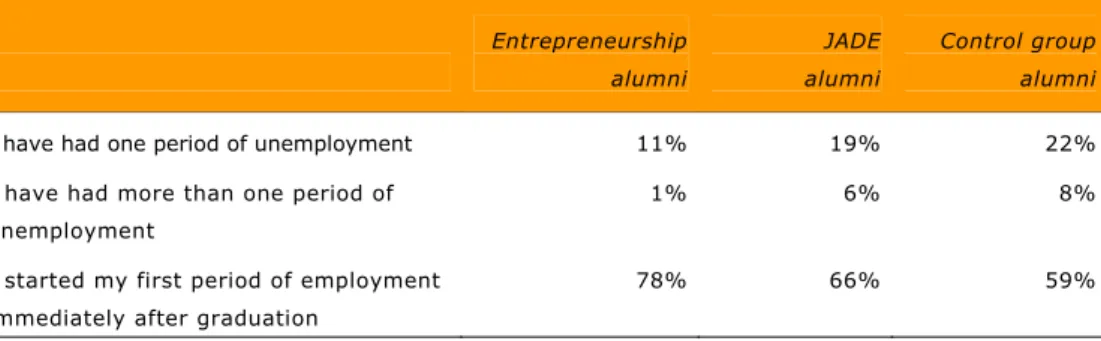
It seems to be easier for entrepreneurship alumni to find employment immedi-ately after their graduation and the chance of being unemployed in the first years after graduation is lower. Following entrepreneurship programmes does not have an impact on the international mindset of graduates and does not result in higher job satisfaction.
Job experience
The share of individuals that had one or more periods of unemployment is lower among entrepreneurship alumni (Table 2).
In addition, relatively more entrepreneurship alumni (78% of the entrepreneur-ship alumni, 66% of JADE alumni and 59% of control group alumni) indicate that they have started their first period of employment immediately after their graduation. These results suggest that it was easier to find paid employment for entrepreneurship alumni.
Table 2 Job experience of the alumni currently in paid employment (n=1,899) Entrepreneurship alumni JADE alumni Control group alumni
I have had one period of unemployment 11% 19% 22%
I have had more than one period of unemployment
1% 6% 8%
I started my first period of employment immediately after graduation
78% 66% 59%
Source: EIM, 2011.
The differences between the groups are not consistent regarding the interna-tional mindset. More entrepreneurship alumni have worked abroad for shorter periods (2 years or less), but more control group alumni have worked abroad for longer periods (more than 2 years). This difference can be explained by the fact that entrepreneurship alumni have better developed personal entrepreneurial characteristics, such as flexibility and adaptability.
Creativity in current position
Improvement of the key competence of entrepreneurship is expected to lead to more innovative behaviour. Consequently, more developed entrepreneurial com-petences put individuals in a position to acquire positions in which more creativ-ity is expected. Therefore, it may be expected that alumni that are in paid em-ployment have positions in which they are able to display creativity and that they can come up with new ideas and that they are able to put them into action. The results show that this is indeed the case; relatively more entrepreneurship alumni have these possibilities in their current positions than alumni in the con-trol group (Figure 3).
Figure 3 Opportunities of alumni currently in paid employment to display creativity and new ideas, by group (n=1,900)
63% 63% 55% 33% 34% 38% 4% 3% 7% 0% 10% 20% 30% 40% 50% 60% 70% 80% 90% 100% Entrepreneurship alumni JADE alumni Control group alumni
Yes, I am able to display creativity and new ideas in my current job
Yes, I am more or less able to display creativity and new ideas in my current job No, I am not able to display creativity and new ideas in my current job
Job satisfaction
Another aspect is the extent to which individuals are satisfied in their current po-sition. Individuals with high employability are in a better position to change jobs; for example, in case they are not satisfied with their position. The job satisfac-tion of the alumni in paid employment is on average the same for both groups of alumni. However, alumni that have graduated at an older age indicate to be more satisfied.
Annual income
Better developed entrepreneurial competences would also imply that individuals are capable of getting better paid jobs. The share of entrepreneurship alumni that earn an income below the national annual income of individuals with a simi-lar level of education (tertiary) is a bit lower among the alumni currently in paid employment than among the control group alumni (entrepreneurship alumni 18%, JADE alumni 17%, control group 22%). Therefore, entrepreneurship alumni in paid employment have a relatively high income. Female alumni in paid em-ployment have a much lower income than males.
Impact of entrepreneurship programmes on society and econ-omy
Entrepreneurship education is expected to improve the entrepreneurship key competence which will have an impact not only on the role of the individual in the economy (working life) but also in society (social and personal life). A more entrepreneurial role will be played due to entrepreneurship education.
The effects of entrepreneurship programmes on the role in society differ. A posi-tive impact is identified in the extent to which individuals take initiaposi-tives to start non-commercial projects outside of work. On the other hand, higher participation in voluntary work seems to be limited.
The survey reveals that entrepreneurship education has an impact on the econ-omy.
The likelihood that entrepreneurship alumni will participate in a business start-up is substantially higher, the frequency with which they set up businesses seems to be higher and they become self-employed earlier in their careers. In addition, the enterprises run by these individuals are perceived as more innovative and the expectations regarding employment growth and turnover growth are higher.
Participation in voluntary work
The impact of entrepreneurship education on society is illustrated by the partici-pation in voluntary work. Entrepreneurship education does not seem to have an impact although JADE alumni are a little more often active as volunteers than the other two groups. The participation in voluntary work is not related to the age of the alumni. Male alumni are significantly more involved than female.
Although there is no difference in the participation between the groups of alumni regarding the participation in voluntary work, there is a difference regarding the extent to which initiatives were taken to start a non-commercial project outside of work. Relatively more entrepreneurship alumni have ever taken this step (49% of the entrepreneurship alumni, 58% of JADE alumni and 38% of control
Involvement in business start-ups of employed alumni
The alumni currently in paid employment or without professional activity were asked about their involvement in business start-ups. Approximately one third of the entrepreneurship and JADE alumni who are in paid employment or who are without a professional activity, have tried to accomplish a transition towards self-employment: they once started a business or they are currently taking steps to start one. In the control group this is true for one fifth.
Approximately 39% of the employed entrepreneurship alumni and 57% of the employed JADE alumni indicate that they are thinking about starting up a busi-ness, against 24% of the control group. In line with these results, 83% of the entrepreneurship alumni and 86% of the JADE alumni state that it is very likely, likely or that there is a possibility that they will start their own business in the next ten years (Figure 4). In the control group this is true for 67%.
Figure 4 Probability that alumni who are currently in paid employment or without a pro-fessional activity will start up a business in the next ten years (n=1,450)
5% 3% 3% 11% 22% 7% 39% 40% 31% 28% 21% 26% 16% 14% 32% 0% 10% 20% 30% 40% 50% 60% 70% 80% 90% 100% Entrepreneurship alumni JADE alumni
Control group alumni
Very likely Likely Possible Small possibility Highly unlikely Do not know
Source: EIM, 2011.
A lot of alumni who are currently in paid employment or without a professional activity are somehow involved in entrepreneurship or are at least thinking about it, but they are currently not self-employed. This indicates that there is much po-tential.
Although the alumni want to become self-employed, this will not be feasible for all of them for several reasons. The Flash Eurobarometer stresses that the major reason for not becoming self-employed is the lack of finances followed by the current economic climate which is not good for a start-up, lack of a business idea or business opportunities; it does not agree with the family situation or the risk of failure and its legal and social consequences are too large.
Alumni who are entrepreneurs
The impact on the economy through paid employment by alumni is described above. Another part of the impact is determined by the extent to which alumni
terms of innovation and growth. Currently, 8% of the entrepreneurship alumni and 9% of the JADE alumni are entrepreneurs (Table 3). In the control group the majority of the self-employed alumni have liberal professions (for example: law-yers, medical practitioners, accountants and architects), they are freelancers or they are active in the agricultural sector.
Table 3 Percentage of entrepreneurs and liberal professions by group (n=2,582)
Entrepreneurship alumni JADE alumni Control group alumni Self-employed 16% 16% 10% Entrepreneurs 8% 9% 3%
Liberal professions and freelancers 8% 7% 7%
Source: EIM, 2011.
Only 5% of the alumni in the survey (a total of 133) are entrepreneurs. Ap-proximately three quarter of these 133 entrepreneurs are active in services. The major share (68%) consists of entrepreneurship alumni. The following results have to be interpreted with care considering the number of enterprises set up by the alumni who were surveyed and they should be considered as indicative. The results are almost all in favour of entrepreneurship and JADE alumni and there-fore they are another indication that entrepreneurship education seems to have an effect. Entrepreneurship and JADE alumni start-up their business before graduation, they are more innovative and the current and future business size is larger (Table 4). Exceptions are employment growth in the past and the net an-nual income which is higher for the control group alumni. This can be explained by the fact that these alumni have been in their current business during a longer period of time than entrepreneurship alumni.
Table 4 Characteristics of entrepreneurs by group (n=133)
Entrepreneurship alumni JADE alumni Control group alumni
Relatives/friends are entrepreneur *** ** *
Start-up before graduation *** *** *
Innovation *** ** *
Current business size ** *** *
Employment growth in the past ** * ***
Turnover growth in the past ** *** *
Ambition: future business size ** *** *
Net annual income ** * ***
Note: *** highest, ** medium, * lowest Source: EIM, 2011.
Business history
Entrepreneurship alumni are in business on average during 7.4 years. The con-trol group is in business during a longer period of time: 9.5 years. This was the
neurship alumni. Therefore, alumni who attended entrepreneurship programmes have established more businesses in a shorter period of time. Another interesting characteristic is the number of years between graduation and starting their first business. Entrepreneurship and JADE alumni show a peak in their business start-up just before and right after graduation. Control grostart-up alumni start their busi-ness between 2 and 5 years after graduation.
Entrepreneurship and JADE alumni started their first enterprise on average be-fore graduation (0.7 years) and control group alumni started on average after graduation (2.8 years).
Level of innovation
Development of the entrepreneurial competence is expected to lead to more in-novative behaviour by individuals and consequently this would mean that the en-terprises that these alumni are leading are more innovative than other enter-prises. This expectation seems to be the case, as relatively more alumni of the entrepreneurship group assess their enterprise as innovative in terms of intro-ducing new or improved processes, introintro-ducing new or improved goods/services and/or introducing new and improved forms of organisation, business structures and practices.
Business size and ambition
In addition, it is expected that entrepreneurs who have attended entrepreneur-ship education are more ambitious regarding the growth of the enterprises. About half of the 133 entrepreneurs have the ambition to allow their enterprise to grow as large as possible and a major part of these entrepreneurs have in-deed attended entrepreneurship education.
In terms of full-time employees, the average size of the enterprises of the entre-preneurship alumni has 4.2 full time equivalents (FTE), slightly larger than the control group alumni (4.0 full time equivalents). However, employment growth during the last 3 years is higher for the control group. This can be explained by the fact that these enterprises have on average existed longer.
In terms of annual turnover growth during the last 3 years, the group differences are opposite: relatively more enterprises run by entrepreneurship alumni experi-ence a turnover growth.
Entrepreneurship alumni turn out to be the most ambitious ones. 58% of the en-trepreneurs in this group want their company to be as large as possible in the future. Entrepreneurs in the control group are less ambitious. Two out of three entrepreneurs in this group want an enterprise size that they can manage them-selves (Figure 5).
Annual income
The annual net income of entrepreneurship group(s) alumni exceeds the income of the control group alumni.
Figure 5 Ambitions of self-employed alumni entrepreneurs in business growth by group and gender (n=133) 58% 48% 33% 42% 52% 67% 0% 10% 20% 30% 40% 50% 60% 70% 80% 90% 100% Entrepreneurship alumni JADE alumni
Control group alumni
I want my company to be as large as possible
I want a size I can manage myself or with a few employees
Source: EIM, 2011.
Policy recommendations
Policy should be supportive of entrepreneurship programmes
Overall, it can be concluded that providing entrepreneurship education at higher educational institutions has a positive effect on entrepreneurship. The results underline the importance of the policy of the development of entrepreneurial skills through education in the European Union.
Entrepreneurship education should become obligatory and expanded to all disciplines
The enterprises created by entrepreneurship alumni can be characterised as more innovative, high growth and ambitious, whereas the enterprises established by the control group can be characterised as traditional, stable and less risky. Entrepreneurship education also has a positive effect on the employability of dividuals in terms of job experience, creativity in the current job and annual in-come earned by the alumni who are presently in paid employment and therefore it makes these individuals more attractive to employers.
These results support the argument to make entrepreneurship education at higher education institutions obligatory and expand this type of education to other disciplines than economics and business and business/management ad-ministration. This enhancement is already taking place but it should be further continued.
Learning by doing should be an important part of the training JADE alumni score better in many aspects. This supports the importance of in-cluding practical training in the education programmes.
Value the impact on society
Improving the entrepreneurial key competence is expected to have an impact on society. Entrepreneurship education has a positive effect in the extent to which
should therefore not only focus on the use of entrepreneurial competences in working life, but also on the personal and social life.
Specific attention to female students
Female alumni value their entrepreneurial characteristics, skills and knowledge less than male alumni and they are less inclined to become an entrepreneur. Specific attention to this group of students is justified.
Measure impact in more than one period
The impact of entrepreneurship education in this study was only measured on one single time period. Most of the entrepreneurship programmes in the higher education institutions are less than ten years old. Combined with the knowledge that many graduates first want to gain some work experience before considering to start a business, it is likely that, for example more alumni will somehow be involved in entrepreneurship in ten years time than at present. This supports the value of longitudinal research.
1
Introduction
1.1
Background
Europe needs more new enterprises and more innovation. Sustainable growth based on innovation and excellence requires an increasing number of start-ups, which are likely to provide more and better jobs. Cultural aspects need to be taken into account although various factors influence entrepreneurship. Europe-ans are reluctant to take up opportunities for self-employment and entrepreneu-rial activities. According to the 2009 Eurobarometer on Entrepreneurship, only 45% of European citizens would like to be self-employed. In the United States these figures are different: 55% of the population would like to be their own boss, while only 36% believe that dependent employment is the best option.
The pace of change in technologies is so fast that it is very difficult or even im-possible to predict how the labour market and the business world will evolve; therefore the ability to adapt, to get new ideas and to put these ideas into ac-tion, to be pro-active and tolerant to failure will be equally as important as the ability to read, write and calculate are today as they will be in the future. Europe cannot compete in the global economy based on cost. Europe can only stay com-petitive by investing in people and their capacity to innovate.
Entrepreneurship concerns an individual’s ability to turn ideas into action. It in-cludes creativity, innovation and risk taking, as well as the ability to plan and manage projects in order to achieve objectives. This supports everyone in day-to-day life, both at home and in society, it makes employees more aware of the context of their work and it makes them better able to seize opportunities, and it provides a foundation for entrepreneurs to establish a social or commercial activ-ity.1
The following objectives are to be reached through entrepreneurship education: − Improvement of the entrepreneurship mindset of young people to enable them
to be more creative and self-confident in whatever they undertake and to im-prove their attractiveness for employers.
− Encourage innovative business start-ups;
− Improvement of their role in society and the economy. 2
Europe 2020 Strategy for smart, sustainable and inclusive growth As response, the EU 2020 strategy3 highlights the need to embed creativity,
in-novation and entrepreneurship in education and it proposes a number of actions to unleash Europe's entrepreneurial and innovative capabilities through the
flag-1 Commission Communication “Fostering entrepreneurial mindsets through education and
learn-ing”, COM(2006) 33 final.
2 See for example Mwasalwiba, Ernest Samwel (2010), Entrepreneurship education: a review of its
objectives, teaching methods, and impact indicators, Education + Training, Vol. 52 (1), pp. 20-47.
3 European Commission (2010), Europe 2020: A European strategy for smart, sustainable and
inclusive growth, http://europa.eu/press_room/pdf/complet_en_barroso___007_-_europe_2020_-_en_version.pdf
ship initiatives of "Youth on the Move", "An Agenda for New Skills and Jobs" and "Innovation Union". There is a need to stimulate the entrepreneurial mindsets of young people and to create a more favourable societal climate for entrepreneur-ship, as the EU is not fully exploiting its entrepreneurial potential. In the Euro-pean reference framework, 'Entrepreneurship and a sense of initiative'1 is one of
eight key competences for lifelong learning which citizens require for their per-sonal fulfilment, social inclusion, active citizenship and employability in a knowl-edge-based society. Education has an important role to play improving this en-trepreneurship key competence.
Small Business Act for Europe
In June 2008, the Small Business Act (SBA) for Europe was adopted.2 The
objec-tive of the Act is ‘to improve the overall approach to entrepreneurship, to anchor the "Think Small first" principle permanently in policy making from regulation to public service, and to promote SMEs' growth by helping them tackle the remain-ing problems which hamper their development’. The Act includes a framework of measures carried out at EU and Member States levels. The most relevant princi-ples on which it is based in the context of this study are:
− Create an environment in which entrepreneurs and family businesses can thrive and entrepreneurship is rewarded
− Make public administrations responsive to SMEs’ needs
− Promote the upgrading of skills in SMEs and all forms of innovation − Encourage and support SMEs to benefit from the growth of markets.
In February 2011, the SBA review was presented3. The most relevant new
ac-tions were suggested in the area of promoting entrepreneurship, job creation and inclusive growth.
Programme for the Competitiveness of enterprises and SMEs (COSME) 2014-2020
In November 2011, the European Commission published the proposal for the Programme for Competitiveness of enterprises and SMEs (COSME) 2014-2020.4
The programme focuses on:
− facilitating Access to finance for Small and Medium-sized Enterprises (SMEs); − creating an environment favourable to enterprise creation and growth; − encouraging an entrepreneurial culture in Europe;
− strengthening the sustainable competitiveness of EU enterprises;
− supporting the internationalisation of SMEs and improving their access to markets.
1 http://ec.europa.eu/dgs/education_culture/publ/pdf/ll-learning/keycomp_en.pdf 2 The Council’s Action Plan for a Small Business Act for Europe,
http://ec.europa.eu/enterprise/policies/sme/files/docs/sba/sba_action_plan_en.pdf
3 Communication from the Commission to the European Parliament, the Council, Economic and
Social Committee and the Committee of the Regions, Review of the "Small Business Act" for Europe, Brussels, 23.2.2011, COM(2011) 78 final
1.2
Assessment of the impact of entrepreneurship education
Demand and supply of entrepreneurship educationThe demand for entrepreneurial learning has been and is still steadily increasing. However, there are a number of obstacles hindering the implementation of en-trepreneurship education. For one, there is a shortage of human resources and funding for this type of education; therefore it is not possible to meet this de-mand fully. Action-oriented teaching is labour-intensive and costly, and requires specific training. Also due to the historic development, where entrepreneurship education often started as a course on small business management and it evolved from the business school setting; there has been a tendency in aca-demic/teaching communities to perceive entrepreneurship education exclusively with learning how to start and run a business. Some academics find this entre-preneurship endeavour to be at odds with the general objectives of higher edu-cation institutions and therefore they are reluctant to engage in entrepreneurship education. More insight into the impact of entrepreneurship education can con-tribute to overcome these obstacles.
Better knowledge about the impact of entrepreneurship education is one of the things that Member States are constantly looking for. However, so far there are only a limited number of studies on the effects of entrepreneurship education that are often from the US and/or project-based. Despite the lack of evidence on the effects of entrepreneurship education, the key role of entrepreneurship edu-cation must not be disregarded. In addition to equipping young people with the skills needed for the 21st century, entrepreneurship education is a means to in-creased social inclusion, it can increase the number of entrepreneurs – social and commercial, and it can be a gateway for a greater integration of the framework for key competences for lifelong learning.
Meanwhile, an increasing number of Member States are implementing national strategies on entrepreneurship education, which creates a platform that provides an opportunity where the impact can be measured in a European context and at a policy-level instead of at a project-level. Currently, the Member States are con-templating how they can measure the impact of their policies and here the Euro-pean dimension can really provide added value. It is important to ensure that Member States are not producing their own individual national measures, but in-stead that they will join forces to find ways to measure the broad impact of en-trepreneurship education.
Importance of assessing impact of entrepreneurship education
An assessment of the impact of entrepreneurship education at the level of educa-tional institutions can determine the degree to which it has accomplished its ob-jectives and justifies the resources that were committed to it. Also, it is impor-tant to apply broad impact measures to reflect that the entrepreneurship key competence is a competence for life and not solely aimed at the creation of a new venture. Having a broad impact measure will help to portray entrepreneur-ship as a broad competence and convince academics that it is also a task for the education system to equip young learners with entrepreneurial mindsets and skills, i.e. a sense of initiative, creativity, tolerance to failure etc. that can be applied to all walks of life and help the youngsters to achieve the goals they set for themselves.
Entrepreneurship education strategies and policies may also require a greater level of commitment of public resources at the level of public policy, and gov-ernments will need to be able to justify such expenditure, especially at a time of budget restraints. However, as long as has not been figured out more explicitly what the level of impact of entrepreneurship education is, it will be difficult for EU and Member States to make a systematic effort to implement such policies.
Measurement will help policy makers know where they are now, and it helps them to get where they want to be. However, there is a perceived lack of evi-dence on the outcomes of entrepreneurship education at policy level; institution level as well as at an individual level, and so far relatively little research has been conducted in this field. This study envisions contributing to fill this informa-tion gap and it can be considered as a first attempt for a broader perspective of the effect of entrepreneurship education.
1.3
Objective
The objective of this study is to measure the impact of participation in neurship education by surveying university alumni who participated in entrepre-neurship programmes as well as surveying a comparable control group consisting of alumni that have not participated in entrepreneurship programmes. This re-search focuses on the impact of entrepreneurship education programmes pro-vided by higher education institutions at four dimensions:
1 Impact on the entrepreneurship key competence; 2 Impact on the intentions towards entrepreneurship; 3 Impact on the individual's employability;
4 Impact on society and the economy.
1.4
Research methodology
The research covers a limited number of entrepreneurship programmes carried out by higher education institutions (HEIs) in Europe. In this section, the re-search methodology is summarised. A detailed description is included in Annex II. The main steps were:
1 Selection of higher education institutions;
2 Execution of an online survey among alumni graduated from these institu-tions;
3 Analysis and reporting.
1. Selection of higher education institutions
In 2008, the European Commission published the results of a survey of entrepre-neurship in higher education in Europe1. In the same year, the European
Com-mission also published the final report of the Expert Group on ‘Entrepreneurship in higher education, especially within non-business studies’. In both reports good-practice examples of entrepreneurship programmes were presented. 43 higher education institutions were identified as possible candidates to be in-cluded in this study, based on these two reports and additional desk research.
1 http://ec.europa.eu/enterprise/policies/sme/pro
The information of their entrepreneurship programmes as presented on their websites was studied in detail. In addition, all institutions were contacted by mail and when necessary by phone in order to check the qualifications of the pro-gramme, to verify the availability of an updated database of alumni to be sur-veyed and to explore their willingness to cooperate.
A priority list of institutions was developed based on the information and feed-back received. A further selection of institutions was made based on the follow-ing three criteria, in close cooperation with the Commission: number of alumni, year of starting the programme and geographical distribution. The Higher Educa-tion InstituEduca-tions that are included in this report are listed in Table 1. A short de-scription of the education programmes of these institutions are presented in chapter 2.
Table 5 Overview of involved Higher Education Institutions
Chalmers University of Technology University of Turku
Dublin Institute of Technology University of Valencia
J.J. Strossmayera University of Osijek Unternehmer TUM
Johannes Kepler University of Linz Utrecht School of Arts
Queen’s University Belfast
In addition to these higher education institutions, members of the European Con-federation of Junior Enterprises (JADE) have also participated in the project. JADE is an international umbrella-organisation of junior enterprises established and managed by students.
2. Online survey
The emphasis of the study is on entrepreneurship versus non-entrepreneurship. It is not the objective to compare the different programmes or countries. The sample for each educational institution consists of a group of alumni who partici-pated in an entrepreneurial programme (entrepreneurship alumni) and a group of alumni who did not take part in the programme (control group alumni).
The Flash Eurobarometer1, Entrepreneurship in the EU and beyond, the
Entrepre-neurship Education Monitor (EEM) developed by EIM2 and the GUESS3 survey
were used for the development of the questionnaire. The questionnaire consisted of the following topics:
− Background information;
1 Over the past 10 years, DG Enterprise and Industry of the European Commission has been
study-ing the development of entrepreneurship in EU Member States and other countries outside Europe, including the US and only recently some Asian countries. More information on the Flash barometer is included in Annex II.
2 EEM is developed by EIM in 2009. EEM is designed to evaluate and reveal the effects of
entre-preneurship education. More information on EEM is included in Annex II.
3 GUESS stands for Global University Entrepreneurial Spirit Students‘ Survey. GUESSS is an
inter-national research project using a geographical and temporal comparison to investigate the entre-preneurial intention and activity of students. More information on GUESSS, is included in Annex II.
− Psychological profile;
− Self-perception of entrepreneurship; − Preferences: self-employed or employee; − Employed or self-employed;
− Job satisfaction;
− Involvement in starting a business; − Annual income.
The complete questionnaire is included in Annex III. The questionnaire was available in all the relevant national languages. A total of 851 entrepreneurship alumni, 1,482 control group alumni and 288 JADE alumni have completed the questionnaire.
3. Analysis and report
The analysis started with a bivariate analysis of all questions included in the questionnaire. To this end, a large number of standard tables have been pre-pared, where the variables that are included in the dataset are tabulated against a limited number of control variables: by group (entrepreneurship, control group, JADE); by gender and by age. It turned out that in several aspects the alumni of JADE are different from the entrepreneurship and control group. JADE is consid-ered as a ‘second’ control group because of these differences. In addition, we took a closer look at the structure to measure competencies. We have used cor-relation, reliability and factor analysis to do this. The results of these analyses are presented in this report.
Self-selection bias
When comparing groups of alumni who did and who did not follow entrepreneur-ship education and when measuring the effects and the impact of the entrepre-neurship education there will be a bias effect. The source of this bias is the self-selection of students. Those who are interested in and who have a positive atti-tude towards entrepreneurship will choose to attend the entrepreneurship educa-tion. Therefore, the alumni who attended the entrepreneurship programmes will show a relatively high score on entrepreneurship effects. This high score is par-tially a result of following the programme, and parpar-tially influenced by their atti-tudes and willingness to become an entrepreneur.
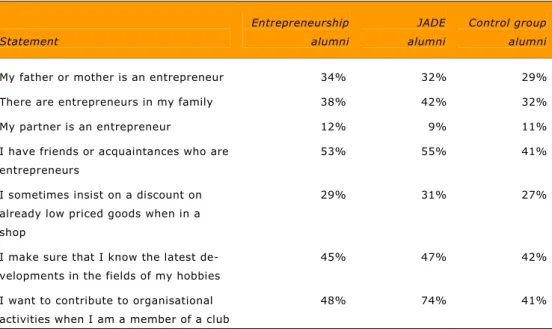
In order to determine to what extent group differences result from the self-selection bias, the characteristics of alumni have been analysed regarding the period following their attending higher education institutions. The analysis fo-cuses on personal characteristics (such as the entrepreneurial background of relatives and activities outside work). Alumni who participated in an entrepre-neurship course are compared with the control group alumni (who did not receive that type of education) based on these characteristics (Table 6).
Table 6 Background of the alumni by group (n=2,582) Statement Entrepreneurship alumni JADE alumni Control group alumni
My father or mother is an entrepreneur 34% 32% 29%
There are entrepreneurs in my family 38% 42% 32%
My partner is an entrepreneur 12% 9% 11%
I have friends or acquaintances who are entrepreneurs
53% 55% 41%
I sometimes insist on a discount on already low priced goods when in a shop
29% 31% 27%
I make sure that I know the latest de-velopments in the fields of my hobbies
45% 47% 42%
I want to contribute to organisational activities when I am a member of a club
48% 74% 41%
Source: EIM, 2011.
It turns out that entrepreneurship alumni more often have relatives or friends with an entrepreneurial background than control group alumni. Furthermore, en-trepreneurship alumni themselves have an entrepreneurial attitude (for instance towards hobbies) prior to their higher education to a larger extent than control group alumni. These results all indicate that there was already - prior to attend-ing the higher education institution and hence choosattend-ing whether or not to attend an entrepreneurial course - a difference in entrepreneurial attitude between en-trepreneurship alumni and control group alumni. Therefore, it seems indeed to be a self-selection bias. However, the latitude of the bias seems to be small con-sidering the relatively limited differences in personal characteristics prior to higher education. Therefore, possible effects and impact of entrepreneurship education result to a large extent from attending entrepreneurship courses and to a limited extent from the self-selection bias.
1.5
Characteristics of the respondents
Some main characteristics of the alumni are presented here, based on the ques-tions regarding their background.
Gender
The sample groups contain more male alumni than female alumni. About two thirds of the entrepreneurship alumni and the JADE alumni are male. The gender division in the control group is more evenly distributed (Table 7).
Table 7 Gender of the respondents by group (n= 2,582) Entrepreneurship alumni JADE alumni Control group alumni Male 61% 66% 55% Female 39% 34% 45% Total 100% 100% 100% Source: EIM, 2011.
In the analysis we have considered differences by gender and in case differences are found these results are presented in this report. We have also compared women in the entrepreneurship group, the JADE group and the control group. In general entrepreneurship and JADE female alumni outperform female alumni in the control group on almost all aspects. These results are in line with the results found if comparing these groups irrespective of gender.
Age
Alumni were asked about their current age and their age when they graduated (Table 8). It turns out that on average the JADE alumni in the sample are cur-rently younger than both the alumni of the entrepreneurship and the control group. The average age of the entrepreneurship alumni is 32, the average age of the control group alumni is 34 and of those of JADE it is 28. There is hardly any group difference in age when they graduate: the alumni of the three groups graduated on average when they were approximately 25 years old. Therefore, more years have passed for the control group alumni since their graduation than for the entrepreneurship alumni.
Table 8 Age of alumni (n= 2,582)
Entrepreneurship alumni JADE alumni Control group alumni Current age (average) 32 years 28 years 34 years
- younger than 26 9% 35% 11%
- 26-30 46% 41% 35%
- 31-35 26% 19% 22%
- older than 35 19% 5% 32%
Total 100% 100% 100%
Graduation age (average) 26 years 25 years 25 years
- younger than 23 10% 10% 27% - 23-24 26% 40% 29% - 25-26 37% 33% 23% - older than 26 27% 17% 21% Total 100% 100% 100% Source: EIM, 2011.
Areas of education
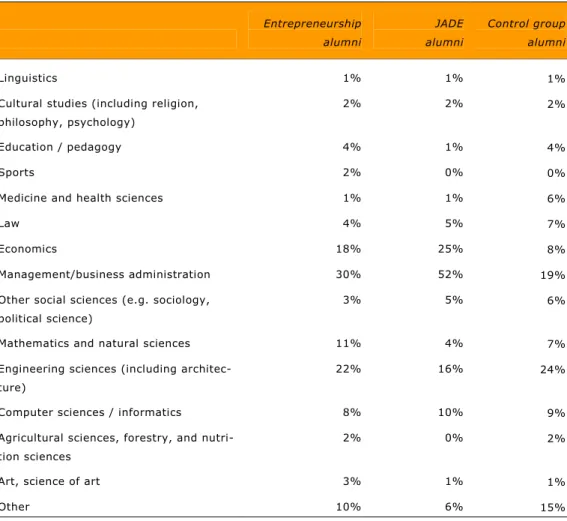
Almost one third of the entrepreneurship alumni graduated in
manage-ment/business administration, around one fifth in economics and almost a fourth in engineering services as shown in Table 9. A fourth was educated in engineer-ing services and one fifth in management/business services, of those in the con-trol group. Half of the JADE alumni have graduated in management/business. The majority of the remaining JADE alumni graduated in economics, engineering sciences and computer sciences.
Table 9 Area of education of the respondents by group (n= 2,582)*
Entrepreneurship alumni JADE alumni Control group alumni Linguistics 1% 1% 1%
Cultural studies (including religion, philosophy, psychology)
2% 2% 2%
Education / pedagogy 4% 1% 4%
Sports 2% 0% 0%
Medicine and health sciences 1% 1% 6%
Law 4% 5% 7%
Economics 18% 25% 8%
Management/business administration 30% 52% 19%
Other social sciences (e.g. sociology, political science)
3% 5% 6%
Mathematics and natural sciences 11% 4% 7%
Engineering sciences (including architec-ture)
22% 16% 24%
Computer sciences / informatics 8% 10% 9%
Agricultural sciences, forestry, and nutri-tion sciences
2% 0% 2%
Art, science of art 3% 1% 1%
Other 10% 6% 15%
* The sum of the percentages is above 100%, because alumni might have graduated in more than one area.
Source: EIM, 2011.
1.6
Structure of the report
The entrepreneurship programmes of the higher education institutions involved in this project are presented in chapter 2. The impact of entrepreneurship educa-tion on the entrepreneurship key competence is presented in chapter 3. Chapter 4 describes the impact on the entrepreneurial intentions. Chapter 5 presents the impact on the individual's employability and chapter 6 discusses the impact of entrepreneurship education on society and the economy. The final chapter
con-tains the key messages including policy recommendations. The report starts with an executive summary.
The annexes include an overview of the literature that was used (Annex I), a de-scription of the methodology that was applied (Annex II) and the questionnaire of the on-line survey (Annex III).
2
Entrepreneurship programmes at higher education
institutions
Alumni from a limited number of well-known entrepreneurship programmes run by higher education institutions have been approached. The institutions are lo-cated in different European countries. This chapter describes their entrepreneur-ship programmes.
Chalmers University of Technology (Sweden)
The entrepreneurship education at Chalmers University of Technology offers a wide array of learning within the field of innovation and entrepreneurship. To-gether with three other schools of entrepreneurship, it closely collaborates dur-ing the two educational years regarddur-ing cross disciplinary seminars, workdur-ing groups, etc. Two of these four schools have participated in this study – the Chalmers School of Entrepreneurship and the Göteborg International Bioscience Business School. These two schools share a common and powerful pedagogy of allowing the students to start real ventures as a formal part of the curriculum.
Chalmers University of Technology hosts the Chalmers School of Entrepreneur-ship (CSE), a 2-years master level programme created in 1997. In 2005 another track was opened in the same master programme, based on the same pedagogy but focusing on bioscience. This was named Göteborg International Bioscience Business School (GIBBS), and it was founded in collaboration with the medical school at the University of Gothenburg. Together, CSE/GIBBS could be described as a hybrid organisation combining pioneering and advanced action-based entre-preneurship education with a new and successful mechanism to commercialise research.
The input into CSE/GIBBS is twofold: specially selected, but inexperienced stu-dents, averaging 25 years of age, as well as early-stage R&D-based ideas from universities or corporations which lack entrepreneurial champions. The output so far has consisted of 47 technology ventures with a survival rate of 80%, and around 300 educated entrepreneurs. These ventures had a total turnover of €30 million and around 270 employees in 2010. Common for most of the ventures from CSE is that their initial ideas would have been too early or too vague to be accepted by traditional incubators. This means that the CSE model represents a novel means to create value that would never have been created otherwise.
The development of the action-based pedagogy of CSE/GIBBS was initiated in 1997 by a key faculty at Chalmers University of Technology. It is centred on an advanced form of role-play between student teams and a comprehensive tailored environment. The first year is preparatory and interdisciplinary together with en-gineering, business, and law and medicine students. The second year consists of an environment which has the following main components:
• A managed team-based process where the students spend one full year during which they are required to try to start a real venture, with the in-tention to incorporate it and to obtain funding at the end of the year.
• Course modules coordinated with regards to time and content with the team based venture creation process, forming an integrated 60 credit points master’s thesis.
• Real-life innovation projects stemming from university research, industry or private innovators that are scouted for and screened by the school and provided to the student teams to be cultivated by them.
• A pairing process where the students are paired together taking into ac-count the need for interdisciplinary and complementary attributes of the individuals.
• A network of coaches, capitalists, service providers, board members, po-tential customers, alumni, etc. that students engage with during the year of venture start-up.
• Office space for the teams, equipped with computers, telephone, copier. • Individual and team based reflection sessions with external specialist
coaches and with the faculty.
• A reasonable equity share of the company for each student, if it ends up being incorporated.
For more information: www.entrepreneur.chalmers.se
Dublin Institute of Technology (Ireland)
DIT has a strong commitment to the development and support of the knowledge of economy and a proactive approach to building successful links with industry. The creation and transfer of knowledge through training, collaborative and com-missioned research, consultancy and the development of campus and non-campus companies form the core of DIT's Industry Programme. DIT's Hothouse will assist companies and entrepreneurs to start and grow businesses based on DIT research and it will assist DIT colleagues and students to commercialise their intellectual property. Hothouse provides incubation space in addition to a range of services and facilities to people who are interested in starting their own busi-ness contact. The Professional Development Services team provides innovative training solutions to meet the increasing demands of Ireland's knowledge driven economy, while DIT also has a number of dedicated Centres which address sec-tor-specific training and development needs. The Centres are responsive to mar-ket demands and they work closely with industries to provide a leading edge of innovation services to the sector in which they operate. One such centre is the Institute for Minority Entrepreneurship which focuses its efforts on helping peo-ple from minority communities to start their own business. In short, DIT cur-rently offers a wide range of entrepreneurship-related services to industries and these are now discussed in greater depth.
Hothouse
Hothouse was established in 2001 and its mission is to assist companies and en-trepreneurs to start and to grow businesses based on DIT research, and to assist DIT colleagues and students to commercialise their intellectual property. Some of the key initiatives of Hothouse are:
− The introduction of Annual Commercial Reviews of Research − The launch of two new Programmes
− FAST TRACK - concept for commercial licences − FAST START - concept to establish a start-up − The establishment of the DIT Seed Fund
− Invention Competitions
− Increased commercialisation training in − Invention Recognition
− Collaborative Research Project Management − Commercialisation of Research
− Licence negotiation
These activities exist to assist academic staff to identify and commercialise their intellectual property in addition to the range of activities already underway at DIT. Such activities include Patent Training, Concept for Commerce events, Pros-pect – pre-incubator training, Hothouse incubator training, mentoring, network-ing, PR assistance, etc. from the Hothouse Incubator. The team also assists aca-demics to identify inventions, protect IP and help them to commercialise their IP, either by searching for licensees or by encouraging them to start their own busi-ness with support from the Hothouse programmes.
Prospect
PROSPECT – also established in 2011 – is a training programme that helps searchers from the Dublin Institute of Technology to commercialise their re-search. The programme offers workshops, business counselling and consultancy to provide the necessary skills and know-how to develop a commercialisation plan for academic research. HOTHOUSE is a year-long programme that provides knowledge-intensive start-ups with the expertise, networks and tools they need to develop highly successful businesses capable of competing in global markets. The FAST GROWTH Programme helps owner/managers of fast-growing companies to deal with the challenges associated with rapid expansion. Almost 50 entrepre-neurs have successfully grown their businesses through this initiative in the last three years. Hothouse also has a BES venture capital fund which it uses to sup-port firms at different stages of growth.
Professional Development Services
DIT has established a reputation for successfully organising and delivering valu-able, relevant and challenging Continuing Professional Development courses for industries and the professions and playing a key role in their future growth and development by working with and having a flexible response to the identified needs of industrial/professional sectors. The list of CPD programmes is quite ex-tensive and it indicates a significant level of activity in this area by DIT.
Centres and Groups
As a part of DIT’s commitment to provide tailored support for industries through research, consultancy, services and facilities, the organisation is home to 32 groups or centres that focus on a specific area of activity. Among these groups, the one of most relevance to this paper is the 'Institute for Minority Entrepre-neurship' which was established to offer the different minority groups in Ireland equal opportunity through entrepreneurship education and training. 'Minority En-trepreneurship' has been broadly defined by the Institute to be inclusive of those communities who are generally regarded as being outside of the mainstream Irish society in terms of entrepreneurship. The following groups are considered to be ‘minority entrepreneurship groups’ by the Institute: Ethnic groups, People with Disabilities, Prisoners, Gay people, Socio-economically Disadvantaged peo-ple, Grey peopeo-ple, and Travellers. The primary objective of the Institute is to bring a significant benefit to its target audiences by researching the needs of