The Relationship between Interpersonal Trust Elements in
E-Commerce: A Case Study of E-Payment in CIMB bank
Zainulabdeen Basil Mohammed1, Sahar Jalal Al-Qaysi2,, Abdullah Ahmed Bagaber1 Dr. Samah Muayad Mahmood3
1.Computer Science and Information System, Universiti Technologi Malaysia, Johor, Malaysia 2.Business Administration, Cihan University, Erbil, Iraq
3.Business Administration, University of Al-Mustansiriya, Baghdad, Iraq
Abstract
Trust is a vital element to the success of e-commerce. The research on the concept of trust has emerged rapidly due to the need of understanding it in order to improve current and future e- commerce implementation. This study aims to find the relationship among interpersonal trust elements with e-commerce. This research examines the concepts of trust elements specifically interpersonal trust. In addition, this research proposed model and shows the elements of interpersonal trust in this model. The results of this research show that interpersonal trust dimensions can be empirically distinguished and have both common and unique antecedents. The results also provide further clarification concerning the correlation among interpersonal trust elements with interpersonal trust. However, this research provides guidelines for web customer to understand more about interpersonal trust in order for them to know a secured and trusted e-commerce website.
Keywords: E-commerce, Trust, Interpersonal trust, E-commerce, costumer’s behavior.
1. Introduction
E-Commerce (EC) is now one of the most important commodities for business organizations to conduct online transactions in today's economy, and technology-based networks. E-commerce today has revolution business applications possible, change between the companies and business processes and business processes to the consumer. Although the e-commerce has emerged as a strong medium-mail and sophisticated business transactions, there are a few issues that can reduce the growth of the e-commerce. This study discussed about the essential problems in e-commerce which guided this research to identify the objectives. And the researcher focused on trust as important issues in e-commerce and took interpersonal trust as the main problem. Also the researcher discussed about the interpersonal trust elements and analyzed the relationships among those elements.
2. Interpersonal trust
Interpersonal definition of trust and the desire of one party depends on the other side with a sense of relative safety in spite of negative consequences are possible. Interpersonal rust is the concept of a specific person; one person is willing to depend on someone else. It is a concept for a particular situation; it applies in a particular situation. Interpersonal trust is an intentional state; the person is ready to depend on the other in the situation. For simplicity, the following discussion refers to only one side of the interpersonal dyad.
The definition of trust embodies seven essential elements found in the trust literature based on some authors. Interpersonal trust refers to an individuals’ trust in another specific party like an e- vendor or the trustworthiness of some third party like a friend who gives recommendations about an e-vendor (Lee and Turban, 2001; Tan and Sutherland, 2004).
2.1 Proposed Model and Hypotheses
Using previous research findings as a foundation, we formulated a model of antecedents and consequences of interpersonal trust see (Fig.1). Next, we present the theory supporting the relationships detailed in the model.
2.2 Product Perfomance
The customer’s assessment of the performance of core service deliverables can be defined as Product performance. Services literatures show the distinction between the functional aspects and results (Gronroos, 1984). Behavioral interactions can be identified via the process quality, while results quality can be identified via performance of the tangible products. As customers find it hard to assess the intangibles, customers give special attention to the performance of tangible results (Shostack, 1977). For example, in the context of financial advisory services, where the core deliverable is financial advice, return on investment constitutes the ultimate proof of service quality. The Attribution theory postulates that individuals will attribute the cause of an event if they can reveal what had control of the case (control); the likelihoodof a recurrence of the event (stability); and who is responsible (place), (Weiner, 1985). The performance of the fundamental aspects of a service can be attributed to the service provider because the service provider is usually responsible for both the implementation of services and quality control (Parasuraman et al., 1985). This performance attribution can therefore influence
trust in the provider (Johnson and Grayson, 2005).
H1: Perceived “product performance” is positively related to interpersonal trust.
2.3 Firm Reputation
Perceived service firm reputation has been defined as the customer’s belief that the firm is fair and honest (Doney and Cannon, 1997). Research by (Drumwright, 1994) indicates that doing things not only because it is fair and balanced, but also because it is the right thing to do, can earn the company a good reputation. Thus reputation is both a symbol of exchange value and an expression of sympathy with clients. Therefore, the customers’ perceptions of the company's reputation are sufficient to affect both affective and cognitive trust. A purchaser's evaluation of the firm's reputation will be positively or negatively affected based on her/his evaluation of the trustworthiness of the service provider through a transference process (Doney and Cannon, 1997). For example, those customers not familiar with the service provider may extrapolate their views directly from the company's reputation (Johnson and Grayson, 2005).
H2: Perceived “firm reputation” is positively related to interpersonal trust.
2.4 Satisfaction with Previous Interaction
Satisfaction can be defined as an emotion resulting from a cognitive process of comparing the expectations of customers with service performance perceptions and assessing these emotions experienced during the consumption experience (Westbrook and Oliver, 1991). The evaluation of customer satisfaction involves the appraisal of tangible attributes and feelings such as anger, joy and fear which were associated with the service experience. Satisfaction with the service experience leads to the perception of justice in the process of exchange, thus enhancing the customers’ confidence that the goods or service will continue to fulfill the expectations in the future (Ganesan, 1994; Johnson and Grayson, 2005).
H3: Perceived “satisfaction with previous interactions” is positively related to interpersonal trust.
2.5 Similarities
between the customer and the service provider imply the existence of common interests and values. Researchers in social psychology have found that in social relations, individuals tend to display greater levels of attraction towards people who are perceived to have similar attitudes to their own. Byrne (1969) indicated that this link happens due to the detection of similarity in attitudes in others that confirms the interpretation of the individual of environment. As a result, a positive effect becomes associated with individual reference through adaptation. This convergence provides a favour able environment for the development of trust. Accordingly, detection of similarities in the provider of a service by the customer causes a positive response, which leads to cooperative development and an understanding attitude towards the service provider. Based on this, Johnson and Grayson (2005) hypothesized there is a relationship between affective trust and similarity.
H4: Perceived “similarity” is positively related to interpersonal trust.
2.6 Web Interface Design
A web site with trust-inducing features can in a sense function as a skilful salesperson for the company therefore; an impersonal web site would be a disadvantage (Jarvenpaa, Tractinsky& Saarinen, 1999).Furthermore, research by Karvonen (2000) and Wang &Emurian (2005) showed that a number of Internet users admitted to making emotional and intuitive purchase decisions based on their perceptions of the online merchant's site when shopping online. Thus the implementation of an e-commerce interface with trustworthy perceptions in the features for the general design is an effective use of an interface when applied to e-commerce websites (Scheffelmaier & Vinsonhaler, 2002). Website design features are classified according to four dimensions, namely: content design, social-cue design, graphic design, and structure design. Through the application of specific design features in these contexts to e-commerce interfaces and web site, online merchants can expect an enhancement in optimal levels of trust by the customers (Wang &Emurian, 2005).
H5: Perceived “web interface Design” is positively related to interpersonal trust.
2.7 Perceived Privacy
Research in marketing and information systems has argued that the most important issues in today's technology based environment are consumer concerns and information privacy (Miyazaki, 2000; Miyazaki, 2001). Privacy concept is not a new concept; it had been defined generally as the ability of the individual to control the conditions by which their personal information are obtained and used (Westin, 1967). Previous research on privacy shows that consumers might be willing to disclose personal information in exchange for some benefits (Culnan, 1999).
According to Culnan (1995); Culnan (2000); and Smith (1996), consumers may also provide private information if they believe they are able to have over all control of their information; if the information
requested is relevant; and if the information is likely to create valid inferences about their preferences. Privacy has also been discussed in many details; both from the standpoint of the individual and organizational practices (Chellappa, 2002).
H6: “Perceived security” is positively related to interpersonal trust in e-payment.
2.8 Perceived Security
A security threat can be defined as a “circumstance, condition, or event with the potential to cause economic hardship to data or network resources in the form of destruction, disclosure, modification of data, denial of service, and/or fraud, waste, and abuse” (Kalakota and Whinston, 1996). Security is therefore for protection against those threats. By this definition, threats can be made either through data transaction, through network attacks, or through unauthorized access (Belanger et al. 2002). A standard ecommerce website must be designed to apply to consumer transactions in such a way that consumer information has value. To adequately cater to consumers, businesses must recognize the economic hardship that is accrued from the damage to privacy (information loss or theft). An example of what can be done in such a case is that the credit information and authentication issues for consumers will be reversed; as the case in such a situation is whether the site is the "real" and not whether the identity of the buyer is real. This definition is designed to explain the security threats from consumers’ viewpoint. Security in B2C electronic commerce is reflected in the technologies used to protect and secure consumer data. Security concerns of consumers may be addressed by many of the same technology protections as those of businesses, such as encryption and authentication (Belanger et al. 2002).
H7: “Perceived privacy” is positively related to interpersonal trust in e-payment.
Fig.1 proposed model of interpersonal trust
3. Method
The model was assessed using survey data from customers of CIMB bank. The questionnaires distrusted on UTM students. A total of 187 responses were realized from distributing to 209 randomly selected customers. Respondents comprise 79 male and 108 female. Surveys items are detailed in Appendix A. Established measures were used with minor modifications to suit the study context. The questionnaires of product performance and similarity were adapted from (Johnson and Grayson, 2005) and firm reputation's questionnaire is adapted from (Teo and Liu, 2007) and (Doney and Cannon 1997). Satisfaction with previous interaction was measured using scales from (Johnson and Grayson, 2005) and (Ganesan, 1994). Perceived privacy, Perceived security, and web interface design were measured using questionnaires from (Eid, 2011). The questionnaire of interpersonal trust was adapted from (Chellappa, 2002). Checks for the internal reliability of each construct were made using Cronbach's Alpha values and factor analysis. The factor analysis results indicated a strong association between items and constructs. All the constructs of this study report Cronbach's Alpha over 0.7, reaching high reliability standards, which indicates that the measurement design is highly credible. Thus the ratability statistics of
Cronbach's Alpha is 0.973.
4. Data analysis
We provided the data analysis of findings, which is based on data collected from the questionnaire. We used questionnaire method for data collection. As mentioned previously the questionnaire was distributed to UTM students to understand their perception of interpersonal trust elements of the CIMB. The purpose of this questionnaire is to find the relationship and significant of interpersonal trust elements.
5. Respondents’ Demographic Profile
Based on the survey, male respondents represented (57.8 percent) of the total respondents while female respondents (42.2) percent. In the case of age distribution, the majority of the respondents were between the ages of 18 to 24 (54.5 percent). In terms of experience of using the internet, the majority of respondents were (32.6 percent). In the category of nationality, local respondents represented (54.0%) and international respondents represented (46.0%).
6. Reliability
Reliability analysis was performed to assess the reliability of the scale used to measure the variables of interest. Reliability assessment of the entire scale was first computed followed by the assessments of individual items supposed to measure the research constructs. The overall reliability assessment of the entire scale was observed to be good with a Cronbach’s alpha of 0.973. The results are shown the composite reliabilities were all above the recommended value of 0.7 suggested by (Hulland, 1999) thus indicating acceptable internal consistency and reliability of the respective measures. Therefore, the measurement model demonstrated adequate convergent and reliability.
7. Correlation Analysis
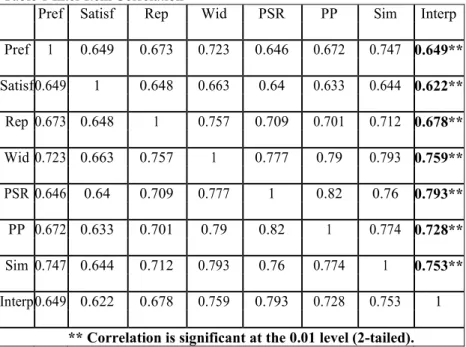
Correlation coefficients were computed in order to test the relationships between each factor and interpersonal trust in e-commerce. As this research already been mentioned product performance, satisfaction with previous interaction, similarity, perceived privacy, perceived security, web interface design, and firm reputation as interpersonal trust elements. This section has been tested the correlation of these seven elements with interpersonal trust. Average variances extracted are all above the recommended 0.5 level, supporting the discriminate validity of measurement scales supporting the discriminate validity of measurement scales (Fornell and Larcker, 1981). Correlation indicates the strength and direction of a linear relationship between two variables. The generated correlation coefficients which represent the strength of the relationships between the study variables are shown in Table below.
Table 1 Inter Item Correlation
Pref Satisf Rep Wid PSR PP Sim Interp Pref 1 0.649 0.673 0.723 0.646 0.672 0.747 0.649** Satisf0.649 1 0.648 0.663 0.64 0.633 0.644 0.622** Rep 0.673 0.648 1 0.757 0.709 0.701 0.712 0.678** Wid 0.723 0.663 0.757 1 0.777 0.79 0.793 0.759** PSR 0.646 0.64 0.709 0.777 1 0.82 0.76 0.793** PP 0.672 0.633 0.701 0.79 0.82 1 0.774 0.728** Sim 0.747 0.644 0.712 0.793 0.76 0.774 1 0.753** Interp 0.649 0.622 0.678 0.759 0.793 0.728 0.753 1
** Correlation is significant at the 0.01 level (2-tailed).
It is obvious from Table (5.1) that the correlation coefficients of the relationships between the study variables which are found strong. Furthermore, from Table (5.1), the correlation coefficient value of 0.649 between Pref and Interp variables indicates these variables are strongly correlated since it is greater than 0.5.Satisf is found to be strongly related to Interp and the correlation coefficient value is 0.622.Rep is strongly
correlated with Interp with correlation coefficient is 0.678. In addition, since that both Wid and Sim are found to be strongly related to Interp with value near of 0.75, and PP is strongly correlated with Interp. the correlation coefficient value of0.793 between PSR and Interp these variables are very strongly correlated. The results still support our proposed model and hypothesis which imposed in session 3. While our results show that whole elements of online transactions are indeed distinct constructs, it also appears that all elements are well correlated with interpersonal trust.
H1: Perceived “product performance” is positively related to interpersonal trust in e-payment.
The results of the study show that a product performance in online transaction is positively associated with interpersonal trust (r = 0.649). The relationship is observed to be statistically significant with significance level less than 0.01 (p = 0.000). Therefore, the research hypothesis is accepted.
H2: Perceived “firm reputation” is positively related to interpersonal trust in in e-payment.
The relationship between firm reputation and interpersonal trust is strong (0.678). The results of the study show that a firm reputation is positively related to interpersonal trust (r = 0.678). The relationship is observed to be statistically significant with significance level less than 0.01 (p = 0.000). Therefore, the research hypothesis is accepted.
H3: Perceived “satisfaction with previous interactions” is positively related to interpersonal trust in e-payment. The results of the study show that a satisfaction with previous interaction is positively related to interpersonal trust (r = 0.622). The relationship is observed to be statistically significant with significance level less than 0.01 (p = 0.000). Therefore, the research hypothesis is accepted.
H4: Perceived “similarity” is positively related to interpersonal trust in e-payment.
The results of the study show that a similarity is positively related to interpersonal trust (r = 0.728). The relationship is observed to be statistically significant with significance level less than 0.01 (p = 0.000). Therefore, the research hypothesis is accepted.
H5: Perceived “web interface Design” is positively related to interpersonal trust in e-payment.
This research has been concluded the increasing security of organization is positively increase customers’ trust. The results of the study show that a perceived security is positively related to interpersonal trust (r = 0.793). The relationship is observed to be statistically significant with significance level less than 0.01 (p = 0.000). Therefore, the research hypothesis is accepted.
H6: “Perceived security” is positively related to interpersonal trust in e-payment.
The results of the study show that a perceived privacy is positively related to interpersonal trust (r = 0.753). The relationship is observed to be statistically significant with significance level less than 0.01 (p = 0.000). Therefore, the research hypothesis is accepted.
H7: “Perceived privacy” is positively related to interpersonal trust in e-payment.
The results of the study show that a web interface design is positively related to interpersonal trust (r = 0.759). The relationship is observed to be statistically significant with significance level less than 0.01 (p = 0.000). Therefore, the research hypothesis is accepted.
8. Discussion
After determining the area of this research and the main problems in this area, the researcher embarked on reviewing related literature on the subject matter and this was followed by collecting the necessary data and analyzing it. In line with that, tremendous achievement, knowledge and experience were recorded. A good understanding of e-commerce the problems inhibiting which effective service delivery to the customers were identified. To find solution to such problems the researcher designed a research question and the achievement of this research depended on how the researcher could answer this question through the research objective which are directly related to the question. The research’s objective which is, to analysis the relationships of interpersonal trust elements with interpersonal trust, has been achieved by distributing a questionnaire to UTM students. A number of questionnaire sets have been distributed among 209 students and then their answers analyzed using SPSS software as analysis tool by testing the correlation and regression analysis.
Acknowledgments
Special appreciation goes to my supervisor, Dr. Othman bin Ibrahim, for his supervision and constant support. His invaluable help of constructive comments and suggestions throughout the experimental and thesis works have contributed to the success of this research. Thanks To those who indirectly contributed in this research, your kindness means a lot to me. Last but not least, my deepest gratitude goes to my beloved father; Prof. Basil Mohammed Saied.
References
Belanger, F., Hiller, J. S., & Smith, W. J. (2002). Trustworthiness in electronic commerce: the role of privacy, security, and site attributes. The Journal of Strategic Information Systems, 11(3-4), 245-270.
Byrne, D. (1969). Attitudes and attraction. In Berkowitz, L. (ed.), Advances in Experimental. Social Psychology, Academic Press, New York, Vol. 4, pp. 38-89.
Chellappa, R. K. (2002). Consumers’ trust in electronic commerce transactions: The role of perceived privacy and perceived security. under submission.
Doney, P. M. and J. P. Cannon (1997): An examination of the nature of trust in buyer-seller relationships., in: Journal of Marketing, Vol. 61 (2): pp. 35-51.
Eid, M. I. (2011). Determinants of e-commerce customer satisfaction, trust, and loyalty in Saudi Arabia. Journal of Electronic Commerce Research, 12(1), 78-93.
Ganesan S. (1994) Determinants of long-term orientation in buyer– seller relationships.1 –19.
Grönroos, (1984) "A Service Quality Model and its Marketing Implications", European Journal of Marketing, Vol. 18 Iss: 4, pp.36 - 44.
Jarvenpaa, S. L., Tractinsky, J., & Saarinen, L. (1999). Consumer trust in an Internet store: A crosscultural validation. Journal of Computer Mediated Communication [on-line serial], 5(2).
Johnson, D. and Grayson, K. (2005). Cognitive and affective trust in service relationships. Journal of Business research, 58(4), 500-507.
Kalakota, R., Whinston, A.B., 1996. Frontiers of Electronic Commerce, Addison-Wesley, Reading, MA.
Karvonen, K. (2000). The beauty of simplicity.In Proceedings of the ACM Conference on Universal Usability. Arlington, VA: The Association of Computing Machinery.
Kubilus, N. J. (2002). Designing an e-commerce site for =[-users.ACM Crossroads [on-line serial], August. Available: http://www.acm.org/crossroads/xrds7-1/ecuser.html.
L.G. Shostack, "Breaking Free From Product Marketing" (1977) 41:2 Journal of Marketing 73-80.
Lee, K.O. Matthew and Turban, E. (2001). A Trust Model for Consumer Internet Shopping. International Journal of Electronic Commerce/ Fall 2001, Vol. 6, No. 1, pp. 75-91.
Neilsen, J. (2000). Designing web usability: The practice of simplicity. Indianapolis: New Riders Publishing. Parasuraman, A., Berry, L.L., and Zeithaml, V. A. (1985) “A conceptual model of service quality and its
implications for further research”, Journal of Marketing: pp. 41– 50.
Scheffelmaier, G. W., &Vinsonhaler, J. F. (2002).A synthesis of research on the properties of effective internet commerce web sites. Journal of Computer Information Systems, Winter 2002– 2003, 23–31.
Tan, F.B. and Sutherland, P. (2004), Online Consumer Trust: A Multidimensional Model, Journal of Electronic Commerce in Organizations, 2(3), pp. 41-59.
Teo, T. S. H. and Liu, J. (2007). Consumer trust in e- commerce in the United States, Singapore and China. Omega, 35(1), 22-38.
Wang, Y. D., &Emurian, H. H. (2005). An overview of online trust: Concepts, elements, and implications. Computers in Human Behavior, 21(1), 105-125. doi:10.1016/j.chb.2003.11.008
Weiner B. (1985) Anattributional theory of achievement, motivation and emotion. Psychol Rev.548–73.
Westbrook RA, Oliver RL (1991) The dimensionality of consumption emotion patterns and consumer satisfaction. J Consum Res 18:84–91.