CA-AQM: Channel-Aware Active Queue Management
for Wireless Networks
Yuan Xue, Hoang V. Nguyen and Klara Nahrstedt
Abstract—In a wireless network, data transmission suffers from varied signal strengths and channel bit error rates. To ensure successful packet reception under different channel con-ditions, automatic bit rate control schemes are implemented to adjust the transmission bit rates based on the perceived channel conditions. This leads to a wireless network with diverse bit rates. On the other hand, TCP is unaware of suchrate diversitywhen it performs flow rate control in wireless networks. Experiments show that the throughput of flows in a wireless network are driven by the one with the lowest bit rate, (i.e., the one with the worst channel condition). This does not only lead to low channel utilization, but also fluctuated performance for all flows independent of their individual channel conditions.
To address this problem, we conduct an optimization-based analytical study of such behavior of TCP. Based on this opti-mization framework, we present a joint flow control and active queue management solution. The presented channel-aware active queue management (CA-AQM) provides congestion signals for flow control not only based on the queue length but also the channel condition and the transmission bit rate. Theoretical analysis shows that our solution isolates the performance of individual flows with diverse bit rates. Further, it stabilizes the queue lengths and provides a time-fair channel allocation. Test-bed experiments validate our theoretical claims over a multi-rate wireless network testbed.
Index Terms—wireless networks, flow control, active queue management, optimization
I. INTRODUCTION
Wireless networks provide ubiquitous access to information and computational resources, and become a popular network-ing solution in both home, office and public areas such as airport and cafes.
In wireless networks, the signal strength and noise level of wireless channels vary widely, especially in indoor environ-ments, leading to diverse channel bit error rates (BER). In IEEE 802.11, to reduce the BER, the sender can transmit at a lower data rate by using a more resilient modulation scheme. Four different bit rate levels (11,5.5,2and1Mbps) are defined in IEEE 802.11 standard. Many vendors of client adaptors and access points implement automatic bit rate control scheme in which the sender adaptively changes the bit rate based on the perceived channel conditions. This leads to a wireless network withrate diversity, where competing flows within the interference range transmit at different rates.
This paper studies the performance of TCP over such multi-rate wireless networks. Besides the unfairness issue, which are
Yuan Xue are with the Department of Electrical Engineering and
Computer Science, Vanderbilt University. Her email addresses are
{yuan.xue}@vanderbilt.edu. Hoang Nguyen and Klara Nahrstedt are with the Department of Computer Science, University of Illinois at Urbana-Champaign.
Their email addresses arehnguyen5,[email protected].
researched extensively in the existing literature, we provide an analytical explanation for the following observations from test-bed experiments. (1) Throughput of flows in a wireless network is confined by the ones with the lowest bit rate (i.e., the one with the worst channel condition), leading to low channel utilization. (2) If there is one flow suffering from fluctuated channel condition, all flows in the network exhibit highly dynamic behaviors, independent of their individual channel condition which causes instability in their application performance.
To address these issues, we investigate a joint solution of flow control and active queue management. Although several flow control and active queue management schemes have been proposed in the context of wireline networks, the unique physical characteristics of wireless networks pose the following challenges which prevent the verbatim applications of the existing algorithms. First, compared with wireline networks where flows only contend at the router that performs flow scheduling (contention in the time domain), the unique characteristics of wireless networks show that, flows also compete for shared channel if they are within the interference ranges of each other (contention in the spatial domain). Second, in a wireless network with rate diversity, different users have different views of the wireless channel capacity. Such observation raises the question of how fairness criteria should be defined in wireless networks. Third, under IEEE 802.11 the achievable channel capacity may vary depending on the number of active users of the wireless networks. This observation prevents the application of previous active queue management schemes which requires the prior knowledge of resource capacity.
To address these challenges, we present a channel-aware ac-tive queue management (CAAQM) scheme. CAAQM provides congestion signals for flow control not only based on the queue length but also the channel condition and the transmission bit rate. Theoretical analysis shows that our solution has the following properties. (1)Performance isolation. The through-put of individual flows only depend on their own channel conditions and BER, but not others as in the case of TCP. (2)Local stability. The presented joint flow control and active queue management scheme can be modelled as a nonlinear system via a utility-based approach. We show that the system is locally asymptotically stable. (3)Fairness. At equilibrium, the system achieves proportional fairness in terms of channel time, where the aggregated utility of all flows are maximized. The remainder of this paper is organized as follows. In Sec. II, we first motivate our work by studying the performance issues of TCP over multi-rate wireless networks, then present
the optimization-based theoretical framework for our flow control scheme. We present the channel-aware active queue management implementation in Sec. III and evaluate our solution in Sec. IV. Finally, we discuss related work (Sec. V) and conclude the paper (Sec. VI).
II. PROBLEMFORMULATION
A. Problem Overview
f1 f2
1 2 3
Fig. 1. Network Topology.
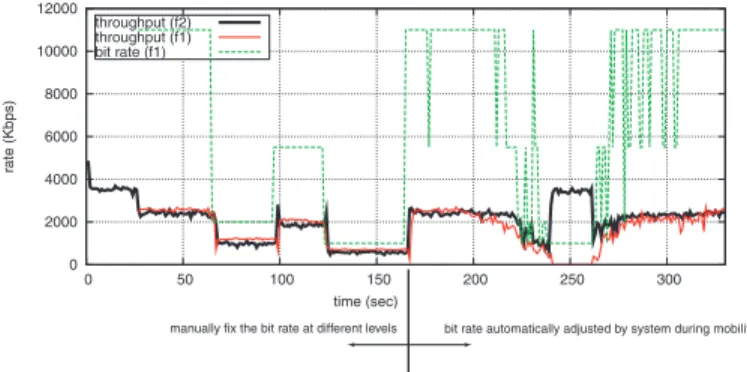
We start with an experimental study of TCP performance in a multi-rate wireless network. In the experiment, we set up a three-node wireless network as in Fig. 1. At time instance 0 sec, node3establishes a TCP connection (flow2) to node2at a fixed bit rate11Mbps. Then at time25sec, node1sends to node2 (flow1) with a varied bit rate using TCP. Initially, we manually adjust the bit rate of node 1 at different levels (in the sequence of 11M, 2M, 5.5M, and 1Mbps). Then at time instance 160 sec, we set the bit rate of node 1 to automatic adjustment mode, then move node1. The observed throughput of both flows and the transmission bit rate of flow2are shown in Fig. 2. 0 2000 4000 6000 8000 10000 12000 0 50 100 150 200 250 300 rate (Kbps) time (sec) throughput (f2) throughput (f1) bit rate (f1)
manually fix the bit rate at different levels bit rate automatically adjusted by system during mobility
Fig. 2. Instantaneous throughput and bit rate.
From the figure, we have the following observation. (1) The throughput of both TCP flows are affected by the bit rate adjustment of node 1, even though the bit rate of flow
2 remains to be 11Mbps; (2) When node 1 is mobile, it experiences highly dynamic channel condition, which causes fluctuated transmission bit rate and throughput of flow1. More importantly, flow 2 also suffers from the same performance instability, even though it is static and enjoys a more consistent and good channel condition; (3) Only during time 240sec to time260sec, when the channel condition of flow 1is so bad that its RTS signal can not be perceived at node 2 and it is virtually get disconnected, the throughput of flow 2gets back to its normal value. Experiments on many other topologies also validate our observations.
In summary, the experiment result shows thatone bad con-nection will drive down the performance of all TCP flows in a multi-rate wireless network without proper scheduling and/or queue management support. And this observation motivates us to study the efficiency and stability of flow control mech-anisms over multi-rate wireless networks. It is worth noting that besides flow control, the scheduling mechanism [1], [2] could also be used to improve the TCP performance in this scenario. Yet residing at a higher-level of the network stack, solutions based on flow control and queue management require less support from the infrastructure and are more flexible in implementation and deployment.
B. Problem Formulation
In wireline networks, flows which share the same resource – wireline link, have the same transmission bit rates. In multi-rate wireless network, although the flows contend for the same wireless channel resource, they have different bit rates, thus different capacities to utilize the resource. Such observation suggests that we need to re-consider the goal of flow control and resource allocation in multi-rate wireless networks to address the deficiency in TCP performance.
In this section, we present a utility-based nonlinear opti-mization formulation for the flow control problem in wireless networks. The formulation follows Kelly’s congestion con-trol model [3], yet incorporates the unique characteristics of wireless networks [4]. This optimization framework provides an analytical insight to the performance deficiency problem of TCP over multi-rate wireless network, and establishes a theoretical foundation for the active queue management scheme that solves this problem.
We consider IEEE 802.11 based wireless LAN networks that are deployed either with the aid of an access point or in an ad-hoc manner. The wireless nodes in the network may experience diversified signal strengths and channel bit error rates and they can adaptively change their bit rates based on the perceived channel conditions.
Consider a set of flowsF in such a wireless network. Let the rate of flow f ∈ F be xf and the bit rate of flow f
be Bf. Then under ideal MAC scheduling, the rates of all
flows satisfy f∈F xf
Bf ≤ 1, where
xf
Bf is the percentage of the channel time that flow f uses. In practice, channel time used for data transmission can be much less than the ideal case in an IEEE 802.11-based wireless network. Due to the nature of CSMA/CA protocol, besides data frame transmission, wireless channel can be idle, suffer collision, or transmit control frame. Letρmaxbe the percentage of channel
time used in data transmission (so called maximum channel utilization). Then the condition of flow rates can be written as
f∈F
xf
Bf ≤ρmax.
We proceed to consider the goal of flow control in the multi-rate wireless network. To have a systematic study on the tradeoff between the user fairness and the channel utilization, we adopt autility-based approach [5]. We associate each flow
f ∈ F with a utility function Uf(xf) : R+ → R+, which
that Uf(·) is increasing, strictly concave and continuously
differentiable.
We consider the optimization problem to maximize the aggregated utility of all flows. Existing research has estab-lished that such an objective would define various notions of fairness and realize different TCP algorithms,when appropriate utility functions are specified. Formally, we formulate the flow control problem in a multi-rate wireless network as the following non-linear optimization problem:
S:
maximize f∈FUf(xf) (1)
subject to f∈F xf
Bf ≤ρmax (2)
over xf ≥0 (3)
C. Flow Control Algorithm
We now present the algorithm to solve the above opti-mization problem S, and perform rate control for competing flows in multi-rate wireless networks. The algorithm that we present solves a relaxation of the original S problem using a penalty-based approach. The basic idea of this algorithm is as follows. A wireless channel incurs certain penalties when heavily loaded. To quantify the penalty, it charges a price ν
to each unit channel time usage. A flow f with rate xf will
then be charged for these penalties, quantitatively represented by a flow costν· xf
Bf.
Flow f attempts to adjust its rates to maximize its net benefit, which is the difference between its cost ν· xf
Bf and
its utility Uf(xf), which is max xf Uf(xf)−xf· ν Bf (4) Obviously, a unique maximizerxf exists when
d dxf Uf(xf)−xf· ν Bf =Uf(xf)− ν Bf = 0 (5)
The flow control algorithm can be represented in the fol-lowing differential equation:
dxf(t) dt =γ 1− 1 Ufxf(t) ν(t) Bf (6) where γis the step size andν(t)is the channel time usage price which is a function of the aggregated channel time requested by all flows,i.e.,ν(t) =ν f∈F
xf(t)
Bf
.
This is an additive-increase, multiplicative-decrease algo-rithm, where the flow reduces its rate according to its unit flow cost – flow price ν
Bf. The algorithm tries to equalize the flow price (Bν
f) with a target valueU
f(xf), where its net
benefit is maximized according to Eq. (5).
Now we analyze the properties of the algorithm. Let
x = (xf, f ∈ F) be the flow rate vector. We first establish the stability of the rate control algorithm given by Eq. (6), and show that it solves a relaxation of the S problem, the maximization goal of which is given by
V(x) = f∈F Uf(xf)− fxf/Bf 0 ν (z)dz (7)
Theorem 1. V(x) is strictly concave. Moreover, it is a Lyapunov function for the system of the differential equation (6). The unique valuexthat maximizesV(x)is a stable point of the system, to which all trajectories converge.
The proof of this theorem is available in our technical report [6] due to the space constraint.
Now we proceed to study the result of rate allocation at the equilibrium.
Corollary 1. At equilibrium, the rate allocated to flow f
is given by xf = Uf−1(Bνf). When Uf = logxf, the rates allocated to any two flowsfi, fj ∈F satisfy the proportional
relation xfi Bfi = xfj Bfj = 1 ν.
This result shows that (1) the rate of flow f only depends on the channel time usage price and its own bit rate. The channel time price does not change with the bit rates of individual flows. Thus the bit rate adjustment of one flow will not affect others’ flow rates; (2) at equilibrium, the flow rate allocation follows time fairness, when the utility function takes the special form as Uf = logxf. This result also
provides a theoretical foundation for the notation of time-based fairness [1], [2]. Further, different from existing works that provide time-based fairness in wireless network [1], [2], our approach is distributed and involves no changes to the MAC and network layer.
Such an optimization-based flow control framework has been shown to be closely related to the TCP behavior – the equilibrium structure of TCP solves the utility maximization problem in Internet [7] (with different utility function def-inition for different TCP versions). Yet compared the TCP dynamics (dxf(t) dt = γ 1 − 1 Uf(xf(t))ν(t) [3], [7]1) with the presented flow control algorithm in Eq. (6), we have the following observation that explains the TCP performance anomaly over multi-rate wireless networks. The TCP flows with different bit rates have the same flow price, but different channel time price. Thus although the flow control algorithm of TCP will converge to the solution of utility maximization problem in the wireline network, it fails to do so in the multi-rate wireless network. In order to achieve utility maximization and thus flow fairness, the transmission bit rate has to be considered into the flow price.
III. CHANNEL-AWAREACTIVEQUEUEMANAGEMENT
A. Algorithm
Our penalty-based rate allocation algorithm presented in Sec. II only solves a relaxation of the S problem. Clearly, how closely the solution of the relaxed problem matches the solution of the original constrained resource allocation depends on the price. In this section, we present a price
1This equation implicitly assumes that the flows from different wireless
nodes share the same congestion signal, which holds for single-hop wireless network. For multi-hop wireless network, this equation may not hold as shown in [4].
computation algorithm where the channel time usage prices are computed based on the queue length and the channel condition.
As a penalty, the wireless channel price increases with the load. The question, however, is how much the price should increase, or alternatively, what is the relation between the load increase and the price increase, so that the value of the prices lead to the global optimum at equilibrium. In previous work [4], [8] that has attempted to determine such a price, we need to knowhow muchthe load exceeds the capacity, orhow much the channel is under-utilized. In wireless networks, however, the achievable channel capacity is not known a priori, and the aggregated rate in the wireless channel can be difficult to obtain efficiently (e.g., without message exchange). In our price computation algorithm, we propose to use both channel measurements and queue monitor to infer the relation between the traffic load and the channel capacity. Price increases when the aggregated normalized queue length increases in the wireless network. When queue length is not long enough to accurately monitor its length change, the price is generated based on channel measurement. Formally, letqf be the queue
length at the sending node of flow f. The price is generated according to the following algorithm.
Ifqf ≥Qthresh ν[t+ 1] = [ν[t] +αf∈F qf Bf] + elseν[t+ 1] = [ν[t] +αxf−BWf Bf ] + TABLE I
PRICE COMPUTATION ALGORITHM
where α is a price adjustment parameter (α γ), and
Qthresh is the threshold above which queue length change
can be accurately generated. BWf is the estimated channel
capacity from the view point of flow f, which is discussed in detail in the next section.
B. Implementation
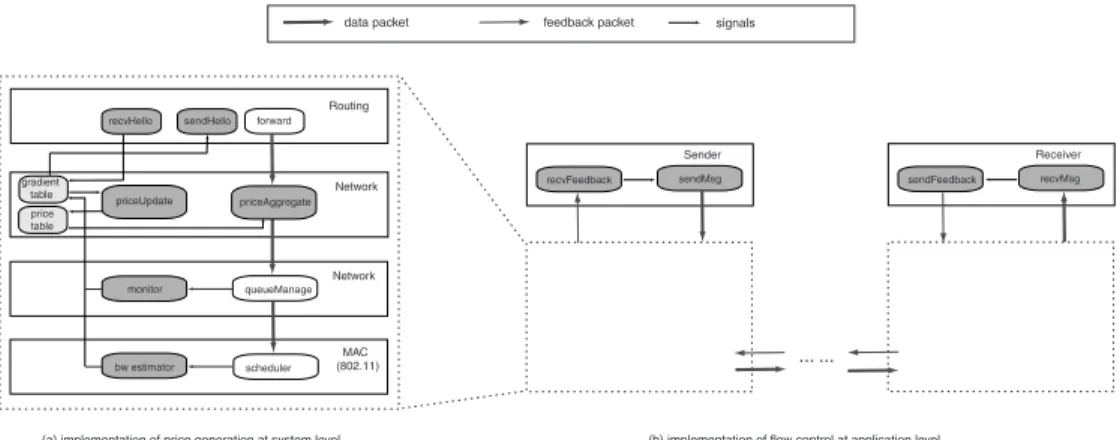
We implement our joint flow control and active queue management in the Linux system kernel version 2.6.5. The software architecture is show in Fig. 3.
In this figure,rate adaptation(Eq. 6) is implemented at both sender and receiver via four modules, which are responsible for sending(or receiving) data(or feedback flow price) packets, respectively. price computation (Tab. I) is implemented as several components at different levels. At the MAC level, the bandwidth estimator measures the achievable bandwidth (Bf). At the interface queue level, the monitor observes the
backlogged traffic (qf). At the routing level, HELLO messages
communicate the local queue information to its neighbors (or AP in the centralized case).
The measurement-based bandwidth estimation is based on the approach presented in [9]. It measures the achievable bandwidth of each wireless link based on its historical data transmission results.
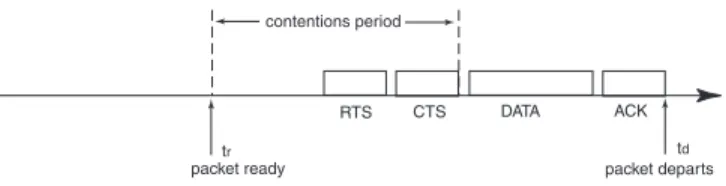
As shown in Fig. 4, under the IEEE 802.11 MAC protocol, at time tr, when a packet from a particular wireless link
RTS CTS DATA ACK packet readyt r packet departs td contentions period
Fig. 4. Measurement-based bandwidth estimation.
becomes the head-of-line packet (i.e., the first packet waiting to be transmitted), we claim that the packet is ready. At time td, when the link layer acknowledgment is received,
the packet departs. The transmission delay of this packet is then given as td −tr, which includes a contention period.
The contention period indicates the channel bandwidth used by packet transmissions of other wireless links within the interference range. The achievable bandwidth observed by this wireless link is then calculated as z
td−tr, where z is the size of the packet. To achieve more accurate measurement results, we use a window of w packets to conduct the bandwidth estimation,i.e., the bandwidth is estimated as ww·z
i=1tid−tir. The measurement-based bandwidth estimation takes into account the effect of physical layer interference and the inefficiency of MAC protocols, as it is based on thescheduling resultsof packet transmissions.
To get the transmit bit rateBfof each wireless node, we use
the software libraryiwlibdeveloped by HP Lab. In particular, function iw sockets open returns a raw socket descriptor to the wireless driver at the kernel. And functioniw print bitrate is used to get the instantaneous channel bit rate used by the current wireless adaptor.
Queue length monitor is implemented as a kernel module. It monitors the instantaneous queue length and provides such information to the user space. To get the instantaneous queue length, this module hooks two kernel queue management routines with our functions. In particular, it first retrieves the wireless device handler2, and its queue discipline member qdisc. Then it replaces the function enqueueand dequeueof qdisc with two new functions that monitor the queue length and its changes. To provide the information of queue length to the user space, this module uses aninodedevice/filequeuelen. The module also hooks up two new file handlers dread and dwrite, which operate over the system memory instead of disk file. This approach provides low-overhead kernel and user space communication.
IV. EXPERIMENTRESULTS
To validate the performance of our joint flow control and queue management solution and evaluate our system imple-mentation, we conduct experiment over a wireless network testbed. In our experiment testbed, the wireless nodes are IBM T42 and G41 laptops with IEEE 802.11b Orinoco wireless adaptors. Each node uses Linux Fedora system with kernel version 2.6.5. The wireless network is configured in ad hoc
2The wireless adaptor device in the Linux system is usually configured to
priceAggregate recvHello sendHello priceUpdate monitor gradient table price table Routing Network Network forward MAC (802.11) bw estimator queueManage scheduler Sender recvFeedback sendMsg Receiver sendFeedback recvMsg ... ... data packet feedback packet signals
(a) implementation of price generation at system level (b) implementation of flow control at application level
Fig. 3. Software Architecture for Joint Flow Control and Active Queue Management.
demo mode using channel 6. In the experiment, HELLO messages are sent every 1 second. The system parameter α
is chosen to stabilize the price computation process, which is
0.00001 in the experiment.
We first study the basic behavior of our algorithm. In the experiment, four wireless nodes in the network are all within the transmission range of each other; two flows with the same bit rate start to transmit at different time instances. The experiment result is shown in Fig. 5.
0 1000 2000 3000 4000 5000 0 20 40 60 80 100 120 140 ra te (Kbps) time (sec) recv rate (f2) send rate (f2) recv rate (f1) send rate(f1) (b) flow rates
Fig. 5. Basic Scenario.
This result shows that: (1) the instantaneous sending rate and receiving rate converges even when traffic dynamically joins and departs the network. The time for convergence is within 10 seconds; (2) At equilibrium, the sending rates and throughput of both flows closely match, which means both flows share the wireless channel fairly.
We proceed to evaluate the performance of our algorithm in multi-rate wireless networks. The first experiment is conducted on a simple topology with one flow sending between two laptops. In the experiment, we manually set the bit rate of the wireless node fixedat different levels (in the sequence of 2M, 1M, 11M, and 5.5Mbps). The instantaneous sending and receiving rates of this flow are shown in Fig. 6. From the result, we see that our algorithm quickly adapts to the channel bit rate adjustment, and converges to the new equilibrium rate allocations within 10 seconds. In the second experiment, we set the channel bit rate of the wireless node to automatic
adaptation mode. In this mode, the channel bit rate will be automatically adjusted based on the channel condition. In the experiment, we move the wireless node to create a dynamic channel condition, so that the bit rate will be adjusted accordingly. The result is plotted in Fig. 7. From the figure, we have similar observations that our algorithm quickly responds to the channel bit rate changes.
0 1000 2000 3000 4000 5000 0 20 40 60 80 100 120 140 160 rate (Kbps) time (sec) recv rate send rate
Fig. 6. Multi-rate scenario with one flow.
0 1000 2000 3000 4000 5000 0 20 40 60 80 100 120 140 160 rate (Kbps) time (sec) recv rate send rate
Fig. 7. Multi-rate scenario (mobile).
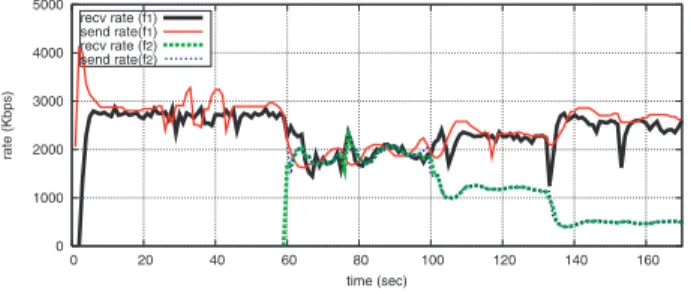
Now we do the experiment on a network with two flows between four laptops (the same as in the base scenario). In this experiment, the channel bit rate of flow 1 is fixed at
11Mbps, while the bit rate of flow 2 is adjusted manually in the sequence of 11M, 5.5M, and 2Mbps. The experiment result is shown in Fig. 8. From the result, we have the following observations. (1) The sending and receiving rates of both flows converge within10second after the bit rate adjustment of flow 2; (2) At equilibrium, when both flow 1 and 2 have the same
channel bit rate, these two flows share the same throughput. When their bit rates are different, the throughput of these two flows are different. Moreover, their throughput ratio follows the ratio of the bit rates. This is a significant different result from the TCP behavior in multi-rate wireless networks shown in Fig. 2. Our experiment shows that our joint solution of flow control and channel-aware active queue management well addresses the TCP performance anomaly issue, improves the channel resource utilization, and provides proportional fair rate allocation to the contending flows in multi-rate wireless networks. 0 1000 2000 3000 4000 5000 0 20 40 60 80 100 120 140 160 rate (Kbps) time (sec) recv rate (f1) send rate(f1) recv rate (f2) send rate(f2)
Fig. 8. Multi-rate scenario with two flows.
V. RELATEDWORK
We evaluate and highlight our original contributions in light of previous related work.
Fairness and its tradeoff between channel utilization in wireless network has been studied extensively in the existing literature [10], [11], [12], [13]. However, most of these solu-tions involves changes to the scheduling algorithm at the MAC layer. This is impractical given the wide deployment of IEEE 802.11 standard and the fact that MAC scheduling algorithm is implemented in the firmware of wireless adaptors. Our work addresses this issue at the flow level, which involves no change to the underlying MAC protocols.
There are recent studies on channel time fairness [1], [2]. This paper is different from and enhances the above work in the following two aspects. First, it presents a theoretical foun-dation for channel time fairness and shows that proportional channel time fairness maximizes the aggregated utility of all flows in a multi-rate wireless network. Second, our approach presents a distributed solution which can be easily extended for multihop wireless networks.
The problem of optimal and fair resource allocation has been extensively studied in the context of wireline networks. Among these works, optimization-based flow control and active queue management has been shown to be an effective approach to achieve distributed solution for rate allocation (e.g.,[3], [14], [8], [15]). The optimization framework of our work is similar to [3], [8], [14], which reflects the relation of the demand and the supply of resources. Nevertheless, the fundamental differences in contention models between wireless and wireline networks deserve a fresh treatment to this topic. This work also enhances our previous work on resource allocation in wireless networks [4] by considering
the rate diversity phenomenon and providing a Linux-based system implementation.
VI. CONCLUDINGREMARKS
This paper investigates the problem of TCP performance anomaly issue over multi-rate wireless networks. It presents an optimization-based framework for flow control in multi-rate wireless networks. This framework provides analytical insight to the performance anomaly problem of TCP and establishes a theoretical foundation for a joint flow control and active queue management scheme that solves this problem. The presented active queue management scheme operates based on channel conditions as well as queue lengths. Testbed experi-ments are conducted on a Linux-based system implementation. The results show that our approach well addresses the TCP performance anomaly issue, improves the channel resource utilization, and provides proportional fair rate allocation to the contending flows in multi-rate wireless networks. As our future work, we will further improve the price computation algorithm and theoretically analyze its stability properties.
REFERENCES
[1] S. Shah and K. Nahrstedt, “Price-based Channel Time Allocation in
Wireless LANs,” in Proc. of 2nd International Workshop on Mobile
Distributed Computing (MDC 2004) in conjuction with ICDCS-2004,
2004.
[2] Godfrey Tan and John Guttag, “Time-based fairness improves
perfor-mance in multi-rate wlans,” inProc. of USENIX’04, 2004.
[3] F. P. Kelly, A. K. Maulloo, and D. K. H. Tan, “Rate Control in
Communication Networks: Shadow prices, Proportional Fairness and
Stability,” Journal of the Operational Research Society, vol. 49, pp.
237–252, 1998.
[4] Y. Xue and B. Li and K. Nahrstedt, “Optimal Resource Allocation in
Wireless Ad Hoc Networks: A Price-based Approach,” IEEE Tran. on
Mobile Computing, vol. 5, no. 4, pp. 347–364, 2006.
[5] F. P. Kelly, “Charging and Rate Control for Elastic Traffic,” European
Trans. on Telecommunications, vol. 8, pp. 33–37, 1997.
[6] Y. Xue and H. Nguyen and K. Nahrstedt, “CA-AQM: Channel-Aware
Active Queue Management for Wireless Networks,” inVanderbilt ISIS
Technical Report, 2007.
[7] Low, S.H.; Paganini, F.; Doyle, J.C., “Internet congestion control,”
Control Systems Magazine, IEEE, vol. 22, no. 1, pp. 28–43, 2002.
[8] S. H. Low and D. E. Lapsley, “Optimization Flow Control: Basic
Algorithm and Convergence,” IEEE/ACM Trans. on Networking, vol.
7, no. 6, pp. 861–874, 1999.
[9] S. H. Shah and K. Chen and K. Nahrstedt, “Dynamic Bandwidth
Management for Single-hop Ad Hoc Wireless Networks,”ACM/Kluwer
Mobile Networks and Applications (MONET), vol. 10, no. 1, 2005.
[10] T. Nandagopal, T.-E. Kim, X. Gao, and V. Bharghavan, “Achieving
MAC Layer Fairness in Wireless Packet Networks,” inProc. of ACM
Mobicom, 2000, pp. 87–98.
[11] L. Tassiulas and S. Sarkar, “Maxmin fair scheduling in wireless
networks,” inProc. of INFOCOM, 2002, pp. 763–772.
[12] H. Luo, S. Lu, and V. Bharghavan, “A New Model For Packet
Scheduling in Multihop Wireless Networks,” inProc. of ACM Mobicom,
2000, pp. 76–86.
[13] J. Wang and H. Zhai and Y. Fang and J. Shea and D. Wu, “OMAR:
Utilizing Multiuser Diversity in Wireless Ad Hoc Networks,” IEEE
Tran. on Mobile Computing, vol. 5, no. 12, 2006.
[14] S. Kunniyur and R. Srikant, “End-to-end congestion control: utility
functions, random losses and ECN marks,” in Proc. of INFOCOM,
2000.
[15] Richard J. La and V. Anantharam, “Utility-based rate control in the
Internet for elastic traffic,” IEEE/ACM Trans. on Networking, vol. 10,