E-Competence – Rooting and Spreading eLearning and eServices in the University Dr. Anke Petschenka, Steffi Engert, M. A.
University of Duisburg-Essen, Forsthausweg 2, D-47057 Duisburg
Abstract
E-Competence is an innovative approach to root and spread eLearning and eServices throughout the University. Key elements are: winning “second-wave” lecturers to eLearning and understanding E-Competence as part of an ongoing strategy towards the digital campus, making eLearning and the adoption of eServices part of everyday life („E-University“). The paper describes the methodical approach and the evolution of the E-Competence- Agency at the University of Duisburg-Essen, spanning five years of experience, including the transition from (funded) project to sustainable institutionalisation. A key role in our strategy is played by the OpenSource LMS Moodle.
Keywords: E-Competence, eLearning, digital university, eLearning-strategy, change management, LMS, Moodle
E-Competence – Basic Approach
E-Competence at the University of Duisburg-Essen started in the summer of 2002 as a project supported by the Ministry of Research and Science of the Land Northrhine-Westfalia (NRW). Its main purpose was to put into practice a new approach towards winning new layers of university lecturers to eLearning. Research had shown that the first generation of funded eLearning projects had not resulted in large-scale adoption of eLearning outside the small layer of “early adopters” and that traditional offerings for the “eQualification” of lecturers such as standard courses did not really reach the groups targetted (Kerres 2001). In addition, the traditional ways of IT- and media services in the university led to the development of (mostly) high level multimedia applications, but not necessarily to a higher degree of e-competence in lecturers and researchers, as these products usually resulted from full-service deliveries in terms of a customer/supplier relationship.
In contrast, the approach of the E-Competence Teams was designed as an interpersonal service of direct “face-to-face” consulting and coaching according to the individual requirements of
lecturers/departments to transfer e-competences by encouraging “learning by doing”. In addition, the team built online information resources, such as online tutorials, presentation of best practice examples, tips and tricks and used the resources of the partner-project www.e-teaching.org a portal for e-teaching1 . The team was “embedded” into the cooperation of the central media service units of the university and staff members from these units spent part of their time in working directly with the E-Competence Team.
The portfolio of the E-Competence Team consisted of a wide range of tools and applications, ranging from Powerpoint, digitisation of teaching materials to collaborative tools such as the document- sharing platform BSCW (Basic Support Collaborative Work2) learning management systems, using media enriched seminar rooms and lecture halls, recording of lectures, live streaming
videoconferencing, and the technical, organisational and didactic considerations involved in different e-learning scenarios.
Also, early on, the university opted for mobile scenarios and bid successfully for a project “eCampus” or Notebook-University (Stratmann/Kerres 2004). Furthermore, conceptions and tools for the digital library were developed and implemented at the university of Duisburg-Essen. In addition to digital catalogues and lending procedures, this involved a multimedia e-publishing server DuEPublico3, for the worldwide publication of dissertations, academic papers and learning materials. This server is also the basis for the “digital reserved reading shelf”. This service includes the repository of learning material and literature as well as the schedule and syllabus of the courses. If materials have to be scanned, this is also done by the library. The digital reserved reading shelf is a very successful service with more than 700 active “shelves” at the moment.
1 http://www.e-teaching.org/hochschule/uni_duisburg_essen/ 2 http://bscw.fit.fraunhofer.de/
3 http://duepublico.uni-duisburg-essen.de/. DuEPublico is using the Metadata-Harvesting-Protocol of the Open-Archives-Initiative (OAI-PMH 2.0)
During the life-time of the project (2002-05), the five members of the E-Competence Team, aided by additional specialists from the university library, the computing and the media centres supported overall 900 clients in a total of 450 intensive consultations. About 28% of the persons using the E-Competence Teams’ services have been professors. More than one-third of the persons, who
consulted the E-Competence Team implemented E-Learning solutions consistently, 55% implemented E-Learning solutions in a “patchwork” manner, i.e. used different scenarios and applications, one at a time.
E-Competence 2.0
Because of the grand success of the E-Competence team, the University decided to grant two staff posts to transform the project into a stable service run jointly by the (newly founded) Centre for Information and Media Services (CIM) and the University Library (UL). Thus, in the beginning of 2006, the E-Competence Agency was launched as a cooperation project. Each staff post is associated with CIM and UL respectively. The UL and the CIM together make up the institutionalised sector of
Information, Communication Media (ICM), which is represented by a board, consisting of the directors of Library and CIM, the chairperson of the ICM committee and the pro-rector for ICM. In this way, the sector is directly linked to the university top management. The structure of the sector is shown in Figure 1.
Figure 1: The Sector Information, Communication and Media at the University Duisburg-Essen.
At the launch of the E-Competence Agency, the original conception was extended in scope and target groups. Henceforth the Agency is supporting all members of staff as well as students, particularly advanced students and postgraduates by offering consultations, coachings and workshops on the e-services of CIM and UL for learning/teaching, research and management. This reflects a general evolution from looking at learning in relation to teaching to a wider perspective of an integrated e-strategy to bring about the “E-University Duisburg-Essen4. It also reflects a greater awareness of postgraduates and students requiring e-competence and e-skills. Especially, all the B.A. students have to acquire key competencies including e-skills.
The concept to work as an Agency, though present already in the original E-Competence team has been spelt out more explicitly for “E-Competence 2.0”:
1) E-Competence is an Agency promoting its offering and hence the e-services of CIM and UL in a proactive manner to the university by using a diversity of “marketing” channels, including personal presentations, newsletters, a website including RSS-feeds and print media such as flyers.
2) It acts as an agency also in the sense of acquiring customers for CIM and UL, in transmitting customer wishes/concerns and discovering and evaluating trends in order to keep its service portfolio up-to-date.
3) Last not least, it networks players and services for the realisation of complex projects or participates actively in such networks. Cases in point are: the organisation of the “moodle07”, conference of the German Moodle community5, cooperation with the E-University project, which fosters e-learning innovation projects, multimedia-enriched course development etc. One of the instruments to facilitate the cooperation between the Agency, CIM and UL is a professional help-desk system, the Call-Manager. Via a hotline each university member can place a call by phone or e-mail to ask for help or to demand a service. Each call will be forwarded to the expert for this request. Thus the E-Competence Agency receives calls for its services or it asks for specialists from CIM and UL whenever they are needed to realise a particular customer request.
In recent years, it has become customary to observe standards of quality. Among the instruments used are agreements on objectives and performance. In 2006 the central service units CIM and UL signed such agreements with the university, setting a number of qualitative and quantitative goals. The E-Competence Agency overfilled its goal set for 2006-7 already in 2006: the target set was 300 consultings and coachings, but the actual figure was more than 500.
Activities in Details
In addition to the learning platform Moodle, group-ware, such as BSCW, e-publishing and creating repositories on the multimediaserver DuEPublico are widely used; video-conferencing and interactive scenarios based on the tablet PC and “authoring on the fly” as well as podcasting are emerging variants of eLearning and e-publishing.
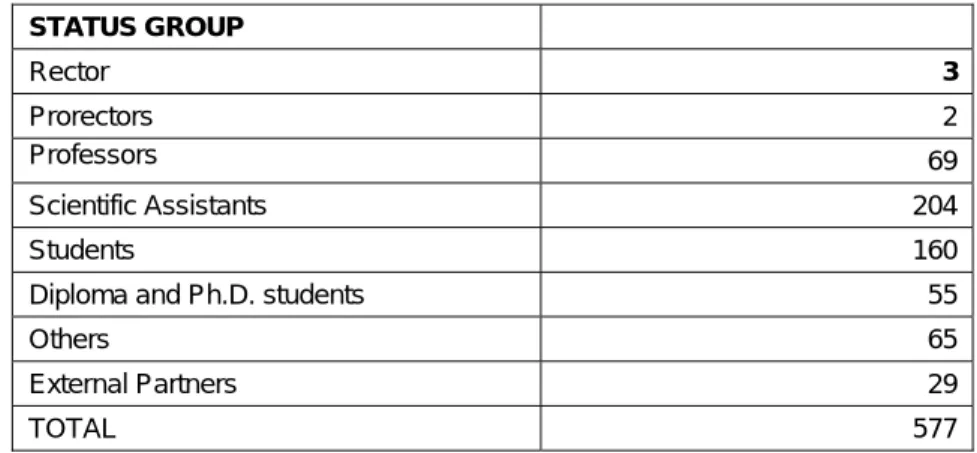
Figure 2 shows the breakdown of consultations of the E-Competence Agency by status groups for the period February 2006 – April 2007:
STATUS GROUP Rector 3 Prorectors 2 Professors 69 Scientific Assistants 204 Students 160
Diploma and Ph.D. students 55
Others 65
External Partners 29
TOTAL 577
Figure 2: E-Competence Consultations by status groups (February 2006 - January 2007)
5
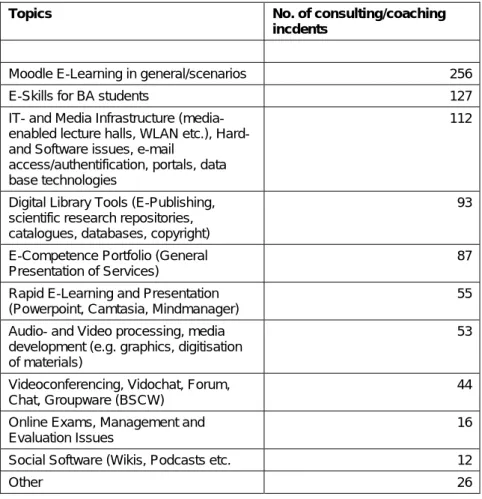
Figure 3 shows the breakdown by topics covered in the consulting sessions:
Topics No. of consulting/coaching
incdents
Moodle E-Learning in general/scenarios 256
E-Skills for BA students 127
IT- and Media Infrastructure (media-enabled lecture halls, WLAN etc.), Hard- and Software issues, e-mail
access/authentification, portals, data base technologies
112
Digital Library Tools (E-Publishing, scientific research repositories, catalogues, databases, copyright)
93
E-Competence Portfolio (General Presentation of Services)
87 Rapid E-Learning and Presentation
(Powerpoint, Camtasia, Mindmanager)
55 Audio- and Video processing, media
development (e.g. graphics, digitisation of materials)
53
Videoconferencing, Vidochat, Forum, Chat, Groupware (BSCW)
44 Online Exams, Management and
Evaluation Issues
16 Social Software (Wikis, Podcasts etc. 12
Other 26
Figure 3: Breakdown by Topics (February 2006 - April 2007)
Moodle – the LMS Facilitating the Adoption of E-Learning
Since the university adopted Moodle as its central eLearning platform in early 2005, the proportion of consistent users has gone up dramatically and is growing steadily. From the humble beginnings of a test environment used by the English department and the E-Competence Agency, usage grew to more than 300 active courses across almost all the faculties of the university with about 12.000 users. The success of Moodle is due to these factors:
• Low learning curve for lecturers and students
• Scalability from simple to complex scenarios
• Existing materials can be re-used
• Flexibility: a wide variety of scenarios can be implemented
• Communication and cooperative skills can be improved interacting in Moodle.
In addition to these intrinsic values of Moodle, the active campaigning by the E-Competence teams and the seamless and far-reaching support given to lecturers worked in favour of the broad adoption of e-learning.
Moodle is attractive, because e-learning materials and activities are concentrated in one workspace. Linking learning materials with specific discussion topics or specific tasks in collaborative settings is one way to motivate learners or to realise collaborative, constructivist learning scenarios. Moodle provides a very wide variety of learning activities. At the same time, it is extensible. For example, lecturers can enrich their Moodle courses with multimedia elements, e.g. videos, simulations,
podcasts. These multimedia elements can be produced specifically for current courses or earlier recordings may be included. Audio and video simulations often deepen a specific learning experience. Videos are used for diverse purposes, e.g. to explain the use of a new tool, for the introduction of the course instructor or for recording courses to be archived for later use. Among the most popular video applications is the recording of courses and presentations, either professionally done by the media specialists from CIM or as do-it-yourself, “rapid e-learning” using products such as Camtasia or the freeware Wink.
In general, most lecturers start out with simple scenarios, e.g. using Moodle as a distribution channel for learning materials. In a next step, interactive/collaborative elements are added, such as forums or wikis. In the meantime, the qualitative development of Moodle scenarios and integration of Moodle and other tools can be demonstrated by a number of best practice examples, using either fairly
elaborate project group scenarios or multimedia elements, such as simulations, audio, combinations of video and audio etc. In a further evolution tests are added. Some of the activities provided by Moodle are used in a creative manner: it has become popular to have the students build a “Who-is-who” of their course on the basis of the glossary activity or to organise the allocation of topics for seminar papers through the poll activity. These examples show the development from simple scenarios to complex scenarios.
Because of the big success of the implementation of the learning management system “Moodle” at the University of Duisburg-Essen, CIM, UL, the E-Competence Agency and the Center for Higher
Education and Quality Development organised the moodleconference 20076 in March 2007. The conference presented interesting solutions and core applications realised with Moodle, in order to show perspectives on how Moodle can be used in a didactically useful manner in schools, higher education, training and further education as well as in enterprises. Furthermore, the conference wanted to initiate a discussion on how to integrate Moodle in future learning landscapes. Over 300 participants from Germany, Switzerland, Austria, Russia, Poland, the Netherlands and England were our guests.
Summary and Conclusions
As shown by the figures above, E-Competence at the University of Duisburg-Essen is a convincing experience. In has succeeded in breaking many barriers preventing “ordinary” lecturers from adopting e-learning. Doubly anchored in the (digital department of the) University Library and the Centre for Information and Media Service, E-Competence plays an important role as an “agency” of the service units, marketing their services to the university audiences and relaying customers’ needs and concerns to the service units. As it was recognised at the University of Duisburg-Essen that an eLearning-strategy cannot be isolated from the main change processes towards “the university of the global digital age” (or E-University) the tasks of the E-Competence Agency were extended towards finding/proposing solutions to support digitally all the relevant processes of the university, i.e. reseach and organisational change alongside teaching and learning. Thus E-Competence is one of the change-agents in the University.
The approach of E-Competence, namely its role as a consulting and marketing service-agency and the personal approach to faculty and other members of the university via a continuous pro-active communication strategy is a “model”, which may be of interest to other universities are even other institutions outside Higher Education (Engert et al 2004). The E-Competence Agency at the University of Duisburg-Essen is very interested in networking on these issues with other colleagues and
institutions.
6
References
Kerres, M., Engert, S. 2006. E-Competence: Fostering sustainable use of E-Learning at University of Duisburg-Essen. In: Iain Mac Labhrainn, Christina McDonald Legg, Dirk Schneckenberg, Johannes Wildt (Eds.): The Challenge of eCompetence Development in Academic Staff Development, published under the auspices of the European E-Competence Initiative, ISBN 0-9551698-1-X by CELT, NUI Galway.
Weckmann, H.-D., Engert, S. 2005. Campus - A Strategy for the Transition towards the E-University. Recent Research Developments in Learning Technologies. Formatex, Badajoz, Spain, ISBN 609-5995-3.
Engert, S., Hennecke, B., Schulte, O. A., Traxel, O., von Danwitz, F. 2004. The Duisburg-Essen Model of ECompetence Transfer,
http://www.unidue.de/imperia/md/content/e_comp/transferthesen_eng_2.pdf
Kerres, M. 2001. Neue Medien in der Lehre: Von der Projektförderung zur systematischen Integration.
Das Hochschulwesen 49:38-44.
Kerres, M. und A. Petschenka (2004). "Nachhaltige Integration von e-Learning in die Hochschullehre." In: Giselher Kaule & Mark Müller (Hrsg.) GIS-Anwendungen und E-Learning. Erfahrungsbericht des BMBF Projektes gimolus (GIS- und Modellgestützte Lernmodule für umweltorientierte Studiengänge). S. 257-265. Heidelberg: Wichmann Verlag.
Stratmann, J. & M. Kerres (2004): From virtual university to mobile learning on the digital campus: Experiences from implementing a notebook-university, Proceedings of the International Conference on Education and Information Systems, Technologies and Applications (EISTA 2004), Orlando, USA, July 21-25, 2004.