a Fuzzy Commitment Scheme. IEEE Access, 7. pp. 12557-12574. ISSN 2169-3536
Published by: IEEE
URL:
https://doi.org/10.1109/access.2019.2893185
<https://doi.org/10.1109/access.2019.2893185>
This version was downloaded from Northumbria Research Link:
http://nrl.northumbria.ac.uk/37553/
Northumbria University has developed Northumbria Research Link (NRL) to enable users to
access the University’s research output. Copyright
©and moral rights for items on NRL are
retained by the individual author(s) and/or other copyright owners. Single copies of full items
can be reproduced, displayed or performed, and given to third parties in any format or
medium for personal research or study, educational, or not-for-profit purposes without prior
permission or charge, provided the authors, title and full bibliographic details are given, as
well as a hyperlink and/or URL to the original metadata page. The content must not be
changed in any way. Full items must not be sold commercially in any format or medium
without formal permission of the copyright holder. The full policy is available online:
http://nrl.northumbria.ac.uk/policies.html
This document may differ from the final, published version of the research and has been
made available online in accordance with publisher policies. To read and/or cite from the
published version of the research, please visit the publisher’s website (a subscription may be
required.)
A Secure Authentication Protocol for
Multi-Server-Based E-Healthcare Using
a Fuzzy Commitment Scheme
SUBHAS BARMAN1, HUBERT P. H. SHUM 2, (Member, IEEE), SAMIRAN CHATTOPADHYAY3, AND DEBASIS SAMANTA4 1Jalpaiguri Government Engineering College, Jalpaiguri, India
2Faculty of Engineering and Environment, Northumbria University, Newcastle Upon Tyne NE1 8ST, U.K. 3Department of Information Technology, Jadavpur University, Kolkata 700098, India
4Department of Computer Science and Engineering, IIT Kharagpur, Kharagpur 721302, India
Corresponding author: Hubert P. H. Shum ([email protected])
This work was supported in part by the Engineering and Physical Sciences Research Council under Grant REF: EP/M002632/1, and in part by the Royal Society under Grant REF: IE160609.
ABSTRACT Smart card-based remote authentication schemes are widely used in multi-medical-server-based telecare medicine information systems (TMISs). Biometric is one of the most trustworthy authenticators and is presently being advocated to use in the remote authentication of TMIS. However, most of the existing TMISs consider a single-server-environment-based authentication system. Therefore, patients need to register and log into every server separately for different services. Furthermore, these schemes do not employ error correction technique to remove the errors from biometric data. Also, biometrics are inherent and demand diversification to generate a revocable template from inherent biometric data. In this paper, we propose a mutual authentication and key agreement scheme for a multi-medical server environment to overcome the limitations of the existing schemes. In the proposed scheme, a cancelable transformation of the raw biometric data is used to provide the privacy and the diversification of biometric data. The errors of the biometric data are corrected with error-correction techniques under the fuzzy commitment mechanism. A formal security analysis using the widely accepted real-or-random model, the Burrows–Abadi–Needham logic, and the automated validation of Internet security protocols and applications tool concludes that the proposed scheme is safe against known attacks. We also compare the computation and communication costs of our scheme to evaluate the performance with the others.
INDEX TERMS Telecare medicine information system (TMIS), fuzzy commitment scheme, BAN logic, real-or-random (ROR), AVISPA tool.
I. INTRODUCTION
Nowadays, people are accessing more and more services through the Internet. For example, they use different elec-tronic gadgets like mobile phones and notebooks to get access to a remote server from anywhere through a public channel. Many countries already introduced e-Health and telemedicine services for easy and wide access to health care services with high availability. Example e-Heath and telemedicine systems include ManageMyHealth (New Zealand), National Health Portal (Government Of India), eCW Heath Care Portal (eClinicalWorks, Georgia), and Boynton Health (University of Minnesota). In recent years, Internet services and low-cost mobile devices make the e-Health care and telemedicine
services available directly to the patient [15]. With e-Health care, patients are able to access different healthcare assistance without visiting the healthcare center physically but through the Internet. Conventional clinical medical service system can be replaced by distance nursing, e-health care and home monitoring facility [15], [17], [18]. In TMIS, patients can remotely check-up their vital signs and physician can read the up-to-date medical information of a patient using a public network channel. However, the security of the patient’s sensi-tive information to prevent unauthorized access by an attacker is crucial. At the same time, the protection of patient’s pri-vacy during the remote access of telecare services is another important concern [15], [64].
With respect to the aforementioned context, a remote authentication scheme can be employed to ensure a secure access to TMIS by patients as well as physicians over inse-cure channels. Lamport [13] introduced password-based authentication in 1981, in which the server stored all the passwords into a password table. Therefore, the scheme is susceptible to stolen-verifier attacks. Dictionary attacks may guess a password with low entropy. Moreover, since the social information of a user is typically used to select a password, social engineering may reveal the password easily with the knowledge of the user’s social information. To overcome these problems, smart cards have been combined with the tra-ditional password authentication to form a two-factor-based authentication scheme. Unfortunately, the stolen smart card may reveal stored information under power analysis [10] and differential attacks [11].
Recently, Wuet al.[23] used passwords and smart cards to design a two-factor-based remote authentication scheme for TMIS. Heet al.[24] performed a cryptanalysis on Wuet al.’s scheme [23] and they concluded that the scheme [23] failed to resist the impersonation attacks, the insider attacks and the stolen smart card attacks. He et al. [24] pro-posed another authentication scheme for TMIS, which can overcome all weaknesses of [23]. Unfortunately, such a scheme is vulnerable to off-line password guessing attacks. As a remedy, Zhu [25] proposed an authentication scheme using RSA-cryptosystem. The research from [26]–[29] also failed to ensure the robustness of the remote authentication scheme using passwords and smart cards. As a new direc-tion, researchers are exploring the use of biometric data (e.g. fingerprint, iris [6], [16], [20]) with traditional authen-tication schemes [3]. In general, three-factor-based authenti-cation schemes are introduced to improve the security of the patient’s information [30]–[34].
Furthermore, the existing schemes from [21]–[25] and [35] overlook the user’s privacy as the user’s identity is transmit-ted openly to the server via an insecure channel. However, a user’s privacy should be protected in TMIS to hide the identity of the patients from unauthorized users. Therefore, user anonymity is expected to preserve the privacy of patients. Puet al.[36] reported an elliptic-curve-cryptosystem-based strong authentication scheme to ensure user anonymity. However, this scheme [36] requires high communication, storage and computation costs. Chen et al. [37] proposed a dynamic id-based authentication scheme that reduced costs. Jiang et al. [38] did a thorough cryptanalysis of Chenet al.’s scheme [37] and observed that the scheme failed to provide user anonymity. They suggested an authentication scheme that achieved user anonymity. Kumari et al. [39] found that Jiang et al.’s scheme is not able to resist password guessing attacks, user impersonation attacks, Denial-of-Service (DoS) attacks and session key disclo-sure attacks. Accordingly, they addressed all the limitations with an improved authentication scheme. Lately, researchers reported many authentication and key agreement schemes for TMIS [40], [41], [43], [64].
In the literature, the authentication schemes are either for a single server environment or a multi-server and cloud-based environment [2], [4], [9], [82], [83]. Researchers pro-posed multi-medical-server-based TMIS because a patient may need access to multiple medical servers with a single reg-istration for different services. In other words, patients may communicate with different medical servers to get services from multiple servers such as Anesthesiologist, Cardiologist, Gastroenterologist, Hematologist, Neurologist, etc. There-fore, multi-server-based TMIS essentially need a remote authentication scheme and a key sharing protocol for a secure message communication. There are several three-factor-based authentication schemes [1], [45]–[48] for a multi-server environment using knowledge (e.g. the password), token (e.g. the smart card) and biometric (e.g. the fingerprint, iris, face, etc.). Chuang and Chen [1] proposed an authentica-tion scheme for a multi-server environment. Mishraet al.[48] and Linet al.[60] observed that the scheme [1] was vulnera-ble to insider attacks, Denial-of-Service (DoS) attacks, server spoofing attacks and user impersonation attacks. Moreover, user anonymity property was not provided in the Chuang-Chen’s scheme. As an improvement, Mishra et al. [48] designed another authentication scheme for expert systems. However, Lu et al. [61] and Wang et al. [68] revisited Mishraet al.’s scheme [48] and found that user anonymity and perfect forward secrecy of the session key were not pro-vided in the scheme. Moreover, Mishraet al.’s scheme failed to resist replay attacks, forgery attacks, Denial-of-Service (DoS) attacks, user and server masquerading attacks. In 2016, Reddy et al. [62] analyzed Lu et al.’s scheme [61] and observed several drawbacks like user impersonation attacks, Man-in-the-middle attacks and clock synchronization prob-lems. Also, the perfect forward secrecy and user anonymity are not ensured in the scheme. In 2016, Wang et al. [68] proposed an authentication scheme with low computation cost. In addition, this scheme alleviated different security issues of Mishra et al. scheme and they included a user revocation phase in [68]. Unfortunately, Wanget al.’sscheme failed to resist different known attacks. Irshad et al. [66] and Reddyet al.[65] identified many drawbacks like insider attacks, the lack of user anonymity and mutual authentica-tion in the scheme of [68]. Reddy et al. [65] proposed a multi-server authentication scheme to resist impersonation attacks. Irshadet al.[66] proposed an improved and light-weight authentication scheme to address the impersonation attacks, user traceability attacks, privileged insider attacks of Wanget al.’s scheme [68]. However, Irshadet al.[66] do not include the biometric template update phase in their scheme. In addition, user revocation and re-registration provisions were not considered. Later on, Yang and Zheng [69] proposed an authentication scheme for expert systems and remote dis-tributed networks, addressing the drawbacks of Wanget al.
scheme. However, this scheme does not consider the biomet-ric template revocation option. Recently, Barmanet al.[78] proposed an authentication scheme using fuzzy commit-ment for a multi-server environcommit-ment. Still, the smart card
revocation process did not consider any checking of user authentication before issuing a new smart card to a user. Also, if an attacker (i.e. insider attacker) knows the user id of a genuine user, he/she can request for a new smart card from the registration center. An attacker can generate a template from his/her biometrics data and he/she can compute the request message using his/her biometric template, password and ran-dom number. The registration center cannot differentiate the genuine request message from attacker’s one. This limitation is addressed in our proposed scheme.
Amin and Biswas [49] proposed a multi-medical-server-based TMIS and claimed that their scheme is able to resist different know attacks. However, Das et al. [50] thoroughly analyzed the Amin-Biswas’s scheme and found that the scheme [49] failed to protect privileged insider attacks, strong replay attacks and man-in-the-middle attacks. Truong et al.[63] proposed an elliptic-curve-cryptosystem-based authentication for a multi-server environment with the provable identity. However, Zhao et al. [70] identified the offline password guessing attacks, user and server imperson-ation attacks in the Trounget al.’s scheme [63]. Moreover, existing remote authentication protocols for a multi-server environment do not consider (1) the privacy of the biometric identity of a patient, (2) the diversification of the biomet-ric template for revocability, (3) the provision of the biometbiomet-ric template update if required, and (4) error correction from a biometric template.
In this paper, the fuzzy commitment scheme is used to design a remote authentication and key agreement protocol for a TMIS with multi-medical servers. We consider the privacy of the identity and the diversification of the bio-metric data. The erroneous template can be corrected and the enrolled template can be updated successfully in the proposed scheme. Our proposed scheme also employs only exclusive-OR operations and one-way hash functions to opti-mize its computation cost. Moreover, the mutual authenti-cation between a user and a server is proved using BAN logic [53]. The Real-Or-Random (ROR) model is used to test the security of the proposed scheme. Furthermore, informal security analysis is also applied to our proposed scheme to ensure the security against some known attacks. The AVISPA tool is used to simulate and test the formal security of the proposed scheme. Finally, we discuss the performance of our scheme with respect to computation and communication costs, and security functions. The performance of our scheme is compared with the existing ones, showing that our scheme requires less computation cost.
A. THE THREAT MODEL
We assume that the Dolev-Yao threat (DY) model [12] and CK-adversary model [73] are applicable in our scheme as the
de factostandard threat model and adversary model, respec-tively. As per the DY model, an adversaryAcan intercept all messages communicated between the genuine participants, modify the content of the messages or intentionally tamper the messages and delete either the total or a part of the
messages communicated between the genuine participants. A can even inject his/her own message to compromise the integrity of the communicated messages. Moreover, the power analysis attacks [10], [11] may reveal the infor-mation from a smart card. In addition, an adversaryAcan compute some temporary or long-term secrets of the com-municating participants as per the Canetti and Krawczyk’s adversary model (CK-adversary model) [73]. Therefore,A should not able to compromise the security of a remote authentication and key establishment scheme even when the ephemeral secrets (temporary or long-term secrets) and the old session keys are compromised during the communication. B. RESEARCH CONTRIBUTIONS
The contributions of this paper are as follows:
• Designing an authentication protocol for
multi-medical-server-based e-Healthcare using fuzzy commitment scheme. Recently, Barman et al. [78] proposed a remote authentication scheme using fuzzy commitment. However, Barmanet al.’s scheme is vulnerable to insider attacks. An insiderAtrusted by the MSRC knows the user id IDi, generates biometric template CTA using
his/her own biometric data, BIOMA, selects a random numberkAand generatesRPWA=h(PWA||CTA). The
attackerAthen sends the smart card revocation message,
<IDi,RPWA⊕kA>to the registration center. The reg-istration center will issue a new smart card to the attacker as the registration center does not have any scope to check the authenticity of the revocation message. In our proposed protocol, this problem of the scheme [78] is addressed. Our proposed scheme provides a secure smart card revocation phase.
The session key security is ensured under the CK-adversary model (I-A). Moreover, our scheme con-siders error correction to remove the noise from a user’s biometric data. The privacy and identity of the biometric data are strongly preserved. The diversification of the biometric template is provided in such a way that it is easy to revoke a biometric template, if required.
• The proposed scheme is tested with the widely
accepted Real-Or-Random (ROR) model, BAN logic and AVISPA tool.
• The proposed scheme is compared with the existing schemes and the proposed scheme is found as the most efficient scheme with respect to the cost and security functions.
C. ORGANIZATION
In Section 2, we discuss the definition and mathematical preliminaries of the fuzzy commitment scheme, error correc-tion techniques and revocable template generacorrec-tion, which are essential for describing our proposed scheme. The proposed protocol is presented in Section 3. In Section 4, we provide the ROR model, BAN logic and AVISPA simulation for the formal security analysis of the proposed scheme. In Section 5, we discuss the informal security analysis for different known
attacks and compare our proposed protocol with other exist-ing schemes. The performance of the proposed scheme is discussed and compared with other schemes in Section 6. Finally, we conclude the work in Section 7.
II. DEFINITIONS AND MATHEMATICAL PRELIMINARIES
We propose a biometric-based fuzzy commitment scheme and a one-way hash function. In the fuzzy commitment scheme, we use a cancelable biometric template and an error correction technique. In this section, we briefly describe the basic concepts of cancelable biometric template generation, one-way hash functions, error correction coding technique and a fuzzy commitment scheme.
A. THE CANCELABLE BIOMETRIC TEMPLATE GENERATION FUNCTION
The cancelable biometric template provides privacy to the original biometric data [19]. The cancelable biometric tem-plate is generated using a transformation function (sayf(.)), which is irreversible in nature. The transformation function uses a transformation key (say Tpi) to convert the
biomet-ric data (say BIOMi) into a cancelable biometric template
(sayCTi), that is,CTi = f(BIOMi,Tpi). Note that multiple
numbers of irreversible templates may be generated from a single biometric using multiple transformation parameters. Moreover, a cancelable transformation process should satisfy the following properties.
(i) A collision-free cancelable template: (a) Say,CTi,C
0
Ti
are two templates generated from a biometric data BIOMi
using two different transformation parameters, Tpi andT
0
pi,
respectively. According to this property, CTi 6= C
0
Ti when
Tpi 6= T
0
pi. (b) Again, ifCTk = f(BIOMk,Tpk) andCTl =
f(BIOMl,Tpl), due to the inter-person variability of
biomet-ric data (i.e. BIOMk 6= BIOMl), CTk 6= CTl even when
Tpk =Tpl.
(ii) Intra-user variability: Suppose we use two instances of a biometric to generate two cancelable templates,CTi =
f(BIOMi,Tp) and CT0i = f(BIOMi0,Tp). If the similarity
between two sets of biometric data is greater than a threshold value, say,δ, the similarity between two cancelable templates should also be greater than δ. Assume that the function of matching score computation isMS(). Then, if the similarity score between the biometric instances is greater thanδ, that is, MS(BIOMi,BIOMi0) > δ, the similarity between the
templates is also greater than the threshold valueδ, that is,
MS(CTi,C
0
Ti)> δ.
(iii) The reusability of biometric data: The biometric template should be easy to revoke if required. An exist-ing template can be cancelled and a new cancelable biometric template can be generated from the same biometric data using the same transformation function but with a new transforma-tion key. Therefore, the biometric data is reusable even when a cancelable template is compromised.
B. THE ERROR CORRECTION CODING TECHNIQUE The errors between two instances of a biometric signal result in the false rejection of genuine users. These errors can be corrected using error correction coding (ECC) tech-niques [7], [8]. Say, there are two instancesBIOMenrol and BIOMqueryof a biometric signal.BIOMenrol is captured and
used at the time of the enrollment. A cancelable template
CTenrol is generated for the enrollment fromBIOMenrol, that
is, CTenrol = f(BIOMenrol,TPi). Similarly, another
cance-lable templateCTquery is generated fromBIOMquery, that is,
CTquery =f(BIOMquery,TPi)). Here, the bitwise dissimilarity
of two templates, that is, e = CTenrol ⊕CTquery is called
an error. An error correction coding technique (say,9) can correct the erroreonly when the size ofeis less than the capacity of the ECC techniques. There are mainly two steps in any ECC technique, encoding (9enc) and decoding (9dec).
An error correction codeword is generated and used to encode a secret string [6], [7]. The encoded string may be transmitted over network channel and few bits may be integrated with the original signal and generate an erroneous message for the recipient. The recipient receives the erroneous message and removes the errors using decoding of the ECC technique. Therefore, the error may be corrected completely if the num-ber of erroneous bits is not more than the error correction capacity of the ECC technique.
C. THE FUZZY COMMITMENT SCHEME
This scheme is used to conceal a secret under the security of a witness. The secret can be unlocked using a witness, which is sufficiently close to the witness used during the enroll-ment. It was initially proposed by Juels and Wattenberg [5] in 1999. This scheme is successfully followed to construct a cryptographic system using the biometric data [6]. In this scheme, sayKr is a randomly generated key and theKr is
encoded with a codeword, that is, KCW = 9enc(Kr). The KCW is called a pseudo code, which looks like an original
biometric code. A biometric code is a binary string (CTi),
extracted from a biometric imprint. This biometric code is also called a cancelable biometric template. A pseudo code
KCW is locked by a cancelable biometric templateCTi using
bit-wise exclusive-OR operation, that is,LTKi=CTi⊕KCW.
Here,LTKiis called helper data as it helps to release the secret
key. The genuine biometric template is applied to extract the secret key from the helper data. In the fuzzy commitment scheme, the biometric template and the random secret, both are deleted carefully. However, the system stores the helper dateHTKi and (h(Kr)) for future use. According to the said
scheme, a genuine biometric template with minimum dissim-ilarity can decode the secret exactly. Theh(Kr) is used for the
verification of the similarity of the regenerated keyKr0from
LTKiusingCT0i.
In the key regeneration process, a newly generated biomet-ric template (sayCT0
that is, KCW0 =LTKi⊕CT0i =CTi⊕KCW ⊕C 0 Ti =KCW ⊕e (1)
Due to the intra-person variability, there must be some errors inCT0
i, that is,e=C
0
Ti⊕CTi. This error is propagated to
KCW0 and can be corrected with the help of the decode phase of the error correction technique (i.e. Kr = 9dec(KCW0 )).
As the error of the intra-person variability is lower than the capacity of the error correction of 9, therefore, a genuine patient can unlock a key correctly using her fresh biometric instance. The high inter-person variability creates the error in the impostor template (with respect to a genuine template) and that is higher than the error correction capacity of9.
D. ONE-WAY CRYPTOGRAPHIC HASH FUNCTION
A one-way hash function is a mapping functionh : A ← B
which takes an arbitrary length messageA= {0,1}∗as input and outputs a fixed-length (say l-bits) compressed message
B= {0,1}lwith the following properties:
• Say, an inputm∈Aand the output isy=h(m),y∈B. For anyh(.), it is easy to computeyofmbut it is difficult to recompute themfrom they.
• Any changes (say in a single bit ofm) in input results in
a completely uncorrelated hash value which is different from hash valueh(m) before changes.
• Preimage resistance:For an one-way hash functionh(.),
the computation of the original message from a given message digest (hash value) is computationally infeasi-ble, that is,m6=h−1(y).
• Second preimage resistance:It is difficult to find two messages,m,m0 ∈Asuch thatm6=m0, but both inputs produce the same outputs, that is,h(m)=h(m0).
• Strong collision resistance:For two different inputsm,
m0∈ A, the hash values arey = h(m) andy0 =h(m0). Ifm6=m0buty=y0, it is called the collision of a cryp-tographic one-way hash function. However, the collision resistance property of a hash function states that for any two different inputs (m,m0 ∈ A andm 6= m0), a hash functionh(.) never outputs the same message digests. E. SMART CARD
A smart card is a device that includes an embedded integrated circuit (i.e. secure micro controller or equivalent intelligence) with internal memory. A smart card connects to a smart card reader with a direct physical contact or with a remote contactless radio frequency interface. Smart cards provide secure storage of personal data, biometric data security and mechanisms like encryption, authentication, communication. They interact intelligently with a smart card reader. Generally, the smart card technology conforms to international standards (ISO/IEC 7816 and ISO/IEC 14443). We have considered the physical contact smart card with the embedded circuit to store the confidential information of the registered patients and
the smart card can process the data for authentication of the registered patients. The smart card can generate and send the login message to the server to establish a secure connection between a registered patient and medical server.
III. THE PROPOSED PROTOCOL
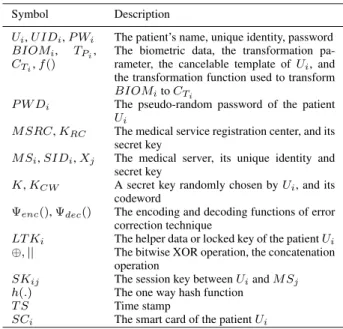
This section includes three procedures: registration of the server and the patient, the session key establishment protocol, and the update phase. In our discussion, we have used several symbols and notations which are given in Table1.
TABLE 1.Notations.
In our proposed scheme, initially, the medical servers and the patients are enrolled with medical service registration center. User authentication is verified by the smart card and only the authentic patients can log into the system. The medical server also checks the authenticity of the patient with respect to the received login message. The medical server transmits a reply-message to the patient after verification of authentication. Then, the patient checks the authenticity of the medical server based on the received message. Finally, the same session key is computed by the patient and the medical server. In the update phase, a patient can update his/her password, biometric template and smart card.
We apply the fuzzy commitment scheme in order to strengthen our scheme. The error correction technique is adopted along with the fuzzy commitment scheme to handle the noisy biometric signal. Furthermore, we use the time-stamp and the random nonce to make our scheme resilient to the replay and man-in-the-middle attacks.
The details of the different phases are discussed in the following subsections.
A. THE REGISTRATION PROCEDURE
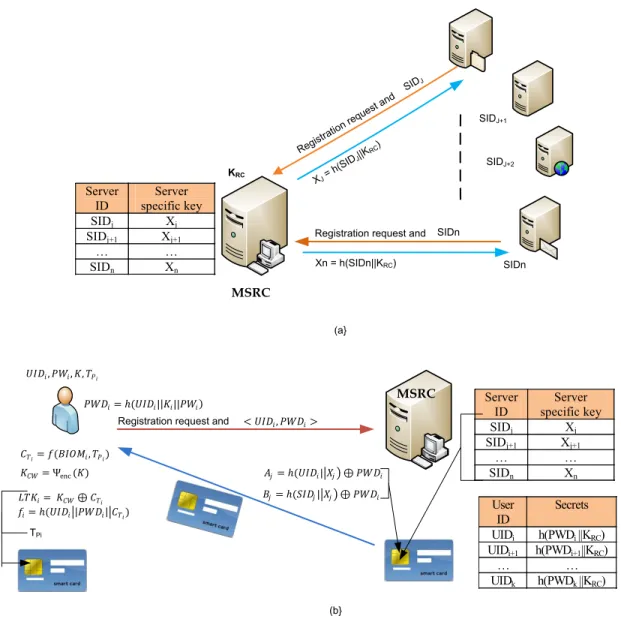
In this proposed scheme, all the medical servers and patients are enrolled to the telecare medical system through the
FIGURE 1. The medical server and patients registration procedure. (a) Server registration process. (b) User registration process.
medical service registration center (MSRC). Both registration procedures are presented in the Figure1.
1) THE SERVER REGISTRATION PROCEDURE
In our scheme, all medical servers (MSj,j=1 to (m+m0)) are
required to be registered with the medical service registration center (MSRC). We assume that initiallymmedical servers are ready to be registered. We also assume that anotherm0
medical servers may be registered in the future. A medical server chooses its unique id, that is, SIDj and sends it to
theMSRCfor the registration. The registration centerMSRC
computes a server specific key Xj = h(SIDj||KRC), where KRC to be the secret key ofMSRC. Then, MSRC sendsXj
to MSj. This Xj is used during the authentication process
of a patient. The MSRC repeats the same process for m
number of the medical server registrations. At the same time, theMSRC assumes thatm0 number of medical servers may
register themselves with theMSRC in the future. Therefore, the MSRC chooses a unique medical server id SIDk for m+1 ≤ k ≤ m+m0 and computes the shared key Xk
form+1 ≤ k ≤ m+m0. The medical server ids and the corresponding keys are stored in the database of theMSRC. In the future, if any medical server requests for registration, the MSRC provides them with an unused unique id and a corresponding key from the database.
2) THE PATIENT REGISTRATION PROCESS
Initially, every patient should register to the medical service registration center (MSRC) via a secure channel. Each patient (say Ui) chooses a user id (UIDi), a password (PWi) and
a transformation key (TPi). The patientUi imprints his/her
biometric data (BIOMi) through a biometric scanner. We have
used the fingerprint biometric in our approach. This biometric has been chosen because it is universal, unique and invariant
over time. More significantly, it is processable in real-time with almost near 100% accuracy. In this work, minutiae-based approach has been followed. The minutiae points are extracted from a fingerprint image using the publicly available NIST Biometric Software (NBIS). The MINDTCT module of NBIS is used as a minutiae detector to extract minutiae points (i.e. ridge ending and ridge bifurcation) from fingerprint image. A set of minutiae points (say, BIOMi)
captured from the fingerprint image of a user is used to generate the cancelable template (i.e. CTi) with a
transfor-mation parameter (TPi) using a transformation functionf(.).
This canelable template is used in the implementation of the proposed authentication protocol. The detailed steps of the patient registration procedure are described as follows.
1) The patient generates a cancelable templates, that is,
CTi =f(BIOMi,TPi).
2) Ui selects a key K randomly and encodes K into a
codeword, KCW uses the error correction encoding
technique9enc, that is,KCW =9enc(K).
3) Ui locksKCW with the cancelable biometric template CTi (i.e.LTKi=KCW⊕CTi).
4) Ui computes PWDi = h(UIDi||K||PWi) and sends
(UIDi,PWDi) along with a registration request to the MSRC.
5) After receiving the registration request from a patient, theMSRC computesAj = h(UIDi||Xj)⊕PWDi and Pj=h(SIDj||Xj)⊕PWDifor 1≤j≤m+m0.
6) The MSRC stores all authentication parameters
{<SIDj,Aj,Pj>|1≤j≤m+m0),h(.)}in a smart card, SCi. Then, theSCiis delivered to patientUithrough a
secure channel. TheMSRC storesUIDi,h(PWDi||Xj)
in the database for future use.
7) Uicomputesfi=h(UIDi||PWDi||CTi) and stores{TPi,
LTKi,h(K),fi,f(.),9enc(),9dec()}intoSCi.
Finally, the smart cardSCicontains {<SIDj,Aj,Pj>|1≤ j≤ m+m0),h(.),TPi,LTKi,h(K),fi,f(.),9enc(.),9dec(.)}.
Therefore, the biometric data of the users/patients need not to be directly stored anywhere in the system. In the proposed approach, the cancelable fingerprint template of a user CTi
is used to lock a randomly generated keyK and the locked key/template (i.e. helper data, LTKi) is to be stored in the
internal memory of the respective user’s smart card. B. THE SESSION KEY ESTABLISHMENT PROTOCOL This procedure includes the login phase, the mutual authen-tication phase and the agreement protocol.
1) THE LOGIN PHASE
Any registered patient Ui can access any registered
med-ical server MSj after a successful authentication. Initially,
a registered patient insertsSCito a smart card reader (SCR),
captures biometric imprint, enters UIDi andPWi to access
a desired medical server. In the login phase,SCiverifies the
authenticity of the patientUi. The smart card generates a valid
login message only when the patient passes the
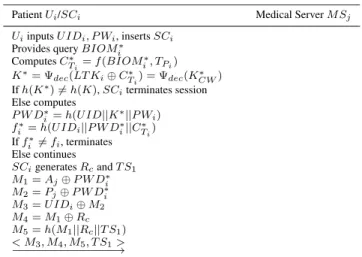
authentica-TABLE 2.The login process.
tion checking through the password, the biometric and the smart card. Detailed steps are described below and illustrated in Table2.
1) Uiinserts theSCito a SCR and inputsUIDi,PWiand
scans his/her biometric to capture a queryBIOMi∗. 2) SCi computes a cancelable template CT∗i from query
BIOMi∗using transformation functionf() and transfor-mation parameterTPi, that is,C
∗
Ti =f(BIOM
∗
i,TPi).
3) SCiunlocksKCW∗ withCT∗i and decodes it to regenerate
the key K∗ as follows: K∗ = 9dec(LTKi ⊕CT∗i) =
9dec(KCW∗ )
4) SCichecksh(K∗)?=h(K) and if it is wrong, it rejects
the session immediately. Otherwise it continues. 5) SCi computes: PWD∗i = h(UIDi||K∗||PWi), fi∗ = h(UIDi||PWD∗i||C ∗ Ti). Then,SCichecksf ∗ i ? =fi. If it
does not hold, the login process is terminated. Other-wise,Uipassed all the login check points.SCigenerates
a random numberRcand a time stampTS1.
6) SCicomputes the following messages M1=Aj⊕PWD∗i =h(UIDi||Xj) M2=Pj⊕PWD∗i =h(SIDj||Xj) M3=UIDi⊕M2
M4=M1⊕Rc M5=h(M1||Rc||TS1)
7) The smart card SCi sends the login message
<M3,M4,M5,TS1>to the medical serverMSj. 2) THE MUTUAL AUTHENTICATION AND
KEY AGREEMENT PHASE
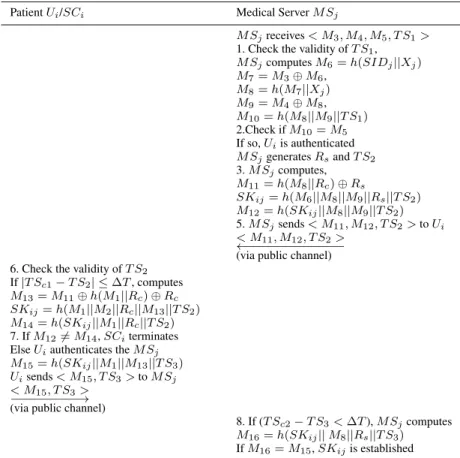
A legal patient and a registered server are mutually authen-ticated to each other before the agreement of a session key. The medical server checks the login messages of the patient and authenticates the patient. Similarly, the patient checks the authenticity of the server to achieve mutual authentication. Then, a session key is established between them for future
TABLE 3. The mutual authentication and key agreement protocol.
secure message communication. This process is illustrated in Table3. The detailed steps are described below.
1) The medical server MSj receives the login message
from the patient/the smart card SCi at time TSc and
checks the validity of the time stamp (TS1) with respect
to a predefined threshold delay1T. If (TSc−TS1)≤
1Tholds then continues, otherwiseMSjterminates the
session.
2) TheMSjcomputes the parameters as follows: M6=h(SIDj||Xj) M7=M3⊕M6=UIDi M8=h(M7||Xj)=h(UIDi||Xj) M9=M4⊕M8=Rc M10 =h(M8||M9||TS1) =h(h(IDi||Xj)||Rc||TS1)
3) MSj compares M10 with received M5. IfM5 = M10
holds, it generates a random numberRsand the current
time stampTS2.
4) Then,MSjcomputes the following parameters: M11 =h(M8||Rc)⊕Rs =h(h(UIDi||Xj)||Rc)⊕Rs SKij =h(M6||M8||M9||Rs||TS2) =h(h(SIDj||Xj)||h(UIDi||Xj) ||Rc||Rs||TS2) M12 =h(SKij||M8||M9||TS2) =h(SKij||h(UIDi||Xj)||Rc||TS2)
5) MSjsends<SIDj,M11,M12,TS2>to the patientUi/the
smart cardSCi.
6) SCireceives the message at timeTSc1, checks the time
delay (i.e. (TSc1 − TS2) and if it is less than 1T,
it computes the following:
M13 =M11⊕h(M1||Rc) SKij =h(M1||M2||Rc||M13||TS2) M14 =h(SKij||M1||Rc||TS2)
7) SCicomparesM12withM14and ifM12=M14, the
ses-sion keySKijis generated correctly at the patient’s site.
8) SCi generates a time stampTS3and computesM15 = h(SKij||M1||M13||TS3) and sends <M15,TS3> to the
medical server MSj for further checking of the right
session key.
9) After receiving the message<M15,TS3>at timeTSc3,
the server computes M16 = h(SKij||M8||Rs||TS3) if
(TSc3−TS3< 1T).
10) MSjcomparesM16withM15. IfM16 =M15, the session
key is shared betweenUiandMSjsuccessfully. Now,
the medical server MSj may send a message to the
C. THE UPDATE PHASE
1) THE PASSWORD CHANGE PHASE
A patient Ui may require to update his/her password.
Password change phase requires a successful login of the patient. In our proposed scheme, the registration center
MSRC is not to be involved in the password change phase. A patient can update his/her password locally. The detailed steps of the password changing process, are as follows.
1) Ui inputs (UIDi,PWi) and scans the biometric to
extractBIOMiand inserts theSCito SCR for successful
login.
2) If Ui fails to log in, the password update process is
terminated by theSCi. Otherwise, theSCiasksUi for
new password.
3) TheUienters a new passwordPWinew.
4) SCi computes PWDnewi = h(UIDi||K||PWinew) and
subsequently, computesAnewj andPnewj andfinewusing
PWDnewi as follows:
Anewj =Aj⊕PWDi⊕PWDnewi Pnewj =Pj⊕PWDi⊕PWDnewi finew =h(UIDi||PWDnewi ||CTi)
5) The SCi removes the Aj,Pj&fi and stores Anewj , Pnewj &finew.
2) THE BIOMETRIC TEMPLATE REVOCATION PHASE
In any biometric based security system, the biometric tem-plate is required to be updated for better security of the system. The biometric template update procedure is described in the following.
1) The patientUi captures a new instance of a biometric
image through scanner and extracts the unique features from the newly captured biometric image. Say, the fea-ture set is represented byBIOMi∗.
2) TheUi providesUIDi,PWi along withBIOMi∗to the
terminals and inserts theSCito theSCRfor successful
login.
3) TheSCicomputesCT0ifromBIOM
∗
i usingf(.) andTPi.
4) After successful login, the patientUi provides a new
transformation parameterTPnew
i to theSCi.
5) TheSCi computes the following: CTnewi = f(BIOM
∗ i, TPnew i ), LTK new i = LTKi ⊕ CT0i ⊕ C new Ti , f new i = h(UIDi||PWDi||CTnewi ).
6) TheSCi replacesLTKi andfi withLTKinew andfinew,
respectively.
3) THE SMART CARD REVOCATION PHASE
A patient may need to revoke his/her smart card. The pro-posed scheme allows the genuine patient to revoke his/her smart card after the verification of the patient’s authentica-tion. In this case, the patient sends a request for a new smart card to the MSRC, which checks the message of the patient before issuing a new smart card.
• A patient enters the user id UIDi, password PWi,
imprints his/her biometricBIOMi0 and scans the smart
cardSCithrough the smart card reader. TheSCi
gener-atesCT0
ifrom theBIOM
0
iand computes (K
∗,
PWD0i,fi∗).
• If h(K∗) = h(K) and fi∗ = fi, the patient sends
UIDi,PWD0ito theMSRCfor a new smart card.
• The MSRC checks the database for the corresponding
UIDi. Ifh(PWD0i||Xj)=h(PWDi||Xj), theMSRC stores SIDj,Aj = h(UIDi||Xj)⊕PWDi,Pj = h(SIDj||Xj)⊕ PWDi forj =1 tom+m0 into the memory of a new
smart card SCinew. Then, theSCinew is delivered to the patientUithrough a secure channel.
• Uicomputesfi = h(UIDi||PWD0i||CTi) and stores{TPi,
LTKi,h(K),fi,f(.),9enc(),9dec()}intoSCi. IV. FORMAL SECURITY ANALYSIS
In this section, the formal security of the proposed scheme is tested using the ROR model, BAN logic and AVISPA tool simulation.
A. VERIFICATION OF SESSION KEY SECURITY
The ROR model [73], [74] is widely used in the existing authentication-based key agreement protocols [72], [75]–[77] to verify the security of a session-key (SK). The proposed scheme is also applied the ROR model to proof the security of session key.
1) THE ROR MODEL
In our scheme, the participants are the patient Ui and the
medical serverMSj. The principal components of the ROR
model related to our scheme are given below.
Participants.Iu
UiandI s
MSjare theoraclesto represent the
instancesuandsofUiandMSj, respectively.
Accepted state. Assuming that the final message is
received by an instanceIt and it enters in an accept state.
Then, we callIt is an accepted state. Now, all the
commu-nication messages (the send and received messages) by the accepted stateItare arranged in order and it forms the session
identification (sid) forItof the current session.
Partnering.Two instances Iu and Is are known as the
partners to each other if they satisfy following three condi-tions concurrently : 1) both are in accepted state, 2) both share the samesid and they can mutually authenticate each other, and 3)IuandIsmust be mutual partners of each other.
Freshness.The participantIu
Ui orI s
MSj is fresh only when
the reveal oracleReveal is not able to leak the session key
SKijestablished between the patientUiand the serverMSj.
Adversary.According to Dolev-Yao (DY) threat model,
an adversary A is capable to intercept, modify and delete few or all messages communicated between the participants. Moreover, CK-adversary model states that an adversary can inject an error to the communicated messages. In ROR model, the adversary may execute the following queries:
Execute(Iu,Is): In ROR model, the adversaryAuses this
query to read the intercepted messages during the communi-cation betweenUiandMSj.
Send(It,M): A can send and receive a message to and
Reveal(It): . The attackerAusesRevealquery to leak the
session keySKijestablished betweenItand its partner in the
current session.
CorruptSmartCard(Iu
Ui): Assume that the smart cardSCiis
with an attackerA. An attacker can apply the power analysis attack [10], [11] A on SCi and can reveal all the secret
information fromSCi.
Test(It): An unbiased coin is flipped in this query and
its output is used as a decider for the game. Say, A exe-cutesTest(It) query. For a fresh session keySK
ijestablished
betweenUiandMSj,It returns the session key ifc=1 or it
returns a random number ifc = 0. Otherwise, a null value (⊥) is returned.
Acan executeCorruptSmartCard(Iu
Ui) queries for a
lim-ited number of times. However, there is no restriction forA on the execution ofTest(It) queries.
Random oracle. We model the hash function h(·) as a
random oracle, sayH. We assume that the h(·) is publicly available.
Definition 1 (Semantic Security):According to the seman-tic security, the session keySKij is not distinguishable from
a random number.AexecutesTest(It) query and check the
consistency of the guessed bitc0against the bitcof the session key. Assume that the probability of winning the game byAis
Succ. The advantage ofAto break the security ofSKijof our
proposed scheme, say denoted byPin a polynomial timetis defined byAdvAP(t)= |2.Pr[Succ]−1| = |2.Pr[c0=c]−1|, wherePr[Xi] is the probability of an eventXi.
Definition 2:The proposed protocol is denoted asPand it is semantically secure ifAdvAP is only negligibly larger than
max{C0.qss0,qs(21lb, εbm)}whereC0,s0,qs,lb, εbmdenote their
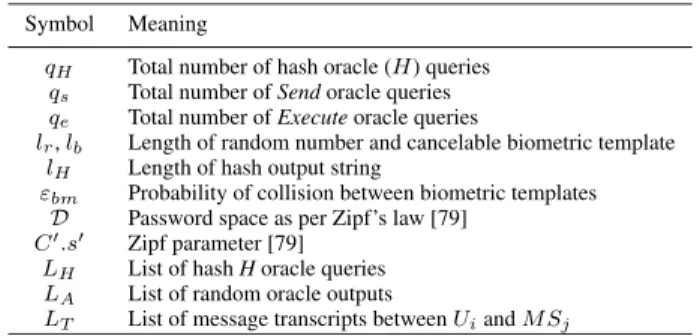
usual meanings as tabulated in Table4.
TABLE 4. Symbols used in the real-or-random (ROR) model.
2) SECURITY PROOF
The session key security proof is provided in Theorem 1. We have considered the Zipf’s law for the attack of password guessing [79]. In this case, when we consider only trawling guessing attacks, advantage of an adversary will be over 0.5 for qs = 107 or108 [79], [80]. The advantage of an
adversary for targeted guessing attack using user’s personal information will be over 0.5 forqs ≤106[85].
Theorem 1: Let the advantage of a polynomial-time
t-adversaryAto break the semantic security of the proposed
schemeP be denoted asAdvAP(t). Then,
AdvAP(t)≤ q 2 H+16qH 2lH +(qs+qe) 2+6q s 2lr +2max{C0.qss0,qs( 1 2lb, εbm) }
where the meaning of all symbols are given in Table4.
Proof: The proof is similar to that as presented in [72], [77], [78], and [81]. In this proof, we need four games, namely,Gm0,Gm1,Gm2,Gm3, andGm4. We denote the
suc-cess of an adversary Aas SuccAGm
j when Awin the game
Gmj, wherej = 0,1,2,3,4. At the same time, advantage
ofAfor winningGmj is denoted and defined byAdvAGmj =
Pr[SuccAGm
j].
• Game Gm0:This game is the actual attack byAto our
schemeP. The game begins whenAchooses bitc. Since the gameGm0 and the actual protocolP are basically
identical to each other, therefore by definition we have,
AdvAP(t)= |2.AdvAGm
0−1|. (2)
• Game Gm1:In this game,Aexecutes the eavesdropping
attack by calling theExecutequery. After that,A exe-cutes the Testquery once the game is completed. The output of this query is the decider to distinguish theSKij
from any random number. According to the formation of the session key,Aneeds the long-term secrets (UIDi, SIDjandXj) and the short-term secrets (Rc,Rs), to
com-pute the session key accurately. Otherwise, the chance of winning the gameGm1is not increased even all the
messagesMsg1,Msg2andMsg3are intercepted. Here, Gm0andGm1are essentially indistinguishable.
There-fore, we have the following:
AdvAGm
1 =Adv
A
Gm0. (3)
• Game Gm2:This is an active attack. TheSend andH
queries are implemented in this game. The attackerA intercepts all the messagesMsg1 = hM3,M4,M5,TS1i
andMsg2= hM11,M12,TS2i,A, andMsg3=M15,TS3.
Auses the intercepted messages for deriving the session keySKij. It is found thatMsg1andMsg2involve the
ran-dom noncesRcandRs. The current time stampsTS1,TS2
andTS3are also involved in the messagesMsg1,Msg2
andMsg3, respectively. Hence, random nonces and
cur-rent time stamps prevent collision in the messages of different session.
Therefore, the gameGm2is identical with the gameGm1
without the involvement of the Send and H queries. Then, we have the following result:
|AdvAGm 2−Adv A Gm1| ≤ (qs+qe)2 2lr+1 + q 2 H 2lH+1. (4)
• Game Gm3:In this game,AexecutesSend(MSj,Msg1),
Send(Ui,Msg2) andSend(MSj,Msg3) queries to win the
game. This results in the collision probality at most
(3qH+4qH+qH)
2lH =
8qH
three messages, collision probability is up to 3qs 2l r . As a whole, we get, |AdvAGm3−AdvAGm2| ≤ 3qs 2lr +8qH 2lH . (5)
• Game Gm4: The adversary A plays this game to
simulate the CorruptSmartCard query and extracts the secret credentials {<SIDj,Aj,Pj>|1 ≤ j ≤ m+m0),h(.),TPi,LTKi,h(K),fi,f(.), 9enc(.), 9dec(.)}
stored into SCi, where LTKi = KCW ⊕ CTi, fi =
h(UIDi||PWDi||CTi),Aj =h(UIDi||Xj)⊕PWDi,Pj =
h(SIDj||Xj) ⊕ PWDi for 1 ≤ j ≤ (m +m0). The
adversary is not able to extract the biometric template
CTi and the password PWi of the user id UIDi. The
maximum probability to guess the biometric template is uptomax{qs(21lb, εbm)}[81]. The guessing of password
has a probability uptoC0.qss0 [79]. Therefore, the game
Gm4andGm3are identical without the guessing attacks
on biometric and password. Overall, we have,
|AdvAGm 4−Adv A Gm3| ≤max{C 0. qss0,qs( 1 2lb, εbm) }. (6) To guess the correct bitc,Aexecutes all the games with the following advantage
AdvAGm
4 =
1
2. (7)
Using Eqs. (2), (3) and (6), we get
AdvAP(t)=2|AdvAGm
0−1|
=2|AdvAGm
1−1|
=2|AdvAGm1−AdvAGm4|. (8) Applying the triangular inequality, we get
|AdvAGm 1−Adv A Gm4| ≤ |Adv A Gm1−Adv A Gm2| + |AdvAGm 2−Adv A Gm4| ≤ |AdvAGm 1−Adv A Gm2| + |AdvAGm 2−Adv A Gm3| + |AdvAGm 3−Adv A Gm4|. (9) Finally, from Eq. (2) to (9), we get the required result:
AdvAP(t)≤ q 2 H +16qH 2lH +(qs+qe) 2+6q s 2lr +2max{C0.qss0,qs( 1 2lb, εbm) }
B. THE VERIFICATION OF MUTUAL AUTHENTICATION WITH BAN LOGIC
Recently, the BAN logic is used to check the mutual authentication in the existing key agreement protocols [50], [54], [65]. We have assessed the mutual authentication betweenUiandMSjwith BAN logic proof.
1) NOTATIONS
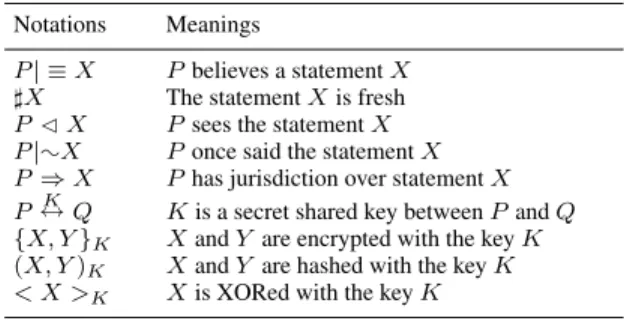
We use different notations in our analysis of the BAN logic. The notations are given in Table5.
TABLE 5.Notations used in BAN logic.
2) RULES
There are mainly five rules in BAN logic. The rules are given below:
Message meaning rules:P|≡P K←→Q,PC{X}
P|≡Q|| ˜X and P|≡P K
←→Q,PC<X>
P|≡Q|| ˜X
-Rule-1.
Nonce verification rule:P|≡]P(X)|≡Q,P|≡|≡XQ|| ˜X -Rule-2. Jurisdiction rule:P|≡Q⇒PX|≡,PX|≡Q|≡X -Rule-3. Freshness-conjuncatenation rule:PP|≡|≡](X,Y](X))-Rule-4. Belief rule:P|≡P(X)|≡(X,Y,P|≡)(Y)-Rule-5.
3) ASSUMPTIONS
We assume that the following holds at the beginning of every run of our scheme.
• A1:Ui| ≡](Rc),Ui| ≡](TS1) • A2:MSj| ≡](Rs),MSj| ≡](TS2) • A3:Ui| ≡Ui M1 ←→MSj • A4:MSj| ≡MSj M1 ←→Ui • A5:Ui| ≡MSj⇒Ui SKij ←→MSj • A6:MSj| ≡Ui⇒Ui SKij ←→MSj 4) GOALS • g1:MSj| ≡Ui| ≡Ui SKij ←→MSj • g2:MSj| ≡Ui SKij ←→MSj • g3:Ui| ≡MSj| ≡Ui SKij ←→MSj • g4:Ui| ≡Ui SKij ←→MSj
5) THE IDEALIZED FORM OF MESSAGES
The messages are transmitted through a public channel by either patient Ui or medical server MSj for
authen-tication and key establishment. The messages are given below.
• Message(1):Ui→MSj:<M3,M4,M5,TS1>
• Message(2):MSj→Ui:<M11,M12,TS2>
• Message(3):Ui→MSj:<M15,TS3>
By combining message 1 and 3, we can write messages as given below:
• Message(1): Ui → MSj: <M3,M4,M5,TS1>,
<M15,TS3>
The idealized forms of the messages are given below:
• Message(1): MSj C <M3,M4,M5,TS1>, <M15, TS3>, that is,
m1: MSj C <UIDi>(SIDj)Xj, <Rc>M1,TS3,(SKij,Rs,
TS3)M1
• Message(2):MSj→Ui:<M11,M12,TS2>, that is,
m2:UiC<Rs>(Rc)M1,TS2,(Ui SKij
←→MSj,Rc,TS2)M
1
6) SCHEME ANALYSIS
1) According to the assumption A3, the message m2
and using the message meaning rule (i.e. Rule-1), we obtain:Ui|| ≡MSj||˜(Ui
SKij
←→MSj,Rc,TS2) (Say,S1).
2) UsingA1andS1, applying the fresh conjuncatenation (i.e.Rule-4) and nonce-verification rules (i.e.Rule-2), we obtain: Ui| ≡ MSj| ≡ (Ui
SKij
←→ MSj, Rc,TS2).
(SayS2).
3) By the belief rule (i.e.Rule-5), we obtain the goal(g3):
Ui| ≡MSj| ≡Ui SKij
←→MS
j, fromS2.
4) Using the assumptionA5and the goalg3, according to the jurisdiction rule (i.e.Rule-3), we obtain the goalg4:
Ui| ≡Ui SKij
←→MSj
5) Considering assumptionA4, the message-meaning rule (i.e.Rule-1) is applied on the messagem1. We obtain formulaS3as:MSj| ≡Ui||˜(U
SKij
←→
i MSj,Rs,TS3)M1 6) We obtain a statement(S4)using A2,S3,Rule-4and
Rule-2, that is,S4:MSj| ≡Ui| ≡(Ui SKij
←→MSj,Rs,TS3)
7) Applying the belief rule on S4, we can conclude as follows:MSj| ≡ Ui| ≡ (Ui
SKij
←→ MSj). Therefore, our
goalg1is proved for our scheme.
8) Considering the truthfulness of the goal g1 and our assumption A6, according to the jurisdiction rule (i.e.Rule-3), we obtainMSij| ≡ Ui
SKij
←→ MSj, which is
equivalent to our goalg2.
C. FORMAL SECURITY VERIFICATION USING AVISPA Recently, security of the existing schemes [49], [50], [52], [67], [76]–[78] is tested using widely accepted AVISPA tool [58]. Mainly, the OFMC and CL-AtSe back-ends are used to check the security of the existing schemes. AVISPA tool executes the simulated protocol specified by HLPSL language [59]. In the protocol specification, three basic roles for three participants (i.e. the user roleUi, the medical
ser-vice registration center role MSRC and the medical server roleMSj) are defined. Accordingly, session role, environment
role and goals are specified in HLPSL.
In our protocol specification in HLPSL language, we have considered four secrecy goals and five authentication proper-ties for verification of our scheme. These goals and authenti-cation properties are described below.
• secrecy_of sub1: KRC is kept secret to theMSj.
• secrecy_of sub2: PWi and K are kept secret to theUi.
• secrecy_of sub3: UIDi is kept secret between Ui
andMSj.
• secrecy_of sub4: Xj is kept secret to theMSj.
• authentication_on user_msj_ts1: The server MSj
receivesTS1 from the patientUiandMSjauthenticates Uibased onTS1.
• authentication_on user_msj_rc: The server MSj
authenticates the patientUibased onRcreceived from
the message of the patientUi.
• authentication_on msj_user_ts2 : The patient Ui
receives TS2 from the message of the server MSj and Uiauthenticates the serverMSjbased onTS2.
• authentication_on msj_user_rs: The patientUi also
authenticates the server MSj based on the receivedRs
from the serverMSj.
• authentication_on user_msj_ts3: The server MSj
authenticates the patientUibased onTS3 received from
the message of the patientUi.
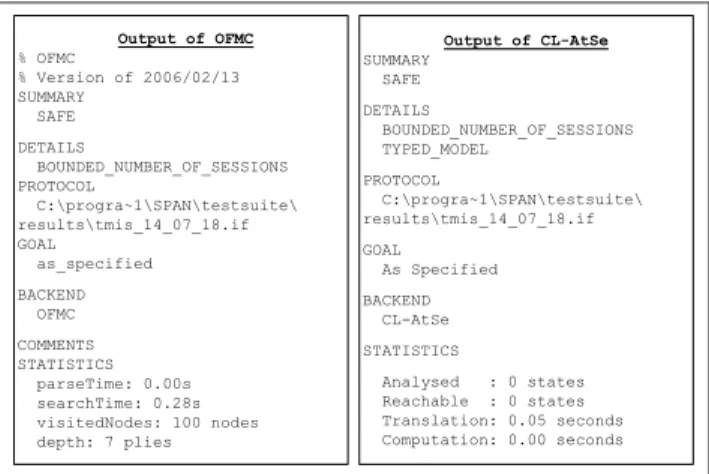
FIGURE 2. The Simulation results of security analysis using the proposed scheme with the AVISPA tool.
The results of AVISPA simulation are given in the Figure2. The results contain the verification of security of the proposed scheme under OFMC and CL-AtSe back-ends models. The simulation results show that the depth of search is 7 plies and total number of visited nodes is 100 in OFMC model. Moreover, OFMC backend needs 0.28 seconds and CL-AtSe backend takes 0.05 seconds to complete the search for attacks. The results of the simulation reported in Fig.2clearly indicate that the proposed scheme is safe against replay and man-in-the-middle attacks.
V. INFORMAL SECURITY ANALYSIS
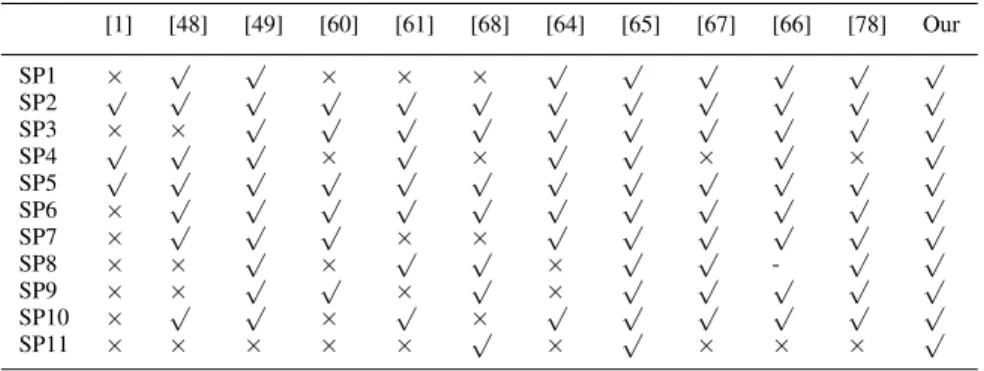
The informal security analysis is used in the existing key agreement schemes [1], [49], [50], [54], [56], [64]–[67], [78]. In this section, we have discussed the security strength of our proposed scheme against different known attacks. The security features of other existing schemes are compared with the proposed scheme.
A. USER ANONYMITY
The user id of a patient is protected under the security of either the biometric data of the patient (fi=h(UIDi||PWDi||CTi)),
or the secret key of the medical server (Aj,Pj,M3=UIDi⊕ M2 = UIDi ⊕ h(SIDj||Xj)). To know the UIDi from the
data stored in the smart card, an adversary should know the passwordPWiand the secret keyKof a patientUi. The secret
keyKis locked with the cancelable biometric templateCTiof
Ui. On the other side, only a registered serverMSjknows the
secret key of the server. Therefore, only the genuine server may compute the user identity. Say, the serverSj knows the
secret keyXj. The messageM2can be generated byMSj as M2 = h(SIDj||Xj). Therefore, after receiving the message
from patientUi, the medical serverMSjcomputes patient id UIDifromM3asUIDi=M3⊕M2. However, in [1] and [32],
user anonymity is not satisfied. B. PRIVILEGED-INSIDER ATTACKS
A patient sendsPWDi = h(UIDi||K||PWi) to theMSRC in
the registration phase. An insider user of the trustedMSRC
may behave like an attackerAand the registration message ofUican be recorded byAduring registration of the patient Ui. Furthermore, we assume that A can access all secret
information ofSCi. In the proposed scheme, deriving thePWi
fromPWDiwithout exact knowledge of the keyK is a hard
problem. Therefore, a privileged insider cannot pretend the patientUito log into the medical server because the attacker
does not knowPWi. Whereas, the schemes [2], [47], [49] do
not resist insider attacks.
C. OFF-LINE PASSWORD GUESSING ATTACKS
An attackerAmay target theSCito obtain the password from fi =h(UIDi||PWDi||CTi). However,Aneeds to knowUIDi,
the K, and theCTi to knowPWi from fi. Again, it is hard
to know the biometric template CTi, the secret key K and
the user idUIDi of a patientUi to guess the passwordPWi
by the A. However, in case of Arshad and Nikooghadam’s scheme [33], it is possible to guess the password off-line.
D. IMPERSONATION ATTACKS
There are two types of impersonation attacks, namely, the user and the server impersonation attacks.
• User impersonation attacks: An attacker A may try
to convince a medical server on behalf of a regis-tered patient Ui. Here, Aneeds to generate a random
nonceRAc and a current time stamp TS1A to compute a login message. Then,A may try to computeM1 = h(UIDi||Xj),M2=h(SIDj||Xj),M3=UIDi⊕M2,M40 = M1⊕RAc ,M50 =h(M1||R
A
c ||TS1A) in order to generate
a valid login message<M3,M40,M50,TS1A>. However,
Aneeds to know the long-term secretsUIDi,SIDjand Xj to impersonate a user with a valid login message.
Therefore, the user impersonation attack is prevented in our proposed scheme.
• Server impersonation attacks:An attacker A may try to send a message to Ui on behalf of MSj. To
com-pute the response message, A generates a random nonceRAs , a current time stamp TS2A and attempts to
compute M11 = h(h(UIDi||Xj)||R0c) ⊕ RAs , M12 = h(SKij||h(UIDi||Xj)||R0c||TS2A) in order to compute a
valid response message. In the proposed scheme, an attacker A is not capable to compute the message without the short-term secret credential (Rc) and
long-term credentials (UIDi,SIDjandXj). It means that our
proposed scheme is protected from the server imperson-ation attacks.
Some existing schemes [1], [33], [61], [68] are vulnerable to the impersonation attacks.
E. MUTUAL AUTHENTICATION
The server validates the time stampTS1and checks whether M5 is equal toM10. Any legitimate server can be
authenti-cated by extracting theRc from the login request message.
On the other hand, only a legal patient can extract the nonce of the serverRs, that is, the patient is authenticated here.
Similarly, only the genuine server can generate the message
M10 and can extract the nonce Rcof a legal patient. In this
way, the mutual authentication between the patient and the medical server is achieved in the proposed scheme. However, some existing schemes [1], [60], [68] are failed to achieve this security function.
F. REPLAY ATTACKS
The proposed scheme uses the current time stamp and randomly generated nonce in every session to prevent the replay attacks. Say, an adversary, A intercepts messages (<M3,M4,M5,TS1>, <M11,M12,TS2>, <M15,TS3>) of
the login, authentication and key agreement procedures. IfA replays an old message by resending to the server or the patient, the server or the patient will detect the attack imme-diately when the freshness of the time stamps will be ver-ified. Chuang and Chen’s scheme [1] and Mishra et al.’s scheme [48] are failed to resist replay attacks.
G. MAN-IN-THE-MIDDLE ATTACK PROTECTION
In this attack, an adversaryApretends himself as a medical server to a patient Ui and as a patient to a medical server MSj. A intercepts a login message <M3,M4,M5,TS1>
from Ui and attempt to generate another login message,
say <M30,M40,M50,TS1m> for the server MSj. The
adver-sary A computes the Rmc randomly and generates a time stampTS1mto compute a login message. To computeM30 = UIDi ⊕ h(SIDj||Xj), M40 = h(UID||Xj) ⊕ Rmc, M
0
5 =
h(h(UID||Xj)||Rmc||TS1m), A needs to know the long-term
secrets UIDi, SIDi and Xj. Moreover, A can not compute
the genuine nonceRcofUiwithout the knowledge about the
long-term secret credentialXj. Hence, the proposed scheme
is able to resist the man-in-the-middle attacks. However, Luet al.’s scheme [61] is prone to Man-in-the-Middle attacks. H. NO ENCRYPTION/DECRYPTION
In our scheme, we do not use any symmetric or asymmetric encryption but only the cryptographic hash