ChildONEurope Secretariat
c/o Italian Childhood and Adolescence Documentation and Analysis Centre Istituto degli Innocenti
P.zza SS. Annunziata 12 I-50122 Firenze tel. 055 2037 305/342 - fax 055 2037344
ISBN 978-88-6374-034-9
Complementarities
and synergies
between
juvenile justice
and
social services
sector
The proceedings of the ChildONEurope Seminar
on Juvenile Justice
(Florence, Istituto degli Innocenti, 19 April 2012)
Chil
dONEur
ope
Complementarities
and synergies
between
juvenile justice
and social services
sector
The proceedings
of the ChildONEurope Seminar
on Juvenile Justice
(Florence, Istituto degli Innocenti,
19 April 2012)
ChildONEurope Secretariat
c/o Italian Childhood and Adolescence Documentation and Analysis Centre Istituto degli Innocenti
P.zza SS. Annunziata 12 I-50122 Firenze
tel. +39 055 2037342/305 - fax +39 055 2037344
e-mail [email protected] - website www.childoneurope.org
Complementarities and synergies between juvenile justice and social services sector
The proceedings of the ChildONEurope Seminar on Juvenile Justice
Scientific Coordination
Roberta Ruggiero
Technical Coordination
Giovanna Marciano and Fabiana Mazzoni
Editorial coordination
Anna Buia
Cover
Cristina Caccavale
© 2013 Istituto degli Innocenti di Firenze ISBN 978-88-6374-034-9
Table of contents
Introduction ... 7
Part 1 The international debate trends on juvenile justice and social services The fulfilment of children’s rights in the juvenile justice framework: the role of social services ... 11
Renate Winter The EU Agenda for the rights of the child: the possible synergies of work with social services ... 15
Margaret Tuite The Council of Europe Guidelines on child friendly justice and on social services friendly to children and families ... 19
Gioia Scappucci A comparative European analysis of national experiences on practices of reintegration ... 21
Cédric Foussard Part 2 Outcomes of the Working groups Working group 1 Juvenile justice and child protection systems in Europe Promoting community sanctions and developing “good practices” in an ‘era of penal excess’ ... 29
Frieder Dünkel, Ineke Pruin Working group 2 The participation of social services in the youth court and their potential for the prevention of re-offending ... 53
Stephanie Rap Working group 3 Unaccompanied migrant children in conflict with the law ... 61
Damien Nantes Programme of the seminar ... 65
Bibliography ... 67
Filmography ... 75
Introduction
This publication contains the collection of papers related to the European Seminar on ‘Complementarities and synergies between juvenile justice and social services sector’ of the European Network of National Observatories on Childhood (ChildONEurope) held in Florence, Istituto degli Innocenti, on 19 April 2012. Throughout a decision of the ChildONEurope Assembly of 24th of February 2012 the ChildONEurope Secretariat convened an European seminar to the issues pertaining to the synergic collaboration between the juvenile justice and the social services dedicated to children ended in conflict with the law. Its main aim was to stimulate a wide-ranging discussion on the different criticalities and implications of juvenile justice more sensitive to the child needs and rights.
The timing of this Seminar was particularly appropriate. The so called ‘third period’ of the history of juvenile justice law, which may be said to date back to the end of the 20th century, is the one characterised by the transformation of institutions (1960-1990) and the drafting of major international documents (Beijing, Riyad and Havana). This period is very rich, it is marked, in turn, by the emphasis on the model of protection, its critical analysis, a tendency towards moving away from the judiciary and having recourse to extra-judiciary solutions. Whereas, some scholars define the period starting from the 1990 onwards as the ‘implementation period’ of these international standards. But several questions on criticalities remain no answered. Therefore, the implementation cannot be so smoothly operated simply on the basis of their formulation in the international standards. Several are the issues at stake, but one is obtaining and increasing attention: how include and enhance the social services action in the child best interest.
Today’s research shows that juvenile justice requires a specific, supple and flexible law that can call upon a range of responses based on aid and education. The development of probation and parole also can be estimated as success in some national experiences. The recidivism and revocation rates have decreased through the use of more constructive and rehabilitative community sanctions. The prevailing new trend on the international scene is to search for alternatives to deprivation of liberty. Focusing on the reality coming from the European experiences, mainly referring to the context of the European Union, the Seminar represents an attempt to place children at the centre of the debate, focussing attention on the main problems facing the implementation of a juvenile justice national frameworks in line with the International standards and on the role that social services should play in order to reach the final aim of setting up a restorative and reintegrative juvenile justice system.
The plenary debate started with the contribution of Renate Winter, Justice Appeals Chamber of the Special Court for Sierra Leone (SCSL) who provided a critical overview over the fulfilment of children’s right in the juvenile justice framework and the crucial role of social services for child care and reintegration. The European dimension of the debate was introduce throughout two contributions. The first, was an analysis of the European Union Agenda of action on the EU Strategy and aimed at verifying the possible synergies of work with the social services in this specific context. It was provided by Margaret Tuite, EU Commission-Coordinator for the Rights of the Child DG Justice, Fundamental rights and rights of the child. The second contribution, based on the presentation of the Council of Europe Guidelines on child friendly justice and on social services friendly to children and families, was carried out by Gioia Scappucci, Council of Europe, Children’s Rights Division. The plenary section was concluded with the contribution of Cédric Foussard, Director of the International Juvenile Justice Observatory who delivered a critical introduction of the national dimension though the presentation of a comparative European analysis of national experiences on practices of reintegration.
The proceedings reproduced in this publication include as well the outcomes of the three working groups minded to further develop the discussion of three specific issues, namely: (1) the promotion of
8
alternative to detention in Europe; (2) the participation of social services in the youth court and their potential for the prevention of re-offending; (3) unaccompanied migrant children in conflict with the law. Each one of the working group was opened with the introductive speech of experts coming from academia and international civil society. The expert involved in the working groups’ discussion were: Frieder Dünkel, University of Greifswald, Germany, with the coordination of Isabella Mastropasqua, Director of the Study, Research and International Activities Bureau, European Study Center of Nisida, Italy, Stephanie Rap, Researcher, Utrecht University, Netherlands, with the coordination of Benoît Parmentier, Director, Birth and Childhood’s Office (ONE), Brussels, Belgium, and Damien Nantes, Director of the Association Hors la Rue, France, with the coordination of Marie-Paule Martin Blachais, Chairperson ChildONEurope Assembly.
Part 1
The international debate trends
The fulfilment of children’s rights
in the juvenile justice framework:
the role of social services
Renate Winter
Articles 27 and 40 of the Convention of the Rights of the Child, Comment nr. 10 of the Committee on the Rights of the Child and the European Guidelines for a Child friendly Justice deal with the most important issues for juvenile justice: the duty of Member States to use diversion and alternative measures to the maximum possible extent, and furthermore to assist the child throughout all stages of criminal as well as civil procedures.
Neither a juvenile judge nor a family judge can provide this assistance alone. A judge can issue orders, but cannot execute those orders. For the execution of orders, decisions or judgements he/she needs the assistance of social services, be it by psychologists, psychiatrists, mediators, social workers or probation officers, all of them working within the justice system.
Even if the work of the assisting personnel might differ in matters of penal, civil and administrative justice, the difference of having or not having somebody available to immediately, swiftly and efficiently take over the protection of a child at risk or in conflict with the law, is of paramount importance for the judiciary. Furthermore, a judge, knowing that his/her order cannot be executed due to the lack of a supervisory body would not issue such order, even if it would be in the best interest of the child. He/she would have to choose not so favourable measures for the child in cases where supervision by social services is unavailable.
Juvenile justice deals with children in conflict with the law, no matter if they are below or above the age of criminal responsibility. In each case a decision on the child that is in the best interest of the child, has to be made. Juvenile justice also deals with children in contact with the law, such as child victims and child witnesses. In such cases a system of assistance for the child, subjectively through a person of trust, objectively through available protection mechanisms, has to be established. To be able to do so, social services must be in place. Sometimes just one person helping the child to get through a difficult time will suffice; sometimes a whole network of services is necessary, as for instance in cases, where trafficked and severely traumatised children have to give evidence in court.
Let us now have a look at penal matters.
To be able to decide in the best interest of the child, a judge or prosecutor needs first of all to know about the circumstances of the child. He/she needs a thorough report on the child, about the family/school/work environment, problems encountered, contacts with police, contacts with courts, behavioural problems, psychological problems, friends etc. Only then appropriate decisions can be made on the need for pre-trial detention, diversion, bail, indictment, in cases when a child is above the age of criminal responsibility. According to Article 12 of the CRC, a child shall be heard in matters pertaining to him/her if ever possible, even if the assistance of an interpreter, a psychologist or of other assisting persons is necessary. A report on the child has not only to be as complete as possible, it has to be delivered as quickly as possible, especially in cases where a decision has to be made on the use of pre-trial detention so as to keep children out of jail if possible or at detained in jail for the shortest possible period of time. Such a report is made by a social worker with special training on court procedures and on dealing with children. If for instance the crime committed encourages the prosecutor/judge to opt for pre-trial detention, the report can influence this decision. If it confirms the possibility for bail or the possibility of returning the child to a well-functioning family for supervision, the prosecutor/judge would certainly avoid depriving the child of his/her liberty, as deprivation of liberty is a measure of last resort, and to use a measure of last resort would not be necessary in this case.
If the judge/prosecutor is inclined to divert the child from the justice system and to use diversionary measures such as victim-offender mediation or community service, several conditions might be imposed. Once again it would be up to the social worker to submit as complete a report as possible on
12
the child to enable the judiciary to reach an appropriate decision for the child in question. In case mediation is envisaged, a mediator (mostly a specially trained social worker or a specially trained psychologist) has to deal with both parties of the mediation - the victim (and his/her family) as well as the offender (and his/her family). The mediator is required to report back to the requesting judicial authority if mediation seems to be feasible and again at a later stage, if the mediation has been successfully finalized. If this is the case, the prosecutor/judge can close the case. If community service is taken into consideration, it is again the social worker who has to report to the prosecutor/judge about the situation and the circumstances of the child, if the child is willing and able to undertake community work duties, on what kind of duties would be best suited to the child (and the victim), on the availability of such community duties, and if the family is in agreement with the child undertaking such work. If the prosecutor/judge has decided which kind of work/duty would have the most beneficial impact on the child and be in the interest of the community, the social worker has to accompany the child to the workplace and deal with the employer, in order to ensure that the child is doing the work properly and that the employer is not misusing the child. After finalisation of the job, the social worker has once again to report back to the judiciary in order for the case to be closed if the job has been done correctly or, if not, to open a case at court.
If case diversion is not possible but alternatives can be used instead of punishment, a social worker is again required to first of all report to the judge on the child and his/her situation, to see which alternatives are available in a given situation and to propose to the judge which of them would be in the best interest of the child giving reasons for the recommendations. The judge will then invite the social worker and the child and his/her family/caregiver, to discuss the matter and make a decision. The order given will spell out the conditions necessary for a successful execution of the order and it is once again the social worker who will accompany the child and his/her family and report back to the judge.
If none of the above has worked or if no alternatives are possible and a case comes to trial, the social worker who has made the initial report has to be invited to trial in order to be questioned about possible changes in the circumstances of the child, to give the latest information on the child, for instance if the child has found gainful employment, or a place at a school, or is undergoing therapy. Furthermore, the social worker has to give information on the child’s development since the time of the committal of the offence and to submit to the judge recommendations on appropriate, individually tailored possibilities for using non-custodial measures. In many countries, for instance as in Austria, a trial without submission of a report and without interrogation of the social worker would be voided. This shows the importance of the role of the social services in the juvenile justice system, as it is stipulated that a judge cannot find an adequate decision in the best interest of the child without information delivered by competent and trained social workers.
In cases where non-custodial measures are ordered by the judge, the nomination of a social worker or probation officer by the social services, depending on the system in place, will be requested by the judge. The duty of this social worker is to assist the child, and often also his/her family, to fulfil the order to avoid custodial measures and to report back to the judge at the end of the measure. If the fulfilment of the order is not possible for a reason over which the child has no influence, a report has to be submitted in order to enable the judge to change the order. In cases where the child is unwilling to fulfil the order of the judge the social worker has to report on that as well, as the judge might be inclined to summon the child and his/her family to give him/her another chance before revoking the order and using custodial measures.
If probation or a sentence with probation time is pronounced, a probation officer (a social worker specially trained to work in this field) is nominated in most of the cases. It is clear that child in difficult situations, where assistance was not given and where the environment was part of the problem and is certainly not part of the solution, somebody is needed to guide the child through the probation period to prevent him/her becoming recidivist. It goes without saying that returning a child, without assistance, to a very problematic environment means that this child will most likely become recidivist! The probation officer has to periodically report to the judge about the progress of the child or the difficulties encountered by him/her.
In cases where a judge has to deprive a child of his/her liberty, this does not mean that this child will not receive assistance during the period in a closed institution, nor that assistance will not be possible (indeed it is more than necessary) after his/her release.
Services should be provided in closed institutions, especially when a child has acute problems such as aggressiveness, drug addiction, grave behavioural problems, learning deficits, lack of vocational training, etc. A closed institution, appropriate for children, has to provide professional assistance to be given by a wide range of social services, according to the needs of the child in question. The most important duty of social services, however, is preparing the child for “the life after” - the life as a law-abiding citizen without the danger of recidivism. This preparation should start as soon as possible, but in any case after one third of the imprisonment time, in order to make the child ready for the “life outside” if parole is granted. In most of the Member States of the CRC, parole is granted to a child after having served half to a third of the sentence and thus preparation for release has to start as soon as possible. In Austria, where good services are available, probation officers say that preparation for release has to start on the day the child enters the closed institution! This means that the probation officer (parole is usually granted with a probation period) has to investigate whether the family/community accept the return of the child, if the child has work/a school place, if the child has a place to live, and if the child has the financial means to bridge the time between release and receipt of income. Furthermore the probation officer will be present when the child is liberated to assist him/her during the first days of liberty and to assist the child during the whole probation period, in the hope of being able to write a positive final report.
In cases where a child that has committed an offense is below the age of criminal responsibility, the juvenile judge has nevertheless to find a solution for this child to prevent this child from becoming a fully-fledged offender when reaching the age of criminal responsibility. He/she will call upon social services to provide assistance through supervision, treatment, counselling, vocational training, assistance at school, or whatever is necessary to get the child safely through the critical situation in which this child is involved.
Another group of children that are in dire need of assistance and who are often forgotten are the victims and witnesses of crime. Children can be direct victims of crimes, but they can also be indirect victims by having been exposed to experiences or sights that are detrimental to their mental health. A child that has been attacked by his/her father for instance will generally have great difficulties in overcoming or dealing with this act and will not only need the assistance of general social services (specialized youth protection services) but also of psychologists or even psychiatrists in grave cases. The same child, as a witness at court will have even more problems, as family members might try to influence the child, others might try to threaten the child into silence or to give evidence the family wants the judge to be told. In such cases a person of trust is dearly needed, and that person should accompany the child through the whole procedure. If there is no friend, no family member to do the job or if it is too dangerous for them to assist the child, a social worker will be designated by the court to guide the child through the ordeal ahead. Such a person would be even more necessary in cases of trafficking, where a trafficked and thus severely traumatised child has to face the trafficker in court, and very often has to face examination by lawyers who will try to discredit the child’s ability to tell the truth. There is need again for strong assistance to be extended to the child to prevent re-victimisation as much as possible. A lawyer, paid by the state, can do the legal protection but the individual psychological protection can only be delivered by a social worker/psychologist.
Another issue is re-compensation in cases where an offender has been found guilty. Who will see to it that the child gets treatment if necessary (and necessary it is in most of the cases)? Who will activate the network of available assistance to the child (protection after trial, monitoring the time of release of the offender, getting legal assistance for having re-compensation really done, finding a place to live if necessary, etc.)? These are duties of social workers acting as persons of trust. It takes a long time for wounds to heal, and justice is quick to close a case. Social services cannot or should not close the case of a child victim/witness before redress has been achieved.
Let’s now turn to civil matters, as child friendly justice doesn’t stop at criminal matters.
Whenever a child is in contact with the law, social services are requested in order to guarantee their protection. Let’s take as an example a divorce procedure: father and mother attack each other, they fight heavily over custody rights, visitation rights, financial agreements and the child is asked by both
14
of them to be his/her witness. Sometimes the parties accuse each other of criminal behaviour such as sexual harassment, incest, violence etc. Once again, both parents want the child to testify on their behalf. There is no need to explain what such a situation means for a child and there is no need either to explain that the family judge will seek to secure the protection of the child by the youth protection services, and, if necessary, to temporarily place the child with a guest family. It is also needless to say that a report by a social worker would be required to reach such a conclusion.
A similar situation arises in cases of adoption where a child has to be heard, in cases where a placement outside the family is needed, be it in an institution, be it with a foster family. Without the assistance and a report on the situation of the child and recommendations on where to place the child, a family judge would be unable to make decisions that would be for the child’s best interest.
If a child has been abducted by a parent or a repatriation procedure has to be undertaken in administrative matters, once again the services of social workers are necessary and important. In abduction cases, social services of both countries involved have to submit reports on the child and the parent in question. In repatriation cases, especially if the child has been trafficked with the consent of the family and a decision has to be made where to send the child, the judge has to know about the situation of the original family and the possible threats by the traffickers to the family, before he/she can issue an order.
The list, where social services are needed in child protection cases is a long one, longer even than the one for penal matters. One cannot say that the one or the other is more important. Both are equally necessary to grant the basic rights and the necessary security to a child in contact with the law and legal institutions.
There is a saying that seems very appropriate to me: a juvenile judge without a social worker is like a fish without water. The same holds for a family judge or somebody deciding in administrative matters. Without the assistance of social services, there is no way to act in the best interests of a child.
The EU Agenda for the rights of the child:
the possible synergies of work with social services
Margaret Tuite
EU objective on the rights of the child
The promotion and protection of the rights of the child is one of the objectives of the EU on which the Treaty on European Union (notably Article 3(3) puts further emphasis. The rights of the child are also enshrined in the Charter of Fundamental Rights of the European Union, where Article 24 of the Charter recognises that children are independent and autonomous holders of rights. Article 24 of the Charter also makes the child’s best interests a primary consideration for public authorities and private institutions.
In that context, the European Commission adopted an EU Agenda for the rights of the child in February 2011, reaffirming the strong commitment of all EU institutions and of all EU Member States to promoting, protecting and fulfilling the rights of the child in all relevant EU policies. The EU Agenda recalls that the standards and principles of the United Nations Convention on the rights of the child must continue to guide EU policies and actions that have an impact on the rights of the child. The EU Agenda focuses on a number of concrete actions in areas where the EU can bring real added value such as child-friendly justice and the protection of children in vulnerable situations that are of relevance to this conference discussion.
It is worth bearing in mind that it is estimated that within the EU 0.2% of the total child population is in formal contact with the police (about one million children per annum). Based on UNODC and Eurostat figures and other studies, efforts have been made to estimate the vulnerability or vulnerabilities of persons in conflict with the law (e.g. approximately 69% of persons in conflict with the law suffer from drug addiction, 22% from alcohol addiction, 10% from mental illness and 9% from learning disabilities or difficulties, 19% are foreigners). Persons in conflict with the law may suffer from more than one vulnerability. These figures are only estimates (and include extrapolations for those Member States for which data is not available), and I give them to provide a very rough indication of the likely scale of numbers involved.
EU Commission activities in the area of child-friendly justice
In the EU Agenda, the Commission undertook to promote the use of the Council of Europe Guidelines of 17 November 2010 on child-friendly justice and to take them into account in future legal instruments in the fields of civil and criminal justice.
Data collection on children’s involvement in justice
The EU will launch a major data collection study that should begin in the third quarter of 2012 to collect data on children’s involvement in administrative, civil and criminal judicial proceedings in all EU Member States. The study results are expected to serve to develop and implement evidence-based policies.
The geographical scope for all parts of the study is all EU Member States. We will collect data on children’s involvement in justice meaning administrative, civil and criminal justice and covering all potential roles that a child may have in relation to judicial proceedings: offenders/perpetrators/accused (juvenile justice), victim (civil claimant, civil party, private prosecutor), witness and/or parties to criminal justice proceedings; party, witness, claimant, plaintiff in administrative or civil proceedings).
The first objective of the study is to provide a narrative overview of the situation - as at 1 June 2012 - in all EU Member States using the Council of Europe Guidelines on child-friendly justice as a template. The narrative overview will record and map legislation, policy and measures in place in
16
Member States. A second objective, after analysis of international and national indicators already available, to draw up a master list of indicators that reflect obligations to respect, protect and fulfil children’s rights in the area of justice. The third overarching objective is to collect statistics on children’s involvement in administrative, civil and criminal judicial proceedings for the years 2008-2010 (and 2011 if available). Beyond the scope of the Guidelines on child-friendly justice, the narrative overview will also include elements related to age limits (upper age limits for juvenile justice, description of what happens after the age of 18 is reached when a child is already in the system (e.g. transfer to adult systems), a detailed description of diversion measures to include the conditions under which they apply and the impact if any on criminal records. Support mechanisms and measures for child victims and witnesses will also be described, as well as advice and support regarding access to complaint, legal appeal and judicial review mechanisms. In terms of this conference topic, there are clear linkages with social services throughout.
In terms of timing, we would expect to have the results of the study for criminal justice by the end of June 2013, with the results for civil and administrative justice due about a year later. We know that data on juvenile justice is more readily available than other data, and it is likely that very little data is gathered on child witnesses. We expect considerable data gaps, but the study will provide an EU-wide overview of children’s involvement in justice for the first time and we hope that the data collection work will provide a sound basis on which to improve data collection in the future.
The study results are intended to be user-friendly and multi-functional and will be designed in such a way as to make it possible for users (results will be publicly available) to filter results according to their needs (for example by Member State/by area of justice/by age/by indicator (structural/process/outcome), by year, etc.
Stakeholders for data collection
Given the broad scope and relative complexity of this study, in order to succeed it is essential for the Commission to work with all stakeholders. As well as the mandatory bilateral consultations of each Member State, some key stakeholder involvement mechanisms have been incorporated in the terms of reference for the study. The Commission will be assisted by a steering group comprising experts from international and other organisations as well as some Member States (e.g. Fundamental Rights Agency of the European Union, Council of Europe, UNICEF (TransMONEE), UNODC, academic experts on rights of the child, NGO representatives and Member State representatives). The steering group mandate is to ensure that relevant knowledge and expertise within the remit of the steering group is made available and to advise the Commission in taking informed key decisions in the execution of this study.
Member State involvement is obviously critical to the success of this study and round table discussions with Member State (Ministry of Justice and National Statistics Offices) representatives are planned at appropriate milestones, for each of the three areas of justice.
In parallel to this secondary data collection study and complementary to it, the Fundamental Rights Agency of the European Union will gather primary data and assess the actual experience on the ground in a specific area focusing on qualitative aspects, through field research (interviews and focus groups with legal and social professionals) to identify what is or is not implemented and how, and to assess impact, good practices, difficulties and gaps, to include different perspectives, to assess usage of guidelines and child-friendly procedures, etc.
Future instrument on vulnerable suspects
The future (end 2013/early 2014) legislative instrument on vulnerable suspects is likely to have a strong child focus. Children may suffer from multiple vulnerabilities, for example if they suffer from mental illness or are part of the migrant population or if they suffer from an addiction. In the work now underway to prepare that legislation, complementarity and synergies with social services are integral to many aspects of the proposal, such as
assessment of vulnerability
the right to information and the right to be heard notification of custody
the right to assistance including medical care and psychological support pre-trial detention measures
interview phases hearings
measures to be taken in cross-border cases.
The consideration of training of legal and other professionals and police officers with regard to interactions with child suspects or accused is also very important. Key issues to be considered are likely to include: identification/definition of vulnerable suspects/accused, safeguards granted to vulnerable suspects to guarantee their effective participation in criminal proceedings, definition of children and measures in place when children are interviewed by the police (e.g. presence of parent/guardian or lawyer), questions around legal representation for children, etc.
The vulnerability of child suspects/accused on grounds other than age is not systematically identified in all Member States and data is lacking within the EU on this topic. Children may not fully understand their rights/charges especially when information is not adapted to their needs; children can waive their right to legal assistance without realising the consequences and, furthermore, a child’s welfare may not be sufficiently protected if appropriate adults are not informed on how to assist them when notified of the child’s custody.
Victims’ rights
Child suspects or accused may also have been or be victims, and it is important to look at measures for child victims when discussing juvenile justice, including the recent Commission proposal on the rights of victims of crime1. A coordinated approach involving the police, education, social services, etc. and combining services in a one-stop-shop or the successful “children houses” that have been implemented in some Member States and Croatia may be considered appropriate and this could also be the case for vulnerable suspects or accused.
Training on child-friendly justice
Training in child-friendly justice is important. Training is not only about legal aspects but should include elements of child psychology and communication (see Guidelines on child-friendly justice.)
The child’s right to be heard (UNCRC Article 12) is a red thread throughout juvenile justice from investigation of a crime through to how matters are explained once a judicial decision is taken, appeal and complaint mechanisms available, etc. In this respect, the Commission will launch a study in November 2012 to map EU-wide legislation, policy and practice on child participation (the child’s right to be heard) in a wide variety of settings including the justice setting.
In 2013, under the Fundamental Rights and Citizenship Programme, the EU intends to make funding available for the provision of training on child-friendly justice to a range of professionals (including judicial and legal practitioners, social workers, etc.).
At EU level the combination of specific legislative measures, the data collection work - both secondary by the Commission and primary by FRA - as well as efforts to promote child-friendly justice and exchange best practice in collaboration with international partners such as the Council of Europe can serve to help ensure that children’s interactions with the justice system are not unnecessarily unpleasant or distressing.
The Council of Europe Guidelines on child friendly justice
and on social services friendly to children and families
*Gioia Scappucci
In November 2010, the Council of Europe adopted Guidelines on child-friendly justice. These apply to everyone under 18 years when they come into contact with the justice system, such as when they break the law, their parents get divorced or when someone who hurt them is being punished.
The Guidelines say that:
Decisions should be made about children in a way that respects their rights. The child’s age and needs must always be taken into account, and his/her privacy respected.
Children should know about their rights and who can help them.
Children have the right to be heard in decisions that affect them, and adults must take children’s views seriously.
Children’s rights should be respected and they must be treated equally.
Children and their parents should be given information about the child’s right to be treated fairly and properly. This should be explained in a way everyone under 18 years can understand. Everyone working with children should receive training on children’s rights, how to talk to
children and on the needs of children.
Special rules should apply when children break the law. They must be respected by the police. Children who understand their rights should be able to go to court to have those rights
protected. They should have their own lawyer and they should have a say in cases that affect them. Decisions should be taken as quickly as possible and should be explained to children in a way they understand. Before they go to court, children should know what it will be like. Special rules should apply to those who have been hurt.
A year later, in November 2011, the Council of Europe also adopted Guidelines on social services friendly to children and families. These encourage states to adapt their social service systems for children and families to the specific rights, interests and needs of children.
The key strategies in child-friendly social service delivery include:
Transparent dissemination in a child-friendly language of information on the availability of social services;
Equal access to social services for all children;
Availability of social services for children and families at different stages and situations of their lives;
Suitability of services based on planning and matching services with individual needs, including an assessment of outcomes for the child;
A common assessment framework and interagency protocols for different professions and agencies working with or for children, especially children at risk;
Training, supervision and accountability for all members of staff working with and for children; Primary consideration for the safety of the child in all social service delivery;
Protection of confidentiality of personal data of children who are or have been recipients of social services;
Mechanisms for re-examination of the outcome of decisions or requests when they are challenged by the child or her/his parents;
An efficient monitoring and evaluation system of all social service providers for children and families.
*For further information, please refer to the full text of the Council of Europe Guidelines available at:
A comparative European analysis
of national experiences on practices of reintegration
Cédric Foussard
The IJJO
1and its EU branch, the EJJO
2Children and young people all over the world are in need of protection and special care when they come into conflict with the law. This is the original inspiration for the International Juvenile Justice Observatory.
The IJJO has set up its European Branch the European Juvenile Justice Observatory (EJJO), as a positive element in the process of combining strategies and good practices in Europe. The objective of the EJJO aims to create the European Council for Juvenile Justice as the European think-tank on Juvenile Justice is composed of European Experts in the field, who works for the development of initiatives and standards of good practices for the education and the inclusion of young Europeans in conflict with the law3 and develop the corresponding strategies and recommendations as this Green Paper pretends.
The International standards and the European standards working in favour of the
social reinstatement of the young people in conflict with the law
Over the last twenty-five years, international juvenile justice standards have been developed by the United Nations at international level and the Council of Europe at regional level. In addition, a range of non-binding declarations and recommendations have produced specific codes concerning the rights of young offenders and other specific areas of juvenile justice.
At the international level:
The Convention on the Rights of the Child (1989), Article 404
United Nations Standard Minimum Rules for the Administration of Juvenile Justice (The Beijing Rules)5
United Nations Standard Minimum Rules for Non-custodial Measures (The Tokyo Rules)6
Both Cédric Foussard’s presentation of the ChildONEurope Seminar of 19th April 2012 on Juvenile justice
and social services sector and this summary take back the principal points of the IJJO Green Paper written by Ms. Severine Jacomy-Vité on The social reintegration of young offenders as a key factor to prevent recidivism. This paper has been done in collaboration with the European Council for Juvenile Justice. It is aimed at examining the orientations and scopes of young offender’s reintegration efforts across Europe so as to highlight perceived challenges and positive practices to be taken into account in further policy and programme developments. (See
also the Green Paper developed by the Public Administration Section The Evaluation of the Implementation of
International Standards in European Juvenile Justice Systems and the Academic Section Measures of Deprivation of
Liberty for young offenders: how to enrich International Standards in Juvenile Justice and promote alternatives to
detention in Europe?).
1 http://www.ijjo.org 2 http://www.ejjo.org/
3 Throughout the paper, different terms are used to refer to this group, or to parts of it: children, adolescents,
minors, juveniles or youths in conflict with the law, young offenders below or above the minimum age of criminal responsibility, etc. All these terms have different ideological, legalistic and practical implications or connotations. They are used indiscriminately but selectively at different points to reflect various aspects, references and contexts of the discussion.
4 http://www2.ohchr.org/english/law/crc.htm
5 http://www2.ohchr.org/english/law/pdf/beijingrules.pdf 6 http://www2.ohchr.org/english/law/tokyorules.htm
22
The United Nations Guidelines for the Prevention of Juvenile Delinquency (The Riyadh Guidelines)7
United Nations General Assembly Resolution on Human rights in the Administration of Justice (Nov 2010) A/C.3/65/L.35/Rev.18
General Comment number 10 (2007) of the Committee on the Rights of the Child on Children’s rights in juvenile justice9
General Comment number 13 (2011) of the Committee on the Right of the Child to freedom from all forms of violence10.
At the European level:
Guidelines of the Committee of the Ministers of the Council of Europe on Child-Friendly Justice - CJ SCH (2010) 1211
Recommendation CM/Rec (2008)11of the Committee of the Ministers to member states on the European Rules for Juvenile offenders subject to sanctions or measures12
Recommendation Rec(2006)2 of the Committee of the Ministers to member states on the European Prison Rules13
Recommendation No. R (89) 12 of the Committee of the Ministers to member states on Education in Prison14.
Key elements of successful social reintegration:
postulate and examples of best practice
Detention as a measure of last resort for children in conflict with the law: This principle is a quasi-universal norm of international law15. Indeed, the use of custodial measures has been documented to be highly damaging for children and adolescents. Hence, this principle must be respected by all means through an array of prevention, diversion and alternative measures. In addition, this may allow improving remaining custodial options, not only in terms of conditions but also in terms of approaches. It is time for a new way of thinking and acting: in juvenile custodial institutions, a pedagogical approach that focuses on “treatment” instead of on “control” is needed.
Child-Friendly Justice: The reintegration of young offenders, notably further to a detention period, can only be complete if it is grounded in a positive “sense” of justice, nurtured by their understanding of justice and by their experience of justice. Hence, child-friendly justice can be considered as another prerequisite to the successful reintegration of young offenders, although it is only just emerging as a concept and as a part of the broader notion of justice for children.
Reintegration as a continuous and long-term objective: Reintegration is not just about aftercare. Actually necessary assistance must be provided to juveniles, “at all stages of the proceedings”16. The founding principle is that reintegration is a process, rather than the end result or the limited mandate of one or two professionals in isolation. That is why it requires consistency, continuity and long-lasting commitment.
7 http://www.un.org/documents/ga/res/45/a45r112.htm 8 http://daccess-dds-ny.un.org/doc/UNDOC/LTD/N10/609/51/PDF/N1060951.pdf?OpenElement 9 http://www2.ohchr.org/english/bodies/crc/docs/CRC.C.GC.10.pdf 10 http://www2.ohchr.org/english/bodies/crc/docs/CRC.C.GC.13_en.pdf 11 http://www.coe.int/t/dghl/standardsetting/childjustice/Guidelines%20on%20child-friendly%20justice%20and%20their%20explanatory%20memorandum%20_4_.pdf 12 https://wcd.coe.int/ViewDoc.jsp?id=1367113&Site=CM 13 https://wcd.coe.int/ViewDoc.jsp?id=955747 14 http://www.exocop.eu/sixcms/media.php/13/CoE_1989_Education_In_Prison.pdf
15 Cf. Article 13 of the Beijing Rules and Article 37 of the CRC. 16 Cf. Article 24.1 of the Beijing Rules.
Support to reintegration as an outcome-oriented process: The reintegration is as one ultimate (“desirable”) goal of juvenile justice17 but it is not specified means to reach this goal. Comparing cost projections of systems with and without solid reintegration services have in some cases enabled to speed up policy change and make long-term savings. Moreover, the “social profit” would be even higher.
Restorative justice as a broader paradigm conducive of reintegration: Restorative justice is only gradually being introduced in juvenile justice across Europe and more as a complementary approach than as an entire system while it has a lot to offer in terms of defining relevant objectives and criteria of reintegration. Indeed, by closely involving the community, restorative justice also enables a stronger and more positive monitoring of recidivism.
Scope of the reintegration agenda
Focus on reintegration from custody: Reintegration is a particularly acute concern for those who have been detained or placed in a custodial setting, as a result of their offending behaviour. Certainly these youngsters combine the double challenge of overcoming the impact of institutional care and the stigma and consequences of their offence and offending behaviour.
Reintegration from non-penal custody: Child offenders under the minimum age of criminal responsibility, underage minors “with deviant behaviour” (e.g. Bulgaria18), unaccompanied, separated or asylum seekers minors and child victims of trafficking are all prone to some form of custody from which reintegration may also be necessary. The recommendations made in the present paper should therefore be considered for application to these groups too.
Reintegration from pre-trial detention: Police custody and pre-trial detention: happen when the child or adolescent is most vulnerable and receptive to any external information but also to risks, aggression, threats, etc.; has been experienced by many of those found later on in the system; by definition also includes children and youths who are innocent, who will be released upon judgment and/or who will be given non-custodial sentences. It is why it is essential that they start being considered as part of the juvenile justice process and its reintegration aim.
Reintegration of young adults: A clear case has been made in International and European standards, as well as in recent research in favour of making young adults up to the age of 21, 23 or even 25, benefit from juvenile justice approaches and services19. Therefore, it is highly recommended that all European countries adopt a blanket approach to young adults in terms of enabling them to benefit from the same level of support to reintegration as minors.
Overview of policies and programmes
in favour of young offender’s reintegration in Europe
Legislative framework: Statutory obligations in terms of reintegration objectives and means for prisons and residential institutions hosting young offenders in Europe generally put the emphasis on education and training, but are far less detailed in terms of other factors of rehabilitation and reintegration. Therefore consideration could be given to encouraging reforms among EU members on
17 Cf. Article 40 of the UN CRC.
18 In Bulgaria, the minimal age of criminal responsibility is 14 years. Yet, a system outside of criminal justice
treats so-called counter-societal behaviour below that age. As a result, Bulgaria institutionalizes children considered “deviant” as young as 8 years.
24
the basis of most developed existing domestic legislations and regulations20. Yet, beyond legislative reform, implementation should be prioritized. Moreover the EU may need to become more directly involved in sanctioning or supporting countries in situation of non-compliance with established international and European standards, or for that matter with their own domestic legislation.
Coordination, capacity, and after care services: Reintegration is a common responsibility of institutions and society: for successful reintegration, institutions need chain partners in society. Re-offending is for a non-negligible amount the result of bad transition management from custody to society. That is why a coordinated approach between all social partners is an important prerequisite.
Programmes and measures: In most if not all countries in Europe, schooling and vocational training are the primary concerns and regulated components of reintegration strategies of custodial institutions for young offenders. In addition to basic academic knowledge and technical skills, education and training programmes may include cultural activities, computer skills and vocational counseling.
Indeed, the focus should always be on self-management, autonomy and self-responsibility of the youngster. To this end, there is a growing trend towards delaying and externalizing training scheme during and after the detention period evaluated due to the fact that contact with the outside world is very important.
While welcoming the emphasis given to education and training as well as the growing provision of treatment programmes in juvenile detention and correctional institutions in Europe, it is high time that these programmes be upgraded to fit the interests, abilities and employment prospects of the concerned youth, that the offer of variety of quality psychosocial and behavioural treatments be an obligation of such institutions and that contacts with family members and/or important others be fully and systematically supported and facilitated, not only through visits, but also through direct involvement in treatments, gradual release and aftercare.
Preparatory and temporary release: Some positive practices of gradual or temporary release exist in Europe, but that they serve the purpose of “deserving” juveniles rather than being a right attached to a structured and systematic rehabilitation policy.
Short custodial sentences appear to have become an obstacle to meaningful and gradual rehabilitation and reintegration purposes. While detention must be “used only as a measure of last resort and for the shortest appropriate period of time”, a well-planned stay in a system of gradual custody, involving the full respect of children’s rights, the promotion of their personality and dignity, and the provision of a comprehensive set of measures and programmes, is clearly more beneficial in most cases than short sentences in a non-rehabilitative, or eve destructive, setting.
Monitoring, evaluation and research: In Europe, there appears to be lack of meta-analyses, notably because cross country comparative analysis is impossible in the absence of common standards and data. This is sometimes even true at country level (e.g. Belgium). A growing number of countries are producing recidivism data on a national scale, which are used in evaluation and monitoring of rehabilitation factors and measures. However, and beyond methodological concerns21, the use of such data should be carefully weighed and put in perspective.
Key components of successful reintegration approaches
This part of the paper intends to point out emerging approaches that are reported to be especially valuable by civil society organizations active in the rehabilitation of young offenders. More than
20 See, for instance, Ireland Children’s Act vs. the Greek Correctional Code.
21 See for instance, C. Friendship, A.R. Beech and K.D. Browne, Reconviction as an outcome measure in
specific projects or measures, the focus is on approaches, programme components or factors of rehabilitation that should be further promoted and developed.
One summary of the key characteristics of such programmes could be that they should be holistic, dynamic and participatory.
The following key objectives or principles appear to guide most promising programmes:
- Guaranteeing integrated and interdisciplinary work: The principle of having a central referent able to convene (and inform) the different professions and partners in the reintegration process of the young offender needs to be established or restored in many countries. The key is that a shift - or at least a better linkage and increased focus - may need to be made from a case-management of the judicial decision-making and implementation process, to a case-management of the reintegration process.
Indeed, the continuous exchange of ideas based on dialogue and communication between stakeholders is fundamental. In this context, in Europe, NGOs have an increasingly important role, being able to operate with a degree of flexibility which allows them to facilitate and manage contacts across the territory in a dynamic way.
- Preventing institutional dependency and ensuring continuity of care: The more institutional dependency will be avoided, the more continuity care can be a light, natural and successful process. One the one hand, key elements of custody must be carefully weighed and planned so as not to nurture inmate’s dependency. One the other hand, continuity of care includes essential elements which should prevent change from custody to after-custody from being too radical and lead to social problems and, potentially, recidivism. One basic element should be the provision of facilities and material support for youngsters to be able to mix rapidly with the local community without being necessarily identified as former offenders and not to be pushed to commit offences for mere material reasons.
- Addressing the youth’s offending behaviour and promoting factors of resilience: To preserve or restore their sense of dignity and identity, it is key that youngsters are not simply trained or cognitively “re-programmed” to behave lawfully, but heard and accompanied to understand themselves and find meaning both in their past and their future life.
Youth led projects and networks of former young offenders acting as agents of their own and their peer’s reintegration are developing. Such projects are transforming a negative experience (offending) into a new identity and role (support to others), beyond mere recovery or social reintegration into the previous environment.
- Opening up realistic and fair socio-professional perspectives: The particular situation of young offenders could be better researched, with less focus on re-offending rates and more focus on other aspects of social and personal integration. In that respect, civil society service providers have noted that clearing the administrative situation of the youth is of utmost importance although it is often neglected, as well as anticipating future housing, means of transports, as well as leisure and hobbies development.
Conclusion
Evaluated practice from a number of countries and field experience from civil society players have allowed to determine a number of elements and approaches which appear to contribute to higher levels of reintegration and, ultimately, non-recidivism than punitive custodial options lacking individual support and aftercare.
Therefore, European societies need to continue strategically investing in the social integration of all vulnerable groups at macro level, so that juvenile justice systems are not left in isolation to address root causes of offending such as dire socio-economic situations, cultural and educational gaps, psychosocial and mental health issues that are beyond its realms.
26
Finally, a rights-based approach to children and adolescents would ensure that young offenders are entitled to an array of benefits and services that favours their reintegration, rather than being gradually excluded from these as their judicial status negatively evolves.
In conclusion, we must ensure that all children and adolescents remain considered first and foremost as subjects of rights and agents of their own lives.
Recommendations
At European level: Bring youth criminality on the EU agenda as a phenomenon to be addressed positively through EU programmes and funding accessible to NGOs
Establish a European platform on the social reintegration of young offenders Develop European directives on the
individualization of education and employment options and outcomes for young offenders during and after custody
Support national strategies and projects which nurture integrated approaches and positive social networks of young offenders in custody
Define modalities for young offenders to fully participate by having their view taken into account at all stages of the judicial procedure and of the
implementation of the penal sanction Encourage domestic legislative and
policy changes to guarantee sustainable living options for young offenders coming out of custody
Establish a mechanism for exchange of good practices and the development of common and results-oriented indicators Monitoring the existence and quality of
national policies and practices on the reintegration of young offenders Foster cooperation between European
institutions such as DG Justice, DG Employment, EACEA, DG Home Affairs, and stakeholders from civil society associations and other bodies.
At national and local level:
Develop child-friendly justice Maintain children deprived of liberty
close to their place of residence Individualize activities and programs Involve different stakeholders, juvenile
offenders, their families and the victim in the planning, develop and
implementation of tailored approaches Promote educational and training paths
to enhance minor’s skills and competences for a full social and working reintegration
Support specialized employability schemes
Determine the appropriateness and modalities of disclosure of criminal records to employers
Introduce and/or enforce the obligation to provide post-sentence assistance Ensure that a coordinated aftercare
system through
Monitor and test the objectives, effectiveness and educational value of reintegration projects on an on-going basis
Develop overarching national strategies for young people who are no longer in education, employment or training Integrate substance abuse prevention
programmes in late elementary school (age 0-11) and early secondary school curriculum.
Part 2
Working group 1
Juvenile justice and child protection systems in Europe
Promoting community sanctions and developing “good practices”
in an ‘era of penal excess’
Frieder Dünkel, Ineke Pruin
Introduction
In the last 20 years, youth justice systems in Europe have undergone considerable changes, particularly in the former socialist countries of Central and Eastern Europe. However, differing and sometimes contradictory youth justice policies have also emerged in Western Europe. So-called neo-liberal tendencies can be seen particularly in England and Wales, and also in France and theNetherlands
(Cavadino and Dignan, 2006: 215 ff; 2007: 284 ff; Goldson, 2002: 392 ff; Tonry, 2004; Muncie and Goldson, 2006; Bailleau and Cartuyvels, 2007; Muncie, 2008; Cimamonti, di Marino and Zappalà, 2010). In other countries, such as Germany and Switzerland, a moderate system of minimum intervention with priority given to diversion and of educational measures has been retained (Dünkel et al., 2011). In many countries, elements of restorative justice have been implemented.
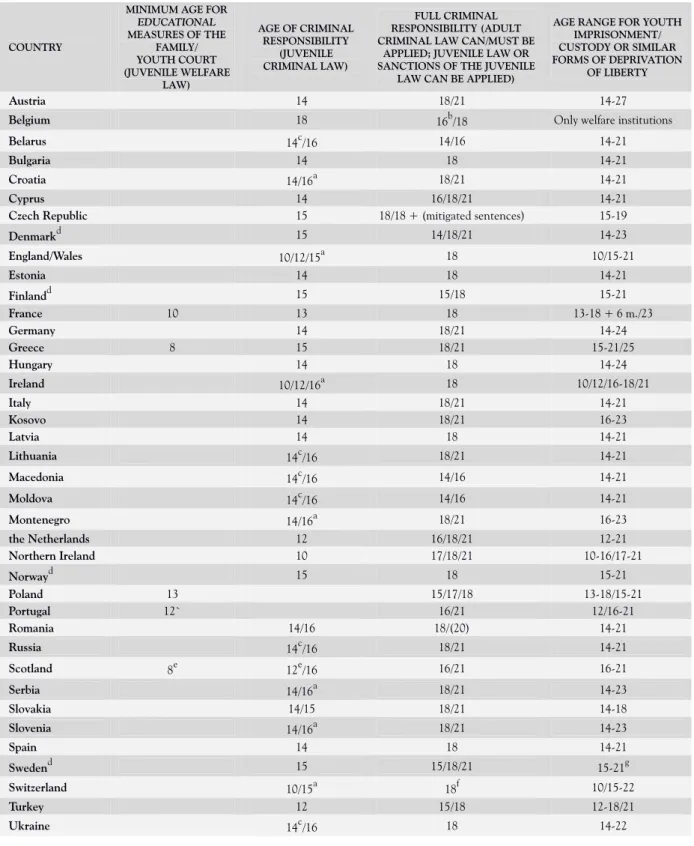
This chapter evaluates youth justice policies and practice in Europe from a comparative perspective. The focus is on tendencies in youth justice legislation and on the sentencing practice of prosecutors and judges in youth courts. Attention is also paid to the traditional ‘welfare’ and ‘justice’ models of youth justice and how they have become intertwined in modern European practice. The claim that a ‘new punitiveness’ is the prevailing strategy is questioned and attention is drawn to the practice of many youth justice systems, which seem to be fairly resistant to neo-liberal policies. Sonja Snacken (2012: 247 ff) has recently sought to explain why continental European countries in general have succeeded in resisting ‘penal populism’. In the conclusion this reasoning is applied to youth justice systems in particular.
Contemporary trends in youth justice policy
Across Europe, policies based on the notions of the subsidiarity and proportionality of state interventions against youth offenders are remaining in force or emerging afresh in most, if not all, countries. Recently however, in several European countries, we have also witnessed developments that adopt a contrary approach. These developments intensify youth justice interventions by raising the maximum sentences for youth detention and by introducing additional forms of secure accommodation. The youth justice reforms in theNetherlands in 1995 and in some respects in France in 1996, 2002 and 2007 should be mentioned in this context, as should the reforms in England and Wales
in 1994 and 1998 (Kilchling, 2002; Cavadino and Dignan, 2007: 284 ff.; 2006: 215 ff.; Junger-Tas and Decker, 2006; Bailleau and Cartuyvels, 2007; Junger-Tas and Dünkel, 2009). The causes of the more repressive or ‘neo-liberal’ approach in some countries are manifold. It is likely that the new punitive trend in the USA, with its emphasis on retribution and deterrence, was not without considerable impact in some European countries, particularly in England and Wales.
These developments at the national level, which is the primary focus of this chapter, have to be understood against the background of international and regional instruments that set standards for youth justice. Most important in this regard is the 1989 UN Convention on the Rights of the Child, a binding international treaty that all European states have ratified. It makes clear that the common and principal aim of youth justice should be to act in the ‘best interests of the child’ - ‘child’ defined for the purpose of this Convention as a person under the age of 18 years - and to provide education, support
30
and integration into society for such children. These ideas are developed further in the 1985 UN Standard Minimum Rules for the Administration of Juvenile Justice and at the European level in the recommendations of the Council of Europe, in particular the 2003 Recommendation regarding new ways of dealing with juvenile offending (Rec [2003]20) and the 2008 Rules for juvenile offenders subject to sanctions or measures (Rec [2008]11; Dünkel, 2009; Dünkel et al., 2011: 1861 ff).
Responsibilisation and neo-liberalism
In England and Wales, and to some extent elsewhere, the concept of responsibilisationhas become a pivotal category of youth justice. Responsiblisation is not limited to young offenders but increasingly parents are held criminally responsible for the conduct of their children. Making parents more responsible may have a positive impact. There is empirical evidence that parental training, combined with child support at an early stage, has positive preventive effects (Lösel et al., 2007). However, it is not necessary to criminalise parents. Ideally, parental training should be offered by welfare agencies (as is the case in Germany and the Scandinavian countries) and not be enforced by penal sanctions (Junger-Tas and Dünkel, 2009: 225 f).
A positive aspect of making young offenders take responsibility for their actions is that it has contributed to the expansion of victim-offender-reconciliation (Täter-Opfer-Ausgleich), mediation and reparation. In the English context, however, it is more problematic as it has been accompanied by the abolition of the previously rebuttable presumption that 10- to 14- year olds may lack criminal capacity. Although in practice the presumption had been relatively easily to rebut, its formal abolition in 1998 was an indication of determination to hold even very young offenders responsible for their actions. The tendencies in English youth justice may be regarded as symptomatic of a neo-liberal orientation, which can be characterised by the key terms of responsibility, restitution (reparation),restorativejusticeand (occasionally openly publicised) retribution. These so-called ‘4 Rs’ have replaced the ‘4 Ds’ (diversion, decriminalization, deinstitutionalization and due process) that shaped the debates of the 1960s and 1970s (Dünkel, 2008). The retributive character of the new discourse is exemplified by the requirement that community interventions should be ‘tough’ and ‘credible’. For example, the ‘community treatment’ of the 1960s was replaced by ‘community punishment’ in the 1980s and 1990s. Cavadino and Dignan attribute these changes to the so-called ‘neo-correctionalist model’ that has come to dominate official English penology (Cavadino and Dignan, 2006: 210 ff; Bailleau and Cartuyvels, 2007; Muncie, 2008).
There are many reasons for the increase in neo-liberal tendencies, as defined by Garland and other authors (Garland, 2001; 2001a; Roberts and Hough, 2002; Tonry, 2004; Pratt et al., 2005; Muncie, 2008). Some are to be found in the renewed emphasis on penal philosophies such as retribution and incapacitation, and in related sentencing policies that demonise youth violence, often by means of indeterminate sentences. There are also underlying socio-economic reasons. More repressive policies have gained importance in countries that face particular problems with young migrants or members of ethnic minorities and that have problems integrating young persons into the labour market, particularly where a growing number of them live in segregated and declining city areas. They often have no real possibility of escaping life as members of the ‘underclass’, a phenomenon that undermines ‘society’s stability and social cohesion and create mechanisms of social exclusion’ (Junger-Tas, 2006: 522 ff, 524). They are at risk of being marginalised and eventually criminalized. In this context recidivist offending is of major concern. Therefore many of the more punitive changes to the law are restricted to recidivist offenders in England andWales, France, and Slovakia for example.
It should be emphasised, however, that, in the case of most continental European countries, there is no evidence of a regression to the classical penal objectives and perceptions of the 18th and 19th centuries. Overall, there is continued adherence to the prior principle of education or special prevention, even though ‘justice’ elements have also been reinforced. The tension between education and punishment remains evident. The reform laws that were adopted in Germany in 1990, in the Netherlands in 1995, in Spain in 2000 and 2006, in Portugal in 2001, in France and Northern Ireland in 2002, as well as in Lithuania in 2001, the Czech Republic in 2003 or in Serbia in 2006 are examples of this dual approach. The reforms in NorthernIreland and in Belgium in 2007 are of particular interest, as they strengthened restorative elements in youth justice, including so-called family conferencing, and