BUSINESS RULES MANIPULATION MODEL
1Liudas Motiejūnas, Rimantas Butleris
Kaunas University of Technology Studentų St. 50, LT51368 Kaunas, Lithuania
Abstract. Business rules approach is quite new and oriented at software systems in which the rules are separated, logically and physically, from other aspects of the system. In this paper some of the methods for description of the business are discussed. Business rules activation from database triggers is presented. Implemented prototype and algorithms are discussed.
1. Introduction Other way is to implement business rules as data-base triggers. There is no united opinion about using the data base triggers for the implementation of the business rules. Some authors state that database trig-gers are used to implement certain types of business rules, such as facts, constraints, actions, enablers and derivations [8]. Other opinions declare that business rules have absolutely nothing to do with program-ming, database triggers or expert systems [2]. In our opinion, business rules should not be implemented as database triggers and must be kept in business rules repository separately in a declarative form.
Business rules are precise statements that describe, constrain and control the structure, operations and the strategy of a business. They can be found everywhere in a raw, unstructured form. The business rules are the most changing part of the business. We can describe a business rule as "a statement that defines or constrains some aspect of the business. It is intended to assert business structure or to control or influence the beha-vior of the business" [9].
1.1. Describing business rules Another way of describing business rules is OCL.
Often simple rules in plain English require several lines of OCL code to represent [1]. Trying to use OCL to describe a business rule written in several para-graphs of plain English text would be extremely complex. OCL is based on first-order predicate logic [18]. Business people would hardly understand this kind of language. Anyway, OCL can be used for both: writing assertions and describing business rules. However, for OCL to act as a language for writing business rules, it would have to be the perfect syntax for all the business situations, but we cannot unam-biguously say that this is true.OCL should concentrate on the primary purpose, and get that right, before trying to be general-purpose business rule syntax. There are a few main ways for describing business
rules. One of them is to store rules in objects. Five design principles for checking business rules in objects are presented below [12]:
1. Business rule checking occurs when objects change state.
2. The object changing its state invokes business rule checking.
3. Business rule checking invokes logic that may or may not reside in the affected object’s implemen-tation.
4. Business rule checking must be flexible enough to allow selective bypassing by trusted services. 5. Business rule checking is separate from logic rule
checking. using rules on the Web and in distributed systems. Rule mark-up languages will be the vehicles for They allow deploying, executing, publishing and com-municating rules on the Web [17]. They are also con-verging towards a lingua franca for exchanging rules between different systems and tools. In a narrow sense, a rule mark-up language is concrete (XML-based) rule syntax for the Web. In a broader sense, it However, business rules are not independent and
they belong to objects. Business rules should be asso-ciated to entities and events. Business rules should be kept in separate business rules repository and mana-ged separately from applications’ code.
1 The work is supported by Lithuanian State Science and Studies Foundation according to High Technology Development Program Project "VeTIS" (Reg. No. B-07042)
should have an abstract syntax as a common basis for defining various concrete sublanguages that serve different purposes. The goal of RuleML is to permit reusability and interchange at a higher level. Anyway, RuleML raises similar problems like XML: it requires an investment from the rule engine vendors to implement, and it requires an additional investment from the software developers and architects to add disambiguating information in the condition of the rules to guarantee the expected behavior.
1.2. Business rules repository
Physically, rule repository is an autonomic busi-ness rule collection which can be altered at any time using relatively easy tools [4]. These are two solutions to storing rules:
1. Parameter driven approach. In this case rules are stored in the database where they are characte-rized by the values of various attributes. It has been shown by different researchers that rule re-pository could be designed as an independent database [14] or as a part of the main logical mo-del [13]. However, the first solution offers more flexibility and more options for the storage of complicated business rules.
2. Independent process-driven approach. This app-roach is similar to the traditional methodologies where rules are implemented directly in the prog-ram code, only in this case the code, representing rules, is stored independently from other layers of the IS and therefore rules are expressed only once in the system.
Business rules repository is a database that stores all the data about business rules and all the necessary metadata about entities, attributes and relationships that are included in the data model. Probably it is impossible to create an universally accepted business rules repository structure, because various organiza-tions or business rules researchers define different types of business rules and ways that the rules are de-scribed [3, 10, 15]. In our case we use the first solution to store business rules.
1.3. Business rules engines
The system-wide enforcement of stored rules is managed by the special rule interpretation mechanism called business rules engine. Such an engine is con-sidered as a monolithic mechanism [11], however, the task of enforcing or implementing rules can be carried out by more or less independent services.
The business rules engine calls business rules from business rules repository and performs actions descri-bed by the rule. Business rules engine can be imple-mented in various ways [16, 19], the same as business rules repository, because its architecture depends on business rules repository (the form that business rules are stored in it). A wider overview of the business rules engines is presented in [7]. It doesn’t matter in
which way the business rules engine is implemented - it must ensure that business rules are performed cor-rectly.
2. Business Rules Repository model
We used business rules repository which is based on repository model introduced by Plotkin [14]. This business rules repository is flexible and easily exten-dable; it gives a possibility to store various types of the business rules. The main improvement of Plotkin’s repository is metadata about logical data structure in-corporation with repository. Connecting business rules with data through metadata makes rules more indepen-dent. Next improvement of the repository is possibility to store functions which are performed by the business rules. Actions that are needed to perform these func-tions are also stored in the repository. This business rules repository is presented in [5, 6].
3. Activation of Business Rules
Because business rules are kept in the business rules repository separate from the program code, they are declarative and implicate no control logic, they have to be called and executed by business rules en-gine. Every rule rejects, produces or projects some type of actions or data. Also each rule is associated with particular data. Until the user does not take any action, business rules are not called from the business rules repository. But when some action occurs, the business rules engine must verify business rules and evaluate that action. Generally, the business rules en-gine starts working on the three basic events – INSERT, DELETE and UPDATE. Business rules that respond these events are similar to data base triggers; however they are kept separately from the database. Either way when the user makes an attempt to insert, delete or update data, the business rules engine must fire business rules that are associated with data that the user wants to change. It is like a monitoring process – business rules engine is inactive and comes to action only when some changes in data are noticed. Business rules of this type must be fired at least on two separate events.
But there can be other kinds of business rules in a system. That means, business rules are fired in other situations, not only when the user attempts to change data. This kind of rules is not associated with the data control; they can create data themselves. As an example, business rules of SELECT or CALCULA-TION type could be pointed out. The result of such business rules is derivative data that can be stored in a file, shown on the screen or printed in a report. These rules usually are called by specific events, which can depend on user's actions (button click) or simply on the timer. Business rules of this type do not have to be fired at least on two events, because they do not ensure the consistency of data, they can create data themselves.
4. Invoking Business Rules from Database Triggers
5. Invoking Business Rules by Specific Events Some business rules can be activated by specific situations in business systems. These situations de-pend on user’s actions and are not related with data control. Such business rules cannot be activated from database triggers, but by appropriate events occurring in a business application (Click(), ValueChange(), etc.). Specific code line is needed which activates business rules engine in the application:
One of the main problems in business rules sys-tems is to activate business rules and bring them to life. “Data control” business rules serve the same pur-pose as database triggers. These rules are responsible for data that are kept in the database. They even react to the same events as database triggers. Business rules differ from database triggers, because they reside in business rules repository and they must be activated by some particular action. Usually it is difficult to capture different events that can activate business rule. In the following example database triggers are used because reaction to events INSERT, DELETE and UPDATE is already implemented. We only need to extend a database trigger with appropriate line that activates business rules engine:
CallEngineSE(Event, F_Action_ID) Formally we can describe requirements for the busi-ness rules activating as follows:
1. Each rule must have an event that activates it: ∀ x ( Rule( x ) ) →∃ z (Event( z ) ∩ Activates( z, x )) 2. Each rule must have a related function of action:
∀ x ( Rule( x ) ) →∃ y (F_Action_ID( y ) ∩ Related( y, x ))
CREATE TRIGGER [Trigger_Name] ON Table_Name
The third requirement is mandatory only for “data control” business rules that are activated by the database triggers.
FOR {[INSERT] [,] [UPDATE] [,] [DELETE]} AS
BEGIN
3. Each rule that is activated from database triggers must have a related table:
declare
@tablename int,
∀ x ( Rule( x ) ) →∃ z (Table( z ) ∩ Related(z,x)) @rowsAffected int,
@nullRows int,
@validRows int, 6. Business Rule Processing
select @rowsAffected = @@rowcount call Event(tablename, rowsAffected, nullRows, validRows, rowcount )
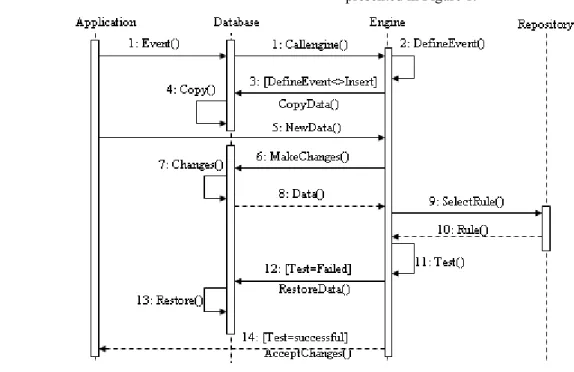
A number of actions is performed in the business rules system when some user-defined action occurs. Actions have to be performed in an appropriate prio-rity. The sequence diagram showing these actions is presented in Figure 1.
End
Call callengine(temp_table) GO
Figure 1. Sequence diagram of business rule processing When a user attempts to change the data, database
trigger detects an event and calls a business rules
en-gine. The Business rules engine defines what kind of event it was. For event INSERT existing data is not
made copied, for other two events (DELETE, UPDATE) data must be copied. Then user-defined ac-tions (changes to existing data) are accepted and busi-ness rules engine selects appropriate busibusi-ness rule from business rule repository according to given parameters. The test described by the rule is perfor-med. If the test fails, the initial data are restored, otherwise changes to data are accepted.
7. Business rules engine implementation During research we assume that business rule set used for experiment is logically correct and we do not
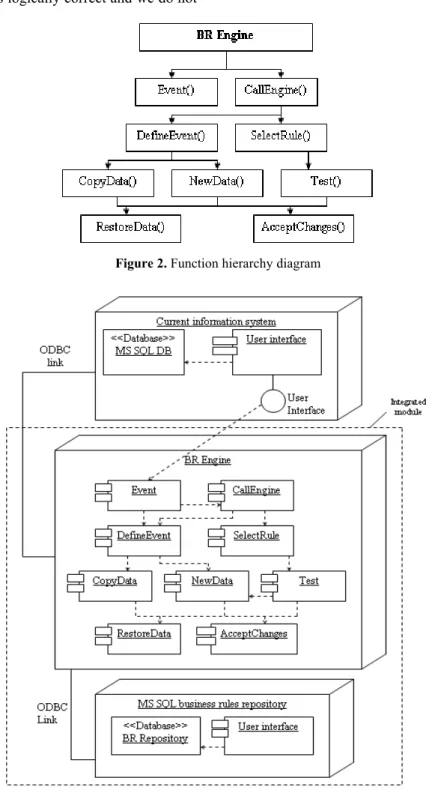
analyze data specification. Abstract service ordering process was implemented for testing described algorithms. The set consisting of 15 business rules was entered into business rules repository in order to check possibility to enter different types of rules. The fullness of the business rules repository was checked using rules classification presented by GUIDE Project. All implemented functions and procedures are shown in Figure 2. The structure of the code matches diagram hierarchy shown in this figure.
Figure 2. Function hierarchy diagram
Functions and procedures are executed according to the hierarchical structure of the given diagram. Two procedures and five functions were implemented du-ring experiment.
A detailed architecture of the developed prototype integration into an information system is shown in Fi-gure 3.
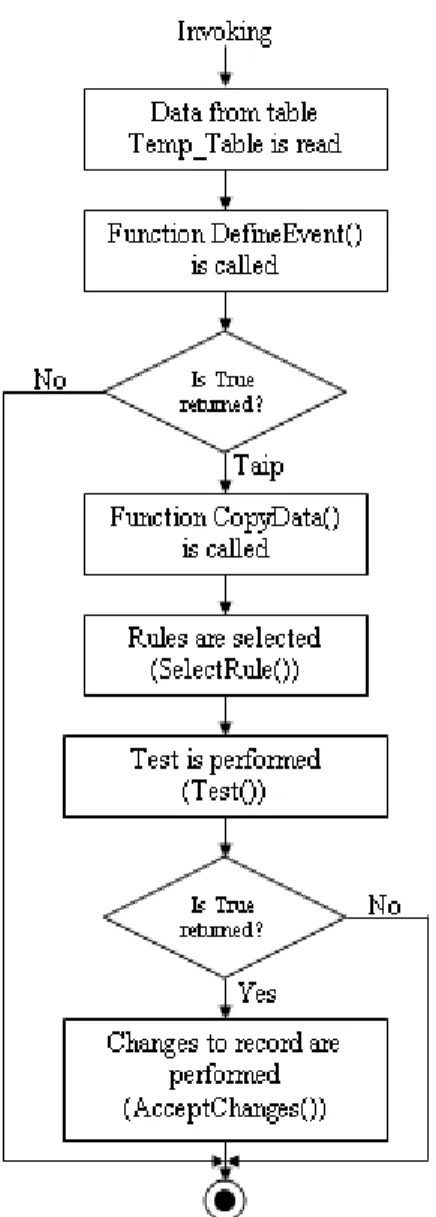
Algorithms of the two main procedures in the busi-ness rules engine are shown in Figure 4 and Figure 5.
Figure 4. Algorithm of the procedure Event() After invoking procedure Event() from database trigger in the first step the values of variables are determined:
• Table name – @tablename;
• Column ID – @rowsAffected; Figure 5. Algorithm of the procedure CallEngine() • Event ID – Insert, Update, Delete;
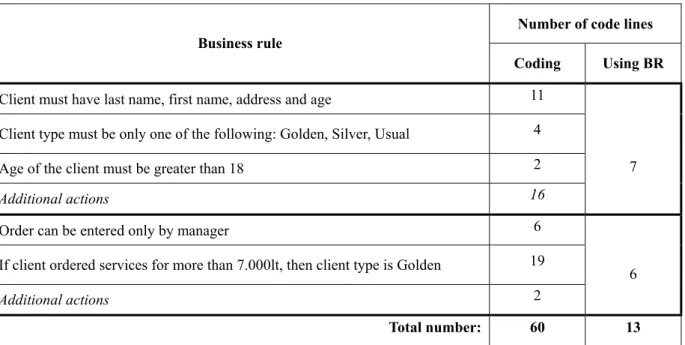
As the table shows, number of code lines needed for different rules can vary a lot. However, storing business rules in the repository and using proposed business rules engine, there is significant reduction of work that is needed to accomplish the same tasks. But it has to mentioned that the designer or programmer will have to enter business rules into rules repository, therefore reduction of work won’t be as significant as it is shown in table 1.
• Changed record attribute – @nullRows, @validRows;
• Changed record count of elements - @rowCount. In the second step temporal table TEMP_TABLE is created, which consists of the following columns: Row_ID, Change (mark is set if the field was chan-ged), Event_ID (common for all fields), Range_Nr (matches predicted number of cycles). In the next step appropriate data are set by the given fields and table TEMP_TABLE is populated. If this table was
popu-lated succsesfully, then value TRUE is returned. 8. Conclusions The algorithm of the procedure CallEngine() is
shown in Figure 5. Resumptive metadata storage model is independent of Metadata are already used in different DBMS. particular database management system. Metadata allow navigating in the logical database without any additional programmed operations and identifying data elements that are impacted by particular business rules. Relating business rules with data not directly, but through metadata, better business rules indepen-dence is achieved.
In the next step of the experiment abstract service ordering process was implemented, but only in a traditional way – business rules were buried in the code.
Table 1 shows the difference between numbers of code lines, when business rules are implemented in traditional way and using the proposed business rules engine model.
Table 1. Difference between numbers of code lines
Number of code lines Business rule
Coding Using BR
Client must have last name, first name, address and age 11 Client type must be only one of the following: Golden, Silver, Usual 4
Age of the client must be greater than 18 2
Additional actions 16
7
Order can be entered only by manager 6
If client ordered services for more than 7.000lt, then client type is Golden 19
Additional actions 2
6
Total number: 60 13
The proposed business rules engine model gives us several advantages. Here are the main ones:
1. Differently from systems where rules are imple-mented as database triggers, in this work triggers are used only to invoke business rules. That’s why during business rules implementation there is no need to have specific programming skills.
2. There is no need to indicate particular business rules, which have to be managed, because accor-ding to passed parameters needed business rule or rules set is invoked depending on situation. A big part of design and development process is automated using business rules, especially developing transactions and applications logic coding. Data struc-ture is created using traditional DBMS; however, some of the restrictions and constraints can be de-scribed by business rules, connecting them with meta-data about logical meta-database. This gives to a program-mer a possibility to enter needed changes without changing data structure.
Instead of rewriting transactions or recoding appli-cation code, appropriate business rules can be imple-mented and automatically executed. Programmer needs only once to relate business rules with data, that are impacted by the rule and this rule will be always invoked when appropriate data are changed. Business rules are invoked from database triggers; therefore there is no need to write additional code for this task.
Business rules repository acts as a common point of communication for both users and IT professionals. The advantages of developing systems using business rules are as follows:
• Rules are represented in a format that is under-standable by users. Users can help enter and manipulate the rules.
• Rules are represented in a format that can be used by IT professionals as a system design document. • Entered business rules can be immediately
veri-fied in the system.
A key difference between the traditional cation process and the business rules-based communi-cation process is that the information in the repository can be understood and used by users. The only poten-tial communication breakdown in this environment is during entering business rules into the repository. Since it is possible verify entered rules almost imme-diately, users can quickly interact with the system and evaluate whether or not the business rules have been accurately represented.
In the future work business rules editing interface will be improved in order to have business rules de-bugging features and business rules engine will be expanded with clear and thorough messages shown to user when business rule is violated.
References
[1] T. Beale. OCL 2.0 Review. 2003,
http://www.deepthought.com.au/it/ocl_review.html.
[2] Blaze Advisor. Ruling a self-service world, 2001,
http://www.qualitywriter.com/Samples/advisor_selfser vice.pdf.
[3] Business Rules Group. Response to MDC/Microsoft
Business Rules Metamodel. 1999, http://www.
businessrulesgroup.org/brg-mdc/BRG-MDC.pdf .
[4] R. Butleris, K. Kapocius. The Business Rules Repo-sitory for Information Systems Design. 6th
East-European Conference ADBIS'2002", Research
[5] R. Butleris, L. Motiejūnas. A Framework for Busi-ness Rules Storing and Activating. 7thInternational Baltic Conference on Databases&Information Sys-tems’2006, 252 – 263.
[6] R. Butleris, L. Motiejūnas. Metadata for business rules integration with database schema. IADIS Vir-tual Multi Conference on Computer Science and
In-formation Systems (MCCSIS 2005), 263-270.
[7] R. Butleris, L. Motiejūnas. Veiklos taisyklių mani-puliavimo mechanizmų analizė. Informacinės
tech-nologijos 2003, XIV-82 – XIV-90.
[8] E. Gottesdiener. Business Rules. Show Power, Pro-mise. Application Development Trends, Vol.4, No.3. 1997,
http://www.ebgconsulting.com/Pubs/Articles/Business
RulesShowPowerPromise-Gottesdiener.pdf.
[9] Guide Business Rules Project, Final Report, 95/11.
http://www.businessrulesgroup.org/brgactv.htm.
[10] P. Kardasis, P. Loucopoulos. Expressing and organi-sing business rules. Information and Software
Technology, 2004, Vol.4, No.11, 701-718.
[11] C. Mariano C. Bornhövd, A. P. Buchmann. Moving Active Functionality from Centralized to Open Distri-buted Heterogeneous Environments. Lecture Notes in
Computer Science, 2001, Vol. 2172, 195-211.
[12] J. Nicola, M. Mayfield, M. Abney. Putting business rules into business objects. 2007, http://www.
streamlinedmodeling.com/papers/business_rules.pdf.
[13] A. Perkins. Business Rules Are Meta Data. Business
Rules Journal, 2002, Vol., No.1,
http://www.BRCommunity.com/a2002/b097.html.
[14] D. Plotkin. Business Rules Everywhere. Intelligent
Enterprise Magazine, 1999, 2 – 4,
http://www.iemagazine.com.
[15] R.G. Ross. The business Rule Book (2nd ed.).
Busi-ness Rule Solutions, 1997.
[16] R.G. Ross. Principles of the Business Rule Approach. 2003.
[17] G. Wagner, S. Tabet, H. Boley. MOF-RuleML: The Abstract Syntax of RuleML as a MOF Model. OMG's INTEGRATE 2003. Boston, Massachusettss 2003,
http://omg.org/docs/br/03-10-02.pdf.
[18] J.B. Warmer, K. Anneke. The object constraint lan-guage: precise modelling with UML, 2000.
[19] K.D. Wilson. Business Rules, Platforms, and Inferen-cing. Business Rules Journal, 2003, Vol. 4, No.10.
http://www.BRCommunity.com/a2003/b169.html.