1. Introduction
1.1 Research Problem
Family firms are among the most prevalent forms of business in many countries of the world. They are believed to account for more than 50% of the gross domestic
product of the world’s most advanced economies.1 In Switzerland, for instance, the
Swiss Institute for Small and Medium-Sized Enterprises at the University of St.
Gallen2 found family enterprises to dominate the economy.3 Family firms are
estimated to make up 88% of all enterprises in the country. However, it is difficult to compare numbers across countries. As of yet, there is no common understanding of what constitutes a family enterprise, so each statistic may be based on a different
definition.4 Accordingly, between 54% and 89% of companies in the USA5 and
between 75% and 90% of companies in Germany6 qualify as family firms.
Regardless of the exact definition used in the statistics, all these businesses have one thing in common. The “family” part of the family enterprise, of course, consists of individual persons. These individuals live through different phases in their personal and professional life, and, in contrast to the life of the legal person “corporation”, their lifetime is limited. Eventually, every entrepreneur has to step down. At that time, the question arises of what should happen to the enterprise and the family’s involvement in it. Because of the crucial role which family enterprises play in many countries in the world, successful succession is important for the economy at large in
these countries.7
Consequently, a number of organizations have recently begun to systematically
monitor the economic dimension of the succession question.8 For example, the state
bank of the federal German State of Baden-Württemberg has conducted a large scale
analysis of generational change in the enterprises in this state.9 It concluded that
1
Aronoff, C. E., Astrachan, J. H. and Ward, J. L., Family Business Sourcebook, 2002, i
2
Frey, U., Halter, F. and Zellweger, T., Familienunternehmen Schweiz, 2004, 2
3
Fueglistaller, U. and Halter, F., Familienunternehmen Schweiz, 2005, 35
4
The definition problem is addressed in detail in section 2.2
5
Astrachan, J. H. and Shanker, M. C., Family Business & US Economy, 2003, 214
6
Neubauer, H., Family Business Western Europe, 2003, 269
7
For instance, Fueglistaller, U., Müller, C. and Volery, T., Entrepreneurship, 2004 argue that this is the case in Switzerland, Germany and Austria (p. VI)
8
For an overview refer to Ibid., p. 173
9
11 – 15 % of all enterprises in Baden-Württemberg are being handed over to a successor between 2002 and 2007, followed by an average of 10 – 14 % of all
companies in the years 2007 – 2012.10 At the same time, both private11 and public12
organizations have begun to offer information and advice on the issue.
There is widespread agreement that “succession is the ultimate test of a family
business.”13 Succession has been said to raise the elemental questions of life,14 and
many scholars agree that planning and implementing the process is a delicate task
that breeds conflict.15 Accordingly, the challenges associated with generational
change can be overwhelming, and conflicts between incumbent and successor may seem inevitable. Hence, conflict management and resolution becomes an essential skill for the family firm to survive.
Family business research has become increasingly rigorous and sophisticated in
recent years.16 However, the area of conflict in the family firm appears to be
under-researched:
“Research shows that conflict plays pivotal roles (both productive and destructive) in family and business health and prosperity. Yet there has been little research and scant useful theory on the
sources and effects of conflict in family business.”17
10
Ibid., 4
11
UBS, UBS Outlook: Nachfolge im Familienunternehmen, 2004, FAZ-Insitut, BHF-Bank and ASU, Nachfolgelösungen im Mittelstand, 2005, Tapies, J., Succession, 2004,
12
For instance, the ”Next Business Generation“ project established by the Canton of Zürich and regions of Baden-Württemberg, Lombardy, Lower Austria, Thessaly, West Midlands makes advice available on its internet-platform www.next-business-generation.net internet platform; the European Commission has published a “Helping the transfer of businesses” guide on http://www.next-business-generation.net/nbg/Partner/index.php?lang=en_EN (accessed September 30, 2005 at 20:01 CET); the Ministry of Economic Affairs Baden-Württemberg has published a ”12 Points Programme Business Succession“, http://www.nachfolgeportal.de/nachfolge/11_English_-information/index.php?PHPSESSID=c765, (accessed on June 16, 2007 1:40 PM CST); and the U.S. Chamber of commerce offers advice on the planning for succession under http://www.uschamber.com/sb/business/p11/-p11_1100.asp (accessed on June 16, 2007 1:45 PM CST)
13
Gersick, K. E., Davis, J. A., McCollom Hampton, M. and Lansberg, I., Family Business Life Cycles, 1997, 193
14
Mueller-Harju, D., Family Business Generational Change, 2002, 79: “Bei der Unternehmensnachfolge werden Grundfragen des Lebens aufgeworfen“. Note: Quotations from texts in the German or Spanish language were translated by the author with the original text appearing in the respective footnote.
15
Aronoff, C. E., Letting go, 2003, 57
16
Bird, B., Welsch, H., Astrachan, J. H. and Pistrui, D., Family Business Research, 2002, 346; the crucial role played by the Family Business Review in this development is analyzed in: Dyer, W. G. J. and Sanchez, M., Family Business Review, 1998
17
Consequently, a need to better understand how conflict impacts the family firm has
been expressed.18 More specifically, calls for research on effective conflict resolution
mechanisms have been made,19 especially with regard to succession conflicts.20
Scholars from the conflict resolution field, on the other hand, have expressed concern
that insights are not being made available to other disciplines.21 From this field, too,
calls for greater interdisciplinary exchange have been voiced.22
1.2 Purpose of Dissertation
This dissertation seeks to contribute to this interdisciplinary effort by exploring how a specific conflict resolution mechanism, mediation, can be of help in the resolution of conflicts arising in the course of family firm succession. Insights from both family business and dispute resolution research are synthesized in order to propose when and how mediation can contribute to the resolution of family firm succession conflicts. As of yet, no theory on the mediation of family firm succession conflicts exists. In order to contribute to the building of such a theory, this dissertation explores the conflict that arises in the most basic scenario: succession between the founder-entrepreneur and his successor, where the incumbent founder-entrepreneur is the father of the successor. In this scenario, consensual conflict solution is necessary for succession to succeed. Hence, mediation – as the process aimed at supporting the parties reaching consensus – would seem ideally suited to help the parties achieve that solution.
The research question, therefore, is: “When and how can a conflict between an entrepreneur and his son on the issue of the son’s succession in the family firm be resolved through mediation?”
18
Cosier, R. and Harvey, M., Functional Conflict, 1998, 133; Miller, N. J., Fitzgerald, M. A., Winter, M. and Paul, J., Family and Business Demands, 1999, 265; Sorenson, R., L. , Family Firm Conflict Management, 1999; Terberger, D., Konfliktmanagement, 1998, 10, 209
19
Sharma, P., Family Business Research, 2004, 18
20
Brockhaus, R. H., Family Business, 2004, 170; Kellermanns, F. W. and Eddleston, K. A., Family Feud, 2004, 222
21
Bush, R. A. B. and Bingham, L. B., Knowledge Gaps, 2005, 101
22
1.3 Research Approach, Methodology, and Sources
1.3.1 Approach
This dissertation addresses the research questions in two steps. It first seeks to understand the nature of family firm succession conflict and how it can be resolved. This understanding is then used to analyze when and how mediation can be used to achieve a resolution.
Any attempt to synthesize the insights from two fields as vast and disparate as family business and dispute resolution research will inevitably be incomplete. These findings are also very diverse. For instance, neither field has so far developed a universally accepted definition of the two notions that are central for this dissertation, “family firm” and “mediation”. At the same time, there are many methods by which a conflict
can be analyzed, such as behavioural or psychoanalytical methods.23 The research
question can therefore be approached from a wide variety of angles. For example, one might explore succession conflict as it relates to the industry or size of the company,
or as it relates to the nationality and specific culture of the family.24
While all these factors shape the nature of succession conflict, this dissertation takes a more general approach. It seeks to explore the structure that is common to all family enterprise, regardless of such factors. What all family firms have in common are the different roles in which their members interact with each other. Family firms are composed of family members, owners, employees and managers, and – if the company does have the corresponding corporate governance system – members of the supervisory body. This dissertation will show that it is certain dilemmas which are inherent in this structure that cause conflicts to arise during succession. Each dilemma contributes a specific dimension to the succession conflict. Hence, the conflict appears to be structural and can therefore be seen as characteristic for family
firm succession.25 On the other hand, the structure in each individual case depends
heavily on aspects such as the culture and the industry of the family firm.
23
Berkel, K., Konflikttraining, 2005, 24 ff
24
Klein, for instance, cautions that succession conflict will play out quite differently in a Calvinist Swiss family and a Catholic Spanish family. Klein, S. B., Interview, December 18, 2006
25
The focus on the structural, and therefore characteristic, aspects of the research subject allows for the usage of sources from countries as diverse as the United States, Switzerland, and Germany, on which this dissertation mainly relies.
While this dissertation will not address such aspects, it proposes a general framework that, when used to empirically analyze a specific case, would be capable of taking them into account. This structural framework also develops an understanding of what would generally be necessary to resolve the conflict, especially through the intervention of a third party. In a second step, this dissertation then analyzes when and how a specific method of third party intervention, mediation, can help in resolving the succession conflict.
1.3.2 Methodology
No theory explaining the research question has yet been proposed, much less tested. Grounding theory-building research on empirical evidence is therefore imperative. This dissertation induces its findings from both literature review and qualitative empirical research in the form of expert interviews thus synthesizing the insights gained in both fields.
In accordance with Eisenhardt´s recommendations for case study research, the
literature review helped shape the initial design of theory-building research.26After a
review of selected literature from both the dispute resolution and the family business fields, interviews were then employed to both refine the research model and to develop propositions for future testing. The interviewees were selected through a
process on which case study research regularly relies,27 “theoretical sampling”. As
explained in the seminal work of Glaser and Strauss, theoretical sampling is a process of data collection for generating theory in which the analyst jointly collects, codes, and analyzes his data and decides what data to collect next and where to find
them, in order to develop his theory as it emerges.28 As Handler notes, this procedure
may appear biased and uncontrolled to the quantitative researcher.29 However, in
contrast to statistical sampling, theoretical sampling is led and controlled by the
structure of the emerging theory.30
26
Eisenhardt, K. M., Case Study, 1989, 536
27
Eisenhardt, K. M., Comparative Logic, 1991, 624
28
Glaser, B. G. and Strauss, A. L., Gounded Theory, 1967
29
Handler, W. C., Succession, 1990, 39
30
To that end, a conflict scenario was created for the expert interviews. This scenario captures what Ward calls the classic conflict during succession from the first to the
second generation:31
In the family enterprise XY the baton has been passed from the incumbent to the successor. While the successor is now in charge of managing the company, the incumbent still holds most of the equity and is often present. The successor feels that the incumbent is improperly interfering with his leadership. Arguments become more and more frequent. Finally, a point is reached where the conflict threatens both the company and the family.
In a first round of interviews, this scenario was submitted to family firm experts along with a set of exploratory, open-ended questions designed to analyze the nature of the conflict and the possible role of a third party in its resolution. All family firm experts were presented with the same scenario and questions, and were asked to share their experience and understanding during the interview.
In the subsequent second round of interviews, the same method was employed to capture insights from professional mediators. Some professionals from the family business consulting and family therapy fields were also interviewed to explore the similarities and differences between the different types of professional third party intervention which are available to the family firm for helping to resolve succession conflict. However, because in the first round of interviews all experts had emphasized cases where the incumbent was the father of the successor, which also appeared to be the case most commonly analyzed in literature, the case scenario was specified
accordingly for the second round of interviews.32 This round of interviews aimed at
exploring more closely when and how mediation may be employed successfully in the resolution of the conflict.
In both rounds of interviews, the experts were confronted with the same scenarios
and asked the same initial questions.33 The interviews were then conducted
31
Ward, J. L., Interview, November 1, 2006; all interviewed family firm experts would later agree to this characterization: Davis, J. A., Interview, November 28, 2006; Halter, F., Interview, January 23 & 30, 2007; Kellermanns, F. W., Interview, December 11, 2006; Klein, S. B., Interview, December 18, 2006; Mühlebach, C., Interview, December 12, 2006; Shefsky, L. E., Interview, November 21, 2006
32
In the second round of interviews, the first sentence of the case description then read “In the family enterprise XY the baton has been passed from father to son.” For details refer to Appendix B.
33
For an the names of the interviewed experts refer to the subsequent Section; for more details on their professional background and contact data, refer to Appendix A; for details on the questionnaire used, refer to Appendix B.
in a non-directive manner, and non-scripted follow-up questions were asked as they arose during the conversation. As the emerging theory took shape, it influenced the direction of these follow-up questions. It is important to note that any one of the possible approaches to understanding conflict is only capable of addressing specific aspects of its subject, and can only arrive at hypotheses regarding the mediation of
succession conflicts.34 This is especially the case when the chosen approach employs
non-directive interviews in the described method of theoretical sampling. This dissertation, therefore, arrives at a set of propositions regarding success factors for
mediating family firm succession conflicts.35
1.3.3 Sources
As has been noted, this dissertation draws from literature reviews of family business and dispute resolution research, and is supplemented and enriched by insights gained in exploratory interviews with eminent experts from both fields.
A review of the family business literature was conducted to explore the nature of family firm succession conflicts and of possible third party interventions. The corresponding interviews were conducted with seven distinguished scholars from the family enterprise field. These experts are (in alphabetical order): Professor John A. Davis of the Harvard Business School (USA), Frank Halter of the University of St. Gallen (Switzerland), professor Franz W. Kellermanns of Mississippi State University (USA), professor Sabine E. Klein of the European Business School (Germany), Dr. Corinne Mühlebach of the University of St. Gallen (Switzerland), professor Lloyd Shefsky of the Kellogg Graduate School of Management at Northwestern University (USA), and professor John E. Ward of the Kellogg Graduate School of Management at Northwestern University (USA). For a detailed overview of the interviewees refer to Appendix A.1.
A review of dispute resolution research was carried out in order to gain insights into mediation success factors. The corresponding interviews were conducted with nine distinguished scholars and practitioners form the fields of family enterprise consulting, therapy, and mediation. The interviewees are (in alphabetical order):
34
Berkel, K., Konflikttraining, 2005, 31
35
The empirical testing of these hypotheses is beyond the scope of this dissertation and must be left to future research.
Professor Douglas C. Breunlin of the Family Institute at Northwestern University (USA), professor Katheryn M. Dutenhaver of the College of Law at DePaul University (USA), professor Stephen B. Goldberg of Northwestern University Law School (USA), Dr. William E. Hartgering, JAMS L.L.C. (USA), Dr. Kenneth Kaye, president of Kaye Family Business Associates, Inc. (USA), Dr. Reiner Ponschab, CEO of the European Institute for Conflict Management (Germany), Dr. Frank H. Schmidt, president of the Deutsche Gesellschaft für Mediation (Germany), professor William L. Ury of the Program on Negotiation at the Harvard Law School (USA), and professor John E. Ward of the Kellogg Graduate School of Management at
Northwestern University (USA).36 For a detailed overview of the interviewees refer
to Appendix A.2.
1.4 Structure of Dissertation
Chapter 2: The Three Dilemmas of Succession
This chapter will show that the family firm, by nature, faces three distinct but intertwined dilemmas in times of generational change. Section 2.2 (The Family Firm) will demonstrate that the nature of the “family business” can best be understood by examining the different roles that the firms´ individuals play. For this, the various role (two-, three-, and four-circle) models of the family firm are explored. Section 2.3. (The Role Dilemma) will demonstrate that the different roles (family, management, ownership, and supervision) that define the family firm place conflicting demands on the individual, therefore leading individuals to experience “role dilemmas” between them at times of succession. Section 2.4 (The Internal Dilemma) will demonstrate that the different roles that define the family firm lead individuals to experience an “internal dilemma” at times of succession because the individuals have to play different roles at the same time. Focussing on the transfer of power from incumbent to successor, section 2.5 (The Relationship Dilemma) will demonstrate that incumbent and successor face a “relationship dilemma” in addition to the other two dilemmas, because of the mutual role adjustment required from them. Chapter 3: The Three Dimensions of Succession Conflict
Chapter 3 will analyze the conflict that arises if incumbent and successor are not committed to jointly finding an equilibrium to the dilemmas.
36
Professor Ward was first interviewed in his capacity as a family firm scholar and later in his capacity as advisor to family firms.
Section 3.2 (The Commitment to Succession) will show that it is the commitment to succession that determines whether incumbent and successor jointly balance their dilemmas. Three types of commitment are distinguished: calculative, affective, and normative commitment. Section 3.3 (The Factors Constraining Commitment) will show that there are three factors that can constrain commitment: information constraints, personal constraints, and relationship constraints. Section 3.4 (The Factors Promoting Commitment) will show that there are three factors that can promote commitment: information promoters, personal promoters, and relationship promoters. Section 3.5 (The Influence of Time on Commitment) will show that passage of time creates an optimal time period for succession to be completed. Section 3.6 (The Three Elements of Succession Conflict) explores the consequences of weak incumbent or successor commitment for the succession process. It will show that from each of the three dilemmas a specific conflict dimension (task, internal, or relationship conflict) is likely to arise.
Chapter 4: The Three Elements of Third Party Intervention
Chapter 4 will show the constructive roles that a third party can play in supporting incumbent and successor in resolving their conflict. In line with the goal of this dissertation, the chapter will then focus on mediation and explore when, and how, mediation can be used to resolve succession conflicts. Section 4.2 (The Role of the Third Party) will identify the general activities that can contribute to resolving each of the three dimensions of the succession conflict. It will explain that a specific activity can be employed for each of these conflicts (task, internal and relationship). Section 4.3 (The Professional Intervention) will explore to what extent the professional third party interventions of therapy, consulting and mediation employ the activities identified as helpful for resolving the different elements of the succession conflict. More specifically, it will show when mediation is the right type of intervention. Section 4.4 (The Timing of the Intervention) will explore how the passage of time creates an optimal time period for intervention. Section 4.5 (The Method of Mediation) explains that mediation is the only third party intervention that can address all three elements of succession conflict. The last section takes a closer look at the methods that can be used to that end, leading to the conclusion how exactly succession conflict can be mediated.
Chapter 5: Conclusions
As the last chapter of this dissertation, Chapter 5 seeks to draw the conclusions from the above findings by formulating propositions and offering suggestions for further research.
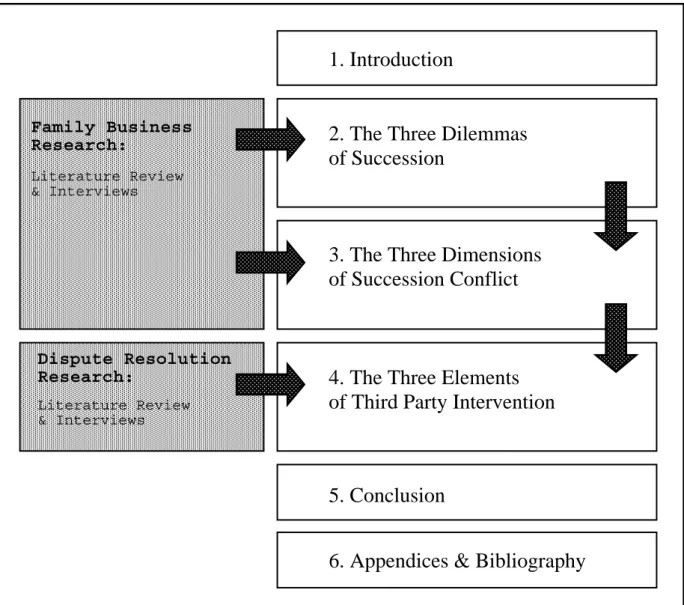
The structure of this dissertation with regard to its sources can be summarized as follows (see Figure 1):
Figure 1: The Structure of the Dissertation
1. Introduction
2. The Three Dilemmas of Succession
3. The Three Dimensions of Succession Conflict
4. The Three Elements of Third Party Intervention
5. Conclusion
6. Appendices & Bibliography
Dispute Resolution Research: Literature Review & Interviews Family Business Research: Literature Review & Interviews
Quelle:
Hans-Georg Berkel: Father to Son. The Mediation of Family Firm
Succession Conflict, Kölner Wissenschaftsverlag, Köln, 2007.