Soile Oikkonen
ALIGNMENT OF CONTACT CENTER
WORKFORCE MANAGEMENT IMPLEMENTATION
WITH RESEARCH AND ITIL VERSION 3
Tietojärjestelmätieteen Pro gradu –tutkielma 30.7.2010
Jyväskylän yliopisto Tietojenkäsittelytieteen laitos
ABSTRACT
Oikkonen, Soile Maria
Alignment of contact center workforce management implementation with research and ITIL version 3
Jyväskylä: Jyväskylän yliopisto, 2010. 106 s.
Pro gradu -tutkielma
The purpose of this research is to theoretically validate three contact center workforce management processes models against both the previous research and the ITIL framework version 3. The three models are about processes themselves, processes implementation, and processes and tools implementation together. The research has been conducted in a constructive way. First, the three models that have been used in real-life are described, the relevant ITIL and workforce management research are summarized, and the ITIL framework service lifecycle is explained on the level it is needed. Then, the models are first compared against the ITIL framework and then against the summarized research. The most important finding is that the three contact center workforce management processes models do follow ITIL guidelines. Also, the processes model is the most comprehensive contact center workforce management model available. Furthermore, although the research itself was not on focus, there were relative few pieces of research available about either ITIL version 3 or the contact center workforce management processes. In conclusion, the three contact center workforce management processes models can also be used in environments where ITIL has been implemented. Also, there needs to be more research done around the models presented here. Furthermore, there needs to be more research done on ITIL version 3 and on ITIL integrations. Finally, contact center workforce management field is also scarcely academically researched.
planning, service desk
CONTENTS
1 INTRODUCTION ... 6
1.1 Research questions and the aim of the research ... 11
1.2 Research method ... 13
1.3 The results and their meaning for the future... 14
1.4 The structure of the paper ... 15
2 ITIL AND WORKFORCE MANAGEMENT RESEARCH ... 16
2.1 ITIL ... 16
2.1.1 ITIL processes ... 19
2.1.2 ITIL integrations ... 23
2.2 Workforce management ... 24
2.2.1 Workforce management processes ... 25
2.2.2 Workforce management tools ... 27
2.3 ITIL and workforce management together ... 31
2.4 Summary ... 33 3 ITIL ... 34 3.1 Service Strategy ... 34 3.2 Service Design ... 38 3.3 Service Transition ... 39 3.4 Service Operation ... 41
3.5 Continual Service Improvement ... 42
3.6 Summary ... 43
4 WORKFORCE MANAGEMENT PROCESSES ... 44
4.1 Business Strategy ... 47 4.2 Documentation ... 47 4.2.1 Functional needs ... 48 4.2.2 Process descriptions... 49 4.2.3 Position descriptions ... 49 4.2.4 Technical requirements ... 49
4.2.5 Key Performance Indicators... 50
4.2.7 The benefits from using resource management ... 52
4.2.8 Current method of operation ... 52
4.2.9 Future method of operation ... 54
4.2.10 General rules of operation... 54
4.2.11 Agreed methods of working ... 55
4.2.12 Contact channels ... 55
4.2.13 The content of contact channels ... 56
4.2.14 Contact channels routing ... 56
4.2.15 Organizational chart ... 57
4.2.16 Information related to agents... 57
4.2.17 Working hours ... 57
4.2.18 Scheduling and shift information ... 58
4.2.19 Shift rotation ... 58
4.2.20 Agent skill management ... 58
4.2.21 Agent tasks ... 59
4.2.22 Breaks ... 59
4.2.23 Meetings ... 59
4.2.24 Trainings ... 59
4.2.25 Other exceptions to a regular work day ... 60
4.2.26 Time off ... 60
4.2.27 Workforce management user rights and user security ... 60
4.2.28 Forecasting with workforce management ... 60
4.2.29 Planning resources with workforce management ... 61
4.2.30 Workforce management as a part of general planning process ... 61
4.2.31 The use of workforce management with performance management . 61 4.2.32 Changing shifts ... 62
4.2.33 Workforce management reporting ... 62
4.2.34 Workforce management technical environment description ... 62
4.2.35 Workforce management integration to other systems ... 63
4.3 Configuration ... 63
4.4 Forecasting... 64
4.5 Scheduling ... 64
4.6 Intraday management: adherence ... 65
4.7 Intraday management: performance ... 65
4.8 Trading... 66
4.10 Training... 66
4.11 Assessment ... 67
4.12 Planning ... 67
4.12.1 Trends ... 68
4.12.2 Yearly planning ... 68
4.12.3 Quartile and monthly planning ... 70
4.12.4 Weekly planning ... 71
4.12.5 Daily planning... 72
4.13 Recruitment ... 72
4.14 Agents involvement ... 73
4.15 Summary ... 73
5 WORKFORCE MANAGEMENT TOOLS ... 75
5.1 Aspect ... 81
5.2 Genesys ... 82
5.3 Teleopti ... 83
5.4 Summary ... 84
6 THE PROCESSES AND TOOLS IMPLEMENTATION MODELS AND ITIL .. 85
6.1 Workforce management and Service Strategy ... 85
6.2 Workforce management and Service Design ... 86
6.3 Workforce management and Service Transition ... 87
6.4 Workforce management and Service Operation ... 88
6.5 Workforce management and Continual Service Improvement ... 89
6.6 Summary ... 90
7 IMPACT OF THE PREVIOUS RESEARCH AND ITIL TO MODELS ... 91
7.1 Changes to models triggered by research ... 91
7.2 Changes to models triggered by ITIL version 3 ... 91
7.3 Summary ... 92
8 CONCLUSION ... 93
Today, organizations are trying to make their operations as efficient and effective as possible and to reduce costs whenever and wherever possible. They attempt to do this by both improving their business processes and by either purchasing or developing their own tools to support these processes. This also means that there is a large group of organizations that either provide processes and tools consulting or sell systems for these organizations driving for better efficiency and effectiveness. One support method for process improvement is the Information Technology Infrastructure Library (ITIL). Its development started about thirty years ago by the British Government but it has been known as “ITIL” about the past twenty years. ITIL is a framework model of best practice for Information Technology (IT) service management. The latest version, version 3, was released in 2007. Jia, Reich and Pearson (2008, 294) studied IT service climate and according to them one measurement of IT effectiveness is service quality and one needs to look inside an IT function to identify those variables. It is important to identify a problem, find the causes for it and to take corrective actions (ibid.., 295). They created a framework for IT managers to identify the causes of service failures and noted that much of the previous research is based on retail banking and not on IT service (ibid.., 296). However, understanding the IT service is the key to improve customer service, increase customer satisfaction and achieve stronger business-IT alignment and they recommend using ITIL for this purpose (ibid.., 311).
However, ITIL is not the only support that is available. There is also IT Service Management (ITSM). Galup, Dattero, Quan and Conger (2007, 47), put it in a nice, compact way when they say that “ITSM is a set of processes that detail best practices based on ITIL standards to enable and optimize IT services in order to satisfy business requirements and manage the IT infrastructure both technically and strategically”. Few years later Stuart, Galup, Dattero, Quan and Conger (2009, 124) continue with ITSM studies and note that it accounts for from 60 percent to 9 percent of total cost of IT ownership. Approximately 80 percent of the cost of an infrastructure comes from service support and delivery and according to Stuart, Galup, Dattero, Quan and Conger ISO/IEC 20000 is the first international standard
for ITSM (ibid.., 125). They also expect up to 48 percent cost reduction by applying ITSM (ibid.., 126). Furthermore, companies are getting their people ITIL certified and more and more companies are joining the IT Service Management Forum (itSMF). Their last two notable observations are that several vendors are using ITIL as their foundation and that university pedagogy is changing and it is including ITSM as one of the new topics to the IT curriculum.
Yet another way to boost operations efficiency and effectiveness, and to reduce the costs, is to improve workforce management processes. According to An, Jeng, Lee and Ren (2007, 2187) workforce management is
the strategic alignment of human capital with business direction. It is a methodical process of analyzing the current workforce, determining future workforce needs, identifying the gap between the present and the future, and implementing solutions so that the organization can accomplish its mission, goals and objectives.
This definition covers the whole workforce management area very nicely. They continue that “The target of an effective workforce management is to recruit, develop and deploy the right people at the right places at the right times to fulfill both organizational and individual objectives”. Sauerbach, Mathis and Nilges (2009, 1) have a similar definition of “appropriate resources with the required qualifications in due course at the right location”. It is very evident that the organizations are in need for an organized workforce management. Johnson, Kraus and Blood (2010, 1) investigated the critical capabilities for contact center infrastructure and concluded that companies prefer solutions that cover everything a contact center or a service desk needs, including workforce management. It is known that about 85 percent of the total costs in 2008 are personnel costs Tracey, Guevara and Stegman (2008, 6). They performed an analysis on spending, staffing and performance inside a help desk.
ITIL and workforce management need tools to support the processes. Both Silliman (2010) and Potter, Smith, Guevara, Hall and Stegman (2010) are observing that the IT spending is declining mostly because of the 2009 recession. Sillman (2010) continues by saying that the enterprise equipment services are suffering less than the other fields and Potter, Smith, Guevara, Hall and Stegman (2010, 40) say that staffing is still one third of overall IT investment. Also, both Coyle and Brittain (2009) and Kraus, Blood and Johnson (2010) note that the IT contact center and
service desk market is already mature. According to Coyle and Brittain vendors are selected because of their licensing models, ease of implementation and the breadth of the tool functionalities not because of incident management functionality (ibid.., 1). The organizations are looking for tools to manage incidents, problems, changes, knowledge, self-service and SLAs and reducing service and support costs, increasing productivity and satisfaction and integrating IT and business are on focus as well (ibid.., 2). Other service desk market trends include saturated vendor landscape with little tool differentiation, limited business case knowledge, modest support service maturity gains, and confusing pricing, packaging and licensing (ibid.., 3-7).
However, this strong focus on improved efficiency and effectiveness through ITIL, ITSM and workforce management is less evident on the recent graduates that have entered to their first or even second job. It has become very evident that these people cannot comprehend the “big picture” because they have troubles even understanding the terminology yet they are supposed to be involved in the implementation. No wonder all consulting firms are seeking “experienced” or “senior” consultants only. They know that new graduates cannot deliver. These personal observations are very well supported by the recent research. According to Cunningham (2008, 1) “research suggests technical communication graduates are not adequately grounded in basic business applications, business planning, project management and problem-solving skills”.
As early as 2006 Sperl recognized the importance of training and especially training based on the contact center demand. Hundley, Jacobs and Drizin (2006) were thinking on similar way and they observed that recruiting the properly skilled employees is a definite advantage and Wasem (2008) added that people have different learning styles and different ways of learning should be provided. Benamati and Mahaney (2007) studied the business demand for new hires and they concluded that the skills needed at work varies from an organization to another but that project management, business and business process knowledge, methodologies, communication skills as well as mainframe and architecture are required. Bullen, Abraham, Gallagher, Simon and Zwieg (2009) did a similar study. They investigated the company requirements for new employees and what should be taught at the universities as a consequence. The conclusion was that the students should learn both technical and non-technical skills. Especially business management and project management skills are missing as well as team work and
communication but IT service management should be included as well. They also observed that many programs are now adding ITIL because of this demand. Furthermore, Galup, Conger, Dattero, Orr, Palmer, Probst and Kontogiorgis (2007) talked about ITSM programs becoming globalized and noted that IT Service Management is important to business-school IT and MIS curricula but that “most business school IT programs ignore IT Support Services” (ibid.., 54). According to them IS graduates must be comfortable with business processes and software-based services.
Another important study came from Zhao, Goul, Purao, Vitharana and Wang (2008). They noted that “service-centric computing is one of the new IT paradigms that are transforming the way corporations organize their information resources” and that both research and teaching activities in the Information Systems (IS) community have fallen behind (ibid., 295). Service-centric computing helps to better align IT with business strategies and improve the quality of IT services (ibid., 296) IS curriculum must change to respond the development because new tools are needed for both service-oriented architectures and business process modeling. Zhao, Goul, Purao, Vitharana and Wang (2008, 296) called for new computational and managerial frameworks. According to them the IS graduates must be comfortable with business processes and software-based services. Jiang and Kamali (2008) demanded for configuration management as one of the topics to study and they proposed as the possible course design: configuration management fundamentals, processes, techniques, tools and application packaging. Finally, Wright (2010, 126) says that the modern computer science students should not focus on programming applications since it is only one of the core practices. They need programming, systems thinking, modeling and innovation skills. According to him, students should learn ITIL and learn it by doing the following things: service desks, change management, programming, networking, problem control and service level management.
Therefore, it can well be assumed that if there are no students trained on these vital areas of ITIL, ITSM, and workforce management in the areas of related processes and tools, there is likely less academic research available about these topics. Moura, Sauve and Bartolini (2007, 19-20) observed that business-driven IT management is facing research challenges because there is only little research conducted so far and that this research should eventually cover all management processes of ITIL. There are also other topics than ITIL, ITSM and workforce
management relevant to this study but they are on minor role and they are also well researched areas. They are Quality Management (QM) and Service Level Agreements (SLAs). As Davies already noted 2006, the QM market is mature although it is still growing. Dutta and Roy (2006) and Kajko-Mattsson (2009) studied SLA and both created a model of their own to support the SLA management processes.
However, there are also two other areas evolving in business, WFO and SaaS that need to be mentioned here. Both of these concepts have only been mentioned and a short review of the studies given later because they are not in the core of either ITIL or workforce management, they form new areas that have been scarcely researched, and including them with workforce models would expand the scope of this paper considerably. WFO comes from “workforce optimization” and the focus is slowly moving from workforce management alone to workforce optimization that would also include areas like quality management and performance management. Guo and Wang (2009) and Munch and Wills (2010) have studied Software as Service (SaaS) and according to Guo and Wang SaaS is a “new style mode of software deployment whereby a provider licenses an application to customers for use as a service on demand” (ibid., 137). They also note that ITIL version 3 does not support SaaS. Wills says that because IT departments are cautious in their spending, new voice and unified communication systems are going for SaaS (ibid., 2).
The approach of this paper is as practical as it can possibly be in an academic research. The writer has been working with ITIL for almost the past 20 years and with the workforce management for the past ten years. The writer is considered as an expert especially on Genesys workforce management tool by the vendor itself and by the colleagues in Europe. The work includes both workforce management processes consulting and the workforce management tools implementation and consulting. One very important reason to write this paper is based on the observation that the recent graduates, indeed, are lost what comes the processes improvement and implementation, and related concepts, and this is a problem with many companies in many countries in Europe. Maybe this paper, if read, would give the future graduates and the recent hires an idea what really is import in the IT services. Another important reason is the fact that the customers have started asking on how well does workforce management fit into ITIL framework and the best practice processes. They have been especially interested in 1) how the
workforce management processes and tools should be implemented according to ITIL to fit already existing ITIL based processes and tools and 2) why the implementation of the processes themselves and the tools take time and money if they are done properly.
1.1 Research questions and the aim of the research
This research is an attempt to obtain a theoretical validation for three different contact center workforce management processes models. These models have evolved throughout the past several years in real life environments, and the contents of the models are fully based on experiences and learned “best practices” of the writer. This is the first time any of them is presented in an academic paper. There are five different research questions developed for these three models. The actual questions are the following:
1. How well is the contact center workforce management processes model presented
in this paper aligned with the previous workforce management research?
2. How well is the contact center workforce management processes implementation
model presented in this paper aligned with the previous ITIL research?
3. How well does the contact center workforce management processes
implementation model presented in this paper fit into ITIL version 3?
4. How well is the contact center workforce management process and tools
implementation model presented in this paper aligned with the previous ITIL research?
5. How well does the contact center workforce management processes and tools
implementation model presented in this paper fit into ITIL version 3?
The overall challenge with fully developed and comprehensive contact center workforce management processes models is that they are hard to find. The fundamental reason for this is that the processes models are usually developed inside various consulting companies and they are then kept confidential. The validation comes with the experiences over a length of time and the implementation processes models have the same faith.
There is a similar challenge with the workforce management tools implementation models. The vendors do give checklists of specific tool-related tasks and they even give detailed step-by-step instructions on how to install the products. However, the writer has never seen any formal attempts from vendors to share their knowledge of how the whole implementation process should be run through. In fact, two of such vendors have been really interested on learning how the writer has proceeded with their products and this task of uniting processes and products seamlessly together. The writer is now willing to share the hard work with the academic community in order to start the possible academic validation of the models sometime in the future.
This research is also seeking the relative level of fitting together the theoretical framework of ITIL and the two contact center workforce management implementation models. The purpose is to investigate whether the models would fit into an organizational environment with an implementation of ITIL version 3 in their current form. In case they do not fit as they are, the models need to be modified to prepare for possible models implementation in such a specific environments.
This research is limited on contact centers and the referenced research is also limited to contact center area for the most part due to the special requirements that the contact centers have. The two specific sub-categories, help desks and service desks, are also included in the review. The ITIL processes framework focuses specifically on service desks only and although the models have been used with all three types of customer service, the work related to ITIL is service desk specific. In addition to ITIL, the review of the actual academic research is narrowed to workforce management only. This means that the broader and somewhat unrelated work regarding human capital management and employee performance management have been excluded. Also, since the work in contact centers, and especially in help desks and service desks, is organized in service layers, only the layers in direct contact with the end users, layers one and two, have been included. The research work of the layers beyond these two levels have been excluded because their work is somewhat specific and could introduce unnecessary complexity into this work in progress.
Finally, the focus here is in the ITIL version 3. Although the current version is based on the earlier ones, the change from the version 2 to 3 is so profound that the
versions would need to be observed separately anyway. However, the earlier academic research has been included when applicable. The processes of version 2 are still valid but they have been totally reorganized in version 3, and as long as the research has not been specifically on the whole version 2 and its interrelations, the work has been included.
1.2 Research method
This research has been conducted in a constructive way. In this case the focus is on a contact center specific workforce management process model and two contact center workforce management implementation process models. The other implementation process model is about the processes only and the other one has both the processes and tools put together. All three process models need to be validated against relevant existing research. The two implementation process models need also to be viewed against the ITIL process framework and their suitability noted for environments where ITIL process framework version 3 has been implemented. Prior to this research the usability of the workforce management process model and the two implementation process models have been developed and tested in practice, in real business environments. Overall, the organizations involved and the employees have been content with the results. Now the focus is first on reviewing the relevant research, mainly on work done with ITIL process framework and especially with the version 3 and the research conducted in the field of workforce management and there especially on work related to contact centers. The ITIL process framework is also investigated and explained on the level of detail necessary for this research. Then, the existing contact center workforce process model and the implementation process models are introduced and explained in more detail. Then, the three models are viewed against the research and the ITIL process framework version 3. In case there are any changes needed based on the research or the ITIL process framework, those changes are made to the existing models and the updated models are shortly presented again. Finally, the conclusions based on the investigation are drawn and the possible next steps derived from the result.
1.3 The results and their meaning for the future
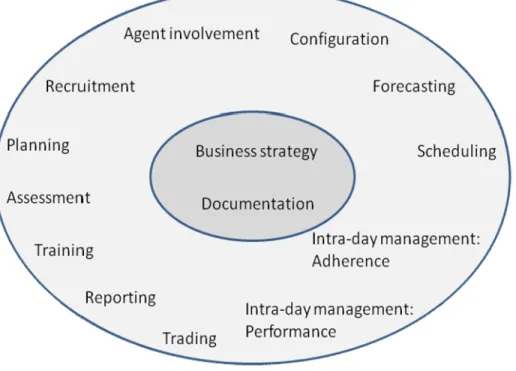
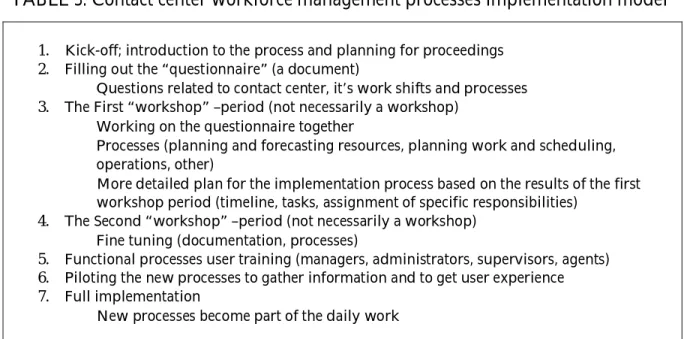
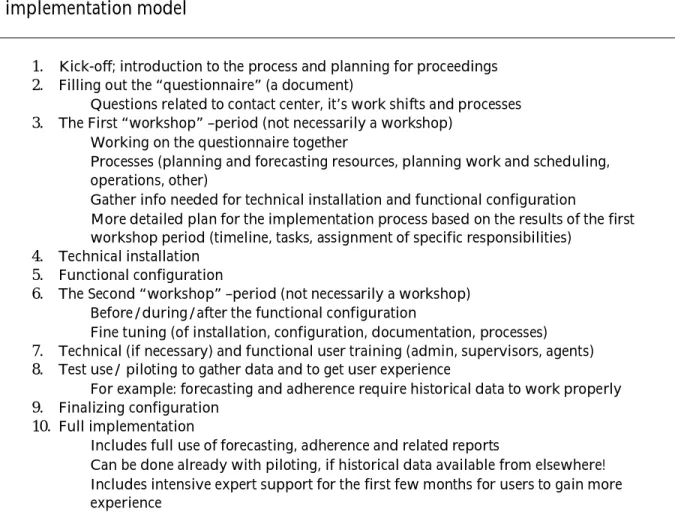
All three contact center workforce management models have been developed over time and in real-life situations. They are not implicitly developed to be based on either the research conducted in the field or on the ITIL framework. The first model, contact center workforce management processes model introduces fourteen different processes that are related to workforce management. There are two processes, business strategy and documentation, in the center because they have an impact on the other processes. These two guide the rest. The second model, contact center workforce management processes implementation model, has seven steps to follow when implementing the workforce management processes into a contact center alone. The third model, contact center workforce management processes and tools implementation model, has ten steps and is basically an extended processes model with the tools implementation. However, even though these models have been developed without theoretical background i.e. academic research and without the explicit guidance of the ITIL, they do follow both of them rather well. There is no need to change any of the models based on the research findings.
One very important point about the findings is that there is a real challenge to find relevant research. Several researchers have noted that these topics, workforce management processes and ITIL, are not widely taught at the higher education institutions and therefore, it can be well assumed that this is also the reason why the related research is so scarce.
This research differs from other research conducted with the topics of the workforce management and ITIL. First, the three models are revealed for the first time outside the actual implementation projects. Second, the contact center workforce management processes model seem to include the most comprehensive list of workforce management processes there is so far in the academic research. Third, the three processes models are validated in theory against both the previous research and against the ITIL framework version 3. Finally, this is the first time workforce management implementation, either processes or tools, is reflected against ITIL.
1.4 The structure of the paper
The purpose of the introduction was to set up the scope of this specific research, define the relevant special terminology, reveal the actual research questions and the goal of the research, and explain the research method used. Next, the relevant research conducted regarding both ITIL and workforce management is presented. The focus on ITIL related research is on the latest version, version 3, but some older work is also presented if it is relevant. The workforce management research is divided into studies related to processes themselves and into various aspects related to workforce management tools. Then, the latest version of ITIL is introduced in more detail. There is a short description of the content of all the five major books with focus on topics that are relevant to the implementation models. Then, the existing contact center workforce management process model together with the contact center workforce management process implementation model are presented in detail. These presentations are followed by a similar description of the contact center workforce management process and tools implementation model with a short introduction to three workforce management tools in the market. Then, the comparison of the models against ITIL is made and on the following chapter, the possible impact regarding the prior research and ITIL into the models is noted and possible modifications made to the process models presented earlier. Finally, the current research is shortly reviewed, the importance of the findings discussed and possible future research topics suggested.
2
ITIL AND WORKFORCE MANAGEMENT RESEARCH
The purpose of this chapter is to provide a good overview to the relevant academic research done related to topics of ITIL and workforce management. The work done with ITIL relates to the past ten years with versions 2 and 3 and the work with workforce management covers investigation conducted those topics related to contact center environment. Overall, Berman (2003) recognized that motivating staff is critical and that any change tends to create anxiety. Therefore, it is important to remember to plan well any ITIL and workforce management related projects and to take into account this findings and the findings presented under this chapter. ITIL is divided further into sub topics of processes and integrations. Workforce management also has sub topic of processes but the other topic is about the workforce management tools.
2.1 ITIL
This topic deals with the academic research that has been done specifically around the ITIL framework model. It is very important to understand ITIL: what is the academic opinion, what are the benefits and challenges with its implementation and what kinds of environmental situations it has been, and can be, used. In addition to these topics, the two sub topics deal with the research conducted on ITIL processes, ITIL implementation with other processes and, in some cases, with tools.
ITIL is widely recognized around the world. This becomes evident when reading various documents dealing with parts of ITIL framework or the concept as a whole. However, as also Galup, Dattero, Quan and Conger (2007, 50) observed, there is only limited amount of actual research that is explicitly ITIL related. They concluded that reason for this situation is that the Information Technology Research and the pedagogy have both been ignoring areas related to information technology operations.
However, Rychkova, Regev and Wegmann (2010) think that the role of a generic framework model like ITIL is important and Ramnath and Ramanathan (2008, 553)
consider ITIL as a best practice model for IT services delivery. ITIL is not a process model (Hochstein, Zarnekow and Brenner 2005, 80) but it is used as a reference model for ITSM (Hochstein, Zarnekow and Brenner 2004) because service organizations rely heavily on information technology (Ramnath and Ramanathan 2008, 535). It is also acknowledged by both Wegman, Regev, Garret and Marcchal (2008) and Donko and Traljic (2009) that the main goal of ITIL is to act as an interface and to align business processes and needs with IT services and service providers. It should be noted here though that this focus on integration is specifically a goal associated with ITIL version 3. Previously the goal was an alignment, not an integration.
Ramnath and Ramanathan (2008) investigated ITIL as a whole. They think that ITIL is a collection of well documented processes for the support and delivery of IT services (ibid., 553), although Hochstein, Zarnekow and Brenner (2005, 80) disagree on this one. One reason for this contradiction might be that the latter ones are talking about ITIL version 3 and the former ones version 2. This assumption is based only on the years both papers are published. ITIL version 3 did not exist prior the year 2007. Furthermore, Ramnath and Ramanathan also note that ITIL tells the readers what to do but not really how to do it. They conclude that each organization is different and that ITIL needs to be adapted every time. This view is also supported by Helbig, Hrdinova and Canestraro (2009) and McLaughlin and Damiano (2007, 251). Ramnath and Ramanathan (2008, 535) also made a very important observation that is generally relevant to this paper as well. They said that the technology does not automatically improve the services and that it is a “mix of organizational goals, processes, organizations, applications and enabling IT components”.
There are many benefits observed from ITIL implementation. Holub (2009) investigated the benefits and noted, rather an obvious thing, that the benefits depend on what is implemented, the level of management support received and the amount of various resources used. Some specific benefits he mentioned were quality improvement from 50 percent to 70 percent deduction in unplanted downtime, efficiency from 10 percent to 25 percent labor productivity increase, and customer satisfaction. The improvement on customer satisfaction was also observed by McLaughlin and Damiano (2007, 251) and by Zhang, Ding and Zong (2008, 682). Other benefits that MCLaughlin and Damiano (2007) observed when they implemented ITIL to their college service desk were reduced costs, improved
customer satisfaction, improved productivity and improved use of skills and experience. Also, Zhang, Ding and Zong (2008) got cost reduction benefits as well as did Bailey, Kandogan, Haber and Maglio (2007). Zhang, Ding and Zong (2008, 682) list of benefits included increased revenue, less disruption, and improved public relations, productivity and use of skills and experience. Hochstein, Zarnekow and Brenner (2005, 82) state that the three most advantages are “client/service orientation and the quality of IT services, efficiency due to standardization, optimizing of processes and process automation, and transparency and comparability through process documentation and process monitoring”. Finally, Morales (2008, 221) implemented ITIL into his university service desk. ITIL had a positive impact on staff recruitment, documentation, training and now they have formal agreements in place like SLAs and OLAs.
In addition to benefits, there are also many challenges identified either with ITIL implementation or ITIL itself. Hochstein, Zarnekow and Brenner (2005, 82-83) noted that in addition to all the benefits, there are some considerable costs involved with ITIL implementation as well. These costs were due to project planning and coordination, system development and tool customization, contracting and training of people, project marketing, quality control, consultation and costs related to processes. There were many other implementation experiences that had similar findings. One of them listed also many other challenging experiences that they had pulled together from other sources (Sharifi, Ayat, Rahman and Sahibudin 2008). These included things like lack of management commitment, too much time spent on complicated process diagrams, missing working instructions, process owners not assigned, too much concentration on performance and other solutions than ITIL were ignored. Latif, Din and Ismail (2010, 85) also noticed some additional challenges on implementing ITIL due to the behavior of the organization itself. They noticed that the units involved did not understand their job responsibilities and the ITIL standard terminology was not used. In the research of Latif, Din and Ismail, the failure is not because of ITIL. It sounds more like it happened regardless of ITIL and the company would have benefitted from agreeing about the job descriptions and having a common vocabulary before starting to implement ITIL in the first place. Finally, Holub (2009) delivered criticism towards ITIL version 3 itself. According to him, many organizations feel that the increased scope of ITIL is overwhelming (ibid., 1), the volumes of Service Strategy and Service design are very academic and theoretical
and the change from version 2 to 3 was so big and advanced that the organizations cannot make the change (ibid., 3).
Finally, there are thousands of organizations using ITIL with various scope of implementation and various versions of it. Greiner (2007) identified some of the well known companies in the world that use ITIL. She listed Procter & Gamble, Microsoft and HP and then added the “governments around the world” (ibid., 9). In addition to this, there would be hundreds of companies found in the internet claiming having implemented ITIL but they rarely go into details of what exactly was implemented and how it was done. Some well known Finnish companies that can be found from the internet associated with a personal ITIL implementation are Fortum, Nokia and Tieto, banks like Suomen Pankki, Nordea and Sampo, insurance companies like Fennia, If, Ilmarinen and Pohjola, and the University of Helsinki.
2.1.1 ITIL processes
It is always possible to study the whole ITIL but it is equally possible to select only one or some of the processes, one part of the lifecycle (meaning one book) or something that is related to ITIL in another way. Many have done just that. Brenner (2006) is one of those people who attempts to classify ITIL processes themselves. He says that ITIL processes should be supported by proper IT tools and he explain what this means because, according to him, ITIL does not explain this in a very detailed way. It should be noted, however, that Brenner talks about version 2 of ITIL and not version 3. Also, the process research is focusing on version 2 so that most of the results would not work directly with the version 3. However, his statement of needing both technological approach and an organizational approach with ITIL (ibid., 21) is still very much valid point. Hochstein, Zarnekow and Brenner (2005) evaluated service oriented IT management but they also worked with the version 2. However, Nabiollahi and Sahibuddin (2008) did a comparative study between the two ITIL versions and investigated the suitability of the ITIL Service Strategy as a framework for IT governance. They found out that ITIL version 2 is not but version 3 actually is suitable for that purpose. Finally, the study of Ayat, Sharifi and Sahibudin (2009) is an example of those studies that focus on configuration management database
implementation. This configuration management database is to record, update and trace all assessed activities and information in the organization.
There is relatively little research found on ITIL processes and little becomes even less when the work is divided according to the ITIL versions 2 and 3 in the market. Hanemann, Sailer and Schmitz (2004) investigated the management of service quality by improved fault management and they noted that the paradigm shift from device focus to service-oriented focus was in its way at that time. Their work included service-oriented event correlation in order to identify problems earlier and that way reduce the SLA violation costs. The same year, Dietel (2004) talked about IT change management and incident management in service desks. He also first created his version of the change management process flow, tested it and improved it based on the findings. Then he went on and implemented this process flow. Later, DeNoia, Carper and Hanczaryk (2009) investigated the service desk incidents and they also used the incident management and IT change management as the base for their study. First they noted that incident management is only a part of problem management. The tickets they investigated were first divided according to their priority and then by origin, symptoms and cause (ibid., 190). Then the causes were taken a closer look and the processes and practices where changed to reduce the incidents or lower their severity (ibid., 191). Finally, they concluded that this kind of analysis should be added into IT academic programs (ibid., 194). Their research is notable because they have realized incident management and especially incident analysis skills are lacking on new graduates. This is very evident if one walks into an organization and asks about the possibility to reduce the customer contacts. The younger people do not seem to make the connection between reducing the costs and analyzing the causes for higher costs through the content of the contacts.
Donko and Traljic (2009) did also do an analysis on ITIL incident management process but they focused only on this process and in one telecom service provider company. Since the main goal of ITIL is to integrate IT services with business needs and processes, they identified two main interfaces uniting these two: service level requirements and user incident reports (ibid., 284). They also noted that incidents should be stored in an incident knowledge base so that they can be reused (ibid., 286), statistics and analysis will help to improve business processes (ibid., 287). The approach of Scholtz (2009) was a bit different. He focused on a specific user group, security officers, and his research identified best practices for
them to use from ITIL version 3. He had also noted that the planned and actual ITIL version 3 implementation rates are increasing and the ITIL v3 supports strongly the work of security officers.
There is actually more research to be found from ITSM than there is from ITIL. As early as 2004 Hochstein, Zarnekow and Brenner considered ITIL as a reference model for ITSM for both formal assessment and for implications in practice. Later, Holub (2009, 2) added that ITIL has become the best-practice guidance for ITSM. Furthermore, according to Galup, Dattero, Quan and Conger (2007, 47), “ITSM is a set of processes that detail best practices based on ITIL standards to enable and optimize IT services in order to satisfy business requirements and manage the IT infrastructure both technically and strategically”. They also defined service as people, processes and technology put together. When reviewing the modern methods and standards of ITSM and the alternative research approaches they noted that there is not much academic work around and they identified three reasons for this: 1) newness of the area, 2) ITSM considered only for IT operations and not for software development, and 3) the mainstream methods of conducting research are not suited for this research area (ibid., 50). Another reason might be that there is still a gap between business planning of services and the management of IT services (Jin and Ray 2008, 1).
The research done around ITSM seems to go all over the place since the area is so large. Bartolini, Stefanelli and Tortonesi (2009, 15) did a business impact analysis and simulation of critical incidents in ITSM. They presented a decision support tool and they also noticed the scarcity of research around their immediate interest by stating: “Only recently have research interests on the people and processes dimensions of IT management emerged, and thus there are relatively few works in the academic literature.” Another study was about creating a methodology for ITSM automation (Ayachitula, Buco, Diao, Maheswaran, Pavuluri, Scwartz and Ward 2007). They talk about people, processes, technology and information as building blocks for successful IT infrastructure. Also, they made several observations that are relevant for workforce management tool implementation in ITIL based environment. They said that people use systems like emails, messaging systems, word documents and spreadsheets to coordinate their work (ibid., 3). There is also a need for a system that collects sharing, monitoring, communicating, coordinating and collaborating together into one place (ibid., 3). Time awareness and calendars are essential (ibid., 4). Finally, Ayachitula, Buco, Diao, Maheswaran,
Pavuluri, Scwartz and Ward (2007) talk about IT process management processes and operational management processes. Management processes correspond to ITIL service support processes and the other process is about infrastructure resources (ibid., 8).
There is also some ITSM research related specific models like ITSM knowledge management model by Liang and Baozhang (2009). They concluded that the model they had created did fully fit with the original ITIL v3 knowledge management model. Then there is the research of ITSM knowledge support structure by Wan and Wang (2007) about operation and maintenance management. Finally, there is a recent study by Graves (2010) who tried to figure out how IT service inventory for ITSM should look like. He concluded that the IT service inventory is not complete: it has a list of services but it does not describe them. It also has exclusions and translations that are debatable (ibid., 7). Many companies still have function-based computing infrastructures instead of service based. The IT service inventory “should be useful for industry to plan skills, divest themselves of services more efficiently performed by others, and better understand the ramification to other IT services and the business doing so” (ibid., 8).
In addition, there are two studies related to ITIL that basically have nothing in common with the other research related to ITIL. Gacek, Giese and Hadar (2004) investigated self-adaptation of software and created a conceptual model and processes for it based on ITIL. Then there is the very recent study of Rychkova, Regev and Wegmann (2010, 1) who “declarative specification and alignment verification of services in ITIL”. Basically, their work was about a formal method for specifying service level agreements and operational level agreements.
Finally, there is a very interesting study of Alter (2010). He is viewing systems as services in the field of information systems. This work differs from all of the above in a sense that the point of view and the focus comes from the information systems and not from the information technology. Alter recommends that the IS academic research would be extended into concepts like ITIL (ibid., 196). According to him, over 50 percent of the revenue of software companies comes from services. Also, there is inadequate user engagement and inadequate alignment between business and information technology (ibid., 196). Systems should be viewed as service systems and he introduces five steps to support this point of view (ibid., 201).
2. Recognize that the value from services tends to be coproduced by
providers and customers.
3. Recognize the significance of service-related design dimensions. 4. Recognize how service systems change and evolve.
5. Incorporate service-related concepts and tools into the evaluation,
analysis, and design of systems.
He concludes that viewing systems as services is “potentially fruitful but generally unexplored approach”. Alter also identifies some advantages of doing this: improved communication with business professionals, a common denominator for talking about services and a synergy between different ways of looking at systems (ibid., 219).
2.1.2 ITIL integrations
In addition to the research done on ITIL, its processes and some special relevant parts like ITSM, there are also some studies made regarding ITIL integrations. The integrations can be made with specific environments, tools and even other concept. One of those studies was made by Zhang, Ding and Zong (2008) and they investigated ITIL process integration with organization environment. They took the viewpoint of security, knowledge, information, control and semantics but they also noted that there is limited research done on any of them (ibid., 682). They concluded that the relationship of five viewpoints should be remembered with integrating ITIL and other systems and tools (ibid., 683). Graupner, Basu and Singhal (2009) made another study where they described a “knowledge-based collaboration environment for ITIL” for IT consultants for “planning, designing and implementing ITIL processes easier” (ibid., 44). They recommend using wikis (open collaboration environments on the web) and claim that the pre-operational stages (service strategy and service design) are not well supported by technology (ibid., 44). Their claim seems to be accurate even if only taking a look at the systems available for service desks. There is only limited amount of systems that any larger service desk can even consider and many companies still create the systems of their own. The claim of Graupner, Basu and Singhal (2009) is also
supported by the actions of Lahtela, Jäntti and Kaukola (2010). They created and implemented an ITIL based ITSM measurement system into a Finnish company. According to them the service support processes are very tool –oriented and ITSM standards and frameworks should provide more practical examples for measuring support processes.
Sahibudin, Sharifi and Ayat (2008) combined ITIL, COBIT and ISO/IEC 27002 in order to form a comprehensive IT framework. They found out that ITIL and COBIT correspond with each other really well and the security process should come from ISO because ITIL is not focused on that. Another study went on the same direction by suggesting that ITIL is not a comprehensive standard, an integrated approach with other process frameworks like Capability Maturity Model (CMMI) or Control Objectives for Information and Related technology (CobiT) is ideal (Brittain and Holub 2010). Finally, there are three studies that talked about integrating either ITL or ITSM with enterprise architecture (EA) and suggested that the integration would be a good idea. Braun and Winter (2007) propose an EA extension to do the integration. Robertson (2009) investigated the similarities and differences of EA and ITIL and how they could be linked to work together. He found out that ITIL is more detailed and narrow focused than EA but they have many similar strategies and goals (ibid., 2-3). According to Robertson EA and ITIL groups ignore each other (ibid., 1) but they could benefit from each other and together get better results than alone (ibid., 4). The last study is from Correia and Abreu (2009). They noted that there is a lack of empirical studies for the relationship of SLAs and the required IT support. EA does not talk about SLAs. Also, formal IT service definition and assessment are missing. The focus has been on best practices (ITIL, COBIT, CMMI), service oriented architecture (SOA) and web services instead (ibid., 553).
2.2 Workforce management
This topic collects together the academic research done on contact center workforce management. According to Liao, Delft, Koole, Dallery and Jouini (2009, 1) workforce management is a critical component of contact center operations. Furthermore, Guido, Roberto, Di Tria and Bisio (1998, 474) have noted that to
maximize efficiency and effectiveness one need organization, procedures and technology supported by various processes. Therefore, the research presented here is divided into two major workforce management areas: processes and tools. Each subtopic covers the respective area on the level that is needed to understand the three workforce management models that will be presented later in this paper.
2.2.1 Workforce management processes
In order to take a look at the academic research done in the field there should first be an agreement on what are the contact center workforce management processes. However, this is not as easy task as one might think. There is a widely spread agreement that at least forecasting, figuring out the staffing needs and scheduling are workforce management processes. According to Wasserkrug, Taub, Zeltyn, Gilat, Lipets, Feldman and Mandelbaum (2007) this is all that is needed. Liao, Delft, Koole, Dallery and Jouini (2009, 1) added intra-day performance management. They also noted that forecasting, figuring out staffing levels and scheduling have basically been the only focus of workforce management research and continued that the intra-day performance management has rarely been researched. Gupta and Parija (2009, 97) recognized that strategic planning is important, as did An, Jeng, Lee and Ren (2007). In fact, the most complete list of workforce management processes comes from An, Jeng, Lee and Ren. In addition to all other mentioned above, they also added turnover analysis, budgeting, hiring and training.
Since there is no single workforce management model to refer to and forecasting with scheduling are clearly only few workforce management processes needed on contact centers, there seems to be a trend that each researcher and a research group have defined their own set of processes and then created models that support at least one of them. Lu, Radovanovic and Squillante (2006, 1144) created a stochastic network model to keep the agreed service level while providing “optimal decisions for cost minimization”. Gupta and Parija (2009) created a mathematical model to calculate the maximal utilization of agent seats. They also recognized the limitation of their model. It works only if all agents can do the same work tasks (Gupta and Parija (2009, 98). However, this is often not the case. Some agents are specialized on certain tasks like written communication or training new agents. Liao, Delft, Koole,
Dallery and Jouini (2009) did a similar model but their focus was on how to optimize the agent headcount when the workload is random. Even An, Jeng, Lee and Ren (2007, 2187) focused on staffing costs. They created a system dynamics model. However, this was created for any company claiming to be service-oriented and it is not suitable for a contact center as it is. It focuses more on projects, hiring and proper skills. There is also a model made for the third level support (Wasserkrug, Taub, Zeltyn, Gilat, Lipets, Feldman and Mandelbaum 2007) but it focuses specifically on a service desk third level support and not on the first and second level support like this paper. Also, the researchers only recognize two workforce management processes: forecasting and scheduling.
There were also two relevant pieces of research that did not create a model. The first one was Koole (2004) who talks about performance analysis and workforce management optimization. On performance issues he recognizes the limitations of the Erlang C calculations with forecasting (ibid., 1). It is a known fact in workforce management forecasting that Erlang C calculates the workload to increase exponentially and this is not the case. Koole also includes service times, number of lines and abandonments calculations as part of the performance measurement. According to him, the optimization covers forecasting, agent requirement calculations, figuring out the shifts needed and scheduling and this approach is found in many software packages (ibid., 2). It should be noted here, though, that when he talked about optimization processes and tools, the term “optimization” with tools currently means totally different. However, he did point out the need for service level management, agent shrinkage, work blending and multiple contact channels. He concluded that all these methods increase the effectiveness and efficiency of agents and reduce training costs (ibid., 3).
The other research, that did not create a specific model, focused on finding the correct level of service desk staffing ratio (Coyle and Brittain 2009). They found out that the volume has the greatest effect in the staffing ratio, that there is no one staffing ratio that would be appropriate for all companies and that too often only the cost determines the staffing ratio, not the service quality. They also noted that service desks with less than ten employees are especially vulnerable to inefficiencies in staffing (ibid., 3). Furthermore, service level agreements have a great effect on staffing (ibid., 4), process maturity affects as well. Finally, average handling time, utilization rate, number of request in queue and service offering are also contributors when determining staffing level.
There is also lots of research done on workforce management fields that would be relevant to the workforce management field in general but would not really contribute on defining the set of workforce management processes topics themselves. This research includes studies like Erlang C versus simulation models, hiring, learning, training and motivation. Each one of these topics actually forms a whole research field of its own. Also, there is a research thread in human capital management that closely reflects workforce management. For example, Holincheck (2009) has listed the top five human capital management processes for 2009 to 2013: workforce planning, talent acquisition, paying for performance, workforce development and workforce management. It is very likely that the workforce management research and human capital management research would have a lot to give to each other.
2.2.2 Workforce management tools
There is a considerable amount of research done regarding workforce management tools. The tools need to be divided into categories depending on the user group. As Holincheck (2003, 2) says, there are no vendors that are or even can provide a single solution for all industries. However, since the focus of this paper is specifically the contact center workforce management tools, the number of research to be found drop dramatically. There are many reasons for this situation. First, the contact center workforce management tools are very special and complex tools. It is not easy to start from nothing and develop a new one. Second, the contact center workforce management tool market is already mature and the major vendors already control the market. Third, each tool has gone through a comprehensive research while being developed and even during implementation, but the research results are proprietary and confidential to the vendor, the implementing partner and the end customer only. If a vendor ever publishes such a research it does not fulfill the academic research standards. No vendor will publish results that are not overly positive. Fourth, the comparative studies between the contact center workforce management tools are either vendor internal for competitive purposes or they are performed by few key groups that are trusted to be mainly independent from a specific vendor. Two of the best known groups in
the contact center area that the organizations seek guidance for decision making are Forrester and Gartner.
However, there are some individual papers where attempts have been made to investigate workforce management tools in contact center environments. Lesaint, Voudouris, Azarmi and Laithwaite (1997) concluded that using a specific workforce management mobile tool has led to efficient and effective workforce. The tool helped on optimizing the schedule, making changes to the work tasks and detecting the availability of the people. Potila (2005, 7) talks about “improving operations efficiency by combining ICT solutions and workforce management”. Sauerbach, Mathis and Nilges (2009) investigated SAP as a tool and demonstrated one possible way of implementing a workforce management system. It should be noted that all these three studies mentioned focus on so called mobile workforce and are not directly relevant to the contact center processes and tools.
There are also three studies that focus on only one or two aspects of contact center workforce management tools. First, according to Manning, Garf and Sweeney (2006) market surveys indicate that the return of investment from using tools for operational planning and scheduling are considerable. Then, Rosenberg (2005) talks about the ways there are to get most out of the workforce management software. According to him the most important individual piece of an advice is that the tools need to be used properly. Also, he notes that the efficiency should not be taken too far because demanding occupancy rates of agents for over 85 percent to 90 percent could cause burnouts. Finally, there were two important observations made from two researches conducted. The first one was that scheduling should be done in no less than one hour intervals and the second one that the queuing should be separated into many channels and that multi-skilled teams are more effective (SenGupta 2009). According to him, queuing theories have so far thought a single queue to be more efficient. However, these two findings are somewhat surprising. Many companies do use the planning period of 15 minutes or a half an hour, especially if they are larger ones. Especially there is a need for shorter intervals when the agents first come to start the day or when they end the day if the contact center does not provide service for 24 hours and seven days a week. Also, shorter intervals, than an hour, are used when meal and coffee breaks are scheduled. The second finding is not surprising but the comment regarding queuing theories is. The writer has known at least for the past ten years that multi-skilled teams are more effective and that this is specifically the reason
why teams should never be formed by skills into singe-skill groups. Even all the contact center infrastructure vendors have broadcasted this same observation for years!
Maybe one of the most valuable pieces of research was conducted by the Gartner Group and presented by Davies (2009 b). Overall, it was found out that the companies seeking and using contact center workforce management tools increasingly value ease of use and full utilization of the software over functionality. Also, the workforce management market is mature and the accuracy on planning, forecasting and scheduling has a great impact on operational efficiency. Furthermore, existing contact center workforce management tools are rather well suited for Software as a Service (SaaS). Therefore, Gartner Group recommends that any contact center with over 100 agents should invest for a proper workforce management tool because of the economic benefits they would gain from it (ibid., 2). Davies also listed and explained the top ten contact center workforce management trends in detail. Since these listings of trends coming from Gartner are known to influence both the vendors and the possible end-user organizations, they are presented here as well. This list will influence especially those vendors that are not the leaders of market share because they want to make sure they are following the “trends”. Organizations, on the other hand, are using these kinds of lists to evaluate possible vendors and they will as from vendors questions like “What is your commitment to agent empowerment?”. The trends are the following:
1. increased deployment flexibility
2. change of focus on technological underpinnings 3. desire for longer-term strategic planning
4. support for work-at-home agents 5. commitment to agent empowerment 6. extension to other departments
7. increased commitment to WFO suites 8. investment from smaller contact centers
9. need for true optimization of multichannel environments 10.internationalization is becoming a key differentiator
The first trend refers to the shifts towards web-based architectures, SaaS-based offering and multitenant hosting. The second trend is about shifting from the forecasting accuracy methods into “ease of use, value for money and functional utilization” (ibid., 2). The third trend is to require the tools to support long-term strategic planning for sustainable service levels and service quality, and for strategic business goals. Concepts like training objectives, recruitment needs and “what-if” scenarios are increasingly demanded. The fourth trend basically wants the workforce management tools to allow the work from anywhere because the underlying technology does already support it. The fifth trend refers the availability of the workforce management tool for agents so that they can perform most of the work related issues independently. The sixth trend refers to the fact that all major contact center workforce management vendors have extended their services to cover the workforce that is not working in the contact centers. Many of the other vendors are trying to follow but some tools just cannot support the work outside the contact center environment itself. The seventh trend just states that there is an increased commitment to workforce management optimization (WFO) suites both from the vendors side and increasingly from the user side as well. The eight trend notes that even the small contact centers are starting to realize that there are tools for small implementations and that they would also benefit from the tool considerably. The tools are no longer only for middle-size and large organizations. The ninth trend is to demand accurate forecasting and scheduling of agents that work simultaneously with more than one channel (phone, email, chat). The last trend is about the demands like multiple language support, local legislation support, and support for prayer breaks and single-sex shifts. The first two are very important in Europe and the last two in Muslim countries.
There is also a major shift going on from contact center workforce management tools into contact center workforce optimization suite. Close (2003) was probably one of the first ones who started talking about workforce optimization in a sense the concept is understood today. She proposed the following functionalities as the possible additions to the pure workforce management tools (writer’s note: that at the time consisted mainly on forecasting, scheduling and reporting): budgeting tools, performance management, quality monitoring, analytics and
training/e-learning solutions (ibid., 3). Since then, it has been mainly Gartner Group and Davies who has followed the WFO market trends and research. Although the WFO research goes beyond the focus of this paper, it is shortly covered here because it will have an impact on the future of the workforce management tools.
Davies (2005) noted that in the year 2005 WFO suite market was in its infancy. According to him the functionalities included are interaction recording, quality management, IVR surveying, e-learning, WFM and performance management (3-ibid., 6). On the following year Davies (2006 a) introduced the WFO framework to be the basis for vendor evaluations in the future. He also predicted that in the future there will be less vendors with more integrated applications (ibid., 2). He saw the core technologies as being workforce management with quality management, e-learning and performance management (ibid., 4). On the same year Davies (2006 c) noted that not all vendors are moving from workforce management to workforce optimization (ibid., 2). Also, workforce optimization tools cover strategic planning, agent recruitment, deployment, monitoring, evaluation, improvement, motivation and corporate accountability (ibid., 3). Then, Davies (2009 c, 2-4) added strategic planning into the requirements and noted that the trends are towards both a single vendor to provide the whole WFO suite and to move into the SaaS model with it. In another research paper Davies (2009 d, 2-3) recommended that the companies should buy from a single vendor and that the vendor landscape is rapidly changing and will look different in two years. Davies, as a representative of the whole the Gartner Group, published the final criteria for WFO tool evaluation: workforce management and strategic planning, call recording and quality management, coaching and e-learning, performance management, surveying and interaction analytics (ibid., 4). Finally, in the beginning of this year Davies (2010) gave an overview of the research done in WFO area in 2009. The areas touched by Gartner research have been recording, agent evaluation, forecasting, scheduling, training, reporting and interaction management. He concluded that despite of the complexity of WFO, the amount of WFO vendors will increase through acquisitions, R&D and OEM partnerships, and that SaaS will become more available and more popular (ibid., 3).
There is really no research done specifically on ITIL framework model with either workforce management processes or tools. There is no integration or even effects discussed. However, according to the writer’s ten year experience on workforce management consulting there is a clear need for this. There have been several companies that have taken an effort to implement ITIL version 2 or even version 3 into their contact centers or more specifically, in their help desks or service desks, but they have then complained that the expected return of investment is not there. Without an exception the case have been that the ITIL implementation has included new work titles and an incident management tool but no integration has been done with the workforce management processes. Some companies have even had a workforce management tool but it had not been integrated efficiently with the workforce management processes and not at all with the ITIL processes or the incident management tool.
Another, specifically workforce management related, issue is that the organizations have not yet purchased a workforce management tool or it has been improperly implemented. Many companies have not realized that with a proper workforce management tool that is properly implemented has a very rapid Return of Investment (ROI), often only a couple of months. It is true that the good workforce management tools cost money and if the ROI calculations have not been made properly, the prize looks high. Also, the company has purchased a tool from a good salesperson, a tool that does not fulfill the needs of the business and/or the tool has not been properly implemented i.e. integrated with the workforce management processes. In fact, it is slowly becoming evident that the many European companies have realized that “something went wrong” but cannot quite say what and they are turning into consulting agencies for help.
Many of these companies asking for consultation already have several ISO certificates, CRM and ERP tools are in use, ITIL model (or similar like EA, CoBit, CMMI or eTOM) has been implemented, the tools that are supposed to change “everything” have been purchased but still the ROI is not what is expected and what various vendors and publications have promised. Finally, it has also become evident that especially with the workforce management consultancy field, the consultants usually know their own product well but are not experts on several product and definitely not, at least, on additional frameworks like ITIL. For example, a head of a university service desk tells how they are implementing the ITIL methodology (Lyons 2009). According to her they will have a new ticketing