Jaehak Yu1, Hyunjoong Kang, Hyo-Chan Bang, MyungNam Bae2 Electronics and Telecommunications Research Institute, 138 Gajeongno, Yuseong-gu,
Daejeon, 305-700, Korea
{dbzzang, kanghj, bangs, mnbae}@etri.re.kr
Abstract. Recently, the Internet of Things has mainly focused on establishing connectivity in a variety of challenging and constrained network environments, and the next logical step will be focusing on the application layer on top network connectivity. Web of Things plays a critical role in enabling smart things as being first-class citizens of the Web. In this paper, we proposed a web broker model on „Web of Thing‟ that can perform collaboration and efficient operation with various devices. This model is designed on the basis of cooperative game theory so that it may perform autonomous cooperation among devices. In addition, the model proposed was so designed as to guarantee the maximum reliability by minimizing the information loss in major devices and services.
Keywords: Internet of Things,Web of Things, Classification of things, Device cooperation and non-cooperation, Web broker.
1 Introduction
The Internet of Things (IoT) is a novel paradigm that is rapidly gaining ground in the scenario of modern wireless telecommunications. The basic idea of this concept is the pervasive presence around us of a variety of things or objects – such as Radio-Frequency IDentification (RFID) tags, sensors, actuators, mobile phones, etc. – which, through unique addressing schemes, are able to interact with each other and cooperate with their neighbors to reach common goals [1], [2].
With the generality of the Web, the Internet of Things is on the verge of experiencing a massive evolution. Indeed, starting from an Internet of nearly one hundred million computers, the Web now turns to be an Internet of nearly 50 billions of things [3] presaging transition from an Internet of Things to a Web of Things (WoT). Some initiatives are already offering things as Web resources – either coupling RFID readers to a Web based infrastructure [3] or by directly binding Web protocols onto physical electronic cards– participating in providing a profusion of new, object-enabled, applications and even the means to „mash them up‟ together. Nevertheless, while paving the way to novel applications through proves of concept,
1 First author, 2 Corresponding author.
practical use of the Web of Things (WoT) in a large-scale deployment scheme still needs to be strengthened. Web of Things plays a critical role in enabling smart things as being first-class citizens of the Web. In this way, web tools and techniques can be directly applied to the real world [4].
Game Theory is a discipline aimed at modeling situations in which decision makers have to make specific actions that have mutual, possibly conflicting, and consequences. Since then, the applications of game are found in economics, politics, computer science, psychology and sociology. In 1950, John Nash proved that finite games always have an equilibrium point, at which all players choose actions which are best for them when given their opponents‟ choices [5], [6]. In cooperative game theory, the payoffs of each potential group, or coalition, can be obtained by the cooperation of its members. On the other hand, non-cooperative game theory is concerned with the analysis of the strategic choices, the details of the ordering and the timing of players‟ choices, which and important to determine the outcome of a game. However, the reality is that there is no efficient and autonomous collaborative technology between things or services in web broker, which is a core of WoT.
In this paper, we proposed a web broker model on „Web of Thing‟ that can perform collaboration and efficient operation with various devices. This model is designed on the basis of cooperative game theory so that it may perform autonomous cooperation among devices. In addition, this model can perform an efficient information operation and collaboration between devices through the cooperation between unconstrained devices and the cooperation between constrained devices and gateways. It is expected that the autonomous cooperation between such devices will be actively utilized in constructing WoT environment. To satisfy this, game theory of Nash bargaining solution (NBS) method by introducing a system operation and performance was attempting to maximize. In addition, the model proposed was so designed as to guarantee the maximum reliability by minimizing the information loss in major things or services.
This paper is organized as follows. In Section 2, describes related work and the cooperative game theory. In Section 3, the proposed cooperation model between devise in Web of Things is presented. Finally, Section 4 discusses the conclusions and future research directions.
2 Related Work
2.1 The Web of Things
With the public interest of Internet of Things, the next logical step will focus on the application layer on top of network connectivity, particularly Web of Things. Today, more and more devices are ubiquitously running around us. Traditional communication schemes make use of heterogeneous protocols, software and user interfaces, making hard devices interaction. Users would like to easily access public devices, whatever their implementation choices [4]. In the paper, this global devices interconnection is called the Internet of Things. This does not refer to any technology
nor any network structure, but only to the idea of interconnecting objects as well as we interconnect computers with the Internet. Use of the Web as the platform hosting and exposing connected objects, can be explained by multiple technological and business benefits, a few of which including deployment, high availability and versatility, use of standardized communication protocols and the ecosystem created thanks to Web 2.0 paradigm.
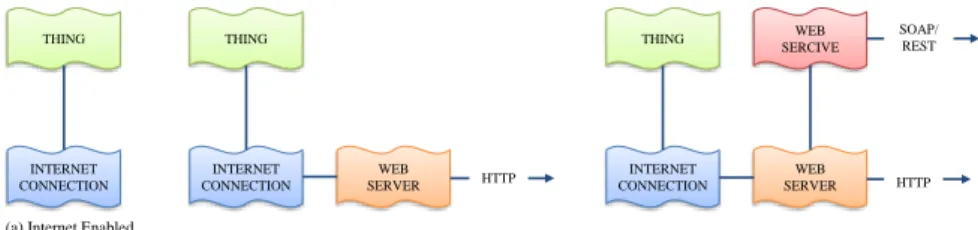
A thing becomes Internet-enabled if it is associated with networking capability, which uniquely identifies it on the Internet (refer to Fig. 1(a)). Today, devices such as sensors, street lights, electric meters, and access cards are already networked and accessed on the Internet; even IP-connected pacemakers are used to monitor the health of patients [7]. A thing becomes Web-enabled when it is augmented with a Web server (refer to Fig. 1(b)) so that it can expose its functional and non-functional capabilities on the Web through HTTP. Researchers have already successfully embedded tiny Web servers on resource-constrained things, making Web-enabled things a reality. Definitely, there is scope for REST in the area of Web services, advances in REST based Web service architectures is propagating the abstraction of physical things as services on the Web. This trend gives rise to the possibilities of wrapping things in the physical world as Web services (refer to Fig. 1(c)).
THING INTERNET CONNECTION THING INTERNET CONNECTION WEB SERVER THING INTERNET CONNECTION WEB SERVER WEB SERCIVE HTTP HTTP SOAP/ REST
(a) Internet Enabled
Thing (b) Web Enabled Thing (c) Thing as a Web Service
Fig. 1. Connecting things on the Web
2.2 A Survey of Game Theory
Game Theory is a discipline aimed at modeling situations in which decision makers have to make specific actions that have mutual, possibly conflicting, and consequences. John Von Neumann and O. Morgenstern have developed a classical theory of two-person zero-sum games in their book [5] “Theory of Games and Economic Behavior”. Since then, the applications of Game are found in economics, politics, computer science, psychology and sociology. In 1950, John Nash proved that finite games always have an equilibrium point, at which all players choose actions which are best for them when given their opponents‟ choices [6]. In the 1950s and 1960s, Game Theory was extended and developed theoretically and applied to problems of war and politics. Since the 1970s, it has created a revolution in economic theory. Moreover, it has found applications in sociology and psychology, and found links with evolution and biology. At the end of the 1990s, Game Theory has been used in the design of auctions for allocating rights to the use of the electromagnetic spectrum bands to the mobile telecommunications industry.
The bargaining problem of the cooperative game theory can be described as follows [6], [8]. Let k =1,2,...,K be the set of players, and S be a closed and
convex subset of K
R to represent the set of feasible payoff allocations that the
players can get if they all work together. Let _ i
U be the minimal payoff a k -person bargaining problem. Given the cooperate things, we can prove that our problem is a two-person bargaining problem. First, we use Si to represent the set of feasible
payoff allocations for user i, i.e.,
(
)
{
| = , , , ≥0, ≥0, + ≤1}
.= U U U p m n m n m n
Si i i i i (1)
Then, the set of feasible payoff allocations that the two players can get when they work together is
(
)
{
= , | ∈ , ∈}
.= U U1U2 U1 S1 U2 S2
S (2)
From the definition of the bargaining problem, we know that S should be a close
and convex subset of 2
R . Since it is obvious that S is closed, we only need to
prove that S is convex, which means for any 0≤θ ≤1, if Ua =
(
U1a,U2a)
∈ S and(
,)
, = U1 U2 S Ub b b ∈ θUa ( θ)Ub S ∈ -1+ . By simple derivation, we can get
( )
[
f(
γ)
(
α β)
f(
γ( ))
β]
M LW U θ U θ a AF p b a 1,2 1 1 1 1 + 1- = 1- - + (3)where α=θma +(1-θ)mb, and β =θna -(1-θ)nb. Because ma,mb,na,nb ≥0, , 1 ≤ + a a n m b + b≤1, n
m and 0≤θ ≤1, it is easy to derive , 0 ≥ α β≥0, α+ β ≤1. (4) Thus, ( ) 1 1 1 + 1-θ U = S U
θ a b . We can also prove by the same method that
( ) 2 2 2 + 1-θ U = S U θ a b . Therefore, ( ) S U θ U θ a b ∈ -1
+ , and S is convex. This way,
we have proved that the game between users in our system is indeed a two-person bargaining problem.
3 The autonomous cooperation model between things in WoT
In cooperative game theory, when analyzing the k-person bargaining problem, the cooperative solution should satisfy four axioms i.e., feasibility, pareto efficiency, symmetry, invariance to linear transformation, and independence of irrelevant alternatives. In this paper, we proposed to maximize system-wide performance using Nash bargaining solution (NBS). Nash showed that there exists a unique solution f
satisfying the axioms of the above, and it takes the following form ( ) ( ) (max)
(
-)(
-)
. = , = , 1 2 , * * d v d u d S f v u S v u ∈ (5)The solution to the following maximization problem is then given by
(
)
( ) ( )∈∏
(
)
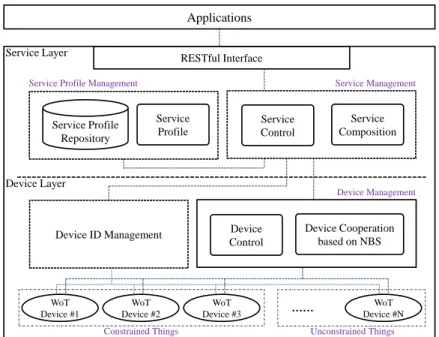
N i α i i S v u N i d u d S f u u 1 = , * * 1,..., = , = max - . (6)In this paper, we proposed a web broker model on WoT that can perform collaboration and efficient operation with various devices. This model is designed on the basis of NBS cooperative game theory so that it may perform autonomous cooperation among devices. In addition, this model can perform an efficient information operation and collaboration between devices through the cooperation between unconstrained devices and the cooperation between constrained devices and gateways. In this paper, we proposed devices cooperation system in WoT Web broker is composed of four modules:
RESTful Interface Service Layer Device Layer Service Profile Repository Service Profile Service Control Service Composition
Service Profile Management Service Management
Device Management Device Control Device Cooperation based on NBS WoT Device #1 WoT Device #2 WoT Device #3 WoT Device #N …… Device ID Management
Constrained Things Unconstrained Things
Applications
Fig. 2. The autonomous cooperation model between things in WoT
1) Service Profile Management module stores the profile information of all services provided through WoT broker. Mainly the type of service, service provider information, such as the service name is stored. Service control block and service composition block search or through the Service is utilized when combined. 2) Service Management module runs the actual service, search, registration and
deletion is performed. In addition, the application to request the services of a broker in the WoT to get the first module. In addition, service composition block by two or more existing services to provide new services to create and perform the role.
3) Device ID Management module stores the physical device IDs as well as the agent IDs belonging to those devices. It also stores sub-network types and service location information.
4) As a function to manage the resources of actual devices, Device Management module contains the privilege information of control, registration, deletion, access and execution for the devices. It also includes a device cooperation block using NBS of game theory in order to perform autonomous cooperation between devices.
4 Conclusion and future work
In this paper, we proposed a web broker model on „Web of Thing‟ that can perform collaboration and efficient operation with various devices. This model is designed on the basis of cooperative game theory so that it may perform autonomous cooperation among devices. In addition, this model can perform an efficient information operation and collaboration between devices through the cooperation between unconstrained devices and the cooperation between constrained devices and gateways. It is expected that the autonomous cooperation between such devices will be actively utilized in constructing WoT environment. In this paper, in order to satisfy, game theory of Nash bargaining solution (NBS) method by introducing a system operation and performance was attempting to maximize.
For the future work, we are planning to develop a prototype system based on the proposed mechanism for things and applications cooperation in WoT Web broker.
Acknowledgments. This work was supported by Electronics and
Telecommunications Research Institute (ETRI) grant funded by the Korea government [13ZC1130, Development of USN/WoT Convergence Platform for Internet of Reality Service Provision].
References
1. Atzori, L., Iera, A., Morabito, G.: The Internet of Things: A survey. J Computer Networks. 54, 15, 2787--2805 (2010)
2. Chenzhou, Y., Shen, W.J., Sun, W., Hu, G., Sun, X.Z.: Active Linked Data for Human Centric Semantic Web of Things. In: 2012 IEEE International Conference on Green Computing and Communications, pp. 9--16. (2012)
3. Christophe, B.: Semantic Profiles to Model the "Web of Things". In: 2011 Seventh International Conference on Semantics, Knowledge and Grid, pp. 51--58. (2011)
4. Duquennoy, S., Grimaud, G., Vandewalle, J. J.: The Web of Things: Interconnecting Devices with High Usability and Performance. In: International Conference on Embedded Software and Systems, pp. 323--330. (2009)
5. Neuman, J.V., Morgenstern, O.: Theory of Games and Economic Behavior, Princeton University Press, (1947)
6. Sally, H.A., Rafie, M.: A survey of Game Theory using Evolutionary Algorithms. In: 2010 International Symposium in Information Technology, pp. 1319--1325. (2010)
7. Mathew, S.S., Atif, Y., Sheng, Q.Z., Maamar, Z.: Web of Things: Description, Discovery and Integration. In: 2011 International Conference on Internet of Things and 4th International Conference on Cyber, Physical and Social Computing, pp. 9--15. (2011) 8. Rasmusen, E.: Games and Information. Blackwell, Oxford, U.K. (1989)