Application of Domain-aware Binary Fuzzing
to Aid Android Virtual Machine Testing
Stephen Kyle
Hugh Leather
Björn Franke
University of Edinburgh [email protected], [email protected], [email protected]Dave Butcher
Stuart Monteith
ARM Ltd. [email protected], [email protected]Abstract
The development of a new application virtual machine (VM), like the creation of any complex piece of software, is a bug-prone process. In version 5.0, the widely-used An-droid operating system has changed from the Dalvik VMto the newly-developed ARTVMto execute Android applica-tions. As new iterations of this VMare released, how can the developers aim to reduce the number of potentially security-threatening bugs that make it into the final product? In this paper we combine domain-aware binary fuzzing and differ-ential testing to produce DEXFUZZ, a tool that exploits the presence of multiple modes of execution within a VMto test for defects. These modes of execution include the interpreter and a runtime that executes ahead-of-time compiled code. We find and present a number of bugs in the in-development version of ART in the Android Open Source Project. We also assess DEXFUZZ’s ability to highlight defects in the experimental version of ART released in the previous ver-sion of Android, 4.4, finding 189 crashing programs and 15 divergent programs that indicate defects after only 5,000 attempts.
Categories and Subject Descriptors D.2.5 [Software En-gineering]: Testing and Debugging—testing tools; D.3.4 [Programming Languages]: Processors—run-time environ-ments, compilers
General Terms virtual machines; testing; reliability; secu-rity
Keywords testing; compiler testing; virtual machine test-ing; fuzztest-ing; Android; DEX; ART; random testing
Permission to make digital or hard copies of all or part of this work for personal or classroom use is granted without fee provided that copies are not made or distributed for profit or commercial advantage and that copies bear this notice and the full citation on the first page. Copyrights for components of this work owned by others than the author(s) must be honored. Abstracting with credit is permitted. To copy otherwise, or republish, to post on servers or to redistribute to lists, requires prior specific permission and/or a fee. Request permissions from [email protected].
VEE ’15, March 14–15, 2015, Istanbul, Turkey..
Copyright is held by the owner/author(s). Publication rights licensed to ACM. ACM 978-1-4503-3450-1/15/03. . . $15.00.
http://dx.doi.org/10.1145/2731186.2731198
1.
Introduction
The creation of a new application virtual machine (VM) is a complicated task and, like the development of any piece of complex software, is bound to create bugs during the pro-cess. Once the initial development is complete, there is the potential for new features and performance improvements to introduce bugs as well. VMs may typically have multiple methods of executing a supplied program, such as an inter-preter or using a just-in-time (JIT) compiler. The develop-ers may wish to optimize such methods of execution further, or even add new ones. When this happens, how can the de-velopers easily test that new bugs are not being introduced? While scrupulous developers will always aim to cover ev-ery corner case, it must be assumed that bugs will inevitably make their way into software.
In this paper, we will focus on the development of the new ART runtime that is used to execute Android applications. The Android mobile operating system continues to enjoy in-creasing popularity, recently reaching over a billion active users measured over a 30-day period. It is therefore impor-tant to use rigorous testing to find and remove as many de-fects that were introduced during development as possible, before the new software is released to the public.
Test suites are a good way to catch bugs during develop-ment, but are typically limited in size, and cannot easily cap-ture all possible interactions between code optimizations in a compiler. The unit test suite of the ARTruntime we discuss in this paper currently stands at around 200 tests, taken and extended from the test suite of the original VMthat Android previously used. Meanwhile, GCC’s unit test suite numbers over 100,000 tests, although GCChas been in development for over 25 years. How can we get from 200 to 100,000 test cases without waiting for 25 years of bug reports? Indeed, regardless of size, these test cases are usually created when bugs are found, and are only intended to prevent regressions. How do we test for bugs that we are not aware of?
When multiple modes of execution are available within a VM, differential testing can be used, where all modes of execution are given the same program, and are expected to
7
7
9 ORIGINAL
TEST DEX FILE MUTATED DEX FLE
ART
INTERPRETER
QUICK COMPILER
OPTIMIZING COMPILER
BUG
Fuzz Testing to Enhance VM Development
Mutating an existing test suite program and running it on the multiple backends of a VM can be used to discover
bugs in these backends.
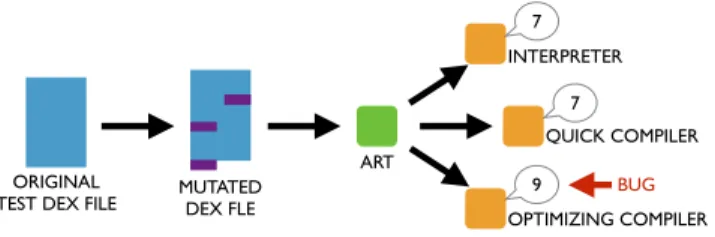
Figure 1. An overview of differential fuzz testing for VMs. A DEXprogram is run using multiple methods of execution, and in this example, one of the methods—the optimizing
compiler—reveals a defect in the way it has compiled and executed the program.
form a consensus about how the program should have been executed. With a VM that is supposed to provide a single platform and set of semantics regardless of the underlying execution platform, this is a sound expectation. Figure 1 visualises how we can use this to test for bugs in the VM. As there is no single canonical reference specification for the ART VM, we assume that the conceptually simplest (and so typically slowest) mode can be considered to be the reference mode, as it will not contain many performance-increasing optimizations that have the potential to introduce incorrect behaviour.
Another common approach to testing is fuzzing, creating random test cases through eithergenerativemeans, where a new test is produced from no initial seed, ormutative, where a test is mutated from a seed program. The combination of fuzzing and differential testing, while applied to domains such as C compilers in the past[12, 16], seems a good can-didate for testing a VMwith the desired rigor that Android’s VMwould need.
We present DEXFUZZ, a tool that takes an existing test suite and performs mutative fuzzing in order to produce new tests, in an attempt to explore the boundaries of the VM. These tests are executed by the various methods of
execution of ART, such as the completed quick compiler, the interpreter, and the in-developmentoptimizingcompiler. In the rest of this paper, we will refer to these modes of execution as “backends” of the VM. We use differences in how these backends execute the mutated tests to identify bugs within in the VM. Some of these bugs are present in the common verification phase of the runtime, while others have been found in the compilation phase. In this paper, we present examples of how these bugs were found, how they came to be, and how they were fixed.
We ran DEXFUZZon the experimental version of ART
released in Android KitKat (v4.4). Even after only 5,000 iterations from one seed program, we had produced 189 programs that crashed the VMand 15 programs that led to divergent behaviour. We checked and confirmed that one of the divergent programs arose from the same bug that we later patched in ART, as described in Section 3.1.1. If DEXFUZZ
had been available during the initial development of ART, it might have been possible to find and fix these issues earlier.
1 // The array-length bytecode reads the length 2 // field of an array object, 8 bytes offset 3 // from the start of the object.
4 //
5 // Original DEX code:
6 // v0 = undef, v1 = undef, v2 = array 7 const/4 v0, 8
8 array-length v1, v2
9 // v0 = 8, v1 = array.length (LD [array, 8]) 10 // v2 = array
11
12 // Mutate array-length from v2 to v0: 13 const/4 v0, 8
14 array-length v1, v0
15 // v0 = 8, v1 = ??? (LD [8, 8]), v2 = array
Listing 1. An example of a DEX mutation leading to a compilation bug, due to incorrect bytecode verification. The compiler will always produce code that reads from the pro-vided array pointer plus 8 bytes. By mutating the array-length instruction to take v0 as an input, we now illegally read from address 8+8=16.
1.1 Motivating Example
The ARTVMis a new implementation of the “Dalvik VM” that executes register-based DEX bytecode on Android. In Figure 1, we see an example of DEXbytecode that loads the constant 8 into virtual register v0 at line 7. On line 8, the
array-lengthinstruction then reads into v1 the length of the array whose reference is stored in v2. If we mutate the array-lengthbytecode to instead read from whatever “reference” is stored in v0, then ART’s bytecode verifier should reject this bytecode, because v0 does not contain an array reference at this point. However, the verifier previously failed to do this. The compiler backend for ARTwould then assume that it was safe to produce code that reads from *(v0+8), and so the resulting code allowed arbitrary reading of the VM
process’ address space, if the constant loaded into v0 was also modified. With the error checking done by the verifier reducing the complexity of the compiler, this requires that verification be sound, which was not always the case, and was a common source of issues.
The Java language aims to provide a “security sandbox” for any program that executes within it. It is still possible to construct pointers and read memory arbitrarily if a mecha-nism such as the Java Native Interface (JNI) is used, so more trust can be placed in an application being “well-behaved” if it contains no JNIcode. Therefore such an application may come under less scrutiny by security analysts, while a piece of crafted DEXcode as presented in Figure 1 could be used in combination with other exploits to read private data. With the open model of Android, and ease with which applica-tions can be accepted into the various application stores that use Android, there is a significant possibility of encountering accidentally or even maliciously malformed DEXfiles.
Using DEXFUZZ, we have found a number of bugs dur-ing the development of ART, and have submitted patches to the Android Open Source Project (AOSP) code base where ART is developed. We focussed our efforts on finding and reporting bugs in thequick compiler, as this is the default mode of execution for ART. It is our expectation that DEX
-FUZZ will become more useful as theoptimizing compiler becomes more sophisticated. As the compiler surpasses the complexity of thequick compiler, optimizations are likely to introduce subtle bugs as they are initially developed. We hope that use of this tool may help prevent these bugs ever being put into released versions of the ARTVM.
1.2 Contributions
The contributions presented in this paper are the following: 1. the description of domain-aware binary fuzzing for DEX
bytecode, improving overi.naive approaches that have a greatly reduced chance of ever producing valid programs;
ii.approaches that may only produce valid programs;iii.
approaches that are limited to only source code genera-tion, and therefore potentially fail to test as many byte-code sequences in a VM.
2. an application of differential testing to the ART virtual machine in Android, that exploits the multiple execution methods available in the VMto find bugs using mutated test programs.
3. a presentation of bugs found in the Android Open Source Project using these approaches, and how they were fixed.
1.3 Overview
In Section 2, we present an overview of our fuzzing and test-ing strategy for findtest-ing bugs in the ARTVM. In Section 3 we present an analysis of the mutation process, as well as giv-ing examples of some bugs that were found usgiv-ing our system and how they were found. In Section 4 we provide some dis-cussion of the impact of our system, and look at related work in the field in Section 5. Finally, we consider potential future work for DEXFUZZin Section 6 and conclude in Section 7.
2.
D
EXF
UZZFuzz testing as a concept initially referred to the random creation of input to test the capabilities of a program or Application Programming Interface (API), particularly to test its ability to gracefully handle erroneous input. Fuzz testing is typically divided into two categories:generative, andmutative, where generative does not require a seed to generate a new piece of input, while mutative does.
2.1 Naive fuzz testing
The most basic form of mutative fuzzing is to take some seed input and randomly flip bits in order to produce some new, mutated input. We could apply this technique immediately to producing test programs for the VM, but this isn’t likely
to yield very useful results. The ARTVMis supposed to pro-vide a secure sandbox for program execution, and so it must verify any bytecode that it is expected to execute. This verifi-cation forms a hierarchy of checks that range from checking that the two input registers to anadd-floatbytecode ac-tually contain float values, to calculating an Adler-32 sum on the file, and checking this against a provided check-sum in the header. Because of these checks, it is extremely likely that any bytecode that is produced through random bitflips will fail some part of verification, if not at least the checksum that protects the entire DEXfile.
We tested this claim by producing a simple fuzzer that fuzzed a test program a million different ways for three dif-ferent fuzzing strategies. In all cases, the DEXfile header is untouched, and then the Adler-32 checksum is recalculated after fuzzing, to ensure that we are checking that such simple fuzzing will be rejected by some other aspect of verification aside from the checksum. We ran each program through the DEX code viewing tool (dexdump) as this reports when a DEXfile has basic structural errors.
The first strategy iterated through every byte after the header, with a 50% chance of having its value varied by +/- 30. This produced no programs that passed structural verification, out of a million programs. The second strat-egy changed the chance to 1%, and still no programs passed structural verification. The final strategy used a chance of 0.1%. This strategy did produce programs that passed struc-tural verification - 14%. With further testing, 4% passed full verification when executed with ART, and of those that passed, 97% ran successfully and 0.14% showed divergent behaviour between different ARTbackends - 0.006% of the million programs that were generated. Focussed mutation could achieve a much higher rate of divergence than this -we stated in Section 1 that -we -were able to find 15 diver-gent programs in only 5,000 attempts, compared to the rate of 60 in 1,000,000 seen here. Additionally, this approach doesn’t have the potential to insert or delete instructions, or insert even more complex constructs such as new methods or classes.
Typical generative approaches to fuzz testing for compil-ers have focussed on producing valid programs in the rele-vant source language. In the case of Csmith[16], this desire for valid program generation stemmed from the presence of undefined behaviour with certain sequences of C code. With a bytecode format like DEX, the concept of undefined be-haviour does not exist. Either a sequence of bytecode has a well-defined set of semantics, or the sequence must not ver-ify. Therefore, we are not concerned with the threat of unde-fined behaviour, and would actually prefer to generate some invalid programs, in a bid to ensure the verifier of ARTis ro-bust. Additionally, prior generative approaches have found it difficult to produce a system that fully utilises all features of the language that they are generating code for[16]. Using a set of programs from a test suite that should at the very least
contain all features of the language as a seed basis for testing seems a better approach.
Neither of the above strategies are ideal for fuzzing byte-code, so in DEXFUZZ we adopt an approach that applies some degree of intelligence to the use of mutations.
2.2 Mutating DEXBytecode
addsub
iget v0v1
new FooBar
try
1
2
3
4
5
6
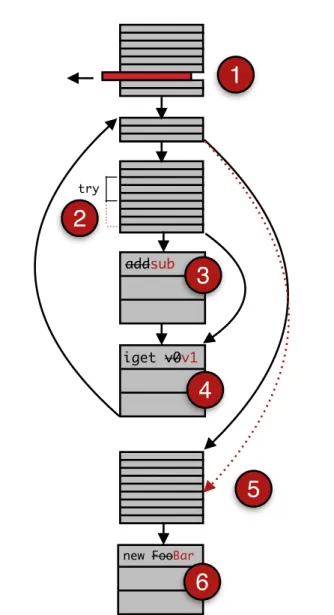
Figure 2. Some examples of DEXbytecode mutations ap-plied to a method formed of six basic blocks. In 1, an in-struction is deleted. In 2, the boundaries of a try block are expanded. In 3, an add operation is replaced with a subtract operation, operating on the same types and virtual registers. In 4, the virtual register specified by anigetinstruction is changed. In 5, the branch from the 2nd basic block to the 6th is shifted forward by a few instructions. Finally, in 6, a new instance of an object of class Bar is created instead of Foo.
Our fuzzing process can be characterised as domain-aware mutation of bytecode. Figure 2 provides an example
of some mutations performed within a single method. Our hope is that the application of a small number of relatively simple, but domain-aware, mutations can lead to both pro-grams that verify, but also highlight bugs in the ART VM
through unexpected handling of mutated bytecode. parse DEXfile into mutatable methods;
Methods= set of mutatable methods;
Mutators= set of mutators;
methodCount= random(2,10);
fori in methodCountdo
method= selectRandom(Methods);
mutationCount= random(1,3);
whilemutationCount > 0do
mutator= selectRandom(Mutators);
ifmutator.canMutate(method)then
method=mutator.applyMutation(method);
mutationCount=mutationCount- 1;
else
ifreached mutation attempt thresholdthen
give up mutating method;
end end end end
write methods and mutated methods into new DEXfile;
Algorithm 1:Mutative fuzzing process for DEXfiles. Algorithm 1 shows pseudo code for the mutation process. DEXFUZZwill parse a program’s DEXfile and produce a set of mutatable code items, each of which represent a method within the program. In order to increase the likelihood that the program will successfully verify, DEXFUZZlimits the number of methods that will be mutated to a random value between 2 and 10. A random subset of the available mutat-able methods are then selected using this value, and each in turn is mutated. Each method has between 1 and 3 mutations applied to it by default, although this value can be config-ured. DEXFUZZrandomly selects from the list of available mutators that are listed in Table 1. Because each mutator checks and reports if it is able to mutate the given method (for example, BranchShifter will only mutate methods con-taining branches), this process repeats until the desired num-ber of mutations has been applied, or a maximum numnum-ber of attempts is reached. After all mutations have been applied to the correct number of methods, a new, mutated DEXfile is produced by DEXFUZZ.
Why does this mutation strategy improve over simple bit-flipping fuzzing?At the very least, this allows us to add and remove instructions within the method. Additionally, we can ensure that branches always remain within the code area, type or field pool indices fall within the range of types of fields available in the DEX file, and a specified virtual
register in an instruction is actually allocated in the given method. These are what we consider to be simple structural constraints that the verifier can easily check for.
Why does it improve over generative or mutative fuzzing that only produces legal programs? While we have highlighted some verifier constraints as simple, others are more complicated, such as checking the types of values in virtual registers are valid wherever they are used. It is im-portant to test these constraints, and so we do not provide any guarantee that a mutation will leave the bytecode in a completely legal state. Indeed a few of the bugs we have found in ARTwere found in the verifier, and this was made possible by allowing the production of invalid programs.
2.3 Differential Testing of Multiple VMBackends
Test suite programs are typically used to test for VM cor-rectness by executing the program, and comparing its output against what it is expected to produce. However, with the generation of new test programs, the expected output is un-known. Therefore, we rely on the fact that the multiple meth-ods of execution available to a VMare intended to produce the same result—one of the design goals of many VMs, but particularly ones related to executing Java code—to test our mutated programs.
Figure 1 visualises our differential testing strategy. We can run mutated programs using the quick and optimizing
compilers, as well as the interpreter. Additionally, in our search for bugs, we ran mutated programs on both 32 and 64-bit variants of the VM. When they fail to reach a consensus about the output of the program, it is highly likely that one of the modes of execution has discovered a bug.
3.
Results
We have used DEXFUZZto find defects in the in-development version of ART when running on an ARMv8 platform, in both AArch32 and AArch64 execution modes. The ver-sion of DEXFUZZ we have used to find bugs is designed to send programs to the target platform via the Android De-bug Bridge (ADB) for execution. Because of the overhead involved in sending programs to the platform, we verify all mutated programs on the host machine first using the DEX
compiler, dex2oat, that has been compiled for the host machine, and only upload programs that pass this initial test. The host and target versions of dex2oatverify all DEX
files the same way.
3.1 Finding Bugs
In this section we present some examples of bugs that we have found in the ARTVMin AOSP, and explain both how they were discovered by DEXFUZZ, and what caused their presence. Some bugs we report were found in the verifier. Although we do not have two verifiers to perform differential testing with, the use of such testing can still lead to bugs being found in the verifier. This typically occurred when a
hole in the verifier would lead to the quick compiler and interpreter producing different results for the falsely verified code. This was usually because thequick compiler would make assumptions about the code it could produce based on properties of the DEX bytecode that the verifier had allegedly proven.
3.1.1 Reading the instance field of a non-reference bearing virtual register
In DEXbytecode, there exist instructions such asiget, that allow the reading and writing of instance fields of objects. The verifier of ART checks that the data currently in input virtual registers for a given bytecode have the correct types, with respect to the types the bytecode operates on.
const/4 v2, 1
iget v0, v1, MyClass.counter add-int/2addr v0, v2
iput v0, v1, MyClass.counter
This piece of DEXbytecode represents the increment of thecounter field of a MyClass object whose reference re-sides in v1. When mutated by the VirtualRegisterChanger mutation, which changed thev1on line 2 tov2, the verifier accepted this bytecode, despiteigetnow attempting to read the instance field of the constant 1 inv2rather than any ref-erence to an object. Thequickcompiler would then assume that it was safe to emit native code that loads from the ad-dress stored in the input toiget, plus the offset of counter. If the constant loaded intov2 initially was modified, then memory could be arbitrarily read from the process’ address space. We submitted a patch for the verifier to AOSP that ensured this check was performed.
3.1.2 Mixed float/int constant usage causes arguments to be passed incorrectly
While many arithmetic and logical operations in DEX code are aware of the types of data they are using, other byte-codes such as data movement and constant loading instruc-tions are not. Consider the following code sample.
const v0, 1 const v1, 1.0
invoke-static {v0}, void Main.doInteger(int) invoke-static {v1}, void Main.doFloat(float) This code loads two constants, 1 and 1.0, and passes them to methods that take integer and float arguments, respec-tively. Theconstbytecode is typeless, and just loads a bit pattern into a virtual register. As such, the load of the float value 1.0, and the integer 0x3f800000 (the IEEE 754 repsentation of 1.0) are indistinguishable in bytecode. This re-quires that type inference be performed - the compiler must look at the uses of constants to determine their types. Be-causev1 is used as a float at line 4, it must be a float. If the VirtualRegisterChanger mutation changes the register on line 3 tov1instead ofv0, then the constant 1.0 inv1is now being passed to both methods. Type inference will determine
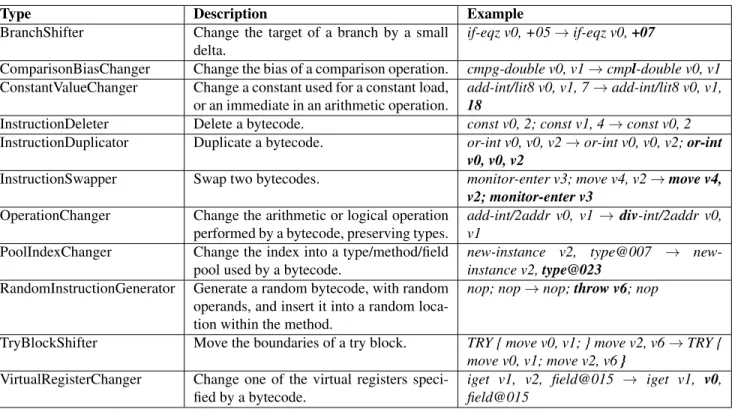
Type Description Example
BranchShifter Change the target of a branch by a small delta.
if-eqz v0, +05→if-eqz v0,+07
ComparisonBiasChanger Change the bias of a comparison operation. cmpg-double v0, v1→cmpl-double v0, v1
ConstantValueChanger Change a constant used for a constant load, or an immediate in an arithmetic operation.
add-int/lit8 v0, v1, 7→add-int/lit8 v0, v1, 18
InstructionDeleter Delete a bytecode. const v0, 2; const v1, 4→const v0, 2
InstructionDuplicator Duplicate a bytecode. or-int v0, v0, v2→or-int v0, v0, v2;or-int v0, v0, v2
InstructionSwapper Swap two bytecodes. monitor-enter v3; move v4, v2→move v4, v2; monitor-enter v3
OperationChanger Change the arithmetic or logical operation performed by a bytecode, preserving types.
add-int/2addr v0, v1 → div-int/2addr v0, v1
PoolIndexChanger Change the index into a type/method/field pool used by a bytecode.
new-instance v2, type@007 → new-instance v2,type@023
RandomInstructionGenerator Generate a random bytecode, with random operands, and insert it into a random loca-tion within the method.
nop; nop→nop;throw v6; nop
TryBlockShifter Move the boundaries of a try block. TRY { move v0, v1; } move v2, v6→TRY { move v0, v1; move v2, v6}
VirtualRegisterChanger Change one of the virtual registers speci-fied by a bytecode.
iget v1, v2, field@015 → iget v1, v0, field@015
Table 1. A complete listing of all the DEXmutations currently performed by DEXFUZZ.
thatv1contains both a float and an integer value, and this is legal according to DEXbytecode specifications.
This lead to a miscompilation in the quick backend of ART, however, because the code that passes arguments to the method using the appropriate calling convention would rely on this type-inference information, resulting in problems in an environment where integer and floating point (FP) values are passed in separate physical registers. Because the mu-tated registerv1had been marked as a float type at line 3, the emitted native code would pass this argument in a FP phys-ical register, when the callee method would expect to find its integer argument in a core (non-FP) register. The callee method would then use whatever data happened to be in that core register, and execute incorrectly. We have submitted a patch to AOSPthat changes the calling convention compiler code to look at the specified types of the callee method in-stead of type-inference information.
3.1.3 Compiler crash from an unreachable check-cast
Verification of DEXbytecode is only performed on reach-able code - code flow analysis takes place during verifica-tion, reporting errors like execution reaching the end with-out an explicitreturnbytecode. It is not intrinsically illegal to have unreachable bytecode, however. Consider the follow-ing DEXbytecode.
return-void check-cast v0, V return-void
The check-cast instruction is illegal when considered alone - it checks that it is acceptable to cast the value in
v0to avoidtype, or throw aClassCastException oth-erwise.Voidis never a legal type to cast to, but because the
check-castis not reachable it is never rejected by the veri-fier. For most bytecode, this would not lead to any problems, however thequickbackend performed a later optimization where it scanned across DEXbytecode it was to compile, to findcheck-castinstructions that it could elide because they would never throw the exception. This optimization would reach the unreachable check-cast and then cause the com-piler to crash when an assertion was broken. While we have presented the simplest example of this bug here, this was found when the RandomInstructionGenerator mutation in-serted such an invalidcheck-cast after a returnstatement. We submitted a patch for AOSP that makes this scan only consider instructions that were flagged as visited during ver-ification.
3.1.4 Verifier allows jump to move-result
In DEXbytecode, every method invocation instruction that calls a result-returning method must be followed by a move-resultbytecode to save the result. This means that verifica-tion must check thatmove-resultalways comes immediately after an invoke. Consider the following DEXbytecode.
002: if-nez v0, 008
004: invoke-static {}, int Main.getInteger() 007: move-result v1
Mutations Analysis Page 10 Bran chSh ifter Com paris onBi asSh ifter Con stan tValu eCha nger Inst ruct ionD elet er Inst ruct ionD uplic ator Inst ruct ionS wap per Ope ratio nCha nger Pool Inde xCha nger Rand omIn stru ctio nGen erat or TryB lock Shift er Virt ualR egist erC hang er 0% 10% 20% 30% 40% 50% 60% 70% 80% 90% 100%
Comparison of Mutations
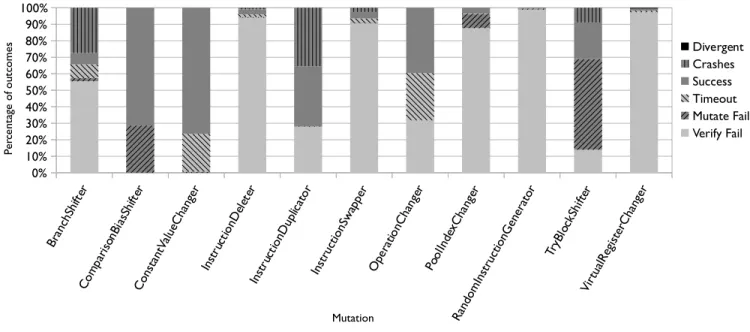
Divergent Crashes Success Timeout Mutate Fail Verify Fail Mutation Pe rc en ta ge o f o ut co m esFigure 3. Breakdown of resulting programs created by individual bytecode mutations. In each case, we have run DEXFUZZ
for 2,000 iterations, and report what percentage of these programs failed to be mutated, failed to verify, timed out, crashed, were successful, or produced program divergence, when run on the experimental version of ARTavailable in Android KitKat (v4.4).
Mutation Verify Fail Mutate Fail Timeout Success Crashes Divergent BranchShifter 1110 37 167 137 549 0 ComparisonBiasShifter 0 572 0 1428 0 0 ConstantValueChanger 0 13 459 1528 0 0 InstructionDeleter 1880 8 32 60 20 0 InstructionDuplicator 558 5 0 728 709 0 InstructionSwapper 1811 7 52 79 50 1 OperationChanger 636 2 571 791 0 0 PoolIndexChanger 1753 169 7 71 0 0 RandomInstructionGenerator 1979 10 2 5 2 2 TryBlockShifter 279 1098 0 444 179 0 VirtualRegisterChanger 1944 2 18 25 0 11
Table 2. Absolute counts of execution outcomes for each mutation shown in Figure 3.
We can see that themove-result instruction legally im-mediately succeeds theinvoke-staticinstruction. For move-result, thequickcompiler will typically emit native code that moves data from the return register of the platform’s calling conventions into whatever storage location is associated with the specified virtual register, be it another physical register, or a stack location. For example on the ARMplatform, the data will be read from ther0register.
The verifier failed to check if there were any instructions that branched directly to amove-resultinstruction, however. If the BranchShifter mutation made the if-nez instruction jump to themove-resultinstruction instead ofadd-int, then
we could have a case where we execute theif-nezinstruction, and then themove-resultinstruction, although we have not returned from an invoke. Previously, the verifier would ac-cept this, and invalid native code would be produced. In this case, if the branch was taken, then execution would jump directly to the copy of the r0 register, although it would no longer be known at this point what datar0might con-tain. We submitted a patch to AOSPthat ensures any form of branching directly to amove-resultinstruction is rejected.
3.2 Characterization of mutations
We have presented 11 mutations that can be applied to DEX
bytecode that aim to highlight bugs within the ART VM. In this section, we characterise which mutations are more responsible for creating verified programs and finding pro-gram divergences. Because we have already used DEXFUZZ
to find and patch a number of defects within ART, in this section all test programs were executed with the experimen-tal version of ARTreleased in Android KitKat (v4.4), where we are certain that there are bug-indicative divergences to be found. We use a single test program as a seed in these experiments—which was confirmed to work in this version of ARTprior to mutation—in order to be sure we are evalu-ating the characteristics of mutation.
We ran DEXFUZZ11 times, each time enabling only one of the available DEXmutations. For each mutation, we pro-duced 2,000 candidate programs, and we report how many verified, how many failed to mutate at all, how many passed verification and ran successfully on the platform without di-vergence, how many crashed, and how many produced diver-gent behaviour that may indicate the presence of a defect. The differential testing we use in these experiments com-pares only the output of the interpreter and the compiler in this older version of ART.
In Figure 3 and Table 2, we present the breakdown of execution outcomes for the different mutations we perform. Some are clearly more successful at finding divergent be-haviour than others, with the VirtualRegisterChangermost responsible for producing divergences. 97% of the pro-grams generated by this mutation failed verification how-ever, so this clearly demonstrates the necessity of allowing the generation of potentially illegal programs in order to find divergences. The other mutations that found divergences were RandomInstructionGenerator, and InstructionSwap-per, which also generated a large percentage of programs that failed to verify, at 99% and 91%, respectively. A num-ber of these divergent programs arose from the bug described in Section 3.1.1.
Many mutations were responsible for producing crashes in ART, with the InstructionDuplicator andBranchShifter
mutations most likely to lead to a crash. From a cursory anal-ysis of the backtraces of these crashes, it appeared that ART
had problems with SSA transformation during the compila-tion stage, which may have been exacerbated by the variety of unique control flow graphs produced by theBranchShifter
mutation in particular.
Looking at each mutation in turn,BranchShifterproduced invalid programs for roughly half of its iterations, and was otherwise responsible for a large number of crashes. The
ComparisonBiasShifter mutation either produced success-ful programs, or failed to mutate the program at all, due to maximum attempt thresholds mentioned in the description of DEXFUZZ’s operation.ConstantValueChangernever pro-duced any invalid programs, but created a number of
long-running programs, presumably when changes to constants meant loops ran longer than the allowed timeout. Instruc-tionDeleter was another mutation that led to a large per-centage of invalid programs, but was also able to find a few crashes.
InstructionDuplicator had a roughly three-way split in terms of crashing, successful and invalid programs pro-duced, with no divergences found, whileInstructionSwapper
found a few crashes, but mainly produced invalid programs. DespiteConstantValueChangeronly changing an operation with a particular set of input types to an operation with the same set of input types, 30% of its programs failed to ver-ify, contrary to expectation. This was traced to bytecodes that operated on 64-bit integers likeadd-longbeing changed to shift operations on longs, such as ushr-long, where the second input, the shift amount, is actually expected to be a 32-bit value, rather than 64-bit.
PoolIndexChanger resulted in a lot of invalid programs, as for example, method invocations were changed to call new methods with incompatible argument types. As might be expected,RandomInstructionGeneratorlead to the largest percentage of invalid programs, but did also find crashes and divergences. The TryBlockShifter mutation found a large number of crashes too, which lends weight to the idea that control flow issues were a major source of crashes in the compiler at the time. Finally, as stated above, VirtualRegis-terChangerwas the most successful mutation, finding the largest number of divergences, but failed to find any crashes at all.
3.3 Effect of multiple mutations
We have seen that some mutations are capable of finding di-vergent behaviour on their own, and indeed some have been individually responsible for many of the bugs that we have discovered in ART so far. With the use of these small mu-tations there is a hope that a combination of these could perhaps find other bugs that individual mutations could not. We ranked the mutations of the previous experiment first by their ability to find divergent behaviour, and then by their ability to produce crashing programs. We took the top 5 of these mutations—VirtualRegisterChanger, RandomInstruc-tionGenerator, InstructionSwapper, InstructionDuplicator, andBranchShifter—and ran DEXFUZZwith all 5 enabled, each with equal chance of being selected. This time, we ran DEXFUZZfor 10,000 iterations, and for each divergence we found, we checked to see if a combination of mutations was responsible for the divergence.
Table 3 presents the breakdown of execution outcomes when running the top 5 most successful mutations. As would be expected, the largest percentage of programs produced were invalid, since three of the top five mutations had ex-tremely high invalid production rates. Like those mutations, divergences were also found. For each divergence found, we assessed if the divergence was produced by a combination of mutations, but found that this was not the case - in each
Execution Outcome Observed Verification Failure 9249 Timeout 129 Mutation Failure 28 Crashing 314 Successful 257 Divergent 23 Iteration Total 10000
Table 3. Breakdown of execution outcomes when run-ning DEXFUZZwith only the top 5 most successful muta-tions enabled: VirtualRegisterChanger, RandomInstruction-Generator, InstructionSwapper, InstructionDuplicator, and BranchShifter.
program, a single instance of mutation created the divergent behaviour. It is easy to imagine a set of mutations that may result in divergence together - for example, creating a ran-dom legalarray-lengthinstruction, and then swapping it to a location where it becomes illegal and finds the bug men-tioned in Section 1.1, where the swap without the array-lengthinstruction would have also been legal. However, we have failed to find such occurrences in practice thus far, and so further investigation is required. More sophisticated mu-tations, such as those mentioned in Section 6 or fuzzing the
optimizingcompiler may provide better results.
3.4 Comparison with other mutative fuzzing strategies
While we showed in Section 2 that a naive fuzzing scheme was not ideal for fuzzing a strictly verified bytecode format, and while we have found no available fuzzing systems that specifically fuzz DEX programs for ART or Dalvik, there do exist target-program-agnostic fuzzers that attempt to intelli-gently perform mutative fuzzing. One such fuzzer is Ameri-can Fuzzy Lop (AFL)[1], a system that fuzzes inputs for an
instrumented binary program, observes the execution paths of the instrumented binary, and attempts to intelligently fuzz new inputs using basic bit-level flipping, such that it will aim to fuzz interesting programs further to explore new execution paths. It aims to maximise the number of unique execution paths it finds, as well as the number of crashes.
We have built a host (x86-64) version of ART with the compiler wrapper that AFLprovides, that inserts the instru-mentation required to be used with the version of AFL. We have specifically disabled the header verification of ARTfor this experiment as well, in order to give AFL a chance to explore more than the checksum calculation code of ART, as this is a known limitation of AFL. We ran AFLin its in-strumented fuzzing mode for 24 hours, with a subset of 16 ART test programs as seeds, to see how many crashes and hangs it found, as well as programs with unique paths. Of these programs with unique paths, we ran them through our differential tester to see if any of the programs produced di-vergence between the interpreter’s and thequickcompiler’s
output. We then ran DEXFUZZfor 24 hours with the same seed programs, to see how many crashes, hangs, and diver-gent programs it produced. In this experiment, DEXFUZZ’s mutations have all been set to have an equal chance of being triggered.
Figure 4. Comparison of success rates of AFLand DEX -FUZZafter a 24-hour period of fuzzing.
Figure 4 shows how DEXFUZZ’s ability to find divergent programs and crashes compares with AFL’s. While it is clear that AFLis capable of producing a significantly larger num-ber of programs within 24 hours, this could be explained by choice of implementation language (DEXFUZZis written in Java, while AFL is written in C), and that very little time has currently been spent optimising DEXFUZZ, as most of the testing time in the tool is dominated by uploading pro-grams to the test platform, and waiting for them to finish ex-ecuting. Despite a comparatively small quantity of tests with respect to AFL, DEXFUZZ managed to find two programs that demonstrate divergent behaviour in ARTwhile none of the programs that AFL marked as having unique execution paths demonstrated divergent behaviour. Indeed, of all the programs that AFLproduced, none of them passed the ver-ification stage of ART either. For all the hanging programs that AFLreported, none of these passed verification, and may have been an artefact of AFL’s default timeout value. Despite having a more lenient timeout value, DEXFUZZwas able to
find many more hanging programs in comparison to AFL, due to it actually producing programs that pass verification. Where AFLdoes excel in comparison to DEXFUZZhowever, is its ability to find crashing behaviour. AFL has probably thoroughly tested the structural verification of ART, while DEXFUZZ’s fuzzing is weaker in this regard. In general,
however, we have shown that the use of domain-aware mu-tation is useful in discovering divergent behaviour.
4.
Impact
In this paper, we have presented DEXFUZZ, a differential mutative fuzz testing tool for finding bugs in ART, and pre-sented a number of bugs discovered in the AOSPversion of ART. We have also presented some information about how many divergent programs we could have found in the exper-imental version of ARTreleased in Android KitKat, if DEX -FUZZhad been available at the time. Now we will discuss some of the impact on ARTfrom our testing.
4.1 Improvements to ARTTest Suite
Previously, the ARTtest suite consisted of a number of Java programs, that were compiled to DEX bytecode and exe-cuted. Our testing has uncovered bugs that are revealed using programs that cannot be produced directly from Java code, but require manipulation of already existing DEXbytecode. Since we started submitting patches to fix bugs uncovered by DEXFUZZ, the developers of ART in AOSPhave added a new suite of tests to the existing ART suite, that allows for tests using mutated DEXbytecode to be checked. Now tests can be described using thesmaliDEXbytecode assem-bly format[6], which allows us to test for regressions in bugs found by DEXFUZZ. Our patches to AOSPwere the catalyst for the creation of these tests, and we always aim to submit any patches with relevant tests for the test suite now.
4.2 Potential for future backends
Currently DEXFUZZhas only been put into practice with thequickcompiler and interpreter of ART, as these are the only mature backends currently available. From looking at the AOSP code base, it is clear that significant work is go-ing towards producgo-ing a new backend, theoptimizing com-piler. Thequickbackend treats DEXbytecode compilation in a simple manner, mapping directly from DEXbytecodes to sequences of native code and performing a few simple code optimizations on top. By comparison, the optimizing com-piler focuses on much more significant optimization, of the DEXbytecode itself before lowering to native code, using much more sophisticated code optimization techniques, such as those found in modern JITcompilers. With such complex-ity comes the potential for bugs however, and as we have demonstrated DEXFUZZ’s ability to find bugs in older ver-sions of ART, we expect use of this tool to find bugs in the
optimizingcompiler early.
4.3 Contribution to AOSP
Since we have started developing DEXFUZZ, we have found a number of bugs in ART, and submitted patches for these bugs to the AOSP tree, most of which have been accepted, showing that DEXFUZZ finds bugs that the developers are interested in fixing. DEXFUZZitself has been successfully submitted as a patch and merged into the AOSP code base, clearly indicating that DEXFUZZis of considerable worth to the future development of ART.
5.
Related Work
The use of fuzzing as a testing strategy started with Purdom[14], where a system that generates random sentences to test parsers was presented. Fuzzing was then used to test UNIX
utilities for vulnerabilities by Miller et al.[13]. There have been a number of recent approaches to black-box fuzz test-ing for file formats, such as Peach[5] and AFL[1], as well as approaches to fuzzing of x86 instructions[11]. In this lit-erature review we shall focus on the prior art of applying fuzzing to the testing of compilers and runtimes, consid-ering other mutative approaches and the use of differential testing.
5.1 Differential testing of compilers
In [16], Yang et al. present Csmith, a tool that can gener-ate millions of C99 compliant programs, and find over 300 bugs in open-source and commercial C compilers. They use differential testing to find these bugs, checking for a con-sensus in output between these different compilers, which inspired our use of multiple “backends” in the ARTruntime. However, their main concern is with avoiding undefined be-haviours of C programs, and as such their system does not actually use all features of any C standard. Because our tests are based on ART’s available test suite, at a minimum we will test all the features of the VMthat the test suite uses, which
we then test in new combinations to explore for defects. We aim to quickly generate and throw away many programs that do not verify, in the hope of finding some that erroneously do verify, and lead to bugs. Finally, while their differential testing work focuses only on testing compilers, we test the verifier, compiler and complete runtime of a VM.
In [12], Vu et al. present Orion, a tool that uses Equiva-lence Modulo Inputs (EMI) to reveal more miscompilations than Csmith, which mainly highlights compiler crash de-fects. EMI is a form of mutative fuzzing, using code cov-erage information about programs to prune test programs into smaller programs with equivalent semantics. The set of equivalent programs are then executed with the same com-piler to ensure they all produce the same result, with differ-ences indicating compiler bugs. Using coverage information to direct mutations would be an interesting direction to take our work into in the future. Again, a concern of Orion is avoiding generating programs with undefined behaviours, a constraint we do not need to worry about.
5.2 Fuzz testing of runtimes
The published fuzzing of a Java virtual machine has been at-tempted before, in the tool jFuzz by Jayaraman et al. [10], built upon an explicit-state Java model checker and a sys-tem that fuzzes Java source code to find new program paths. However, we have not found any published literature con-cerning the application of fuzz testing at the bytecode-level for JVMs or the Dalvik/ARTVMs. One advantage of fuzzing bytecode rather than source code is that features of the byte-code that the source language doesn’t use can be tested. For example, while the invoke_dynamic JVM instruction isn’t used by Java, it is used by other source languages that com-pile to JVMbytecode. Some preliminary research was per-formed into fuzzing ARTby Sabanal at the Hack in the Box Amsterdam 2014 conference[4], but was not formally pub-lished.
Research has been made into other virtual machines that take source code rather than bytecode as their primary in-put. In particular, these tools have applied mutative and gen-erative fuzzing to the source code using grammars. In [9], Holler et al. present LangFuzz, a language-agnostic system that has been tested against the JavaScript and PHPruntimes. The authors of [8] introduce the use of constraint logic pro-gramming into fuzzing, building upon the generation goals of stochastic context-free grammars that systems like Lang-Fuzz use for program generation. They apply this technique to the JavaScript virtual machine. Our contribution in this paper, domain-aware binary fuzzing, is related to the use of stochastic context-free grammars, and it would be interest-ing to see if DEXFUZZmutations could be described using context-free grammars in general.
The authors of [15] apply fuzz testing to the ActionScript virtual machine, and is probably most similar to our work, since ActionScript VMs accept compiled bytecode as input rather than source code. The authors’ approach is to produce nearly valid ActionScript source code, parse this source and perform runtime class mutations to produce valid Action-Script programs, which then test the ActionAction-Script VM. This approach is ultimately generative, and the authors compare its achieved code coverage against an existing test suite for ActionScript, whereas we use a test suite as a set of program seeds to perform our fuzzing.
6.
Future Work
While DEXFUZZ has been submitted and merged into the ART code base in AOSP, we have a number of plans for extensions and improvements to DEXFUZZ.
As it is theoretically possible for bugs to arise from a set of multiple DEX mutations, we plan to add a feature to DEXFUZZ where once a divergent program is found, DEXFUZZwill automatically search for the minimal set of mutations that result in execution divergence. This can be done by, for example, finding if the mutations can be limited to a single method, and then performing a binary search from
there. This will aid users of the tool in finding the source of the bug, if they know exactly which methods and mutations are responsible for the issue.
In the case of multi-threaded programs, it is possible that while a test suite seed program produces deterministic out-put during normal execution, mutation could cause the pro-gram to produce non-deterministic output, either during nor-mal execution, or during the process of error reporting. Cur-rently DEXFUZZ will filter out any found divergences be-tween backends due to this problem, by checking if one of the backends produces divergent output with itself when tested multiple times with the same program. However, a better solution might be to run a backend multiple times to find the range of divergent outputs it produces, and check that the other backends’ outputs fall within this set of diver-gent outputs, such as performed in QuickCheck[7].
DEXFUZZ’s testing strategy is currently predicated on the belief there are no bugs in the VMsuch that all backends of the VMwill produce exactly the same incorrect output. In this case, there would be no divergence to indicate the pres-ence of a bug. This is a general flaw with the differential testing methodology, and the only possible mitigation is to use more backends to perform testing. Alternatively, another VMthat obeys the same specification could be used. While this is easily possible when testing JVMs, with the myriad of implementations available, the only feasible execution al-ternative to ARTon Android is the previous VM, Dalvik, al-though there exist alternative Dalvik implementations such as Myriad’s Alien Dalvik[2] and BlueStacks AppPlayer[3]. It would be useful to execute programs with both the ART
and Dalvik VMs, provided that the compared output is fil-tered to remove known divergences between the two imple-mentations - namely the way that they report errors.
Finally, we plan to add more mutations to DEXFUZZ, in-cluding “global” mutations such as changing the access flags of classes, methods, and fields. For example, the volatile flag of fields could be flipped randomly, to ensure that the loading and storing to and from the fields always holds the correct semantics in presence of other optimizations, although again this may require measures to check for self-divergence. Ad-ditional method-level mutations are planned, such as inject-ing the console printinject-ing of virtual register values at ran-dom locations, or calls to specific system methods such as theSystem.gc()method, to exercise random calls to the garbage collector.
7.
Conclusion
In this paper we have presented a tool to augment the testing of the new ARTVMin Android, called DEXFUZZ. We have shown how use of this tool in the past could have prevented the inclusion of security bugs in the original experimental re-lease of ART. We have also described a number of bugs that we have found and fixed using this tool in the AOSP ver-sion of ART, to demonstrate the utility of this tool to prevent
bugs being released in future versions of the software. DEX -FUZZis built upon the combination of domain-aware binary fuzzing and differential testing, and we have evaluated what sorts of binary mutations that we have applied to DEXfiles lead to divergent behaviour in the experimental version of ARTfound in Android KitKat, to confirm which mutations
were more useful for finding bugs. We find that mutating use of virtual registers, insertion of random instructions, and swapping instructions, while increasing the amount of in-valid programs produced, are the mutations most likely to lead to divergent behaviour, and should be useful initial mu-tations to use if future VMdesigners wish to use this testing approach.
References
[1] american-fuzzy-lop on Google Code.https:
//code.google.com/p/american-fuzzy-lop/. Accessed: 2014-11-12. [2] Alien Dalvik.http: //www.myriadgroup.com/products/device-solutions/mobile-software/alien-dalvik/. Accessed: 2014-11-25. [3] BlueStacks AppPlayer.http: //www.bluestacks.com/app-player.html. Accessed: 2014-11-25.
[4] HITB2014AMS - Day 1 - State of the ART: Exploring the new Android KitKat Runtime.https://www.corelan. be/index.php/2014/05/29/hitb2014ams-day- 1-state-of-the-art-exploring-the-new-android-kitkat-runtime/. Accessed: 2014-11-20. [5] Peachfuzzer.http://peachfuzzer.com/. Accessed:
2014-11-20.
[6] smali - an assembler/disassembler for android’s dex format on Google Code.
https://code.google.com/p/smali/. Accessed: 2014-11-19.
[7] K. Claessen and J. Hughes. Quickcheck: A lightweight tool for random testing of haskell programs. InProceedings of the Fifth ACM SIGPLAN International Conference on Functional Programming, ICFP ’00, pages 268–279, New York, NY, USA, 2000. ACM. ISBN 1-58113-202-6. . URL
http://doi.acm.org/10.1145/351240.351266. [8] K. Dewey, J. Roesch, and B. Hardekopf. Language fuzzing
using constraint logic programming. InProceedings of the 29th ACM/IEEE International Conference on Automated
Software Engineering, ASE ’14, pages 725–730, New York, NY, USA, 2014. ACM. ISBN 978-1-4503-3013-8. . URL
http:
//doi.acm.org/10.1145/2642937.2642963. [9] C. Holler, K. Herzig, and A. Zeller. Fuzzing with code
fragments. InProceedings of the 21st USENIX Conference on Security Symposium, Security’12, pages 38–38, Berkeley, CA, USA, 2012. USENIX Association. URLhttp://dl. acm.org/citation.cfm?id=2362793.2362831. [10] K. Jayaraman, D. Harvison, V. Ganesh, and A. Kiezun. jfuzz:
A concolic whitebox fuzzer for java. InNASA Formal Methods, pages 121–125, 2009.
[11] A. Lanzi, L. Martignoni, M. Monga, and R. Paleari. A smart fuzzer for x86 executables. InProceedings of the Third International Workshop on Software Engineering for Secure Systems, SESS ’07, pages 7–, Washington, DC, USA, 2007. IEEE Computer Society. ISBN 0-7695-2952-6. . URL
http://dx.doi.org/10.1109/SESS.2007.1. [12] V. Le, M. Afshari, and Z. Su. Compiler validation via
equivalence modulo inputs. InProceedings of the 35th ACM SIGPLAN Conference on Programming Language Design and Implementation, PLDI ’14, pages 216–226, New York, NY, USA, 2014. ACM. ISBN 978-1-4503-2784-8. . URL
http:
//doi.acm.org/10.1145/2594291.2594334. [13] B. P. Miller, L. Fredriksen, and B. So. An empirical study of
the reliability of unix utilities.Commun. ACM, 33(12): 32–44, Dec. 1990. ISSN 0001-0782. . URL
http://doi.acm.org/10.1145/96267.96279. [14] P. Purdom. A sentence generator for testing parsers.BIT
Numerical Mathematics, 12(3):366–375, 1972. ISSN 0006-3835. . URL
http://dx.doi.org/10.1007/BF01932308. [15] G. Wen, Y. Zhang, Q. Liu, and D. Yang. Fuzzing the
actionscript virtual machine. InProceedings of the 8th ACM SIGSAC Symposium on Information, Computer and Communications Security, ASIA CCS ’13, pages 457–468, New York, NY, USA, 2013. ACM. ISBN
978-1-4503-1767-2. . URLhttp:
//doi.acm.org/10.1145/2484313.2484372. [16] X. Yang, Y. Chen, E. Eide, and J. Regehr. Finding and
understanding bugs in c compilers. InProceedings of the 32Nd ACM SIGPLAN Conference on Programming Language Design and Implementation, PLDI ’11, pages 283–294, New York, NY, USA, 2011. ACM. ISBN 978-1-4503-0663-8. . URLhttp: