Experimenting with a Policy-Based HIDS Based on an Information
Flow Control Model
Jacob Zimmermann, Ludovic Mé, Christophe Bidan
{firstname.lastname}@supelec.fr
Abstract
In [1], we proposed a model for policy-based intru-sion detection, based on information flow control. In the present paper, we show its applicability and effect-iveness on a standard OS. We present results of two set of experiments, one carried out in a completely con-trolled environment, the other on an operational server with real network traffic. Our results results show that the model fulfills its goals and serves as a successful runtime policy-based intrusion detector.
1. Introduction
Beginning with the first works in the intrusion detec-tion field [2], an intrusion has been defined as a secur-ity policy violation.Paradoxically, the most traditional IDS design does not provide any means to actually im-plement a policy. Instead, the two most widely used techniques rely on signatures or learned profiles to de-tect event traces that are believed to be symptoms of intrusions :
Scenario-based (also known as signature-based) IDSes detect actions and behaviour that are known to be able to violate some security policy; Anomaly-based IDSes detect behaviour that differ
from some statistical “normal usage” profile. Most IDS designers and users agree that current sys-tems based on these techniques are suboptimal. Signa-ture bases used for scenario-based detection are usually too simplistic to discriminate real exploits from benign actions, thus advanced correlation techniques must be used. Even so, it is often impossible to tell whether the action executed through a known exploit is actu-ally malicious or benign. Similarly, an anomaly-based detector may report alerts when facing some unusual behaviour, even if no policy violation actually occurs.
An alternative approach with increasing interest is policy-based intrusion detection. Its goal is to en-force a logically-defined security policy; i.e. a policy defined in terms of mandatory usage profile, system behaviours, etc. Such a policy-based IDS would ulti-mately offer high reliability and detection accuracy, provided that the policy definition and enforcement mechanisms are sufficiently precise.
As we agreed that the logical starting point for de-tecting security policy violations is a policy definition, in [1], we proposed a policy-based intrusion detection model based on information flow control. In this pa-per, we demonstrate the applicability and effectiveness of this model on a standard OS.
The rest of this paper is organized as follows: In section 2, we discuss related work. Section 3 re-introduces the reader to the proposed approach. Sec-tions 3.4 and 4 cover the experiments we conducted, the former in a strictly controlled environment (using Vigna’s BuggyHTTP server), the latter in an authen-tic operational environment (using our team’s opera-tional mail and web servers.)
2. Related work
When considering the work outlined in this paper, two bodies of knowledge are of special interest. The first is the previous work done in policy-based intru-sion detection; the second is previous work done in the information flow control field.
The idea of enforcing a security policy by monit-oring process behaviour is not new. To overcome the problems inherent to traditional misuse and statistical anomaly detection [3],specification-baseddetection has been proposed [4, 5]. Instead of building upon de-scription of known attacks, means to enforce expec-ted program behaviourare provided in the form of behaviour specification languages and sets of specifica-tions for critical programs.
While this approach has proved to be flexible and effective, it has the disadvantage of requiring
know-ledge of the monitored program behaviour. This may not be a problem in the case of well-documented soft-ware with source code available, or even in the case of ”closed-source” but simple programs, but dealing with large and complex systems is difficult. In contrast, our proposed approach requires no prior knowledge of ex-pected behaviour, as the security policy is defined in terms of information flows instead of executed ac-tions.
In [6], the authors show how race-condition attacks can be detected by checking the interleaving of sys-tem calls executed by privileged and unprivileged pro-cesses. This model requires only knowledge of the sys-tem calls semantics to define conditions of syssys-tem call execution interleaving legality, so it has also the poten-tial do detect unknown and novel attacks. Our proposal follows a similar path, but because the chosen theoret-ical foundation is a superset of the one used by the au-thors, our detector is able to handle a wider class of attacks.
In the information flow control field, runtime policy enforcement mechanisms [7, 8] have been proposed. These models operate in specific environments such as the Java platform, where the set of possible inform-ation flow channels is deduced from knowledge avail-able about program components (such as object inter-faces) and other properties (method visibility scope, etc.). Our approach is similar to these models in that no static analysis in needed, as the set of legal flow channels is inferred from known and observed inform-ation such as the system calls semantics and process access to objects. However, our model is intended to be used over a generic operating system kernel, run-ning unaltered, existing applications.
3. Outline of the approach
We begin by presenting three well-known attacks, each exploiting a different class of vulnerability (race condition, input validation error, Trojan horse). We then present our approach, demonstrating its key fea-tures by applying it to these three attacks.
3.1. Attack examples
3.1.1. lpr vulnerability No current system is af-fected by this vulnerability anymore; nevertheless, we present it here as it provides a straightforward instance of a proverbial race-condition exploit scenario.
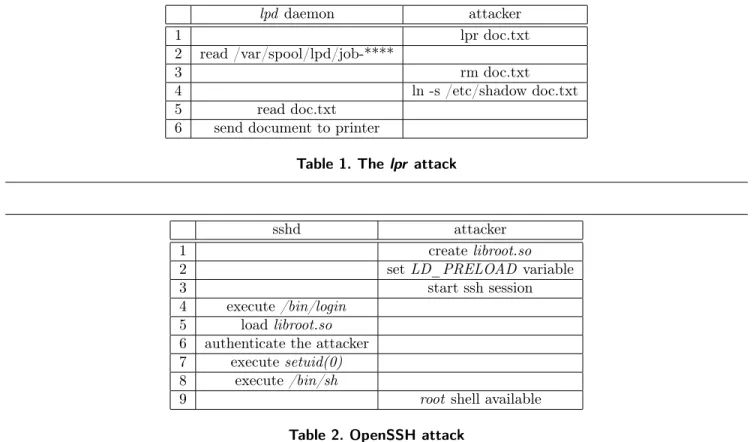
Please refer to table 1 for a simple exploit. First, the attacker requests the printing of some benign file (for example, his own filedoc.txt). His rights are checked by
thelpr command and, if access is granted, the request is put into the printer daemon queue. Then, before the printing actually starts, the attacker removes the prin-ted file and replaces it by a link to some file he is not allowed to access (for example,/etc/shadow). As a res-ult, the latter file will eventually be printed on his be-half.
3.1.2. Apache vulnerability This vulnerabil-ity [CAN-2003-0084] allows attackers to execute ar-bitrary operations on a target system through a format string error in Apache’smod_auth_any mod-ule.
The mod_auth_any module provides a client au-thentication interface for the Apache server. Informa-tion sent by a connecting client is passed to some ex-ternal program that implements the actual authentica-tion mechanism. Some versions of this module lack rig-orous checking of data provided by clients. As strings sent through the module are used as command line ar-guments, a carefully formed string can therefore result in executing arbitrary shell commands.
The Apache server can thus be abused as a con-fused deputy to achieve various effects, such as denial-of-service (by shutting down the Apache server) or in-tegrity violations (by overwriting files on the target sys-tems that are writable under the Apache process user identity). It can even yield general security protection violations, if the attack is combined with some other “user to root” technique such as the ptrace_kmod ex-ploit [CAN-2003-0127].
3.1.3. OpenSSH vulnerability This is a sophistic-ated “user to root” attack through a security hole in OpenSSH [9]. Originally, the telnet daemon was also affected by the same problem. Although both telnetd andOpenSSH have been patched, more software is po-tentially compromised.
Table 2 presents the major steps of the attack. The attacker creates a shared library (here calledlibroot.so) that provides a setuid() function whose purpose is to call the actual setuid() primitive provided in the sys-tem’s API, but with0 as parameter regardless of what the calling program may have requested. If this lib-rary is loaded by some process, it overloads the default setuid() function, so that any setuid(u) call made by that process is translated intosetuid(0).
The OpenSSH daemon may allow users to declare their own environment variables in their ssh profile. If the attacker declares LD_PRELOAD=libroot.so, any programs launched by the ssh session will be linked against that library, including thelogin program used to authenticate users. Because of the overloading of
lpd daemon attacker 1 lpr doc.txt 2 read /var/spool/lpd/job-**** 3 rm doc.txt 4 ln -s /etc/shadow doc.txt 5 read doc.txt
6 send document to printer
Table 1. Thelpr attack
sshd attacker
1 createlibroot.so
2 set LD_PRELOAD variable
3 start ssh session
4 execute/bin/login
5 load libroot.so
6 authenticate the attacker 7 executesetuid(0) 8 execute/bin/sh
9 root shell available
Table 2. OpenSSH attack
setuid(), the attacker’s authentication procedure will eventually execute thesetuid(0) system call.
So this is a way for the attacker to infect the OpenSSH system with a Trojan horse, which leads ul-timately to getting a root shell.
3.2. Detecting Intrusion Symptoms
In all three attacks presented above, the respective security policies (more precisely, data confidentiality and/or integrity requirements) are violated the trans-fer of information into forbidden locations:
• in thelprattack, the contents of a file the attacker is forbidden to access is copied into a destination where he has full access rights (the printer), thus achievingde-facto access privilege granting [10];
• in the second example, uncontrolled information flows occur between local files stored on the tar-get system, and the remote client connected on a TCP socket without proper authentication;
• in the third example, protected information (the executable memory image of a root process) is overwritten by uncontrolled information (the lib-root.so library) produced by an unprivileged at-tacker.
More generally, many actual attacks consist precisely in achieving someillegal information flowbetween sys-tem objects1. We can further observe that the very
ex-istence of such an information flow is a conditionsine qua non for the attack to be effective: for example, from our point of view, using thelpr exploit to print a public-readable document does not violate any confid-entiality requirement.
Generally speaking, confidentiality and integrity goals of any policy can be expressed as an informa-tion flow control problem. Thus, an illegal informainforma-tion flow is the symptom of a policy violation, i.e. of an at-tack. No hypothesis has to be made about the actual scenario that leads to the attack, so controlling inform-ation flows generated by running programs provides a reliable confidentiality and integrity violation de-tection mechanism, allowing to detect known and unknown attacks2.
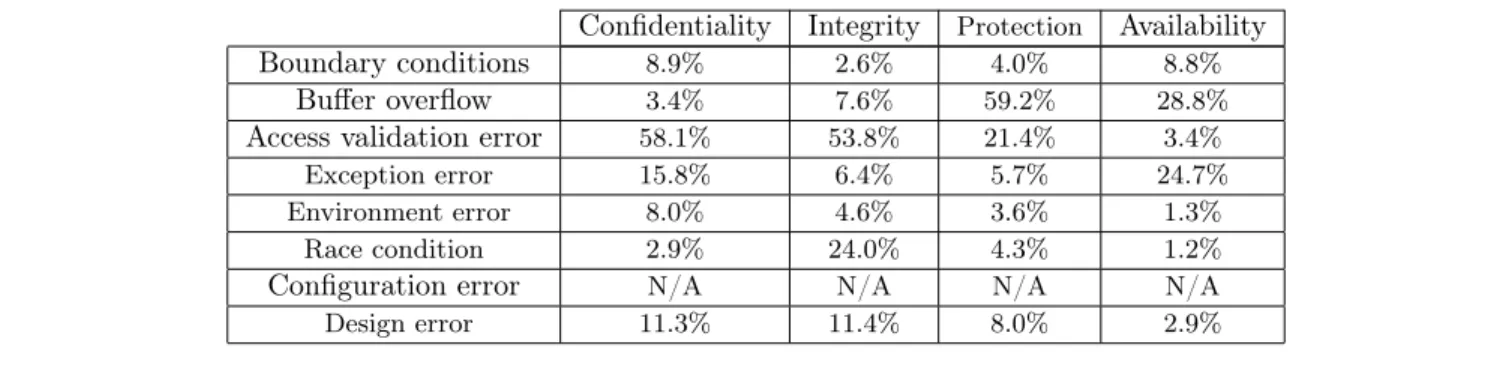
Table 3 shows the percentage of each of the 7 con-sidered CVE vulnerability classes3 in exploits that
1 An object is any information container that has a precise identifier and whose state can be accessed through a pre-cise set of primitive operations. Examples of objects are files, sockets, messages, memory pages etc.
2 Please notice that we do not handle system availability re-quirements.
ac-achieve each of the 4 policy violation goals defined by CVE. In our case, in addition to Confidentiality and In-tegrity violations themselves, we have also to deal with Protection violations, since by getting for exampleroot privileges on some host, an attacker can steal confiden-tial information and/or modify information that he is not allowed to access. We can thus observe that each vulnerability class has a substantial usage importance in at least one of these 3 categories. By detecting Con-fidentiality and Integrity attacks, as well as confiden-tiality and/or integrity violations that eventually oc-cur through Protection attacks, we can thus deal with a wide range of actual attack scenarii.
3.3. Implementing security policies
Our proposed approach to intrusion detection and the policy implementation model have been discussed in detail in [11]. In this section, we briefly describe its application to Discretionary Access Control-based op-erating systems, such as Linux, Unix and Windows.
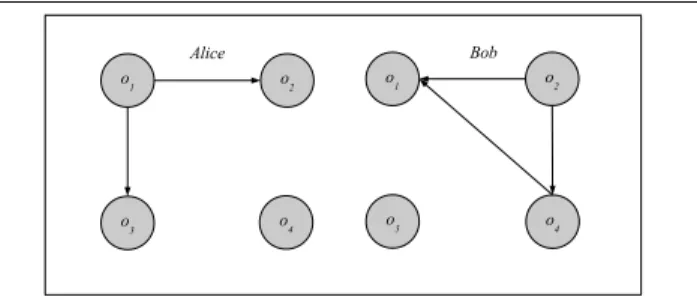
Our purpose is to enforce an existing confidential-ity and integrconfidential-ity policy. In DAC-based systems, confid-entiality and integrity policies are implemented using access control rights. Such an access control policy im-plies a set of legal information flows between objects. The basic idea is that if the access control policy al-lows some user to gather information from some ob-jectA (for example, to read a file) and to modify the state of some object B (for example, to write a file), then by definition it allows him to create an informa-tion flow fromAtoB.
For example, the DAC policy shown on table 4 al-lows Alice to create information flows from o1 to o2 ando3, and Bob to create flows from o2 and o4 to o1 ando4 (please refer to figure 1).
Figure 1. Legal information flows
count, since these can actually be considered as policy spe-cification errors.
Information flows between system objects are cre-ated by calling operations on these objects, i.e. by ex-ecuting system calls. Given a security policy specific-ation in terms of legal informspecific-ation flows and a sys-tem call execution trace, the intrusion detector checks whether the executed system calls do not create illegal flows, either directly (for instance, asendfilecall copy-ing illegally the contents of a file into a network socket), or by transitive combination of legal flows (in the ex-ample above, such a combination would be for instance a flow fromo1too2created byAlice, followed by a flow from o2 to o4 created by Bob. That would result in a flow fromo1too4, which is not legal given this policy). To evaluate the effectiveness of our detection ap-proach, we tested it using attacks against Vigna’s BuggyHTTP server [12] which has several vulnerabil-ities of different classes. These can be easily exploited; however, real-world products such as Apache or MS-IIS have identical security issues.
This choice was made after the model design and im-plementation were frozen, so the BuggyHTTP daemon provided a neutral, independently developed applica-tion with attacks that were unknown to us.
3.4. Testbed environment
The tests were performed on a standard Linux sys-tem, with no special assumptions about the behaviours of the observed daemons. The enforced security policy was derived from existing access privileges as described in paragraph 3.2. Since no authentication mechanism is used on HTTP client connection, only information from world-readable objects could flow to the HTTP client’s socket, and information sent by the client could only flow into world-writable objects.
Moreover, the environmental conditions were as fol-lows:
• The BuggyHTTP daemon ran on a default Linux workstation along with other standard applica-tions, including a full graphical desktop, a Web navigator, an email client, a ssh server and a game server;
• No incoming traffic to that host from outside of the local network was allowed, so that we could precisely evaluate the number of attack attempts and the rate of successful detections vs. false pos-itives
• The tested attacks achieved confidentiality and in-tegrity violations in different ways. All were per-formed locally as well as across the network. 14 system calls, which could generate 18 different types of information flows, were controlled by the detector.
Confidentiality Integrity Protection Availability
Boundary conditions 8.9% 2.6% 4.0% 8.8%
Buffer overflow 3.4% 7.6% 59.2% 28.8%
Access validation error 58.1% 53.8% 21.4% 3.4%
Exception error 15.8% 6.4% 5.7% 24.7%
Environment error 8.0% 4.6% 3.6% 1.3%
Race condition 2.9% 24.0% 4.3% 1.2%
Configuration error N/A N/A N/A N/A
Design error 11.3% 11.4% 8.0% 2.9%
Tab. 3. Vulnerabilities vs. policy violations
Alice Bob
o1 read write
o2 write read
o3 write ∅
o4 ∅ read,write
Tab. 4. Sample DAC policy
3.5. Attack detection
3.5.1. Malicious URLs Illegal file access through a malformed path in the HTTP request is the easiest at-tack against a web server. Such a request can access:
1. a file that is part of the website, but referenced through a needlessly complicated pathname, e.g. GET ../../www/html/index.html
2. a file that is declared world-readable by the access control policy, but for which it is unclear whether it is supposed to be available to web clients. For example:
GET ../../etc/hostname
3. a file that must not be accessed by anyone. In this case the web server can be used as a con-fused deputy, thereby granting access to the file: GET ../../etc/shadow
Any access results in a flow from a file to the cli-ent’s socket. In the first case, this flow is by definition legal, so no alert must be generated. In the third case, the confidentiality policy is violated by a flow from /etc/shadow to a random location, which is by defini-tion illegal, so an alert is raised. In the second case, the security policy is actually ambiguous since by default, the access rights are too coarse-grained to make differ-ence between “local access” and “remote access” (how-ever, this can be easily corrected using extended ACLs, available in all modern OSes). From a strict access con-trol point of view, no security policy violation occurs
and our detector raises no alert. Nevertheless, many ad-ministrators would probably consider that being able to download a random file outside of thewww tree is a security threat, even if that file is supposed to be read-able by anyone.
In comparison, a signature-based IDS such asSnort usually contains a rule matching all URLs containing the“../..”pattern. Note that this signature would trig-ger false positives for the first and (possibly, depending upon interpretation) the second attack scenarios out-lined above. It would also fail to recognize several valid attacks: for instance if the attacker first uses some other attack technique to replace theindex.html file by a link to/etc/shadow.
3.5.2. Attacks through cgi-bin Similarly, we can execute arbitrary programs on the server as cgi-bin scripts. If the server runs as root, this opens a wide spectrum of possible effects, including:
1. accessing any file in the system, for instance GET /cgi-bin/../../bin/cat /etc/shadow 2. overwriting any file, for instance
GET /cgi-bin/../../bin/echo “hacked” > /etc/shadow
3. executing arbitrary commands, even aroot shell: GET /cgi-bin/../../bin/sh
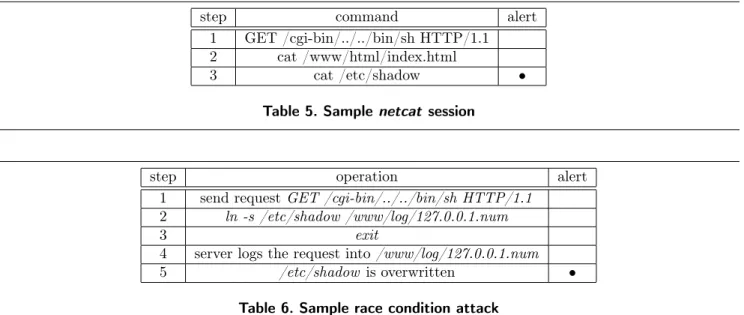
Let us consider aroot shell example, as it is the most general. Please refer to table 5 for a possible use. Al-though launching the shell at step 1 is a security
protec-tion violaprotec-tion by itself, no illegal informaprotec-tion flow oc-curs yet, so no alert is expected. Step 2 produces an in-formation flow fromindex.html to the socket, which is by definition legal, so no alert is raised4. On the other
hand, reading /etc/shadow at step 3 is of course il-legal and an alert is raised.
The same comparison to signature-based detection (e.g. snort) as in paragraph 3.5.1 applies. Moreover, given that the sequence of commands possibly executed this way is unpredictable, providing exhaustive and re-liable signatures is almost impossible. To deal with such an attack using a traditional IDS, one would have to de-tect essentially the mere fact of launching a shell. Not only does this raise false positives (as in step 2, or if the attacker only started the shell and immediately ex-ited without actually executinganything), its very de-tection is actually largely nontrivial. In this case, some of the advantages of our approach are:
• we need to take no further special hypotheses to handle this case, the detector configuration is un-changed;
• a forbidden information flow is reliably detected, no matter how it is achieved.
3.5.3. Buffer overflow exploits The BuggyHTTP server contains a buffer overflow vulnerability. It can be exploited either:
1. to achieve a denial-of-service by making the server crash; or
2. to let it execute an operation, for instance by us-ing a shell-code.
As we do not enforce availability requirements, a denial-of-service attack is undetected by our ap-proach. However, an attempt to execute some oper-ation can be detected: since in paragraph 3.5.2 no hypothesis was made on how the operation execu-tion is achieved, it can be done using a cgi-bin exploit as well as a buffer overflow exploit.
3.5.4. Race conditions exploits We patched the BuggyHTTP server to introduce an additional race condition vulnerability. By default, the server operates in two steps: first, the client’s request is written into a log file, then it is processed. By letting the server first execute the request, then log it, it is possible to viol-ate the system integrity using a scenario similar to the one on table 6.
Of course, there exists many ways to achieve the ef-fect of the first 3 steps, i.e. to create the symbolic link. 4 Of course, this is a rather unusual way to access a web site, but strictly speaking, it does not violate the security policy in any way !
In any case, step 5 results in a flow from the client’s socket into/etc/shadow and as such, it is illegal.
The important part is that since, by design of the server, flows from the socket to the log files directory are legal (as input from the client is copied into the log), creating the symlink is not illegalper se. Actually, the same effect could be achieved by sending a string sim-ilar to the contents of/etc/shadow. However, the flow from the client’s socket to /etc/shadow which results from it violates the integrity policy.
3.6. Proof of concept
The results presented in this section show that our approach is able to reliably detect illegal information flows, even if the means to achieve them are unusual, unknown and/or highly complex. It fulfills its role as a policy-based intrusion detector.
4. Real-world usage
4.1. Environment
To evaluate the intrusion detection abilities of this approach in a real environment, we installed our de-tector on two hosts: a mail and web server used daily by our team (13 researchers and PhD students) and a test server running an older Linux distribution known to be affected by many vulnerabilities (RedHat Linux 6.2 on x86). The experiment lasted ten days; another test for a several month-long period is currently under-way.
The exploits used against these systems were chosen at random, from collections of exploits targeting the current versions of running software. As we selected these exploits at random, we consider them to repres-ent a fair replica of attacks that might be conducted by an external attacker with no particular knowledge of our operational network. Moreover, this allows us to test the ability of our IDS to detect unknown at-tacks. Indeed, some successfully detected exploits were unknown to us when the tests started.
On this network, we run the open source IDSsnort, which raises between 100 and 1000 alerts per day, de-pending upon configuration. Upon further investiga-tion by our security officer, virtually all are false pos-itives. This detection pattern has remained stable over time in our environment.
4.2. Security policy
In addition to a default local security policy handled as discussed in §3.3, we deal with the network services as follows.
step command alert 1 GET /cgi-bin/../../bin/sh HTTP/1.1 2 cat /www/html/index.html
3 cat /etc/shadow •
Table 5. Sample netcat session
step operation alert
1 send requestGET /cgi-bin/../../bin/sh HTTP/1.1 2 ln -s /etc/shadow /www/log/127.0.0.1.num
3 exit
4 server logs the request into/www/log/127.0.0.1.num
5 /etc/shadow is overwritten •
Table 6. Sample race condition attack 4.2.1. Web In our Linux installation, the Apache
server runs aswww-data. It can be configured to man-age its log files either through the standardsyslog sys-tem, or by directly accessing them. In the first case, the default security policy needs no amendment. In the second case, we note that in addition to inform-ation flows resulting from default access control rights, flows from the client socket to objects writable by www-data are authorized. The “client socket” is any socket created by connecting to TCP port 80.
More precisely, The Apache server security policy thus allows some flows between TCP port 80 and ob-jects readable or writable bywww-data. A HTTP client socket initialization is by definition a flow from port 80 to the newly created port. In effect, this is a straightfor-ward translation of the standard policy that restricts Apache access rights to those ofwww-data.
4.2.2. E-mail We implemented the following email policy: SMTP clients may write mail into any mail-box. That is, information incoming from clients con-necting to the SMTP service can flow into any of the mailboxes in /var/spool/mail. Furthermore, the con-tents of the mailboxes may flow to clients connecting to the POPS and IMAPS services.
A naive approach to implementing this policy would be to rely on pure access rights. However, a plain Unix-like access control policy in not precise enough to suit amailbox. For each useru, either it forbids flows from TCP port 25 to /var/spool/mail/u, or it allows flows from port 25 to any object writable byu. Thus, we au-thorize explicitly the following flows:
• from TCP port 25 to/var/spool/mail/u;
• from/var/spool/mail/u to port 993 (IMAPS) and 995 (POPS).
We did not define any special policy regarding outgo-ing mail in these tests.
4.3. Executed tests
We exploited several vulnerabilities (CVE-2001-0690, CAN-2002-0392, CAN-2003-0127, CVE-2000-0666) to achieve 50 actual security policy violations on these two systems, i.e., an average of 5 succeeded at-tacks per day:
• Denial of service;
• Stealing confidential files (for instance /etc/shadow, /etc/ssh/ssh_host_dsa_key, etc...);
• Overwriting arbitrary files;
• Executing local operations (for instance append-ing/etc/shadow to/var/spool/mail/jzimm). In addition, we used some of these exploits to achieve goals that do not violate the system confidentiality and integrity or that are irrelevant, service availability is-sues aside. For instance:
• Capturing a root shell and not executing anything;
• While logged on as mail, gaining root privileges but only executing operations thatmail is author-ized to execute;
• Killing the Apache daemon, binding a trivial “root shell server” to port 80, then using it to access /home/httpd/index.html;
4.4. Results
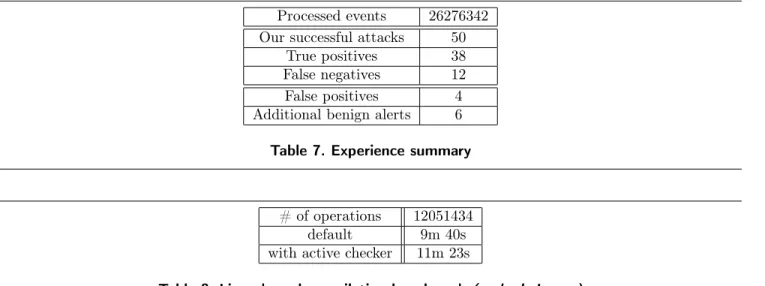
Results for the test period are summarized in table 7. Given the large number of processed events (> 26
million system calls), the attacks themselves are buried in the noise floor generated by benign operations. 4.4.1. True positives Of the 50 succeeded attacks, 38 were accurately detected on the basis of the imple-mented security policy. All were violations of confiden-tiality or integrity of resident information. Some goals (i.e. stealing a non-public file) were achieved using sev-eral different attack techniques, most notably:
• capturing a root shell and reading the file;
• moving (remotely or locally) the file into a mail-box and then reading mail;
• moving (remotely or locally) the file into a loca-tion where it could be accessed as a web page;
• etc.
Given the security policy implemented as described in section 4.2, with no change to the software nor the user’s capabilities, we assert thatall of our attempts to violate this policy were successfully detected. Moreover, when we launched an identical attack procedure without violating this policy, no alert was raised. Thus we assert that our detector satisfied its primary goal. To recap, given a security policy, our sys-tem can reliably detect violations of that policy, regard-less of the attack technique used to accomplish that vi-olation; furthermore, when the same attack techniques are used to benign effect, false positives do not occur. 4.4.2. False negatives The 12 undetected attacks achieved effects that include the following:
1. accessing world-readable files that are not expli-citly part of the website;
2. modifying an user’s mailbox contents using only data incoming from the network;
3. modifying world-writable files; 4. a denial of service.
As we discussed in §3.5.1, case 1 can be considered as a legitimate action given the default security policy; it can be prevented by refining the policy to forbid some information to flow to remote locations. The same re-mark applies to case 3.
Case 2 is a pure integrity of transiting information problem. To detect such attacks, one has to check the contents of incoming information, which is not the pur-pose of our model. It is also possible to define manually extremely fine-grained policy regarding utilities such as
echoorcatthat these attacks can use. So while detect-ing such attacks seems theoretically possible to some extent, it clearly falls outside of our approach.
4.4.3. False positives and additional be-nign alerts The systems also generated 6 benign alerts and only 4 false positives. Alerts we call be-nign refer to actions that do violate the implemented security policy strictly speaking, but the achieved ef-fect cannot be qualified as really malicious. These alerts were raised for example:
• when we logged on the mail server and tried to use a console mail client. By construction of the policy regarding e-mail, this was detected as an il-legal flow;
• similarly, when we created files in ahome direct-ory and tried to access them through the IMAP server;
• when we launched as root a recursive grep search, that generated flows from many different objects (including mailboxes and other private files) to one single destination.
As, given the implemented policy, users are not sup-posed to execute anything directly on the mail server, such actions actually violate the policy, even if they do not really violate confidentiality nor integrity.
The 4 remaining alerts were genuine false positives. Three were generated by thessh server (accessing the host key database and using public key-based authen-tication, which is not handled by the policy defini-tion at this time). Finally, the last alert remains un-explained.
5. Conclusion
In this paper, we show that the model we pro-posed in [1] and [11] provides an applicable and efficient means to detect security policy violations in runtime. By controlling information flows on a host, we are able to detect a wide range of confidentiality and integrity violations. Despite the fact that we pose no hypotheses on the vulnerabilities exploited by an attacker nor the attack scenario itself, and furthermore use no learn-ing method to characterize normal system activity, we are able to detect unknown and/or novel attacks. We demonstrate that even in the case when a known ex-ploit is used to accomplish a benign effect, unless the security policy is violated, no alert is triggered.
Our model focuses on local information flow, which allows one to detect local intrusions. However, most re-mote intrusions lead to a local information flow policy
Processed events 26276342 Our successful attacks 50
True positives 38
False negatives 12
False positives 4 Additional benign alerts 6 Table 7. Experience summary
# of operations 12051434
default 9m 40s
with active checker 11m 23s
Table 8. Linux kernel compilation benchmark(make bzImage)
violation and are thus detected as well. Our first exper-iment carried out on the BuggyHTTP-based platform demonstrates this point. This also shows that policy should specify how local objects may be remotely ac-cessed, which is rarely done by default.
Our real-usage experiment shows that, despite the large number of analysed events (more than 26 million), the current implementation detects in runtime all 38 of the executed attacks that explicitly violate the confid-entiality and integrity requirements of the policy, in addition to 6 cases in which the implemented policy is also violated. The 12 executed attacks that the sys-tem was not able to detect were either exploits violat-ing availability policy or exploits against an insufficient security policy specification.
At the same time that our system reliably detec-ted attacks, the rate of false positives was low. No false positives were generated during the controlled Buggy-HTTP tests, and only 4 out of the 48 alarms gener-ated during our real-usage tests were false positives. This low false positive rate held despite an extremely large number of system events.
At this stage of our research, we did not devote ex-tensive time and energy to measuring the impact of our detector on system performance. We did perform a simple benchmark (please refer to table 8) demon-strating that on our test system (PIII 450 MHz, 128 Mb, SCSI), the overhead when compiling a Linux ker-nel is slightly over 15%.
A subsequent experiment is underway, in which our approach is being tested in a real-world operational en-vironment over several months. To this date, observed results remain consistent with those reported in this pa-per. The next major step in our work is to propose an approach to support automated explanation of
gener-ated alerts, correlating them to observed events.
References
[1] J. Zimmermann, L. Mé, and C. Bidan. Introducing reference flow control for detecting intrusion at the os level. In Proceedings of the Fifth International Sym-posium on Recent Advances in Intrusion Detection, pages 292–306, October 2002.
[2] J.P. Anderson. Computer security threat monitoring and surveillance. Technical report, James P. Anderson Company, Fort Washington, Pennsylvania, April 1980. [3] Herve Debar, Marc Dacier, and Andreas Wespi. To-wards a taxonomy of intrusion-detection systems.
Computer Networks, 31(8):805–822, 1999.
[4] Calvin Ko, George Fink, and Karl Levitt. Auto-mated detection of vulnerabilities in privileged pro-grams by execution monitoring. InProceedings of the 10th Annual Computer Security Applications Confer-ence, pages 134–144, Orlando, FL, 1994. IEEE Com-puter Society Press.
[5] R. Sekar, T. Bowen, and M. Segal. On preventing in-trusions by process behavior monitoring. In Proceed-ings of the 1999 USENIX Intrusion Detection Work-shop, pages 29–40, 1999.
[6] Calvin Ko and Timothy Redmond. Noninterference and intrusion detection. In Proccedings of the IEEE Symposium on Security and Privacy, 2002.
[7] Thomas P. Jensen, Daniel Le Metayer, and Tommy Thorn. Verification of control flow based security prop-erties. InIEEE Symposium on Security and Privacy, pages 89–103, 1999.
[8] E. Ferrari, P. Samarati, E. Bertino, and S. Jajodia. Providing flexibility in information flow control for object-oriented systems. InProceedings of the IEEE Symposium on Security and Privacy, pages 130–140, 1997.
[9] CMU CERT/CC. Vu#40327: Openssh uselogin option allows remote execution of commands as root. http://www.kb.cert.org/vuls/id/40327, Novem-ber 2001.
[10] M. Bishop and L. Snyder. The transfer of informa-tion and authority in a protecinforma-tion system. In Proceed-ings of the Seventh Symposium in Operating Systems Principles, pages 45–54, December 1979.
[11] J. Zimmermann, L. Mé, and C. Bidan. An improved reference flow control model for policy-based intrusion detection. InProceedings of the European Symposium on Research in Computer Security (ESORICS), 2003. [12] Giovanni Vigna. The buggy web server (tm).