NURUL IMAN BT MUSTAFFAR KAMAR
A master project report submitted in fulfillment of the requirement for the award of the degree of Master of Science in Construction Contract Management
Faculty of Built Environment Universiti Teknologi Malaysia
To
Mak, ayah, kak asma’, jihah, syafiq, and aimi sara
ACKNOWLEDGEMENT
A research of this nature may not be undertaken without help and support of others. First and foremost, I would like to extend my sincerest and appreciation to
Dr Norazam Bin Othman for his word of wisdom, guidance and comment throughout the whole process of writing this dissertation.
Extended thanks are also due to all my devoted lecturers, without whom I would not have had the knowledge to proceed of writing this dissertation.
Thanks also due to my parents for their support, and all my colleagues especially kak munirah, fasihah, hidayah and kerk, without them this road might be difficult for me.
Last but not least, thank you to all who have made this master project possible. Thank you.
ABSTRACT
ABSTRAK
“Time at large” adalah istilah yang digunakan untuk menunjukkan bahawa
tugas untuk menyelesaikan kerja-kerja pada masa tertentu hilang. Apabila projek pembinaan lewat siap, Kontraktor menggunakan "time at large" untuk mengelak daripada membayar ganti rugi jumlah tertentu dan ditetapkan. Kontraktor mungkin berhujah bahawa tempoh kontrak tidak pernah ditubuhkan atau kelewatan disebabkan oleh kelalaian Majikan. Oleh itu, Majikan terhalang daripada menguatkuasakan hak terhadap ganti rugi tersebut. Walau bagaimanapun, tafsiran bagi “time at large” tidak begitu jelas kerana terdapat perbezaan atau pelbagai interpretasi istilah. Prinsip asas "time at large" mencadangkan Kontraktor mempunyai banyak masa untuk menyiapkan kerja-kerja yang ditetapkan. Dengan itu, prinsip ini perlu dijelaskan dengan lebih lanjut khususnya berkaitan dengan ganti rugi jumlah tertentu dan ditetapkan. Penyelidikan ini dijalankan untuk menentukan keadaan di mana "time at
large" boleh diterima dengan sah oleh Mahkamah dalam menghindari atau
TABLE OF CONTENTS
CHAPTER TITLE PAGE
DECLARATION iii
DEDICATION iv
ACKNOWLEDGEMENT v
ABSTRACT vi
ABSTRAK vii
TABLE OF CONTENTS viii
LIST OF TABLES xii
LIST OF FIGURES xiii
LIST OF ABBREVIATIONS xiv
LIST OF CASES xv
1 INTRODUCTION
1.1 Background Studies 1
1.2 Problem Statement 4
1.3 Research Objective 6
1.4 Scope of Research 6
1.5 Significance of the Research 7
1.6 Research Methodology 7
1.7 Organization of Research Chapter 9
2 TIME IN RELATION TO CONTRACT
2.1 Introduction 10
2.3.1 Public Work Department Form (PWD) 203A (Rev 1/2010)
13
2.3.2 PAM Contract 2006 15
2.4 Time as of the essence in Construction
Contract
2.5 Completion of Work 18
2.5.1 Damages for Late Completion 20
2.6 Extension of Time 23
2.6.1 Ground for Extension of Time 2.6.1.1 Variation and Extra Work
2.6.1.2 Force Majeure 2.6.1.3 Exceptionally
Inclement Weather Condition 2.6.1.4: Late Site Possession 2.6.1.5 Delay in Approvals and Instruction
2.6.1.6 Compliance with Instructions
2.6.1.7 Other Stipulated Grounds. 25 27 29 30 32 33 34
2.6.2 Inoperable Extension of Time Provision
34
2.7 Time at Large
2.7.1 General Principle 35
2.7.2 Act of Prevention 37
2.7.3 Events cause Time at Large 2.7.3.1 No stated time or fix date for completion
2.7.3.2 Waiver
2.7.3.3 Failure of Contractual Machinery
38 39
2.7.4 Reasonable Time 42
2.8 Conclusion 43
3 RESEARCH METHODOLOGY
3.1 Introduction 45
3.2 Legal Research 3.2.1 Introduction 3.2.2 Sources of Law
46 46 3.3 Stages of Research Methodology 47
3.3.1 Initial Stage – Preliminary Study
3.3.2 Second Stage – Literature Review
3.3.3 Third Stage – Data Collection 3.3.4 Fourth Stage – Data Analysis 3.3.5 Fifth Stage – Deriving
Conclusion 48 49 50 52 52
3.4 Conclusion 52
4 TIME AT LARGE: IMPLICATION OF LIQUIDATED DAMAGES
4.1 Introduction 4.2 Summary of Cases
54
4.2.1 ABB Transmission and
Distribution Sdn Bhd v Sri Antan Sdn Bhd
4.2.2 Foo Yee Construction Sdn Bhd v Vijayan A/L Sinnapan
4.2.3 Guthrie Landscaping Sdn Bhd v Hasrat Usaha Sdn Bhd
4.2.4 Hock Huat Iron Foundry v Naga Tembaga Sdn Bhd
4.2.5 Sim Chio Huat v Wong Ted Fui
55
61
65
70
4.2.6 Teo Hock Guan & Anor (T/A Teo Meng Huah Construction) v Johor Builders & Investment Sdn Bhd
4.2.7 Thamesa Designs Sdn Bhd & Ors Kuching Hotels Sdn Bhd.
78
81
4.3 Summary of Discussion 84
4.4 Acceptable Circumstances by the Court on “Time at Large”
4.4.1 Additional Variation and Extra Work
89
4.4.2 Late Site Possession 90
4.4.3 Delays and disrupt of work performance
91
4.4.4 Failure to grant extension of time
92
4.4.5 Waiver 93
4.4.6 Non- strict compliance with the deadline.
94
4.5 Conclusion 95
5 CONCLUSION AND
RECOMMENDATION
5.1 Introduction 96
5.2 Summary of Research Findings 96 5.3 Problems and Constraints 98
5.4 Conclusion 99
LIST OF TABLES
TABLE NO. TITLE PAGE
3.3.3 (a) Search terms used to retrieve the cases
50
3.3.3 (b) List of cases 51
4.3 Summaries of Discussion 85
LIST OF FIGURES
FIGURE NO. TITLE PAGE
1.1 Research Methodology
Flowchart
LIST OF ABBREVIATIONS
ABBREVATION DESCRIPTION
LAD Liquidated and Ascertained
Damages
LRT Light Rail Transit
MLJ Malay Law Journal
PAM Pertubuhan Arkitek Malaysia
PWD Public Work Department
S.O Superitending Officer
LIST OF CASES
ABB Transmission and Distributions v Sri Antan [2009] 7 MLJ 644
Aruna Mills Ltd. v. Dhanrajmal Gobindram [1968] 1 Q.B 655
Balfour Beatty Building Ltd v Chestermount Properties Ltd [1993] 62 BLR 1
Bluewater Energy Services BV v Mercon Steel Structures BV and others [2014] EWHC2132 (TCC)
Bernhard’s Rugby Landscapes Ltd v Stockley Park Consortium Ltd [1997] 82 BLR 39
British Steel Corporation v Cleveland Bridge & Eng Co [1981] 24 BLR 100
Bruno Zornowv v Bcroft Development [1990] 51 B.L.R. 16
Bunge Corp. v. Tradax Export S.A [1981] 1 W.L.R 711,725
Contract Millichamp v.Jones {1983} 1 All E.R 267
Foo Yee Construction Sdn Bhd v Vijayan a/l Sinnapan [2014] 5 MLJ 660
Gaymark Investment v Walter Construction Group Limited [1999] 16 BCL 449
Guthrie Landscaping v Hasrat Usaha [2011] 4 MLJ 121
Hartley v. Hymans [1920] 3 K.B 475,484
Hick v Raymond and Reid [1893]AC 22
Hock Huat Iron Foundry v Naga Tembaga [1999] 1 MLJ 65
Holme v Guppy [1838] 3 M&W 387
HW Nevil (Sunblest) v William Press & Sons [1982] 20 BLR 78
J and J Fee Ltd v The Express Lift Company Ltd [1993] 34 ConLR 147.
Le Baupin v Crispin [1920] 2 KB 714
Mariner International Hotels Ltd & Anor v Atlas Ltd & Anor [2007] HKCU 209
Maclean v. Dunn [1828] 4 Bing.722,728
Neodex Limited v The Borough of Swinton and Pendlebury [1958] 5 BLR 38
Peak Construction (Liverpool) v Mckinney Foundation [1976] 1 BLR 111
Penang Development Corporation v. Teoh Eng Huat [1992] 1 MLJ 749
Rapid Building Group v. Ealing Family Housing Association [1984] 29 BLR 5
RDP Royal Palm Motel, L.P. ex rel. PADC Hospitality Corp. I v. Clark Const. Group, Inc., [2006]168 Fed. Appx. 348
Ryan v Ridley & Co .[1902] 8 Com.Cas 105
R.V. Ward Ltd v. Bignall [1967] 1 Q.B 534,550
Selene G [1981] 2 Lloyd’s Rep.180, 185.
Sim Chio Huat v Wong Ted Fui [1983] 1 MLJ 151
Simplex Concrete Piles v Metropolitan Borough of St Pancras [1985]14 BLR 80
Tan Ah Kian v Haji Hasnan (1962) MLJ 400
Thamesa Designs v Kuching Hotels [1993] 3 MLJ 25
Teo Hock Guan & Anor v Johore Builders & Investments [1996] 2 MLJ 596
Toepfer v. Lenerson Poortman N.V.[1980] 1 Lloyd’s Rep. 143
Tool Metal Manufacturing v Tungsten Electric [1955] 2 All ER 657
Westminster Corporation v J Jarvis & Sons Ltd [1970] 1 WLR 637 at p 646
CHAPTER 1
INTRODUCTION
1.1 Background of Study
A contract is an agreement that gives rise to obligations of the parties which are enforced by law (Haidar and Barnes, 2011). The parties must perform his or her obligations strictly according to the contract (Chow, 1998). When a party without a valid reason fails or refuses to execute the obligations, he has committed a breach of the contract. Breach of contract is when the party fails to perform contractual obligations provided under conditions (Haidar and Barnes, 2011). A breach of contract may be a partial or complete failure to perform, delayed performance, faulty or inadequate performance (Oon, 2003).
construction work on time is important as it may affect the cost of the project. Thus, time becomes an extremely important element towards the performance of the project.
As time is important in a construction project, the Employer may use time is of the essence of the contract. The failure of the Contractor to finish the works by the deadline is a breach of the contract. According to Furst and Ramsey (2001), when time is of the essence, the breach of condition related to time discharges the other party from the liability in performing the contract. The Employer can terminate the contract if the Contractor fails to meet the deadline in a contract in which time is of the essence (Keating, 1978).
The legal requirement and effect for the work to be completed within stipulated time can be referred to the provision of section 56 (1) of Contract Act 1950:
“When a party to a contract promises to do a certain thing at or before a specified time, …, and fails to do any such thing at or before the specified time, the contract, or so much of it as has not been performed, becomes voidable at the option of the promisee, if the intention of the parties was that time should be of the essence of the contract.”
In the case of Sim Chio Huat v Wong Ted Fui [1983], 1 MLJ 151 the Federal Court held:
A new revised date for completion can only be done if the contract permits it (Murdoch and Hughes, 2008). As to this, most construction contracts contain machinery which fixes an initial deadline to complete the works and for extensions of time to the original date of completion for specific delay events (Smith, 2012). In the event of late completion, the Contractor will be chargeable for liquidated damages either through action, deduction or set-off (Co, 2017).
Liquidated damages are represented in a fixed sum in a contract, payable in certain circumstances where there is a breach. Liquidated damages have been used as a mechanism for the Employer to encourage the Contractor to comply with the work programme in completing the project (Davis, 2014). Moreover, the liquidated damages are considered as compensation due to a breach of contract. Furthermore, it is used as an initial agreement of the Contractor before entering the contract, to pay the damages without having the Employer to prove the loss (Lee, 2006).
Construction contracts often had a “liquidated damages” clause in favour of the Employer. This clause provides that if the Contractor fails to complete the work by the deadline, he is required to pay Employer the agreed amount of damages from the initial date of completion until the work is fully completed.1Most standard form of contract inserts a specific clause which is called as “Liquidated Damages” or “Liquidated and Ascertained Damages” (LAD) in the event of failure to complete the works by the Contractor.2 However, the clause will only be relevant once liability is proven or admitted (McNair, 2016).
1 Clause 22.2 PAM 2006
1.2 Problem Statement
However, there will be circumstances where the Employer is unable to claim liquidated damages. The Contractors may use the “time at large” to refuse from paying liquidated damages. Time has become at large when the contract does not have an extension of time to be granted (Davis, 2014). Eggleston (2009) stated that time at large when the duty to finish the work particular time is lost. The Contractor may argue that the duration of the contract was never established or delay was caused by Employer’s default. In such situation, the contractual duty of Contractor is to complete within a reasonable time.
According to Varley (2014), the issues of time at large were recently reviewed
in Bluewater Energy Services BV v Mercon Steel Structures BV and others.3 Ramsey
J stated that:
“The principle is of some antiquity and has a surprising effect on the contractual obligations as to the time for completion. As I have found that there is an extension of time machine for acts of prevention and I am able… to determine the appropriate adjustments to the… Key Dates, this is not the opportunity to consider the underlying basis for the principle.”
Meanwhile, in local case Foo Yee Construction Sdn Bhd v Vijayan a/l
Sinnapan4, the issue arose on whether it was the respondent's failure to insist on strict
compliance with the completion date under the contract and delay in filing an action for specific performance set time at large. It was held that any damages recoverable were limited to the amount derived from applying the expressly agreed liquidated damages formula set out in the contract. Despite the existence of a “time is of the
3 [2014] EWHC2132 (TCC)
essence” clause in the building contract, the respondent by his conduct did not insist on strict compliance with the deadline for handing over of vacant possession but had waited until the project is completed to commence his action. In the circumstances, time was set at large.
In Thamesa Designs v Kuching Hotels5 the site possession from the Employer
to the Contractor was late which has caused delay by the Contractor. Therefore, the Employer should not be authorized to claim for liquidated damages due to his failure to give site possession on time which affected the time to become at large in which there was no specific date for the damages to be evaluated.
These cases summarized that when the time is at large, the Employer is disallowed to claim the liquidated damages as there is no fixed date that can be counted for liquidated damages. However, the interpretation of time at large is not straightforward. There are different or various interpretations of time at large based on the cases law above. According to Ministry of Housing and Local Government Malaysia (2013), there are rising issues on the reluctance to pay compensation for late delivery. Contractors are prone to apply the “time at large” situation to avoid from paying the liquidated damages.
The principle of “time at large” suggests the Contractor has a lot of time to fulfil the works. The principle needs to clarify further in relation to liquidated damages where Contractor may use the time at large to stop liquidated damages from being executed. Contractors regularly argue the provision for extending the time is unworkable due the contract machinery has been damaged. This issue requires extensive research as the meaning and effect are often argued incorrectly and misunderstood by the parties involved (Lip, 2010).
Hence, there is a crucial need to determine the circumstances for which time at large scenario may be validly acceptable by the court in avoiding or mitigating the liquidated damages claim.
1.3 Research Objective
The objective of this study is to determine the circumstances for which “time at large” may be validly acceptable by the Courts in avoiding or mitigating the liquidated damages.
1.4 Scope of Research
The scope of this research is based on case law. There are no restrictions on the case law referred in this study as long as the cases are related to the time at large and liquidated damages. The standard forms of contract that will be referred to in this research are:
1. Pertubuhan Arkitek Malaysia (PAM) Condition of Contract 2006 2. Public Works Department (P.W.D) Form 203A (Rev. 1/2010)
Delays in the construction industry are not uncommon. Delays are always associated with the claim for liquidated damages by one party. When a delay occurs the parties will start to raise the argument that will lead to intense disputes. Therefore, when the industry players are provided with the sufficient understanding of time at large and the effect on liquidated damages towards the contracting parties, this situation can be avoided at an earlier stage. The fulfilment of interest for both parties can be improved if the time at large issues both from the contractual and practical perspectives are efficiently managed and controlled without having to be embroiled in time-consuming and costly legal entanglements.
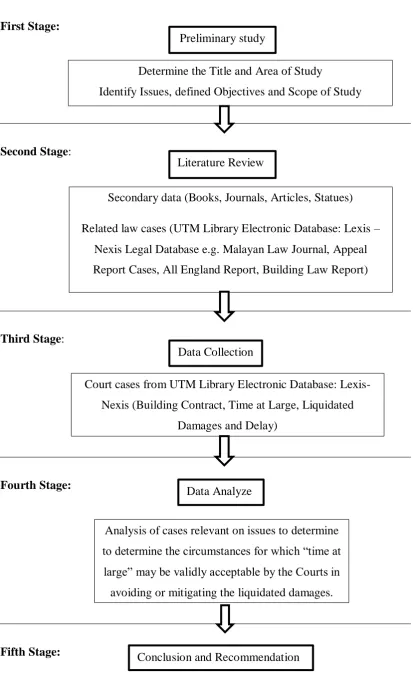
1.6 Research Methodology
First Stage:
Second Stage:
Third Stage:
Fourth Stage:
Fifth Stage:
Figure 1.6 Research Methodology Flowcharts Preliminary study
Determine the Title and Area of Study
Identify Issues, defined Objectives and Scope of Study
Literature Review
Secondary data (Books, Journals, Articles, Statues) Related law cases (UTM Library Electronic Database: Lexis –
Nexis Legal Database e.g. Malayan Law Journal, Appeal Report Cases, All England Report, Building Law Report)
Data Collection
Court cases from UTM Library Electronic Database: Lexis-Nexis (Building Contract, Time at Large, Liquidated
Damages and Delay)
Data Analyze
Analysis of cases relevant on issues to determine to determine the circumstances for which “time at
large” may be validly acceptable by the Courts in avoiding or mitigating the liquidated damages.
1.7 Organization of Thesis Chapter
Chapter 1 is where the idea for the research is initiated. The chapter will start with the background of the study, followed by problem statement, the objective of the research which states the aims of the study; scope of the research; significance of the study, the research methodology process and lastly the organization of thesis chapter.
Chapter 2 will cover on Standard Form Provisions in PWD and PAM Contract related to time; time as an essence in the contract; construction completion; extension of time for the purposes of provisions and grounds for extension; Prevention Principle; time at large; and reasonable time.
Chapter 3 will detail out the methods used to collect and analyse the data in order to achieve the research objective. Chapter 4 is the essential part of the research. Here, the cases law related to the time at large in the context of liquidated damages shall be analysed and the result will be discussed. The outcome will later answer the research objective.
REFERENCES
Adams, K. (2006), “Time is of the Essence”, Retrieved at: http://www.adamsdrafting.com/time-is-of-the-essence/
Ali Haidar and P.Barnes. (2011). Delay and Disruption Claims in
Construction. Institutions of Civil Engineers.
Bello, W. A., (2010). An Assessment of Liquidated and Ascertained
Damages in Contract Delivery. Accra, Ghana, West Africa Built
Environment Research (WABER) Conference, University of Reading,
pp. 81-89.
Building Contract Claim.(2011), 2.1 Time of the essence. (p. 22).
Bordoli, D. (2010). WEATHER CLAIMS IN THE UNITED KINGDOM
CONSTRUCTION INDUSTRY. Drive Consult Limited, pp6
Carnell.,N.J.(2005).Causation and Delay in Construction Disputes, Second Edition, Blackwell Publishing, United Kingdonm, pp: 14
Chow, Kok Fong.(1988). “An Outline of the Law and Practice of
Construction Contract Claims”. Longman Singapore Publishers Pte.
Ltd.pp.27
Co, A. T, (2017). “Liquidated Damages”, pp 1–2.
Cornell University Law School, “Legal Research”, Retrieved from http://www.law.cornell.edu /wex/legal_research
Cross Examination”, English Oxford Living Dictionary, Retrieved at: https://en.oxforddictionaries.com/definition/us/cross-examination
Davis, S (2014). “Liquidated and Ascertained Damages”, Devonshires Solicitors, Retrieved at
http://www.devonshires.com/corporate/liquidated-and-ascertained-damages/
Eggleston,.B (2009). Liquidated Damages and Extensions of Time, 3rd Edition, Wiley-Blackwell, West Sussex, pp: 25
Fawzy, S. A., El-Adaway, I. H., & Asce, M. (2014). Time At Large within the Common Law Legal System: Application to Standard Forms of
Contract, pp1–8.
Furst,S and Ramsey,V (2001). “Keating on Building Contracts”, 7th Edition. at p. 276, para 9-04.
Garner,.B (2011), “Garner's Dictionary of Legal Usage” 3rd ed, New York: Oxford University Press
Gould, N. (1971). Time, delay and liquidated damages. Fenwick Elliot, 1–10
Hamin,.M.Z (2013). Delay and Extension of Time: The Real Issue in Conflicts between Time-Bar Provisions and Prevention Principle
Hardjomuljadi, S. (2014). Analysis on the Possession of Site as Physical Cause of Claim and the Related Clauses in the “FIDIC Conditions of
Contract for Construction MDB Harmonised Edition. Basic and
Applied Scientific Research, 4(12), 109–121
Harris, C. M., & Dorfman, E. (n.d.). “Holding the Owner to His Word (or
Silence): Waiver as a Defense to Liquidated Damages.” Watt, Tieder,
Hoffar & Fitzgerald, L.L.P., pp1.
Holmes, O. (n.d.). Implied Duties and Obligations in Construction Contracts.
In MODEL JURY INSTRUCTION: CONSTRUCTION
LITIGATION, 2ND EDITION
Keating, D.(1978)” Building Contracts”. 4th Edition. London: Sweet & Maxwell.
Kheng, O. C. (2003). Extension of Time and Liquidated Damages In
Knowles, R. (2005). 150 contractual problems and their solutions, 2nd Ed., Blackwell, London
Lee Chong Fong (2011). The Malaysian PWD Form of Construction
Contract. Second Edition. Sweet and Maxwell Asia
Lew Yoke-Lian, S. Hassim, R. Muniandy, and Tan Mee-Ling,(2012) The
Assessment of Applications for Extension of Time, IACSIT
International Journal of Engineering and Technology, Vol. 4, No. 4, pp1
Lim Chuen Ren. (2001). “Variations in Construction Contracts”, CR Lim Construction Lawyers, Melbourne (n.d). Retrieved at
http://www.lawgazette.com.sg/2001-2/Feb01-feature.htm
Linares, T. (2013). Time at Large and Extension of Time Principles. Expert’s Corner, 2012–2013.
Lip, E. (2010), “Time Issues in Construction Revisited”, KPK Research Building Cost and Contract Information, pg:3
Liquidated / Delay Damages. (2012). In 200 Contractual Problems and their
Solutions (pp. 137–166).
Lee, Y. M, (2006). Liquidated and Ascertained Damages (LAD) and
Requirements of Mitigation, Universiti Teknologi Malaysia.
Lloyd, His Honor Judge Humphrey,(2002) “Emden’s Building Contracts,” 8th ed. London: Butterworth.
MacRoberts Solicitors. (2008). “MacRoberts on Scottish building contracts”, 2nd Ed., Blackwell, London
Mallesons S. Jaques (2008). Corporate Counsel CPD program 2008, Force
Majeure Clauses: Key questions answered, Retrieved September 15,
2008, from http://www.mallesons.com/News/ James_Fahey_Corp_Counsel_Pre sentation.pdf
Ministry of Housing and Local Government Malaysia (MHLG). (2013)
eHome, Official Portal National Housing Department. Retrieved at:
http://ehome.kpkt.gov.my/main.php?Content=vertsections&SubVertS ectionID=123&VertSectionID=116&CurLocation=119&IID=
Murray,M.D & DeSanctis,C.H (2005), “Legal Research and Writing,” Foundation Press, United States of America, pp:2
Murdoch, J., and Hughes, W. (2008). Construction Contracts Law and
Management”, 4th Ed., Taylor and Francis.
Naoum, D. S. G., (2007). “Dissertation Research and Writing for
Construction Students.” 2nd ed. United State of America: Elsevier Ltd
Oon Chee Keong. “Extension of Time and Liquidated Damages in Construction Contracts”,(2003), pp1–19.)
Pickavance, K. (2006). “Calculation of a reasonable time to complete when
time is at large.” Int. Const. Law Rev., 23, 167–186
Rensburg, A. J. van. (2016). Additional and or Extra Work Done in the
The course of Construction (Vol. 27).
Rufus B. Rodriguez (2002) “Legal Research”, Manila, Rex Publishing
Sundra Rajoo. (2010), “The PAM 2006 standard form of building contract”, LexisNexis, Petaling Jaya, Selangor Darul Ehsan, Malaysia
Smith, G, (2012). “Challenges to LAD for delay”, pp17
Smith,.R.W (2006),”Construction Contract: Law and Practice”, 1st Ed, New York: Oxford University Press
Stannard, J.E. (2007), “Delay in Performance of Contractual Obligations”, New York; Oxford University Press, pp4
Stims, R. (n.d), “Time is of the Essence Contract Provisions: What does a "Time is of the essence" contract provision means, and will it be
enforced? “Retrieved at http://www.nolo.com/legal
Tretel, .G.H. (1983), “The Law of Contract”, 6th ed, England; Stevens & Sons; pp620
The Entrusty Group. (2009). “What if Force Majeure and can it include Price
Escalation?” Master Builders Journal, 2, 89
Varley,.J,(2014), “Time to change “time at large”?”, Berwin Leighton Paisner LLP, Retrieved at
http://constructionblog.practicallaw.com/time-to-change-time-at-large/
VIP Consultancy.(n.d). Extension of time – “Time of the Essence” & “Time
At Large” Retrieved at
http://vipconsultancy.co.uk/extension-of-time-time-of-the-essence-time-at-large/
Williams, O. (2013). “Delay and completion.”Lewis Silkin.LLP, London
Yaqin, A. (2007). Legal Research and Writing. Kelana Jaya: LexisNexis
Ying,.O.R (2007), “Time at Large and Reasonable Time in Completion,” Universiti Teknologi Malaysia
Yusof, M. A., Mohammad, N., & Mat Derus, Z. (2007). Excusable and Compensable Delays in the Construction of Building Project - A Study in the States of Selangor and Wilayah Persekutuan Kuala Lumpur,
Malaysia. Journal-The Institution of Engineer, 68(4), 21–26.
Zin, H. M. (2013). “Delay and Extension of Time: The Real Issue in
Conflicts Between Time-Bar Provisions and Prevention Principle.”