A Study on Internet of Things Tracking It's
Progress and Development Over the Years
Akshata Mohite1, Deepika Khithani2, Payal Popat3
Student, Dept. of Computer Engineering, V.E.S Institute of Technology, Chembur, India1
Student, Dept. of Computer Engineering, V.E.S Institute of Technology, Chembur, India2
Student, Dept. of Information Technology, V.E.S Institute of Technology, Chembur, India3
ABSTRACT: This paper discusses the vision possible usage scenarios and technological blocks of “Internet of Things”. We have given introduction of IOT technology, its characteristics, leading sectors, emerging India in IOT and its upcoming projects that are likely to arise as vision of the Internet of Things becomes a reality.
KEYWORDS: IOT, Vmware, Fog computing ,CISCO.
I.INTRODUCTION
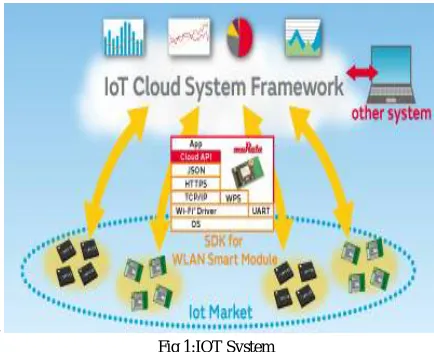
The Internet of things (IOT) is the internetworking of typical devices vehicles to as connected devices and smart devices Buildings and other items (embedded ,electronics, software ,sensors,actuators)and networking connectivity that enables these object to collect and exchange data.In 2013 the Global Standards Initiative on IOT was ” INFRASTRUCTURE OF INFORMATION SOCIETY”. The IOT allows objects to be sensed and for controlled remotely across exiting network infrastructure creating opportunity for more direct integration of physical world into computer system and resulting in improved efficiency accuracy and economic benefit in addition reduced human intervention. When IOT is augmented with sensors and acheators the technology become as instance of more general class of cyber physical system which also encompasses technologiessuch as smart grid, smart homes,intelligient transportation and smart cities
.
Fig 1:IOT System
The concept of Internet of Things was invented by term coined by PETER T.LEWIS in September 1985 in a speech he delivered at a US Federal Communication Commission support session at the Congressional Black access 15th Legislative Weakened.
As of 2016 the vision of internet of things due to convergence of multiple technologies including wireless communication, real-time analytics, machine learning commodity sensors and embedded system. This means traditional field of embedded systems, wireless sensor network and control system ,automation and other all contribute to enabling the internet of things.
The concept of Internet of Things became popular in 1991 through Auto-Id center at MIT and related market analysis publications.
Radio frequency identification was seen by KEVIN ASHTON as a prerequisite of Internet of Things.
At that point one of the 1st consequences of implementing the IOT by equipping all objects in the world with minuscule identifiers would be to transform daily life.
II. TRENDS AND CHARACTERISTICS
II-A INTELLIGENCE
In future the Internet of Things may be non –deterministic and open network in which auto-organized or intelligent entities virtual objects will be interoperable and able to act indecently.Modern IOT product and solution in the market place uses a variety of different technologies by support such context aware automation but more sophisticated forms of intelligence are requested to permit sensors limits to be deployed in real environment.
II-B ARCHITECTURE
Building on the top of Internet of Things is an architecture of the application layer of internet of things looking at the convergence of data from IOT devices into web application to create innovative use cases
.In order to program and
control flow of information in the Internet of Things a predicted architectural direction is being
called
everywhere which is a blending traditional process management with process management , process mining and special capabilities.
Fig 2
:
IOT Structural EcosystemII-C SIZE CONSIDERATION
The IOT things would encode 50 to 100 trillion objects and be able to follow the movement of those objects .Human being in surveys urban environment or each surrounded by 1000-5000 tractable objects.
II-D SPACE CONSIDERATION
The precise geographical location of a things and also the precise geographical dimension of a thing will be critical. The facts of time and space have been less critical to track because the person processing the information can decide whether or not the information was important to action being taken.
II-E SECTORS
3 sectors of IOT are- Enterprise , Home , Government with the EIT being largest by 2019 the EIOT sector is estimated to account for nearly 40% or 9.1% billion devices.
Prime Minister Namenda Modi announces COE for IOT in partnership with Nasscom,Diety .
Fig 3:Start up India
As a part of digital India Program launch Prime Minister Narenda Modi has announced the launch of the Center of Excellence for IOT in Bangalore to enable rapid adaption of IOT technology and faster new growth strategy as well as empower India to have a leap of advantage in domain.
A joint venture of National Association of software and services companies Depart of Electronics and information technology and education research network the COE will run on a public private partnership model with seed fund from the government and will be managed by Nassscom.
In India IOT can be leverage to address issues like transport system, parking ,electricity, waste management, water management and women safety to create smart cities smart health care services , smart agriculture.
III. INTERNET OF THINGS GADGETS TOBE COMING INDIA
III-A CARCLS
III-B SEN-SE MOTHER
Mother is a universal monitoring solution and can be used for a range of tasks around the house ,Four cookies provided with each unit can be used for monitoring the brushing ,habit of child keeping track of your walking ,having check on anyone entering the house , cycle predictions or your water/coffee intake .
IV. TOP SECTORS THAT IOT IS REVOLUTIONIZING IN INDIA
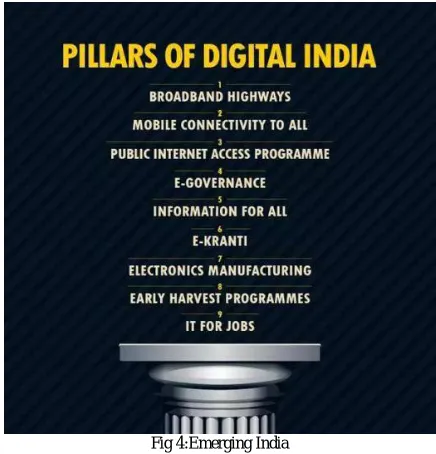
It is estimated that there will be 80 billion connected devices by 2020 .The past few years has been growing built in space,CISCO‘S investment is reportedly increasing in IOT’s startups to $150 million globally from 2014 onwards it projects that the IOT industry can be $14.4 trillion market by 2022
Fig 4:Emerging India
V. VMWARE “COWS TO CLOUD”
Fig 5: From cow to cloud
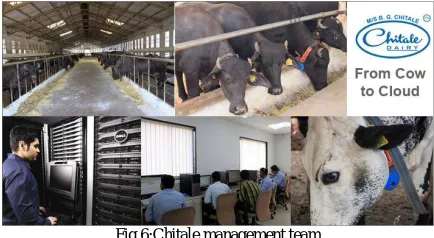
VMWARE India helped diary to move more information on cow and more than 25 of its business critical application to private cloud complete with automated operations management disaster , recovery and software of what we have larger extended to our farmer says ”Vishwas Chitale” CEO and CTO of Chitale diary.
The concept of cows to cloud was born where information on every cow is available in cloud which can be accessed by every farmer.
Fig 6:Chitale management team
VI. CHALLENGES AHEAD
The building blocks of technology require delivery of the most fundamental challenges. Many IOT power devices should ensure years of battery operation and harvested power devices.IOT applications need end to end solutions including cloud services. With so many interconnected devices out there in market and plenty of more to come in near future ,a security policy cannot be after thought. It’s important to ensure security,resillance.The possible tracking and surveillance of people by government and private agencies increases as the device are constantly connected to the internet.
Fig7:Challenges in IOT
VII. 7 TRENDS OF IoT IN 2017
VII-A IoT AND BLOCKCHAIN WILL CONVERGE
Blockchain is more than a concept now and has applications in many verticals besides FinTech including IoT. Blockchain technology is considered by many experts as the missing link to settle scalability, privacy, and reliability concerns in the Internet of Things. Blockchain technology can be used in tracking billions of connected devices, enable the processing of transactions and coordination between devices; allow for significant savings to IoT industry manufacturers. This decentralized approach would eliminate single points of failure, creating a more resilient ecosystem for devices to run on. In 2017 IoT will converge with Blockchain for better security and privacy opening the door for a new category in applications, hardware, and talents.
Fig8:Trends of IoT
VII-B IoT DEVICES AND MORE DDOS ATTACKS
Fig9:Principles of IoT
VII-C IoT AND MANY MOBILE MOEMENTS
IoT is creating new opportunities and providing a competitive advantage for businesses in current and new markets. It touches everything—not just the data, but how, when, where and why you collect it. The technologies that have created the Internet of Things aren’t changing the internet only, but rather change the things connected to the internet. More mobile moments (the moments in which a person pulls out a mobile device to get what he or she wants, immediately and in context) will appear on the connected device, right from home appliances to cars to smartwatches and virtual assistants.
VII-D IoT, ARTIFICIAL INTELLIGENCE AND CONTAINERS
In an IoT situation, AI can help companies take the billions of data points they have and boil them down to what’s really meaningful. The general premise is the same as in the retail applications – review and analyzes the data you’ve collected to find patterns or similarities that can be learned from so that better decisions can be made. The year 2017 would see Internet of Things software being distributed across cloud services , edge devices, and gateways.
VII-E IoT CONNECTIVITY
VII-F IoT AND TALENT SHORTAGE
Organizations launching IoT projects including smart cities and industrial facilities face a tougher time in recruiting talent. Complicating matters is that it remains a challenge to find enough workers to secure the Internet of Things. 45 percent of IoT companies struggle to find security professionals, according to a TEKsystems survey. 30 percent report
having difficulty finding digital marketers.
VII-G IoT AND NEW BUSINESS MODELS
business models for IoT we will have another bubble , this model must satisfy all the requirements for all kinds of e-commerce; vertical markets, horizontal markets, and consumer markets.
VIII .THE ROAD AHEAD
The Internet of Things (IoT) is an ecosystem of ever-increasing complexity; it is the next level of automation of every object in our life and convergence of new technologies will make IoT implementation much easier and faster, which in turn will improve many aspects of our life at home and at work and in between. From refrigerators to parking spaces to smart houses, IoT is bringing more and more things into the digital fold every day, which will likely make IoT a multi-trillion dollar industry in the near future. One possible outcome in the near future is the introduction of “IoT as a Service” technology. If that service offered and used the same way we use other flavors of “as a service” technologies today the possibilities of applications in real life will be unlimited. But we have a long way to achieving that dream; we need to overcome many obstacles and barriers at many fronts before we can see the benefits of such technology.
IX .CONCLUSION
Internet of things is an emerging paradigm that is increasingly popular. Internet of Things have made possible in connectiong non-It sectors remotely not only that it has helped them to expand their business too. Many countries have undertaken IOT’s project and proudly India comes in it. Many different sectors are using this invention smoothly. Internet of Things has made life easier
.
REFERENCES
1. Internet of Things –From Research and Innovation to Market Deployment ,Chapter 4,River Publishers,Ovidiu Vermessan and Peter Friess,PP-199-224,2015.
2.Ashton K,’Internet of Things’ ,RFID Journal,www.rfdijournal.com/article/print/4896,2009. 3.Fleisch,E.:What is the Internet of Things?Auto-ID Labs White Paper,WP-BIZAPP-053,2010. 4.International Telecomunication Union:The Internet Of Things.ITU,2005.