Scholarship at UWindsor
Scholarship at UWindsor
Electronic Theses and Dissertations Theses, Dissertations, and Major Papers
2011
Agent Modeling In Decision Support System: A Case Study In A
Agent Modeling In Decision Support System: A Case Study In A
Base Hospital System
Base Hospital System
Ashish Nakhwal University of Windsor
Follow this and additional works at: https://scholar.uwindsor.ca/etd
Recommended Citation Recommended Citation
Nakhwal, Ashish, "Agent Modeling In Decision Support System: A Case Study In A Base Hospital System" (2011). Electronic Theses and Dissertations. 332.
https://scholar.uwindsor.ca/etd/332
This online database contains the full-text of PhD dissertations and Masters’ theses of University of Windsor students from 1954 forward. These documents are made available for personal study and research purposes only, in accordance with the Canadian Copyright Act and the Creative Commons license—CC BY-NC-ND (Attribution, Non-Commercial, No Derivative Works). Under this license, works must always be attributed to the copyright holder (original author), cannot be used for any commercial purposes, and may not be altered. Any other use would require the permission of the copyright holder. Students may inquire about withdrawing their dissertation and/or thesis from this database. For additional inquiries, please contact the repository administrator via email
by
Ashish Nakhwal
A Thesis
Submitted to the Faculty of Graduate Studies through Computer Science
in Partial Fulfillment of the Requirements for the Degree of Master of Science at the
University of Windsor
Windsor, Ontario, Canada 2010
c
by
Ashish Nakhwal
APPROVED BY:
Dr. Anne W. Snowdon Odette School Of Business
Dr. Robert D. Kent School of Computer Science
Dr. Ziad Kobti, Advisor School of Computer Science
Dr. Scott D. Goodwin, Chair of Defense School of Computer Science
I hereby certify that I am the sole author of this thesis and that no part of this thesis has been published or submitted for publication.
I certify that, to the best of my knowledge, my thesis does not infringe upon anyone’s copyright nor violate any proprietary rights and that any ideas, techniques, quotations, or any other material from the work of other people included in my thesis, published or oth-erwise, are fully acknowledged in accordance with the standard referencing practices. Fur-thermore, to the extent that I have included copyrighted material that surpasses the bounds of fair dealing within the meaning of the Canada Copyright Act, I certify that I have ob-tained a written permission from the copyright owner(s) to include such material(s) in my thesis and have included copies of such copyright clearances to my appendix.
I declare that this is a true copy of my thesis, including any final revisions, as approved by my thesis committee and the Graduate Studies office, and that this thesis has not been submitted for a higher degree to any other University or Institution.
Health practitioners are studying different techniques to provide quality patient care and to prevent injuries in the hospitals, which motivate the ground work to model such a complex system with the objective to understand the chief social factors leading to injury.
The underlying social factors such as socialization, task scheduling, domain knowledge and path finding contribute to the day-to-day activity of the health practitioners and agents in social models which ultimately affect their performance.
The aim of this study is to outline the objective decision support elements in mission critical human social models and critically examine the influence of those factors on the system. The outcome of this research leads to a development of more realistic artificial agents in a social complex modeling for the better understanding of the system’s behavior.
To the Nakhwal family and my loving parents.
First and foremost, I am grateful to my advisor Dr. Ziad Kobti for providing me the oppor-tunity to work in an exciting and challenging field of research. His constant motivations, support, innovative ideas, own research and infectious enthusiasm have guided me toward successful completion of my thesis. My interactions with him have been of immense help in defining my research goals and in identifying ways to achieve them.
My sincere gratitude goes to Dr. Robert D. Kent for his valuable advice and helpful discussions during my thesis research. I would like to thank Dr. Anne W. Snowdon for her valuable comments and suggestions that helped me in my research. I would also like to thank Shamual Rahaman for his advice and long discussions that helped me in learning new things.
Finally I would like to thank my grandparents, parents, uncles and aunts for their un-conditional support and love.
Author’s Declaration of Originality iii
Abstract iv
Dedication v
Acknowledgements vi
List of Figures xi
List of Tables xiii
1 Introduction 1
1.1 Problem Specification . . . 1
1.2 Motivation . . . 1
1.3 Thesis Statement . . . 2
1.4 Thesis Objective . . . 2
1.5 Thesis Organization . . . 3
2 Literature Review and Background Survey 5 2.1 Components in Complex Modeling . . . 5
2.1.2 Environment . . . 6
2.1.3 Dynamics . . . 7
2.1.4 Heterogeneity . . . 7
2.1.5 Social Interactions . . . 8
2.1.6 Task Scheduling . . . 9
2.1.7 Simulation . . . 9
2.1.8 Verification and Validation . . . 11
2.1.9 Feedback and Reporting of Results . . . 12
2.2 Multi-Agent Systems (MAS) . . . 12
2.2.1 Application of MAS . . . 15
2.3 Social Networks . . . 16
2.4 Complex Social Systems . . . 16
2.4.1 Problem Specific Issues with Complex Modeling . . . 18
2.5 Decision Support Systems (DSS) . . . 21
3 Approach 28 3.1 Important Key Factors in Social Complex Modeling . . . 30
3.1.1 Path Finding . . . 30
3.1.2 Task Scheduling . . . 31
3.1.3 Social Factors . . . 32
3.1.4 Domain Knowledge . . . 33
4 Case Study: Base Hospital System 36 4.1 Health Care and Simulations . . . 36
4.3 Hospital Case Study . . . 39
4.4 Hospital Floor Plan . . . 41
4.5 Agents in Hospital . . . 42
4.5.1 Patient Agent . . . 43
4.5.2 Nurse Agent . . . 45
4.6 Difference Between Pre-empting, Unpredictable Events and Socialization . 52 4.7 Parameters Used in Model . . . 53
4.8 Working of the Model at Each Step . . . 54
4.9 Repast (Recursive Porous Agent Simulation Toolkit) . . . 55
4.9.1 Repast Setup . . . 57
4.9.2 Repast Tool Bar . . . 57
5 Experiments and Results 59 5.1 Base Model Results . . . 61
5.1.1 Patient Service and Nurse Task Activity . . . 61
5.2 Effect of Different Parameters on Simulation . . . 63
5.2.1 Social Path versus Shortest Path . . . 64
5.2.2 Day versus Night Shift . . . 65
5.2.3 Severity Level . . . 66
5.2.4 Socialization Rate . . . 67
5.2.5 Short (8 hrs.) versus Long (12 hrs.) Shift . . . 68
5.2.6 With and Without Pre-empting (Task scheduling) . . . 69
5.2.7 Unpredictable Event Rate . . . 70
6.1 Verification and Validation of Results . . . 74
7 Conclusion and Future Works 77
7.1 Conclusion . . . 77 7.2 Future Works . . . 79
Bibliography 80
2.1 Decision support system flow diagram . . . 22
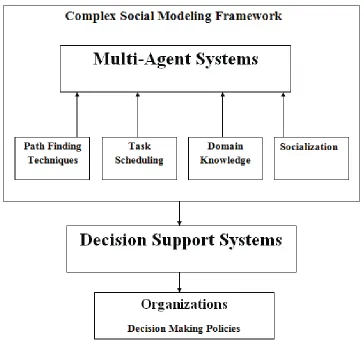
3.1 Complex social modeling framework . . . 34
4.1 Connectivity of the rooms and hallways in a hospital floor plan . . . 42
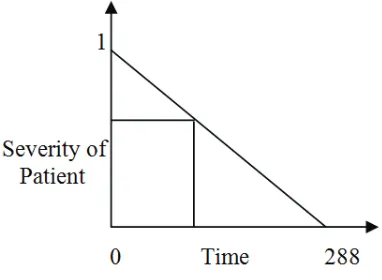
4.2 Slope for calculating visit time . . . 45
4.3 Repast tool bar 1 . . . 58
4.4 Repast tool bar 2 . . . 58
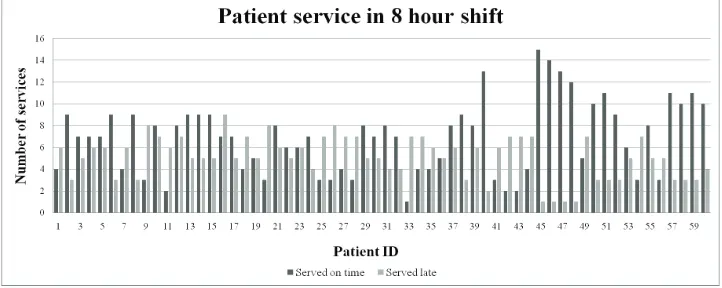
5.1 Patient service in a 8 hour shift . . . 61
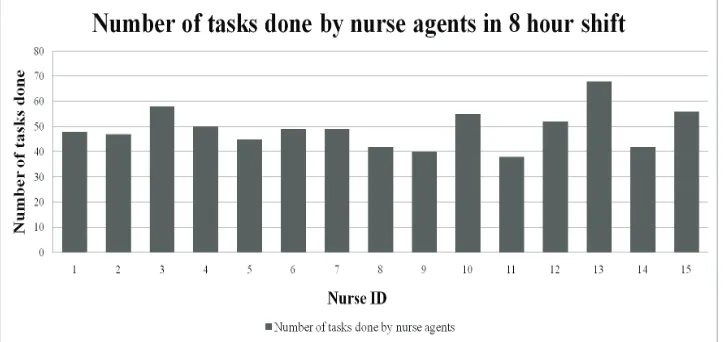
5.2 Number of tasks done by nurses in a 8 hour shift . . . 62
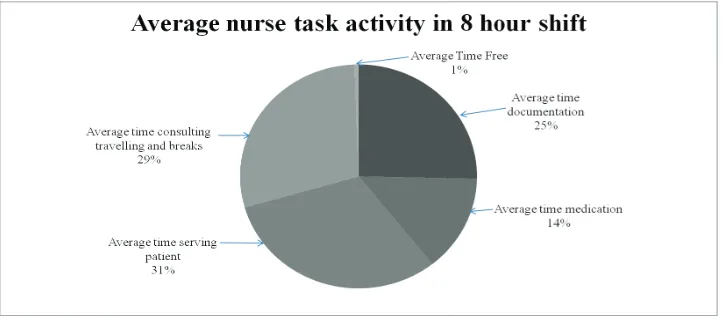
5.3 Average task activity and average task done in 8 hour shift . . . 63
5.4 Percentage of average success rate of patient service versus time, social path versus shortest path . . . 64
5.5 Percentage of average success rate of patient service versus time, day shift and night shift . . . 66
5.6 Percentage of average success rate of patient service versus time with sever-ity level 20%, 50%, 80% respectively . . . 67
5.7 Percentage of average success rate of patient service versus time with dif-ferent socialization rate 30%, 50%, 80% respectively . . . 68
5.8 Percentage of average success rate of patient service versus time; short shift and long shift . . . 69 5.9 Average success rate versus time with pre-empting and without pre-empting 70 5.10 Percentage of average service success rate versus time with different
4.1 Description of parameters used in the model . . . 53 5.1 Values of parameters used in the model . . . 60
Introduction
1.1
Problem Specification
The problem is to outline the key decision support elements in mission critical human social models; specifically in the context of path finding, socializing, task scheduling, and domain knowledge. Furthermore, we seek to evaluate the role of each element in the system and how these elements reveal distinct and substantial effect on the dynamic complex systems.
1.2
Motivation
Modeling human cultures using computer simulations is a challenging task. In these com-plex systems, there are myriad of factors that account for individual’s decisions [2]. These factors may have different effects on the system which makes it difficult to decide the in-volvement of each parameter on the outcome. We may use probability to decide the contri-bution of factors on the behavior of a system. However when the decision is critical, such as when one’s decision can save somebody’s life then it becomes really important to know
the ratio of involvement of different factors behind the decision. In order to understand the decision making process we need to account for individual, social as well as environmental factors. To measure the involvement of each factor first we need to develop such a system that is capable of capturing major factors in such a way that we should be able to develop a more realistic artificial social simulation system.
1.3
Thesis Statement
A health care system is highly dynamic and time constrained environment which includes various key factors such as workplace stress, quality of life, human and emotional factors and so on, that is a part of almost every complex social system. In this thesis, we aim to extend artificial social modeling simulation to include key model ingredients and to create a framework for modeling dynamic decision support system for mission critical health care environments.
1.4
Thesis Objective
the social settings that effect an individual’s decision, which includes social distractions, task scheduling or any unpredictable event that may happen in an environment. We present such a simulation as a tool for decision support which create a bridge to other disciplines so that they can get a benefit from such a tool design.
The outcome of this research may offer important findings for creating supportive envi-ronments for agents in social models that maximizes their performance. For example, the hospital management staff can observe the nurse agent’s time utilization or patient service success rate by changing the given different parameters in the simulation. The effect of different parameters, such as ratio of nurse agents to patient agents, socialization rate, time spent on different tasks, probability of random event happening, short-long shift and so on, can be easily examined by changing the particular variable and comparing the results with the base model settings. These findings can allow health care managements to allocate the settings that can maximize the quality of patient care and efficient use of nurse’s time in a general hospital.
1.5
Thesis Organization
Literature Review and Background
Survey
In this chapter, various different components of the multi-agent systems have been dis-cussed which plays an important role in complex modeling. Complex social modeling has been discussed and the role of key elements, such as path finding, task scheduling, social factors and domain knowledge is described. Social complex modeling can further be used as a decision support system which is a useful tool for organizations in decision making activities.
2.1
Components in Complex Modeling
2.1.1
Agency
Agents are autonomous, active, persistent (software) components that perceive, reason, act and communicate [50]. Software agents have evolved from multi-agent systems. Agents
are autonomous entities capable of exercising choice over their actions and interactions, act to achieve individual objectives. The concept of an agent provides a convenient and powerful way to describe a complex software entity that is capable of acting with a certain degree of autonomy in order to accomplish tasks on behalf of its user [63]. An agent is defined in terms of it’s behavior [54]. The architecture of an agent is the computational structure that, along with the more dynamic knowledge represented within it, generates the agent’s behavior in the environment. The architecture must contain structures that enable representing knowledge and achieving goals, interacting with the environment, and coping with unexpected occurrences. Due to the increased technological complexity, the need for complex applications have raised that require systems consisting of multiple agents who can communicate in a peer to peer fashion. Depending on the nature of the environment agent should be capable of performing tasks with co-ordination and collaboration of other agents resulting in human like behavior and affect [58]. For example, the nurse agents in hospital settings receive requests from the patients in a hospital and using the path finding techniques, task scheduling techniques and domain knowledge they respond and do specific actions to serve the patients.
2.1.2
Environment
is decided upon the characteristics of an environment. As the complexity of an environment increases, the system becomes more realistic and the user can obtain more accurate results. In this study, environment is considered as the physical hospital floor plan which include hallways, patient rooms, nurse stations etc. (refer to section 4.4).
2.1.3
Dynamics
Complex environments are dynamic in nature such that, they have high tendency of chang-ing their states frequently. The rapidly changchang-ing environment results in different workchang-ing conditions for an agent at each time step [44]. The agent must adapt to a new situation and overcome possibly unpredictable problems with actions required for autonomous be-havior [54][9]. Dynamic environments are helpful in simulating real world environments and observing them because of their similar behavior. The dynamic nature of a simulation helps to imitate the working of a real world to some extent. There are various examples of dynamic environments that change very rapidly which includes a market place, hospitals, shopping malls, and so on. Consider an example of a hospital where multiple number of agents work, the outcome of one agent or happening of any unpredictable event may lead to different working conditions for other agents such as delaying of tasks or spending more time on a task.
2.1.4
Heterogeneity
which they must make different decisions and take actions that can lead the system to mimic real world qualities. In a base model hospital simulation, heterogeneity is expressed by different types of agents and different environmental conditions.
2.1.5
Social Interactions
acquiring human-like behavior.
2.1.6
Task Scheduling
In dynamic environments, agents’ tasks require real time scheduling and execution. In order to finish their tasks and improve system performance they need to coordinate their actions both constantly and extensively [64]. The multi-agent systems need to operate in a real time that involve scheduling and task execution. In the multi-agent systems task scheduling is an important characteristic of the agents in order to finish their task successfully and to keep the service success rate high. Completion of tasks in the hospitals is critically important for the patient safety and quality of care.
2.1.7
Simulation
are usually called agents and the simulations of their behavior and interactions are knows as agent-based simulations. The properties of individual agents describing their behavior and interactions are known as elementary properties and the properties emerging on the higher collective level are known as emergent properties. In a hospital settings, elemen-tary properties are the nurse agent’s and the patient agent’s behavior (refer to section 4.5), and emergent properties are the services that the nurse agents deliver to the patient agents such as a path nurses follow (social or shortest path) using their domain knowledge, task scheduling, socializing, and so on.
Like deduction, simulation starts with a set of explicit assumptions. But unlike de-duction, it does not prove any theorems. Instead, a simulation generates data that can be analyzed inductively. Unlike typical induction, however, the simulated data comes from a rigorously specified set of rules rather than direct measurements of the real world. While induction can be used to find patterns in a data, and deduction can be used to find conse-quences of the assumptions. Simulation means driving a model of a system with suitable inputs and observing the corresponding outputs. These purposes include: prediction, train-ing, entertainment, and education.
• Prediction: Simulation is able to take complicated inputs, process them by taking hypothesized mechanisms into account, and then generate their consequences as pre-dictions. For example, if the goal is to predict the nurse’s performance by allocating the different number of nurses in a hospital setting then simulation would be the best and economic technique.
example of the use of simulation for training.
• Entertainment: From training, it is only a small step to entertainment. Flight sim-ulations on personal computers are fun. So are simsim-ulations of completely imaginary worlds.
• Education: From training and entertainment, it is only another small step to the use of simulation for education such as hospital simulations.
2.1.8
Verification and Validation
and verification phase must be completed before any experimentation with the simulator; otherwise the results will be unreliable.
2.1.9
Feedback and Reporting of Results
Developing a simple model in the beginning phase is very helpful for the future validations, and to report the results to their clients in order to obtain their feedbacks and work accord-ingly [9]. After reviewing the initial output, client’s objectives for the project may change and one can save a lot of time in the initial model development. Feedback is a mechanism, process or signal, that is looped back to control a system within itself; such a loop is called a feedback loop. In systems containing an input and output, feeding back part of the output so as to increase the input is positive feedback; feeding back part of the output in such a way as to partially oppose the input is negative feedback. Feedback loops provide generic mech-anisms for controlling the running, maintenance, and evolution of software and computing systems. Feedback loops are important models in the engineering of adaptive software, as they define the behavior of the interactions among the control elements over the adapta-tion process to guarantee system properties at run-time. Feedback loops and foundaadapta-tions of control theory have been successfully applied to computing systems [9].
2.2
Multi-Agent Systems (MAS)
dis-tributed processing, MAS are emerging as an important discipline of AI. In general, MAS is a computational system where multiple autonomous entities having different informa-tion and/or diverging interests interact with one another in order to satisfy certain goals [7][41][42]. Multi-agent system can also be defined as a loosely coupled network of prob-lem solvers that interact to solve probprob-lems that are beyond the individual’s capability or knowledge of each problem solver [59]. These problem entities or solvers are often called agents. The agents in such systems may be homogenous or heterogeneous such that, they may have common goals or individual goals [37][38]. The agents are capable of operating in dynamic and open environments and often interact with other agents including both peo-ple and software. The agents are a way to manage interactions between different kinds of computational entities, and to get the right kind of behavior out of large-scale distributed systems [17].
Multi-agent systems are usually characterized in terms of their internal behaviors and external interactions between the agents [46]. Some of the characteristics of the agent’s internal behavior are the type of cognition used and the performance measure they utilize when choosing how to behave in model based, reactive, goal based and utility based en-vironments. Some of the characteristics of agent’s external behavior are how the agents interact with each other to share information and to perform tasks. Multi-agent system’s main internal and external behaviors characterize them as a unique type of distributed com-putation system which has to be supported by a generic distributed computer infrastructure or a set of middleware services. Software agents communicate with each other to find out the tasks other agents are able to perform.
and observe the behavior of a system. In MAS, the agents often cooperate to solve a com-mon problem rather than achieving their individual goals. Multi-agent systems are suitable for the domains that involve interactions between different people or organizations, with different goals and proprietary information [58]. Data in the MAS are decentralized and computations by the agents are asynchronous. The absence of centralized data coordination makes it difficult to determine the current state of the system and/or to predict the effects of actions. During this process, agents access the environment’s resources and services and occasionally produce results for the entities that initiated these software agents.
The agents interact in a concurrent, asynchronous and decentralized manner, this kind of system can be categorized as a complex system. The most important reason to use MAS when designing a system is that some domains require it [43]. In particular, if there are different people or organizations, with different (possibly conflicting) goals and proprietary information, then a MAS is needed to handle their interactions. Even if each organiza-tion wants to model its internal affairs with a single system, the organizaorganiza-tions will not give authority to any single person to build a system that represents them all; the different orga-nizations will need their own systems that reflect their capabilities and priorities.
agents, can also benefit from this advantage of MAS.
Multi-agent technology is assumed to be one possible solution to meet the requirements coming from complex and dynamic environments. Due to their adaptability and flexibility, agent based information systems have the potential to significantly improve the competi-tiveness of enterprises. Their application should allow more effective and efficient (logistic) processes and may also generate new customer welfare by making product improvements available.
2.2.1
Application of MAS
2.3
Social Networks
A social network is a set of nodes of individuals, groups, organizations, and related systems that tie in one or more types of interdependencies: these include shared values, visions, and ideas, social contacts, kinship, conflict, financial exchanges, trade, joint membership in organizations, and group participation in events, among numerous other aspects of human relationships[15] [65]. People are represented as nodes in the network and relationships among the people are represented as edges. The structure of the network can contain many sub structures such as, groups and cliques. By analyzing these substructures we can find out the likely behavior of the network as a whole. In it’s simplest form, a social network is a map of all of the relevant ties between all the nodes being studied. The shape of a social net-work helps determine a netnet-work’s usefulness to its individuals [51]. Social netnet-work maps and measures formal and informal relationships to understand what facilitates the knowl-edge flows that bind interacting units, who knows whom, and who shares what information and knowledge with whom. For example, in a hospital environment, there are various dif-ferent networks such as nurse-to-nurse, patient-to-nurse, nurse-to-doctor, and so on. Social networking is spreading over the internet at high rate in these days. People are connecting with their friends, family and business partners with the help of social networking sites such as, Facebook, Orkut, Twitter and so on.
2.4
Complex Social Systems
derived from summation of individual components behavior [15]. The observations of such a system requires visualization tools or a running simulation with which one can observe the behavior of a system and elucidate conclusions. In many systems, we can distinguish a set of fundamental building blocks, which interact nonlinearly to form compound struc-tures or functions with an identity that requires more explanatory devices than those used to explain the building blocks. This process of emergence of the need for new, comple-mentary, nodes of description is known as hierarchical self-organization, and systems that observe this characteristic are defined as complex. A truly complex system is assumed to be completely irreducible, means that it would be impossible to derive a model from the system without losing all its relevant properties [27]. However, in reality different levels of complexity exist. In the real world there are various influential factors and properties. In order to make the complex system we need to ask a question that to what extent can we make an abstraction of microscopic interactions in order to understand macroscopic behav-iors? In what measure are microscopic interactions linked in a non-reducible way with the laws that govern more structured behaviors? The reduction of complexity is an essential stage in the traditional scientific and experimental methodology (also known as analytic) [65]. After reducing the number of variables (deemed most relevant), this approach allows systems to be studied in a controlled way. The following are the properties of the complex systems [45]:
• Non-Determinism and Non-Tractability: A complex system is fundamentally non-deterministic. It is impossible to anticipate precisely the behavior of such systems even if we completely know the function of its constituents.
stable parts. Its permanent interaction with its environment and it’s properties of self-organization allows it to functionally restructure itself.
• Distributed Nature of Information and Representation: A complex system pos-sesses properties comparable to distributed systems (in the connectionist sense), such that some of its functions cannot be precisely localized. In addition, the relationships that exist within the elements of a complex system are short-range, non-linear and contain feedback loops (both positive and negative).
• Emergence and Self-Organization: A complex system comprises emergent prop-erties which are not directly accessible (identifiable or anticipatory) from an under-standing of its components.
2.4.1
Problem Specific Issues with Complex Modeling
In complex modeling there are various factors those have influential effects on the system behavior [49], however there are various other factors that may not be important. It is difficult to decide which factor has more influence on the system. In this section, we are describing important factors that are significant in the complex social systems [2].
Path Finding
optimal and natural between the starting and target location [57]. The optimality crite-rion for the path is determined on the surrounding environment and running conditions [33][23][22]. There are several methods for computing both the safest and the shortest paths, which can be classified as either local or global [21] [56][34]. Global path planning takes into account all the information in the environment whereas local path planning (re-active) algorithms are designed to avoid obstacles within a close vicinity of the agent. The path could be the safest, shortest or hybrid path. Extensive literature exists on path planning for multiple agents in virtual environments and optimal path planning for multiple agents [60][11][35][5].
Task Scheduling
that involve both scheduling and task execution. The characteristics of an environment requires substantial coordination among agents, but exclude time consuming and elaborate coordination activities.
Social Factors
In complex models, agents have an important role to play as social actors [65]. In human cultures, in absence of social interactions it is very difficult for the agents to work in coordi-nation and have other agent’s corporation. Social interactions are important to relieve from stress and maintain one’s own vigor. In complex agent models, where environment changes rapidly resulting in different situations for agents, and where agents work under high stress; it is really important for the agents to interact for mutual help. Social interactions are also important for the agents to work in corporation and in coordination in order to keep their performances high and to remain socially active [51][15].
Domain Knowledge
procedures for manipulating the facts. Procedural knowledge is described by executable code that performs some action. Procedural knowledge refers to how-to do something. In this research the nurse agents have a procedural knowledge in context of finding path, communicating and doing different tasks of serving, medicating and report writing (refer to section 4.5.2). Declarative knowledge is used with the patient agents in context of waiting for nurse agents for specific interval of time. Usually, there is a need for both kinds of knowledge representations to obtain an intelligent behavior in a particular domain.
2.5
Decision Support Systems (DSS)
DSS.
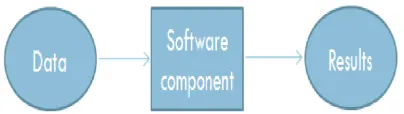
Decision support systems have become popular because of their capability to fill the need of decision making by given information. It is a class of information systems that support business and organizational decision making activities. It couples the intellectual resources of individual’s with the capabilities of the computer to improve the quality of decisions [13]. It is a computer-based support for management decision makers who deal with semi-structured problems. A properly designed DSS is an interactive software-based system intended to help decision makers to compile useful information from a combination of raw data, documents, personal knowledge, or business models to identify and solve problems and make decisions. A DSS is a general term for any computer application that enhances a person or group’s ability to make decisions. It can also be used as a tool in which user inputs the data and the software component process the data and decisions are made on the basis of the information given. In order to make the decision making tool all the major components of the system should be considered in the system to get an optimal result. Figure 2.1 shows the decision support system flow diagram in any decision support system.
For example: a national online book seller wants to begin selling its products interna-tionally although they need to determine if that will be a wise business decision. The vendor can use a DSS to gather information from its own resources (using a tool such as OLAP) to determine if the company has the ability or potential ability to expand its business and also from external resources, such as industry data, to determine if there is indeed a demand to meet. Another example is, a hospital management wants to examine the various different factors that affect the nurse’s performance in the hospital in order to make any decisions regarding the allocation of nurses or changing other environmental factors after observing the results. The DSS will collect and analyze the data and then present it in a way that can be interpreted by humans. Some decision support systems come very close to acting as artificial intelligence agents. DSS applications are not single information resources, such as a database or a program that graphically represents sales figures, but the combination of integrated resources working together.
technological processes and their parameters, planning business operations, logistics, and investments. Decision making is a fundamental managerial activity. It may be conceptual-ized as consisting of four stages: intelligence, design, choice and implementation.
Important Aspects of the DSS :
(1) The most important consideration is, DSS’s ease of use, such that its ability to allow non-technical people to deal with it directly. The single greatest and most enduring problem with computers has been their inflexibility, their inability to let the person who actually needs the data to deal directly with the computer.
(2) The ability to access information should not be restricted to only the part of an or-ganization or to only certain managerial or professional groups. Instead the resource should be distributed to all of the people and part of an organization needing it with-out widespread access; the power of advanced distributed processing system will go untapped as they typically have in the past.
(3) The ideal DSS in sharp contrast to previous method of designing applications should not be a ’system’ at all in the strict sense of the term. Rather, it should be a highly adaptive decision support generator that can easily be used by professionals to quickly design data support prototypes suited to each specific decision-making task.
(4) To adequately support the human element, this highly adaptive support capability must be able to provide access to operational data and as well as to summary data that already has been processed by application programs designed for other specific operational tasks.
generator should be able to interface with a true data base management system. (6) The management or professional information workstation would incorporate a
key-board, display screen and an interface to a printer which could print everything from straight text to graphics like pie charts, bar charts and line charts.
(7) The support tool must interface with several different systems and capabilities, it must be compatible with all of them, the tool must provide users with a single easily used language to access manipulate and present data in a way that will best support the end-user.
Abilities of the DSS:
(1) Support decision making in ill-structured situations in which precisely owing to the lack of structure, problem do not lend themselves to full computerization, and yet require computer assistance for access to and processing of voluminous amount of data.
(2) Help to rapidly obtain quantities results needed to reach the decision. (3) Support various stages of the decision making process.
(4) Foster high quality decision making by encouraging decisions based on the integra-tion of available informaintegra-tion and human judgment.
(5) Offer flexibility as opposed to a preordained pattern of use, making it easy to accom-modate the particular decision making style of an individuals.
(7) Support group decision making particularly through group DSS (GDSS).
(8) Give organization the opportunity to gain a better understanding for their business by developing and working with models.
Decision support systems are used in various domains from military, education and any other industry. Decision support system tools are been used to improve the effectiveness of the system rather than examining the efficiency of the systems. These tools are potential measuring tools which are used for management purposes. In DSS the decisions are largely dependent on the quality of information available. While concluding any decisions always best case scenarios are considered with no faults in a system. Problems arise when the quantity of available information is huge, and non uniform and is difficult to make any conclusion from the information given. The quality of decisions in DSS could not be stated in advance. To build a DSS for observing a complex system is a challenging task. Complex systems are highly dynamic in nature which consists of various parameters that affect the system. Once we have all the important parameters of the complex system in the DSS it is easy to conclude the decisions but it is hard to decide that which parameter has more influence on the system.
Approach
In [15] “A complex system is a system for which it is difficult, if not impossible to restrict its description to a limited number of parameters or characterizing variables without losing its essential global functional properties”. Modeling social human environments in MAS is always a complex and difficult task. The social systems are modeled using simple agents. Social complex systems consist of many individuals (autonomous agents) who interact non-linearly within the environment and their behavior is unpredictable. The interactions and agent’s decisions often affect their behavior resulting in different working conditions for them within the system. The result is that it becomes impossible to analyze a society as a whole by studying individuals one at a time. In complex systems, components have proper-ties of self organization which makes them non-predictable and the behavior of the society is said to emerge from the actions of it’s units or agents. Simulation is a third way of doing this science with which one can observe the behavior of a system and elucidate conclusions [4]. Complex environments in which the agents should reflect human like qualities and behaviors, includes various parameters to be considered in a simulation. Different proper-ties can be included in the system to have it behave more like a human environment such
as, communication, agent’s movement, work stress, and so on [49]. However, system’s complexity increases and it becomes more prone to errors which could lead to incorrect results.
In theory, all models are simplifications of reality, on the contrary there is always a trade-off as to what level of detail should be included in the model [20]. If too little detail is included in the model, one runs the risk of missing relevant interactions and the resul-tant model does not promote understanding. If too much detail is included in the model, the model may become overly complicated and actually preclude the development of un-derstanding. In order to observe and understand the behavior of a system as whole, it is important to include the key factors that have a substantial effect on the system. However, there are various other factors that can be ignored in such a way that the system should not lose its relevant behavior. In social modeling, there are various factors (such as path finding, task scheduling, socialization, domain knowledge, and so on) that are common for different social environments. In a hospital domain there are various different factors that are important and have a significant affect on patient care and safety. These factors are com-munication, situation awareness, decision making, stress, fatigue, and working environment [18].
complexity of the social complex systems low to validate the working of the system, and we can add more properties to the system later.
3.1
Important Key Factors in Social Complex Modeling
In this research, we have chosen a hospital domain for the study of artificial social complex modeling. In a hospital domain, patient safety and patient care are the central concerns for the hospital staff management for the quality patient service delivery. There are various factors underling that have considerable influence on the performance of hospital staff that ultimately affects the patient care in hospitals. In order to observe the effects of the hospital staff behavior and different hospital environmental conditions on the patient service, we have included the important key factors such as path finding techniques, task scheduling techniques, socialization, and domain knowledge to the agent modeling. These factors are included in the agent modeling on the basis of the different studies done on the factors affecting the patient safety in hospitals [18].
3.1.1
Path Finding
distractions, personal preferences, domain knowledge, and so on. Due to the influence of these factors the shortest path remains no longer shortest and becomes a social path, or in the other words, socially influenced path.
Agents usually follow the shortest path in a domain where service is required quickly. Dijkastra’s algorithm is used to calculate the shortest path from one vertex to another. In this model, the nurse agents use same algorithm to calculate their path from their initial location to the patient agent’s room.
The Dijkastra algorithm is a graph search algorithm that solves the single-source short-est path problem for a graph with non-negative edge path costs, producing a shortshort-est path tree [28]. This algorithm is often used in routing. For a given source vertex (node) in the graph, the algorithm finds the path with lowest cost (such as the shortest path) between that vertex and every other vertex. It can also be used for finding costs of shortest paths from a single vertex to a single destination vertex by stopping the algorithm once the shortest path to the destination vertex has been determined. For example, if the vertices of the graph represent cities and edge path costs represent driving distances between pairs of cities con-nected by a direct road, Dijkastra’s algorithm can be used to find the shortest route between one city and all other cities.
3.1.2
Task Scheduling
In social environments, the agents try to keep the success rate of the execution of pri-mary tasks higher to keep the overall service success rate high and balance their own vigor. In reality, when someone knows that they will not be able to finish the current task on time, and if they can estimate that if they will start the current task they will definitely miss the second following task. Then one can intentionally miss the current task and start doing the second following task to keep the successful execution of tasks higher and can serve the missed task after finishing the other task (refer to section 4.5.2).
In order to keep the success rate of the execution of primary tasks higher, agents pre-empt their current tasks so they can successfully execute the tasks following. Pre-pre-empting of tasks serves the current waiting task later, and does the second waiting task first to keep the service success rate of execution of tasks high. In some cases, the agents have long waiting times and they wait until they get service.
3.1.3
Social Factors
3.1.4
Domain Knowledge
Figure 3.1: Complex social modeling framework
Case Study: Base Hospital System
4.1
Health Care and Simulations
Health care is the largest industry in Canada and the U.S., and is characterized by very complex and dynamic environments where health services are delivered. Health care is characterized by dynamics, variety, and fragmentation of distributed medical prevention, diagnosis, treatment, and rehabilitation processes. The health care institutions struggle to meet the increasing demands for services and the rising costs of these services. The sustainability of Canadian and U. S. health care systems may be dependent on achieving innovation in productivity and cost effective strategies for health care delivery [32].
While attempting to achieve more cost effective health care delivery, patient safety and risk must be a central concern. Patient safety is a serious global public health issue in a health care systems that represent a fundamental principle of health care [53]. Adverse Event (AE) is defined as an injury caused by medical management rather than underly-ing disease that prolongs hospitalization, produces a disability at the time of discharge, or both. Adverse events are also referred to as untoward incidents, therapeutic misadventures,
iatrogenic injuries, or other adverse occurrences directly associated with care or services provided within the jurisdiction of a medical center, outpatient clinic, or other facility [53]. Adverse events increase the length of hospital stay and have a substantial impact on patients which includes discomfort, injury, increased morbidity or even death. Adverse events result in psychological implications for the patient with a decrease in self-confidence and build fear. This contributes to a decrease in mobility and culminates in a significant reduction in a quality of life. Although only a small number of failures in service produce significant injury, the impact on the health care system can be massive, resulting in an increased length of hospital stay, possible further surgery and a more unhealthy patient population.
Simulation has been used for modeling health care systems for over 40 years [10] to improve health care quality and efficiency of operations, reduce medical errors, identify new approaches, and to reduce delivery costs [26]. Agent-based modeling and simulation is a contemporary approach to modeling artificial systems comprised of autonomous, in-teracting agents [39]. The field of agent navigation is continuously evolving [60]. In the design of realistic artificial intelligence, it is a challenge to capture the reality of how agents act and interact [21]. In this model, the nurse agent’s movement is illustrated using path finding techniques which are usually deployed at the core of every AI movement system. This ability becomes critical when agents operate in dynamic environments, where unpre-dictable changes may occur. The optimal criterion for the nurse agent’s path is determined by the surrounding hospital environment and the running conditions of the model.
4.2
Patient Care in Hospitals
Patient safety represents a fundamental principle of health care, and is simply defined as ”the prevention of harm to patients”. It is a serious global public health issue in health care system. [53] [1].
model.
Social factors are very substantial for nurses’ to decide their path. Social networks are a set of people, organization, or social entities with social relationships and informal connec-tions between people in a society [27]. The relaconnec-tionships are often ones of communication, awareness, trust, and decision-making [51]. In our simulation, we have two different social networks, nurse-to-nurse and nurse-to-patient network which defines the nurse-to-nurse and nurse-to-patient communication and connections. The nurse-to-nurse social network is an immense network with various connecting nodes relative to the nurse-to-patient network, because only a few patients are assigned to a particular nurse and patients have commu-nication limited to that nurse. Each nurse has two networks, one with working colleagues (nurses) and another with the assigned patients. However, a patient is only connected to the nurse assigned. The task scheduling is another big concern in the multi-agent simulations where agents always try to keep their performance higher and reprioritize the tasks at dif-ferent time intervals. In our simulation the nurses do the same, in that way they always try to keep the patient service higher by missing fewer number of patients waiting for service. The nurses reprioritize their tasks and try to serve more patients on time.
4.3
Hospital Case Study
envi-ronment was investigated, which includes the time she spent on different tasks in a daily shift. With this tool design decision makers can identify and prevent such conditions that effect service quality levels. The goal of this study is, to use artificial agent simulation to critically examine the factors and influences that contribute to patient service in a hospital setting. In this study, we describe the use of agent modeling simulations to examine the influence of the hospital environment (length of shift, time of day etc.), the behavior of the nurse (path taken, social interactions, task execution etc.), and the patient agent (waiting time, severity etc.) on the outcome of a nurse response to a patient request.
A hospital case study is a study of the real environment that can be used to maximize the quality of service delivery of the nurses to the patients within community hospital set-tings using the appropriate identification and care for people at risk. The hospital case study simulation has been developed with the guidance of a team of nurses working in a small rural Ontario hospital and different studies conducted on patient care in hospitals [53][32][18][3][24]. The majority of their patients were elderly (such that, over 70 years of age) and were considered at high risk for injury. The research team spent time with the team of nurses to more closely understand the working environment of nurse in a hospital.
Nurses schedule their tasks during their shifts to keep the patient service success rate high and take breaks for balancing their own energy.
4.4
Hospital Floor Plan
Figure 4.1: Connectivity of the rooms and hallways in a hospital floor plan
Figure 4.1 is the example of a floor plan of a hospital and how rooms and hallways are connected with each other. In the Figure 4.1 hallway H1 is connected to patient rooms PR250, PR251, PR252, nurse station NS1, store rooms SR1, SR2, and another hallways H16 and H3. Hallway H1 is connected to another hallway H2 via H16, NS1, SR1 and H3.
4.5
Agents in Hospital
on. In this model, it is assumed that the majority of a nurse’s time on the hospital unit is spent providing care to patients and their families. Considering this fact, we have limited the implementation of agents to a nurse agent and a patient agent, to provide clarity in the model. Base model hospital simulation runs for different time steps in which one time step is equivalent to 12.5 seconds in a real world.
4.5.1
Patient Agent
Characteristics and Modeling Assumptions
(a) Patient agents are at fixed locations and do not move.
(b) In hospitals, the patients have different physical conditions, some patients are very critical and characterized by a very severe condition, some patients have moderate severity and other have low severity. In this model, patient agent’s severity level is measured on the scale ranging from 0 to 1. Patient agent severity is always known by the nurse agent assigned.
Scheduling of Visit Time
Nurse agents are suppose to visit the patient agents after every hour in a hospital. One hour is 288 time steps in our simulation. As the severity goes higher the visit time is scheduled more frequently, for example if the severity is 1 the visit time would be the current time in addition to the time corresponding to severity 1 which is 0. According to the equation visit time would be,
This shows that if severity of the patient is 1 then he should be visited right away. Every patient agent has different waiting times (TotalTimeToWait) to wait for a nurse agent to respond to patient’s call for assistance. Some patient agents wait for a short time, some wait for longer period of time. Patient agents wait for a nurse agent until their TotalTimeToWait. If the nurse agent visits a patient agent within its waiting time, then the patient agent is considered a ”patient served” and if it nurse arrives late to the patient then it is considered as ”serviced late”.
Severity of Patient Agent
In this model, it is assumed that patient agents stay in their rooms and do not move from their locations. The patient agents have different severity levels which defines their physi-cal condition or degree of illness. There are different values of severity, which are random numbers generated between 0 and 1 and are known by the nurses assigned. The patient agents with higher severity such as severity greater than 0.7, are considered critical condi-tion patients. Visit time is scheduled based on the severity level. If a patient agent is more severe than other patient agents, then the nurse agent is expected to visit the patient agent more often. After every visit by the nurse agents, the severity level of the patient agent changes and the visit time is scheduled again on the basis of that severity level. Visit time is scheduled for every patient agent and the nurse agent visits the patient agent within the expected time schedule. Following is the equation to calculate the visit time for the patient agent:
Visit Time = -288 * Severity of Patient Agent + 288 + Current Time
Figure 4.2: Slope for calculating visit time
4.5.2
Nurse Agent
Nurse agents are assumed to be at nursing station in the beginning of the simulation. Nurse agent possesses the knowledge about the floor plan of the hospital which is their domain knowledge. Nurse agents walk at the speed of 0.8 m/sec which is equivalent to the speed of normal person’s walk [12]. The equal numbers of patient agents are assigned to the nurse agents. Nurse agents start their shift by serving the patient agents assigned starting from the patient with the higher urgency of need. When nurse agents reach the patient agent they must finish the multiple tasks of serving, medicating and writing report for the patient agent. Nurse agents can consult or get distracted by the other nurse agents in the hospital during their shift.
Characteristics and Modeling Assumptions
(a) Nurse agents are initially positioned at nursing stations.
which path is a shortest path to the patient room.
(c) Nurse agent’s velocity (walking speed) is .8 m/sec [12].
(d) A particular number of patient agents are assigned to each nurse agent and only the assigned nurse agent serves those patient agents (for example, 5 patients assigned to each nurse).
(e) Nurse agents visit the patient agents after every hour and if a patient agent is more severe then the frequency of their visits increases.
(f) Nurse agents serve the patient agent for MinTimeServePatient, which is a minimum amount of time for which nurse agent spent serving the patient agent.
(g) Nurse agents do medication of the patient agent after serving for MinTimeMed, which is an amount of time nurse agents spent to bring the medication and give it to the patient agent .
(h) Nurse agents write the report for the patient agent after medication task for MinTime-Doc, which is an amount of time nurse agents spent on writing the report.
(i) Once the nurse agent started serving the patient agent she should finish all the con-secutive tasks that are medication and documentation.
(j) Nurse-to-nurse interactions happen frequently in any particular shift, however in this model nurses interact a maximum frequency of every 40 minutes.
(k) All nurse agents takes 10 minutes break after every 2 hour. Only few number of nurses go for a break at any given time.
(m) There are always fewer number of nurse agents at night shifts than who work on day shifts.
Task Done by Nurse Agent
(a) Travelling and consulting task: The nurse agents begin their shifts by visiting their assigned patient agents, starting with the patient agent having greatest urgency of need (due to the illness). The model assumes that the nurse agents always try to go through the shortest path to the patient, which is decided on the basis of Dijkastra algorithm. Along the way the nurses could distracted from their original path due to the social interactions, because interactions with health professionals are important for patient care delivery in the hospitals. On the contrary, the nurse agents also try to meet the patient agent’s needs as quickly as possible with the shortest possible time to reach the patient agent to respond to their request for assistance.
Consider the figure 4.1 again if a nurse agent has to go to the patient agent room PR247 from PR250 she can follow four different paths,
• Path 1: PR250-H1-H16-H2-PR247
• Path 2: PR250-H1-NS1-H2-PR247
• Path 3: PR250-H1-SR1-H2-PR247
• Path 4: PR250-H1-H3-H2-PR247
different path which could be longer. The shortest path would become the socially influenced path which could be shortest or longest.
(b) Serving patient task: Once a nurse agent responds to a patient agent she must start serving the patient agent which includes regular check-up, patient assessment, and other observations. A nurse agent serve the patient agent for MinTimeServePatient
which is a minimum time for which every nurse agent has to be with the patient agent andMinTimeServePatientcould vary according to the severity of a patient agent.
MinTimeServePatient = MinTimeServePatient + (MinTimeServePatient *
PatientSeverity) + (MinTimeServePatient * ProbRandEventRate)
WherePerRandEventRateis a percentage of any unpredictable AE that could happen during the patient agent service. ProbRandEventRateis a number between 0 and1, which represents a probability of any AE that could happen during the patient agent service and prolong the nurse agent’s stay with a patient agent.
(c) Medication task: After a nurse agent done with serving the patient agent she start doing the medication forMinTimeMed which is an amount of time a nurse needs to get the medication and give it to the patient agent. Medication task also depends on the unpredictable events that could happen in the hospital. After medication the severity of the patient agent changes and the time for next visit is scheduled for the patient care.
MinTimeMed = MinTimeMed + (MinTimeMed * PatientSeverity) + (MinTimeMed *
(d) Documentation task: After finishing the medication task with the patient agent, nurse agent has to write a report regarding the observations of the patient agent and what type of medication she has given. The nurse agents does this task for MinTime-Doc, which is a variable and an amount of time she needs to write a report.
Decision Rules and Algorithm for an Individual Decision Making
(a) Preempting of tasks: When a nurse agent starts her shift she has a particular number of patient agents assigned and a task list to serve the patient agents. In her shift, a nurse agent always attempt to serve more patient agents on time to keep the service success rate of patient agents higher. In order to do that she sometimes misses first waiting patient (PA1) intentionally and serves the next waiting patient (PA2) and serves the first waiting patient (PA1) later. Pre-empting of tasks is to serve the current waiting task later and do the second waiting task first to keep the service success rate of execution of a task high. In order to miss one patient agent she does an estimate before starting, for the first waiting patient agent and the second waiting patient agent in a task list. The nurse agent serves the second waiting patient agent (PA2) first only when she does an estimate that she will not be able to serve the first waiting patient agent (PA1) on time. If the nurse agent goes to the first patient agent (PA1) she will definitely miss the first patient agent (PA1) and the second patient agent (PA2) too and also when she checks that first patient agent (PA1) is not critical, such that severity is smaller than 0.7. Following are the conditions in algorithm for the nurse agent to pre-empt her task and all the conditions must be true before she can pre-empt any task,
current time subtracted from the visit time of first waiting patient agent (PA1).
• Condition 2:If the visit time of second waiting patient(PA2) is smaller than the current time added to the time to reach first waiting patient agent (PA1) added to the time to reach from first waiting patient agent (PA1) to second waiting patient agent (PA2).
• Condition 3:If the first waiting patient agent (PA1) has severity smaller than 0.7. (b) Nurse agent break: In an 8 hour shift, nurse agents are assumed to take breaks approximately after every 2 hours. The break lasts for 10 minutes. When nurse agents work 12 hour shifts, fatigue factor effects their performance [18] and they start taking breaks more often (after one and a half hour) and for longer interval that last for 15 minutes. Nurse agents do not go on breaks together, only 30% of nurse agents go on break at time, for example if a nurse agent has to take a break, she will check a break log if 30% of nurse agents are on break, then she will wait until any nurse returns. Nurse agents always take breaks when they are idle, such that they have no task to do at that time. The following are the conditions for a nurse agent to decide whether she should go on break or not and all must be true before she goes on break,
• Condition 1:If nurse agent is Idle.
• Condition 2:If number of nurse agents on break is less than 30%.
• Condition 3:If nurse agent has not been on break for last three hours.
These estimates on a nurse agents work hours and break time were determined in col-laboration with the nurse agents working in the rural Ontario hospital that partnered with the research team. Visit times are scheduled on the basis of the level of severity of the patient agent. The greater the severity of the patient agent’s condition, the more frequent the visit will be for that patient agent by the nurse agent as described earlier. (c) Modeling of visit time: Nurse agents serve patient agents forMinTimeServePatient
which is the minimum time for the nurse agent to be with patient agent and MinTime-ServePatientcould vary according to the severity of patient agent.
MinTimeServePatient = MinTimeServePatient + (MinTimeServePatient *
PatientSeverity) + (MinTimeServePatient * ProbRandEventRate)
(d) Unpredictable events: Unpredictable events are the events that happen in a hospital without any notification. These events are also called AE that prolong nurse agent’s service time because nurse agents have to overcome these AEs. For example, if a nurse agent is doing a medication task where MinTimeServePatientis 15 time steps (15 * 12.5 seconds) and patient severity is 0.5 and probability of happening of AE in hospital is .2 then according to the following formula,
MinTimeServePatient = MinTimeServePatient + (MinTimeServePatient *
PatientSeverity) + (MinTimeServePatient * ProbRandEventRate)
4.6
Difference Between Pre-empting, Unpredictable Events
and Socialization
• Pre-empting: Pre-empting of tasks is a rescheduling of tasks when a nurse agent knows that the first waiting patient agent is not very critical and she will not be able to serve the next waiting patient agents successfully at a given time. If nurse agent will start doing the first waiting task she will not be able to finish the second task successfully. On the basis of the pre-empting rules nurse agents reschedule the visit time of the first waiting patient agent.
• Unpredictable Events: Unpredictable events are any AEs that could happen during the serving and medicating the patient that can prolong the nurse agents stay with the patient agent during the serving time and the medicating time, that could lead nurse agents to pre-empt the following tasks. When AE happens during the serving of a patient agent the nurse agents have to stay with the current patient agent for longer interval of time, depending upon the intensity of the adverse event due to which she misses the next waiting patient agents.
4.7
Parameters Used in Model
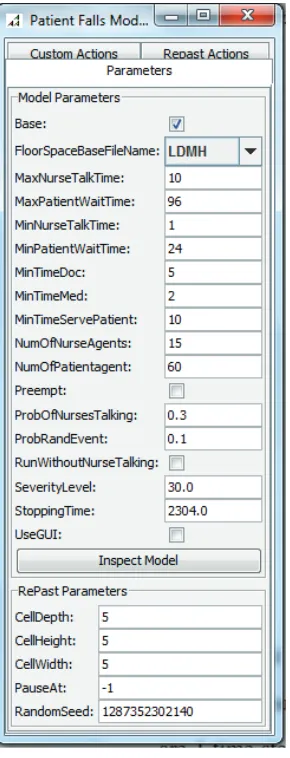
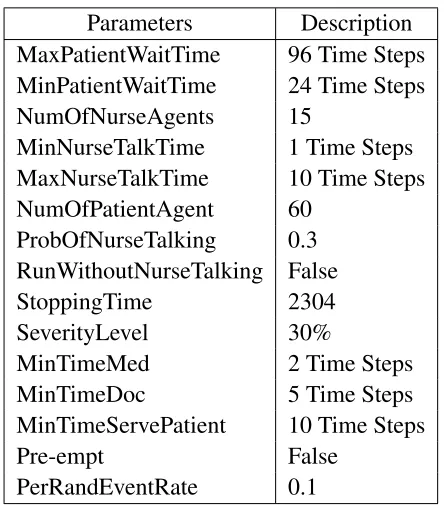
Repast is an open source agent modeling toolkit which was used for this simulation. Repast is a very useful tool that captures the dynamic nature of the social interactions in the model. With the help of Repast, we are able to control some of the parameters of the nurse agents and the patient agents. The following are the parameters which have been used in the model to observe how the system behavior changes by changing these parameters. There are various parameters that could have been included in the system but following are the most important parameters that should be assigned to the agents and model behavior.
Parameters Description
MaxPatientWaitTime Time for which a patient agent waits for a nurse agent
MinPatientWaitTime The minimum time for which every patient agent waits for nurse agent
NumOfNurseAgents The total number of nurse agents caring for patient agents
MinNurseTalkTime The minimum time for which one nurse agent consults with other nurse agents
MaxNurseTalkTime The maximum time for which one nurse agent consults with other nurse agents
NumOfPatientAgent The total number of patient agents in the hospital
ProbOfNurseTalking The probability that a nurse agent engaged in an interaction by other nurse agents
RunWithoutNurseTalking (Boolean) Nurse agents are interacting with other team members or not
StoppingTime Short shift (8 hours) long shift (12 hours)
SeverityLevel Percentage of number of patients have severity level greater than 0.7
MinTimeMed Minimum amount of time for which nurse agents do medication of the patient agent
MinTimeDoc Minimum amount of time for which nurse agents write the patient agent’s report
MinTimeServePatient Minimum amount of time for which nurse agents stay with patient agent for servicing
Pre-empt (Boolean) Run with pre-empting or without
PerRandEventRate Percentage of random AE that could happen in a hospital model
Table 4.1: Description of parameters used in the model
change on the nurse agent’s ability to respond to the patient agent. For example, one can observe the change in the patient service success rate as an outcome of the nurse agent’s ability or limitation in responding to patient agent requests for assistance, or the outcome of increasing the probability of a nurse agent talking to another nurse agent, or increas-ing the number of nurse agents on duty at the hospital. The model’s behavior reflects the subsequent changes while changing these parameters.
4.8
Working of the Model at Each Step
breaks after every two hours for 10 minutes and only 30% of nurse agents go for a break at a particular time. For example, if there are 10 nurse agents in a hospital, then after every two hours only 3 nurse agents will go for a break and rest will wait untill others return. This process is repeated in a day for 8 hours and if the shift is long, then 12 hours. Every patient agent in a hospital waits for a specific interval of time for nurse agent service which is their tolerance time or waiting time, if the nurse agent comes within their waiting time, then the patient service is considered a successful service or service on time and if nurse agent arrives late then the service is considered late.
An eight hour shift is 2304 time steps and a 12 hour shift is 3456 time steps. A small percentage of task is done at each time step and simulation is run for 2304 time steps to finish the 8 hour shift and 3456 time steps to finish the 12 hour shift. For example if a nurse agent has to serve the patient agent for 15 time steps, so for 15 time steps of the simulation the nurse agent has to be with the patient agent.
4.9
Repast (Recursive Porous Agent Simulation Toolkit)
Repast version that is built on the Java platform is Repast J 3.0. It is an integrated simulation development framework that provides some functionality to develop and run simulations. These functionalities are,
1. Graphical display features to demonstrate the simulation.
2. To create charts and graphs to capture the outcome of the simulation visually.
3. The user settings menu which allows the user to initialize, run, stop or pause the simulation while running.
Repast behaves as a discrete event simulator whose quantum unit of time is known as a tick. The tick exists only as a hook on which the execution of events can be hung, ordering the execution of the events relative to each other. For example, if event x is scheduled for tick 3, event y for tick 4, and event z for tick 5, then event y will execute after event x and before event z. If no events are scheduled for a certain tick, then it is as if that tick never occurred. Ticks are merely a way to order the execution of events relative to each other.
4.9.1
Repast Setup
The main function routine is given below. The first routine that starts the environment is loadModel in the instantiated init object of class SimInit() that loads the object model of class BaseHospitalModel. The engine class is responsible for setting up, manipulating, and driving a simulation. The SimModel interface is the super-class for all models written with Repast. The SimpleModel class can be used to automate event scheduling as described above. The controller classes (BaseController, Controller, and BatchController) are respon-sible for handling user interaction with a simulation either through a GUI or by automating such interaction through the use of a batch parameter file. In addition, the engine package contains the classes that make up the scheduling mechanism.
The gui classes are responsible for the graphical animated visualization of the simula-tion as well as providing the capability to take snapshots of the display and make Quick-Time movies of the visualization as it evolves over time. DisplaySurface, the LocalPainter class handles the actual display of these spaces on the screen, and the DisplaySurface itself allows for the probing of the displayed objects.