University of Windsor University of Windsor
Scholarship at UWindsor
Scholarship at UWindsor
Electronic Theses and Dissertations Theses, Dissertations, and Major Papers
2015
Accommodating Complex Chained Prepositional Phrases in
Accommodating Complex Chained Prepositional Phrases in
Natural Language Query Interface to an Event-Based Triplestore
Natural Language Query Interface to an Event-Based Triplestore
Elham EmamiUniversity of Windsor
Follow this and additional works at: https://scholar.uwindsor.ca/etd
Recommended Citation Recommended Citation
Emami, Elham, "Accommodating Complex Chained Prepositional Phrases in Natural Language Query Interface to an Event-Based Triplestore" (2015). Electronic Theses and Dissertations. 5254.
https://scholar.uwindsor.ca/etd/5254
This online database contains the full-text of PhD dissertations and Masters’ theses of University of Windsor students from 1954 forward. These documents are made available for personal study and research purposes only, in accordance with the Canadian Copyright Act and the Creative Commons license—CC BY-NC-ND (Attribution, Non-Commercial, No Derivative Works). Under this license, works must always be attributed to the copyright holder (original author), cannot be used for any commercial purposes, and may not be altered. Any other use would require the permission of the copyright holder. Students may inquire about withdrawing their dissertation and/or thesis from this database. For additional inquiries, please contact the repository administrator via email
Accommodating Complex Chained Prepositional Phrases in
Natural Language Query Interface to an Event-Based
Triplestore
By:
Elham Emami
A Thesis
Submitted to the Faculty of Graduate Studies and Research through the School of Computer Science
in Partial Fulfillment of the Requirements for the Degree of Master of Science at the University of Windsor
Windsor, Ontario, Canada 2015
Accommodating Complex Chained Prepositional Phrases in
Natural Language Query Interface to an Event-Based
Triplestore
By:
Elham Emami
APPROVED BY:
______________________________________________ Dr. D. Martinovic,
Faculty of Education and Academic Development
______________________________________________ Dr. J. Lu
School of Computer Science
______________________________________________ Dr. R. Frost, Advisor
School of Computer Science
iii
DECLARATION OF ORIGINALITY
I hereby certify that I am the sole author of this thesis and that no part of this thesis has been published or submitted for publication.
I certify that, to the best of my knowledge, my thesis does not infringe upon anyone’s copyright nor violate any proprietary rights and that any ideas, techniques, quotations, or any other material from the work of other people included in my thesis, published or otherwise, are fully acknowledged in accordance with the standard referencing practices.
iv Abstract:
Building Natural language query interfaces (NLI) to databases is one the most interesting and challenging fields of study for computer scientists and researchers. There have been many advancements and achievements in this area that enables NLIs to operate more efficiently and have wide NL coverage. However, there exists some shortcomings in query interface to semantic web triplestores. Some researchers have attempted to extend the range of queries that can be answered. However, only a few techniques can handle queries containing complex chained prepositional phrases. This thesis involves extending an existing method that can accommodate prepositional phrases to also be able to handle “when…,” “where…,” and “with what…” type queries. The approach developed is
implemented in the Miranda programing environment.
v Acknowledgements
I would like to thank my supervisor Dr. R. A. Frost for his valuable suggestions, remarks, comments, discussion and encouragement.
I would also like to thank Dr. Dragana Martinovic and Dr. Jianguo Lu for reading my thesis report and for their valuable comments.
vi Table of Contents
DECLARATION OF ORIGINALITY ...iii
Abstract ... iv
Acknowledgements ... v
List of Tables ... viii
List of Figures... viii
Chapter 1: PREFACE ... 1
1.2 Outline of report... 1
Chapter 2: INTRODUCTION ... 3
2.1. Introduction ... 3
2.2 Montague`s Approach to Natural Language ... 5
2.3 Problem Addressed ... 6
2.4 Thesis Statement ... 6
2.5 Why the thesis is important ... 7
2.6 How the thesis will be proven ... 7
Chapter 3: Montague Semantics ... 8
3.1 Subject-Predicate and Determiner-Noun rules: ... 11
3.2 Conjoined sentences, Verb phrases and Term phrases ... 14
3.3 Anaphoric Pronouns as bound variables: ... 16
3.4 Transitive verbs, Meaning Postulates and Non-Specific Readings: ... 17
3.5 Adverbs ... 19
3.6 Negation ... 20
Chapter 4: Related work on prepositional phrases and quantifiers... 21
4.1. Montague’s approach to quantifiers ... 21
4.2 Improved Montague Semantic by Event approach ... 22
4.3 Other researcher’s approaches to accommodate the prepositional phrase ... 29
Chapter 5: The specific problem addressed ... 32
Chapter 6: The new idea ... 35
6.1. Summary of the new idea ... 35
6.2. Statement and Contribution ... 36
Chapter 7: Implementation of the new idea ... 39
Chapter 8: ANALYSIS/EXPERIMENTS CONDUCTED ... 49
vii
9.1 Claim ... 53
9.2 What has been achieved? ... 53
9.3. Relationships to parsing and access to triplestores ... 54
9.4 Contribution to Computational Linguistics and Computer Science ... 54
REFERENCES: ... 56
Appendix I - Program ... 58
Appendix II – Survey ... 65
Appendix III – Annotated Bibliography ... 100
viii LIST OF TABLES
Table 1 ………. 11
Table 2 ………. 30
LIST OF FIGURES
Figure 1 ……….12
Figure 2 ……….34
1
1.1 Introduction
This report describes a new approach for the accommodation of prepositional phrases in natural language interfaces to triplestore database and develops an event-based denotational semantics that can be used for natural-language (NL) query interfaces to triplestores. This topic is significant because the usage of triplestores databases in the semantic web, and natural language interfaces to them, is growing rapidly and are now extensive and popular. A wide range of queries can be answered by a proposed method using a denotational semantics that accommodates prepositional phrases in natural language queries to triplestores.
1.2 Outline of report
This report shows to how accommodate prepositional phrases in natural language interfaces and handle queries that ask for temporal and spatial details and contain “when..?,” “where…?,” and “with what…?” type questions. Chapter 2 of the report
contains an introduction to Montague Semantic, the thesis statement and the main motivation of it. Chapter 3 is about the use of Montague Semantics in database query processing. Chapter 4 describes previous work that has studied prepositional phrase
2
3 2.1. Introduction
A Database is a collection of data that is organized to process future accessibility. A database management system is a collection of programs that enables users to create and maintain the database system for access in the future. There are different models to store data, such as the relational database model, in which data is stored as records and fields in rows and columns of tables. Data can be related to each other by defining relationships between tables. Another popular method of storing data that is studied in this thesis is the triplestore method. A Triple consists of a “subject”, a “predicate” and an “object”. The
triplestore has some advantages compared with relational stores. Although the relational model is more mature and popular than the triplestore model, it suffers some limitations and deficiencies. A major aspect of the relational model is that it uses a schema for its organization, thus, the designer or database administrator has the responsibility to recognize what type of questions will be asked in advance and builds a schema based on that. Therefore, the relational data has to have schema for its organization. Problems shows up when the database schema needs to be changed because the relational database is not flexible and its schema remains static while the stored data type is not known in advance in some applications, like criminal investigations. In order to provide continuous changes to apply to database schema and queries, some researchers believe that it would be easier
4
if the data is represented in binary relations or graphs and stored in triplestores rather than conventional relational databases. Because triplestores do not have the deficiency of a fixed schema, they are highly flexible. Most data in the Semantic Web is stored in Resource Description Framework (RDF) triplestore format. A triple includes a subject, a predicate and an object. The subject is the resource, the predicate denotes the property and the object is the value of the property that can be another resource. Values of subjects, predicates and the objects are denoted by Uniform Resources Identifiers (URIs), which are similar to URLs used in the web to ensure that their values are unique for the future access. For example the fact “Al Capone was married to Mae Capone” can be represented by the
following triple.
<http://dbpedia.org/resource#Al_Capone>
<http://dbpedia.org/ontology/spouse>
<http://dbpedia.org/resource#Mae_Capone>
Adding more details regarding the time and place of the marriage, is possible by adding more triples to existing triples. However, it is not always sufficient to do this because it might be that Capone married more than once and therefore adding another triple simply stating the time of the marriage could lead to ambiguity about which marriage took place at that time. The following discusses this problem and provides more detail regarding the solutions of the issue. Triples are considered as one of the basic units of languages like RDF, RDFS and OWL, which can enhance interface capabilities. These languages are used to represent data in the the semantic web.
The role of databases has grown dramatically with advancements in data storage. An example triplestore is DBpedia, which contains 2.5 billion facts extracted from Wikipedia.
5
advantages to providing a natural language interface for users to connect with databases. The natural language interfaces to database allow people to communicate with database in the same way they communicate with each other. The main advantages of natural language interface is that users are not required to learn queries languages like SQL because they are difficult for non-experts to learn and use. Moreover, there are some type of questions, specifically those containing negation and quantification, that can be expressed easily in natural language rather than formal query languages such as SQL.
One approach that has made considerable progress in answering natural language queries to triplestore data has been developed by Frost et al. [2014]. The approach is based on an efficient version of f Montague Semantics. After doing a survey and study in natural language queries to the triplestore database, it was realized that no existing method can accommodate prepositional phrases, such as “who stole a car in Manhattan in 1980?,” as
referred to by Frost et al. [2013] and Frost et al. [2014]. However, though a method suggested approach by Frost et al. [2014] can handle chained complex prepositional phrases, it cannot accommodate “when…,” “where…,” or “with what…,” type questions.
2.2 Montague`s Approach to Natural Language
In the 1970s, Richard Montague developed an approach to the interpretation of natural language in which he claimed that we could precisely define the syntax and semantics for substantial sub-sets of natural languages such as English. He described the aim of his enterprise as follows:
“The basic aim of semantics is to characterize the notion of a true sentence (under a given interpretation) and of entailment” Montague [1970].
The salient points of Montague's approach are a model of theoretical semantics, a
systematic relation between syntax and semantics, and a fully explicit description of a
fragment of natural language. His approach constituted a revolution after the Chomsky
revolution that brought mathematical methods into syntax. Richard Montague was a
mathematical logician who had specialized in set theory and modal logic. In Montague's
view, the study of natural language belonged to mathematics, not to psychology, Janssen
6
“There is in my opinion no important theoretical difference between natural languages and
the artificial languages of logicians; indeed I consider it possible to comprehend the syntax
and semantics of both kinds of languages with a single natural and mathematically precise
theory.”
In Montague’s semantics, all things can be depicted as sets of entities in the universe of discourse. He claimed that each object in a phrase of natural language can be interpreted as a function. Montague claimed that there is a correspondence between each syntactic category of natural language and each semantic type in the universe of discourse, and he also believed that there is correspondence between syntactic rules that explain how complex syntactic phrases can be built from simpler ones. Similarly, the semantic rules that explain how complex semantic functions that are the meanings of complex phrases can be built from the meanings of simpler phrases. Montague was one of the first to develop a compositional semantics for a substantial part of English. The next chapter provides more details and description regarding Montague’s semantics.
2.3 Problem Addressed
To address the main problem of natural language interface to triplestore, there is no method to accommodate chained prepositional phrases in natural language interfaces that can also handle questions type “when..,”, “Where…and,” “With what..”.
2.4 Thesis Statement
It is possible to construct natural language query interfaces to triplestores which can accommodate arbitrarily-nested complex chained prepositional queries such as:
“When did Capone steal a car in Manhattan using a crowbar…?” “Where did Capone steal a car in 1918 or 1920…?”
“With what did Capone steal two cars and a truck that was owned by a gangster
7 2.5 Why the thesis is important
This thesis is important because proving it will enable the extension of the coverage of queries about spatial and temporal details of stored facts in triplestore databases and provide an approach to deal with queries such as “When did Capone marry?,” “Where was the red car stolen in 1905?” and “With what did Hall discover Phobos in 1187?”.
2.6 How the thesis will be proven
In order to prove this thesis, anew semantics that manipulate events rather than entities was developed. This required the most significant denotations in the method of Frost et al. [2013] to be changed. The new semantics was implemented in Miranda with an in-program triplestore. The advantages of using Miranda as the in-programing language include:
It has built-in list operators and a list comprehension construct which correspond to the “relative set notation” that used in denotations of transitive verbs.
The higher-order functions used in the denotations can be defined directly in
Miranda.
Given the declarative nature of Miranda, the definitions are executable specifications which allow us to test our ideas.
8
To analyze the meaning of natural language expressions, a semantics of them has to be modeled theoretically. In two papers written by Montague in 1971 “Universal Grammar” and “The proper Treatment of Quantifications in ordinary English” PTQ, M0ntague
introduced his novel ideas about language. Richard Montague was a logician and philosopher who had done significant and remarkable work on language based on the theory known after his death as Montague grammar. Montague grammar is a new strating point for studying formal semantics, Partee et al. [1930].
Based on paper by Partee et al., Montague was born September 20, 1930 in California and died March 7, 1971 in Los Angeles.
He studied journalism in Junior College, he joined the University of California, Berkeley in 1948, and started studying in mathematics, philosophy, and Semitic languages, graduating with a B.A in Philosophy in 1950. He continued graduate work at Berkeley in all three areas, receiving an M.A. in mathematics in 1953 and his Ph.D. in Philosophy in 1957. Montague quickly turned into a known person in mathematical logic, with contributions to proof theory, model theory, axiomatic set theory, and recursion theory. He could apply logical methods to a different of issues in philosophy, such as the philosophy of language. Montague’s work on semantics was very significant and important for
9
linguistics. Building on his development of a high order typed intentional logic with a possible-worlds model theoretic semantics and a formal pragmatics incorporating indexical pronouns and tenses, Montague turned in the late 1960’s to the project of “Universal Grammar”.
The following is based on Partee et al. [1997]: Montague had attempted to develop a philosophically satisfactory and logically accurate form of syntax, semantics and pragmatics that exist in both formal and natural language. There were controversies amongst linguistics about Montague’s ideas because some of them believed that natural language such as English is not suitable to accurate formalize. Also, many linguistics were not sure about the appropriateness of logicians’ approaches to the domain of natural language semantics.
“The proper Treatment of Quantifications in ordinary English” had the most impact on linguists and also on the developing of formal semantics which had been used by Montague in 1973.
As the author in the paper referred to by Partee et al., Montague grammar refers to PTQ and its extensions most the time by linguistics and philosophers but it contains an algebraic framework of “Universal Grammar” that constitutes Montague’s theory of grammar. The
strength of Montague proposal was truly decisive for the compositional semantic interpretation of syntax structure. That is demonstrated in PTQ in which higher-order logics that accompanied lambda abstraction made it possible to interpret noun phrases such as “every man”, “the man”, “a man” as semantics components. PTQ also contains a
pioneering approach for quantifiers and transitive verbs, conjunctions, adverbial modifiers and more.
10
The λ calculus is highly powerful method because any computable function can be represented and evaluated by applying this formalism. Some researchers and linguistics believe that it is similar to Turing machines although it emphasizes the use of transformation and does not pay attention to machine implementation.
Church et al. [1941] realized that each expression in natural language which contains …..x… can be defined as function of x. He proposed λx as name for the function. The rule for λ conversion is as follow:
λx [ …x…..] (α) ⇒ [….α….]
In which, each x is replaced by α, so the result would be [….α…...].
Montague Grammar and semantics is described in detail in the book titled “Montague Semantics” by Dowty et al. [1981]. Montague used some examples to explain more about the semantics of NL expressions by using lambda. The following two example a. The translation of “Every man eats” and “Every man sleeps” in predicate logic would be:
∀x(M(x)→ E(x)) and ∀x(M(x) → S(x))
The general format of the above sentences is the following:
λY[∀x(M(x)→ Y(x))] Which for first sentence it would be:
λY[∀x(M(x)→ Y(x))](E) And for the second one, the conversion would be:
λY[∀x(M(x)→ Y(x))](S)
There is difference between sense and reference of expression in Montague theory. The sense or intension of expression relates to the meaning of expression but the reference or extension of expression considers the semantics of the expression. According to the rules of PTQ grammar αi shows the intension of expression of α and αe denotes the extension of expression of α. Montague also introduced another rule which is called the cancellation rule. It is denoted by ei and is important in simplification of expression produced by translation of sentence in natural language. The determinants “every” and “a” denote the following expressions:
11
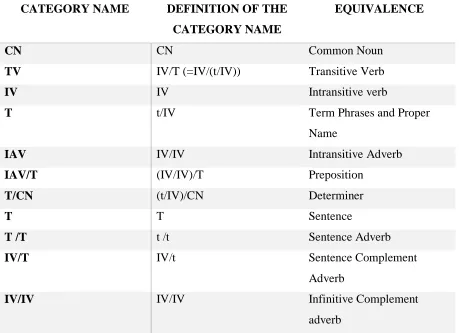
There are syntactic categories which are used in the PTQ grammar:
CATEGORY NAME DEFINITION OF THE
CATEGORY NAME
EQUIVALENCE
CN CN Common Noun
TV IV/T (=IV/(t/IV)) Transitive Verb
IV IV Intransitive verb
T t/IV Term Phrases and Proper
Name
IAV IV/IV Intransitive Adverb
IAV/T (IV/IV)/T Preposition
T/CN (t/IV)/CN Determiner
T T Sentence
T /T t /t Sentence Adverb
IV/T IV/t Sentence Complement
Adverb
IV/IV IV/IV Infinitive Complement
adverb
Table 1. Categories used in PTQ grammar
3.1 Subject-Predicate and Determiner-Noun rules:
The set of basic expressions of category of A is being stated by BA that can be specified as
simply as “lexical entries” of each category. The set of phrases of category A can be
denoted by PA that includes the basic expressions for each category together and
complicated expression of that category that are formed by syntactic rules. The first syntactic rule of PTQ rules is related to basic expressions:
12
The rest of the rules take care of more complicated expressions which all of them include three major type of information: (1) category or categories of expression that are used as input of the syntactic rule, (2) the category of expression which is denoted as output of syntactic rule and is result of applying function on the input categories, (3) the operational structure of expressions that describe how the input categories turns to output one.
The general form of syntactic rules in PTQ grammar is as follow:
Sn : If α∈ PA and β∈ PB then Fn(α, β) ∈ PC, where Fn(α, β) is……….
A and B state the syntactic categories of input expression and C is syntactic category of output which is the result of function Fn, n demonstrate the number of the rule and Fn is the name of rule in the PTQ grammar. Some of the PTQ grammar which is required to understand Montague semantic has been provided as follows:
Consider S4 as example of syntactic rule which is called “subject-predicate” rule.
S4: If α∈ PT and β∈ PIV then F4(α, β) ∈ Pt, where F4(α, β) = αβ’, and β’is
the result of replacing the first verb in β by its third person singular present form.
This rule takes the term phrase which is member of PT and PIV member of verb phrase then
forms a sentence by combing them that is member of Pt. In order to explain more about the
operation of this rule take the following example: Jack ∈Bt so expectedly refer to S1 we
have Jack ∈Pt, walk ∈BIV so we have walk ∈PIV thusbased onS4 Jack walks ∈Pt.
Sentence or phrases which are constructed syntactically can be demonstrated through an analysis tree. The analysis tree for “Jack walks” is as shown below.
All the terminal nodes of the analysis tree are basic expressions. The translation rule related to S4 is as follow:
13
T4: If α∈ PT and β∈ PIV and α, β translate into α’, β’respectively, then F4(α,
β) translates into α’ ( β’i). The translation of “Jack talks” is as follow:
Jack translates into λP [Pe(j)] Jack talks
1.Jack ⇒ λP [ Pe (j)]
2.talks ⇒ talk’
3.λP [Pe(j)](talk’i) [ From 1,2 by T4]
4.talk’e,i (j) [Lambda conversion]
5.talk’(j) [Cancellation rule]
It should be mentioned that j is an individual constant corresponding to the person called Jack.
The S2 rule relates the “Determiner-Noun rule” which combines determiner such as “every” and “a” to produce partial sentences like: “every color” or “a car”. The format of
S2 rule is as follow:
S2: If α∈ PT/CN and β∈ PCN then F2(α, β) ∈ PT , where F2(α, β) = α’ β and α’
is αexcept in the case where α is a and the first word in β begins with a vowel, here α
’ is an. The translation for rule S2 is:
T2: If α∈ PT/CN and β∈ PCN and α, β translate into α’, β’ respectively, then F2 (
α, β) translates into α’ ( β’i).
The words every, the and a can be translated as follows according to Montague: every translates into: λP [λQ ∀x [ Pe(x) → Qe(x)]]
the translates into: λP [λQ ∃x [∀x [Pe(x) ⇔ x = y] ∧ Qe(y)]]
a translates into: λP [λQ ∃x [ Pe(x)∧ Qe(x)]]
The translation of the sentence “Every dog runs” is like below by applying T2 and T4.
1.every ⇒ λP[λQ∀x[Pe (x)→ Qe (x)]] 2. dog ⇒ dog´
3.every dog ⇒ λP[λQ∀x[Pe (x)→Qe (x)]]( dog´i) [From 1,2 by T2]
4.λQ∀x[dog´e, i (x)→ Qe(x)] [ Lambda conversion] 5.λQ∀x[dog´i (x) → Qe (x)] [Cancellation Rule] 6. runs ⇒ runs ´
14 [From 5,6 by T4]
9.∀x[dog´(x)→ runs´e, i (x)] [ Lambda conversion] 10.∀x[dog´ (x)→ runs´(x)] [Cancellation Rule] Based on T2 and T4 the following translation can be as: “The sun shines”
∃x [∀x [sun’(x) ⇔ x = y] ∧ shines’(y)]
“A dog barks”
∃x [ dog’(x)∧ barks’(x)]
3.2 Conjoined sentences, Verb phrases and Term phrases
The first conjunction rule in PTQ grammar which combines two sentences and combine them is called S11a and produce a new sentences by assigning rule S11. Take two following sentences as example for considering rule S11. “Jack talks” and “every dog runs” are two
sentences which can be conjoined by the rule S11a and the new sentence “Jack talks and every dog runs” can be produced by applying S11. The rule is as follows:
S11a: If α, β∈ Pt , then F11a(α, β) ∈ Pt , where F11a(α, β) = α and β The associated translation rule of S11a is T11a which is:
T11a: If α, β∈ Pt and α ,β translate into α´, β´ respectively, then F11a(α, β) translates into [α´ ∧ β´].
By helping T11a, the sentence “Jack runs and every dog runs” can be translated to [talk´(j) ∧ ∀x [dog´ (x) → runs´ (x)] ] which “Jack talks” can be translated into talk´ (j) and every dog runs can be translated into ∀x [ dog´ (x) → runs´ (x)].
The rule S11b define as follow:
S11b: If α, β∈ Pt , then F11(α, β) ∈ Pt , where F11b(α, β) = α or β The translation rule for S11b would be T11b, which is:
T11b: If α, β∈ Pt and α,β translate into α´, β´ respectively, then F11b(α, β) translates into [α´ ∨ β´]
15
member of Pt and combine together to make a meaningful sentence. Here the rules S12a, S12b and S13 are defined:
S12a: If α, β∈ PIV, then F12a(α, β) ∈ PIV , where F12a(α, β) = α and β
S12b: If α, β∈ PIV, then F12b(α, β) ∈ PIV , where F12b(α, β) = α or β
S13: If α, β∈ PIV, then F13(α, β) ∈ PIV , where F13 (α, β) = α or β
The associated translation with above rule are:
T12a: If α, β∈ PIV and α ,β translate into α´, β´respectively, then F12a(α, β)
translates
into λx [α´ (x) ∧ β´ (x)]
T12b: If α, β∈ PIV and α ,β translate into α´, β´respectively, then F12b(α, β)
translates
into λx [α’(x) ∨ β’(x)]
T13: If α, β∈ PT and α,β translate into α´, β´respectively, then F13(α, β)
translates into λP [α´ (P) ∨ β´ (P)]. The translation of sentence “Every human walks or talks” by using T12b can be:
Every human walks or talks.
1.every human ⇒ λQ∀x[human´ (x)→ Qe (x)] [Derived in section 2]
2.walk ⇒ walk´ 3.talk ⇒ talk´
4.walk or talk ⇒ λx[walk´ (x) ∨ talk´ (x)][From 2,3 by T12b] 5.every human walks or talks ⇒
λQ∀y[human(y)→ Qe(y)](λx[walk´ (x) ∨ talk´ (x)] i )
[From 1,4 by T4]
6.∀y[human´ (y)→ λx[walk´ (x) ∨ talk´ (x)] e,i (y)]
[Lambda conversion]
7.∀y[human´ (y)→ λx[walk´ (x) ∨ talk´ (x)](y)]
[Cancellation Rule]
8.∀y[human´ (y)→ [walk´ (y) ∨ talk´ (y)]]
16 3.3 Anaphoric Pronouns as bound variables:
The rule associated with pronoun is called S14 which is as follow:
S14: If α∈ PT , β∈ Pt, then F14,n(α, β) ∈ Pt
The translation rule of S14 is:
T14: If α∈ PT , β∈ Pt and α ,β translate into α´, β´ respectively, then F14,n(α, β) translates into α´(λxn β´ i).
Now the sentence “A woman eats and enjoys” by using T14 rule will be as below: As example pronoun “She” is translated as follow:
Shen => λP [ Pe(xn)] “A woman eats and enjoys.”
1. Shen => λP [ Pe(xn)]
2. eat => eat 3. enjoy => enjoy
4. She2 eats ⇒ λP [ Pe(x2)](eat´i) [From 1,2 by T4]
5. eat´i,e( x2 ) [Lambda conversion] 6. eat´ ( x2 ) [Cancellation Rule]
7. She2 enjoys ⇒ λP [ Pe(x2)] ( enjoy´i) [From 1,3 by T4]
8. enjoy´i,e(x2) [Lambda conversion]
9. enjoy´ (x2) [Cancellation Rule]
10. She2 eats and She2 enjoys ⇒[eats´ (x2) ∧ enjoys´ (x2)]
11. a woman ⇒ λP ∃x [ woman´ (x) ∧ Pe(x) ]
12. a woman eats and she enjoys ⇒ λP∃x[woman´ (x) ∧ Pe(x)](λx
2[ eat´ (x2)∧enjoy´ (x2)]i)
From 10,11 by T14]
13. ∃x [woman´ (x) ∧ λx2[ eat´ (x2) ∧ enjoy´ (x2)] i,e(x)]
[Lambda convention]
14. ∃x [woman´ (x) ∧ λx2[ eat´ (x2) ∧ enjoy´ (x2)](x)]
[Cancellation Rule]
17
3.4 Transitive verbs, Meaning Postulates and Non-Specific Readings:
The rule S5 combine two discussions of transitive verb and term phrase that the result is IV-phrase. The rule S5 is as follow:
S5: If α∈ PTV, β∈ PT , then F5(α, β) ∈ PIV where F5(α, β) = αβ The translation of the S5 rule is as follow:
T5: If α∈ PTV, β∈ PT and α ,β translate into α’, β’ respectively, then F5(α, β) translates
into α´(β´i).
Tomseeks a dog” can be translated as follow by applying T5:
The other way for translation is: “Tom seeks a dog.”
1. he0 ⇒ λP[Pe(x0)] [Basic expression]
2. seek ⇒ seek´
3. seek him0 ⇒ seek´(λP[Pe (x0)]i) [By T5]
4.Tom seeks him0 ⇒ λP[Pe (t)](seek´( λP[Pe(x0)]i)i [By T4]
5.seek´ ( λP [ Pe(x0)]i)i´e(t) [ Lambda conversion]
6.seek´(t , λP [ Pe(x0)]i) [ Cancellation Rule and Relational Notation]
7.a dog ⇒ λQ ∃x [ dog´(x) ∧ Qe(x)] [Previously derived]
8.Tom seeks a dog ⇒ λQ ∃x [ dog´(x) ∧ Qe(x)](λx
0 [seek´(t,λP [ Pe(x0)]i)]i) [By T14]
9.∃x [ dog´(x) ∧ λx0 [ seek´(t , λP [Pe(x0)]i)]i ´e (x)] [Lambda conversion]
10.∃x [dog´(x) ∧ λx0 [seek´(t,λP [Pe(x0)]i)] (x)]
[Cancellation rule] 1.seek ⇒ seek´
2.a dog ⇒ λQ∃x[dog´(x) ∧ Qe(x)] [Previously derived]
3.seek a dog ⇒ seek´(λQ ∃x[dog´(x) ∧ Qe(x)]i )
[From 1,2 by T5]
4.John seeks a dog ⇒ λP [Pe(t)] (seek´(λQ ∃x[dog´ (x) ∧ Qe(x)]i )i)[By T4]
5.seek´ (λQ ∃x [dog´ (x)∧ Qe(x)]i)i´e(t) [Lambda conversion]
6.seek´ (λQ∃x [dog´ (x)∧ Qe(x)]i)(t) [Cancellation Rule]
18 11.∃x [dog´(x) ∧ [seek´(t, λP [ Pe(x)]i)]]
[Lambda conversion]
There is another special notation which has been introduced by Montague, the definition is as follow:
δ*= λyλx [ δ( λP[Pe(y)]i)(x)], where δ ∈ ME f (TV)
So based on the new notation, we have:
The translation for “be” is as follow:
This translation is considered as the most complicated expression assigned as a translation of any English word in Montague semantic based on Dowty et al, 198. In order to describe this notation, the following example shed more light on the definition: 12.∃x[dog´(x) ∧ [ seek´( λP [ Pe(x)]i)(t)]]
[Relational notation]
13.∃x[dog´(x) ∧ [ λz [seek´(λP[Pe(x)]i)(z)(t)]]
[λ-conversion]
14.∃x[dog´(x) ∧ [λy [λz [seek´( λP [ Pe(y)]i)(z)]](x)(t)]] [λ-conversion]
15.∃x[dog´ (x) ∧ [ seek´*(x)(t)]] [δ* notation]
16.∃x[dog´ (x) ∧ [ seek´*(t, x)]] [Relation notation]
19 “Maloos is a cat”.
3.5 Adverbs
Two type of adverbs are categorized in the PTQ grammar that includes sentence adverb like necessarily and verb phrase adverb like slowly. Adverb like necessarily is noted by the symbol □ and the verb phrase adverb is shown as:
Necessarily Mary eats
1. She2 eats ⇒ eat´(x2) [previously derived] 2.necessarily ⇒ λp [ � p]e [Basic Expression]
3.necessarily she2 eats⇒ λp [ � p]e ([eat’(x2)]i) [By T2] 4.[ eat´(x2)] [Lambda conversion and Cancellation rule ]
5.necessarily Mary eats⇒ λP[Pe(m)](λx2 � [eat´(x2)]i) [By T14] 6.λx2 [eat´(x2)](m)[Lambda conversion and Cancellation Rule] 7.[eat´(m)] [Lambda conversion]
And sentence like Mary eats slowly is translated as: Slowly´(˄eat´)(m) 1.a cat ⇒ λQ ∃x [cat’(x) ∧ Qe(x)] [Previously derived]
2.be a cat ⇒ λΦλx Φ( λy[x = y ]i)e( λQ∃x [cat (x) ∧ Qe(x)]i ) [By T5] 3.λΦλx Φ(λy[ x = y ]i)e( λQ ∃z [cat (z) ∧ Qe(z)]i )
[Alphabetic variant of 2] 4.λx λQ∃z[cat (z) ∧ Qe(z)]i (λy[ x = y]i)e
[Lambda conversion] 5.λx λQ∃z[cat(z)∧ Qe(z)] (λy[ x = y ]i)
[Cancellation Rule]
6.λx ∃z[cat (z) ∧ λy[ x = y]i,e(z)] [Lambda conversion] 7.λx ∃z[cat (z) ∧ λy[ x = y ](z)] [Cancellation Rule] 8.λx ∃z [cat (z) ∧ x = z] [Lambda conversion]
9. Maloos is a cat ⇒ λP[Pe(m)](λx∃z[cat (z) ∧ x = z ]i) [By T4] 10.λx ∃z [cat´(z) ∧ x = z ]i,e(m) [Lambda conversion]
11.λx ∃z [human´(z) ∧ x = z ](m) [Cancellation Rule] 12.∃z [human´(z) ∧ m = z ] [Lambda conversion]
13. human´(m) [By principle of first-order logic with identity]
20 3.6 Negation
The rule S17 of PTQ is related to negation which is as follow:
S17: If α∈ PT and β∈ PIV , then F17a(α, β), F17b(α, β), F17c(α, β), F17d(α, β),
F17e(α, β)∈ Pt, where:
F17a(α, β) = αβ´ and β´is the result of replacing the first verb in β by its negative
third
person singular present;
F17b(α, β) =αβ´´ and β´´is the result of replacing the first verb in β by its third
person
singular future;
F17c(α, β) = αβ´´´and β´´´is the result of replacing the first verb in β by its negative
third person singular future;
F17d(α, β) =αβ´´´´and β´´´´is the result of replacing the first verb in β by its third
person
singular present perfect; and
F17e(α, β) = αβ´´´´´and β´´´´´is the result of replacing the first verb in β by its
negative
third person singular present perfect; The translation of S17 is as follows:
T17: If α∈ PT, β∈ PIV and α ,β translate into α´, β´respectively, then:´ ( β´i)
Where the negation and tense operators (P and F) are given wider scope than the translation of the subject term phrase.
For example the sentence every animal doesn’t run can be translated to: ¬∀x[animal´ (x) → run´ (x)]
or ∀x[animal (x) → ¬run´ (x)]
F17a(α, β) translates into ¬α´ ( β´i)
F17b(α, β) translates into Fα´ ( β´i)
F17c(α, β) translates into ¬Fα´ ( β´i)
F17d(α, β) translates into Pα´ ( β´i)
21 4.1. Montague’s approach to quantifiers
As the previous chapter mentioned, Montague attempted to denote some elements of natural language by set of in entities in the “universe of discourse” such as common nouns
and transitive verbs. On the other hand, proper nouns can be denoted as functions defined in terms of entity. It means proper nouns denote functions that take set of entities as an argument and return true if that proper noun is member of function otherwise set the result of function false. In the Frost [2007] version of Montague Semantics:
Capone setofents => (ENT“capone”) ∈ setofents Torrio setofents => (ENT“capone”) ∈ setofents fpg setofents => (ENT“fpg”) ∈ setofents
Frost et al’s [2007] version of Montague Semantics also defines some denotation related
to quantifiers:
a nph vph = #(nph ∩ vph) ~ = 0
two nph vph = #(nph ∩ vph) = 2
every nph vph = nph ⊆ vph etc.
22
4.2 Improved Montague Semantic by Event approach
A more efficient form of Montague semantics that can be used as a basis for natural-language query processors to relational databases was developed by Frost [2004] that called FLMS. In paper written by Frost et al. [2004], authors introduced sets and relations instead of entities for the denotations of proper nouns and transitive verbs. For example:
||thief|| = {capone, torrio, moran .. ||gang|| = {bowery, fpg ..
||smoke|| = {capone, torrio, moran .. ||Capone|| = λ p capone ∈ p
||Moran|| = λ p moran ∈ p ||Torrio|| = λ p torrio ∈ p
||Five Points Gang|| = λ p fpg ∈ p ||every|| = λs λt s → t
||a|| = λs λt s ∩ t 6= {}
||and || = λf λg λs ((f s) & (g s))
||join|| = λq {x|(x,image_x) ∈ collect(join_rel) & q(image_x)}
join_rel = {(capone, bowery),(capone, fpg), (torrio, fpg),etc.}
Frost, Agboola, Matthews and Donais [2014] believe that using the entity-based approach that converts natural language to SPARQL queries makes obstacle for development of expressive NL query processors. The reason is that the entity-based approach cannot handle complex prepositional phrases and the development of such theories is considerably more complex because of the translation to SPARQL.The fact that “Capone joined Five Points Gang” is presented as follows in the entity-based approach:
(…/Capone, .../joined/ …/fpg)
Where “…/” represents a Uniform Resource Identifier “URI” for name and “…/capone” is a URI for a person. One major problem of this method is that adding specific date to the fact becomes to difficult:
“Capone joined Five Points Gang in 1914”.
(…/Capone, …/year_join_gang, …/1914)
23
{(EV 1001, REL "type", TYPE "join_ev"),
(EV 1001, REL "subject", ENT "capone"),
(EV 1001, REL "object", ENT "fpg")}
The following fact “Capone joined fpg in 1914” can be represented by adding below triple in the event-based approach.
(EV 1001, REL "year", ENTNUM 1914)
The event-based approach is a result of two revisions which have been made to renowned and well known formal semantics of English, called Montague semantic. Montague semantic has been modified to create computationally tractable form which is called FLMS, Frost et al. [1989] that can be useful and suitable as a basis for natural language query interfaces to relational databases. FLMS is then modified to a form which is called EV-FLMS, Frost et al. [2013] which can be suitable as basis for querying event-based triplestores. Here is an example event-based triplestore:
The fact “Capone smokes” which has an intransitive verb is represented by {(EV 1005, REL "type", TYPE "smoke_ev"),
data =
[(EV 1000, REL "type", TYPE "born_ev"), (EV 1000, REL "subject", ENT "capone"), (EV 1000, REL "year", ENTNUM 1899), (EV 1000, REL "location", ENT "brooklyn"), (EV 1001, REL "type", TYPE "join_ev"), (EV 1001, REL "subject", ENT "capone"), (EV 1001, REL "object", ENT "fpg"),
(EV 1002, REL "type", TYPE "membership"), (EV 1002, REL "subject", ENT "capone"), (EV 1002, REL "object", ENT "thief"), (EV 1002, REL "year", ENTNUM 1908 ), (EV 1003, REL "type", TYPE "join_ev"), (EV 1003, REL "subject", ENT "capone"), (EV 1003, REL "object", ENT "bowery"), (EV 1004, REL "type", TYPE "steal_ev"), (EV 1004, REL "subject", ENT "capone"), (EV 1004, REL "object", ENT "car_1"), (EV 1004, REL "year", ENTNUM 1918), (EV 1004, REL "location", ENT "manhattan"), (EV 1005, REL "type", TYPE "smoke_ev"), (EV 1005, REL "subject", ENT "capone"), (EV 1006, REL "type", TYPE "membership"),
(EV 1006, REL "type", TYPE "membership"), (EV 1006, REL "subject", ENT "car_1"), (EV 1006, REL "object", ENT "car"),
(EV 1007, REL "type", TYPE "membership"), (EV 1007, REL "subject", ENT "fpg"), (EV 1007, REL "object", ENT "gang"), (EV 1008, REL "type", TYPE "membership"), (EV 1008, REL "subject", ENT "bowery"), (EV 1008, REL "object", ENT "gang"), (EV 1009, REL "type", TYPE "join_ev"), (EV 1009, REL "subject", ENT "torrio"), (EV 1009, REL "object", ENT "fpg"),
24
(EV 1005, REL "subject", ENT "capone")}
Set membership is the result of an action, for example “Capone became a thief”, can be represented by modeling set membership as an event. The modeling is brought below:
{(EV 1002, REL "type", TYPE "membership"),
(EV 1002, REL "subject", ENT "capone"),
(EV 1002, REL "object", ENT "thief")}
The fact that “he became a thief in 1908” can be represented just by adding the following triple:
(EV 1002, REL "year", ENTNUM 1908)
If set membership is considered a consequence of an intrinsic property of an entity, e.g. the triples representing following fact “Capone stole a car in 1918 in Manhattan” are:
{(EV 1004, REL "type", TYPE "steal_ev"),
(EV 1004, REL "subject", ENT "capone"),
(EV 1004, REL "object", ENT "car1"),
(EV 1004, REL "year", ENTNUM 1908),
(EV 1004, REL "location", ENT "Manhattan")}
The providing explanation is derived from Frost et al. [2014]. It is required to notify that “car1” is member of “car” set. Thus, the following triples should exist in the triplestore:
{(EV 1006, REL "type", TYPE "membership"),
(EV 1006, REL "subject", ENT "car1"),
(EV 1006, REL "object", ENT "car")}
The basic retrieval functions that have been defined in event-based approach are provided.
The “gets” function returns triples from data that match to taken field value(s):
getts (a,ANY,ANY) = [(x,y,z) | (x,y,z) <- data; x = a]
getts (ANY,ANY,c) = [(x,y,z) | (x,y,z) <- data; z = c]
etc.
Example:
getts (ANY, "subject", "torrio") => [(1009, "subject", "torrio"), (1011, "subject", "torrio"), etc.]
25
Operators to extract one or more fields from a triple include:
first (a,b,c) = a
second (a,b,c) = b
third (a,b,c) = c
thirdwithfirst (a,b,c) = (c, a) etc.
There are some operators that can return sets of fields from sets of triples by using the functions:
firsts trips = map first trips
thirds trips = map third trips
thirdswithfirsts trips = map thirdwithfirst trips etc.
More difficult operators can be defined such as:
get_subj_for_event ev = thirds (getts (ev, REL "subject", ANY))
get_subjs_for_events evs = concat (map get_subj_for_event evs)
Example:
get_subjs_for_events [EV 1000, EV 1009] => [ENT "capone",ENT "torrio"]
The function “get_members” returns all entities that are members of a taken set argument:
get_members set = get_subjs_for_events events where events_for_type_membership
= firsts (getts (ANY,REL "type",TYPE "membership")) events_for_set_as_object
= firsts (getts (ANY,REL "object", ENT set)) events
= intersect events_for_type_membership events_for_set_as_object
An example of operator usage is:
get_members "person" => [ENT "capone",ENT "torrio"]
Another useful operator is one which returns all of the subjects of an event of a given type:
get_subjs_of_event_type event_type = get_subjs_for_events events
26 As instance we have
get_subjs_of_event_type "smoke" => [ENT "capone"]
There is denotation of noun in the event based approach that is the set of entities. The entities are members of the set associated with that noun. The “get_members” function returns a set as a list. These denotations can then be used by other functions in the program.
person = get_members "person"
gang = get_members "gang"
car = get_members "car"
thief = get_members "thief"
e.g. gang => [ENT "fpg", ENT "bowery"]
The denotation of an intransitive verbs can be defined as the set of entities that are subjects of an event associated with verb:
smoke = get_subjs_of_event_type "smoke_ev" e.g smoke => [ENT "capone"]
Intransitive use of transitive verbs are similar:
steal_intrans = get_subjs_of_event_type "steal_ev"
steal_intrans => [ENT"capone"]
In event-based approach proper nouns denote functions that take a set of entities as argument and return “True” if a particular entity is a member of set otherwise result is “False”:
capone setofents = member setofents (ENT "capone")
torrio setofents = member setofents (ENT "torrio")
car_1 setofents = member setofents (ENT "car_1)
fpg setofents = member setofents (ENT "fpg")
year_1908 setofents = member setofents (ENTNUM 1908)
etc.
Example:
27
The quantifiers such as “a”, “one”, “two”, “every”, etc. and conjoiners are defined in the same way described in FLMS:
a nph vbph = #(intersect nph vbph) ~= 0
one nph vbph = #(intersect nph vbph) = 1
two nph vbph = #(intersect nph vbph) = 2
every nph vbph = subset nph vbph
nounand s t = intersect s t
nounor s t = mkset (s ++ t)
that = nounor
termand tmph1 tmph2 = f where f setofevs = (tmph1 setofevs) & (tmph2 setofevs) termor tmph1 tmph2 = f where
f setofevs = (tmph1 setofevs)\/(tmph2 setofevs)
In order to depict the transitive verb denotation, the “image” has been defined:
make_image et
= collect (concat [(thirdswithfirsts . getts)
(ev, REL "subject", ANY)| ev <- events])
where
events = (firsts . getts) (ANY, REL "type", TYPE et)
Example:
make_image "join_ev"
=> [(ENT "capone", [EV 1001, EV 1003]),
(ENT "torrio", [EV 1009])]
The transitive verb denotation is as follow:
Join = f where f tmph
= [subj|(subj,evs)<- make_image "join_ev";
tmph(concat[(thirds.getts)
(ev, REL "object", ANY)| ev <- evs])]
Example:
28 If user asks question such as:
“Did Capone steal a car?” make_image output will be as following:
make_image “steal_ev" => {(ENT "capone", [EV 1004, EV 1012]),
(ENT "torrio", [EV 1013])}
Afterward “a car” is applied to the output set and it returns whole subjects of the triple that are associated with “a car”.
{“capone”, “torrio”}
In the next step, subject “Capone” will apply on the result set and then returns “True” if the “Capone” is member of the result set, otherwise the returning value is “False”.
Capone (steal (a car)) True
The problem of the accommodating prepositional phrases is being highlighted and remarkable in this step because the return value is Boolean type that it is not possible to ask questions like “when…?” or “where….?”. In order to query “when” or “where” type
of questions that search for preposition phrases, the expecting result value should be event type, not Boolean. Usage of event type is required to figure out what time or which place is associated with the returned value. With existing event based approach, it is possible to answer the “who ….?” or “what…?” type of questions but not “when” and “where”
questions type.
Frost, Agboola, Matthews, & Donais [2014] pointed that their proposed approach is able to locate multiple prepositional phrase easily by parsers that convert the list of prepositional phrases to list of prepositional phrase list that each pair includes REL value and termphrase. Two following phrase that contains prepositional phrase are converted as:
“in 1908 or 1918, in Manhattan”
29
4.3 Other researcher’s approaches to accommodate the prepositional phrase
In order to attain the formal knowledge in ontologies which is used to represent the taxonomy of domain and plays one of the most important role in sematic web, users are required to be familiar with some formats like the ontology syntax such as RDF and OWL, query languages such as RDQL2 and SPARQL3, the structure of the target ontology. In paper referred by Wang, Xiong, Zhou & Yu [2007] state the previous research which has been done by Bernstein, Kaufmann, Gohring & Kiefer [2007] expressed there is undeniable gap between the logic of the semantic web and real-world users. That would be too difficult for users to remember the mentioned format. On the other hand, semantic web requires ontology syntax to have expected efficiency. In paper referred by Wang, Xiong, Zhou &Yu [2007] the authors considered related paper referred by Kaufmann, Bernstein, Zumstein [2006] which they have following shortcoming and defects, the authors stated it is too tough for machines to understand the ordinary natural language because of its ambiguity and complexity. Although NLP community have been attempting to solve and they reach up to 90% in precision and recall, it has so far to recognize words and resolve it.
On the other hand, even parsing natural languages would have been done successfully, there should be some obstacles to translate them to appropriate formal queries. For example the stored vocabularies in knowledge base is totally different with user’s entered words so one of the challenges is to map the user’s words to existing vocabulary in the database. The
authors mention that the other challenges in this area is how to utilize semantic information in knowledge base which includes lexical and syntactic information of parsed queries to acquire the formal query. One more thing is that various representations need different methods to interpret the user queries. Although SPARQL is introduced as standard query language for semantic web community, novel approaches are attempting to translate natural language to them.
30
that they investigate some problems with translating natural language queries to SPARQL queries and some complicated and advanced features of the semantic like negation, comparative and superlative modification are considered in their new idea.
The authors implemented PANTO as stand-alone web application, it uses StandfordParse7 which produces one parse tree for each input. Test data which has been used in this experiment are based on Mooney which is being used to evaluate the natural language interface. Geography data in United States, restaurant information and job announcement are three domains in this dataset. Original Prolog database is translated into OWL as ontologies in current experiment.
The goal of the experiments is to quantitatively assess the performance and effectiveness of our approach in the current implementation.
The authors state to assess the correct rate that how many of the translated queries correctly represent the semantics of the original natural language queries,
The metrics precision and recall are being used to compare the output with the manually generated SPARQL queries. For each domain, precision means the percentage of correctly translated queries in the queries that PANTO produced an output; recall refers to the percentage of queries that PANTO produced an output in the total query set. Since the queries are prepared for evaluating natural language interface to database, some features in the queries are not supported by the current version of SPARQL.
Table2. Wang, Xiong, Zhou & Yu [2007]
31
and they claim that queries show that all the correctly parsed natural language queries can be correctly translated into QueryTriples and then be mapped to OntoTriples. They claim that their experiments on three different ontologies have shown that the PANTO approach produces promising results also their novel approach helped bridge the gap between the logic-based semantic web and real-world users.
32
The event based approach that described in Chapter 4 is a modified version of Montague Semantics that can be useful as basis for natural language interface to relational databases. The improved version of Montague semantics that is described in previous chapter is called EV-FLMS proposed by Frost et al. [2013] that uses events to represent facts. The event-based approach can handle cover and provide answers for questions such as “Who…?”, “What…?” but it has some shortcoming that is main motivation of doing current thesis.
Take the following fact as example “Capone stole a car in 1918”. The approach was
suggested by Frost et al. [1989] can answer queries like “Did Capone steal a car in 1918”.
Here is part of data in database related to above fact:
data = {(EV 1004, REL "type", TYPE "steal_ev"),
(EV 1004, REL "subject", ENT "capone"),
(EV 1004, REL "object", ENT "car_1"),
(EV 1004, REL "year", ENTNUM 1918),
(EV 1006, REL "type", TYPE "membership"),
(EV 1006, REL "subject", ENT "car_1"),
(EV 1006, REL "object", ENT "car")}
33
In order to answer “Did Capone steal a car?”, it requires to apply functions like “make_image eve” that has been defined by Frost et al. [2013]. This function take a event name that is “steal_eve” in this example..The operation of the function is as follow:
make_image “steal_ev" =>
{(ENT "capone", [EV 1004, EV 1012]), (ENT "torrio", [EV 1013])}
Afterward the defined function called “steal_ev tmph” function that takes “tmph” as
argument and its output is set of entities that are subjects of steal event type and their object
are tmph in triplestore. The denotation for transitive verb like steal is as follow:
steal_ev tmph = [subj|(subj,evs)<- make_image " steal_ev ";
tmph(concat[(thirds.getts) (ev, REL "object", ANY)| ev <- evs])]
So we have:
Steal(car) => [ENT "capone", ENT "torrio"]
The result is a set containing subject of steal event that the object is a “car”. To provide answer to query “Did Capone steal a car?”, it needs to apply the function of “Capone” to
result of “steal_ev tmph” function. The “Capone” function takes a set of entities like the
set result of “steal_ev tmph” and proveds “True” if “Capone” is member of the set
otherwise “False”.
Capone (steal (a car)) => Capone ([ENT "capone", ENT "torrio"]) => True
Based on Boolean result, the “Did Capone steal a car?” type of question can be answered.
In the above example the output is true, so the answer for this query is “Yes”.
According paper referred by Frost et al. [2013], event-based semantics can accommodate
queries such as:
34
But not
“When did Capone steal a car in Manhattan?”
This thesis modifies the event-based semantics to accommodate queries of the form:
“When did…?”
“Where did …?”
“With what did..?”
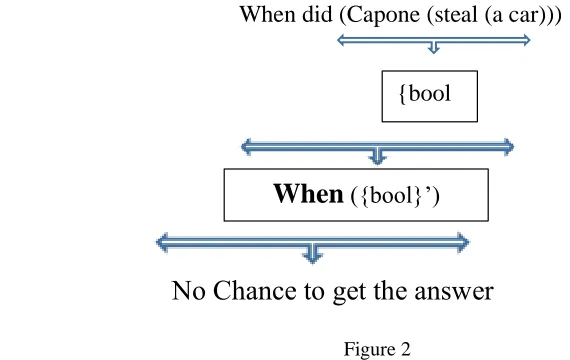
The approach proposed by Frost et al. [2013] cannot answer the “when did..?,” “where
did..?, and”, “with what did..?” type of questions because the output after applying
functions like “Capone” is Boolean type of data. Thus, if “When” function takes Boolean
type of data as an argument, it cannot provide the answer. It needs to take a set of steal
events that “Capone” is subject and “car” is object of that. Then, it returns years of the
events.
Because of the mentioned shortcoming, paper referred by Frost et al. [2013] cannot provide
answer for the “when did..?”. In the next chapter, the new idea that improves event-based
approach and also coverage of queries can be answered is provided, questions that looks
for prepositional phrases in the fact.
When did (Capone (steal (a car)))
{bool }
When
({bool}’)No Chance to get the answer
35
6.1. Summary of the new idea
One of shortcoming of event-based approach which has been introduced by Frost et al. [2013] and is inspired by Montague Semantic, is related to how to accommodate the prepositional phrase and answer the queries that concerns about time and place of facts. The detail of shortcoming locating of prepositional phrases in EV-FLMS (Frost et al. [2013]) has been provided in previous chapter. The problem of prepositional phrase accommodation in event-based approach is related to functions definition. The defined functions in paper referred by Frost et al. [2013] should be modified in way that return events rather than entities. Some defined functions in event-based approach such as “Capone” do not return event type of data that is main problem of prepositional phrase locating. The main intention of this thesis is to modify the functions definition and the other notations in way to return events instead of entities or Boolean. The event type of data can be used for further processing and be helpful for prepositional phrase accommodation to answer “when did..,” “where did…and,” ”with what did...” type of questions. On the other
hand, quantifiers such as “a”, “two” and “every” definitions needs to be modified in way
36
to returns set that contains pair of subject and event, in the current version of the EV-FLMS
approach the definition for the quantifier “a” is as :
a nph vbph = #(interset nph vbph) ~= 0
That notation is based on intersection of nph and vbph that return value should not be zero. In the new definition of “a” quantifier that is event-based should return pair of subjects and
events that can be used in next steps. It has been attempted to alter the all defined notations in way to reach the events easily and can be covered whole type of questions.
new_a nph vph = [(subj2, evs2) | (subj1, evs1) <- nph; (subj2, evs2) <- vph; subj1 = subj2]
6.2. Statement and Contribution
It is possible to construct natural language query interfaces to triplestores that can accommodate arbitrarily-nested complex chained prepositional queries such as:
“When did Capone steal a car in Manhattan using a crowbar…?” “Where did Capone steal a car in 1918 or 1920…?”
“With what did Capone steal two cars and a truck that was owned by a gangster
who joined every gang in Brooklyn that was joined by Torrio?”
The notation that have been added to EV-FLMS approach, proposed by Frost et al. [2013] are as follow that are related to recognizing the time of fact or stored data as event.
year_of ev = thirds (getts (ev, REL "year", ANY))
The above function takes an event and returns the year associated with the year. In order to get set of years, it requires to denote another function that collects all related years. The definition of this function is as follow:
years_of evs = concat (map year_of evs)
37
For example, here is defined notation for the “Capone” function that returns pairs of events and subjects instead of Boolean value:
new_capone ev_image = [(subj, evs) | (subj, evs) <- ev_image; subj = ENT "capone"]
Moreover, the notation for the image function of “steal” can be explained as below, the image function attempts to collect pair of (subj,obj,[eve]) that events have to be “steal” and subjects and objects can be anything.
new_image_steal = collect
[(subj, (obj, [ev])) | ev <- events;
subj <- thirds (getts (ev,REL "subject", ANY)); obj <- thirds (getts (ev, REL "object", ANY))] where events
= firsts (getts (ANY, REL "type", TYPE "steal_ev"))
The other function that has to be changed to provide answer for “When did Capone steal a car?” is “steal tmph” that gets the tmph, in this case tmph is “a car”, and returns a set of
pairs which each of them contains subject a*nd all the events that are type of “steal” and their object is taken tmph input.
new_steal tmph
= [(subj, concat(map snd (tmph objs_evs))) |
(subj, objs_evs) <- new_image_steal; tmph objs_evs ~= [] ]
In addition to above modification, notation for “car” and “a” also are required to be changed as follow:
new_get_members set
= [((get_subj_for_event ev)!0, [ev]) | ev <- events] where
events_for_type_membership
38 events_for_set_as_object
= firsts (getts (ANY, REL "object", set))
events = intersect events_for_type_membership events_for_set_as_object
new_car = new_get_members (ENT "car") new_a nph vph
= [(subj2, evs2) | (subj1, evs1) <- nph; (subj2, evs2) <- vph; subj1 = subj2]
The result for the “new_steal(new_a new_car)”is:
[(ENT "capone",[EV 1004,EV 1012]),(ENT "torrio",[EV 1014])]
The above set contains pairs of subjects with events that type of each event is “steal” and object of them is “a car”. The result of applying new definition of “Capone” function to
result of above set is as follow:
new_capone(new_steal(new_a new_car)) = [(ENT "capone",[EV 1004,EV 1012])]
In order to obtain the time attribute of fact or event, definition of other function is necessary, which is called “when”. The “when” function takes the image of events as input and returns set of years correspondent to taken input events.
when ev_image
= [(subj, years_of evs) | (subj, evs) <- ev_image; years_of evs~=[]]
If “when” function applies to result of “new_capone(new_steal(new_a new_car))”, the
result is as following:
[(ENT "capone",[ENTNUM 1908,ENTNUM 1928])]
39
The implementation of new idea is provided in this chapter. The prototype of the Semantics have been implemented by Miranda programming language. However, other programming languages that can support high level functions can implement these semantics such as Lisp, Haskell, Python and Scheme. The data which has been used for testing is:
data = [(EV 1000, REL "type", TYPE "born_ev"),
(EV 1000, REL "subject", ENT "capone"),
(EV 1000, REL "year", ENTNUM 1899),
(EV 1000, REL "location", ENT "brooklyn"),
(EV 1001, REL "type", TYPE "join_ev"),
(EV 1001, REL "subject", ENT "capone"),
(EV 1001, REL "object", ENT "fpg"),
(EV 1002, REL "type", TYPE "membership"),
(EV 1002, REL "subject", ENT "capone"),
(EV 1002, REL "object", ENT "thief"),
(EV 1002, REL "year", ENTNUM 1908 ),
(EV 1003, REL "type", TYPE "join_ev"),
40