Smart Helmet: A Protective Headgear System
Nilesh M. Verulkar1, Swati S. Patil2, Namrata A. Gandhi3, Komal B. Todkar4
Assistant Professor, Department of Electronics and Telecommunication Engineering, Mauli Group of Institution’s,
College of Engineering and Technology, Shegaon, Maharashtra, India1
PG Students, Department of Electronics and Telecommunication Engineering, Shree Sant Gajanan Maharaj College of
Engineering, Shegaon, Maharashtra, India 2,3,4
ABSTRACT
-
In present day scenario we encounter numerous cases of two wheeler road accidents leading to death.The main reason for severe head injuries is despite of the fact that helmets are available everywhere, people are not wearing them for protection. So we have come up with an idea of SMART HELMET. This is implemented using Arduino Uno development kit which consists of RF transmitter and RF receiver system. The bike will not get start without wearing helmet by the user or rider. An alcohol sensor is placed near to the mouth of the driver in the helmet to detect the presence of alcohol breath. If the breath of the driver is non-alcoholic then these two conditions are satisfied and the bike will get started. Here we have used LDR sensor which can turn the headlights of the bike ON and OFF automatically.
We have also used the vibration sensors in different places of helmet so that when the rider crashes and the helmet hits the ground, the sensors sense and the Arduino extract data using the GSM module and when the data exceeds minimum stress limit then GSM module automatically send message to ambulance or police or family members. Security system applied in this paper meet the characteristics of a perfect rider and the application should be highlighted. This paper will improve safety and reduce accidents, especially fatal to the motorcyclist.
KEYWORDS- Road Accident, Vibration sensor, microcontrollers, GSM module.
I. INTRODUCTION
Security and safety is one of the most talked of topics in almost every aspect. Previously the most compulsion is to wear the helmet for the bike riders. For the inconvenience caused many of them failed to wear the helmet which caused the death of the people. Keeping in the view of the inconvenience caused in the helmet we have implemented many features in the helmet which are flexible to the rider. Actually in existence system, if the person met with any accident we can’t get the information regarding that accident so the person may die due to the late medication by using these proposed system can send that information like accident alert and position of the accident place to the particular number or ambulance emergency number so we can provide the medication to the victim just in time. By avoiding these problems proposed system will help.
II. LITERATUREREVIEW
An Optimal Driving System by Using Wireless Helmet by K. Rambabu1, B. Premalatha and C. Veeranjaneyulu, they have used a wireless communication between bike to helmet and bike to traffic signal and speed breaker along with Arm-7 Microcontroller which is placed in the bike module and also the voice recognition unit which records the left, right & stop.Smart Helmet with Sensors for Accident Prevention by MohdKhairulAfiqMohdRasli, Nina KorlinaMadzhi, Juliana Johari, in this paper microcontroller Peripheral Interface Controller (PIC) 16F84a along with Force Sensing Resistance (FSR) and the speed sensor (BLDC Fan) are used as sensors to operate this paper.
ISSN(Online): 2320-9801
ISSN (Print) : 2320-9798
I
nternational
J
ournal of
I
nnovative
R
esearch in
C
omputer
and
C
ommunication
E
ngineering
(A High Impact Factor, Monthly, Peer Reviewed Journal)
Website: www.ijircce.com
Vol. 6, Issue 1, January 2018
Manjesh N, et al. In this paper they have used Vibration sensor, Alcohol Sensor, Temperature Sensor & Solar Cell as power supply.A Solar Powered Smart Helmet with Multifeatures by Mr.P.Dileep Kumar, et al in this proposed system Bluetooth is used.
Safety Helmets for Coal Miners Using ZigBee Technology by Monika Prasad, et al this technology is planned to be simpler and less expensive than the other WPANs, such as Bluetooth.Safety measures for “Two wheelers by Smart Helmet and Four wheelers by Vehicular Communication” Manjesh N, et al here they used VANET as network which has self-organizing, movable, more efficient, and communication establishes in decentralized manner. Here GSM and GPS are used for sending the data.
III.PROPOSEDSYSTEM
A. Transmitter Unit:
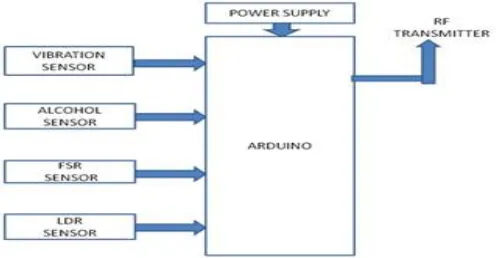
Fig 1.Helmet Unit/Transmitter Unit
This system mainly focuses on avoidance of drunken driving. Hence this system will not turn on the vehicle, when the user is in drunken condition. The system will send short message service to the friends or relatives when an accident occurs. Our system consists of two major parts. They are 1) Helmet unit and 2) Bike unit as shown in fig. This paper describes the design of an effective system for a bike, in order to avoid accidents and other malpractices. In our paper we combine these two aims in a single system. This section consists of an alcohol sensor, FSR Sensor, LDR Sensor and Vibration Sensor along with Arduino and an RF transmitter.
All the sensors are fitted in the helmet. Arduino reads data from the sensors, finds if the driver has non-alcoholic breath and helmet sensor is in proper position and gives corresponding digital output to an encoder only if the two conditions are satisfied. Also LDR the sensors respective output is given to the Arduino. It encodes one of the active inputs to a coded binary output. RF transmitter transmits this coded binary output from the encoder. Here we use the popular ASK modulation technique. In this RF system, the digital data is represented as variations in the amplitude of carrier wave. This kind of modulation is known as Amplitude Shift Keying (ASK).
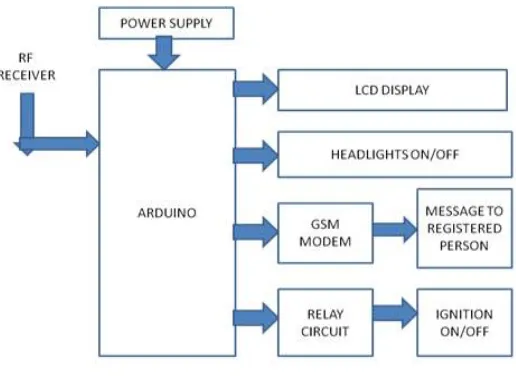
Fig 2.Bike Unit/Receiver Unit
This part consists of the signal reception and control part. Receiver section is placed on the bike; it consists of an RF receiver, Arduino, GSM module, LCD as indicator, Relay circuit. RF receiver receives the coded binary data transmitted by the RF transmitter and gives to the RF decoder. RF decoder decodes the input and gives four bit digital data to the ARDUINO only if the address bit of encoder and decoder matches. ARDUINO operate the DC motor through motor driver IC L239D when it receives digital data from the transmitter section. In case alcohol is detected by the sensor, the GSM module gets activated and a message is sent to the mobile number of a concerned person or police man, so that proper action on drunken person can be taken by the authority. The block diagram of the system at the bike is shown in Fig.
Also depending upon the LDR values, the headlights of bike will be ON/OFF. ARDUINO operate the engine of the vehicle when it receives digital data from the transmitter section, it operates the engine through a relay circuit but it cannot operate the relay directly, so a relay interface is also used here. The system is provided by the motor vehicle department to avoid abnormal circumstances.
C. Flowchart:
The first step of paper is it initializes all the port and then transmitter waits for signals getting from all of the sensors. After that it checks weather the helmet is wore or not. If Helmet is not wore then the ignition of bike will get stop. Hence the Rider can’t start the bike without wearing the helmet. But if the condition satisfies then rider can start the bike.
ISSN(Online): 2320-9801
ISSN (Print) : 2320-9798
I
nternational
J
ournal of
I
nnovative
R
esearch in
C
omputer
and
C
ommunication
E
ngineering
(A High Impact Factor, Monthly, Peer Reviewed Journal)
Website: www.ijircce.com
Vol. 6, Issue 1, January 2018
D. Helmet Diagram
Fig 4.Conceptual Diagram of Helmet with Different Sensors
We already mentioned that we divide a paper in two units namely helmet and bike unit. In helmet unit, the force sensing resister is placed on inside upper part of the helmet where actually head was touched with sensor surface and alcohol sensor is placed on in front of rider’s mouth so that it can sense easily. We can place the vibration sensors at different places on helmet. So that the vibrations can be sensed more easily. LDR sensor is placed on the top of the helmet so that it can sense the intensity of light outside the helmet and work accordingly. And the battery and regular circuits are fixed inside the helmet as shown in the fig. Secondary controller and RF transmitter circuit was also placed on inside the helmet, antenna are located outside the helmet.
IV.RESULTS
1. LDR Sensor Output:
Here, for LDR sensor we had set the threshold value as 600. Hence if light is applied on the LDR sensor, it will sense the intensity of light and if it goes above this threshold value then the light will be ON. Otherwise it remains OFF.Following figure shows the appropriate output of the sensor below the threshold value as well above the threshold value.
Fig 5.LDR Sensor Output
2. FSR Sensor Output:
Fig 6.FSR Sensor Output
3. Alcohol Sensor Output:
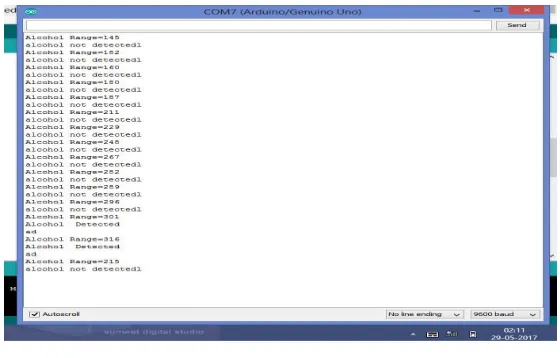
Here we have set the threshold value as 300.When the riders breath is alcoholic then the will not start. The bike will start only when the riders breath is non alcoholic.Following figure shows the appropriate output of the sensor below the threshold value as well above the threshold value.
Fig 7.Alcohol Sensor Output
4. Vibration Sensor Output:
ISSN(Online): 2320-9801
ISSN (Print) : 2320-9798
I
nternational
J
ournal of
I
nnovative
R
esearch in
C
omputer
and
C
ommunication
E
ngineering
(A High Impact Factor, Monthly, Peer Reviewed Journal)
Website: www.ijircce.com
Vol. 6, Issue 1, January 2018
Fig 8.Vibration Sensor Output
5. Receiver Output:
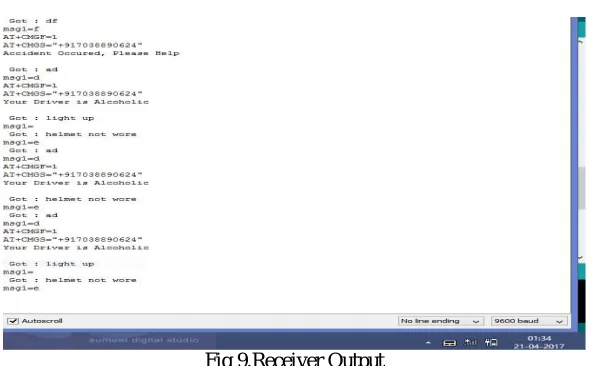
Here we have shown all the Receiver output of all the sensors as follows
Fig 9.Receiver Output 6. GSM Output on Mobile:
Fig 10.GSM Output on Mobile
V. CONCLUSION
This paper has a good real life scope, if it is implemented by the government. It can help to reduce lot of road accidents of two wheelers as it is the major cause of deaths in the whole world. The severities of those accidents are increased because of the absence of helmet or by the usage of alcoholic drinks. In this paper we have a tendency to develop an electronic smart helmet system that efficiently checks the wearing of helmet and drunken driving. By implementing this system will reduce the accident rate due to drunken driving.
Also the helmet is being made user friendly with the help of GSM, in case of accident it sends message to the registered person. This ensures that the victims get proper and prompt medical attention to increase the chances of survival, if met with an accident.
REFERENCES
[1] K. Rambabu, B. Premalatha, C. Veeranjaneyulu, “AN OPTIMAL DRIVING SYSTEM BY USING WIRELESS HELMET”, International Journal of Science, Engineering and Technology Research (IJSETR) Volume 2, Issue 9, September 2013.
[2] MohdKhairulAfiqMohdRasli, Nina KorlinaMadzhi, Juliana Johari, “SMART HELMET WITH SENSORS FOR ACCIDENT PREVENTION” international Conference on Electrical, Electronics and System Engineering 2013 IEEE.
[3] Sudharsana Vijayan, Vineed T Govind, Merin Mathews, SimnaSurendran, Muhammed Sabah, “ALCOHOL DETECTION USING SMART HELMET SYSTEM”, International Journal of Emerging Technology in Computer Science & Electronics (IJETCSE) ISSN: 0976-1353 volume 8 issue 1 –APRIL 2014.
[4] Manjesh N,Prof. Sudarshan Raj ,”SMART HELMET USING GSM & GPS TECHNOLOGY FOR ACCIDENT DETECTION AND REPORTING SYSTEM” International Journal of Electrical and Electronics Research ISSN 2348-6988 Vol. 2, Issue 4, pp: (122-127), Month: October - December 2014, Research Publish Journals
[5] Ping Li, Ramy Meziane, Martin J.-D. Otis, Hassan Ezzaidi, “A SMART SAFETY HELMET USING IMU and EEG SENSORS FOR WORKER FATIGUE DETECTION” ,REPARTI Center, University of Quebec at Chicoutimi Chicoutimi, Canada.
[6] R. Prudhvi Raj, Ch. Sri Krishna Kanth, A. BhargavAdityaand K. Bharath, “SMART-TECH HELMET”Advance in Electronic and Electric Engineering ,ISSN 2231-1297, Volume 4, Number 5 (2014).
ISSN(Online): 2320-9801
ISSN (Print) : 2320-9798
I
nternational
J
ournal of
I
nnovative
R
esearch in
C
omputer
and
C
ommunication
E
ngineering
(A High Impact Factor, Monthly, Peer Reviewed Journal)
Website: www.ijircce.com
Vol. 6, Issue 1, January 2018
[8] Kajalthakre, ,Pranaliwaskar, Poojasawant, Suchitanaik, Sumitachandak “SMART HELMET”,volume 5, issue 2, february 2015 issn: 2277 128x International Journal of Advanced Research
[9] Monika prasad1, Deovratsingh, Rishabhsachdeva, Priyanka singh, Mr.Manojvishnoi “SAFETY HELMETS FOR COAL MINERS USING ZIGBEE TECHNOLOGY ”volume 3, issue 2, april-may, 2015 ISSN: 2320 – 8791.
[10] Nitinagarwal, Anshulkumarsingh, Pushpendrapratapsingh, Rajesh sahani “SMART HELMET” International Research Journal of Engineering and Technology (IRJET) e-issn: 2395 -0056 volume: 02 issue: 02 , may-2015
[11] AnshusinghGautam, Gulshankumardubey, Mayank Mishra, Mohitaprabhat. 1165 “SMART HELMET SYSTEM” april 2015, volume 2, issue 4 JETIR (ISSN-2349-5162) JETIR1504059 Journal of Emerging Technologies and Innovative Research (JETIR)
[12] Ashwinkumar T. Limbanee, angraj G. Kad, swapnil N. Jagtap, komal S. Lonari, prof. Shiv sutar “SMART HELMET TO AVOID ROAD KILLS (SHARK)” ,IOSR journal of electronics and communication engineering (IOSR-JECE) e-issn: 2278-2834,p- ISSN: 2278-8735.Volume 10, issue 4, ver. II (jul - aug .2015)
[13] S. Anil Babu , SumathiAyyalusamy, RejinRanjit Singh , SreejinDharmarijan, Jason James , Mohamed Anas, “DEVELOPMENT OF HELMET DETECTION SYSTEM AND SMART SEAT BELT” IOSR Journal of Electronics and Communication Engineering (IOSR-JECE) e-ISSN: 2278-2834,p- ISSN: 2278-8735.Volume 10, Issue 4, Ver. II (Jul - Aug .2015).
[14] Manjesh N , Prof. Sudarshan raju C H “ SAFETY MEASURES FOR TWO WHEELERS BY SMART HELMET AND FOUR WHEELERS BY VEHICULAR COMMUNICATION” ,International Journal of Engineering Research and Applications (IJERA) ISSN: 2248-9622 NATIONAL CONFERENCE on Developments, Advances & Trends in Engineering Sciences (NCDATES- 09th & 10th January 2015)
[15] Wilhelm von Rosenberg, Theerasakhanwimalueang, Valentin Goverdovsky, Danilo P. Mandic “SMART HELMET : MONITERING BRAIN, CARDIAC AND RESPIRATORY ACTIVITY” ,IEEE 2015.
[16] Prof. N. B. Kodam “SMART HELMET (NO BIKE RIDING WITHOUT HELMET)”(IRJI) International Research Journal Of India ISSN 2454-8707 VOLUME-I, ISSUE-I, SEPT-2015.
[17] DevendraItole,DnyaneshwarAvatirak,OmkarKale,NikhilDeshpande,Aakash Menon, “INTELLIGENT HELMET”, International Journal Of P2P Network Trends and Technology (IJPTT)-volume 17 Number 1 March 2015.
[18] Aviral Vijay, Ajay Singh, Abhimanyu Yadav, Blessy Varghese And Ankit Vijay, “HI-TECH HELMET AND ACCIDENTAL FREE TRANSPORTATION SYSTEM”,International Journal of Advanced Technology and Engineering Exploration ,ISSN 2394-5443 VOLUME-2 ISSUE-6 MAY-2015.
[19] Saravana Kumar K, Anjana.B.S, Litto.Thomas, Rahul.K.V, “SMART HELMET”, International Journal of Scientific & Engineering Research, Volume 7, Issue 3, March-2016.
[20] Jennifer william, Kaustubhpadwal, Nexonsamuel, Akshaybawkar, smitarukhande “INTELLIGENT HELMET”, International Journal of Science, Engineering and Technology Research (IJSETR), volume 5, issue 3, march 2016.
[21] Mrs.K.V.Archana (Asst.Prof.), M.Abirami, T.AbisehaAruna, V.Aishwarya, C.N.Suchitra “SAFEMATE USING ARDUINO” International journal of advanced research in electronics and communication engineering (IJARECE) volume 5, issue 3, march 2016.
[22] Sivakumar, DHIVYA,“SMART HELMET SYSTEM USING ALCOHOL DETECTION FOR VEHICLE PROTECTION” ,international journal of advanced science and engineering research www.Ijaser.In volume: 1, issue: 1, june 2016 ISSN: 2455-9288
[23] R S Saravanakkumar, Mr.Muniraj “ACCIDENT ALERTING SYSTEM TO SAVE BIKERS USING SMART HELMETS” international journal of advanced research trends in engineering and technology (IJARTET) Vol. 3, special issue 3, april 2016
[24] A. Srikrishnan, K. Senthil Kumar and S. Ravi ”CLOUD INCORPORATED SMART HELMET INTEGRATED WITH TWO-WHEELER COMMUNICATION SETUP” ,I J C T A, 2016, pp. 251-261.