University of Windsor University of Windsor
Scholarship at UWindsor
Scholarship at UWindsor
Electronic Theses and Dissertations Theses, Dissertations, and Major Papers
2013
MINIMIZATION OF ELECTRICAL LOSSES IN A VECTOR
MINIMIZATION OF ELECTRICAL LOSSES IN A VECTOR
CONTROLLED INDUCTION MACHINE DRIVE
CONTROLLED INDUCTION MACHINE DRIVE
Debarshi Biswas University of Windsor
Follow this and additional works at: https://scholar.uwindsor.ca/etd
Recommended Citation Recommended Citation
Biswas, Debarshi, "MINIMIZATION OF ELECTRICAL LOSSES IN A VECTOR CONTROLLED INDUCTION MACHINE DRIVE" (2013). Electronic Theses and Dissertations. 4960.
https://scholar.uwindsor.ca/etd/4960
This online database contains the full-text of PhD dissertations and Masters’ theses of University of Windsor students from 1954 forward. These documents are made available for personal study and research purposes only, in accordance with the Canadian Copyright Act and the Creative Commons license—CC BY-NC-ND (Attribution, Non-Commercial, No Derivative Works). Under this license, works must always be attributed to the copyright holder (original author), cannot be used for any commercial purposes, and may not be altered. Any other use would require the permission of the copyright holder. Students may inquire about withdrawing their dissertation and/or thesis from this database. For additional inquiries, please contact the repository administrator via email
MINIMIZATION OF ELECTRICAL LOSSES
IN A VECTOR CONTROLLED
INDUCTION MACHINE DRIVE
By
D
EBARSHIB
ISWASA Thesis
Submitted to the Faculty of Graduate Studies
through the Department of Electrical and Computer Engineering
in Partial Fulfillment of the Requirements for
the Degree of Master of Applied Science at the
University of Windsor
Windsor, Ontario, Canada
2013
Minimization of Electrical losses
In a Vector Controlled
Induction Machine Drive
By
Debarshi Biswas
APPROVED BY:
Dr. S. Das, Outside Reader
Department of Civil and Environmental Engineering
Dr. K. Tepe, Departmental Reader
Department of Electrical and Computer Engineering
Dr. N. C. Kar, Advisor
Department of Electrical and Computer Engineering
iii
AUTHOR'S DECLARATION OF ORIGINALITY
I hereby certify that I am the sole author of this thesis and that no part of this
thesis has been published or submitted for publication.
I certify that, to the best of my knowledge, my thesis does not infringe upon
anyone’s copyright nor violate any proprietary rights and that any ideas, techniques,
quotations, or any other material from the work of other people included in my thesis,
published or otherwise, are fully acknowledged in accordance with the standard
referencing practices. Furthermore, to the extent that I have included copyrighted
material that surpasses the bounds of fair dealing within the meaning of the Canada
Copyright Act, I certify that I have obtained a written permission from the copyright
owner(s) to include such material(s) in my thesis and have included copies of such
copyright clearances to my appendix.
I declare that this is a true copy of my thesis, including any final revisions, as
approved by my thesis committee and the Graduate Studies office, and that this thesis has
iv
ABSTRACT
Induction motors have found application in household goods as well as in
industries. These machines are rugged and very easy to maintain, making them a favorite
with the consumers. With the introduction of vector control induction motor drives have
gained a lot of popularity. Induction motors, however, prove to be inefficient at low
speeds when compared to other AC machines. Hence there is a need to improve the
efficiency of induction machines over their entire speed range. Thus it is desirable to
design a loss minimization controller which can improve the efficiency. This thesis
therefore documents the following:
Modeling of an induction motor with core loss included.
Realization of vector control for an induction motor drive with loss element
included.
Derivation of the loss minimization condition.
v
To
My mother and father: Alpana Biswas, Debasish Biswas
My sister: Priyanka Biswas
vi
ACKNOWLEDGEMENTS
I would like to express my appreciation and sincere gratitude towards my
supervisor, Dr. Narayan Kar for his invaluable support and guidance throughout the
course of this program. His encouragement helped me achieve what was simply an idea
at the beginning of my tenure as a research assistant. He has truly been as inspiration.
Words cannot express the respect I have for him.
I would also like to thank Dr. Kaushik Mukherjee, a visiting professor to
CHARGE labs at the University of Windsor, for his unconditional support during his
tenure here in Windsor. His constant nurturing helped me understand the minute
intricacies that were related to this research. I am indebted to him for sharing his
knowledge with me.
I would like to extend my gratefulness to my committee members, Dr. Kemal
Tepe and Dr. Sreekanta Das, for providing their valuable suggestions and presenting their
insight on my topic of research. Their critiques were indeed helpful in adding value to my
research.
Last but not the least, I would like thank my mother, father, sister and
brother-in-law who stood by me from the moment I started my research. My father has been my
biggest strength as he instilled the confidence in me that I could finish what I started. I
vii
TABLE OF CONTENTS
AUTHOR’S DECLARATION OF ORIGINALITY ... iii
ABSTRACT ... iv
DEDICATION...v
ACKNOWLEDGEMENTS ... vi
LIST OF TABLES ...x
LIST OF FIGURES ... xi
NOMENCLATURE ... xvi
1. Introduction ...1
1.1. Introduction to Induction Motor ...1
1.2. Construction and Operation of an Induction Motor ...2
1.3. Evolution of Induction Motor Drives ...4
1.4. Literature Review...5
1.5. Problem Statement ...10
1.6. Objective of this Research ...12
1.7. Organization of the Thesis ...14
2. Induction Motor Modeling ...16
2.1. Two Axis Theory of Motor Model ...16
2.2. Modeling of an Induction Motor...19
3. Vector control of Induction Motor ...21
3.1. Theory of Vector Control...21
viii
3.3.2. Field Oriented Control ...23
3.3.3. Indirect Field Oriented Vector Control ...23
3.4. Requirements of the PI Controller ...25
4. Vector Control of Induction Motor Model with Core Loss Included ...29
4.1. Motor Model Including Core Loss ...29
4.2. Indirect Field Oriented Vector Control ...31
4.3. Designing the Controller ...33
4.3.1. Requirements of the Current Loop Controller ...34
4.3.2. Calculating the Proportional Gain of the Current Loop Controller ...37
4.3.3. Design Methodology of the Outer Speed Loop Controller ...42
5. Loss Minimization Controller ...47
5.1. Loss Reduction Techniques ...47
5.2. Control Strategies used for Loss Minimization ...49
5.2.1. Search Control (SC) ...49
5.2.2. Loss Model based Controller (LMC) ...50
5.3. Theory for Minimizing Losses...51
5.3.1. Modeling the Losses ...51
5.3.2. Criteria for Loss Minimization ...52
5.4. Block Diagram of the Proposed Scheme ...55
6. Simulation Results ...57
6.1. DOL Starting of Induction Motor ...57
6.2. Motor Performance During Vector Control ...70
ix
7. Conclusion ...104
7.1 Contributions of This Research ...105
7.2 Future Scope ...105
REFERENCES ...107
APPENDIX ...110
x
LIST OF TABLES
xi
LIST OF FIGURES
Fig. 1.1. Typical induction motor with cooling fins on the stator and coupler on the
rotor shaft. ...2
Fig. 2.1. Phasor diagram depicting the positions of three phase values (marked in red, green and black) and the corresponding dq values (marked in orange). . 17
Fig. 2.2. Equivalent circuit of an induction motor. ...18
Fig. 3.1. D. C. shunt motor. ... 21
Fig. 3.2. Orthogonal orientation of armature current and field current in a separately excited DC machine. ...22
Fig. 3.3. Current control loop...27
Fig. 4.1. Dynamic model of an induction motor including core loss...29
Fig. 4.2. Block diagram implementing vector control with core loss included in the modeling. ...31
Fig. 4.3. Representation of a simple feedback loop. ...38
Fig. 4.4. Dynamics of the current control loop... ...40
Fig. 4.5. Outer speed control loop...43
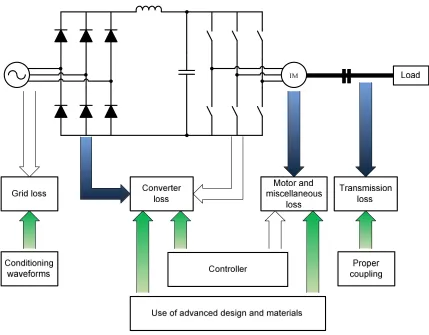
Fig. 5.1. Typical induction motor drive showing the losses incurred by each component (blue arrows) and the methodology used to improve the efficiency (green arrows). ...48
Fig. 5.2. Basic block diagram of a search controller. ...50
xii
Fig. 5.4. Block diagram of proposed loss minimization controlled induction motor
drive. ...55
Fig. 6.1. Three phase voltage supplied to the induction motor from the grid. ...58
Fig 6.2. Two axis representation of three phase voltage in synchrounously rotating reference frame. ...58
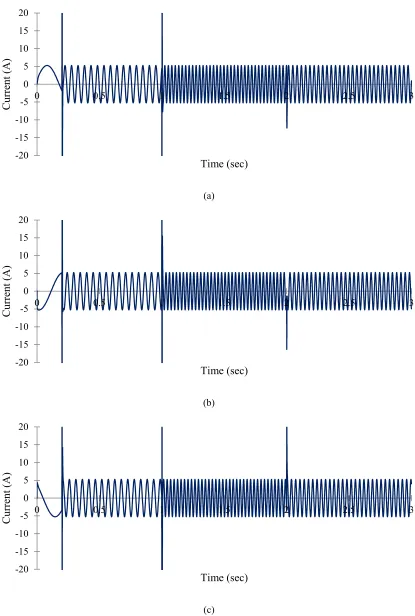
Fig. 6.3. Starting current in an induction motor. ...59
Fig. 6.4. Torque vs. speed characteristics of the 7.5 hp induction motor. ...60
Fig. 6.5. Speed of the induction motor under different loading conditions. ...61
Fig. 6.6. Change in rotor speed due to loading variation from 0% to 50%. ...62
Fig. 6.7. Torque profile of the induction motor under different loading conditions. ...62
Fig. 6.8. Variation in torque when load changes from 0% to 50%. ...63
Fig. 6.9. Variation of stator current under different loading conditions. ...64
Fig. 6.10. Variation of rotor current under different loading conditions ...65
Fig. 6.11. Variation of core loss branch current under different loading conditions. ...66
Fig. 6.12. Variation of magnetizing branch current under different loading conditions.. .67
Fig. 6.13. Change in stator current amplitude due to increase in load from 0% to 50. ...68
Fig. 6.14. Change in rotor current amplitude due to increase in load from 0% to 50...69
Fig. 6.15. Torque profile of the induction motor at full load under vector control. ...70
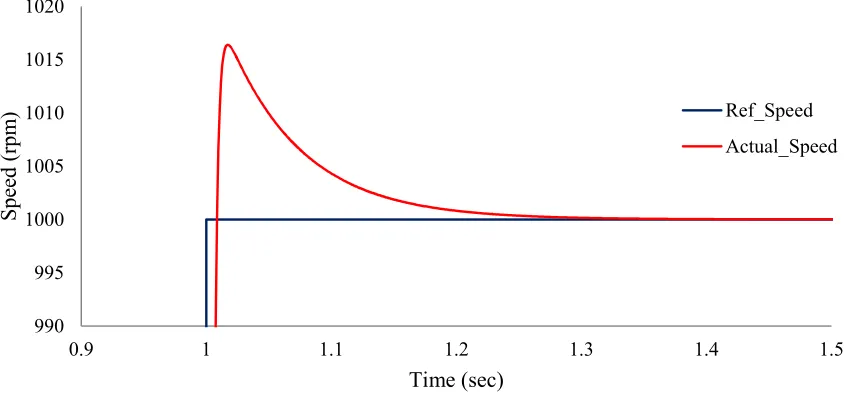
Fig. 6.16. Changes in reference speed as given by the user and dynamics of the actual rotor speed. ...71
xiii
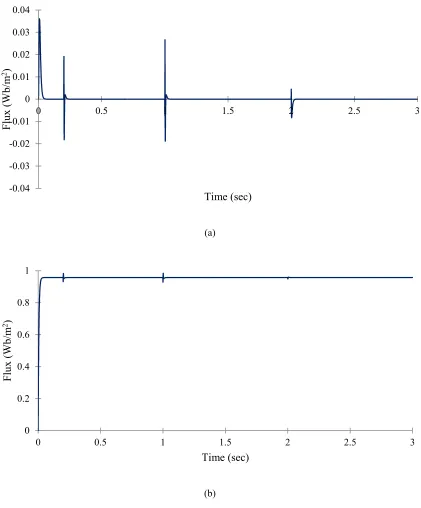
Fig. 6.18. Rotor flux profile as forced by the vector controller. ...72
Fig. 6.19. Time taken to set up rated flux. ...73
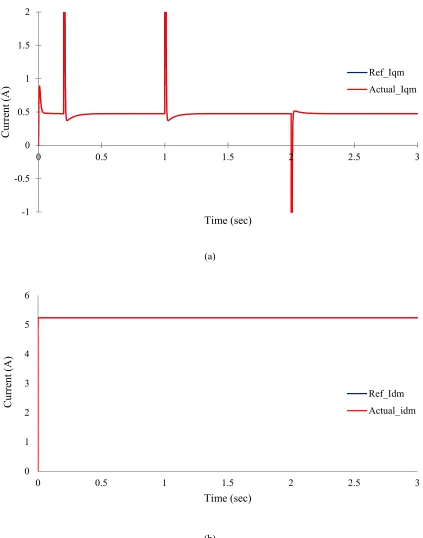
Fig. 6.20. Reference and actual magnetizing currents. ...74
Fig. 6.21. Magnetizing currents in three phase. ...75
Fig. 6.22. Stator currents.. ...76
Fig. 6.23. Stator currents in three phase. ...77
Fig. 6.24. Torque profile under the influence of loss minimization controller. ...79
Fig. 6.25. Reference Speed and dynamics of actual rotor speed. ...80
Fig. 6.26. Reference and actual magnetizing currents. ...81
Fig. 6.27. Dynamics of stator current at 1700 rpm.. ...82
Fig. 6.28. Stator currents in three phase at 1700 rpm.. ...82
Fig. 6.29. Dynamics of rotor current at 1700 rpm. ...83
Fig. 6.30. Rotor currents in three phase at 1700 rpm. ...83
Fig. 6.31. Dynamics of core loss branch current at 1700 rpm.. ...84
Fig. 6.32. Core loss branch currents in three phase at 1700 rpm. ...84
Fig. 6.33. Losses in the motor at 1700 rpm. ...85
Fig. 6.34. Reference and actual magnetizing currents at 500 rpm. ...86
Fig. 6.35. Dynamics of stator current at 500 rpm. ...87
xiv
Fig. 6.37. Dynamics of rotor current at 500 rpm. ...88
Fig. 6.38. Rotor currents in three phase at 500 rpm.. ...88
Fig. 6.39. Dynamics of core loss branch current at 500 rpm. ...89
Fig. 6.40. Core loss branch currents in three phase at 500 rpm. ...89
Fig. 6.41. Losses in the motor at 500 rpm. ...90
Fig. 6.42. Torque profile under the influence of loss minimization controller ...92
Fig. 6.43. Reference Speed and dynamics of actual rotor speed ...93
Fig. 6.44. Reference and actual magnetizing currents at 1700 rpm.. ...94
Fig. 6.45. Dynamics of stator current at 1700 rpm.. ...95
Fig. 6.46. Stator currents in three phase at 1700 rpm. ...95
Fig. 6.47. Dynamics of rotor current at 1700 rpm ...96
Fig. 6.48. Rotor currents in three phase at 1700 rpm. ...96
Fig. 6.49. Dynamics of core loss branch current at 1700 rpm. ...97
Fig. 6.50. Core loss branch currents in three phase at 1700 rpm. ...97
Fig. 6.51. Losses in the motor at 1700 rpm. ...98
Fig. 6.52. Reference and actual magnetizing currents at 500 rpm ...99
Fig. 6.53. Dynamics of stator current at 500 rpm.. ...100
Fig. 6.54. Stator currents in three phase at 500 rpm. ...100
Fig. 6.55. Dynamics of rotor current at 500 rpm. ...101
xv
Fig. 6.57. Dynamics of core loss branch current at 500 rpm. ...102
Fig. 6.58. Core loss branch currents in three phase at 500 rpm. ...102
xvi
NOMENCLATURE
vqs : Q-axis stator voltage
vds : D-axis stator voltage
vqs_comp : Q-axis compensation voltage
vds_comp : D-axis compensation voltage
iqs : Q-axis stator current
ids : D-axis stator current
iqr : Q-axis rotor current
idr : D-axis rotor current
iqm : Q-axis magnetizing current
idm : D-axis magnetizing current
iqc : Q-axis current in the core loss branch
idc : D-axis current in the core loss branch
qs : Q-axis stator flux
ds : D-axis stator flux
qr : Q-axis rotor flux
dr : D-axis rotor flux
r : Rated flux
xvii
Rr : Rotor resistance
Rc : Core loss resistance
Lls : Stator leakage inductance
Llr : Rotor leakage inductance
Lm : Magnetizing inductance
Te : Electromagnetic torque
Tl : Load torque
: Speed of arbitrarily rotating dq-frame rad/sec
r : Rotor speed in rad/sec
sl : Slip speed in rad/sec
: Angle of transformation from three phase to two phase
J : Moment of inertia
P : Number of poles
p : Differentiation operator
iKp : Inner loop proportional gain
oKp : Outer loop proportional gain
iKi : Inner loop integral gain
i, o : Damping factor for inner and outer loop respectively
ni, no : Natural frequency for inner and outer loop respectively
xviii
PSCL : Stator copper loss
PCore : Core loss
PRCL : Rotor copper loss
idm_opt : Optimal d-axis magnetizing current
fa, fb, fc : Component of any variable in phase A, B or C respectively
fq, fd : Component of any variable in q or d-axis respectively
1
1. INTRODUCTION
1.1. I
NTRODUCTION TOI
NDUCTIONM
OTORWith the inception of AC distribution systems, application of AC motors has
widened to a large extent. This has prompted motor manufacturers to build AC motors
that will cater to the various types of applications. All electric motors transform electric
power into mechanical power. In DC motors, there is a physical connection between the
stator and the rotor. This allows the transfer of power. However, in AC motors there is no
such physical connection between the stationary and the rotating part. The conversion of
electrical to mechanical energy occurs through induction and hence the name induction
motors. Induction motors are found in many applications today, whether it be in small
scale or large scale. Because induction motors are constant speed motors, they are found
in many household appliances such as pumps and fans. In industries they are used for
heavy duty applications. Induction motors are the largest consumer of electrical power
[1]. The reasons for this popularity are rugged construction, low maintenance cost,
reliable and inexpensive compared to other motors. But possibly the biggest advantage is
that it does not need any starter motor and it can be directly connected to a power source.
It does however have disadvantages. An induction motor works best when it is running at
or near its rated loading capacity. The motor can still be used at lower loading conditions
but at the cost of efficiency. Energy consumption has become an issue over the past few
years. It is of utmost importance that attention is paid to make machines run more
efficiently. Speed control can bring about significant energy savings but vector controlled
induction motor drives focus mainly on delivering high dynamic performance. Thus, it is
2
compensating for efficiency. Advancements in the design process and improvements in
materials used to construct induction motors have helped improve the efficiency of
induction motors. However, there is no substitute for a controller dedicated to optimize
the efficiency. Loss minimization can be achieved in many different ways. The ideal loss
minimization controller should not only reduce the heat signature of the motor but also
account for losses in the converter in conjunction with delivering the required load
torque. Designing a loss minimization controller will definitely help overcome the
primary disadvantage of induction motors.
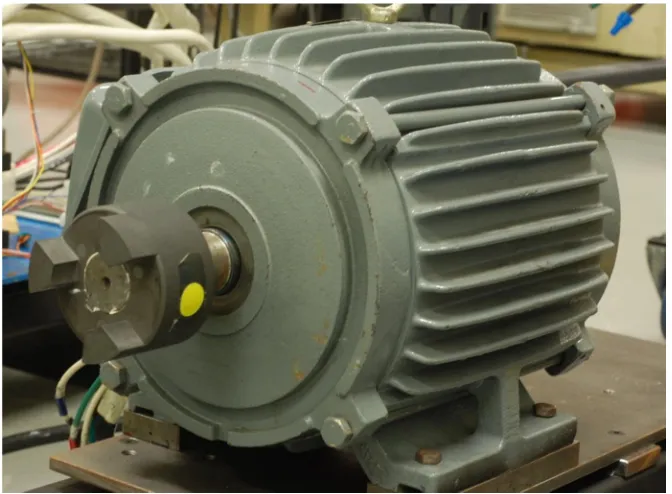
Fig. 1.1: Typical induction motor with cooling fins on the stator and coupler on the rotor shaft.
1.2. C
ONSTRUCTION ANDO
PERATION OF ANI
NDUCTIONM
OTORAn induction motor is made up of two major components. The outer stationary
casing is called the stator. The stator is made up laminated stamping slotted to hold the
3
specific number of poles. There are two kinds of rotors for the induction motors. They are
the squirrel cage rotor and the wound rotor. The squirrel cage rotor essentially has metal
bars shorted at the ends by metal rings called the end rings. This construction makes the
rotor look like a squirrel cage and hence the name. Because this kind of a construction
lacks any physical wiring, there is no access to the rotor. This feature makes squirrel cage
motors very rugged and usable in almost any condition. The wound rotor, as the name
suggests, has windings in the rotor which are a mirror image of the windings in the stator.
These motors are used in specific applications due to the access to the windings.
However, wound rotor machines have reliability issues when compared to squirrel cage
machines and are more expensive. In this thesis only the squirrel cage induction motor
will be considered.
An induction motor is essentially a transformer with a rotating secondary.
Exciting the stator windings creates a rotating flux. The speed at which the rotating flux
rotates is called the synchronous speed. The rotating flux cuts across the rotor bars and an
e.m.f. is induced in the stationary rotor as per Faraday's law. The magnitude of this
induced e.m.f. is proportional to the relative velocity between the rotating flux and the
rotor bars. Because the rotor bars are short circuited, a current is produced due to this
induced e.m.f. The direction of this current, as per Lenz's law, is such that it opposes the
cause that produces it. The cause in this case is the relative velocity between rotating flux
and the rotor bars. In order to oppose this cause the rotor begins to rotate in the in same
direction as the rotating flux. It should be noted that the rotor can never catch up to the
rotating flux. If this happened there would be no relative motion between the flux and the
4
induction motor is always less than the synchronous speed. The difference in of these two
speeds is known as the slip speed which is generally expressed as a percentage of the
synchronous speed [2].
1.3. E
VOLUTION OFI
NDUCTIONM
OTORD
RIVESBefore vector control was developed for induction motors, scalar control was
widely used in speed control of these machines. Perhaps the most popular strategy is the
volts/hertz method. Although scalar control is simple it has a few drawbacks. The biggest
disadvantage of this method is that it has slow transient response time. This means that it
is slow to transition from one operating point to another. In case of any disturbance it is
slow to recover to its original operating point as well. The second flaw of this strategy is
that the slightest of change in supply can upset the air gap flux of the machine which will
in turn affect the speed of the motor. Overall, it can be concluded that scalar control is not
very precise. Some industrial applications may not need such precise speed of operation
but there are many applications that need higher performance drives. F. Blaschke
proposed a revolutionary idea which changed the way induction motors were controlled
[3]. Separately excited DC motors have naturally decoupled armature and field flux. As a
result DC motors have very quick transient response. With the advent of vector control,
AC machines, like the induction motor, could also be made to behave like a separately
excited DC motors. An analogy between the two has been drawn in the subsequent
chapters. Vector control or field oriented control (FOC) was an immense step forward in
terms of performance. Realization of FOC in real-time also became a possibility with the
5
1.4. L
ITERATURER
EVIEWStrategies to control loss minimization can be broadly classified into two
categories: loss minimization controller and search control. Loss minimization controller
utilizes the machine parameters to estimate the loss model. The controller thus designed
using this procedure is then responsible for selecting an appropriate flux level which
facilitates the minimization of losses. Much research has been conducted in this field
using this strategy [4-13]. Earlier, scalar control was the most widely used technique to
control the speed of induction motors. Scalar control essentially employs choosing a
specific stator voltage and a frequency to facilitate speed control in the induction
machine. For a given operating point for an induction motor there are combinations of
stator voltages and frequencies that exist which promote loss minimization. This has been
very aptly described in [4, 5]. Another method to achieve optimum efficiency has been
presented by H. G. Kim et al. in [6] by using a current source inverter. It was suggested
that the optimum efficiency could be achieved for a specific combination of torque and
speed by reducing the air gap flux. As a current source inverter is being used the air gap
flux can be expressed as functions of stator currents and rotor slip. In addition to reducing
the losses, this method also improved the power factor at light loads. The relationship
between the stator current and the slip frequency, the condition for loss minimization,
was obtained numerically. The control loop was then designed based on these
calculations to accommodate for variable flux. Kioseridis et al. [7] presented a loss
minimization scheme using the loss model of an induction motor. The scheme is simple
and employs optimal air gap flux to achieve loss minimization in scalar controlled
6
of the drive at a bare minimum. P. Famouri and J. J. Cathey [8] proposed a closed loop
control technique using per unit values. The modeling of the losses was done using the
copper losses, core loss, losses crossing the air gap and the rotational losses. These were
then used to calculate the per unit efficiency as a function of slip and frequency.
Implementation of the closed speed loop was a significant improvement over the previous
open loop volt/hertz technique. Lorenz and Yang [9] proposed a dynamic programming
method which would enhance the efficiency in a field oriented induction motor drive
being operated in a closed cycle. Losses taken into account were the copper and core
losses. The copper loss was expressed as a function of the square of the currents. The
core loss on the other hand was modeled as a function of frequency, exhibiting the
hysteresis and eddy current losses distinctively. The loss of the drive was also considered
and defined as an objective function. The constraints of the objective function were the
limits on motor flux, speed, voltage and current. The optimal trajectory for the flux and
flux producing current were computed by solving the problem. The entire control strategy
was then implemented using a microcontroller. Garcia et al. [10] proposed a novel
method to minimize copper losses and iron losses in variable speed variable torque
induction motor drive while maintaining a good dynamic response. It has been very
clearly stated that a good control over the magnetic flux would result in obtaining a
balance between the copper and iron losses. This balance between the copper loss and
core loss would essentially assist in achieving optimum efficiency. The induction motor
model been expressed in dq-coordinate system. However, for simplicity, the leakage
inductance was deleted from the motor model. Resistances were used to represent the loss
7
condition for minimum loss where the d-axis current was made the control variable as
this component of stator current would eventually influence the flux level in the induction
motor. Chakraborty and Hori [11] approached the problem of loss minimization from
different perspective altogether. They proposed a hybrid scheme to address this issue
which consisted of combining loss model approach and search control approach in a
vector controlled induction motor. The loss model approach calculated the optimum flux
level numerically. The search control algorithm on the other hand estimated the optimum
flux level based on the measurement of the input the power through an iterative process.
Combining both the loss minimization techniques gave rise to the development of a very
capable controller. The hybridization of the two loss minimization methods ensured that
the controller had a fast response by virtue of the loss model approach. Also, the search
algorithm provided sufficient immunity to variation in motor parameters. Although the
performance of the controller is greatly increased, the approach adopted by the authors in
[11] adds to the complicacy of the overall system. The authors used the same approach to
model the losses as used in [10]. However, a simple and approximate model of the
induction motor to achieve their objective. In [12], the authors, Bernal et al., proposed a
generalized loss model using the dq-theory. This loss model would cater to machines
such as permanent magnet synchronous motors, induction motors, and dc motors which
could be used to the fulfill the needs required in the design procedure of controllers
facilitating to loss minimization. Effects due to core saturation have also been accounted
for by the authors. Interestingly, the loss model proposed in [10] has again been used to
the model the induction motor losses. S. Lim et al. [13] proposed a model which included
8
connected a dependent voltage source with the core loss resistor as a part of the
equivalent circuit for the induction motor. Based on their modeling, it was reported that
the findings were aligned to the complete induction motor model when compared to the
data presented by previous researchers.
Search controller works on the principle of minimum input power measurement in
order to choose the optimum flux level [14-19]. Moreira et al. [14] introduced a new
method to implement search control algorithm for induction motors. He proposed that the
third harmonic of the air gap flux could be used to determine the currents responsible for
producing the flux and torque in the machine which could be utilized to maximize the
efficiency of the induction motor. He also used this technique to estimate the speed of the
rotor. Necessary adjustments could be made to the flux producing component of the
stator current to ensure production of minimum input power. Sul and Park [15] proposed
an idea where an induction motor could be more efficient if the value of slip was
appropriately chosen. Their idea discarded the need for sensors required to measure
speed. Instead, the stator voltage and the stator current were used to estimate all the
necessary values, slip speed being one of them. All these values were then stored in a
microprocessor which would essentially serve as a look up table. The control system
would then refer to the look up table and choose the optimum slip by trial and error at
first. The control system would then ensure the induction motor is then operated by
tracking the optimal slip. Kirschen et al. [16] maximized the efficiency of the induction
motor drive by making flux the control variable. The flux command was gradually
decreased in very small steps to get to the point where minimum power was required to
9
a solution. This is because the step size by which the flux command is reduced is very
small. Again, there is no option but to choose small step size for flux reduction because
sudden variations in flux levels in the motor can cause unwanted pulsations in the torque
profile. In spite of choosing a small enough torque pulsations could not be done away
with as evident from the results published. Sousa et al. [17] extended the work already
presented in [16]. A fuzzy logic based controller was used to achieve maximum
efficiency in an indirect vector controlled induction motor. The fuzzy controller ensured
there was an adaptive decrement in the d-axis current, which would eventually reduce the
flux in the machine. This approach was chosen to speed up convergence as search
controllers in general are slow to converge to a solution. In [16] a fixed step size was
chosen for the reduction of the flux command. However, Sousa et al. manipulated the
step size with the help of fuzzy logic controller. Thus, based on the input power
measurement, the controller would initially choose a suitable step size to reduce the
current signal by. But as the d-axis current approached the optimum value the step size
itself would automatically be reduced by virtue of adaptive control. Also, a feed forward
compensation technique was used to reduce the pulsations in the torque profile. Kim et al.
[18] proposed a strategy to control induction motors which would deliver "maximum
power efficiency" augmented with unexceptional dynamic performance. Their strategy
was to adjust the squared rotor flux as per the requirement dictated by the minimum
power algorithm till the input power was at its minimum. Unwanted torque ripple was
mitigated by decoupling the speed of the motor and the rotor flux. This decoupling action
was achieved with the help of a nonlinear controller. The design process of the controller
10
of the rotor resistance needed to be very accurate because it would eventually affect the
estimation of the rotor flux. Unfortunately, the resistance of the rotor would change with
changes in the temperature inside the induction motor. This could adversely affect the
estimated value of the flux. As a result, the authors devised an online method to measure
the rotor resistance so that any slight change in its value could be quickly tracked and
accounted for by the controller. Undoubtedly, the adoption of this method was a clear
improvement over the previous methods. However, inclusion of these features in the
algorithm added to the complexity of the overall system. Ta and Hori [19] devised a
novel technique to improve the convergence of search controllers. They developed an
algorithm which would provide the optimum value of the current needed for minimum
loss by employing the "golden section technique". Their proposed strategy provided a
fast convergence without the need for measuring speed or torque. In addition to this, the
controller was immune to variation in parameters. There was however issues related to
the selection of the upper and lower limits of the current responsible for setting up the
flux.
1.5. P
ROBLEMS
TATEMENTFrom the previous sections it is clear that loss minimization controller has its own
advantages. Firstly, the controller offers fast response. Secondly, opting for this
methodology to implement loss minimization overcomes the issue of torque ripple
completely which is a common problem with search controllers.
Even though there are advantages, loss minimization controller does have flaws.
The very first flaw is in the designing of the controller itself. Design of the controller
11
the mathematical model dictates the accuracy of the controller. Any approximations made
in the mathematical model of the motor will affect the performance of the controller.
However, it is not always possible to include all the facets of modeling simply because it
adds to complexity of the overall system. An example of approximations made in motor
modeling can be found in [10]. The authors presented an equivalent circuit of the
induction motor where the leakage inductance was ignored. This approximation was
made in order to avoid making the overall system more complex. The same approach was
chosen by the authors in [11, 12].Thus, the design process of the loss minimization
controller always includes a tradeoff between the complexity and accuracy of the system.
Another factor that affects the loss modeling approach is variation in parameters.
As the motor runs the temperature inside it rises. It is a well-known fact that resistance is
a function of temperature. Thus, any fluctuation in temperature will cause the resistance
of any element to change. Due to this phenomenon, factors affecting parameter variation
should be accounted for in the modeling else no matter how accurate the mathematical
model is, in reality the performance of the controller will be affected. In previous works,
such as [13], the parameters of the induction motor have been considered to be constant.
Even though the system may behave perfectly theoretically, practically variation in
parameters due to temperature change will undoubtedly affect the performance of the
system. Online estimation of parameters is a solution to mitigate this issue but the
complexity of the system increases exponentially. However, as mentioned earlier,
incorporating all the minute intricacies to develop a perfect controller would give rise to a
12
Search controllers on the other hand do not need prior knowledge of the machine
parameters. The issue with search controllers is that they are slow to converge and
produce ripples in the torque profile of the machine. The search controller works on the
principle of detecting the minimum input power. This process is an iterative process
which eventually is the primary reason for slow convergence. Again, because the flux
level gets adjusted in every iteration, the torque also gets affected as a result. Also, while
implementing search control algorithm, adjustment of the flux should be done in
sufficiently small steps. Sudden and large changes in flux can adversely affect the torque
produced by the machine [16].
1.6. O
BJECTIVE OF THISR
ESEARCHSubstantial research has been conducted in the field of loss minimization.
Different avenues have also been explored to achieve this [4-19]. In this thesis, the
strategy of loss minimization controller has been adopted.
Various mathematical models of the induction motor have been proposed by
various researchers. Out of these different models the two axis model proposed by P. C.
Krausse is widely accepted. The model he proposed can be very easily derived from the
three phase steady state circuit of an induction motor. There are two primary reasons for
choosing a two axis model. Firstly, with the help of two axis equivalent circuit there are
only two components of the motor variables that need to be taken into consideration, viz.
q-axis and d-axis components. Secondly, for analytical purposes, a suitable frame of
reference can be chosen based upon the type application the induction motor is being
13
induction motor is operating in the synchronously rotating frame. This reference frame
would be ideal because all sinusoidal variables will appear as DC values. Also, unlike in
[10], his model includes the leakage inductance. The biggest flaw of using such an
equivalent circuit is that it lacks the core loss resistor. In order to formulate the loss
model it is most desirable that core loss is also included as a part of the equivalent circuit.
Importance is given to the inclusion of core loss because the primary losses experienced
by the induction motor are copper loss (stator and rotor) and core loss. The other losses
such friction and windage loss are comparatively much lesser than copper and core loss
as a result of which they are neglected.
Once the equivalent circuit of the induction motor has been well established focus
will be shifted to modeling the losses. The copper losses will be modeled as functions of
the square of the current. The core loss on the other hand can be modeled in two ways.
The first method would be to express the iron loss as a function of square of the current.
The other method is to express it as a summation of hysteresis loss and eddy current loss.
In this thesis all the losses will be modeled as functions of square of the current. The total
loss expression will be finally expressed as a function of the magnetizing current. It will
be shown in the later chapters that choosing the magnetizing current as the control
variable will be most convenient in order to implement the control strategy. The next step
would be to derive the condition for minimum loss which is the primary objective of this
thesis.
The second objective of this thesis is to design a proportional and integral (PI)
controller for the system. The PI controller is one of the very basic controllers in
14
properly a PI controller is capable of delivering commendable performance when
compared to the new age controllers. There are two principle methods by which the gains
of a PI controller can be determined. The first method involves solving a set of equations
to determine the controller gains and the second method is to determine those values by
trial and error. Much research has been done where the gains of a PI controller has been
determined by trial and error method. The issue with this method is that it could be time
consuming to come across a value of the gain that serves the purpose. Again, even if the
gains are determined, it cannot be pointed out for sure that the values chosen are the most
apt for the given system. In this thesis the proportional gain and the integral gain have
been calculated mathematically. Another advantage of the mathematical calculation is
that the method introduces two new variables which dictate the values of the proportional
and integral gain. These two variables are more significant when compared to
proportional and integral gain because it is these performance parameters that dictate how
the system will behave when subjected to a specific input.
1.7. O
RGANIZATION OF THET
HESISThe following chapters of this thesis are organized as follows. Chapter 2
introduces the dq-model of the induction machine. The beginning of the chapter gives a
brief history as to how the transition from three phase to two axis theory came about. It
also helps in learning the method necessary to transform from three phase to two phase.
The chapter ends by introducing all mathematical equations that describes the induction
motor in dq-reference frame. Chapter 3 dives into the details of vector using the machine
equations described in chapter 2. An analogy is drawn between the working principle of a
15
gives a clearer picture as to why the theory for vector control was developed. The
conditions that govern vector control are stated. The equations necessary to implement
indirect field oriented (IFOC) vector control are then derived followed by the
requirements of the PI controller. Chapter 4 speaks more about the induction motor
model. However, it provides vivid details of the changes needed to incorporate core loss
into the already established dq-model of the induction machine. The equations required to
implement IFOC are derived again to account for the changes brought about by the
inclusion of core loss. The focus then shifts to the design methodology adopted in this
thesis to calculate the gains for the PI controller. Chapter 5 gives extensive details on how
the losses are modeled. With the assistance of this loss model the condition for
minimizing the losses in an induction motor is then derived. The results obtained from
simulations are documented in chapter 6. Finally, chapter 7 presents the conclusion and
16
2. INDUCTION MOTOR MODELING
2.1. T
WOA
XIST
HEORY OFM
OTORM
ODELR. H. Park introduced a method in the late 1920s which enabled the elimination of
time varying inductance from stator equations. This method was however applied to
synchronous machines. Essentially he referred the stator variables to a frame of reference
fixed in the rotor. This method today is popularly known as Park's transformation. In the
1930s however, H. C. Stanley proposed a method which would enable the change of
variables for induction machines. Unlike R. H. Park's transformation, Stanley's method
referred the rotor variables to a fixed stationary frame in the stator. G. Kron suggested
another method whereby time varying mutual inductances of a symmetrical induction
motor were eliminated by referring the motor variables to a reference frame rotating in
synchronism with the rotating magnetic field. This reference frame is called the
synchronously rotating frame. D. S. Berenton employed the change of variables for
symmetrical induction machines from a reference frame fixed in the rotor. In essence this
was the transformation done using Park's transformation but applied to induction motors.
These techniques were developed in order to cater to a particular application.
However, in the1950s it became clear that any real transformation that is used to analyze
induction machines could be generalized. This general solution would help in eliminating
the time varying inductances by referring them to a rotating reference rotating at any
arbitrary angular velocity. It should be noted that when using stator reference frame for
17 fa fc fb fq fd r r
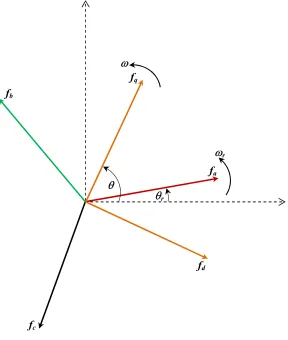
Fig 2.1: Phasor diagram depicting the positions of three phase values (marked in red, green and black) and the corresponding dq values (marked in orange).
The following equation shows how the three-phase variables can be expressed in an
arbitrary reference frame.
c b a d q f f f f f f 2 1 2 1 2 1 3 2 sin 3 2 sin sin 3 2 cos 3 2 cos cos 3 2 0 (2.1)
It can also be shown that the three phase variables can again be obtained from the
18
Rs Rr
Lm Llr Lls Vqs iqs iqr iqm
ds ( - r)dr
(a)
Rs Rr
Lm Llr Lls Vds ids idr idm
qs ( - r)qr
(b)
Fig 2.2: Equivalent circuit of an induction motor. A) q-axis. B) d-axis.
0 1 3 2 sin 3 2 cos 1 3 2 sin 3 2 cos 1 sin cos f f f f f f d q c b a (2.2)
In equations (2.1) and (2.2) the variable f could be interpreted as voltage, current or flux
19
The angular velocity and the angular displacement are related as per the
following expression
dt
(2.3)
2.2. M
ODELING OF ANI
NDUCTIONM
OTORAny induction motor is governed by the following equations [20].
Voltage equations:
ds qs
qs s
qs Ri p
v (2.4)
qs ds
ds s
ds Ri p
v (2.5)
r
dr qrqr r
qr Ri p
v 0 (2.6)
r
qr drdr r
dr Ri p
v 0 (2.7)
The rotor voltages, as depicted by equations (2.6) and (2.7), have been equated to zero
because the windings in the rotor of an induction motor are intentionally short circuited.
Flux equations:
qs qr
m qs ls
qs L i L i i
(2.8)
ds dr
m ds ls
ds L i L i i
(2.9)
qs qr
m qr lr
qr L i L i i
(2.10)
ds dr
m dr lr
dr L i L i i
(2.11)
20
qr dr dr qr
mlr m
e i i
L L
L P
T
4 3
(2.12)
r l
e p
P J T
T 2
21
3. VECTOR CONTROL OF INDUCTION MOTOR
3.1. T
HEORY OFV
ECTORC
ONTROLSpeed control in induction motors, using scalar control techniques, have been
observed since the earliest of days. The preferred control method was volts per hertz
method, alternately known as scalar control of induction motors. However, scalar control
did not have fast response, as sometimes demanded by the user. DC machines, on the
other hand, could provide very fast transient response. Thus, vector control was
formulated in order to make the AC machine behave like a DC machine. The analogy
between the speed control of DC machine and vector control is explained in the next
section.
Fig. 3.1: DC shunt motor.
3.3.1. ANALOGY BETWEEN VECTOR CONTROLLED INDUCTION MOTOR AND SPEED
CONTROL OF A SHUNT DC MOTOR
Before diving into the theory of vector control of an induction motor, the working
principle of a separately excited DC motor should be understood. This is necessary
22
Ia
If
Fig 3.2: Orthogonal orientation of armature current and field current in a separately excited DC machine.
are two separate currents at work inside a DC motor. One is called the armature current
and the other is known as the field current. The construction of a DC motor, as depicted
in figure 3.1, is such that both the currents are orthogonal to each other. Because the
currents are responsible for producing the armature and field fluxes, it can inferred that
these fluxes will also be orthogonal. This means that if we depict both the armature and
field currents along with the fluxes through a phasor diagram they would be
perpendicular to each other as shown in figure 3.2. From the phasor diagram it can be
concluded that changing any one of the current values will not affect the other. In other
words, it can be said that changes in armature current will not affect the field current or
the field. Again, the armature current, which directly affects the developed torque of a
DC motor, remains unaffected if any change is observed in the field current. This is the
very reason as to why a DC motor has very fast torque response.
The same idea is extended to induction motors. Through vector control, the d and
q-axis currents are decoupled and made orthogonal. In order to make the sinusoidal
variables such as voltages, currents and fluxes appear as DC quantities the induction
motor is considered to be in a synchronously rotating frame. For an induction motor the
q-axis current is analogous to the armature current and the d-axis current is analogous to
23
current while the d-axis current remains unaffected. Again, the rotor flux, which is a
function of the d-axis current, can be easily controlled by varying the d-axis current itself
while the torque and q-axis current remain unchanged.
3.3.2. FIELD ORIENTED CONTROL
Vector control, alternately known as field oriented control, is one of the modern
control techniques used to control AC machines. This thesis only looks at the
methodology that can be applied to induction motors only. The name, vector control, has
emerged from the fact that the control is achieved in field coordinates. The parameters
that are controlled with the help of this technique are as follows:
Stator flux
Air-gap flux
Rotor flux
Essentially, the voltages, currents and flux linkages are represented in the form of
vectors. With the help of the controller the specific orientation is achieved. Normally,
while trying to implement vector control rotor flux orientation is best choice as it
provides natural decoupling when compared to stator flux orientation or air-gap flux
orientation.
3.3.3. INDIRECT FIELD ORIENTED VECTOR CONTROL
Indirect field oriented control (IFOC) eliminates the use of sensors which are used
to measure terminal voltages and currents to determine the unit vector components cos
24
[21]. This method is cost effective but any changes in the parameters of the motor while
in operation makes the controller vulnerable to degradation in performance [22].
At the very outset the conditions that govern vector control must be to understood.
There are three main criteria that need to be satisfied:
dr r, a constant at steady state (3.1)
0, 0
dt d qr
qr (3.2)
0
dt d dr
, when in steady state (3.3)
With the above conditions in mind the equations for vector control can now be derived.
Substituting dr=r, equation (2.8) can be written as
ds dr
m dr lr
r L i L i i
(3.4)
Simplifying equation (3.4) further yields
r ds m
r r dr
L i L L
i (3.5)
Where Lr=Llr+Lm
Substituting qr =0 in equation (2.7) and simplifying the same yields
r qs m qr
L i L
i (3.6)
25
0 dr qr r r ds m r r r p L i L L R (3.7)
Introducing the conditions (3.2) and (3.3) in equation (3.7) reduces it to
ds m r L i
(3.8)
Again, substituting (3.6) in (2.3) yields
0 qr r sl r qs m r p L i L
R (3.9)
Wherer sl and introducing the conditions (3.1) and (3.2) in (3.9) gives
lr r qs m r sl L i L R (3.10)
Substituting (3.1), (3.2),(3.5) and (3.6) in the torque equation numbered (2.9) yields
qs ds r m
e i i
L L P T 2 4 3 (3.11)
The above equations clearly portray the fact that the conditions assumed for
vector control, equations (3.1) through (3.3), indeed decouple the q and d-axis currents. It
can easily be concluded that ids is the flux producing component while iqs is solely
responsible for changes in the electromagnetic torque.
3.4. R
EQUIREMENTS OF THEPI
C
ONTROLLERIt is clear from the equations presented in section 3.3.3 that the control variables
26
Changing the values of these currents will enable the user to very quickly change the
torque at a particular set speed. From figure 3.3 it is clear that the voltage equations need
to be expressed as a function of the stator currents. In order to achieve this it is first
necessary to express the stator fluxes in terms of stator currents only. The procedure is as
follows.
First equation (2.5) is considered. It is a function of iqs and iqr. As mentioned
earlier, the control variables are the q and d-axis stator currents. Thus, iqr needs to be
eliminated from the flux equation.
Substituting equation (3.6) in (2.5) eliminates iqr. The flux equation can be rewritten as
qs s qs Li
(3.12)
Where
m lr r
m ls s
r s
m
L L L
L L L
L L
L
2
1
Similarly, equation (2.6) is a function of ids and idr. Thus, substituting equation (3.5) in
(2.6) yields
r r m ds s ds
L L i
L
(3.13)
The stator voltages can now be expressed in terms of stator currents. Thus, substituting
27
+
- RssLs
1 * qm i qm i + - + + comp qs v _ qm i PI (a) +
- RssLs
1 * dm i dm i comp ds v _ dm i PI (b)
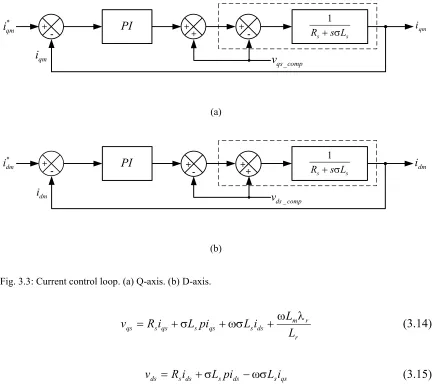
Fig. 3.3: Current control loop. (a) Q-axis. (b) D-axis.
r r m ds s qs s qs s qs L L i L pi L i R
v (3.14)
qs s ds s ds s
ds Ri L pi Li
v (3.15)
A close look at equations (3.14) and (3.15) reveals that both the q-axis and d-axis
voltages have dependency on iqs and ids. In other words, the voltage equations are not
decoupled. Considering in vector control, the control variable of choice are the q and
d-axis stator currents, any change in one variable will automatically affect the other. Thus,
the cross coupled terms need to be compensated for. Figure 3.3 shows the procedure by
which the effect of the cross coupled terms can be negated. In equation (3.14) any term
which is a function of ids is treated as a disturbance. Since the magnitude of this
disturbance can be estimated, introducing a signal opposite in polarity but bearing the
28
equation (3.15), any term which is function of iqs is treated as a disturbance and its effect
29
4. VECTOR CONTROL OF INDUCTION MOTOR MODEL
WITH CORE LOSS INCLUDED
Rs Rr
Rc
Lm
Llr
Lls
Vqs
iqs iqr
iqc
iqm ds
Lmidm
( - r)dr
(a)
Rs Rr
Rc
Lm
Llr
Lls
Vds
ids idr
idm
idc
qs ( - r)qr
Lmiqm
(b)
Fig: 4.1: Dynamic model of an induction motor including core loss. (a) q-axis. (b) d-axis.
4.1. M
OTORM
ODELI
NCLUDINGC
OREL
OSSThe three phase steady state induction motor model including core loss is well
established [2] and so is the dynamic motor model [20] neglecting core loss. However,
not much attention has been paid to the dynamic model as far as the inclusion of core is
concerned. Considering this thesis deals with minimization of the losses it is of utmost
30
the model presented in [20] was proposed by [23]. The equations depicting the induction
motor including core loss are depicted by the following equations:
Voltage equations:
ds qs
qs s
qs Ri p
v (4.1)
qs ds
ds s
ds Ri p
v (4.2)
r
dr qrqr r
qr Ri p
v 0 (4.3)
r
qr drdr r
dr Ri p
v 0 (4.4)
It should be noted that the voltage has been equated to zero in equation (4.3) and (4.4)
because in a squirrel cage induction motor the rotor bars are shorted with end rings.
Current equations: dm m qm m qc
ci L pi L i
R (4.5)
qm m dm m dc
ci L pi L i
R (4.6)
qc qm qr
qs i i i
i (4.7)
dc dm dr
ds i i i
i (4.8)
Flux equations:
qm m qs ls
qs L i L i
(4.9)
dm m ds ls
ds L i L i
(4.10)
qm m qr lr
qr L i L i
(4.11)
dm m dr lr
dr L i L i
31 + - dt d * e
T iqm*
* ds V * qs V qs V ds
V
* r N * dm i qm i dm i qm pi dm pi * r * rN sync*
am
i ibmicm
Fig. 4.2: Block diagram implementing vector control with core loss included in the modeling.
Mechanical equations
dr
qs qc
qr
ds dc
mlr m
e i i i i
L L
L P
T
4 3 (4.13) r l e p P J T
T 2 (4.14)
It should be noted here that addition of core loss in the model of an induction motor
increases the order of the system by two.
4.2. I
NDIRECTF
IELDO
RIENTEDV
ECTORC
ONTROLIn chapter 3 all the necessary expressions for vector control were derived. The
theory essentially remains the same apart from the changes observed in the equations
which will be elaborated in this section. Including the core loss element increases the
32
longer be chosen as the stator currents. Magnetizing currents are chosen as the control
variables to implement vector control when core loss is included in the modeling of an
induction motor. The block diagram for explaining this method is shown in figure 4.2.
The three main criteria for vector control are reiterated again. They are as follows:
dr r, a constant at steady state (4.15)
0, 0
dt d qr
qr (4.16)
0
dt d dr
, when in steady state (4.17)
With the above conditions in mind the equations for vector control can now be derived.
Thus, after substitutingdr r, equation (4.12) can be written as
dm m dr lr
r L i L i
(4.18)
From (4.18),
lr dm m r dr
L i L
i (4.19)
Substituting (4.19) in (4.4) yields
0
dr qr
r lr
dm m r
r p
L i L
R (4.20)
Introducing the conditions (4.15) and (4.17) in (4.20) reduces it to
dm m r L i
33
Substituting (4.16) in (4.11) yields
lr qm m qr L i L
i (4.22)
Again, substituting (4.22) in (4.3) yields
0 qr dr r lr qm m r p L i L R (4.23)
Writing r sl and introducing the conditions (4.15) and (4.16) in (2.23) gives
lr r qm m r sl L i L R (4.24)
Substituting (4.15), (4.16) and (4.22) in the torque equation numbered (4.13) yields
lr m qm r m lr m e L L i L L L P T 1 4 3 (4.25)From the above equations it is evident that the d and q-axis currents have been decoupled
and are completely independent of each other.
4.3. D
ESIGNING THEC
ONTROLLERNow that the equations for vector control have been derived, focus should now be
shifted to the requirements of the PI controller. There will be three controllers in used in
the entire system. One PI controller will be for the outer loop or the speed control loop.