Authentication Scheme Based on ECC
Ding Wang1,2⋆, Chun-guang Ma1⋆⋆, and Yu-heng Wang2,3 1
Harbin Engineering University, Harbin City 150001, China
2
Automobile Management Institute of PLA, Bengbu City 233011, China
3 Golisano College of Computing and Information Sciences, Rochester Institute of
Technology, 102 Lomb Memorial Dr., Rochester, NY 14623, USA [email protected]
Abstract. The design of secure remote user authentication schemes for mobile applications is still an open and quite challenging problem, though many schemes have been published lately. Recently, Islam and Biswas pointed out that Lin and Hwang et al.’s password-based authen-tication scheme is vulnerable to various attacks, and then presented an improved scheme based on elliptic curve cryptography (ECC) to over-come the drawbacks. Based on heuristic security analysis, Islam and Biswas claimed that their scheme is secure and can withstand all related attacks. In this paper, however, we show that Islam and Biswas’s scheme cannot achieve the claimed security goals and report its flaws: (1) It is vulnerable to offline password guessing attack, stolen verifier attack and denial of service (DoS) attack; (2) It fails to preserve user anonymity. The cryptanalysis demonstrates that the scheme under study is unfit for practical use.
Keywords: Authentication protocol; Smart card; Cryptanalysis; User anonymity; Elliptic curve cryptography
1
Introduction
With the large-scale proliferation of internet and network technologies over the last couple of decades, more and more electronic transactions for mobile devices are implemented on Internet or wireless networks. It is increasingly important to protect the systems and the users’ privacy and security from malicious adver-saries. Accordingly, user authentication becomes an essential security mechanism for remote systems to assure one communicating participant of the authenticity of the corresponding party by acquisition of corroborative evidence. Authenti-cation factors are generally grouped into three categories [1]: 1) what you know (e.g., passwords, PINs); 2) what you have (e.g., tokens, smart card); and 3) who you are (e.g., biometric). Among numerous methods based on one or more of
⋆Corresponding author. ⋆⋆
these three types, password authentication is one of the most simple and effec-tive approaches for authentication in a client/server environment, and has been widely deployed in areas like e-banking, e-commerce, e-health services and so on. Since Lamport [2] introduced the first password-based authentication scheme in 1981, many password-based remote user authentication schemes [3–6] have been proposed, where a client remembers a password and the corresponding server holds the password or its verification data that are used to verify the client’s knowledge of the password. These easy-to-remember passwords, called weak passwords, have low entropy and thus are potentially vulnerable to various sophisticated attacks, especially offline password guessing attack [7], which is the gravest threat a well-designed password authentication scheme must be able to thwart.A common feature among the published schemes is that computation efficiency and system security cannot be achieved at the same time. As the com-putation ability and battery capacity of mobile devices (e.g. PDAs, smart cards) are limited, the traditional public-key based remote authentication schemes are not suitable for mobile applications.
Fortunately, it seems to see the dawn in recent two years, where several schemes based on ECC have been proposed to reduce computation cost while preserving security strength [8–12]. However, The reality of the situation is that this dilemma is only partially addressed and most of the ECC-based schemes were found severely flawed shortly after they were first put forward, so intensive further research is required. More recently, Islam and Biswas [13] proposed an advanced password authentication scheme based on ECC. The authors claimed that their scheme provides mutual authentication and is free from all known cryptographic attacks, such as replay attack, offline password guessing attack, insider attack and so on. Although their scheme is superior to the previous solu-tions for implementation on mobile devices, we find their scheme cannot achieve the claimed security: their scheme is vulnerable to the offline password guessing attack, the stolen verifier attack. Almost at the same time with us, He et al. [14] also have identified these defects in Islam-Biswas’s scheme. Hence, we went on to perform a further cryptanalysis on this protocol and observe that it is also prone to a denial of service (DoS) attack, and it transmits user’s identity in plain during the login request and thus user anonymity is not provided, while provision of user identity confidentiality is of great importance for a protocol in mobile environments [15].
The remainder of this paper is organized as follows: in Section 2, we review Islam-Biswas’s scheme. Section 3 describes the weaknesses of Islam-Biswas’s scheme. Section 4 concludes the paper.
2
Review of Islam-Biswas’s scheme
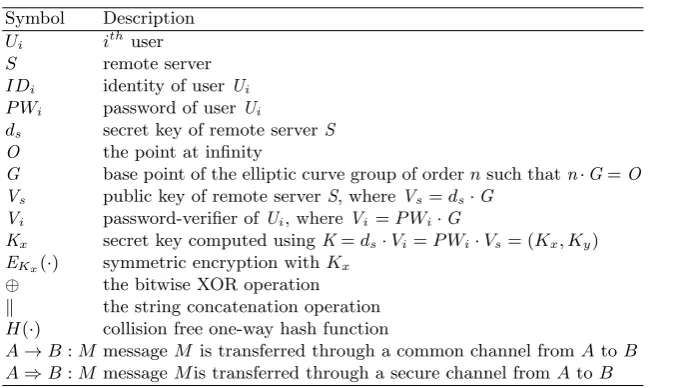
For ease of presentation, we employ some intuitive abbreviations and notations listed in Table 1.
Table 1.Notations
Symbol Description
Ui ithuser
S remote server
IDi identity of userUi
P Wi password of userUi
ds secret key of remote serverS
O the point at infinity
G base point of the elliptic curve group of ordernsuch thatn·G=O Vs public key of remote serverS, whereVs=ds·G
Vi password-verifier ofUi, whereVi=P Wi·G
Kx secret key computed usingK=ds·Vi=P Wi·Vs= (Kx, Ky)
EKx(·) symmetric encryption withKx
⊕ the bitwise XOR operation
∥ the string concatenation operation
H(·) collision free one-way hash function
A→B:M messageM is transferred through a common channel fromAtoB A⇒B:M messageMis transferred through a secure channel fromAtoB
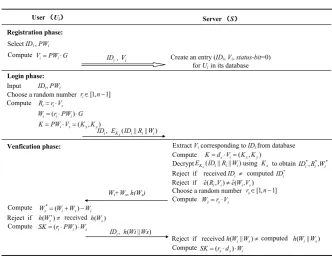
2.1 Registration phase
Before the system begins, the server S selects a large prime numberpand two integer elements a and b, where p > 2160 and 4a3+ 27b2(modp) ̸= 0. Then S selects an elliptic curve equationEpover finite fieldFp:y2=x3+ax+bmodp.
LetGbe a base point of the elliptic curve with a prime ordernandObe a point at infinite, where n·G=Oand n >2160 . The server chooses the private key ds and computes the corresponding public keyVs=P Wi·G. The registration
phase involves the following operations:
1) Ui chooses his identityIDi and passwordP Wi, computesVi=P Wi·G.
2) Ui⇒S:{IDi, Vi}.
3) On receiving the registration message fromUi, the serverScreate an entry
(IDi, Vi, status-bit) in its database, where the status-bit indicates the
status of the client, i.e., when the client is logged-in to the server thes
tatus-bitis set to one, otherwise it is set to zero.
2.2 Login and authentication phase
1) Ui keys his identity IDi and the password P Wi into the terminal. The
client selects a random numberrifrom [1, n−1], computesRi =ri·Vsand
Wi = (ri·P Wi)·G. Then encrypts (IDi, Ri, Wi) using a symmetric key
Kx, whereKx is thexcoordinate ofK=P Wi·Vs= (Kx, Ky).
2) Ui⇒S:{IDi, EKx(IDi∥Ri ∥Wi)}
3) S computes the decryption key Kx by calculatingK=ds·Vi= (Kx, Ky)
and then decryptsEKx(IDi∥Ri∥Wi) usingKx. SubsequentlyScompares decryptedIDi with receivedIDi, ˆe(Ri, Vi) with ˆe(Wi, Vs), respectively. If
both conditions are satisfied,S selects a random numberrsand computes
Ws=rs·Vs=rs·ds·G.
4) S→Ui:{Wi+Ws, H(Ws)}.
5) Ui retrievesWs by subtracting Wi from Wi+Ws. If the hashed result of
retrieved Ws is equal to the received H(Ws), then Ui performs the hash
operationH(Wi∥Ws) and sends it to the server.
6) Ui→S:{H(Wi∥Ws)}.
7) The serverScomputes the hash value with its own copies ofWsandWiand
compares it with the receivedH(Wi ∥ Ws), to accept or denied the login
request. If the equality holds, the server grants the client’s login request, otherwise rejects.
2.3 Session key distribution phase and password change phase
Since both the session key distribution phase and password change phase have little relevance with our discussions, they are omitted here.
3
Cryptanalysis of Islam-Biswas’s scheme
With superior performance over other related schemes and a long list of argu-ments of security features that their scheme possesses presented, Islam-Biswas’s scheme seems desirable at first glance. However, their security arguments are still specific-attack-scenario-based and without some degree of rigorousness, and thus it is not fully convincing. We find that Islam-Biswas’s scheme still fails to serve its purposes and demonstrate its security flaws in the following.
3.1 Offline password guessing attack
To successfully launch an offline password guessing attack on a remote user authentication scheme, the following two conditions must be satisfied [16]: (1) the user’s password is a weak password, and (2) a piece of password-related information that can be obtained and used as a comparison target for password guessing.
Registration phase:
Select IDi,PWi
Login phase:
Venfication phase:
Compute
User˄Ui˅ Server˄S˅
Compute
i
ID Create an entry (IDi,Vi,status-bit=0)
for Uiin its database
Input IDi,PWi
Compute
( )
( , )
i i s
i i i
i s x y
R r V W r PW G K PW V K K
!
! !
!
, ( || || )
x
i K i i i
ID E ID R W
(s s) i
SK r d! !W Wi+Ws,h(Ws)
Compute
Reject if received
Reject if ( *) s
h W "
i
ID "
(i i) s
SK r PW! !W
computed
received
* i
ID
( s)
h W
( , )
s i x y
K d V! K K
i i
V PW G!
Compute ,
i
V
Choose a random number ri#[1,n$1]
Extract Vicorresponding to IDifrom database
Decrypt EKx(IDi||R Wi|| i)using Kxto obtain ID R Wi*, i*, i*
Reject if ˆe R V( , )i i "e W Vˆ( i, s) Choose a random number rs#[1,n$1] Compute Ws r Vs! s
* ( )
s i s i
W W%W $W
, ( || )
i
ID h Wi Ws
Reject if received (h W Wi|| s)"computed h W W( i|| s)
Compute
Fig. 1.Islam-Biswas’s remote user authentication scheme
weak passwords, have low entropy and thus are potentially vulnerable to offline password guessing attack.
Besides, userUi′s identity is transmitted in plaintext within the login request, it is not difficult for an adversary A to identify the login request message sent byUi. Once the login request messageIDi, EKx(IDi∥Ri∥Wi) during any au-thentication process is intercepted byA, an offline password guessing attack can be launched as follows:
Step 1. Guesses the value of P Wi to beP W∗i from a dictionary spaceD.
Step 2. Computes K∗ = P W∗i ·Vs = (Kx∗, Ky∗), as Vs is the public key of
server S.
Step 3. Decrypts the previously intercepted EKx(IDi ∥ Ri ∥ Wi) usingKx∗
to obtainID∗i.
Step 4. Verifies the correctness of P W∗i by checking if the computedID∗i is equal to the interceptedIDi.
Step 5. Repeats Step 1, 2, 3, and 4 of this procedure until the correct value ofP Wi is found.
After guessing the correct value ofP Wi,Acan compute the valid symmetric
key K = P Wi ·Vs = (Kx, Ky) . Then the attacker can impersonate Ui to
send a valid login request message {IDi, EKx(IDi ∥ Ri ∥ Wi)} to the service provider serverS, since Ui’s identityIDi can be intercepted from the channel,
Ri and Wi can be correctly fabricated with the correctly guessed P Wi . Upon
receiving the fabricated login request,S will find no abnormality and responds with {Wi+Ws, H(Ws)}. ThenA can compute the valid Ws since she knows
Wi. Hence the attacker A can successfully masquerade as a legitimate user Ui
to serverS. On the other hand, the attacker may also impersonate the serverS toUi successfully in a similar way.
3.2 Stolen verifier attack
Let us consider the following scenarios. In case the verifier table in the database of the server S is leaked out or stolen by an adversary A . With the obtained entry (IDi, Vi,status−bit) corresponding toUi, she can guess out the password
P Wi ofUi using the method as follows:
Step 1. Guesses the value of P Wi to beP W∗i from a dictionary spaceD.
Step 2. ComputesVi∗=P W∗i ·G, asGis public.
Step 3. Verifies the correctness of P W∗i by checking if the computed Vi∗ is
equal to the somehow obtained Vi.
Step 4. Repeats Steps1, 2, and 3 of this procedure until the correct value of P Wi is found.
As the size of the password dictionary , i.e. |D|, is very limited in practice, the above attack procedure can be completed in polynomial time. Since the underlying assumption of the above attack introduced is much constrained, it is much less effective than the attack introduce in Section 3.1. However, it is still an insecure factor to be noticed.
3.3 Failure of protecting the user’s anonymity
which indicates that the attacker can neither know who the initiator is nor dis-tinguish whether two conversations come from the same (unknown) initiator [18]. A protocol with user anonymity prevents an adversary from acquiring sensitive personal information about an individual’s preferences, lifestyles, shopping pat-terns, social circle, current location, etc. by analyzing the login information.
In Islam-Biswas’s scheme, the user’s identityIDis transmitted in plain, which may leak the identity of the logging user once the login messages were eaves-dropped; the user’s identity ID is static in all the login phases, which may facilitate the adversary to trace out the different login request messages belong-ing to the same user and to derive some information related to the userUi. In a
word, neither initiator anonymity nor initiator un-traceability can be preserved in their scheme.
3.4 Denial of service attack
Without any knowledge of the user private information like password or security parameters stored in smart card, an adversaryAcan successfully launch a kind of denial of service attack, which is the so called “clogging attack” [19], in many non-DoS-resilient cryptography protocols. Let’s see how this could happen with Islam-Biswas’s scheme in place. The following is performed by the adversaryA: Step 1. Sends the previously intercepted{IDi, EKx(IDi ∥Ri ∥ Wi)}to the
server S.
Step 2. Ignores the reply from the serverS. The following is performed by the server:
Step 1′. On receiving the login request fromUi(actuallyA),Scomputes the
decryption keyKx by calculatingK=ds·Vi= (Kx, Ky) and then
decrypts EKx(IDi ∥ Ri ∥Wi) using Kx. SubsequentlyS compares decrypted IDi with received IDi, ˆe(Ri, Vi) with ˆe(Wi, Vs),
respec-tively.
Step 2′. Selects a random numberrsand computesWs=rs·Vs=rs·ds·G.
Step 3′. Sends out {Wi+Ws, H(Ws)} and waits for the response from Ui
(actuallyA), which will never come.
Since IDi and EKx(IDi ∥ Ri ∥ Wi) are valid,S will find no abnormality in Step 1′, and then proceeds to Step 2′.
It should be noted that even DoS-resilient mechanisms (e.g. timeout or lock-ing user account for a period of time after a predefined number of login failures) are introduced on server side, it may be not a real obstacle for attacker A as it can initialize new sessions with different intercepted identities in an inter-leaving manner. Hence,Acan potentially performs the above attack procedure continuously, which will make the victimized server keeps computing the useless expensive operations rather than any real work. Thus A clogs S with useless work and thereforeS denies any legitimate user any service. If distributed DoS attacks are launched based on this strategy, the consequences will be more seri-ous.
4
Conclusion
Understanding security failures of cryptographic protocols is the key to both patching existing protocols and designing future protocols. Smartcard-based password authentication technology has been widely deployed in various kind-s of kind-security-critical applicationkind-s, and careful kind-security conkind-siderationkind-s kind-should be taken when designing such schemes. In this paper, we have shown that Islam-Biswas’s scheme suffers from the offline password guessing attack, stolen-verifier attack and denial of service attack. In addition, their scheme fails to provide the property of user anonymity. In conclusion, Although Islam-Biswas’s scheme is very efficient and possesses many attractive features, it, in fact, does not provide all of the security properties that they claimed and only radical revisions of the protocol can possibly eliminate the identified flaws. Therefore, the scheme un-der study is not recommended for practical applications. In future work, we will propose an improvement over Islam-Biswas’s scheme to overcome the identified drawbacks.
Acknowledgment
The authors would like to thank the anonymous reviewers for their valuable comments and constructive suggestions. This research was partially supported by the National Natural Science Foundation of China (NSFC) under Grants No. 61170241 and No. 61073042.
References
1. O’Gorman, L.: Comparing passwords, tokens, and biometrics for user authentica-tion. Proceedings of the IEEE 91(12), 2021–2040 (2003)
2. Lamport, L.: Password authentication with insecure communication. Communica-tions of the ACM 24(11), 770–772 (1981)
3. Liao, I.E., Lee, C.C., Hwang, M.S.: A password authentication scheme over insecure networks. Journal of Computer and System Sciences 72(4), 727–740 (2006) 4. Song, R.: Advanced smart card based password authentication protocol. Computer
5. Yeh, K.H., Su, C., Lo, N.W., Li, Y., Hung, Y.X.: Two robust remote user au-thentication protocols using smart cards. Journal of Systems and Software 83(12), 2556–2565 (2010)
6. Ma, C.G., Wang, D., Zhang, Q.M.: Cryptanalysis and improvement of Sood et al.s dynamic id-based authentication scheme. In: Distributed Computing and Internet Technology, LNCS, vol. 7154, pp. 141–152. Springer-Verlag (2012)
7. Klein, D.V.: Foiling the cracker: A survey of, and improvements to, password se-curity. In: Proceedings of the 2nd USENIX Security Workshop. pp. 5–14 (1990) 8. Wang, R.C., Juang, W.S., Lei, C.L.: Robust authentication and key agreement
scheme preserving the privacy of secret key. Computer Communications 34(3), 274–280 (2011)
9. Wu, S.H., Zhu, Y.F., Pu, Q.: Robust smart-cards-based user authentication scheme with user anonymity. Security and Communication Networks 5(2), 236–248 (2012) 10. Wei, J., Hu, X., and Liu,W.: An improved authentication scheme for telecare medicine information systems. Journal of Medical Systems, 1–8, 10.1007/s10916-012-9835-1 (2012)
11. Pu, Q., Wang, J., Zhao, R.: Strong authentication scheme for telecare medicine information systems. Journal of Medical Systems pp. 1–11 (2011), doi:10.1007/s10916-011-9735-9
12. He, D.B., Chen, J.H., Zhang, R.: A more secure authentication scheme for tele-care medicine information systems. Journal of Medical Systems pp. 1–7 (2012), doi:10.1007/s10916-011-9658-5
13. Islam, S.H., Biswas, G.P.: Design of improved password authentication and up-date scheme based on elliptic curve cryptography. Mathematical and Computer Modelling (2011), doi:10.1016/j.mcm.2011.07.001
14. He, D.B.: Comments on a password authentication and update scheme based on elliptic curve cryptography. Cryptology ePrint Archive, Report 2011/411 (2011), http://eprint.iacr.org/2011/411.pdf
15. Wan, Z., Zhu, B., Deng, R.H., Bao, F., Ananda, A.L.: Dos-resistant access control protocol with identity confidentiality for wireless networks. In: 2005 IEEE Wire-less Communications and Networking Conference (WCNC). vol. 3, pp. 1521–1526. IEEE (2005)
16. Horng, W.B. and Lee, C.P. and Peng, J.W.: Cryptanalysis of a more secure remote user authentication scheme. In: 2010 International Computer Symposium (ICS). pp. 284–287. IEEE (2010)
17. Hughes, D., Shmatikov, V.: Information hiding, anonymity and privacy: a modular approach. Journal of Computer Security 12(1), 3–36 (2004)
18. Li X., Qiu W., Zheng D., Chen K., and Li J.: Anonymity enhancement on ro-bust and efficient password-authenticated key agreement using smart cards. IEEE Transations on Industrial Electronics 57(2), 793–800 (2010)
19. Roy, S., Das, A.K., Li, Y.: Cryptanalysis and security enhancement of an advanced authentication scheme using smart cards, and a key agreement scheme for two-party communication. In: 2011 IEEE 30th International Performance Computing and Communications Conference (IPCCC). pp. 1–7. IEEE (2011)