Modeling spectral sensitivity at low light levels
based on mesopic visual performance
Meri Viikari Aleksanteri Ekrias Marjukka Eloholma Liisa Halonen
Lighting Laboratory, Helsinki University of Technology, Finland
Correspondence: Meri Viikari
Lighting Laboratory, Helsinki University of Technology, P.O. BOX 3000, FI-02015 TKK, Finland
Tel +358 9 451 4981 Fax +358 9 451 4982 Email [email protected]
Abstract: The spectral sensitivity of the eye at low light levels, ie, mesopic conditions, is determined by the rod and cone photoreceptors of the retina operating together in varying degree as adaptation luminance shifts between the scotopic and photopic. Thus mesopic spectral sensitivity is different from photopic, where only cones contribute to vision. There are defi nite needs for a practical system of mesopic photometry to be used in assessing light at low light levels, especially in road and other outdoor lighting applications. However, neither of the recently proposed systems of mesopic photometry, the MOVE-model or the X-model, is found satisfactory by common consent of the lighting community. The most active debate has considered the upper luminance limit of the mesopic region, which is regarded to be too high for the MOVE-model and too low for the X-model. The present paper proposes a new modifi ed MOVE-model whose upper luminance limit is adjusted to meet the actual road and street lighting luminance values measured in different weather conditions. The paper compares the MOVE-model, X-model, and the proposed modifi ed MOVE-model with three independent visual performance data sets provided by different European universities. Based on the comparison, recommendations are given for future actions towards internationally accepted practice for mesopic photometry. Keywords: spectral sensitivity, mesopic, visual performance, mesopic model, photometry, night-time driving
Introduction
The spectral sensitivity of the eye varies with the wavelength of the visible spec-trum (380–760 nm). Spectral sensitivity functions are derived from psychophysical experiments based on the use of certain visual criteria and a defi ned set of lighting and viewing conditions. In current photometric practice, the response of the visual sys-tem is approximated by the CIE (Commission Internationale de l’Eclairage) photopic spectral luminous effi ciency function V(λ) (CIE 2004). The V(λ) function characterises the spectral sensitivity of foveal cones in photopic lighting conditions. In the mesopic luminance region, between the photopic and scotopic, both the rods and cones on the retina may be active. This results in changes of spectral sensitivity. Due to the distribu-tion of rods and cones on the retina the mesopic spectral sensitivity is not constant, but varies with light level and viewing conditions. Until today, there are no internationally accepted mesopic spectral sensitivity functions and consequently no accepted system of mesopic photometry.
such as detection threshold and response to the onset of visual stimulus are used as visual criteria. By today there are two visual performance based mesopic models which describe mesopic spectral sensitivity and which are applicable in practice for defi ning mesopic lighting units.
The X-model has been introduced by Rea and colleagues (2004) as a unifi ed system for photometry. It is based on two investigations of He and colleagues (1997, 1998). The fi rst work of He and colleagues (1997) resulted in a mesopic model, which was a linear combination of the scotopic V′(λ) function and the photopic V10(λ) function based on reaction time data of two subjects. According to He and colleagues (1997), the visual inspection of the two subjects’ off-axis reaction time data showed a separation between the two light sources below 0.3 cd/m2, but no clear separation was observed above 1 cd/m2. As the midpoint between these luminances in log units is 0.6 cd/m2, and as the literature referred to described the rod-cone discontinuity at about this luminance, the 0.6 cd/m2 luminance value was chosen by He and colleagues as a convenient point of bifurcation on fi tting the data curves. Furthermore, He and colleagues (1997) assumed that there is no rod contribution above 0.6 cd/m2 to the reaction time task investigated. The second work of He and colleagues (1998) was based on binocular simultaneity method (reaction time differences between the two eyes) and resulted in luminous effi ciency functions for one subject at three retinal illuminances 0.3, 3 and 10 Td. The derived mesopic luminous effi ciency functions were fi tted with the linear model developed in the earlier work of He and colleagues (1997). The transition point between mesopic and photopic regions was not reached within the retinal illuminance range studied. Following this, the tran-sition point for the data of the one subject in question was estimated to occur at 21 Td, corresponding to a luminance level 1.7 cd/m2. The X-model was derived from the data of the two experiments and it describes mesopic luminous effi ciency as a linear transition between the scotopic V′(λ) and the photopic V(λ) functions. A parameter X characterizes the proportion of the photopic luminous effi ciency at any luminance level. In the X-model the upper luminance level of the mesopic region is at 0.6 cd/m2.
Another visual performance based model has been introduced by a European research consortium MOVE (Mesopic Optimisation of Visual Effi ciency) (Eloholma and Halonen 2006). Due to the complex nature of mesopic vision, the MOVE consortium recognized that an exten-sive amount of data was needed to establish a solid basis for performance-based mesopic photometry. The MOVE
work steered away from conventional techniques, where only one aspect of visual performance had been considered at a time, and developed a multi-technique method. The visual criteria of MOVE covered the methods of achromatic detection threshold (increment and/or decrement of the visual target’s intensity around the threshold) (Freiding et al 2007), speed of response (reaction times for a number of coloured targets with different spectral characteristics) (Walkey et al 2007) and achromatic recognition threshold (visual acuity) (Várady et al 2007). All the experiments were based on a common set of parameter values (eg, background luminances 0.01, 0.1, 1, and 10 cd/m2) for each particular data set generated in different test locations. Altogether 109 subjects participated in the experiments. The MOVE model describes mesopic spectral sensitivity as a linear transition between the scotopic V′(λ) and photopic
V(λ) functions and a parameter x is used for weighting the photopic and scotopic contents in calculating mesopic values.
Despite the similar forms of the X- and MOVE-models, they are not, however, similar in characterizing mesopic spectral sensitivity (Viikari et al 2006). The major differ-ences between the models result from the choice of the upper luminance limit of the mesopic region. He and colleagues assumed that there is no rod contribution above 0.6 cd/m2 to the reaction time task investigated and this was chosen as the upper luminance limit of the X-model. In the MOVE experi-ments spectral sensitivity changes were measured up to about 10 cd/m2 and this was consequently chosen as the upper limit of the MOVE-model.
Visual conditions in night time
driving
In road and street lighting luminances fall in the mesopic region. In Europe the recommended average road surface luminances (Lave) are between 0.3–2 cd/m2 (CEN 2003) and in the US between 0.3–1.2 cd/m2 (IESNA 2000). In night-time driving conditions it is not only the road surface that affects the adaptation conditions of the road-users. Luminances of visual objects surrounding the road (traffi c signs, guiding systems, buildings, commercial lighting etc) have their effect on the luminance distribution of the visual fi eld. Also, the luminance levels of road surfaces are usu-ally very dynamic and depend to large extent on weather conditions.
conditions. The installations covered local streets with minor lighting requirements as well as heavily traffi cked roads. In wet conditions the luminance distributions of road surfaces change signifi cantly compared with dry conditions. Road surface areas with specular refection towards the observation point become very bright and may cause discomfort glare. On the other hand, the luminances of the darker areas of road surface decrease. This results in lower luminance uniformi-ties and in worse driver’s visibility conditions. However, average luminances of wet road surfaces are usually higher compared to the dry conditions. Also in foggy conditions, despite the increased average luminance and luminance uniformities, the fog may result in substantially decreased driver’s visibility.
Luminances of snowy road surfaces can be multiple times higher than in dry and so called “normal” conditions. And even if there is a minor amount of snow and snow clearance is done, luminance levels are still 40%–100% higher compared with conditions without any snow. By taking into account the luminances of the road surfaces and their surrounding areas and considering the effects of different weather conditions on luminances, it can be concluded that the average visual fi eld luminances in night-time driving conditions fall below 5 cd/m2.
Driving is a complex task. The visual environment con-sists of several visual elements such as other vehicles, lane markings, signs, pedestrians, cyclists, and any unexpected objects appearing in the visual fi eld. Much of the visual information in driving is peripheral. The basic visual task in driving a car is to obtain suffi cient information from the visual fi eld to be able to get by in the environment (CIE 1992). In order to trigger visual perception and to detect a target a certain luminance difference between the target and its background is needed. In night-time driving conditions the contrasts of visual targets depend on the target refl ectance properties, vehicle headlights, the geometry of the lighting installation as well as on the location of the target in relation to the luminaries.
At the Lighting Laboratory of Helsinki University of Technology (HUT), the variation of target contrast was studied in different lighting levels and weather conditions on a recently built extension section of the highway Ring Road III. In this pilot location road lighting installation is new and consists of HPS lamps (250 W) with luminaire spacing of 55 m. The visual targets used in the measure-ments were a pedestrian with grey clothing (refl ectance 16%) and 20 cm × 20 cm fl at square targets with differ-ent refl ection factors. The square target size corresponds
roughly to the least clearance between the road surface and the body structure of normal vehicles. Thus the target represents a critical object which is the most diffi cult to perceive (geometrically small) but still dangerous for a normal-sized vehicle (De Boer 1967). In the American National Standard Practice for Roadway Lighting similar 18 cm × 18 cm square targets are used for Small Target Visibility calculations (IESNA 2000). Similar fl at surface targets were also used as the basis of present road lighting recommendations (De Boer 1967).
Figure 1 shows an example of the variation of target contrast for two different targets. Measurements were made in different target locations (10 m, 20 m, 30 m, 40 m, and 50 m from the fi rst luminaire) between the luminaire spacing. The square target was placed in the middle of the carriageway. The pedestrian was positioned on the side of the road to create a realistic and common night-time driv-ing scene with the pedestrian walkdriv-ing on the roadside or aiming to cross the road. Figure 1 represents measurement results from two different lighting scenes: one with an old pavement and full road lighting and the other one with a new pavement and dimmed road lighting (power 50%). The average road surface luminances (Lave) were 1.7 cd/m2 (power 100%, old pavement) and 0.8 cd/m2 (power 50%, new pavement) (CEN 2003). The target contrasts C are defi ned as
C L L
L
t bg bg
= −
where Lt is the luminance of the target and Lbg that of the background.
According to the results of the example (Figure 1) and many other measurements conducted at the HUT, the target contrasts usually vary between C= –0.9–1. The luminance contrast of the target depends on the target refl ectance and the target location in relation to the luminaries. The con-trasts of the targets highly depend on the positioning in the longitudinal direction because in different locations lumi-naires light the target and the target background differently. Road lighting has usually bidirectional light distribution. When the target is located close to the fi rst luminaire, the target is lit more compared to the situation when the target is located close to the second luminaire. Thus usually when the target is located close to the second luminaire a very dark target is apparent giving negative contrast on the lit road surface.
The investigations underlying the X-model were based on visual targets of high-contrast (C= 2.3), which can argued not
to be representative of those encountered in night-time driving, whereas the MOVE experiments covered a range of contrasts with particular attention paid to the low contrast range. It has been indicated that the spectral sensitivity changes are more pronounced at low visibility conditions (low luminance, low contrast) (Viikari et al 2006). The high contrast value of the X-model experiments can be suspected to result in inaccuracy of the X-model to assess spectral sensitivity for low contrast visual tasks encountered in night-time driving.
It can be argued that the X-model upper luminance limit 0.6 cd/m2 is too low to cover the mesopic luminances in road and street lighting. Moreover, mesopic spectral sensitivity changes were found in the MOVE-experiments up to about 10 cd/m2 indicating that the mesopic region extends well above 0.6 cd/m2. However, the differences between meso-pic and photomeso-pic luminances given by the MOVE-model become small when photopic luminance increases above 5 cd/m2 for most common light sources with S/P-ratios (ratio of photopic to scotopic luminous ouput) 0.5–2.5. The road lighting measurements indicate that in road and street lighting luminances rarely exceed 5 cd/m2, but can reach up to this value due to changing weather conditions (Castillo 2007; Ekrias et al 2007). This limit is suffi ciently high to cover all practical road and street lighting levels in varying weather conditions, without impinging unnecessarily on higher
luminance levels and applications where peripheral vision is less important. It is thus chosen as the upper luminance limit of the mesopic region in the mesopic modeling to be presented in this paper.
Modifi
ed MOVE-model
The new modifi ed MOVE-model is based on the same experimental data as the original MOVE-model (Freiding et al 2007; Várady et al 2007; Walkey et al 2007). The upper luminance level of the modifi ed MOVE-model is at approximately 5 cd/m2, which is lower than the 10 cd/m2 of the original MOVE-model. The lower luminance level of the modifi ed MOVE-model is approximately 0.005 cd/m2, but it should be noted that both the upper and lower limit of the model in terms of photopic luminance are dependent on the light source S/P-ratio.
The modifi ed MOVE-model is similar in form to the original MOVE-model and the X-model, although the parameter values and the luminance regions over which they apply are all different. The modifi ed MOVE-model provides a smooth transition from the photopic V(λ) to the scotopic
V′(λ). This transition is defi ned by Equation 2.
M x V( ) mes( )λ =xV( ) (λ + −1 x V) ′λ) 0#x#1 (2)
-1 -0.75 -0.5 -0.25 0 0.25 0.5 0.75 1
10 20 30 40 50
Target location in between two adjacent luminaries (m)
Small target, Lave 0.8 cd/m2 Small target, Lave 1.7 cd /m2
Pedestrian, Lave 0.8 cd/m2 Pedestrian, Lave 1.7 cd /m2
Ta
rget contrast C = (L
t
- L
bg
)/L
bg
where Vmes(λ) is the mesopic scpectral sensitivity function under the given conditions, M(x) is a normalizing function such that the mesopic spectral sensitivity function attains a maximum value of 1, and x is a coeffi cient dependent on the photopic and scotopic values of the adaptation luminance.
The coeffi cient x and the mesopic luminance can be iteratively calculated as follows:
x0= 0.5
L x L 1 x L V
x x V
mes, n
n p n s n n = + + − − − − − ′ − ′
1 1 0
1 1 1 0
( ) ( )
( ) ( ) ,
λ
λ (3)
xn=a +b log10 (Lmes, n) 0 ⱕxnⱕ 1 (4)
where Lmes is the mesopic luminance, Lp is the photopic luminance,
Ls is the scotopic luminance, and V′(λ0) = 683/1699 is the value of scotopic spectral sensitivity function V´(λ) at λ0= 555 nm, which is the wavelength where photopic spectral sensitivity function attains its maximum V(λ0) = 1, a and b are parameters which have the values a= 0.7670 and b= 0.3334, and n is an iteration step. A similar type of formulation of x-calculation has been discussed in CIE TC 1–58 Beijing 2007 meeting.
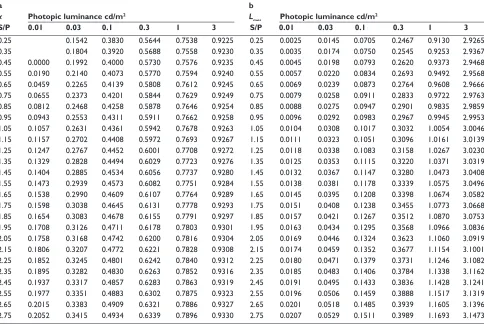
The values of x and Lmes given by the modifi ed MOVE-model as a function of photopic luminance and light source S/P-ratio are presented in Table 1.
Comparison of models
General comparison
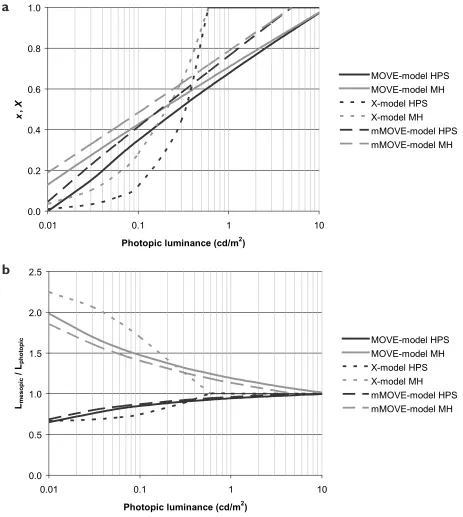
The MOVE-, modifi ed MOVE-, and X-models were compared using two broadband light sources similar to high pressure sodium (HPS) (S/P = 0.65) and daylight metal halide (MH) (S/P = 2.35) lamps. Figure 2a presents the coeffi cients x of the MOVE- and modifi ed MOVE–models and coeffi cient X of the X-model as a function of photopic luminance. Figure 2b shows the corresponding ratio of mesopic luminance (calculated using the MOVE-, modifi ed MOVE-, and X-models) to photopic luminance as a function of photopic luminance.
Both in the MOVE- and modifi ed MOVE-model the coef-fi cient x is a linear function of log photopic luminance while the uppercase X of the X-model shows a different behavior. The values of X increase gradually from 0.01 cd/m2 to 0.1 cd/m2, after which there is a steep increase in between 0.1–0.6 cd/m2. The three models differ also in the transition point between mesopic and photopic regions, which is the point where x and
X become unity. In the X-model this point is 0.6 cd/m.2 The modifi ed MOVE-model and the MOVE-model give mesopic
values for photopic luminances up to about 5 and 10 cd/m2, respectively.
Due to the different approach in defi ning the coeffi cients
x and X as a function of photopic luminance and lamp spectra (S/P-ratio), the three models result in different correspond-ing mesopic luminances. However, the differences between the MOVE- and the modifi ed MOVE-models are small while the X-model differs considerably from the two other models. These differences are largest for MH lamp at the low luminance levels.
Comparison with three independent
experimental data sets
The MOVE-, modifi ed MOVE-, and X-models were com-pared using three independent visual performance data sets measured in different European universities. The data sets were the detection threshold data of L-LAB, University of Paderborn, Germany (Raphael and Leibenger 2007), detection threshold data of Virtual Environments and Imaging Technologies Laboratory, University of Pannonia UP, Hungary (Vas and Bodrogi 2007), and the reaction time data of Lighting Laboratory, Helsinki University of Technology HUT, Finland (Orreveteläinen 2005). The experimental setups and measurement parameters of the three data sets are presented in Table 2.
Spectral sensitivity is usually investigated by determin-ing the target radiance required to achieve a specifi c level of performance (eg, detection threshold or fi xed reaction time) at any specifi c background conditions. In detection threshold experiment, the intensity of the target is increased or decreased until the target becomes visible or invisible. At the threshold, the photopic luminance or radiance of the target is recorded. In a fi xed reaction time experiment, the intensity of the target is adjusted to elicit a fi xed reaction time. The intensity of the target, both in detection threshold and reaction time experiments, can be described by the contrast against its background. In the mesopic region, where all the three visual performance experiments were conducted, the mesopic contrast can be calculated with any given candidate mesopic model. The mesopic contrast Cmes is defi ned as
C =L L
L
mes
mes, t mes, bg mes, bg
−
where Lmes, t is the mesopic luminance of the target and Lmes, bg
is the mesopic luminance of the background.
If we assume, that for specifi c background conditions and target eccentricity, the mesopic contrast required to reach
the detection threshold or fi xed reaction time is the same for all target colors, then the spectral sensitivity function (ie, mesopic model) describes the visual performance correctly. Optimal model is such that the variation in the mesopic con-trasts is minimal. Thus, the spread of mesopic concon-trasts gives a measure of how closely a spectral sensitivity function (ie, mesopic model) describes the measured data. The smaller the spread, the better the model predicts the data. In this paper, standard deviation is used as a measure of spread.
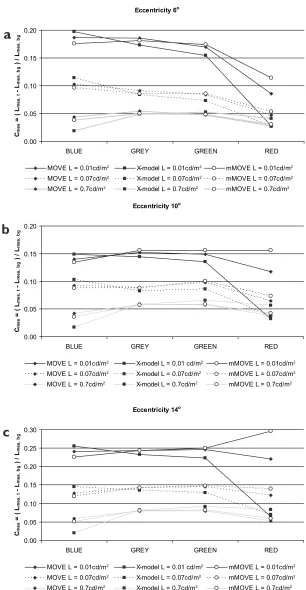
Figure 3 shows the mesopic contrast thresholds (calcu-lated using the MOVE-, modifi ed MOVE-, and X-models)
of L-LAB detection threshold data as a function of target color at three target eccentricities.
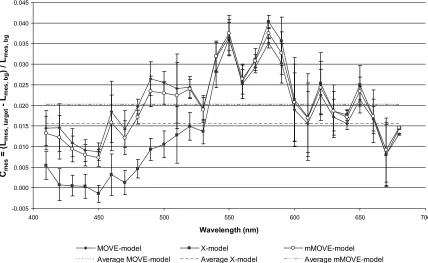
Figure 4 shows the mesopic contrast threshold of UP detec-tion threshold data as a funcdetec-tion of target peak wavelength.
Figure 5 shows the mesopic contrasts of HUT reaction time data that produce fi xed reaction times as a function of dominant wavelength of target colors.
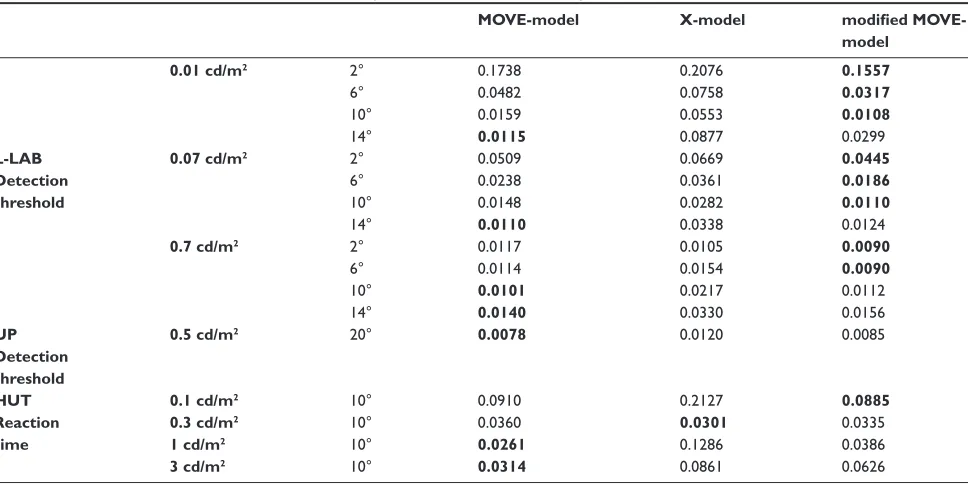
The standard deviations between the mesopic contrasts calculated using each model are presented in Table 3.
Figure 3 and Table 3 suggest that the modified MOVE-model describes the L-LAB detection threshold Table 1a) The values of x given by the modifi ed MOVE-model as a function of photopic luminance and S/P-ratio. b) The values of Lmes
given by the modifi ed MOVE-model as a function of photopic luminance and S/P-ratio
a b
x Photopic luminance cd/m2 L
mes Photopic luminance cd/m2
S/P 0.01 0.03 0.1 0.3 1 3 S/P 0.01 0.03 0.1 0.3 1 3
0.25 0.1542 0.3830 0.5644 0.7538 0.9225 0.25 0.0025 0.0145 0.0705 0.2467 0.9130 2.9265 0.35 0.1804 0.3920 0.5688 0.7558 0.9230 0.35 0.0035 0.0174 0.0750 0.2545 0.9253 2.9367 0.45 0.0000 0.1992 0.4000 0.5730 0.7576 0.9235 0.45 0.0045 0.0198 0.0793 0.2620 0.9373 2.9468 0.55 0.0190 0.2140 0.4073 0.5770 0.7594 0.9240 0.55 0.0057 0.0220 0.0834 0.2693 0.9492 2.9568 0.65 0.0459 0.2265 0.4139 0.5808 0.7612 0.9245 0.65 0.0069 0.0239 0.0873 0.2764 0.9608 2.9666 0.75 0.0655 0.2373 0.4201 0.5844 0.7629 0.9249 0.75 0.0079 0.0258 0.0911 0.2833 0.9722 2.9763 0.85 0.0812 0.2468 0.4258 0.5878 0.7646 0.9254 0.85 0.0088 0.0275 0.0947 0.2901 0.9835 2.9859 0.95 0.0943 0.2553 0.4311 0.5911 0.7662 0.9258 0.95 0.0096 0.0292 0.0983 0.2967 0.9945 2.9953 1.05 0.1057 0.2631 0.4361 0.5942 0.7678 0.9263 1.05 0.0104 0.0308 0.1017 0.3032 1.0054 3.0046 1.15 0.1157 0.2702 0.4408 0.5972 0.7693 0.9267 1.15 0.0111 0.0323 0.1051 0.3096 1.0161 3.0139 1.25 0.1247 0.2767 0.4452 0.6001 0.7708 0.9272 1.25 0.0118 0.0338 0.1083 0.3158 1.0267 3.0230 1.35 0.1329 0.2828 0.4494 0.6029 0.7723 0.9276 1.35 0.0125 0.0353 0.1115 0.3220 1.0371 3.0319 1.45 0.1404 0.2885 0.4534 0.6056 0.7737 0.9280 1.45 0.0132 0.0367 0.1147 0.3280 1.0473 3.0408 1.55 0.1473 0.2939 0.4573 0.6082 0.7751 0.9284 1.55 0.0138 0.0381 0.1178 0.3339 1.0575 3.0496 1.65 0.1538 0.2990 0.4609 0.6107 0.7764 0.9289 1.65 0.0145 0.0395 0.1208 0.3398 1.0674 3.0582 1.75 0.1598 0.3038 0.4645 0.6131 0.7778 0.9293 1.75 0.0151 0.0408 0.1238 0.3455 1.0773 3.0668 1.85 0.1654 0.3083 0.4678 0.6155 0.7791 0.9297 1.85 0.0157 0.0421 0.1267 0.3512 1.0870 3.0753 1.95 0.1708 0.3126 0.4711 0.6178 0.7803 0.9301 1.95 0.0163 0.0434 0.1295 0.3568 1.0966 3.0836 2.05 0.1758 0.3168 0.4742 0.6200 0.7816 0.9304 2.05 0.0169 0.0446 0.1324 0.3623 1.1060 3.0919 2.15 0.1806 0.3207 0.4772 0.6221 0.7828 0.9308 2.15 0.0174 0.0459 0.1352 0.3677 1.1154 3.1001 2.25 0.1852 0.3245 0.4801 0.6242 0.7840 0.9312 2.25 0.0180 0.0471 0.1379 0.3731 1.1246 3.1082 2.35 0.1895 0.3282 0.4830 0.6263 0.7852 0.9316 2.35 0.0185 0.0483 0.1406 0.3784 1.1338 3.1162 2.45 0.1937 0.3317 0.4857 0.6283 0.7863 0.9319 2.45 0.0191 0.0495 0.1433 0.3836 1.1428 3.1241 2.55 0.1977 0.3351 0.4883 0.6302 0.7875 0.9323 2.55 0.0196 0.0506 0.1459 0.3888 1.1517 3.1319 2.65 0.2015 0.3383 0.4909 0.6321 0.7886 0.9327 2.65 0.0201 0.0518 0.1485 0.3939 1.1605 3.1396 2.75 0.2052 0.3415 0.4934 0.6339 0.7896 0.9330 2.75 0.0207 0.0529 0.1511 0.3989 1.1693 3.1473
Table 2 The experimental setups and measurement parameters of the three independent visual performance datasets
L-LAB UP HUT
Method Detection threshold Detection threshold Reaction time
Background luminance 0.01, 0.07, 0.7 cd/m2 0.5 cd/m2 0.1, 0.3, 1, 3 cd/m2
Background color Uniform grey, S/P ≈ 2.8 White, S/P ≈ 2.05 White, S/P ≈ 1.86
Target eccentricity 2°, 6°, 10°, 14° 20° 10°
Target colors blue, green, grey, red from 410 to 680 nm, 10 nm steps blue, cyan, green, amber, red
Target size 0.7° 2° 0.29°
data best giving the smallest value of standard deviation at eight situations out of 12. The original MOVE-model performs best at an eccentricity of 14° at every background luminance level and at an eccentricity of 10° at the highest 0.7 cd/m2 luminance level. Figure 3 shows that the differences between the three models are largest at the blue and red target colors and smallest at
grey and green. The differences between the MOVE- and the modified MOVE-model are considerably smaller than the differences between the MOVE- and X-model and the modified MOVE- and X-model.
The UP detection threshold data presented in Figure 4 is described best by the MOVE-model. The standard deviation given by the MOVE-model is slightly smaller Figure 2a) Coeffi cients x of MOVE- and modifi ed MOVE-model, and coeffi cient X of X-model as a function of photopic luminance for HPS (S/P = 0.65) and MH (S/P = 2.35) lamps. b) The ratio of mesopic luminance (calculated using the MOVE-, modifi ed MOVE-, and X-models) to photopic luminance as a function of photopic lumi-nance for HPS (S/P = 0.65) and MH (S/P = 2.35) lamps.
a
b
0.0 0.2 0.4 0.6 0.8 1.0
0.01 0.1 1 10
Photopic luminance (cd/m2)
x
,
X
MOVE-model HPS MOVE-model MH X-model HPS X-model MH
mMOVE-model HPS mMOVE-model MH
0.0 0.5 1.0 1.5 2.0 2.5
0.01 0.1 1 10
Photopic luminance (cd/m2)
Lm
e
s
opi
c
/L
phot
opi
c MOVE-model HPS
MOVE-model MH X-model HPS X-model MH
Figure 3 Mesopic contrast thresholds of L-LAB detection threshold data (Raphael and Leibenger 2007) as a function of target color at an eccentricity of a) 6°, b) 10°, c) 14°.
Eccentricity 6o
0.00 0.05 0.10 0.15 0.20
BLUE GREY GREEN RED
C
mes
=(
L
mes,
t
-L
mes,
b
g
)/
L
mes,
b
g
MOVE L = 0.01cd/m2 X-model L = 0.01cd/m2 mMOVE L = 0.01cd/m2
MOVE L = 0.07cd/m2 X-model L = 0.07cd/m2 mMOVE L = 0.07cd/m2
MOVE L = 0.7cd/m2 X-model L = 0.7cd/m2 mMOVE L = 0.7cd/m2
Eccentricity 10o
0.00 0.05 0.10 0.15 0.20
BLUE GREY GREEN RED
C
mes
=(
L
mes,
t
-L
mes,
b
g
)/
L
mes,
b
g
MOVE L = 0.01cd/m2 X-model L = 0.01 cd/m2 mMOVE L = 0.01cd/m2
MOVE L = 0.07cd/m2 X-model L = 0.07cd/m2 mMOVE L = 0.07cd/m2
MOVE L = 0.7cd/m2 X-model L = 0.7cd/m2 mMOVE L = 0.7cd/m2
Eccentricity 14o
0.00 0.05 0.10 0.15 0.20 0.25 0.30
BLUE GREY GREEN RED
C
mes
=(
L
mes,
t
-L
mes,
b
g
)/
L
mes,
b
g
MOVE L = 0.01cd/m2 X-model L = 0.01 cd/m2 mMOVE L = 0.01cd/m2
MOVE L = 0.07cd/m2 X-model L = 0.07cd/m2 mMOVE L = 0.07cd/m2
MOVE L = 0.7cd/m2 X-model L = 0.7cd/m2 mMOVE L = 0.7cd/m2
a
b
than that given by the modified-MOVE model and evi-dently smaller than that given by the X-model, as can be seen in Table 3. The differences between the three models are largest at the blue end of the spectrum at wavelengths approximately below 540 nm while at the red end of the spectrum all the three models perform quite similarly. Again, the X-model differs considerably from the MOVE- and modified MOVE-models especially at the blue end of the spectrum.
Table 3 suggests that the HUT reaction time data is described best by the MOVE-model at the two highest luminance levels. The modifi ed MOVE-model gives the smallest value of standard deviation at the 0.1 cd/m2, and the X-model at the 0.3 cd/m2 background luminance level. The modifi ed MOVE-model, however, performs better than the MOVE-model at 0.3 cd/m2. Figure 5 shows that the differences between the three models are largest for the blue, amber, and red target colors while green target color provides very marginal differences.
Conclusions
The urgent need for a practical system of mesopic photometry has recently been acknowledged by the head organizations in the lighting field. Both CIE (Orreveteläinen et al 2007) and Illuminating Engineer-ing Society of North America (IESNA 2006) have taken
actions to reach the common objective of establishing a mesopic photometric system within the near future. Also, the lighting industry has encouraged the researchers in the lighting fi eld to prompt actions towards a new interna-tional standard on mesopic photometry. And, indeed, the adoption of mesopic photometry could result in a differ-ent classifi cation of light sources in terms of their lumi-nous output. Light sources with high output in the short wavelength region have frequently been acknowledged to be visually more effective at the mesopic light levels (Eloholma et al 2005; Ketomäki 2006; Akashi et al 2007), whereas the usage of photopic photometry at the low light levels of road and street lighting favors HPS lamps because of their high output around the peak wavelength of the photopic V(λ).
The previously proposed MOVE-model by MOVE consortium (Goodman et al 2007) and the X-model by Rea and colleagues (2004) have both met criticism concern-ing especially the upper luminance limit of the mesopic region (Eloholma and Halonen 2006; Rea and Bullough 2007). The upper luminance limit of the MOVE-model (10 cd/m2) is claimed to unnecessarily complicate practi-cal photometry and lighting specifi cations for “high” light levels, whereas the upper luminance limit proposed by the X-model (0.6 cd/m2) would make the mesopic dimensioning concern only the roads in the lower lighting classes, which,
-0.005 0.000 0.005 0.010 0.015 0.020 0.025 0.030 0.035 0.040 0.045
400 450 500 550 600 650 700
Wavelength (nm)
MOVE-model X-model mMOVE-model
Average MOVE-model Average X-model Average mMOVE-model
Cmes
= (L
mes, target
- L
mes, bg
) / L
mes, bg
a
b
Photopic background luminance L
bg= 0.1 cd/m
20 0.2 0.4 0.6 0.8
460 480 500 520 540 560 580 600 620
Dominant wavelength (nm)
MOVE-model X-model mMOVE-model
Photopic background luminance L
bg= 0.3 cd/m
20 0.1 0.2 0.3 0.4
460 480 500 520 540 560 580 600 620
Dominant wavelength (nm)
MOVE-model X-model mMOVE-model
Cme
s
=(
Lme
s
,
ta
rg
e
t
-L
me
s
,
b
g
)/
Lm
es,
b
g
Cme
s
=(
Lm
e
s,
ta
rg
et
-L
me
s
,
b
g
)/
Lm
es,
b
Figure 5 The mesopic contrasts of HUT reaction time data (Orreveteläinen 2005) that produce common reaction times as a function of dominant wavelength of target colors at background luminance level of a) 0.1 cd/m2, b) 0.3 cd/m2, c) 1 cd/m2, d) 3 cd/m2.
c
d
Photopic background luminance L
bg= 1 cd/m
20 0.1 0.2 0.3 0.4
460 480 500 520 540 560 580 600 620
Dominant wavelength (nm)
Cme
s
=(
Lme
s
,
ta
rg
e
t
-L
me
s
,
b
g
)/
Lme
s
,
b
g
MOVE-model X-model mMOVE-model
Photopic background luminance L
bg= 3 cd/m
20 0.1 0.2 0.3 0.4
460 480 500 520 540 560 580 600 620
Dominant wavelength (nm)
Cme
s
=(
Lm
es,
ta
rg
et
-L
m
es,
b
g
)/
Lm
es,
b
g
Table 3 The standard deviations between the mesopic contrasts calculated using the MOVE-, modifi ed MOVE-, and X-models
MOVE-model X-model modifi ed
model
0.01 cd/m2 2° 0.1738 0.2076 0.1557
6° 0.0482 0.0758 0.0317
10° 0.0159 0.0553 0.0108
14° 0.0115 0.0877 0.0299
L-LAB 0.07 cd/m2 2° 0.0509 0.0669 0.0445
Detection 6° 0.0238 0.0361 0.0186
threshold 10° 0.0148 0.0282 0.0110
14° 0.0110 0.0338 0.0124
0.7 cd/m2 2° 0.0117 0.0105 0.0090
6° 0.0114 0.0154 0.0090
10° 0.0101 0.0217 0.0112
14° 0.0140 0.0330 0.0156
UP 0.5 cd/m2 20° 0.0078 0.0120 0.0085
Detection threshold
HUT 0.1 cd/m2 10° 0.0910 0.2127 0.0885
Reaction 0.3 cd/m2 10° 0.0360 0.0301 0.0335
time 1 cd/m2 10° 0.0261 0.1286 0.0386
3 cd/m2 10° 0.0314 0.0861 0.0626
at least in the European countries, are very few. The present paper proposes a new modifi ed MOVE-model whose upper luminance limit is in between the limits of the previously proposed models. The selection of upper luminance limit of the modifi ed MOVE-model is based on road lighting measurements in different weather conditions. The proposed limit of 5 cd/m2 covers luminances encountered in road and street lighting conditions without unnecessarily impinging on higher luminance levels where peripheral vision is less important.
The proposed modifi ed MOVE-model was examined along with the MOVE- and X-models using three indepen-dent experimental data sets provided by different European universities. The modifi ed MOVE-model described the data best in nine situations out of 17. The MOVE-model was best in seven situations and X-model in one. The differences between the MOVE- and modifi ed MOVE-model were small while X-model differed considerably from both the MOVE- and modifi ed MOVE-models.
Based on the comparison of the visual performance-based mesopic models and on the fact that 5 cd/m2 is practical upper limit for mesopic region the authors of the present paper sug-gest the new modifi ed MOVE-model into the consideration of CIE TC 1–58 for the basis of a new practical system of mesopic photometry.
Acknowledgments
The authors gratefully acknowledge MSc Sabine Raphael from University of Paderborn, DSc Peter Bodrogi from University of Pannonia, and DSc Pasi Orreveteläinen from Helsinki University of Technology for kindly providing the experimental raw data of their visual performance experiments. The authors also acknowledge the Finnish Academy, Graduate School of Electrical and Communica-tions Engineering, Electrical Engineering (EIS) founda-tion, Finnish Cultural foundafounda-tion, Henry Ford foundation and Jenny and Antti Wihuri foundation for supporting this research work.
References
Akashi Y, Rea MS, Bullough JD. 2007. Driver decision making in response to peripheral moving targets under mesopic light levels. Lighting Res Technol, 39(1): 53–67.
American National Standards Institute/Illuminating Engineering Society of North America. 2000. ANSI/IESNA RP-8-00. American national standard practice for roadway lighting, New York: IESNA.
Castillo AF. 2007. Intelligent management of road lighting control systems using fuzzy controllers. M.Sc. thesis. Espoo: Helsinki University of Technology, Lighting Laboratory.
CEN European Committee for Standardization. 2003. European standard EN 13201-2:2003 E. Road lighting – Part 2: Performance require-ments, Brussels: CEN.
CIE Commission International de l’Éclairage. 2004. Standard CIE S 010/E:2004. Photometry – the CIE system of physical photometry, Vienna: CIE.
De Boer JB. 1967. Public lighting. Eindhoven: Philips Technical Library. Ekrias A, Eloholma M, Halonen L. 2007. Analysis of road lighting quantity
and quality in varying weather conditions. LEUKOS, 4(2):In press. Eloholma M, Halonen L. 2006. New model for mesopic photometry and its
application to road lighting. LEUKOS, 2(4):263–93.
Eloholma M, Ketomäki J, Orreveteläinen P, et al. 2005. Visual performance in night-time driving conditions. Ophthal Physiol, 25:1–10.
Eloholma M, Viikari M, Halonen L, et al. 2005. Mesopic models – from brightness matching to visual performance of night-time driving: a review. Lighting Res Technol, 37(2):155–75.
Freiding A, Eloholma M, Ketomäki J, et al. 2007. Mesopic visual effi ciency I: Detection threshold measurements. Lighting Res Technol, 39(4): In press.
Goodman T, Forbes A, Walkey H, et al. 2007. Mesopic visual effi ciency IV: A model with relevance to night-time driving and other applications. Lighting Res Technol, 39(4):In press.
He Y, Bierman A, Rea M. 1998. A system of mesopic photometry. Lighting Res Technol, 30:175–81.
He Y, Rea M, Bierman A, et al. 1997. Evaluating light source effi cacy under mesopic conditions using reaction times. J Illum Eng Soc, 26:125–38.
IESNA. 2006. Spectral effects of lighting on visual performance at mesopic light levels. Technical memorandum 12–06. New York, NY: Illuminat-ing EngineerIlluminat-ing Society of North America.
Ketomäki J. 2006. Effects of lighting parameters on contrast threshold in the mesopic and photopic luminance ranges. Ph.D dissertation. Espoo: Helsinki University of Technology, Lighting Laboratory.
Orreveteläinen P, Eloholma M, Halonen L. 2007. Mesopic spectral sensi-tivity and related CIE standardisation work. Proceedings of the 26th session of the CIE – Beijing, 1:D1-34-7. Vienna, Austria: Commission Internationale de’Éclairage.
Orreveteläinen P. 2005. Models for spectral luminous effi ciency in peripheral vision at mesopic and low photopic luminance levels. Ph.D dissertation. Espoo: Helsinki University of Technology, Lighting Laboratory. Raphael S, Leibenger M. 2007. Models of mesopic photometry applied to
the contrast threshold of peripheral and foveal objects. Proceedings of the 26th session of the CIE – Beijing, 1:D1-38-41. Vienna, Austria: Commission Internationale de’Éclairage.
Rea MS, Bullough JD. 2007. Making the move to a unifi ed system of photometry. Lighting Res Technol, 39(4):In press.
Rea MS, Bullough JD, Freyssinier-Nova JP, et al. 2004. A proposed unifi ed system of photometry. Lighting Res Technol, 36(2):85–111. Várady G, Freiding A, Eloholma M, et al. 2007. Mesopic visual effi ciency
III: Discrimination threshold measurements. Lighting Res Technol, 39(4):In press.
Vas Z, Bodrogi P. 2007. Additivity of mesopic photometry. Proc ISAL2007, TU Darmstadt, Germany [in press].
Viikari M, Chen W, Eloholma M, et al. 2006. Comparative study of two visual performance based models based on reaction time and contrast threshold data. Light Eng, 14(4):21–32.