for Homomorphic Computations
Jung Hee Cheon and Jinsu Kim
Seoul National University (SNU), Republic of Korea [email protected], [email protected]
Abstract. We introduce a hybrid homomorphic encryption by combining public key encryption (PKE) and somewhat homomorphic encryption (SHE) to reduce storage for most applications of somewhat or fully homomorphic encryption (FHE). In this model, one encrypts messages with a PKE and computes on encrypted data using a SHE or a FHE after homomorphic decryption. To obtain efficient homomorphic decryption, our hybrid schemes is constructed by combining IND-CPA PKE schemes without complicated message paddings with SHE schemes with large integer message space. Furthermore, we remark that if the underlying PKE is multiplicative on a domain closed under addition and multiplication, this scheme has an important advantage that one can evaluate a polynomial of arbitrary degree without recryption. We propose such a scheme by concatenating ElGamal and Goldwasser-Micali scheme over a ringZNfor a composite integer
N whose message space isZ×N.
To be used in practical applications, homomorphic decryption of the base PKE is too expensive. We accelerate the homomorphic evaluation of the decryption by introducing a method to reduce the degree of exponentiation circuit at the cost of additional public keys. Using same technique, we give an efficient solution to the open problem [16] partially.
As an independent interest, we obtain another generic conversion method from private key SHE to public key SHE. Differently from Rothblum [23], it is free to choose the message space of SHE.
Keywords: ElGamal, Goldwasser-Micali, Naccache-Stern, Hybrid Scheme, Multiplicative Ho-momorphic Encryption, Additive HoHo-momorphic Encryption, Fully HoHo-momorphic Encryption, Decryption Circuit, Exponentiation, Bootstrapping
1 Introduction
The concept of computation on encrypted data without decryption was firstly introduced by Rivest, Adleman and Detourzos in 1978 [22]. After thirty years, Gentry proposed a fully homomorphic encryption (FHE) based on ideal lattices [9]. This scheme is far from being practical due to its large computation costs and large ciphertexts. Since then, lots of efforts has been done to devise more efficient schemes and their successors become much more efficient [3, 11, 12]. However, most FHE schemes still have huge ciphertext size, at least millions of bits for a single ciphertext. This is a big bottleneck when it is deployed in practice.
However, its converting complexity (homomorphic decryption of a ciphertext) is generally too large when using bit-encrypting FHEs.
In this paper, we explore efficient hybrid homomorphic encryption schemes by combining a public key encryption with small ciphertext size and a somewhat homomorphic encryption (SHE) that could evaluate the decryption circuit of the PKE. For efficient construction, we consider SHE for hybrid scheme rather than FHE.
For efficient conversion, PKE scheme needs to be IND-CPA secure without complicated message padding whose evaluation requires lots of computation. Interestingly, most candidates are additive or multiplicative homomorphic. When using these schemes as the underlying PKEs, we obtain an additional advantage in computations on encrypted data. When using additive homomorphic encryptions (AHE), it has an advantage that it can evaluate any linear function without converting to a SHE. We consider the Goldwasser-Micali scheme for encrypting a bit and the Naccache-Stern scheme for encrypting small messages. We remark that the leveled DGHV scheme gives more efficient evaluation of their decrypt circuit.
When using multiplicative homomorphic encryptions (MHE), it has a very interesting property that one can compute SHE(f(m1, . . . , mk)) from PKE.Enc(m1), . . . , PKE.Enc(mk) without (expensive) bootstrapping for any multivariate polynomial f(x1, . . . , xk) with poly-nomially many terms, since each monomial of f(x1, . . . , xk) could be computed under the PKE. One problem of this approach is that the domain of a MHE is usually not closed under an addition operation. For example, the (IND-CPA) ElGamal encryption over a ringR could take as messages only elements in a prime order subgroup, which covers only small part of
R except a binary fields. However, the discrete logarithm problem in an extension field with small characteristic is not a hard problem any more [14, 2]. Thus we construct a multiplica-tive homomorphic encryption whose message space isZ×N for a RSA modulus N =p1p2. The
proposed scheme is obtained by combining an ElGamal over Z×N and the Goldwasser-Micali encryption over ZN and is secure under the decisional Diffie-Hellman assumption and the quadratic residuosity assumption for commonN =pq.
One concern of this approach is the converting complexity. All the decryption circuits of PKE we considered is composed of an exponentiation by a secret exponent e. Gentry and Halevi [10] showed that its homomorphic evaluation is done by evaluating a polynomial of degree loge. This degree is generally very large up to several thousands in our situation. To obtain efficient converting algorithm, we represent an integer as a binary vector ofwlogwe length and reduce the degree to logwe at the cost of ˜O(w) additional public keys for an arbitrary positive integerw.
Also we resolve the open problem of [16] partially that evaluate modqmodp homomor-phically. We convert the double modulo reduction into depth-3 circuit and then apply the technique of [10]. Our improved technique plays important role especially in this method, since the selection of parameters heavily depends on the homomorphic capacity of FHE differently from leveled FHE.
As an independent interest, our approach gives a generic conversion from private key SHE to public key SHE. In [23], Rothblum shows the way how to transform any homomorphic private key encryption scheme whose message space is Z2 into a public key homomorphic
Zp for large primep. We only add encryptions of secret key of a PKE under the private SHE to the public key instead of {SHE.Enci(0)}i and {SHE.Enci(1)}i as in [23].
2 Preliminaries
In this section, we introduce some definitions and base problems needed to prove security.
Notation For m, n ∈ N, [m, n] and [m, n) denote the sets {m, m + 1, . . . , n −1, n} and
{m, m+1, . . . , n−2, n−1}, respectively. Denote the element inZ∩(−n2,n2] which is equivalent toa modulo n by amodn or [a]n. We denote the unique integer in (−
Q ipi 2 ,
Q ipi
2 ] which is
congruent tomi modulo pi for all ibyCRT(p1,...,pk)(m1, . . . , mk).
2.1 Base Problems
Definition 1 (Decisional Diffie-Hellman problem over G). Let G be a group with a generator g of order q. For given a tuple (g, ga, gb, gc), the decisional Diffie-Hellman (DDH) problem overG is to decide whethergab=gc or not.
Definition 2 (Quadratic Residuosity problem overZN).Given an odd composite inte-gerN and a∈JN where JN :={a∈Z∗N| Na
= 1}, the quadratic residuosity problem (QR) overZN is to decide whether ais quadratic residue modulo N or not.
We say that the DDH assumption overGq holds if no polynomial time distinguisher can solve the DDH problem with non-negligible advantage. The QR assumption over ZN is defined similarly.
2.2 Homomorphic Encryption Schemes
Definition 3 (ElGamal Encryption over a Ring).LetRbe a ring andGqa multiplicative cyclic subgroup of prime orderq in R. The ElGamal encryption scheme ElG= (ElG.KeyGen, ElG.Enc,ElG.Dec) consists of the following algorithms:
ElG.KG(λ) : Take as input a security parameter λ. Choose a generator g of Gq and a random e ∈ [0, q), and compute y =ge. Output a public key pkElG = (R,Gq, g, y) and a secret key skElG =e.
ElG.Enc(pkElG, m) :Take as input the public key pkElG and a plaintext m∈Gq. Choose a randomr ∈[0, q) and compute g−r andm·yr. Output c= (g−r, m·yr).
ElG.Dec(skElG, c) : Take as input the secret key skElG and a ciphertext c = (v, u) ∈ R2. Output m=veu.
Definition 4 (Goldwasser-Micali Encryption).TheGoldwasser-Micali encryption scheme GM= (GM.KeyGen,GM.Enc,GM.Dec) consists of the following algorithms:
GM.KG(λ) : Choose random primes p, q and compute N = pq. Compute quadratic non residue x moduloN satisfying
x p
=
x q
GM.Enc(pkGM, m) : For a plaintextm∈ {0,1}, choose y∈[0, N) such that gcd(y, N) = 1. Output a ciphertext c=y2xmmodN.
GM.Dec(skGM, c) : For a ciphertext c∈ZN, if
c p
= 1 and qc= 1 output 0. Otherwise output 1.
Definition 5 (Naccache-Stern Encryption).TheNaccache-Stern encryption schemeNS= (NS.KeyGen, NS.Enc,NS.Dec) consists of the following algorithms:
NS.KG(λ) : Choose random small primes p1, . . . , pk and compute u = Qk/i=12pi and v =
Qk
i=k/2+1pi and set σ = uv. Choose large primes a and b such that p = 2au+ 1 and
q = 2bv + 1 are prime and set N = pq. Choose a random gmodN of order φ(n)/4. Output a public keypkNS= (σ, N, g) and a secret key skNS = (p, q)
NS.Enc(pkNS, m) : For a plaintext m ∈ Z/σZ, choose x ∈ ZN and output a ciphertext
c=xσgm modN.
NS.Dec(skNS, c) :For a ciphertext c∈ZN, computecφ(N)/pi and obtain mi by comparing it with gjφ(N)/pi for allj = 1, . . . , p
i−1. Output m=CRT(p1,...,pk)(m1, . . . , mk).
3 Encrypt with PKE and Compute with SHE
In this section, we give a concept of hybrid scheme by combining a PKE and a SHE. A message is encrypted under the PKE and it is converted to a ciphertext under the SHE when it needs homomorphic computations on the message. The ciphertext is decrypted under SHE.
3.1 A Hybrid Scheme of a PKE and a SHE
Suppose that a client who has limited computation capability wants to computef(m1, . . . , mk) for sensitive messages {m1, . . . , mk} and a multivariate polynomial f. The client could out-source the heavy computation to a server which has large computing power. Until now, fully homomorphic encryptions are good solutions for the delegation of computations [5] ignoring bandwidth of the client and storage of the server. However these are most significant measures in construction of cloud environment since they are directly connected the cost in real.
One can reduce bandwidth and storage by combining a PKE with small ciphertext size and a SHE that could evaluate the decryption circuit of the PKE not its own decryption circuit. We propose a hybrid scheme to improve an efficiency of SHE when one use it in cloud computing environment. Let PKE = (PKE.KG,PKE.Enc, PKE.Dec) be a public key encryp-tion with depth-d decryption circuit and SHE = (SHE.KG, SHE.Enc,SHE.Dec,SHE.Eval) be a somewhat homomorphic encryption. Suppose that there exists a multivariate polynomial
fDec such that f(sk1, . . . , skn, c) = m for all c = PKE.Enc(m) where (sk1, . . . , skn) is the expanded secret key of skPKE. The Hybrid scheme of PKEand SHE consists of the following five algorithms Hyb= (Hyb.KG,Hyb.Enc,Hyb.Conv,Hyb.Eval,Hyb.Dec) :
Hyb.KG(λ,PKE.KG,SHE.KG) : RunPKE.KGandSHE.KGto get (pkPKE, skPKE, pkSHE, skSHE). Output
pkHyb= (pkPKE, pkSHE, SskPKE, fDec)
whereSskPKE is an expanded secret key set and SskPKE =
SHE.Enc(a) :a∈SskPKE .
Hyb.Enc(pkHyb, m) : For a plaintextm∈MpkPKE, output c=PKE.Enc(pkPKE, m).
Hyb.Conv(pkHyb, c) : Evaluate the decryption circuit PKE.Dec with SskPKE. That is,
com-pute and output a ciphertextC
C=fDec(SskPKE,SHE.Enc(c)).
Hyb.Eval(pkHyb, f, c1, . . . , ct) : For given circuit f and t ciphertexts c1, . . . , ct under SHE, output SHE.Eval(pkSHE, f, c1, . . . , ct).
Hyb.Dec(skHyb, c) : For a ciphertext c∈CpkSHE, outputm=SHE.Dec(skSHE, c).
Remark 1. InHyb.Conv algorithm, we remark that
C =fDec(SHE.Enc(SskPKE),SHE.Enc(c)) =SHE.Enc(fDec(SskPKE, c)) =SHE.Enc(m),
since SHE could evaluate the decryption circuit of PKE fDec.
Remark 2. In a hybrid scheme, the homomorphic capacity of the SHE at least exceeds the degree of the decryption circuit fDec of the PKE.
Theorem 1 (Semantic Security of Hybrid Scheme). If both the public key encryption and the somewhat homomorphic encryption are semantically secure, then so is the hybrid scheme.
The security follows by the standard hybrid argument similar to Theorem 4.2.3 in [8]. We omit the details.
Let M,C be message space and ciphertext space of the PKE, respectively, andM be a message space of the SHE. If M,CandMare in the same category and there exist efficient computable homomorphisms φ:M→ Mk and ψ:C→ Mk for some positive integer k, one could construct more efficient hybrid scheme. In this paper, therefore, we only focus on the case that M, C and Msatisfy the above conditions.
Remark 3. Although the elliptic curve ElGamal cryptosystem [18] has small ciphertext, we do not consider in this paper since it is hard to evaluate the inverse map of message encoding and the addition of points on the elliptic curve.
3.2 Additive Homomorphic Encryptions for the PKE in Hybrid Scheme
Goldwasser-Micali Encryption We remark that the decryption circuit of Goldwasser-Micali encryption is: for a given ciphertext c ∈ZN, output 1 if
c p
= 1 andcq= 1 and output 0 otherwise. We could modify the decryption circuit by
m=CRT(p,q)(c(p−1)/2, c(q−1)/2).
Using homomorphic evaluation of secret exponentiation and the Chinese remaindering algo-rithm, one could evaluate the decryption circuit of Goldwasser-Micali encryption. Sincepand
q are secret, encryptions of q(q−1modp) and p(p−1modq) must be added to the public key of the hybrid scheme. In this case, the message space of GM encryption isZ2and the message
space of the SHE is Z2N. The degree of the decryption circuit is about 2 logp (≈λ2) using Gentry and Halevi’s technique [10].
Naccache-Stern Encryption The decryption of Naccache-Stern encryption is to compute
cφ(N)/pi and getm
i by comparing it withgjφ(N)/pi for all j= 1, . . . , pi−1. The messagem is recovered by computingm=CRT(p1,...,pk)(m1, . . . , mk). To compute mi homomorphically, at
first one needs to compute a polynomialfi(x) of degreepi−1 such that fi(gmφ(n)/pi) =mfor all m ∈ Zpi using the Lagrange interpolation. And then compute CRT(p1,...,pk)(m1, . . . , mk) homomorphically. In Naccache-Stern encryption, the message space isZM whereM =Qki=1pi and the message space of the SHE isZQwhereQ=M N. The degree of the decryption circuit is about logφ(n) + maxi{pi−1}.
3.3 Multiplicative Homomorphic Encryptions for the PKE in Hybrid Scheme
We may consider ElGamal encryption [7] as a candidate for a multiplicative PKE in con-structing a hybrid scheme. An ordinary ElGamal encryption over a ring R has a message space Gq ⊂R of prime order q. In other words, elements not in the prime subgroup cannot be encrypted under ElGamal encryption securely. Although one can take all nonzero element in R as a message only when R = F2n for n such that 2n−1 is prime, one could not use
the ElGamal encryption over F2n for a PKE, since a DLP in an extension field with small
characteristic is not a hard problem any more [14, 2]. Unlike the extension field case, it is impossible to construct an ElGamal encryption whose message space is a full domain over a integer ring.
We propose a new multiplicative homomorphic encryption whose message space is Z×N, which covers almost all nonzero elements ofZN. Our scheme is a combination of the ElGamal scheme over ZN and the Goldwasser-Micali encryption scheme over ZN [13] for common
N =p1p2, and the ciphertext consists of three elements inZ×N. We call this scheme by EGM encryption.
Let N =p1p2 with p1 = 2q1+ 1 and p2 = 4q2+ 1 for distinct primes p1, p2, q1, q2. Then
the order of Z×N is φ(N) = 8q1q2 and the Jacobi symbol of -1 is
−1
N
= −p1
1 −1
p2
= −1.
Take an elementσ ∈Z×N with
σ p1
=
σ p2
=−1. We use a bijective mapι,
ι:Z×N →JN× {0,1}, m7→( ˆm,mˇ) =
m
m
N
,
1−m N
/2
,
where JN := {a∈ Z∗N| Na
EGM.KG(λ) : Choose a generator g of JN with order φ(N)/2 in Z×N and a random e ∈ [0,4q1q2), and compute y ≡ gemodN. Output a public key pkEGM = (N, g, y, σ) and a secret keyskEGM= (e, p2).
EGM.Enc(pkEGM, m) : For a plaintext m ∈ Z×N, compute ι(m) = ( ˆm,mˇ) and choose a random r ∈ [0, N2)1 and a random h ∈ ZN. Output a ciphertext c = (c1, c2, c3) =
(g−r,myˆ r, σmˇh2).
EGM.Dec(skEGM, c) : Take as input the secret keyskEGM and a ciphertextc= (c1, c2, c3)∈
(Z×N)3. Compute and output a message m≡ce1c2·CRT(p1,p2)(c
q1
3 , c 2q2
3 ) modN.
The EGM encryption is multiplicative homomorphic over Z×N, which covers almost all nonzero element ofZN. We remark thatCRT(p1,p2)(c
q1
3 , c 2q2
3 ) = 1 if ˇmis even, andCRT(p1,p2)(c
q1
3 , c 2q2
3 ) = −1 otherwise. From this, the EGM encryption is correct for unlimited number of
multipli-cations on encrypted data. Also the EGM encryption is semantically secure under the DDH assumption overJN and the QR assumption over ZN for commonN =p1p2.
Theorem 2 (Multiplicative Homomorphic). For any positive integer k, suppose that
ci=EGM.Enc(pkEGM, mi) for all i∈[1, k]. Then
EGM.Dec(skEGM, k
Y
i=1 ci) =
k
Y
i=1 mi,
where a multiplication of two ciphertexts is defined by componentwise. That is, EGM encryp-tion is multiplicative homomorphic.
Proof. Suppose thatci := (ci1, ci2, ci3) = (gri,mˆiyri, σmˇih2i) fori∈[1, k]. Then
C= (C1, C2, C3) :=
k
Y
i=1
ci = (g
Pk i=1ri,
k
Y
i=1
ˆ
miy
Pk
i=1ri, σPki=1mˇi
k
Y
i=1 h2i)
We remark that if Pk
i=1mˇi is even, T(C3) = 1 and Qik=1(mNi) = 1. Unless,T(C3) = −1 and
Qk
i=1(mNi) =−1. Thus we obtain
C1eC2T(C3) =
Yk
i=1
ˆ
mi
·T(C3) =
Yk
i=1 mi
mi
N ·T(C3) =
k
Y
i=1
mi (modp2).
u t
Theorem 3 (Semantic Security).TheEGMscheme is semantically secure under the DDH assumption over JN and the QR assumption overZN.
Sketch of Proof.We use a hybrid argument to prove semantic security. We define a sequence of games.
Game0: this is the original attack scenario. That is, we simulate the challenger by running
EGM.KeyGento obtain a public key pk0= (N, g, y, σ) and a secret keysk0= (e, p2).
1
The statistical distance betweenD1andD2is at most 1/N, whereD1:={chooser←[0, N2) : outputrmod
φ(N)}andD2:={chooser←[0, φ(N)) : output r}. In fact, one can chooseN1+for some >0 instead of
Game1: this game is the same as Game0, except for the following modification to the key
generation. Instead of choosing σ∈Z×N with (pσ
1) = (
σ
p2) =−1, we choose it as σ
0 =r2 for a
randomly chosen r from ZN. That is, pk1= (N, g, y, σ0).
Game2: this game is the same as Game1, except for the following modification to the
en-cryption of mb. Instead of encrypting a mb as c = (g−r,mˆbyr, σ0mˇbh2), we compute c = (g−r, u, σ0mˇbh2) for randomly chosen r ∈ [0, N2), h ∈
ZN and u ∈ JN and send c to the attacker as a challenge ciphertext.
Since the challenge ciphertext c in Game2 is independent from message mb, Pr[S2] is 1/2,
whereSi is the event that the attacker succeeds in Gamei. Thus the advantage of the attacker in Game0 is negligible under the DDH assumption over JN and the QR assumption over
ZN. ut
Encryption of Zero Since the EGM scheme has the message space Z×N, one can encrypt neither the zero nor a multiple of p1 or p2 in ZN. Since the probability that an encryptor chooses the multiples ofp1 orp2 is negligible, we only care for the message zero.
By borrowing the idea in [24], we could modify the scheme by appendingλGM encryptions of encoding defined by 07→r∈R{0,1}λ and 17→0λ ∈ {0,1}λ for 2λ security. The ciphertext of the modified EGM scheme is of the form (g−r,myˆ r, h2σmˇ,GM.Enc(r1), . . . ,GM.Enc(rλ)) where (r1, . . . , rλ) = (0, . . . ,0) for a nonzero message m ∈ Z×N and a random λ-bit element for the zero element. Note that ˆm and ˇm can be taken arbitrary from Z×N when m= 0. The random (r1, . . . , rλ) in appended ciphertext is preserved under multiplications with 1−2−λ probability. The decryption algorithm is similar to the original EGM by using a polynomial
f(r1, . . . , rλ) = (−1)
λ
λ!
Qλ
i=1(r1+· · ·+rλ−i).
EGM Encryption The decryption circuit of EGM encryption consists of three secret ex-ponentiations, two multiplications and one Chinese remaindering algorithm. Similar to the GM encryption, one could evaluate the decryption circuit of degree loge+ logp1 (≈λ2). The
message space of EGM isZ×N and ciphertext space is (Z×N)3. One needs to choose the message space of SHE asZN in construction of hybrid scheme.
4 Homomorphic Evaluation of Exponentiation
To enhance a performance of the hybrid scheme, one needs to evaluate a modular exponenti-ation by a secret exponent efficiently that is related to the decryption circuit of GM, NS and EGM encryptions. Actually, this problem is dealt with by Gentry and Halevi [10] when evalu-ating the depth-3 decryption circuit of the formΣΠΣ. Their idea is to express the secret key
eof the ElGamal encryption as a binary representation and then convert the exponentiation into a multivariate polynomial. In their approach, the decryption circuit of the ElGamal is represented by 4λ degree polynomial which is large to evaluate efficiently whereλis the se-curity parameter. We give an improved algorithm to evaluate an exponentiation with a small degree multivariate polynomial.
4.1 Improved Exponentiation using Vector Decomposition
representatione=P
iei2i with ei ∈ {0,1} and computeve as follows:
ve=vPiei2i =Y
i
vei2i.
They use the Lagrange interpolation in computing vei2i, that is vei2i = eiv2
i
+ (1−ei)v0. The degree of their exponentiation circuit is about 2 loge (≈ 4λ) which is large where λ
is the security parameter. Reducing the degree of exponentiation by secret exponent is a meaningful approach since the degree is directly related to selection in parameters of a FHE. One may consider a w-ary representation of the secret e with w > 2 to reduce a degree of the exponentiation circuits. When one uses w-ary representation, there are logwe terms of individual veiwi which is smaller than log
2e. However it requires degree (w−1) polynomial
to express each veiwi for e
i ∈[0, w−1] when using the Lagrange interpolation. Indeed this increases the degree of exponentiation by efrom 2 logetowlogwe.
We use a vector representation ofei to reduce the degree ofveiw
i
instead of the Lagrange interpolation. At first, we expand the secret e in a w-ary representation,e=Pblogwec
`=0 e`w
`. Then ve can be written in the form ve =vPn`=0e`w` =Qn
`=0ve`w `
,where e` ∈[0, w−1] and
n=blogwec. We define a map π
π:W −→Zw
a7−→fa+1
where W = [0, w −1] and {f1, . . . ,fw} is the standard basis in Zw. We denote π(ei) = (ei0, . . . , ei(w−1))∈ Zw where eik ∈ {0,1} for all i ∈[0, n] and k∈ [0, w−1]. We also define a vector vi := (1, vw
i
, v2wi,· · ·, v(w−1)wi) ∈ Gwq. Then one can easily verify that veiw
i
=
hvi, π(ei)i, whereh·,·iis the ordinary inner product inZw. To operate this procedure publicly, we add encryptions of e`k for all `∈ [0, n], k ∈[0, w−1] under the SHE to the public key. In fact, we can omit an encryption of ei0, since ei0 is equal to 1−Pwk=1−1eik which can be computed homomorphically.
Eval.Exp.Setup(pkSHE, e, w): Take as input a public keypkSHEofSHE, a secret exponenteand expansion parameterw.
1. Expand e = Pn
i=0eiwi and compute π(ei) = (ei0, . . . , ei(w−1)) for all i ∈ [0, n] where n=blogwec.
2. Output ¯Ee:=
n
SHE.Enc(eik) :i∈[0, n], k∈[0, w−1]
o
.
Eval.Exp(pkSHE,E¯e, w, v): Take as input the public key pkFHE of FHE, the set ¯Ee output by Eval.Exp.Setup and v.
1. Encryptvkwi for all i∈[0, n], k∈[0, w−1] under the SHE.
2. Outputc:=Qn
i=0
Pw−1
k=0 SHE.Enc(eik)·SHE.Enc vkw
i
.
The proof of Theorem 4 is straightforward. It is verified that the degree of exponentiation is about 2 logwewhich is logwtimes smaller than the original method. Using our method, one can evaluate the exponentiation by a large secret exponent homomorphically with a small degree polynomial at the cost of ˜O(w) additional public keys for an arbitrary integer w.
4.2 Improve the Bootstrapping without Squashing
Gentry and Halevi [10] proposed a new method to construct FHE without squashing, called chimeric FHE. The chimeric FHE uses a multiplicative homomorphic encryption (MHE) to bootstrap a SHE without squashing, thereby they remove the assumption on the hardness of the sparse subset sum problem. The Gentry and Halevi’s technique in [10] is to express the decryption of a SHE scheme as a depth-3 (P Q P
) arithmetic circuit. They temporarily switch to a ciphertext under a MHE, such as ElGamal, to computeQ
part. And then they homomorphically evaluate the decryption circuit of MHE to get a ciphertext under SHE. Using their method, SHE only needs to evaluate MHE’s decryption circuit of fixed degree 2 loge, not its own decryption circuit. Using our efficient evaluation of exponentiation given in Section 4.1, we can reduce the degree from 2 loge to 2 logwe. Moreover, we point out that one can handle more general class of SHE whose decryption circuit is a composition of restricted depth-3 circuit P Q P
and several low depth circuits. This will be given in Appendix C. By applying our technique, we show that any SHE with decryption circuit of [·]q modp type is bootstrappable if it could evaluate degree 2 logwecircuits.
Evaluate Double Modulo Reduction The bottleneck of bootstrapping is to compute [·]q modp homomorphically. We call [·]q modp as adouble modulo reduction circuit. In gen-eral, when the plaintext isZ2, the bootstrapping is done by using bit operations on binary
representations of integers. However it is not easy to bootstrap a ciphertext when the mes-sage space isZpwithp >2. We propose a method to evaluate [·]q modphomomorphically for largepusing Gentry and Halevi’s idea [10]. As a application, we give a bootstrapping method of [4] when a message is large enough. Since one could not use modulus switching technique to handle errors of ciphertexts in batch fully homomorphic encryption [4], the selection of parameters of the FHE heavily depends on the homomorphic capacity of the scheme. Thus our improved technique plays important role in bootstrapping ciphertexts.
We assume thatq is equivalent to 1 modulop. Then [c]q modpcan be written in the form as DGHV [27],
[c]q modp=c− bc/qe ·q modp=c− bc/qemodp.
In comparison with DGHV scheme, it is hard to express the division by p by a low degree polynomial overZp when p is larger than two. To apply the technique in [10], we first modify the division part using the Gentry’s squashing technique [9]. Let us consider parametersκ, Θ, θ
such that κ =γη/ρ0logp, Θ =ω(κ·logλ) andθ =λ where γ is a bit length of c,η is a bit length ofq which is larger than ρ0 = 2λ.
dlogp8eprecision afterp-ary point fori= 1, . . . , Θ. That is, [c·yi] =zi−∆i for some∆i with
|∆i| ≤1/16θ. We have
"
(c/q)−
Θ
X
i=1 sizi
#
p =
"
(c/q)−
Θ
X
i=1
si[c·yi]p+ Θ
X
i=1 si∆i
#
p
=
"
(c/q)−chXsi·yi
i
p+ Θ
X
i=1 si∆i
#
p
=
"
(c/q)−c[(1/q)−∆q]p+ Θ
X
i=1 si∆i
#
p
=
"
c·∆q+ Θ
X
i=1 si∆i
#
p
.
Since the bit length of c is at most 2γ < pκ−4, thus c·∆q ≤ 1/16. Also we observe that
|P
si∆i| ≤θ·1/16θ= 1/16. Thus we have
[c]q modp=c− bc/qemodp=c−
jX
sizi
m
modp. (1)
To apply chimeric technique [10], we convert the above subset sum into a P Q P
form, defined in Appendix D. The equation (1) can be converted as follows:
[c]qmodp≡c− bc/qcmodp
≡c−
$
c·
Θ
X
i=1 sizi
'
modp
≡c−
Θ
X
i=1 sizi0
| {z }
simple part −
$
p−n
Θ
X
i=1 siz00i
'
| {z }
complicated part
modp,
wherezi =zi0 +zi00·Q−κ with positive integers zi0, zi00. As well as the simple part, the “com-plicated part” can be also expressed as aLA-restricted depth-3 circuit C, when we choose p
such thatp >2Θ2 by the Lemmas in Appendix D. Thus we obtain the following Theorem:
Theorem 5. Let q, p be primes such that q > p > 2Θ2 and q ≡ 1 modp. For any A ⊂ Zp
of cardinality at least 2Θ2 + 1, the double modulo reduction [·]q modp can be expressed as
LA-restricted depth-3 circuitC of LA-degree at most 2Θ2 having at most2Θ2+Θ+ 1 product gates. Thus one can evaluate the double modulo reduction circuit using chimeric technique.
greater than 2. We can solve this problem partially with the above technique and so com-plete the bootstrapping stage for large enoughQi’s. It gives a fully homomorphic encryption dealing with large integers. Note that ifQi’s are relatively prime, we can map a plaintext on ZM withM =QiQi intoQiZQi and so it enables large integer arithmetics on ZM. In this
bootstrapping procedure, our improved technique in evaluation of exponentiation plays im-portant role, since the parameters of the FHE heavily depends on the homomorphic capacity of the scheme. Using our method, the homomorphic capacity can be reduced from 2 logeto 2 logwe at the cost of public key size ˜O(w).
5 Discussions
We give typical applications of fully homomorphic encryption in database and cloud comput-ing environment and analyze advantages of our hybrid scheme under some scenarios.
5.1 Application Model
Database Encryption Let us consider the situation that a government agency collects medical records of patients from the hospital and extracts some statistical information from the records. When lots of data are stored in a storage, it becomes more serious problem to protect data from insider’s misuse or outsider’s hacking. To reduce the risk, one may store data after encryption. We are to give a storage efficient solution using a hybrid scheme under this scenario.
At first, the agency generates (pkHyb, skHyb) of hybrid scheme and storesskHyb in secure area and makes public onlypkPKEto hospitals andpkHyb to a database. Each hospital uploads its medical records after encrypted under the pkPKE in the database. The agency requests for some computations on patients data to extract information to the databased. Then the database performs homomorphic computation on encrypted data usingpkHyb. After evaluation of requested computations, the resulting ciphertexts are sent to the agency. The decryption is carried out in secure area of the agency.
Outsourcing of Computations in Cloud Environment Suppose that a client who has small computing power wants to compute heavy computation on private data. He can use a hybrid scheme to protect his privacy, that is, he outsources computations of PKE-encrypted data along withpkHyb to a cloud that has huge computing power and storage. The cloud only performs the outsourced computations and returns the results ciphertext encrypted under SHE. Although the fact that the client must sendpkHyb with large size seems as a weakness of our hybrid scheme, it doesn’t matter since pkHyb is sent to the cloud only once in the procedure of outsourcing.
Remark 4. Since the client may not trust the cloud, it is desirable to have the cloud prove that the computation on encrypted data was done correctly. In [5], they give a solution to prove the correctness when using FHE only. It needs more study on this problem when one uses the hybrid scheme in delegation of computations.
5.2 Advantages
Small Bandwidth In cloud environment, each client encrypts their messages with small computing power and storage and a server manages encrypted data with large computing power and storage. However, the current FHE’s may not be suitable to this environment, because it has a large ciphertext size which causes large communication cost. In the above scenario, each hospital and the client can encrypt data using efficient PKE scheme instead of using an inefficient FHE. And then they send ciphertexts with only few thousands of bits to the database and the cloud. It could reduce the bandwidth of clients dramatically.
Storage Save After receiving the ciphertext from each clients, the server stores ciphertexts which contain secret information of clients. The server can save the storage by storing only small PKE ciphertexts rather than large FHE ciphertexts. The server convert them to SHE ciphertexts and compute some operations only when it is required.
Efficient Computing In our hybrid scheme, one could choose a PKE among additive ho-momorphic and multiplicative hoho-momorphic depending on the property of a circuit we are to evaluate. Suppose that the server is to evaluate a multivariate polynomialf and g where
f has polynomially many monomials on inputs and g has polynomially many linear factors. We will use multiplicative homomorphic encryption as PKE in the first case, and additive homomorphic encryption as PKE for the second case.
At first, let us consider f(x1, . . . , xn) = Pi∈IMi(x1, . . . , xn) be an n-variable polyno-mial over a ring R, where each Mi is a monomial of f. If the degree of f is large, sev-eral decryption or modulus switching procedures are required when using ordinary FHEs, which are slow or increase the ciphertext size. However, using our hybrid scheme, one may evaluatef without a bootstrapping regardless of the degree f. Suppose the ciphertexts are encrypted under a multiplicative encryptionE with the key (pk, sk) and the SHE can eval-uate the decryption circuit D(sk,·) of Epk. Given c1 = Epk(m1), . . . , cn = Epk(mn), we can computeSHE.Enc(f(m1, . . . , mn)) withSHE.Enc(sk). Below, we denoteSHE.Enc bySHE and SHE.Dec(a) =SHE.Dec(b) bya≡b.
SHE(f(m1, . . . , mn))≡
X
i
SHE(Mi(m1, . . . , mn)) (∵SHE is add. homo.)
=X
i
SHE{D(sk,Epk(Mi(m1, . . . , mn)))} (∵ D◦Eis an identity)
=X
i
SHE{D(sk, Mi(Epk(m1), . . . ,Epk(mn)))} (∵ Eis mult. homo.)
≡X
i ¯
D(SHE(sk),SHE(Mi(Epk(m1), . . . ,Epk(mn)))),
where ¯D is the decryption circuit encrypted with SHE and the last equality is because SHE can evaluateDwithSHE(sk). More concretely, we follow the steps:
1. Given c1 =Epk(m1),· · · , cn =Epk(mn), compute Mi(c1,· · ·, cn) =Epk(Mi(m1,· · ·, mn)) for each i.
3. Add them to obtain SHE(f(m1, . . . , mn))
Now let us consider that the server is to compute a polynomialg(x1, . . . , xn) =
Q
i∈ILi(x1, . . . , xn) where eachLi is a linear multivariate factor ofg. Suppose that the ciphertexts are encrypted
under an additive homomorphic encryptionE. In this case, we follow the steps:
1. Given c1 = Epk(m1),· · · , cn = Epk(mn), compute Li(c1,· · · , cn) = Epk(Li(m1,· · ·, mn)) for each i.
2. Encrypt Epk(Li(m1,· · · , mn)) with SHE and then evaluate the decryption circuit ¯Dwith the encrypted secret key SHE(sk) of Epk. (Observe: one may use trivial encryption on Epk(Li))
3. Multiply them to obtain SHE(f(m1, . . . , mn))
Remark 5. As you see, one could compute on ciphertexts under a SHE not a PKE after conversion of ciphertexts. Therefore one makes more good use of the hybrid scheme when evaluating fixed multivariate polynomials.
5.3 Generic Conversion of SHE from Private-Key to Public-Key
In [23] , Rothblum shows the way how to transform any additively homomorphic private-key encryption scheme into a public-key homomorphic encryption scheme when the message isZ2.
To apply this method, the private-key SHE needs to be compact which means that the length of a homomorphically generated encryption is independent of the number of ciphertexts from which it was created. An additive homomorphic encryption is converted from private-key to public key by adding a number of encryptions of zero and one to the public key.
One could consider our hybrid scheme as a generic conversion of SHE from private-key to public key whose message space is Zp for large prime p. We only add encryptions of secret key of a PKE under the private SHE to the public key instead of {SHE.Enci(0)}i and
{SHE.Enci(1)}i. And the encryption algorithm of “public-key” SHE is made up of Hyb.Enc andHyb.Conv. Given a hybrid schemeHyb= (Hyb.KG,Hyb.Enc,Hyb.Conv,Hyb.Dec,Hyb.Eval) of aPKEand private key SHE schemePrivSHE, we could construct a public key SHEPubSHE as follows:
PubSHE.KG(λ) : RunPKE.KGto obtainpkPKEandskPKE. Output a public keypkPubSHE= (pkHyb) and a secret keyskPubSHE= (skHyb).
PubSHE.Enc(pkPubSHE, m) : For a plaintext m ∈ Zp, encrypt m under Hyb.Enc and then output a ciphertextC←Hyb.Conv(pkPubSHE, c) wherec←Hyb.Enc(m).
PubSHE.Dec(skPubSHE, C) : For a ciphertextC, output a messagem←Hyb.Dec(skPubSHE, C).
The semantic security of this conversion follows that of hybrid scheme.
6 Implementation of Hybrid Scheme
6.1 Implementation Model
We consider a scenario that a client delegates of computations on encrypted data. The client encrypts a message under EGM given in Section 3.3 and sends the ciphertext with FHE evaluation key. We use symmetric version of [6], since there is no difference between symmetric version and public version in this scenario.
Hybrid Scheme of EGM and leveled-DGHV The hybrid scheme of the EGM over ZN and the leveled-DGHV [6] with is as follows:
Hyb.KG(λ,EGM.KG,FHE.KG) : Take as input security parameterλ,EGM.KGandFHE.KG algorithms. Run EGM.KG and FHE.KG to get (N, g, y, σ, κ, e, p1 = 2q1 + 1, p2 = 4q2 +
1, pkFHE, skFHE) where JN = hgi and y = ge with e ∈ [0,22λ). Let k0 = blogwec and
k1 = blogwq1c. Define a vector vi := (1, vw
i
, v2wi,· · · , v(w−1)wi). Define a multivariate polynomialfDec as
fDec(x0, . . . , xk0, y0, . . . , yk1, z0, . . . , zk1, u, v, t) :=
k0
Y
i=0
hvi, π(xi)i ·v· α1
k1
Y
i=0
hti, π(yi)i+α2
k1
Y
i=0
hti, π(zi)i
!
whereα1=p2·(p2−1modp1) andα2 =p1·(p−11 modp2). OutputpkHyb = (N, g, y,S¯1,S¯2, fDec, FHE.Enc(α1),FHE.Enc(α2)) andskHyb= (skFHE), where
¯
S0=
FHE.Enc(eij)
e=
k0
X
i=0
eiwi, π(ei) = (eij)wj=0−1 ,
¯
S1=
FHE.Enc(q1,ij)
q1 =
k1
X
i=0
q1,iwi, π(q1,i) = (q1,ij)wj=0−1 ,
¯
S2=
FHE.Enc(q2,ij)
2q2 =
k1
X
i=0
q2,iwi, π(q2,i) = (q2,ij)wj=0−1 ,
Hyb.Enc(pkHyb, m) : Take as input the public keypkHyb and a plaintext m∈Z×N. Output EGM.Enc(m).
Hyb.Conv(pkHyb, c) : Take as input the public key pkHyb and a ciphertextsc= (c1, c2, c3)
underEGM encryption. Compute and output
C=fDec(FHE.Enc(e1,00), . . . ,FHE.Enc(q1,00), . . . ,FHE.Enc(q2,00), . . . ,FHE.Enc(q2,k1w−1), c1, c2, c3).
Hyb.Dec(skHyb, C) : Take as input the secret keyskHyb and a ciphertextC. Compute and output a messageM =FHE.Dec(skFHE, C).
Remark 6. The degree of decryption circuit fDec is 2(k0+k1) ≈ O(λ2) for the security
pa-rameterλ.
6.2 Results
Asymptotic Key Size Let N = p1p2 be the modulus of EGM scheme, ρ and κ be the
lattice attacks on approximate gcd problem [26, 27] to choose η and γ. In our construction, the message space of the EGM and leveled-DGHV isZN and the set of secret key for leveled-DGHV is{P1, . . . , PL} wherePi is i-th modulus with size (i+ 1)µ bits for eachi= 1, . . . , L. To remain the ciphertext noise as the same, one should chooseµsuch thatµ≥2ρ+κ+40. We give concrete analysis in Appendix B. We choose the parameters asymptotically as follows:
ρ=O(λ), κ=O(λ2), µ=O(λ2), ηL=L·O(λ2) andγ =ω(µ2logλ) =ω(λ4logλ).
Optimization Let dbe a degree of the decryption circuit of EGM. If one use Gentry and Halevi’s technique [10], dbecomes 2κ+ 2 loge. We could reduce this to (2κ+ 2 loge)/logw
when usingw-ary expansion of secret exponent. Thus the depthL of leveled DGHV scheme become smaller as the parameterw increase. Also, we use W-bit decomposition and powers instead ofBitDecompand Powersof2as in [6] to reduce running time ofSwitchKeyby a factor of W at the cost of increasing the noise byW bits. We take w= 128 and W =µ/2 in our implementations.
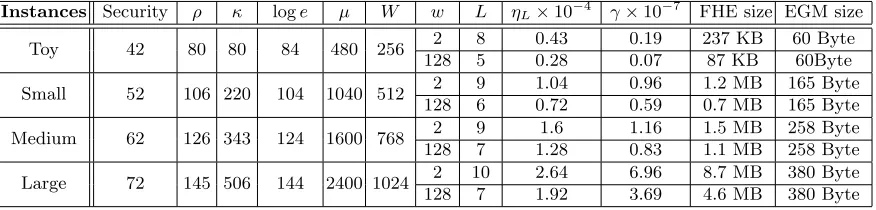
Storage Save As in Table 1, we can use EGM ciphertexts instead of FHE ciphertexts, which results in aboutfour thousands times storage save.
Instances Security ρ κ loge µ W w L ηL×10−4 γ×10−7 FHE size EGM size
Toy 42 80 80 84 480 256 2 8 0.43 0.19 237 KB 60 Byte
128 5 0.28 0.07 87 KB 60Byte
Small 52 106 220 104 1040 512 2 9 1.04 0.96 1.2 MB 165 Byte 128 6 0.72 0.59 0.7 MB 165 Byte Medium 62 126 343 124 1600 768 2 9 1.6 1.16 1.5 MB 258 Byte 128 7 1.28 0.83 1.1 MB 258 Byte Large 72 145 506 144 2400 1024 2 10 2.64 6.96 8.7 MB 380 Byte 128 7 1.92 3.69 4.6 MB 380 Byte
Table 1.The parameter setting of the hybrid scheme.
Timing Results We test the timing of the hybrid scheme on a PC with Intel core i7-2600 3.4GHz and 192GB memory and use the NTL library [25] with the GMP library [1]. Table 2 shows that it takes about 52 minutes 11 seconds in FHE.KGand about 1 minute 25 seconds inHyb.Convalgorithm under “Medium” parameter setting withw= 128. We verify that our efficient homomorphic evaluation of exponentiation technique gives about eight times faster than that of the original method [10].
7 Conclusion
Instances w FHE.KG EGM.KG Hyb.KG Hyb.Conv
Toy 2 1 min 40 s 0.09 s 2.02 s 16.61 s 128 15.2 s 0.06 s 14.3 s 1.38 s Small 2 28 min 13 s 1.28 s 32.2 s 4 min 38 s 128 7 min 3 s 0.03 s 5 min 15 s 31.7 s Medium 2 1 h 36 min 2.43 s 1 min 4 s 8 min 15 s 128 52 min 11 s 2.1 s 13 min 16 s 1 min 25 s Table 2.Timing results of the hybrid scheme.
References
1. GMP: The gnu multiple precision arithmetic library. http://gmplib.org, 2013.
2. R. Barbulescu, P. Gaudry, A. Joux, and E. Thom´e. A quasi-polynomial algorithm for discrete logarithm in finite fields of small characteristic. IACR Cryptology ePrint Archive, 2013. http://eprint.iacr.org/ 2013/400.
3. Z. Brakerski, C. Gentry, and V. Vaikuntanathan. (Leveled) Fully homomorphic encryption without boot-strapping. In S. Goldwasser, editor, Innovations in Theoretical Computer Science 2012, pages 309–325. ACM, 2012.
4. J. Cheon, J.-S. Coron, J. Kim, M. Lee, T. Lepoint, M. Tibouchi, and A. Yun. Batch fully homomor-phic encryption over the integers. In T. Johansson and P. Nguyen, editors, Advances in Cryptology -EUROCRYPT 2013, volume 7881 ofLecture Notes in Computer Science, pages 315–335. Springer Berlin Heidelberg, 2013.
5. K.-M. Chung, Y. Kalai, and S. Vadhan. Improved delegation of computation using fully homomorphic encryption. In T. Rabin, editor,Advances in Cryptology CRYPTO 2010, volume 6223 ofLecture Notes in Computer Science, pages 483–501. Springer Berlin Heidelberg, 2010.
6. J.-S. Coron, D. Naccache, and M. Tibouchi. Public key compression and modulus switching for fully homomorphic encryption over the integers. InAdvances in Cryptology - EUROCRYPT 2012, volume 7237 ofLecture Notes in Computer Science, pages 446–464. Springer Berlin Heidelberg, 2012.
7. T. E. Gamal. A public key cryptosystem and a signature scheme based on discrete logarithms. In G. R. Blakley and D. Chaum, editors,Advances in Cryptology - CRYPTO 1984, volume 196 ofLecture Notes in Computer Science, pages 10–18. Springer, 1984.
8. C. Gentry. A fully homomorphic encryption scheme. In PhD thesis. Stanford University, 2009. crypto.stanford.edu/craig.
9. C. Gentry. Fully homomorphic encryption using ideal lattices. In M. Mitzenmacher, editor,Proceedings of the 41st Annual ACM Symposium on Theory of Computing - STOC 2009, pages 169–178. ACM, 2009. 10. C. Gentry and S. Halevi. Fully homomorphic encryption without squashing using depth-3 arithmetic circuits. In R. Ostrovsky, editor,IEEE 52nd Annual Symposium on Foundations of Computer Science -FOCS 2011, pages 107–109. IEEE, 2011.
11. C. Gentry, S. Halevi, and N. P. Smart. Fully homomorphic encryption with polylog overhead. In D. Pointcheval and T. Johansson, editors, Advances in Cryptology - EUROCRYPT 2012, volume 7237 ofLecture Notes in Computer Science, pages 465–482. Springer, 2012.
12. C. Gentry, S. Halevi, and N. P. Smart. Homomorphic evaluation of the AES circuit. In R. Safavi-Naini and R. Canetti, editors,Advances in Cryptology - CRYPTO 2012, volume 7417 ofLecture Notes in Computer Science, pages 850–867. Springer, 2012.
13. S. Goldwasser and S. Micali. Probabilistic encryption. J. Comput. Syst. Sci., 28(2):270–299, 1984. 14. A. Joux. A new index calculus algorithm with complexity L(1/4+o(1)) in very small characteristic.IACR
Cryptology ePrint Archive, 2013.
15. M. Joye and B. Libert. Efficient cryptosystems from 2k-th power residue symbols. InAdvances in Cryp-tology, EUROCRYPT 2013.
16. J. Kim, M. S. Lee, A. Yun, and J. H. Cheon. CRT-based fully homomorphic encryption over the integers. Cryptology ePrint Archive, Report 2013/057, 2013. The merged paper appears in Eurocrypt 2013 [4]. 17. A. K. Lenstra. Key length, 2004.
19. M. Naehrig, K. Lauter, and V. Vaikuntanathan. Can homomorphic encryption be practical? In C. Cachin and T. Ristenpart, editors, Proceedings of the 3rd ACM Cloud Computing Security Workshop - CCSW 2011, pages 113–124. ACM, 2011.
20. T. Okamoto and S. Uchiyama. A new public-key cryptosystem as secure as factoring. In K. Nyberg, editor,
Advances in Cryptology - EUROCRYPT 1998, volume 1403 ofLecture Notes in Computer Science, pages 308–318. Springer, 1998.
21. P. Paillier. Public-key cryptosystems based on composite degree residuosity classes. In J. Stern, editor,
Advances in Cryptology - EUROCRYPT 1999, volume 1592 ofLecture Notes in Computer Science, pages 223–238. Springer, 1999.
22. R. Rivest, L. Adleman, and M. Dertouzos. On data banks and privacy homomorphism. Foundations of Secure Computation, pages 168–177, 1978.
23. R. Rothblum. Homomorphic encryption: From private-key to public-key. In Y. Ishai, editor,TCC, volume 6597 of Lecture Notes in Computer Science, pages 219–234. Springer, 2011.
24. T. Sander, A. L. Young, and M. Yung. Non-interactive cryptocomputing for NC1. In 40th Annual Symposium on Foundations of Computer Science, FOCS ’99, 17-18 October, 1999, New York, NY, USA, pages 554–567, 1999.
25. V. Shoup. NTL: A library for doing number theory ver. 6.0.0. http: // www. shoup. net/ ntl/, 2013. 26. J. H. Silverman, editor.Cryptography and Lattices, International Conference, CaLC 2001, Providence, RI,
USA, March 29-30, 2001, Revised Papers, volume 2146 ofLecture Notes in Computer Science. Springer, 2001.
27. M. van Dijk, C. Gentry, S. Halevi, and V. Vaikuntanathan. Fully homomorphic encryption over the integers. In H. Gilbert, editor, Advances in Cryptology - EUROCRYPT 2010, volume 6110 of Lecture Notes in Computer Science, pages 24–43. Springer, 2010.
A Proofs
Proof of Theorem 3.Under the attacker scenario, the attacker first receives a public key of the encryption scheme, and outputs a message m0, m1 ∈ ZN. The challenger returns an encryption of mb for a randomly chosen bit b. Finally, the attacker outputs a guess b0 and succeeds ifb=b0. We use hybrid argument to prove semantic security. We use a sequence of games and denoteSi the event that the attacker succeeds in Gamei.
Game0: this is the original attack scenario. That is, we simulate the challenger by running
EGM.KeyGento obtain a public keypk0 = (N, g, y, σ) and a secret keysk0 = (e, φ(N), σ1, σ2).
Game1: this game is the same as Game0, except for the following modification to the key
generation. Instead of choosing σ∈Z∗N with (pσ1) = (pσ2) =−1, we choose it as σ0 =r2 for a randomly chosen r from ZN. That is, pk1= (N, g, y, σ0).
It is clear that any significant difference between Pr[S0] and Pr[S1] leads immediately to
an effective statistical test for solving the QR problem over ZN. Thus we obtain
|Pr[S0]−Pr[S1]| ≤AdvQR,
whereAdvQRdenotes the advantage in solving QR problem over ZN.
Game2: this game is the same as Game1, except for the following modification to the
en-cryption of mb. Instead of encrypting a mb as c = (g−r,mˆbyr, σ0mˇbh2), we compute c = (g−r, u, σ0mˇbh2) for randomly chosen r ∈ [0, N2), h ∈
ZN and u ∈ JN and send c to the attacker as a challenge ciphertext.
It is also clear that any significant difference between Pr[S1] and Pr[S2] leads immediately
to an effective statistical test for solving the DDH problem overJN. Thus
whereAdvDDH denotes the advantage in solving DDH problem overJN.
Since the challenge ciphertext c in Game2 is independent from message mb, Pr[S2] is 1/2.
Thus we obtain that
Pr[S0]−
1 2
=|Pr[S0]−Pr[S2]|
≤ |Pr[S0]−Pr[S1]|+|Pr[S1]−Pr[S2]| ≤AdvQR+AdvDDH.
Thus the advantage of the attacker in Game0 is negligible under DDH assumption over JN
and QR assumption overZN. ut
B Leveled DGHV Scheme with Large Message Space
In [6], they firstly propose the leveled fully homomorphic encryption over the integers. One could not use the modulus switching technique of BGV scheme [3] directly to DGHV scheme sincepandp0 must remain secret. For given ciphertext c=pq+r, they use virtual ciphertext of the formc0 = 2k·q0+r0 with [q0]2= [q]2 to switch secret modulus.
In hybrid scheme with the EGM scheme and the leveled DGHV scheme, the message space of the FHE isZN for RSA modulusN. In this section, we modify the Lemmas in [6] to deal with the leveled DGHV scheme whose message space isZQ.
Lemma 1 (Lemma 4 in [6]). Let p be an odd integer. Let c = pq+r be a ciphertext of DGHV. Letk, κbe an integer such that|c|<2κ. Let ybe a vector of Θ numbers withκ bits of precision after the binary point, andsbe a vector ofΘ bits such thatQk/p=hs,yimodQk+1
with||<2−κ. Let c = (bc·yiemodQk+1)1≤i≤Θ and c0 =hs,ci. Then c0 =Qk·q0 +r0 with [q0]Q= [q]Q and r0 =br·Qk/pc+δ where δ≤2 +Θ/2.
Lemma 2 (Lemma 5 in [6]). Let p and p0 be odd integers such thatp ≡p0 modQ. Let k
be integer such thatp0 < Qk and c=pq+r be a ciphertext. Let y be a vector of Θ numbers withκ bits precision after the binary point, and lets be a vector of Θ bits such thatQk/p=
hs,yi+modQk+1where ||<2−κ. Let σ=p0q+r+bs0·pQk+1e. Letc= (bc·yie)1≤i≤Θ and c0 =BitDecomp(c,k)be the expanded ciphertext. Letc00=Qhσ,c0i+ [c]Q. Thenc00=p0q00+r00 where r00=br·p0/pc+δ0 for some δ with|δ| ≤Q·2ρ+1·Θ·(k+ 1)
Now we give the modulus switching algorithm for DGHV with message spaceZQ.
SwitchKeyGen(pk, sk, pk0sk0) :
1. Take as input two DGHV secret keyspandp0 of sizeηand η0 respectively. Letκ= 2γ+η
whereγ is the size of the public key integers xi underp. Let η00=bη0/logQc.
2. Generate a vector yof Θ random moduloQη00+1 withκ bits of precision after the binary point, and a random vector s of Θ bits such that Qη00/p =hs,yi+modQη00+1 where
||<2−κ. Generate the expanded secret keys0 =Powersof2(s, η00)
3. Compute a vector encryptionσ of s0 under sk0, defined as follows:
σ=p0·q+r+
s· p
0
Qη00+1
where q ← (Z∩[0, q0))(η
00+1)Θ
and r ← (Z∩(−2ρ 0
,2ρ0))(η00+1)Θ, where q00 is from x00 =
p0q00+r0 inpk0.
4. Outputτpk→pk0 = (y,σ)
SwitchKey(τpk→pk0, c) :
1. Let (y,σ)←τpk→pk0
2. Compute the expanded ciphertextc= (bc·yiemodQη 00+1
)1≤i≤Θand letc0 =BitDecomp(c, η00). 3. Outputc00=Qhσ,c0i+ [c]Q.
C Improved Bootstrapping without Squashing
Suppose that s := (s1, . . . , sn) ∈ {0,1}n is a secret key of the SHE and c := (c1, . . . , cn) ∈
{0,1}n is a ciphertext of plaintext m ∈
Zp under the SHE. Suppose that the decryption of SHEconsists of one or several following functions:
f(c) =T
n+1
X
j=1 λj
n
Y
i=1
(aj+si·ci)
, (3)
where theaj’s and λj’s are the publicly known constants in Zp and T is a circuit of degree
d. Actually, aj’s are chosen such that aj and aj + 1 are quadratic residues modulo p and
λj is chosen depending on aj’s. We allow that T is a composition of several P and Q, and so may have exponentially many terms when represented as a sum of monomials. Now we describe recrypting a ciphertext c =SHE.Enc(m) using our new technique. The public key of FHEcontains encryptions of the secret key of SHE under ElGamal and encryptions of the secret key ofElGamal under SHE additionally. FHE.Recryptlow.Setup and FHE.Recryptlow are as follows:
FHE.Recryptlow.Setup(pkSHE, skSHE, pkElG, skElG,{λj},{aj}, w): Take as input the public key and secret key pair ofSHE andElGwith publicly known constant {λj} and {aj}.
1. Encrypt aj +si and aj for all i∈ [1, n] and j ∈[1, n+ 1] where s := (s1, . . . , sn) is the secret key of the SHE.
2. Expand eas aw-ary representation,e=Pblogwec
`=0 e`w` withe` ∈[0, w−1].
3. Encrypte`k for`∈[0,blogwec] and k∈[0, w−1], whereπ(e`) = (e`0, . . . , e`(w−1)).
4. Output
E1:=
ElG.Enc(aj+si)
i∈[1, n] and j∈[1, n+ 1] ∪
ElG.Enc(aj)
j∈[1, n+ 1]
E2:=
SHE.Enc(e`k)
`∈[0,blogwec] andk∈[0, w−1] .
FHE.Recryptlow(pkSHE, E1, E2, w, c): Take as input the public key ofSHE, the setE1,E2output
byFHE.Recryptlow.Setup and a ciphertextc= (c1, . . . , cn) to recrypt.
1. Given ciphertextc:= (c1, . . . , cn), ifci= 1, choosebji :=ElG.Enc(aj+si), otherwise choose
2. Let bj = (yj, hj). Compute SHE.Enc((yw
`
j )k) and SHE.Enc(hj) for all j ∈ [1, n+ 1], ` ∈ [0,blogwec] and k∈[0, w−1].
3. Compute Aj := SHE.Enc(hj)·Q
blogwec
`=0
Pw−1
k=0 SHE.Enc(e`k)·SHE.Enc((yw
`
j )k)
for all
j∈[1, n+ 1].
4. Encrypt the publicly known constantλj under SHE, and define dj :=SHE.Enc(λj) for all
j∈[1, n+ 1].
5. OutputB :=T(Pn+1
j=1 djAj).
In the step 4 and 5,
Aj =SHE.Enc
hj·
blogwec
Y
`=0
( w−1
X
k=0
e`k·ye`2
`
j )
=SHE.Enchj ·yej
=SHE.Enc n
Y
i=1
(aj+si·ci)
,
sinceye`w` =Pw−1
k=0 e`k·(yw
`
)k fore` ∈[0, w−1] and
B =T
nX+1
j=1
SHE.Enc
λj n
Y
i=1
(aj +si·ci)
=SHE.Enc
T
nX+1
j=1 λj
n
Y
i=1
(aj +si·ci)
.
Thus B = SHE.Enc(m) which is a refreshed ciphertext of m by the equation (3). We ob-serve thatB is not a completely refreshed ciphertext, since computing B involves evaluating (2blogwec+ 3) +ddegree polynomials in ciphertexts.
In the originalFHE.Recryptalgorithm in [10], the SHE needs to support evaluating poly-nomials of degree 2blogec+ 2 (≈4λ). To ensure this, one must increase the parameters of the SHEscheme until it can handle them. We give the alternative approach to solve this problem. Thew-ary representation instead of binary representation reduces the parameter required to enable the bootstrapping. TheSHE only needs to support degree 2blogwec+ 2 polynomial in our variant which is smaller than 2blogec+ 2. Our contribution is the reduction in the degree of polynomial required to bootstrap. It prevents the parameter rise which causes inefficiency overall scheme.
D Definitions and Lemmas
Definition 6. Let L={Lj(x1, . . . , xn)} be a set of polynomials, all in the same n variables. An arithmetic circuitC is anL-restricted depth-3 circuit over x:= (x1, . . . , xn)if there exists multi setsS1, . . . , St⊂ Land constants λ0, λ1, . . . , λt such that
C(x) =λ0+
t
X
i=1 λi·
Y
Lj∈Si
Lj(x1, . . . , xn).
The degree ofC with respect toL is d= maxi|Si|.
Lemma 3 ([10]). Let Q be a prime with Q > 2Θ2. Regarding the “complicated part” of the decryption circuit, there is an univariate polynomial f(x) of degree ≤ 2Θ2 such that
f(PΘ i=1siz
00
i) =bQ
−nPΘ i=1siz
00
Lemma 4 ([10]). Let T, Θ be positive integers, and f(x) a univariate polynomial over ZQ (for Q prime, Q≥ T Θ+ 1). Then there is a multilinear symmetric polynomial Mf on T Θ variables such that
f( Θ
X
i=1
sizi00) =Mf(s1, . . . , s1
| {z }
z001
,0, . . . ,0
| {z }
T−z100
, . . . , sΘ, . . . , sτ
| {z }
z00Θ
, . . . ,0, . . . ,0
| {z }
T−z00Θ
), (4)
for alls= (s1, . . . , sΘ)∈ {0,1}Θ and z100, . . . , zΘ00 ∈[0, T], .
Lemma 5 ([10]). Let Q ≥ Θ + 1 be a prime, let A ⊂ ZQ have cardinality Θ + 1, let x = (x1, . . . , xΘ) be variables, denote LA = {(a+xi : a ∈ A,1 ≤ i ≤ Θ}. For every multilinear symmetric polynomial M(x) over ZQ, there is a circuit C(x) such that:
• C is aLA-restricted depth-3 circuit over ZQ such that C(x)≡M(x) modQ.
• C has Θ+ 1 product gates of LA-degree Θ, one gate for each value aj ∈A, with the j-th gate computing the value λjQi(aj+xi) for some constant λj.
• A description of C can be computed efficiently given the values M(x) at all x= 1i0Θ−i
Sketch of Proof. Since M(x) is multilinear (degree 1 with respect to each xi) and sym-metric, M(x) = Pτ
i=0`iei(x), where ei is i-th elementary symmetric polynomial. Consider
f(x) =Qτ
i=1(x+xi) =eτ(x) +eτ−1(x)x+· · ·+eo(x)xτ. Thus
f(α0)
.. .
f(ατ)
=
1α0· · · ατ0
..
. . .. ... 1ατ· · · αττ
eτ(x) .. .
e0(x)
ThusM(x) can be written in the form,
M(x) =
`τ · · · `0
eτ(x) .. .
e0(x)
=
`τ · · · `0
1α0· · · ατ0
..
. . .. ... 1ατ· · · αττ
−1
f(α0)
.. .
f(ατ)
=
λ0· · · λτ
f(α0)
.. .
f(ατ)
.
We can write M(x) =Pτ