Adaptively Secure Puncturable Pseudorandom Functions in the
Standard Model
Susan Hohenberger∗ Johns Hopkins University
Venkata Koppula University of Texas at Austin
Brent Waters†
University of Texas at Austin [email protected]
November 26, 2015
Abstract
We study the adaptive security of constrained PRFs in the standard model. We initiate our exploration with puncturable PRFs. A puncturable PRF family is a special class of constrained PRFs, where the constrained key is associated with an elementx0in the input domain. The key allows evaluation at all pointsx6=x0.
We show how to build puncturable PRFs with adaptive security proofs in the standard model that involve only polynomial loss to the underlying assumptions. Prior work had either super-polynomial loss or applied the random oracle heuristic. Our construction uses indistin-guishability obfuscation and DDH-hard algebraic groups of composite order.
More generally, one can consider at-puncturable PRF: PRFs that can be punctured at any set of inputs S, provided the size ofS is less than a fixed polynomial. We additionally show how to transform any (single) puncturable PRF family to a t-puncturable PRF family, using indistinguishability obfuscation.
∗
Supported by the National Science Foundation (NSF) CNS-1154035 and CNS-1228443; the Defense Advanced Research Projects Agency (DARPA) and the Air Force Research Laboratory (AFRL) under contract FA8750-11-C-0080, the Office of Naval Research under contract N00014-14-1-0333, and a Microsoft Faculty Fellowship.
†
1
Introduction
Pseudorandom functions (PRFs) are one of the fundamental building blocks in modern cryptogra-phy. A PRF system consists of a keyed function F and a set of keys K such that for a randomly chosen key k ∈ K, the output of the function F(k, x) for any input x in the input space “looks” random to a computationally bounded adversary, even when given polynomially many evaluations ofF(k,·). Recently, the concept of constrained pseudorandom functions1 was proposed in the con-current works of Boneh and Waters [4], Boyle, Goldwasser and Ivan [6] and Kiayias, Papadopoulos, Triandopoulos and Zacharias [21]. A constrained PRF system is associated with a family of boolean functions F ={f}. As in standard PRFs, there exists a set of master keys K that can be used to evaluate the PRFF. However, given a master keyk, it is also possible to derive aconstrained key
kf associated with a functionf ∈ F. This constrained keykf can be used to evaluate the function F(k,·) at all inputsxsuch thatf(x) = 1. Intuitively, we would want that even if an adversary has
kf, the PRF evaluation at an input x not accepted by f looks random. Security is captured by
an adaptive game between a PRF challenger and an adversary. The adversary is allowed to make multiple constrained key or point evaluation queries before committing to a challengex∗ not equal to any of the evaluation queries or accepted by any of the functions for which he obtained a con-strained key.2 The challenger either sends the PRF evaluation atx∗ or an output chosen uniformly
at random from the PRF range space, and the adversary wins if he can distinguish between these two cases.
Since their inception, constrained PRFs have found multiple applications. For example, Boneh and Waters [4] gave applications of broadcast encryption with optimal ciphertext length, identity-based key exchange, and policy-identity-based key distribution. Sahai and Waters [24] used constrained PRFs as a central ingredient in their punctured programming methodology for building cryptosys-tems using indistinguishable obfuscation. Boneh and Zhandry [5] likewise applied constrained PRFs for realizing multi-party key exchange and broadcast systems.
Adaptive Security in Constrained PRFs In their initial work, Boneh and Waters [4] showed constructions of constrained PRFs for different function families, including one for the class of all polynomial circuits (based on multilinear maps). However, all their constructions offer selective security - a weaker notion where the adversary must commit to the challenge input x∗ before
making any evaluation/constrained key queries.3 Using complexity leveraging, one can obtain adaptive security by guessing the challenge input x∗ before any queries are made. However, this results in exponential security loss. The works of [6, 21] similarly dealt with selective security.
Recently, Fuchsbauer, Konstantinov, Pietrzak and Rao [11] showed adaptive security for prefix-fixing constrained PRFs, but with quasi-polynomial security loss. Also recently, Hofheinz [16] presented a novel construction that achieves adaptive security forbit-fixing constrained PRFs, but in therandom oracle model.
While selective security has been sufficient for some applications of constrained PRFs, including many recent proofs leveraging the punctured programming [24] methodology (e.g., [24, 19, 5, 2]), there are applications that demand adaptive security, where the security game allows the adversary to query the PRF on many inputs before deciding on the point to puncture. For instance, [5] give
1These were alternatively calledfunctional PRFs [6] anddelegatable PRFs [21]. 2
This definition can be extended to handle multiple challenge points. See Section 3 for details.
a construction for multiparty key exchange that is semi-statically secure, and this construction requires adaptively secure constrained PRFs for circuits. We anticipate that the further realization of adaptively secure PRFs will introduce further applications of them.
Our Objective and Results Our goal is to study adaptive security of constrained PRFs in the standard model. We initiate this exploration with puncturable PRFs, first explicitly introduced in [24] as a specialization of constrained PRFs. A puncturable PRF family is a special class of constrained PRFs, where the constrained key is associated with an element x0 in the input domain. The key allows evaluation at all points x 6= x0. As noted by [4, 6, 21], the GGM tree-based construction of PRFs from one-way functions (OWFs) [14] can be modified to construct a puncturable PRF.4A selective proof of security follows via a hybrid argument, where the reduction algorithm uses the pre-determined challenge queryx∗ to “plant” its OWF challenge. However, such a technique does not seem powerful enough to obtain adaptive security with only a polynomial-factor security loss. The difficulty in proving adaptive security arises due to the fact that the reduction algorithm must respond to the evaluation queries, and then output a punctured key that is consistent with the evaluations. This means that the reduction algorithm must be able to evaluate the PRF at a large set S (so that all evaluation queries lie in S with non-negligible probability). However, S cannot be very large, otherwise the challenge x∗ will lie in S, in which case the reduction algorithm cannot use the adversary’s output.
In this work, we show new techniques for constructing adaptively-secure puncturable PRFs in the standard model. A central contribution is to overcome the conflict above, by allowing the reduction algorithm to commit to the evaluation queries, and at the same time, ensuring that the PRF output at the challenge point is unencumbered by the commitment.
Our main idea is to execute a delayed commitment to part of the PRF by partitioning. Initially, in our construction all points are tied to a single (Naor-Reingold [23] style) PRF. To prove security we begin by using the admissible hash function of Boneh and Boyen [3]. We partition the inputs into two distinct sets. The evaluable set which contains about (1−1/q) fraction of inputs, and a
challenge set which contains about 1/qfraction of inputs, whereqis the number of point evaluation queries made by the attacker. Via a set of hybrid steps using the computational assumptions of indistinguishability obfuscation and subgroup hiding we modify the construction such that we use one Naor-Reingold PRF function to evaluate points in the evaluable set and a completely independent Naor-Reingold PRF to evaluate points in the challenge set.
After this separation has been achieved, there is a clearer path for our proof of security. At this point the reduction algorithm will create one PRF itself and use it to answer any attacker point query in the evaluable set. If it is asked for a point x in the challenge set, it will simply abort. (The admissible hash function ensures that we get through without abort with some non-negligible probability.) Eventually, the attacker will ask for a punctured key on x∗, which defines x∗ as the challenge input. Up until this point the reduction algorithm has made no commitments on what the second challenge PRF is. It then constructs the punctured key using the a freshly chosen PRF for the challenge inputs. However, when constructing this second PRF it now knows what the challengex∗ actually is and can fall back on selective techniques for completing the proof.
At a lower level our core PRF will be the Naor-Reingold PRF [23], but based in composite-order groups. Let G be a group of order N = pq, where p and q are primes. The master key consists of a group element v ∈ G and 2n exponents di,b ∈ ZN (for i = 1 to n and b ∈ {0,1}).
4
The PRF F takes as input a key k = (v,{di,b}), an `-bit input x, uses a public admissible hash
functionh:{0,1}`→ {0,1}n to computeh(x) =b
1. . . bnand outputs v Qn
j=1dj,bj. A punctured key
corresponding to x0 derived from master key k is the obfuscation of a program P which has k, x0
hardwired and outputsF(k, x) on inputx6=x0, else it outputs⊥.
We will use a parameterized problem (in composite groups) to perform some of the separation step. Our assumption is that giveng, ga, . . . , gan−1 for randomly choseng∈
Ganda∈Z∗N it is hard
to distinguishgan from a random group element. While it is somewhat undesirable to base security on a parameterized assumption, we are able to use the recent results of Chase and Meiklejohn [8] to reduce this to the subgroup decision problem in DDH hard composite order groups.
t-puncturable PRFs We also show how to construct t-puncturable PRFs: PRFs that can be punctured at any set of inputsS, provided|S| ≤t(wheret(·) is a fixed polynomial). We show how to transform any (single) puncturable PRF family to a t-puncturable PRF family, using indistin-guishability obfuscation. In the security game fort-puncturable PRFs, the adversary is allowed to query for multiple t-punctured keys, each corresponding to a set S of size at most t. Finally, the adversary sends a challenge input x∗ that lies in all the sets queried, and receives either the PRF evaluation at x∗ or a uniformly random element of the range space.
In the construction, the setup and evaluation algorithm for thet-puncturable PRF are the same as those for the puncturable PRF. In order to puncture a keykat setS, the puncturing algorithm outputs the obfuscation of a program P that takes as input x, checks that x /∈ S, and outputs
F(k, x).
For the proof of security, we observe that when the first t-punctured key query S1 is made by
the adversary, the challenger can guess the challenge ˜x ∈ S1. If this guess is incorrect, then the
challenger simply aborts (which results in a 1/tfactor security loss). However, if the guess is correct, then the challenger can now use the punctured key K˜x for all future evaluation/t-punctured key
queries. From the security of puncturable PRFs, it follows that even after receiving evaluation/t -punctured key queries, the challenger will not be able to distinguish betweenF(k,x˜) and a random element in the range space.
We detail this transformation and its proof in Section 5.1. We also believe that we can use a similar approach to directly modify our main construction to handle multiple punctured points, however, we choose to focus on the generic transformation.
Related Works Two recent works have explored the problem of adaptive security of constrained PRFs. Fuchsbauer, Konstantinov, Pietrzak and Rao [11] study the adaptive security of the GGM construction for prefix-free constrained PRFs. They show an interesting reduction to OWFs that suffers only a quasi-polynomial factorqO(logn) loss, whereq is the number of queries made by the adversary, andnis the length of the input. This beats the straightforward conversion from selective to adaptive security, which results in O(2n) security loss.
Hofheinz [16] shows a construction for bit-fixing constrained PRFs that is adaptively secure, assuming indistinguishability obfuscation and multilinear maps in therandom oracle model. It also makes novel use of the random oracle for dynamically defining the challenge space based on the output ofh. It is currently unclear whether such ideas could be adapted to the standard model.
exponential factor security loss. More abstractly, using their techniques, one can show that any bit-fixing scheme that has the following properties will face this obstacle: (a)fingerprinting queries
- By querying for a set of constrained keys, the adversary can obtain a fingerprint of the master key. (b) checkability - It is possible to efficiently check that any future evaluation/constrained key queries are consistent with the fingerprint. While these properties capture certain constructions, small perturbations to them could potentially circumvent checkability.
Partitioning type proofs have been used in several applications including identity-based en-cryption [3, 25, 1, 17], verifiable random functions [20], and proofs of certain signature signature schemes [9, 18, 19]. We believe ours is the first to use partitioning for a delayed commitment to parameters. We note that our delayed technique is someway reminiscent to that of Lewko and Waters [22].
Recently, there has been a push to prove security for indistinguishability obfuscation from basic multilinear map assumptions. The recent work of Gentry, Lewko, Sahai and Waters [13] is a step in this direction, but itself requires the use of complexity leveraging. In the future work, we might hope for such reductions with just polynomial loss — perhaps for special cases of functionality. And thus give an end-to-end polynomial loss proof of puncturable PRFs from multilinear maps assumptions.
Two works have explored the notion of constrained verifiable random functions (VRFs). Fuchs-bauer [10] and Chandran, Raghuraman and Vinayagamurthy [7] show constructions of selectively secure constrained VRFs for the class of all polynomial sized circuits. The construction in [7] is also delegatable.
Future Directions A natural question is to construct adaptively-secure constrained PRFs for larger classes of functions in the standard model. Given the existing results of [11] and [16], both directions seem possible. While the techniques of [16] are intricately tied to the random oracle model, it is plausible there could be constructions in the standard model that evade the negative result of [11]. On the other hand, maybe the negative result of [11] (which is specific to the [4] construction) can be extended to show a similar lower bound for all constructions of constrained PRFs with respect to function familyF.
2
Preliminaries
First, we recall the notion ofadmissible hash functions due to Boneh and Boyen [3]. Here we state a simplified definition from [19]. Informally, an admissible hash function family is a functionhwith a ‘partition sampling algorithm’ AdmSample. This algorithm takes as input a parameter Q and outputs a ‘random’ partition of the outputs domain, where one of the partitions has 1/Q fraction of the points. Also, this partitioning has special structure which we will use in our proof.
Definition 2.1 Let l, n and θ be efficiently computable univariate polynomials, h : {0,1}l(λ) →
{0,1}n(λ) an efficiently computable function and AdmSample a PPT algorithm that takes as input
1λ and an integer Q, and outputs a string u ∈ {0,1,⊥}n(λ). For any u ∈ {0,1,⊥}n(λ), define
Pu:{0,1}l(λ)→ {0,1} as follows: Pu(x) = 0 if for all1≤j ≤n(λ), h(x)j 6=uj, else Pu(x) = 1.
We say that (h,AdmSample) isθ-admissible if the following condition holds:
For any efficiently computable polynomial Q, ∀ x1, . . . , xQ(λ), x∗ ∈ {0,1}l(λ), where x∗ ∈ {/ xi}i, P r[(∀i≤Q(λ), Pu(xi) = 1)∧Pu(x∗) = 0]≥
1
where the probability is taken over u←AdmSample(1λ, Q(λ)).
Theorem 2.1 (Admissible Hash Function Family [3], simplified proof in [9]) For any ef-ficiently computable polynomiall, there exist efficiently computable polynomials n, θ such that there exist θ-admissible function families mapping l bits to n bits.
Note that the above theorem is information theoretic, and is not based on any cryptographic assumptions.
Next, we recall the definition of indistinguishability obfuscation from [12, 24]. Let PPT denote probabilistic polynomial time.
Definition 2.2 (Indistinguishability Obfuscation) A uniform PPT machine iO is called an indis-tinguishability obfuscator for a circuit class {Cλ} if it satisfies the following conditions:
• (Preserving Functionality) For all security parameters λ ∈N, for all C ∈ Cλ, for all inputs
x, we have that C0(x) =C(x) where C0 ←iO(λ, C).
• (Indistinguishability of Obfuscation) For any (not necessarily uniform) PPT distinguisher
B= (Samp,D), there exists a negligible function negl(·) such that the following holds: if for all security parametersλ∈N,Pr[∀x, C0(x) =C1(x) : (C0;C1;σ)←Samp(1λ)]>1−negl(λ),
then
|Pr[D(σ, iO(λ, C0)) = 1 : (C0;C1;σ)←Samp(1λ)]−
Pr[D(σ, iO(λ, C1)) = 1 : (C0;C1;σ)←Samp(1λ)]| ≤negl(λ).
In a recent work, [12] showed how indistinguishability obfuscators can be constructed for the circuit classP/poly. We remark that (Samp,D) are two algorithms that pass state, which can be viewed equivalently as a single stateful algorithmB. In our proofs we employ the latter approach, although here we state the definition as it appears in prior work.
2.1 Assumptions
Let G be a PPT group generator algorithm that takes as input the security parameter 1λ and outputs (N, p, q,G,Gp,Gq, g1, g2) wherep, q∈Θ(2λ) are primes,N =pq,Gis a group of orderN, Gp and Gq are subgroups ofG of order p and q respectively, and g1 and g2 are generators of Gp
and Gq respectively.
Assumption 1 (Subgroup Hiding for Composite Order DDH-Hard Groups) Let (N, p,
q, G, Gp, Gq, g1, g2)← G(1λ) and b← {0,1}. Let T ←G if b= 0, else T ←Gp. The advantage
of algorithm A in solving Assumption 1 is defined as
AdvSGHA =
P r[b← A(N,G,Gp,Gq, g1, g2, T)]−
1 2
Note that the adversary A gets generators for both subgroups Gp and Gq. This is in contrast to
bilinear groups, where, if given generators for both subgroups, the adversary can use the pairing to distinguish a random group element from a random subgroup element.
Analogously, we assume that no PPT adversary can distinguish between a random element of G and a random element of Gq with non-negligible advantage. This is essentially Assumption 1,
where prime q is chosen instead of p, and Gq is chosen instead of Gp.
Assumption 2 This assumption is parameterized with an integern∈Z. Let(N, p, q,G,Gp,Gq, g1, g2)←
G(1λ),g←G, a←Z∗
N andb← {0,1}. LetD= (N,G,Gp,Gq, g1, g2, g, ga, . . . , ga
n−1
). LetT =gan
if b= 0, else T ←G. The advantage of algorithm A in solving Assumption 2 is defined as
AdvA =
P r[b← A(D, T)]−1
2
We say that Assumption 2 holds if for all PPT A, AdvA is negligible in λ.
We will use Assumption 2 for clarity in certain parts of our proof, but we do not give it a name because it is implied by other named assumptions. First, Assumption 2 is implied by the n-Power Decisional Diffie-Hellman Assumption [15]. Second, it is also implied by the non-parameterized Assumption 1. The recent results of Chase and Meiklejohn [8] essentially show this latter implication, but that work focuses on the target groups of bilinear maps, whereas our algebraic focus does not involve bilinear maps.
3
Constrained Pseudorandom Functions
In this section, we define the syntax and security properties of a constrained pseudorandom function family. This definition is similar to the one in Boneh-Waters [4], except that the keys are constrained with respect to a circuit family instead of a set system.
Let K denote the key space, X the input domain and Y the range space. The PRF is a functionF :K × X → Y that can be computed by a deterministic polynomial time algorithm. We will assume there is a Setup algorithm F.setup that takes the security parameter λ as input and outputs a random secret key k∈ K.
A PRF F :K × X → Y is said to be constrained with respect to a circuit family C if there is an additional key spaceKc, and three algorithms F.setup,F.constrainand F.evalas follows:
• F.setup(1λ) is a PPT algorithm that takes the security parameter λas input and outputs a description of the key space K, the constrained key space Kc and the PRFF.
• F.constrain(k, C) is a PPT algorithm that takes as input a PRF keyk∈ Kand a circuitC∈ C
and outputs a constrained keykC ∈ Kc.
• F.eval(kC, x) is a deterministic polynomial time algorithm that takes as input a constrained
key kC ∈ Kc and x ∈ X and outputs an element y ∈ Y. Let kC be the output of F.constrain(k, C). For correctness, we require the following:
F.eval(kC, x) = (
F(k, x) ifC(x) = 1
Security of Constrained Pseudorandom Functions: Intuitively, we require that even after obtaining several constrained keys, no polynomial time adversary can distinguish a truly random string from the PRF evaluation at a point not accepted by the queried circuits. This intuition can be formalized by the following security game between a challenger and an adversaryA.
LetF :K × X → Y be a constrained PRF with respect to a circuit familyC. The security game consists of three phases.
Setup Phase The challenger chooses a random key k← K and b← {0,1}.
Query Phase In this phase, Ais allowed to ask for the following queries:
• Evaluation QueryA sends x∈ X, and receivesF(k, x).
• Key Query A sends a circuitC ∈ C, and receivesF.constrain(k, C).
• Challenge Query A sends x ∈ X as a challenge query. If b = 0, the challenger outputs
F(k, x). Else, the challenger outputs a random element y← Y.
Guess A outputs a guessb0 of b.
LetE ⊂ X be the set of evaluation queries,L⊂ Cbe the set of constrained key queries andZ ⊂ X
the set of challenge queries. A wins ifb =b0 and E∩Z = φ and for allC ∈ L, z ∈ Z, C(z) = 0. The advantage of Ais defined to beAdvFA(λ) =P r[A wins].
Definition 3.1 The PRFF is a secure constrained PRF with respect toCif for all PPT adversaries
A AdvFA(λ) is negligible in λ.
3.1 Puncturable Pseudorandom Functions
In this section, we define the syntax and security properties of a puncturable pseudorandom function family. Puncturable PRFs are a special class of constrained pseudorandom functions.
A PRF F :K × X → Y is a puncturable pseudorandom function if there is an additional key space Kp and three polynomial time algorithmsF.setup,F.evaland F.punctureas follows:
• F.setup(1λ) is a randomized algorithm that takes the security parameter λ as input and outputs a description of the key space K, the punctured key space Kp and the PRFF.
• F.puncture(k, x) is a randomized algorithm that takes as input a PRF keyk∈ Kand x∈ X, and outputs a keykx∈ Kp.
• F.eval(kx, x0) is a deterministic algorithm that takes as input a punctured keykx ∈ Kp and x0 ∈ X. Letk∈ K,x∈ X andkx←F.puncture(k, x). For correctness, we need the following
property:
F.eval(kx, x0) = (
F(k, x0) ifx6=x0
⊥ otherwise
Security of Puncturable PRFs: The security game between the challenger and the adversary
Setup Phase The challenger chooses uniformly at random a PRF keyk← Kand a bitb← {0,1}.
Evaluation Query Phase A queries for polynomially many evaluations. For each evaluation queryx, the challenger sends F(k, x) toA.
Challenge Phase Achooses a challengex∗ ∈ X. The challenger computeskx∗ ←F.puncture(k, x∗). Ifb= 0, the challenger outputskx∗andF(k, x∗). Else, the challenger outputskx∗andy← Ychosen uniformly at random.
Guess A outputs a guessb0 of b.
Let E⊂ X be the set of evaluation queries. A wins ifb=b0 andx∗∈/ E. The advantage ofA is defined to be AdvFA(λ) =P r[Awins].
Definition 3.2 The PRF F is a secure puncturable PRF if for all probabilistic polynomial time adversaries A AdvFA(λ) is negligible in λ.
3.1.1 t-Puncturable Pseudorandom Functions
The notion of puncturable PRFs can be naturally extended to that oft-puncturable PRFs, where it is possible to derive a key punctured at any set S of size at most t. A formal definition of
t-puncturable PRFs can be found in Section 5.
4
Construction
We now describe our puncturable PRF family. It consists of the PRF F : K × X → Y and the three algorithms F.setup, F.punctureand F.eval. The input domain is X ={0,1}`, where `=`(λ).
We define the key space K and range spaceY as part of the setup algorithm described next.
F.setup(1λ) F.setup, on input 1λ, runsG to compute (N, p, q,G,Gp,Gq, g1, g2)← G(1λ). Letn, θ
be polynomials such that there exists a θ-admissible hash function h mapping `(λ) bits to n(λ) bits. For simplicity of notation, we will drop the dependence of `and non λ.
The key space isK =G× Z2N n
and the range is Y =G. The setup algorithm choosesv∈G,
di,b∈ZN, fori= 1 to nand b∈ {0,1}, and sets k= (v,((d1,0, d1,1), . . . ,(dn,0, dn,1))).
The PRFFfor keykon inputxis then computed as follows. Letk= (v,((d1,0, d1,1), . . . ,(dn,0, dn,1)))∈ G× Z2Nn andh(x) = (b1, . . . , bn), where bi∈ {0,1}. Then,
F(k, x) =v Qn
j=1dj,bj.
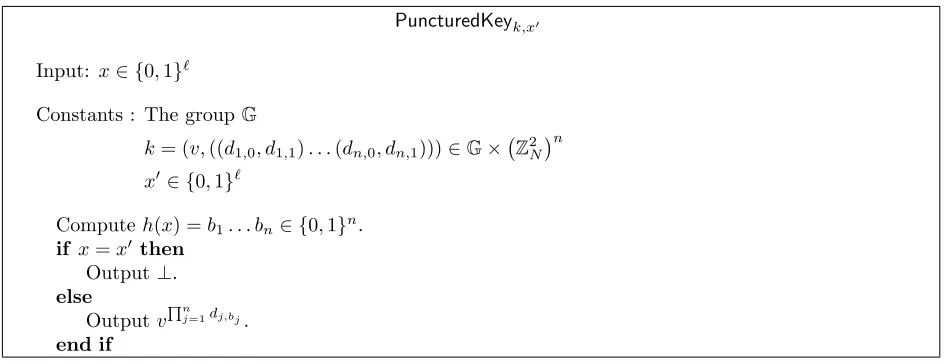
F.puncture(k,x0) F.puncturecomputes an obfuscation of PuncturedKeyk,x0 (defined in Figure 1); that is,Kx0 ←iO(λ,PuncturedKeyk,x0) wherePuncturedKeyk,x0 is padded to be of appropriate size. 5
5
Looking ahead, in the proof of security, the programPuncturedKeyk,x0will be replaced byPuncturedKey0V,w,D,u,x0,
PuncturedKeyk,x0
Input: x∈ {0,1}`
Constants : The group G
k= (v,((d1,0, d1,1). . .(dn,0, dn,1)))∈G× Z2N n
x0∈ {0,1}`
Computeh(x) =b1. . . bn∈ {0,1}n. if x=x0 then
Output⊥.
else
OutputvQnj=1dj,bj.
end if
Figure 1: Program PuncturedKey
F.eval(Kx0,x) The punctured key Kx0 is a program that takes an `-bit input. We define
F.eval(Kx0, x) =Kx0(x).
4.1 Proof of Security
We will now prove that our construction is a secure puncturable PRF as defined in Definition 3.2. Specifically, the claim we show is:
Theorem 4.1 (Main Theorem) AssumingiO is a secure indistinguishability obfuscator and the Subgroup Hiding Assumption holds for groups output byG, the PRF F defined above, together with algorithms F.setup,F.punctureandF.eval, is a secure punctured pseudorandom function as defined in Definition 3.2.
Proof: In order to prove this, we define the following sequence of games. Assume the adversary
A makes Q = Q(λ) evaluation queries (where Q(·) is a polynomial) before sending the challenge input.
4.1.1 Sequence of Games
We underline the primary changes from one game to the next.
Game 0 This game is the original security game from Definition 3.2 between the challenger and
Ainstantiated by the construction under analysis. Here the challenger first chooses a random PRF key, thenAmakes evaluation queries and finally sends the challenge input. The challenger responds by sending a key punctured at the challenge input, and either a PRF evaluation at the challenged point or a random value.
1. Let (N, p, q,G,Gp,Gq, g1, g2)← G(1λ). Choosev∈G, di,b ∈ZN, fori= 1 tonandb∈ {0,1},
and setk= (v,((d1,0, d1,1), . . . ,(dn,0, dn,1))).
2. On any evaluation queryxi∈ {0,1}`, computeh(xi) =bi1. . . bin and outputv Qn
j=1dj,bij
3. Asends challenge inputx∗such thatx∗ 6=xi∀i≤Q. ComputeKx∗←iO(λ,PuncturedKeyk,x∗) and h(x∗) =b1∗. . . b∗n. Lety0 =v
Qn j=1dj,b∗
j andy
1 ←G. 4. Flip coin β← {0,1}. Output (Kx∗, yβ).
5. Aoutputs β0 and wins ifβ =β0.
Game 1 This game is the same as the previous one, except that we simulate a partitioning game while the adversary operates and if an undesirable partition arises, we abort the game and decide whether or not the adversary “wins” by a coin flip. This partitioning game works as follows: the challenger samplesu ∈ {0,1,⊥}n using AdmSample and aborts if either there exists an evaluation
query xsuch that Pu(x) = 0 or the challenge queryx∗ satisfiesPu(x∗) = 1.
1. Let (N, p, q,G,Gp,Gq, g1, g2)← G(1λ). Choosev∈G, di,b ∈ZN, fori= 1 tonandb∈ {0,1},
and setk= (v,((d1,0, d1,1), . . . ,(dn,0, dn,1))).
Choose u←AdmSample(1λ, Q) and letSu={x:Pu(x) = 1} (recall Pu(x) = 0 if h(x)j 6= uj ∀1≤j ≤n).
2. On any evaluation queryxi∈ {0,1}`, check ifPu(xi) = 1.
If not, flip a coinγi← {0,1} and abort. A wins ifγi = 1.
Else computeh(xi) =bi1. . . bin and output v Qn
j=1dj,bi j.
3. Asends challenge input x∗ such that x∗ 6=xi ∀i≤Q. Check if Pu(x∗) = 0.
If not, flip a coinγ∗← {0,1} and abort. A wins ifγ∗ = 1.
Else compute Kx∗ ←iO(λ,PuncturedKeyk,x∗) and h(x∗) =b∗1. . . b∗n. Let y0 =v
Qn j=1dj,b∗
j and
y1 ←G.
4. Flip coin β← {0,1}. Output (Kx∗, yβ).
5. A outputs β0. B performs an artificial abort step. If artificial abort occurs, B chooses a uniformly random bitγ0 ← {0,1}, and Awins if γ0 = 1.
If artificial abort does not occur, Awins if β=β0.
Artificial Abort: The information theoretic guarantee of admissible hash functions states that for all queries x1, . . . , xQ, x∗, Pr[Pu(xi) = 1 for all i, Pu(x∗) = 0]≥1/θ(Q). However, this probability
(over the choice ofu) could be different for different tuples (x1, . . . , xQ, x∗). To handle this, Waters
[25] introduced the artificial abort technique. At a high level, this technique ensures that the experiment aborts with almost identical probability for all input sequences. This is achieved in the following manner: after the adversary submits its guess, the challenger estimates the abort probability corresponding to this input sequence. The experiment then ‘artificially’ aborts with an additional probabilityη. This probability η, which depends on the sequence (x1, . . . , xQ, x∗), is
computed as follows.
• First, estimate the abort probability corresponding to (x1, . . . , xQ, x∗). This is performed
by choosing ˜u ← AdmSample(1λ, Q) repeatedly and checking if Pu˜(xi) = 1 for all i and Pu˜(x∗) = 0. Using Chernoff bounds, we can argue that this gives us an accurate estimate τ
of the abort probability corresponding to (x1, . . . , xQ, x∗).
• Letτ∗ = 1−1/θ(Q). Abort with probability (τ∗−τ)/(1−τ).
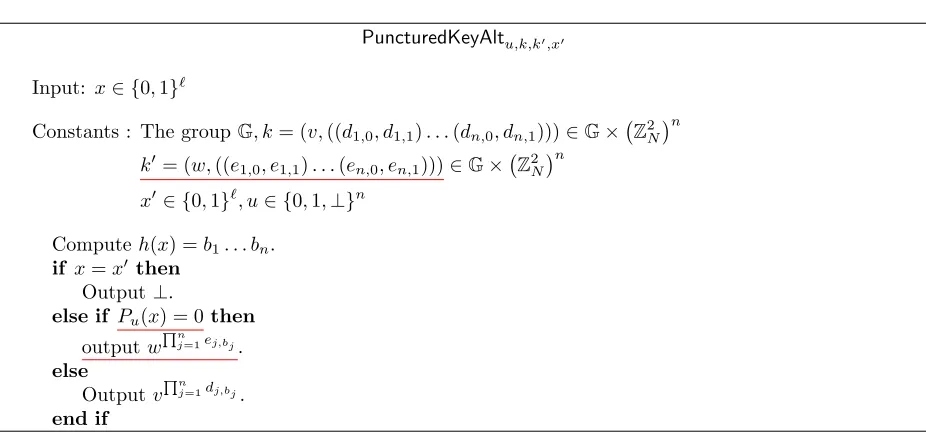
Game 2 In this game, the challenger modifies the punctured key and outputs an obfuscation of PuncturedKeyAlt defined in Figure 2. On inputsx such thatPu(x) = 1, the altered punctured key
uses the same master key k as before. However, if Pu(x) = 0, the altered punctured key uses a
different master key k0 that is randomly chosen from the key space.
1. Let (N, p, q,G,Gp,Gq, g1, g2)← G(1λ). Choosev∈G, di,b ∈ZN, fori= 1 tonandb∈ {0,1}.
Setk= (v,((d1,0, d1,1), . . . ,(dn,0, dn,1))).
Choose u←AdmSample(1λ, Q).
2. On any evaluation queryxi∈ {0,1}`, check ifPu(xi) = 1.
If not, flip a coinγi← {0,1} and abort. A wins ifγi = 1.
Else computeh(xi) =bi1. . . bin and output v Qn
j=1dj,bi j.
3. Asends challenge input x∗ such that x∗ 6=xi ∀i≤Q. Check if Pu(x∗) = 0.
If not, flip a coinγ∗← {0,1} and abort. A wins ifγ∗ = 1. Else choose w∈G, ei,b ∈ZN, fori= 1 to nand b∈ {0,1}.
Setk0 = (w,((e1,0, e1,1), . . . ,(en,0, en,1))).
Compute Kx∗ ←iO(λ,PuncturedKeyAlt
u,k,k0,x∗) and h(x∗) = b∗1. . . b∗n. Let y0 = w
Qn j=1ej,b∗j
and y1←G.
4. Flip coin β← {0,1}. Output (Kx∗, yβ).
5. A outputs β0. B performs an artificial abort step. If artificial abort occurs, B chooses a uniformly random bitγ0 ← {0,1}, and Awins if γ0 = 1.
If artificial abort does not occur, Awins if β=β0.
PuncturedKeyAltu,k,k0,x0
Input: x∈ {0,1}`
Constants : The group G, k= (v,((d1,0, d1,1). . .(dn,0, dn,1)))∈G× Z2N n
k0= (w,((e1,0, e1,1). . .(en,0, en,1)))∈G× Z2N n
x0∈ {0,1}`, u∈ {0,1,⊥}n
Computeh(x) =b1. . . bn. if x=x0 then
Output⊥.
else if Pu(x) = 0then
outputwQnj=1ej,bj.
else
OutputvQnj=1dj,bj.
end if
Figure 2: Program PuncturedKeyAlt
Game 3 In this game, the challenger changes how the master key k0 is chosen so that some elements contain ana-factor, for use on inputsx wherePu(x) = 0.
and setk= (v,((d1,0, d1,1), . . . ,(dn,0, dn,1))).
Choose u←AdmSample(1λ, Q).
2. On any evaluation queryxi∈ {0,1}`, check ifPu(xi) = 1.
If not, flip a coinγi← {0,1} and abort. A wins ifγi = 1.
Else computeh(xi) =bi1. . . bin and output v Q
jdj,bij
.
3. Asends challenge input x∗ such that x∗ 6=xi ∀i≤Q. Check if Pu(x∗) = 0.
If not, flip a coinγ∗← {0,1} and abort. A wins ifγ∗ = 1. Else choose w←G,a←ZN∗ ande0i,b ←ZN.
Letei,b=e0i,b·aifh(x∗)i=b, elseei,b =e0i,b.
Letk0 = (w,((e1,0, e1,1), . . . ,(en,0, en,1))),Kx∗←iO(PuncturedKeyAltu,k,k0,x∗). Leth(x∗) =b1∗. . . b∗n and y0 =w
Q jej,b∗j
and y1 ←G. 4. Flip coin β← {0,1}. Output (Kx∗, yβ).
5. A outputs β0. B performs an artificial abort step. If artificial abort occurs, B chooses a uniformly random bitγ0 ← {0,1}, and Awins if γ0 = 1.
If artificial abort does not occur, Awins if β=β0.
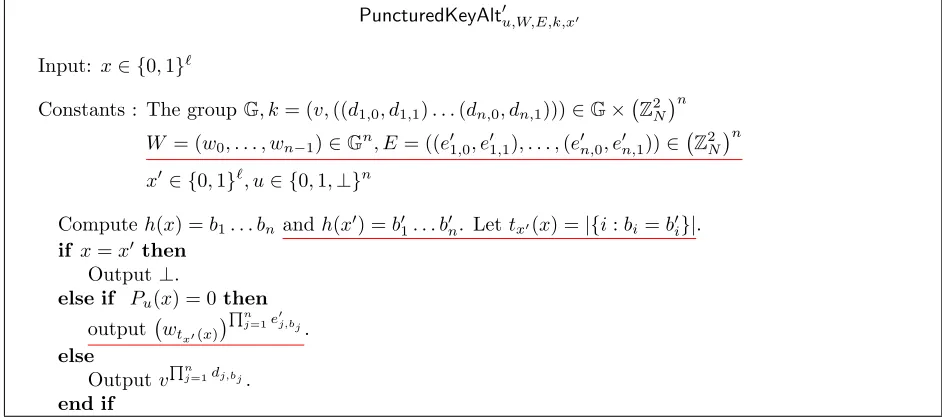
Game 4 This game is the same as the previous one, except that the altered punctured program contains the constants {wai}n
i=0 hardwired. These terms are used to compute the output of the
punctured program. The punctured key is an obfuscation of PuncturedKeyAlt0 defined in Figure 3.
1. Let (N, p, q,G,Gp,Gq, g1, g2)← G(1λ). Choosev∈G, di,b ∈ZN, fori= 1 tonandb∈ {0,1},
and setk= (v,((d1,0, d1,1), . . . ,(dn,0, dn,1))).
Choose u←AdmSample(1λ, Q).
2. On any evaluation queryxi∈ {0,1}`, check ifPu(xi) = 1.
If not, flip a coinγi← {0,1} and abort. A wins ifγi = 1.
Else computeh(xi) =bi1. . . bin and output v Q
jdj,bi j.
3. Asends challenge input x∗ such that x∗ 6=xi ∀i≤Q. Check if Pu(x∗) = 0.
If not, flip a coinγ∗← {0,1} and abort. A wins ifγ∗ = 1. Else choose w←G,a←Z∗
N ande0i,b ←ZN.
LetW = (w, wa, . . . , wan−1),E = ((e01,0, e01,1), . . . ,(e0n,0, e0n,1)).
LetKx00∗ ←iO(PuncturedKeyAlt0u,W,E,k,x∗),h(x∗) =b∗1. . . b∗n,y0 = wa n
Q je0j,b∗j
and y1 ←G. 4. Flip coin β← {0,1}. Output (Kx00∗, yβ).
5. A outputs β0. B performs an artificial abort step. If artificial abort occurs, B chooses a uniformly random bitγ0 ← {0,1}, and Awins if γ0 = 1.
If artificial abort does not occur, Awins if β=β0.
Game 5 In this game, we replace the term wan with a random element fromG. Hence, both y0
and y1 are random elements ofG, thereby ensuring that any adversary has zero advantage in this game.
1. Let (N, p, q,G,Gp,Gq, g1, g2)← G(1λ). Choosev∈G, di,b ∈ZN, fori= 1 tonandb∈ {0,1},
and setk= (v,((d1,0, d1,1), . . . ,(dn,0, dn,1))).
PuncturedKeyAlt0u,W,E,k,x0
Input: x∈ {0,1}`
Constants : The group G, k= (v,((d1,0, d1,1). . .(dn,0, dn,1)))∈G× Z2N n
W = (w0, . . . , wn−1)∈Gn, E= ((e01,0, e01,1), . . . ,(e0n,0, e0n,1))∈ Z 2
N n
x0∈ {0,1}`, u∈ {0,1,⊥}n
Computeh(x) =b1. . . bn andh(x0) =b01. . . bn0. Lettx0(x) =|{i:bi=b0i}|. if x=x0 then
Output⊥.
else if Pu(x) = 0then
output wtx0(x)
Qnj=1e
0
j,bj.
else
OutputvQnj=1dj,bj.
end if
Figure 3: Program PuncturedKeyAlt’
2. On any evaluation queryxi∈ {0,1}`, check ifPu(xi) = 1.
If not, flip a coinγi← {0,1} and abort. A wins ifγi = 1.
Else computeh(xi) =bi1. . . bin and output v Qn
j=1dj,bi j.
3. Asends challenge input x∗ such that x∗ 6=xi ∀i≤Q. Check if Pu(x∗) = 0.
If not, flip a coinγ∗← {0,1} and abort. A wins ifγ∗ = 1. Else choosew ←G,a← Z∗
N, ande0i,b ← ZN. LetW = (w, wa, . . . , wa
n−1
), E = ((e01,0, e01,1),
. . ., (e0n,0, e0n,1)) andKx∗←iO(λ,PuncturedKeyAlt0
u,W,E,k,x∗). Leth(x∗) =b∗1. . . bn∗. Choose T ←Gand lety0 = (T)
Qn j=1e
0 j,b∗
j and y
1←G. 4. Flip coin β← {0,1}. Output (Kx∗, yβ).
5. A outputs β0. B performs an artificial abort step. If artificial abort occurs, B chooses a uniformly random bitγ0 ← {0,1}, and Awins if γ0 = 1.
If artificial abort does not occur, Awins if β=β0.
4.1.2 Adversary’s Advantage in these Games
LetAdviA denote the advantage of adversaryAin Game i. We will now show that if an adversary
A has non-negligible advantage in Game i, then A has non-negligible advantage in Game i+ 1. Finally, we show thatAhas advantage 0 in Game 5.
Claim 1 For any adversary A, Adv1A ≥Adv0A/θ(Q).
Proof: This claim follows from theθ-admissibility of the hash functionh. Recallhisθ-admissible if for all x1, . . . , xq, x∗, P r[ ∀i, Pu(xi) = 1∧Pu(x∗) = 0] ≥ 1/θ(Q), where the probability is only
over the choice of u←AdmSample(1λ, Q). Therefore, ifAwins with advantagein Game 0, then
Claim 2 AssumingiO is a secure indistinguishability obfuscator and the Subgroup Hiding Assump-tion holds, for any PPT adversaryA,
Adv1A−Adv2A≤negl(λ).
Clearly, the two programs in Game 1 and Game 2 are functionally different (they differ on ‘challenge partition’ inputs x where Pu(x) = 0), and therefore the proof of this claim involves multiple
intermediate experiments. In the first hybrid experiment, we transform the program such that the program computes the output in a different manner, although the output is the same as in the original program. Next, the constants hardwired in the modified program are modified such that the output changes on all ‘challenge partition’ inputs (this step uses Assumption 2). Essentially, both programs use a different base for the challenge partition inputs. Next, using Subgroup Hiding Assumption and Chinese Remainder Theorem, even the exponents can be changed for the challenge partition, thereby ensuring that the original program and final program use different PRF keys for the challenge partition. The formal proof can be found in Appendix A.
Claim 3 For any PPT adversary A, Adv3A=Adv2A.
Proof: Game 2 and Game 3 are identical, except for the manner in which the constantsei,b are
chosen. In Game 2, ei,b ← ZN, while in Game 3, the challenger first choosese0i,b ←ZN,a←Z∗N,
and sets ei,b =e0i,b·a ifh(x)i = b, else setsei,b = e0i,b. Since a∈Z∗N (and therefore is invertible), e0i,b·ais also a uniformly random element inZN ife0i,b is. Hence the two experiments are identical.
Claim 4 If there exists a PPT adversary A such that Adv3A −Adv4A is non-negligible in λ, then
there exists a PPT distinguisher B that breaks the security of iO with advantage non-negligible in
λ.
Proof: Suppose there exists a PPT adversaryA such thatAdv3A−Adv4A =. We will construct
a PPT algorithm Bthat breaks the security of iOwith advantage by interacting withA. B first sets up the parameters, including u and k, and answers the evaluation queries of A exactly as in steps 1 and 2 of Game 3, which are identical to steps 1 and 2 of Game 4. When A sends B a challenge inputx∗,Bchecks thatPu(x∗) = 0 and if not aborts (identical in both games).
Next B chooses further values to construct the circuits: w ← G, a ← Z∗
N and e0i,b ← ZN.
Let ei,b = e0i,b·a if h(x∗)i = b, else ei,b = e0i,b. Let k0 = (w,((e1,0, e1,1), . . . ,(en,0, en,1))), W =
(w, wa, . . . , wan−1) and E= ((e01,0, e01,1),. . . ,(e0n,0, e0n,1)).
B constructs C0 =PuncturedKeyAltu,k,k0,x∗, C1 =PuncturedKeyAlt0u,W,E,k,x∗, and sends C0, C1 to theiO challenger. B receivesKx∗ ←iO(Cb) from the challenger. It computes h(x∗) =b∗1. . . b∗n,
y0 =w
Q jej,b∗
j, y ← G, β ← {0,1}, sends (Kx∗, yβ) to A and receives β0 in response. If β =β0, B outputs 0, else it outputs 1.
We will now prove that the circuitsC0 and C1 have identical functionality. Consider any `bit
string x, and leth(x) =b1. . . bn. Recalltx∗(x) =|{i:bi =b∗i}|.
For any x∈ {0,1}` such that x=x∗, both circuits output ⊥.
For any x∈ {0,1}` such that x6=x∗ and P
u(x) = 1, both circuits outputv Qn
j=1dj,bj.
For any x∈ {0,1}` such that x6=x∗ and P
C0(x) =PuncturedKeyAltu,k,k0,x∗(x) =w
Qn
j=1ej,bj =watx ∗(x)Qn
j=1e
0 j,bj =
wtx∗(x)
Qn
j=1e
0
j,bj =PuncturedKeyAlt0
u,W,E,k,x∗(x) =C1(x).
AsC0andC1have identical functionality,P r[B wins ] =P r[Awins in Game 3] -P r[Awins in Game 4].
IfAdv3A−Adv4A=, thenB wins theiO security game with advantage.
Claim 5 If there exists a PPT adversary A such that Adv4A −Adv5A is non-negligible in λ, then there exists a PPT adversary B that breaks Assumption 2 with advantage non-negligible in λ.
Proof: Suppose there exists an adversary A such that Adv4A −Adv5A = , then we can build
an adversary that breaks Assumption 2 with advantage . The games are identical except that Game 5 replaces the termwan with a random element of G. On input an Assumption 2 instance (N,G,Gp,Gq, g1, g2, w, wa, . . ., wa
n−1
) together with challenge value T (which is either wan or a random element inG), use these parameters as in Game 5 with A. IfAguesses it was in Game 4, guess thatT =wan, else guess that T was random.
Observation 1 For any adversary A, Adv5A = 0.
Proof: If the challenger aborts either during the evaluation or challenge phase, then A has 0 advantage, since A wins with probability 1/2. If the challenger does not abort during both these phases, then A receives (Kx∗, yβ), and A must guess β. However, both y0 and y1 are uniformly random elements inG, and therefore,Adv5A= 0.
4.1.3 Conclusion of the Main Proof
Given Claims 1-5 and Observation 1, we can conclude that if iO is a secure indistinguishability obfuscator and Assumption 1 holds (in Appendix B, we show that Assumption 1 implies Assumption 2), then any PPT adversaryAhas negligible advantage in the puncturable PRF security game (i.e., Game 0).
5
t
-Puncturable PRFs
Let t(·) be a polynomial. A PRF Ft : K × X → Y is a t-puncturable pseudorandom function if
there is an additional key space Kp and three polynomial time algorithms Ft.setup, Ft.eval and Ft.puncture defined as follows.
• Ft.setup(1λ) is a randomized algorithm that takes the security parameter λ as input and
outputs a description of the key space K, the punctured key space Kp and the PRFFt.
• Ft.puncture(k, S) is a randomized algorithm that takes as input a PRF keyk∈ KandS⊂ X,
• Ft.eval(kS, x0) is a deterministic algorithm that takes as input a t-punctured key kS ∈ Kp
and x0 ∈ X. Let k ∈ K, S ⊂ X and kS ← Ft.puncture(k, S). For correctness, we need the
following property:
Ft.eval(kS, x0) = (
Ft(k, x0) ifx0 ∈/ S
⊥ otherwise
The security game between the challenger and adversary is similar to the security game for puncturable PRFs. However, in this case, the adversary is allowed to make multiple challenge queries (as in the security game for constrained PRFs). The game consists of the following three phases.
Setup Phase The challenger chooses a random key k← K and b← {0,1}.
Query Phase In this phase, Ais allowed to ask for the following queries:
• Evaluation QueryA sends x∈ X, and receivesFt(k, x).
• Key Query A sends a setS⊂ X, and receivesFt.puncture(k, S).
• Challenge Query A sends x ∈ X as a challenge query. If b = 0, the challenger outputs
Ft(k, x). Else, the challenger outputs a random element y← Y.
Guess A outputs a guessb0 of b.
Let x1, . . . , xq1 ∈ X be the evaluation queries, S1, . . . , Sq2 ⊂ X be the t-punctured key queries
and x∗1, . . . , x∗s be the challenge queries. A wins if ∀i≤q1, j ≤s, xi 6=x∗j,∀i≤q2, j ≤s, x∗j ∈Si
and b0 =b. The advantage ofA is defined to beAdvFt
A(λ) =P r[A wins].
Definition 5.1 The PRFFt is a securet-puncturable PRF if for all PPT adversariesA AdvFAt(λ)
is negligible in λ.
5.1 Construction
In this section, we present our construction of t-puncturable PRFs from puncturable PRFs and indistinguishability obfuscation. LetF :K×X → Ybe a puncturable PRF, andF.setup,F.puncture,
F.eval the corresponding setup, puncturing and evaluation algorithms. We now describe our t -puncturable PRFFt, and the corresponding algorithmsFt.setup,Ft.punctureand Ft.eval.
Ft.setup(1λ) Ft.setup is the same as F.setup.
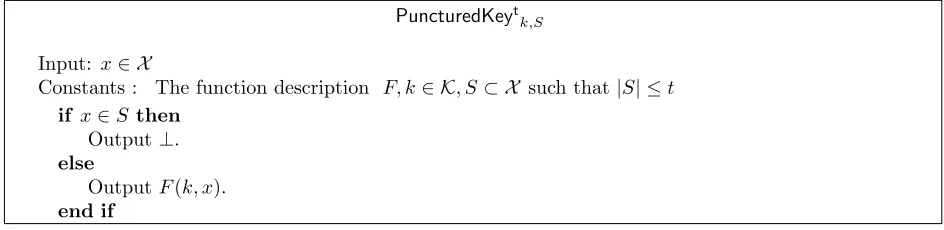
Ft.puncture(k,S) Ft.puncture(k, S) computes an obfuscation of the programPuncturedKeytk,S
de-fined in Figure 4; that is,KS ←iO(λ,PuncturedKeytk,S). As before, the programPuncturedKeytk,S
is padded to be of appropriate size.
PuncturedKeytk,S
Input: x∈ X
Constants : The function description F, k∈ K, S⊂ X such that|S| ≤t
if x∈S then
Output⊥.
else
OutputF(k, x).
end if
Figure 4: Program PuncturedKeyt
5.2 Proof of Security
We will now prove that the above construction is a securet-puncturable PRF as defined in Definition 5.1.
Theorem 5.1 AssumingiOis a secure indistinguishability obfuscator andF, together withF.setup,
F.punctureandF.evalis a secure puncturable PRF, the PRFFtdefined above, together withFt.setup, Ft.puncture and Ft.eval, is a secure t-puncturable PRF.
For simplicity, we will assume that the adversary makesq1 evaluation queries,q2punctured key
queries and 1 challenge query. As shown by [4], this can easily be extended to the general case of multiple challenge queries via a hybrid argument. We will first define the intermediate hybrid experiments.
Game 0 This game is the original security game between the challenger and adversaryA, where the challenger first chooses a PRF key, thenAmakes evaluation/t-punctured key queries and finally sends the challenge input. The challenger responds with either the PRF evaluation at challenge input, or sends a random element of the range space.
1. Choose a keyk← K.
2. Amakes evaluation/t-punctured key queries.
(a) IfA sends an evaluation queryxi, then output F(k, xi).
(b) IfAsends at-punctured key query for setSj, output the keyKSj ←iO(PuncturedKey t
k,Sj).
3. Asends challenge queryx∗such thatx∗=6 xi∀i≤q1andx∗ ∈Sj∀j≤q2. Chooseβ ← {0,1}.
Ifβ = 0, outputy=F(k, x∗), else outputy ← Y. 4. Asends β0 and wins ifβ =β0.
Game 1 This game is the same as the previous one, except that the challenger introduces an abort condition. When the first t-punctured key query S1 is made, the challenger guesses the
challenge query ˜x←S1. The challenger aborts if any of the evaluation queries are ˜x, if any of the
future t-punctured key queries does not contain ˜xor if the challenge query x∗ 6= ˜x.
2. Amakes evaluation/t-punctured key queries.
LetS1 be the firstt-punctured key query. Choose ˜x←S1 and output key
KS1 ←iO(λ,PuncturedKeytk,S1). For all evaluation queries xi before S1,
output F(k, xi).
For all queries after S1, do the following.
(a) IfA sends an evaluation queryxi and xi= ˜x, abort.
Choose γ1
i ← {0,1}. Awins ifγi1= 1.
Else if xi 6= ˜x, output F(k, xi).
(b) IfA sends at-punctured key query for setSj and ˜x /∈Sj, abort.
Choose γi2 ← {0,1}. Awins ifγi2= 1.
Else if ˜x∈Sj, outputKSj ←iO(λ,PuncturedKey t
k,Sj).
3. Asends challenge query x∗ such thatx∗6=xi ∀i≤q1 and x∗ ∈Sj ∀j ≤q2.
If ˜x6=x∗, abort. Chooseγ∗← {0,1}. A wins ifγ∗ = 1.
Else if ˜x=x∗, choose β ← {0,1}. Ifβ = 0, outputy=F(k, x∗), else outputy← Y. 4. Asends β0 and wins ifβ =β0.
Next, we define q2 games, Game 1l, 1≤l≤q2. Let Game 10 = Game 1.
Game 1l In this game, the firstl punctured key queries useKx˜, while the remaining use k.
1. Choose a keyk← K.
2. Amakes evaluation/t-punctured key queries.
LetS1 be the firstt-punctured key query. Choose ˜x←S1.
Compute K˜x←F.puncture(k,x˜).
OutputKS1 ←iO(λ,PuncturedKeyAlttK˜x,S1) (wherePuncturedKeyAlt
tis defined in Figure 5).
For all evaluation queries xi beforeS1, output F(k, xi).
For all queries after S1, do the following.
(a) If A sends an evaluation query xi and xi = ˜x, abort. Choose γi1 ← {0,1}. A wins if γi1 = 1.
Else if xi 6= ˜x, output F.eval(Kx˜, xi) =F(k, xi).
(b) If A sends a t-punctured key query for set Sj and ˜x /∈Sj, abort. Choose γi2 ← {0,1}.
Awins if γi2 = 1.
Else if ˜x∈Sj and j≤l, outputKSj ←iO(λ,PuncturedKeyAlt t
K˜x,Sj).
Else outputKSj ←iO(λ,PuncturedKey t
k,Sj).
3. Asends challenge query x∗ such thatx∗6=xi ∀i≤q1 and x∗ ∈Sj ∀j ≤q2.
If ˜x6=x∗, abort. Chooseγ∗← {0,1}. A wins ifγ∗ = 1.
Else if ˜x=x∗, choose β ← {0,1}. Ifβ = 0, outputy=F(k, x∗), else outputy← Y. 4. Asends β0 and wins ifβ =β0.
Game 2 In this game, the challenger outputs a random element as the response to the challenge query.
PuncturedKeyAlttKx˜,S
Input: x∈ X
Constants : The function descriptionF, K˜x, S⊂ X such that|S| ≤t if x∈S then
Output⊥.
else
OutputF.eval(Kx˜, x). end if
Figure 5: ProgramPuncturedKeyAltt
2. Amakes evaluation/t-punctured key queries.
LetS1be the firstt-punctured key query. Choose ˜x←S1and computeKx˜ ←F.puncture(k,x˜).
OutputKS1 ←iO(λ,PuncturedKeyAlttK˜x,S1).
For all evaluation queries xi beforeS1, output F(k, xi).
For all queries after S1, do the following.
(a) If A sends an evaluation query xi and xi = ˜x, abort. Choose γi1 ← {0,1}. A wins if γi1 = 1.
Else if xi 6= ˜x, output F.eval(Kx˜, xi) =F(k, xi).
(b) If A sends a t-punctured key query for set Sj and ˜x /∈Sj, abort. Choose γi2 ← {0,1}.
Awins if γi2 = 1.
Else if ˜x∈Sj, outputKSj ←iO(λ,PuncturedKeyAlt t
K˜x,Sj).
3. Asends challenge query x∗ such thatx∗6=xi ∀i≤q1 and x∗ ∈Sj ∀j ≤q2.
If ˜x6=x∗, abort. Chooseγ∗← {0,1}. A wins ifγ∗ = 1. Else if ˜x=x∗, choose β ← {0,1}and output y← Y. 4. Asends β0 and wins ifβ =β0.
5.2.1 Adversary’s Advantage in these Games
LetAdviA denote the advantage of adversaryAin Game i.
Observation 2 For any adversary A, Adv1A ≥Adv0A/t.
Proof: Since one of the elements ofS1 will be the challenge input, and|S1| ≤t, the challenger’s
guess is correct with probability 1/|S1| ≥1/t. Hence,Adv1A≥Adv0A/t.
We will now show that Game 1land Game 1l+1are computationally indistinguishable, assuming
iO is secure.
Claim 6 If there exists a PPT adversary A such that Adv1l A−Adv
1l+1
A is non-negligible inλ, then
there exists a PPT distinguisher B that breaks the security of iO with advantage non-negligible in
λ.
Proof: Note that the only difference between Game 1l and Game 1l+1 is in the response to the
(l+ 1)th t-punctured key query. In Game 1l, PuncturedKeytk,Sl+1 is used to compute KSl+1, while
Adv1l A −Adv
1l+1
A =. We will construct a PPT algorithm B that interacts with A and breaks the
security of iO with advantage .
B chooses k ← K and for all evaluation queries xi before the first t-punctured key query,
outputsF(k, xi). On receiving the firstt-punctured key queryS1,Bchooses ˜x←S1 and computes
Kx˜ ← F.puncture(k,x˜). The evaluation queries are computed as in Game 1l and 1l+1. The first
l t-punctured key queries are constructed using k, while the last q2−l−1 t-punctured keys are
constructed usingKx˜ (as in Game 1l and Game 1l+1). For the (l+ 1)thquery,Bdoes the following.
B sets C0 = PuncturedKeytk,Sl+1 and C1 = PuncturedKeyAlt
t
K˜x,Sl+1, and sends C0, C1 to the iO
challenger, and receivesKSl+1 in response, which it sends to A.
Finally, after all queries, the challenger sends the challenge query x∗. B checks that ˜x = x∗, sets y0 = F(k, x∗) and chooses y1 ← Y, β ← {0,1}. It outputs yβ and receives β0 in response. If β =β0,B outputs 0, else it outputs 1.
From the correctness property of puncturable PRFs, it follows thatF.eval(K˜x, x) =F(k, x) for
all x /∈Sl+1. Hence, the circuits C0 and C1 are functionally identical. This completes our proof.
Next, we show that Game 1q2 and Game 2 are computationally indistinguishable.
Claim 7 If there exists a PPT adversary A such that Adv1q2
A −Adv2A is non-negligible in λ, then
there exists a PPT distinguisher B that breaks the security of puncturable PRF F with advantage non-negligible in λ.
Proof: We will useA to construct a PPT algorithm B that breaks the security of puncturable PRF F with advantage Adv1q2
A −Adv2A. Observe that in Game 1q2, the challenger requires the
master keyk only for the evaluation queries before the first t-punctured key query. After the first
t-punctured key queryS1, the challenger chooses ˜x←S1, computes a punctured keyKx˜, and uses
this to compute all future evaluation queries andt-punctured keys.
B begins interacting with A. For each evaluation query xi before the first t-punctured key
query, B sendsxi to the puncturable PRF challenger, and receives yi, which it forwards toA. On
receiving the first t-punctured key query S1,B chooses ˜x ←S1 and sends ˜x as challenge input to
the puncturable PRF challenger. B receives K˜x and y. It uses Kx˜ for all remaining queries. On
receiving challenge x∗ from A, B checks x∗ = ˜x and sends y. B sends A’s response to the PRF challenger.
Note that until the challenge query is made, both games are identical and B simulates them perfectly. Ifyis truly random, thenAreceives a response as per Game 2, else it receives a response as per Game 1q2.
Finally, we have the following simple observation.
Observation 3 For any adversary,Adv3A = 0.
6
Conclusion
Puncturable and t-puncturable PRFs have numerous cryptographic applications. This work pro-vides the first constructions and proofs of adaptive security in the standard model. This is an interesting step forward in its own right, and we believe the techniques used to achieve adaptive-ness from indistinguishability obfuscation may be useful elsewhere. Moreover, this work resolves for at least the puncturable PRF space, the larger question of characterizing which classes of functions admit an adaptively-secure constrained PRF in the standard model. As noted earlier, the results of [11] and [16] provide intuition both for and against whether this is indeed possible for many other function families.
References
[1] Agrawal, S., Boneh, D., Boyen, X.: Efficient lattice (h)ibe in the standard model. In: Pro-ceedings of the 29th Annual international conference on Theory and Applications of Cryp-tographic Techniques. pp. 553–572. EUROCRYPT’10, Springer-Verlag, Berlin, Heidelberg (2010),http://dx.doi.org/10.1007/978-3-642-13190-5_28
[2] Bitansky, N., Canetti, R., Paneth, O., Rosen, A.: Indistinguishability obfuscation vs. auxiliary-input extractable functions: One must fall. Cryptology ePrint Archive, Report 2013/641 (2013),http://eprint.iacr.org/
[3] Boneh, D., Boyen, X.: Secure identity based encryption without random oracles. In: CRYPTO. pp. 443–459 (2004)
[4] Boneh, D., Waters, B.: Constrained pseudorandom functions and their applications. In: ASI-ACRYPT. pp. 280–300 (2013)
[5] Boneh, D., Zhandry, M.: Multiparty key exchange, efficient traitor tracing, and more from indistinguishability obfuscation. In: CRYPTO (2014)
[6] Boyle, E., Goldwasser, S., Ivan, I.: Functional signatures and pseudorandom functions. In: Public-Key Cryptography - PKC 2014 - 17th International Conference on Practice and Theory in Public-Key Cryptography, Buenos Aires, Argentina, March 26-28, 2014. Proceedings. pp. 501–519 (2014)
[7] Chandran, N., Raghuraman, S., Vinayagamurthy, D.: Constrained pseudorandom func-tions: Verifiable and delegatable. Cryptology ePrint Archive, Report 2014/522 (2014),http: //eprint.iacr.org/
[8] Chase, M., Meiklejohn, S.: D´ej`a q: Using dual systems to revisit q-type assumptions. In: EUROCRYPT. pp. 622–639 (2014)
[9] Freire, E.S.V., Hofheinz, D., Paterson, K.G., Striecks, C.: Programmable hash functions in the multilinear setting. In: CRYPTO. pp. 513–530 (2013)
[11] Fuchsbauer, G., Konstantinov, M., Pietrzak, K., Rao, V.: Adaptive security of constrained prfs. In: Advances in Cryptology - ASIACRYPT 2014 - 20th International Conference on the Theory and Application of Cryptology and Information Security, Kaoshiung, Taiwan, R.O.C., December 7-11, 2014, Proceedings, Part II. pp. 82–101 (2014)
[12] Garg, S., Gentry, C., Halevi, S., Raykova, M., Sahai, A., Waters, B.: Candidate indistinguisha-bility obfuscation and functional encryption for all circuits. In: FOCS (2013)
[13] Gentry, C., Lewko, A., Sahai, A., Waters, B.: Indistinguishability obfuscation from the multi-linear subgroup elimination assumption. Cryptology ePrint Archive, Report 2014/309 (2014),
http://eprint.iacr.org/
[14] Goldreich, O., Goldwasser, S., Micali, S.: How to construct random functions (extended ab-stract). In: FOCS. pp. 464–479 (1984)
[15] Golle, P., Jarecki, S., Mironov, I.: Cryptographic primitives enforcing communication and storage complexity. In: Financial Cryptography. pp. 120–135 (2002)
[16] Hofheinz, D.: Fully secure constrained pseudorandom functions using random oracles. IACR Cryptology ePrint Archive 2014, 372 (2014)
[17] Hofheinz, D., Kiltz, E.: Programmable hash functions and their applications. J. Cryptology 25(3), 484–527 (2012)
[18] Hohenberger, S., Sahai, A., Waters, B.: Full domain hash from (leveled) multilinear maps and identity-based aggregate signatures. In: CRYPTO (2013)
[19] Hohenberger, S., Sahai, A., Waters, B.: Replacing a random oracle: Full domain hash from indistinguishability obfuscation. In: EUROCRYPT. pp. 201–220 (2014)
[20] Hohenberger, S., Waters, B.: Constructing verifiable random functions with large input spaces. In: EUROCRYPT. pp. 656–672 (2010)
[21] Kiayias, A., Papadopoulos, S., Triandopoulos, N., Zacharias, T.: Delegatable pseudorandom functions and applications. In: ACM Conference on Computer and Communications Security. pp. 669–684 (2013)
[22] Lewko, A.B., Waters, B.: New proof methods for attribute-based encryption: Achieving full security through selective techniques. In: CRYPTO. pp. 180–198 (2012)
[23] Naor, M., Reingold, O.: Number-theoretic constructions of efficient pseudo-random functions. J. ACM 51(2), 231–262 (2004)
[24] Sahai, A., Waters, B.: How to use indistinguishability obfuscation: deniable encryption, and more. In: STOC. pp. 475–484 (2014)
A
Proof of Claim 2 (
Adv
1A−
Adv
2Ais negligible)
Recall that Claim 2 states that ssuming iO is a secure indistinguishability obfuscator and the Subgroup Hiding Assumption holds, for any PPT adversary A,
Adv1A−Adv2A ≤negl(λ).
In order to prove this, we establish a sequence of intermediate experiments Game 1A to Game 1G and show that any two consecutive experiments are computationally indistinguishable. First, we recall Game 1.
Game 1
1. Let (N, p, q,G,Gp,Gq, g1, g2)← G(1λ). Chooseu←AdmSample(1λ, q).
Choose v←G,di,b ←ZN. Setk= (v,((d1,0, d1,1), . . . ,(dn,0, dn,1))).
2. On any evaluation queryxi∈ {0,1}`, check ifPu(xi) = 1.
If not, flip a coinγi← {0,1} and abort. A wins ifγi = 1.
Else computeh(xi) =bi1. . . bin and output v Q
jdj,bi j.
3. Asends challenge input x∗ such that x∗ 6=xi for all i≤q. Check if Pu(x∗) = 0.
If not, flip a coinγ∗← {0,1} and abort. A wins ifγ∗ = 1.
Else compute Kx∗ ← iO(λ,PuncturedKeyk,x∗) and h(x∗) = b∗1. . . b∗n. Let y0 =v
Q jdj,b∗
j and
y1 ←G.
4. Flip coin β← {0,1}. Output (Kx∗, yβ). 5. Aoutputs β0 and wins ifβ =β0.
Game 1A We change the sampling procedure for thedi,b values so that some include a factor of a.
1. Let (N, p, q,G,Gp,Gq, g1, g2)← G(1λ). Chooseu←AdmSample(1λ, q).
Choose v←G,d0i,b ←ZN,a←Z∗N and setdi,b =d0i,b ifui =b, elsedi,b=d0i,b·a.6.
Setk= (v,((d1,0, d1,1), . . . ,(dn,0, dn,1))).
2. On any evaluation queryxi∈ {0,1}`, check ifPu(xi) = 1.
If not, flip a coinγi← {0,1} and abort. A wins ifγi = 1.
Else computeh(xi) =bi1. . . bin and output v Q
jdj,bi j.
3. Asends challenge input x∗ such that x∗ 6=xi for all i≤q. Check if Pu(x∗) = 0.
If not, flip a coinγ∗← {0,1} and abort. A wins ifγ∗ = 1.
Else compute Kx∗ ← iO(λ,PuncturedKeyk,x∗) and h(x∗) = b∗1. . . b∗n. Let y0 =v
Q jdj,b∗j
and
y1 ←G.
4. Flip coin β← {0,1}. Output (Kx∗, yβ). 5. Aoutputs β0 and wins ifβ =β0.
6Ifu
Game 1B We substitute an alternative method of computing the punctured key program output using a differently formatted input.
1. Let (N, p, q,G,Gp,Gq, g1, g2)← G(1λ). Chooseu←AdmSample(1λ, q).
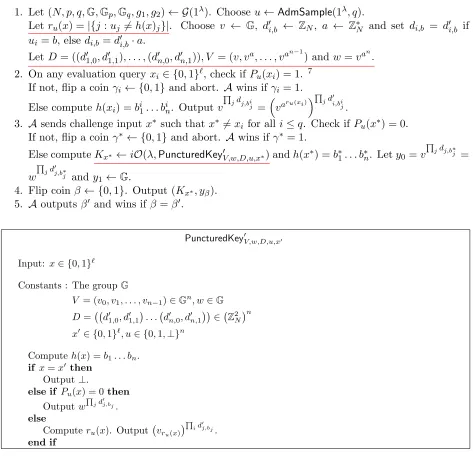
Letru(x) =|{j :uj 6=h(x)j}|. Choose v ← G, d0i,b ← ZN, a ← Z∗N and set di,b = d0i,b if ui =b, elsedi,b=d0i,b·a.
LetD= ((d01,0, d10,1), . . . ,(d0n,0, d0n,1)), V = (v, va, . . . , van−1) and w=van.
2. On any evaluation queryxi∈ {0,1}`, check ifPu(xi) = 1. 7
If not, flip a coinγi← {0,1} and abort. A wins ifγi = 1.
Else computeh(xi) =bi1. . . bin. Outputv Q
jdj,bi j =
varu(xi) Q
jd0i,bi j.
3. Asends challenge input x∗ such that x∗ 6=xi for all i≤q. Check if Pu(x∗) = 0.
If not, flip a coinγ∗← {0,1} and abort. A wins ifγ∗ = 1.
Else computeKx∗ ←iO(λ,PuncturedKey0
V,w,D,u,x∗) andh(x∗) =b∗1. . . b∗n. Lety0 =v
Q jdj,b∗j
=
w Q
jd0j,b∗j
and y1←G.
4. Flip coin β← {0,1}. Output (Kx∗, yβ). 5. Aoutputs β0 and wins ifβ =β0.
PuncturedKey0V,w,D,u,x0
Input: x∈ {0,1}`
Constants : The group G
V = (v0, v1, . . . , vn−1)∈Gn, w∈G
D= d01,0, d01,1
. . . d0n,0, d0n,1
∈ Z2
N n
x0∈ {0,1}`, u∈ {0,1,⊥}n
Computeh(x) =b1. . . bn. if x=x0 then
Output⊥.
else if Pu(x) = 0then
Outputw Q
jd
0
j,bj.
else
Computeru(x). Output vru(x)
Qid
0
j,bj.
end if
Figure 6: ProgramPuncturedKey0
Game 1C In this game, the term van is replaced by a random element of G.
1. Let (N, p, q,G,Gp,Gq, g1, g2) ← G(1λ). Choose u ← AdmSample(1λ, q). Let ru(x) = |{j : uj 6=h(x)j}|.
Choose v←G,d0i,b ←ZN,a←Z∗N and setdi,b =d0i,b ifui =b, elsedi,b=d0i,b·a.
LetD= ((d01,0, d01,1). . . ,(dn,0 0, d0n,1)), V = (v, va, . . . , van−1) and w←
G.
7
2. On any evaluation queryxi∈ {0,1}`, check ifPu(xi) = 1.
If not, flip a coinγi← {0,1} and abort. A wins ifγi = 1.
Else computeh(xi) =bi1. . . bin. Outputv Q
jdj,bi j =
varu(xi) Q
jd0i,bi j.
3. Asends challenge input x∗ such that x∗ 6=xi for all i≤q. Check if Pu(x∗) = 0.
If not, flip a coinγ∗← {0,1} and abort. A wins ifγ∗ = 1.
Else compute Kx∗ ←iO(λ,PuncturedKey0V,w,D,u,x∗) andh(x∗) =b∗1. . . b∗n. Let y0=w
Q jd
0 j,b∗
j
and y1←G.
4. Flip coin β← {0,1}. Output (Kx∗, yβ). 5. Aoutputs β0 and wins ifβ =β0.
Game 1D This game is same as the previous one, except thatvandware chosen from subgroups Gp and Gq respectively, instead of G.
1. Let (N, p, q,G,Gp,Gq, g1, g2) ← G(1λ). Choose u ← AdmSample(1λ, q). Let ru(x) = |{j : uj 6=h(x)j}|.
Choose v←Gp,w←Gq,d0i,b ←ZN,a←Z∗
N and set di,b =d0i,b ifui=b, elsedi,b =d0i,b·a.
LetD= ((d01,0, d01,1), . . . ,(d0n,0, d0n,1)), V = (v, va, . . . , van−1). 2. On any evaluation queryxi∈ {0,1}`, check ifPu(xi) = 1.
If not, flip a coinγi← {0,1} and abort. A wins ifγi = 1.
Else computeh(xi) =bi1. . . bin. Outputv Q
jdj,bi j =
varu(xi) Q
jd0i,bi j.
3. Asends challenge input x∗ such that x∗ 6=xi for all i≤q. Check if Pu(x∗) = 0.
If not, flip a coinγ∗← {0,1} and abort. A wins ifγ∗ = 1.
Else compute Kx∗ ← iO(λ,PuncturedKey0V,w,D,u,x∗) and h(x∗) =b∗1. . . b∗n. Lety0 =w
Q jd
0 j,b∗
j
and y1←G.
4. Flip coin β← {0,1}. Output (Kx∗, yβ). 5. Aoutputs β0 and wins ifβ =β0.
Game 1E
1. Let (N, p, q,G,Gp,Gq, g1, g2) ← G(1λ). Choose u ← AdmSample(1λ, q). Choose v ← Gp, w←Gq,di,b←ZN. Letdi,b,p=di,b mod p anddi,b,q =di,b mod q.
Setk= (v,((d1,0,p, d1,1,p), . . . ,(dn,0,p, dn,1,p))).
Setk0 = (w,((d1,0,q, d1,1,q), . . . ,(dn,0,q, dn,1,q))).
2. On any evaluation queryxi∈ {0,1}`, check ifPu(xi) = 1.
If not, flip a coinγi← {0,1} and abort. A wins ifγi = 1.
Else computeh(xi) =bi1. . . bin. Outputv Q
jdj,bi j =v
Q jdj,bi
j,p.
3. Asends challenge input x∗ such that x∗ 6=xi for all i≤q. Check if Pu(x∗) = 0.
If not, flip a coinγ∗← {0,1} and abort. A wins ifγ∗ = 1.
Else computeKx∗ ←iO(λ,PuncturedKeyAlt
u,k,k0,x∗) andh(x∗) =b∗1. . . b∗n. Lety0 =w
Q jdj,b∗j
=w
Q jdj,b∗
j,q and y1←G.
Game 1F
1. Let (N, p, q,G,Gp,Gq, g1, g2) ← G(1λ). Choose u ← AdmSample(1λ, q). Choose v ← Gp, w←Gq,di,b,p←Zp,ei,b,q ←Zq.
Setk= (v,((d1,0,p, d1,1,p), . . . ,(dn,0,p, dn,1,p))).
Setk0 = (w,((e1,0,q, e1,1,q), . . . ,(en,0,q, dn,1,q))).
2. On any evaluation queryxi∈ {0,1}`, check ifPu(xi) = 1.
If not, flip a coinγi← {0,1} and abort. A wins ifγi = 1.
Else computeh(xi) =bi1. . . bin. Output =v Q
jdj,bi j,p.
3. Asends challenge input x∗ such that x∗ 6=xi for all i≤q. Check if Pu(x∗) = 0.
If not, flip a coinγ∗← {0,1} and abort. Awins if γ∗ = 1.
Else computeKx∗ ←iO(λ,PuncturedKeyAlt
u,k,k0,x∗) andh(x∗) =b∗1. . . b∗n. Lety0 =w
Q jej,b∗j,q
and y1←G.
4. Flip coin β← {0,1}. Output (Kx∗, yβ). 5. Aoutputs β0 and wins ifβ =β0.
Game 1G This game is same as the previous one, except that thedi,bandei,bvalues are uniformly
chosen fromZN instead ofZp and Zq, respectively.
1. Let (N, p, q,G,Gp,Gq, g1, g2) ← G(1λ). Choose u ← AdmSample(1λ, q). Choose v ← Gp, w←Gq,di,b←ZN,ei,b←ZN.
Setk= (v,((d1,0, d1,1), . . . ,(dn,0, dn,1))) and k0= (w,((e1,0, e1,1), . . . ,(en,0, dn,1))).
2. On any evaluation queryxi∈ {0,1}`, check ifPu(xi) = 1.
If not, flip a coinγi← {0,1} and abort. A wins ifγi = 1.
Else computeh(xi) =bi1. . . bin. Output =v Q
jdj,bi j.
3. Asends challenge input x∗ such that x∗ 6=xi for all i≤q. Check if Pu(x∗) = 0.
If not, flip a coinγ∗← {0,1} and abort. A wins ifγ∗ = 1.
Else computeKx∗ ←iO(λ,PuncturedKeyAlt
u,k,k0,x∗) and h(x∗) =b∗1. . . b∗n. Lety0 =w
Q jej,b∗j
and y1←G.
4. Flip coin β← {0,1}. Output (Kx∗, yβ). 5. Aoutputs β0 and wins ifβ =β0.
Game 2 This is Game 2 from Section 4.1. This game is same as the previous one, except thatv
and ware chosen from Ginstead of the subgroups Gp and Gq respectively.
1. Let (N, p, q,G,Gp,Gq, g1, g2)← G(1λ). Chooseu←AdmSample(1λ, q).
Choose v←G,w←G,di,b ←ZN,ei,b ←ZN.
Setk= (v,((d1,0, d1,1), . . . ,(dn,0, dn,1))) and k0= (w,((e1,0, e1,1), . . . ,(en,0, dn,1))).
2. On any evaluation queryxi∈ {0,1}`, check ifPu(xi) = 1.
If not, flip a coinγi← {0,1} and abort. A wins ifγi = 1.
Else computeh(xi) =bi1. . . bin. Output =v Q
jdj,bi j.
3. Asends challenge input x∗ such that x∗ 6=xi for all i≤q. Check if Pu(x∗) = 0.
If not, flip a coinγ∗← {0,1} and abort. A wins ifγ∗ = 1.
Else computeKx∗ ←iO(λ,PuncturedKeyAltu,k,k0,x∗) and h(x∗) =b∗1. . . b∗n. Lety0 =w
Q jej,b∗j