A geometry for the shell model
P. Van Isacker1,a
1Grand Accélérateur National d’Ions Lourds, CEA/DRF–CNRS/IN2P3 Bd Henri Becquerel, B.P. 55027, F-14076 Caen, France
Abstract. A geometric interpretation is given of matrix elements of a short-range inter-action between states that are written in terms of aligned neutron–proton pairs.
1 Introduction
In this contribution matrix elements of the nucleon–nucleon interaction between shell-model states are studied from a geometric point of view. An approach of this kind goes back to the seminal study of Schiffer [1]. The interaction between two nucleons can be expressed in terms of the angle between the angular momenta of the nucleons. Furthermore, the strength of the nucleon–nucleon interaction has a universal dependence on this angle—universality that can be shown to result from the short-range character of the effective interaction [2]. This geometric interpretation of the nucleon–nucleon interaction is by now an accepted feature of nuclear structure; a discussion of it can be found in textbooks on nuclear physics, see e.g. Sect. 4.2 of Ref. [3].
The geometry of the shell model can be extended from two- to four-nucleon configurations [4]. In this contribution the geometric interpretation of the neutron–proton (np) interaction is examined for a four-nucleon configuration when written in terms of aligned np pairs.
2 Matrix elements of the neutron-proton interaction in a 2n–2p basis
States for two neutrons with angular momentum Jν and two protons with angular momentum Jπ, coupled to total angular momentumJ, can be written as|JνJπ;J ≡ |jνjν(Jν),jπjπ(Jπ);J, which, for all even values ofJνandJπallowed by angular-momentum coupling, form a complete and orthogonal basis. Matrix elements of the np interaction in the 2n–2p basis areJ
νJπ;J|Vˆνπ|JνJπ;J=4[Jν][Jν][Jπ][Jπ]
R
(2R+1)
jν jπ Jπ Jν
R jπ J jν
jν jπ Jπ Jν VR
νπ, (1)
with [x]≡ √2x+1, and whereVνπR ≡ jνjπ;R|Vˆνπ|jνjπ;Rare the np two-body matrix elements and the symbol in square brackets is a 12jcoefficient of the second kind, which is known as a sum of products of four 6jcoefficients [5].
The expression (1) is used in Ref. [6] to demonstrate the crucial role played by the np matrix elementVR
νπwith aligned neutron and proton angular momenta, that is, forR= jν+jπ. This generic feature of the np interaction results from angular momentum coupling [i.e., from the 12jcoefficient in Eq. (1)] as well as from the matrix element in the aligned configuration, which is moderately to strongly attractive for any reasonable np interaction. The importance of the aligned np matrix element raises the question whether a shell-model approximation can be formulated in terms of aligned np pairs, as recently proposed in Ref. [7]. (See Sect. 4.3 of Ref. [8] for a review of this debate.) This question is also addressed in Ref. [6] for a 2n–2p system, and more generally forkn–kp systems in N = Z nuclei in Ref. [9], with the conclusion that the wave functions of many, but certainly not all, yrast states have a dominant component in terms of aligned np pairs. Here I examine whether a description in terms of aligned np pairs gives rise to a geometry of the shell model.
3 Matrix elements of the neutron-proton interaction in a np–np basis
An alternative basis exists in terms of np pairs of the form|J1J2;J ≡ |jνjπ(J1),jνjπ(J2);J. If J1 andJ2acquire all values allowed by angular-momentum coupling, this defines an overcomplete basis of states, which are not necessarily normalized, as indicated by the double bracket. Matric elements in the np–np basis can be obtained with the help of the transformation|J1J2;J=−
Jνeven
Jπeven
jν jπ J1
jν jπ J2
Jν Jπ J
|JνJπ;J, (2) where the symbol in square brackets is a unitary 9jcoefficient [10]. Note that the basis states on the right-hand side are orthogonal and normalized while those on the left-hand side are not. In the application of interest one constructs states in terms of a single np pair such thatJ1=J2≡J¯, in which case the overlap matrix element is
J¯2;J|J¯2;J= 1+(−)J 4
1−
jν jπ J¯ jπ jν J¯
¯
J J¯ J
, (3)
which is zero for odd values ofJ. This shows that the np pair behaves as a boson since two identical np pairs can only coupled to evenJ. Henceforth it is assumed thatJis even. The matrix elements of the np interaction in the np–np basis are
J¯2;J|Vˆ
νπ|J¯2;J = VνπJ¯ −2
jν jπ J¯ jπ jν J¯
¯
J J¯ J VJ¯
νπ
+(2 ¯J+1)2 R
(2R+1)
jν jπ J¯ J¯
R jν J jπ
jν jπ J¯ J¯ VR
νπ. (4)
For aligned np pairs,Jmax = jν+ jπ, the unitary 9jcoefficient in the overlap (3) and in the matrix element (4) is much smaller than 1 and can be neglected. [ForJ = 2Jmax the unitary 9jcoefficient equals 1 but this angular momentum is excluded by the Pauli principle—see Eq. (3).] The sum over the 12jcoefficients, however, cannot be neglected. To a good approximation the matrix elements of the np interaction between normalized states are therefore
J2
max;J|Vˆνπ|Jmax2 ;J ≈2VνπJmax+2(2Jmax+1)2
R
(2R+1)
jν jπ Jmax Jmax
R jν J jπ
jν jπ Jmax Jmax VR
The expression (1) is used in Ref. [6] to demonstrate the crucial role played by the np matrix elementVR
νπwith aligned neutron and proton angular momenta, that is, forR= jν+jπ. This generic feature of the np interaction results from angular momentum coupling [i.e., from the 12jcoefficient in Eq. (1)] as well as from the matrix element in the aligned configuration, which is moderately to strongly attractive for any reasonable np interaction. The importance of the aligned np matrix element raises the question whether a shell-model approximation can be formulated in terms of aligned np pairs, as recently proposed in Ref. [7]. (See Sect. 4.3 of Ref. [8] for a review of this debate.) This question is also addressed in Ref. [6] for a 2n–2p system, and more generally forkn–kp systems in N = Z nuclei in Ref. [9], with the conclusion that the wave functions of many, but certainly not all, yrast states have a dominant component in terms of aligned np pairs. Here I examine whether a description in terms of aligned np pairs gives rise to a geometry of the shell model.
3 Matrix elements of the neutron-proton interaction in a np–np basis
An alternative basis exists in terms of np pairs of the form|J1J2;J ≡ |jνjπ(J1),jνjπ(J2);J. If J1 andJ2acquire all values allowed by angular-momentum coupling, this defines an overcomplete basis of states, which are not necessarily normalized, as indicated by the double bracket. Matric elements in the np–np basis can be obtained with the help of the transformation|J1J2;J=−
Jνeven
Jπeven
jν jπ J1
jν jπ J2
Jν Jπ J
|JνJπ;J, (2) where the symbol in square brackets is a unitary 9jcoefficient [10]. Note that the basis states on the right-hand side are orthogonal and normalized while those on the left-hand side are not. In the application of interest one constructs states in terms of a single np pair such thatJ1=J2≡J¯, in which case the overlap matrix element is
J¯2;J|J¯2;J= 1+(−)J 4
1−
jν jπ J¯ jπ jν J¯
¯
J J¯ J
, (3)
which is zero for odd values ofJ. This shows that the np pair behaves as a boson since two identical np pairs can only coupled to evenJ. Henceforth it is assumed thatJis even. The matrix elements of the np interaction in the np–np basis are
J¯2;J|Vˆ
νπ|J¯2;J = VνπJ¯ −2
jν jπ J¯ jπ jν J¯
¯
J J¯ J VJ¯
νπ
+(2 ¯J+1)2 R
(2R+1)
jν jπ J¯ J¯
R jν J jπ
jν jπ J¯ J¯ VR
νπ. (4)
For aligned np pairs,Jmax = jν+ jπ, the unitary 9jcoefficient in the overlap (3) and in the matrix element (4) is much smaller than 1 and can be neglected. [ForJ = 2Jmaxthe unitary 9jcoefficient equals 1 but this angular momentum is excluded by the Pauli principle—see Eq. (3).] The sum over the 12jcoefficients, however, cannot be neglected. To a good approximation the matrix elements of the np interaction between normalized states are therefore
J2
max;J|Vˆνπ|Jmax2 ;J ≈2VνπJmax+2(2Jmax+1)2
R
(2R+1)
jν jπ Jmax Jmax
R jν J jπ
jν jπ Jmax Jmax VR
νπ. (5)
�ν=��/� �π=��/� �=� � � �� �� �� � � � �ν=��/� �π=��/� �=� � � �� �� �� � � � �ν=��/� �π=��/� �=� � � �� �� �� � � �
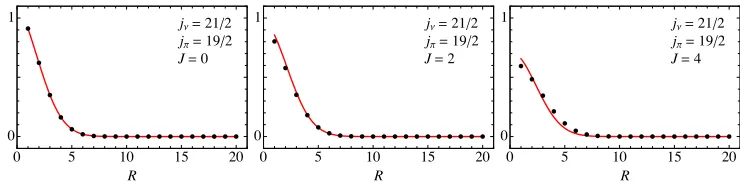
Figure 1.Illustration of the 12j-coefficient approximation forjν=21/2,jπ=19/2 andJ=0,2,4, as a function
ofR. The dots are the exact expression on the left-hand side and the curve is its approximation on the right-hand side of Eq. (8).
Not surprisingly, one finds that, in a basis constructed out of aligned np pairs, the main contribution to the 2n–2p configuration stems from the matrix elementVJmax
νπ . There are however corrections to this dominant contribution, which depend on the total angular momentumJand on the strengths of the np interaction withRJmax.
4 Expressions in the high-
J
and the low-
J
limits
For a schematic short-range interaction the expressions in the np–np basis simplify. Specifically, for a surface delta interaction (SDI) classical approximations to the sum in Eq. (5) can be worked out for aligned np pairs, Jmax = jν+jπ. With the method of Ref. [12], based on the classical limit of 3n j coefficients [11], the matrix element (5) can be reduced to
J2
max;J|VˆνπSDI|Jmax2 ;J ≈2VνπJmax−
3a0+a1 πsinθ +(−)
ν+jν+π+jπa0−a1
πtanθ, (6)
wherea0(a1) is the isoscalar (isovector) strength of the np interaction andθis the angle between the angular momentaJmaxof the two np pairs that couple to total angular momentumJ,
θ=arccosJ(J+1)−2Jmax(Jmax+1)
2Jmax(Jmax+1) . (7)
The classical approximation (6) is reasonable except for low angular momentumJ, in particular forJ =0 orθ=πwhen it diverges. Unlike in Ref. [12] one is interested in the caseJ =0 since it corresponds to the energy of the ground state. The following approximate expression can be derived for the 12jcoefficient under the assumption thatJis low and that the np pair is aligned,Jmax= jν+jπ:
(Jmax+1)2(2Jmax+1)
jν jπ Jmax Jmax
R jν J jπ
jν jπ Jmax Jmax
≈exp
−4R(R+1)−J(J+1)+ √R(R+1)J(J+1)+4(jν−jπ)2 2(Jmax+1)
. (8)
(�)
��+×��+�� � νπ ���
��+��+��
� �� �� �� ��
-� �
������� ���������
���
���
(�)
��-×��-�� � νπ
���
��-��-��
� �� ��
-� �
������� ���������
���
���
Figure 2.The exact expression for the 2n–2p matrix element (5) of the np interaction (dots) compared with the high-J(red) and low-J(blue) approximations of Eqs. (6) and (8), respectively. The comparison is carried out for (a) a SDI witha0=a1=0.25 and for jν=21/2 andjπ=19/2 andνandπeven, and (b) a SDI witha0=0.75
anda1=0.25, and forjν=h11/2and jπ=g9/2. The constant contribution 2VνπJmaxis not included.
��
���
��
��
����
������
(
�
)
(
�
)
(
�
)
(
�
)
(
�
)
�+
(�+)
(�+)
(�+)
(�+)
(��+)
�+
�+
�+
�+
�+
��+
-
�
-
�
-
�
-
�
-
�
-
�
-
�
���
���
(
�
��
)
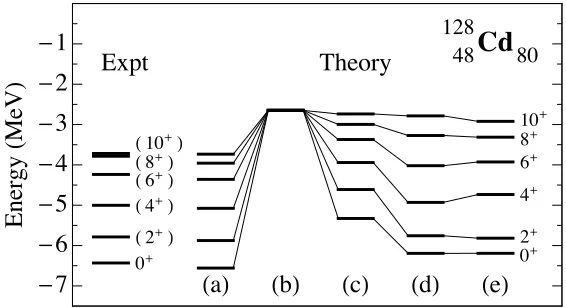
Figure 3.The experimental spectrum of128Cd compared to the shell-model approximations (a)–(e) discussed in
the text.
5 The example of
128Cd
Let me now illustrate the different approximations with the example of the nucleus128Cd, with two neutron (proton) holes inν0h11/2(π0g9/2) with respect to the core132Sn. The relevant two-body np matrix elements are derived from the realistic interaction jj45pna [13], and the nn and pp interac-tions are taken from130Sn and130Cd, respectively. The results of a shell-model calculation with this interaction in the (ν0h11/2)−2(π0g9/2)−2 model space are shown in Fig. 3(a), and are seen to agree with the observed energies. The jj45pna interaction can therefore be considered as a realistic basis for further approximations. The approximation (b) consists of keeping only the np matrix element V10−
(�)
��+��+�� �
νπ ���
��+��+��
� �� �� �� ��
-�
�
������� ���������
���
���
(�)
��-��-�� �
νπ
���
��-��-��
� �� ��
-� �
������� ���������
���
���
Figure 2.The exact expression for the 2n–2p matrix element (5) of the np interaction (dots) compared with the high-J(red) and low-J(blue) approximations of Eqs. (6) and (8), respectively. The comparison is carried out for (a) a SDI witha0=a1=0.25 and forjν=21/2 andjπ=19/2 andνandπeven, and (b) a SDI witha0=0.75
anda1=0.25, and forjν=h11/2and jπ=g9/2. The constant contribution 2VνπJmaxis not included.
��
���
��
��
����
������
(
�
)
(
�
)
(
�
)
(
�
)
(
�
)
�+(�+)
(�+)
(�+)
(�+)
(��+)
�+ �+ �+ �+ �+ ��+
-
�
-
�
-
�
-
�
-
�
-
�
-
�
���
���
(
�
��
)
Figure 3.The experimental spectrum of128Cd compared to the shell-model approximations (a)–(e) discussed in
the text.
5 The example of
128Cd
Let me now illustrate the different approximations with the example of the nucleus128Cd, with two neutron (proton) holes inν0h11/2(π0g9/2) with respect to the core132Sn. The relevant two-body np matrix elements are derived from the realistic interaction jj45pna [13], and the nn and pp interac-tions are taken from130Sn and130Cd, respectively. The results of a shell-model calculation with this interaction in the (ν0h11/2)−2(π0g9/2)−2 model space are shown in Fig. 3(a), and are seen to agree with the observed energies. The jj45pna interaction can therefore be considered as a realistic basis for further approximations. The approximation (b) consists of keeping only the np matrix element V10−
νπ and putting all others (nn, pp and np) to zero. As already pointed out by Zamick and Escud-eros [14], this clearly is inadequate. It is essential to keep the nn and pp interactions and therefore, in order to the test the influence of the np interaction, in the approximations (c)–(e) the realistic nn and pp interactions are taken without modification. In Fig. 3(c) are shown the results obtained in the
(ν0h11/2)−2(π0g9/2)−2 model space with the exact nn and pp interactions but with a single non-zero matrix elementV10−
νπ . This is the approximation advocated in Ref. [6]; it is indeed remarkable that with asinglecomponent ofVR
νπthat much of the np correlations can be accounted for. The results (d) are obtained with Eq. (5) and equivalent expressions for the nn and pp interactions (not given here). This is the aligned-np-pair approximation [9]: take the full, realistic interaction within the restricted space constructed out of aligned np pairs, which in this example consists of a single state. Comparison of (a) and (d) shows that the aligned-np-pair approximation is adequate for lowJbut fails forJ=8 and 10. Finally, the results (e) are obtained with the np interaction in the low-Japproximation (8) for J ≤4 and the classical approximation (6) forJ≥4 witha0 =0.5 anda1 =0.13, strengths obtained from a fit of the SDI to the jj45pna interaction. The results forJ=4 are essentially indistinguishable in the two approximations.
6 Concluding remark
It is important to distinguish between the following two approximations: (i) The full shell-model interaction is considered in the restricted space constructed out of aligned np pairs; (ii) Only the component of the np interaction in the aligned configuration is taken and diagonalized in the full shell-model space. The two approximations arenotequivalent and have their respective merits and problems. If approximation (i) is made for a short-range interaction, a simple geometric interpretation can be obtained, as argued in this contribution. Approximation (ii), on the other hand, can be shown to give rise to a partially solvable problem for the four-nucleon system [15].
Acknowledgement
I acknowledge fruitful discussions with Yung Hee Kim, Maurycy Rejmund and Antoine Lemasson.
References
[1] J. P. Schiffer, Ann. Phys. (N.Y.)66(1971) 798.
[2] A. Molinari, M. B. Johnson, H. A. Bethe and W. M. Alberico, Nucl. Phys. A239(1975) 45. [3] R. F. Casten, Nuclear Structure from a Simple Perspective(Oxford University Press, Oxford,
2000).
[4] P. Van Isacker, EPJ Web Conf.78(2014) 03004.
[5] A. P. Yutsis, I. B. Levinson and V. V. Vanagas,The Theory of Angular Momentum(Israel Program for Scientific Translations, Jerusalem, 1962).
[6] Y. H. Kim, M. Rejmund, P. Van Isacker and A. Lemasson, to be published. [7] B. Cederwallet al., Nature469(2011) 68.
[8] S. Frauendorf and A. O. Macchiavelli, Prog. Part. Nucl. Phys.78(2014) 24. [9] P. Van Isacker, Int. J. Mod. Phys. E20(2011) 191.
[10] I. Talmi,Simple Models of Complex Nuclei. The Shell Model and the Interacting Boson Model (Harwood, Chur, 1993)
[11] E. P. Wigner,Group Theory and Its Application to the Quantum Mechanics of Atomic Spectra (Academic Press, New York, 1959).
[12] P. Van Isacker and A. O. Macchiavelli, Phys. Rev. C87(2013) 061301(R). [13] M. Hjorth-Jensen, T. T. Kuo and E. Osnes, Phys. Reports261(1995) 125. [14] L. Zamick and A. Escuderos, Phys. Rev. C87(2013) 044302.