Volume 2008, Article ID 649581,11pages doi:10.1155/2008/649581
Research Article
An Efficient Multibit Aggregation Scheme for
Multihop Wireless Sensor Networks
Bhushan G. Jagyasi,1Bikash K. Dey,2S. N. Merchant,2and U. B. Desai2
1TCS Innovation Labs, Mumbai, Tata Consultancy Services, Yantra Park, Thane (W), Mumbai 400601, India
2SPANN Laboratory, Electrical Engineering Department, Indian Institute of Technology, Bombay Powai, Mumbai 400076, India
Correspondence should be addressed to Bhushan G. Jagyasi,[email protected]
Received 14 December 2007; Revised 28 September 2008; Accepted 2 December 2008
Recommended by Sayandev Mukherjee
A single-hop wireless sensor network for distributed detection has been considered in the majority of the existing literature. However, a wireless sensor network for an event detection application with cheap and short range sensors is likely to be a multihop network. Here we consider a distributed detection problem in a multihop wireless sensor network with tree topology. We propose an optimum multibit decision fusion rule derived from the previously known optimum likelihood ratio for a single-hop network with star topology. Subsequently, we present an efficient multibit decision fusion rule for a multihop wireless sensor network with tree topology. Through numerical results, the proposed scheme is shown to achieve a significant improvement in detection accuracy over existing distributed detection schemes.
Copyright © 2008 Bhushan G. Jagyasi et al. This is an open access article distributed under the Creative Commons Attribution License, which permits unrestricted use, distribution, and reproduction in any medium, provided the original work is properly cited.
1. INTRODUCTION
Wireless sensor network (WSN) [1] is a network formed by a large number of sensor nodes deployed in the area of interest. These sensor nodes can sense, process, and communicate information among themselves to collaboratively perform a particular task. We consider the use of WSN for binary event detection [2–7]. The event of interest could be an intruder crossing the line of control, the rise of pollution level above some threshold, the detection of disasters like landslides [8, 9], fire [10], and volcanoes [11, 12]. The problem of binary event detection is a binary hypothesis testing problem in which the event hypothesis H takes two values {0, 1} indicating the nonoccurrence and the occurrence of the event.
For event detection using WSN, we consider the deploy-ment of a large number of inexpensive, albeit less precise, sensor nodes in an application area rather than having a few expensive and more precise sensor nodes. Each sensor node observes some real value corresponding to the phenomenon under consideration; for example, sensors may measure ambient temperature, moisture, humidity, strain, or any other parameter as required by the application. Sensor nodes may then use few (sayq) bits to quantize the
information sensed by them. In star topology, nodes transmit the quantized information directly to the sink node, the only fusion center, which makes the final decision.
Distributed detection using multiple sensors with var-ious network topologies has been considered in [4, 5]. A review on various decentralized detection schemes is available in [13]. In [3–5,14–17], the observation of each sensor and the communication to its parent were considered to be one bit. In [3, 14, 16, 17], the authors considered the WSN with star topology having sensors with different probability of detection (Pd) and the probability of false alarm (Pf). The Chair-Varshney (CV) rule [14] gives an optimum way to fuse the 1-bit information received at fusion center from every sensor node in a star topology. This requires knowledge of the performance indices (Pds andPfs) of all the sensors nodes.
channels have been assumed from each sensor node to the fusion center.
In our work, we consider a tree topology where the sensor nodes lying far from the sink may transmit to the sink in multiple hops via the intermediate sensor nodes. In contrast to [18], the intermediate nodes act as sensors as well as relays. This significantly reduces the communication cost and makes the network more scalable in terms of coverage area. Further in tree topology, every node can be considered as a fusion center and can be used to do some processing on the received data before transmitting. Thus data aggregation in a tree topology is significantly different than that in a star topology.
For a WSN with tree topology, if the sensors detect binary value representing the occurrence of an event, the best scheme, as shown in [2], is when each intermediate node informs its parent about the actual number of its descendants observing “0” and the actual number of its descendants observing “1.” Only one of these numbers is required to be transmitted if every node has a priori knowledge of the number of descendants of its each child (however, this may not be feasible in a dynamic network). Thus the sink node has the exact information about the total number of nodes in the entire network detecting “0” and the number of nodes detecting “1.” Using this information, the sink node makes the final decision. In a large multihop network, this will require the intermediate nodes to transmit many bits to its parent. Note that even though the hypothesis as well as data sensed by each node is binary, the message transmitted by any intermediate sensor node is not binary in this case.
In this paper, for a tree topology, every sensor node quantizes its sensed data using q-bits. Each leaf node transmits itsq-bit quantized information to its parent node. The intermediate node fuses the q-bit information sensed by itself with the information received from its children to make a summary of l bits for transmission to its parent. In general, l may be different for different nodes. But throughout this paper, we considerlto be the same for all the nodes and also the same as q. Henceforth, the q-bit summary information generated by each node or theq-bit quantized information of the leaf nodes will be called their decision. On receiving the decision information from all its children, the sink node makes the final 1-bit decision about the event. Since communication requires more power than computation [19], to save power, it is necessary to transmit as less number of bits as possible. However, the detection accuracy of the sink is expected to increase with the increase inq. Our numerical and simulation results inSection 5will show this tradeoff.
We consider the problem of designing an efficient multibit (q-bit) decision fusion scheme, implemented at every node in a tree topology, so as to maximize the detection accuracy of the sink node. In [2], a 1-bit aggregation scheme based on the majority rule with a specific routing scheme was proposed for tree topology. Here a parent node takes the majority of its children’s decision as its own decision. In [6], the weighted aggregation scheme (WAS) for WSN with tree topology has been proposed with q = 1. In
WAS, any non-leaf node weights the decision made by its each child with the minimum mean square error (MMSE) estimate of the number of descendants of that child deciding in the favor of event. In [6], it is assumed that every sensor node has knowledge of the number of descendants of its each child. In [7], a multibit generalization to WAS, q-bit weighted aggregation scheme (q-WAS), requiring q bits of transmission from any node to its parent was proposed. This provided a lifetime-accuracy tradeoff by varyingq.
In this paper, we present a two-fold generalization of existing optimum 1-bit CV fusion rule: 1-bit to q-bits (q-CV) and star to tree topology. We first propose the optimum multibit fusion rule (q-CV) derived from likelihood ratio for a single-hop network with star topology. This enables the fusion center to optimally fuse q-bit information received from its each child to make either 1-bit decision or aq-bit summary as required. The multibit fusion scheme is then developed for WSN with tree topology which is a more generic topology as compared to star topology.
Different definitions ofnetwork lifetime have been con-sidered in literature [2,6,20]. In this paper, we consider three different measures ofnetwork lifetime. The simplest measure of network lifetime that we consider is where a network is considered to be alive till all the nodes in network are alive. Since in our schemes all the nodes transmit equal number of bits during data aggregation and we assume the transmission of equal power of each bit and each node, all the nodes are expected to have approximately the same node lifetime. We also consider another measure of network lifetime where a network is alive till 50% of the sensor nodes die or run out of power. Yet another measure of network lifetime we considered is where the network is considered alive as long as the detection accuracy is above a fixed threshold. The details of the network lifetime simulations are presented in
Section 5.2.
The majority rule performs well when the tree is balanced [2] and all the sensor nodes have equal sensing accuracies because then the majority rule is equivalent to the optimum scheme. However, if the tree is not balanced, the performance of the majority rule will degrade from the optimum performance, [2, 20]. The majority rule is also not optimum when the different sensor nodes have different sensing accuracies. In either case, of an unbalanced tree or different sensing accuracies of the nodes, our scheme is expected to perform better than the majority rule.
In Section 2, we derive an optimum multibit fusion rule (q-CV) for a star topology. This is precursor to deriving a multibit q-CV fusion rule for tree topology in
S0
Figure1: Star topology.
2. OPTIMUM MULTIBIT DECISION FUSION RULE
InSection 2.1, we develop the optimum multibit fusion rule (q-CV) for single-hop WSN. In what follows, we first present the existing optimum 1-bit CV rule [14] for a star topology (seeFigure 1).
The binary event, represented by binary random variable H ∈ {0, 1}, is assumed to be observed by all sensors in an application area. Each sensorSi, fori=1, 2,. . .,K, has 1-bit
quantized informationXi ∈ {0, 1}about the occurrence of
the event with the probability of detectionPdi=P(Xi=1|
H =1) and the probability of false alarmP fi =P(Xi=1|
H=0).
In the existing optimum 1-bit CV rule [14], the fusion center S0 makes a 1-bit decision X0 to detect an event by
thresholding
The 1-bit decisionX0ofS0can be obtained using
ΛCV
whereT is the threshold which can be varied to achieve a tradeoffbetween the probability of detection Pd0 and the
probability of false alarmP f0of the fusion centerS0.
2.1. Proposed optimum multibit fusion rule (q-CV)
The optimum multibit fusion rule (q-CV) for single-hop WSN (seeFigure 1) is derived in this subsection. Here each node quantizes its observation usingq-bits to make aq-bit quantized local decision about the occurrence of the binary event and transmits the same to the fusion center. Theq-bit decision of a node has not only information of the binary event hypothesis as inferred by it but also has information of its confidence in deciding the event hypothesis.
In q-CV scheme, each node Si (refer to Figure 1)
transmits itsq-bit decisionXi∈ {0, 1,. . ., 2q−1}to its parent
S0. We representXias (Xi,1,Xi,2,. . .,Xi,q), whereXi,j∈ {0, 1}
is the jth bit in Xi. Here Xi,1 provides the binary event
detection made by node Si, while the remaining bits inXi
denote the confidence on the detectionXi,1made by nodeSi.
If Xi is one bit, then probability of detection Pdi =
P(Xi =1|H =1), probability of false alarmP fi =P(Xi =
1 |H =0), probability of missed detectionPmi = P(Xi =
0 | H =1) =1−Pdi, and probability of correct no event
detection Pni = P(Xi = 0 | H = 0) = 1−P fi are the
performance indices of the decision Xi. These parameters
should be known for optimum 1-bit fusion rule (CV rule). In the proposed q-CV (Xi is q-bits) rule, we require the
knowledge of performance indicesPi
mn=P(Xi=m|H=n)
form∈ {0, 1,. . ., 2q−1}andn∈ {0, 1}about decisionXiof
the sensor nodeSi.
For notational convenience, we denoteP(H = 0) and P(H =1) byP(H0) andP(H1), respectively. Optimum
log-likelihood ratio (LLR) test [14,21,22] for binary detection is given by
Representing the likelihood ratio forq-CV byΛCVq, we get
ΛCVq=Λ
from (8), with some thresholdsT0,T1,. . .,T(2q−2),
to the threshold selection criteria presented in Section 4. As far as binary event detection in a single-hop WSN is concerned, the q-bit decision of fusion center not only detects the event but also gives an extra information about the confidence of its decision. The presented multibit fusion rule gives an efficient way to increase the detection accuracy of the fusion center by simply increasing “q” that is number of bits transmitted by each node. This provides a tradeoff between detection accuracy and network lifetime which is shown in the results presented inSection 5.
2.2. Special case ofq=2
In the proposed 2-CV scheme, for a star topology (see
Figure 1) each nodeSi transmits its 2-bit decisionXito its
parent S0. Thus Xi ∈ {00, 01, 10, 11} or Xi ∈ {0, 1, 2, 3}.
HereXi = 3 andXi = 2 represent decisions in the favor of
the occurrence of the event with more and less confidence, respectively, while Xi = 0 and Xi = 1 represent decisions
in the favor of the nonoccurrence of the event with more and less confidence, respectively. In 2-CV, the knowledge of the performance indices Pi
mn = P(Xi = m | H = n) for
m ∈ {0, 1, 2, 3} andn ∈ {0, 1}about decision Xi of the
sensor nodeSiis required. That is, the fusion centerSOmust
know the following eight parameters for its each childSifor
i=1, 2,. . .,K:
probability of strong detection=Pdsi=P31i ,
probability of weak detection=Pdwi=Pi21,
The likelihood ratio for 2-CV, using (8), is given by
ΛCV2=logP
from (10), fusion centerS0can make a 2-bit decision
X0=
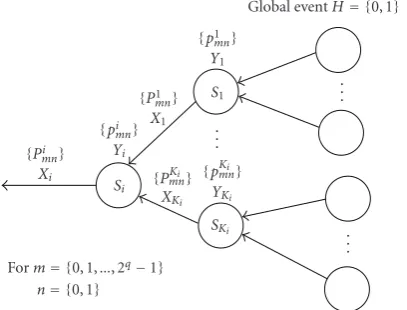
Figure2: A local view of a tree topology showing an intermediate node Si with its Ki children S1,S2,. . .,SKi. For any node Si, Yi represents its q-bit observation while Xi corresponds to itsq-bit decision.
3. MULTIBIT DECISION FUSION RULE FOR TREE TOPOLOGY
The optimum multibit (q-bit) fusion rule (q-CV) for star topology had been derived inSection 2, and is given by (8) and (9). In this section, we develop the multibit decision fusion rule (q-CV) for tree topology.
3.1. Proposedq-CV fusion rule for tree topology
A local view of a tree topology is shown inFigure 2, in which Siis any intermediate node havingKichildrenS1,S2,. . .,SKi.
In a tree topology, any non-leaf node has the following function: it senses the data (observation) and fuses the data sensed by itself with the data received from its children to form a summary, and it forwards the summary to its parent (data transmission), while a leaf node observes the data and transmits it to its parent.
Here every nodeSiquantizes its sensed data usingqbits
to obtain itsq-bit quantizedobservationYi ∈ {0, 1,. . ., 2q−
1}. We representYias (Yi,1,Yi,2,. . .,Yi,q), whereYi,j∈ {0, 1}
is the jth bit inYi. The performance indices associated with
Yiarepimn=P(Yi=m|H =n) form∈ {0, 1,. . ., 2q−1}
andn ∈ {0, 1}. Further, each node (saySi) acts as a fusion
center to make its q-bit decision Xi ∈ {0, 1,. . ., 2q −1}
using the proposedq-bit optimum fusion rule (q-CV). Recall thatq-bitdecisionXi=(Xi,1,Xi,2,. . .,Xi,q) of nodeSi, where
Xi,j ∈ {0, 1}is the jth bit inXi. The performance indices
associated with Xi are Pmni = P(Xi = m | H = n) for
m∈ {0, 1,. . ., 2q−1}andn∈ {0, 1}. To make local optimum q-bit decisionXi, nodeSiuses the proposed optimumq-bit
fusion rule (q-CV). The likelihood ratio forq-CV fusion rule for star topology has been given by (8). In a tree topology, the likelihood ratio forq-CV fusion rule at any nodeSihavingKi
children takes the form
whereai ∈ {0, 1,. . ., 2q−1}is the value taken byYi, and
bj ∈ {0, 1,. . ., 2q−1}is the value taken byXj. The fusion
centerSimakes itsq-bit decisionXiby comparingΛCVqwith
the thresholdsT0,T1,. . .,T(2q−2)using (9).
Thus each nodeSirequires the knowledge ofpimnandP j mn
of its each childSj, for j =1,. . .,Ki,m∈ {0, 1,. . ., 2q−1},
andn∈ {0, 1}. At a first glance, it looks difficult to have the information about the performance indices associated with the decision made by every sensor node practically available. However, as will be seen latter, for implementingq-CV for tree structure, we can compute the performance indices for every node’s decision, in a hierarchical manner, starting from the leaf nodes to the sink node.
Computation of performance indices
Here we show how the performance indices Pi
mn, for any
node Si, can be computed when the performance indices,
pi
mnof its observation and the performance indicesP j
mnof
the decision made by its each childSj, j = 1, 2,. . .,Ki, are
known.
For any 0 ≤ m ≤ 2q −1, letX
m be the set of values
X=[Yi,X1,X2,. . .,XKi]∈ {0, 1,. . ., 2
q−1}Ki+1which gives
Xi=m. Then for anyn∈ {0, 1}, we have
Pimn=P
Xi=m|H=n
=
(ai,b1,...,bKi)∈Xm
PYi=ai|H=n
PX1=b1|H=n
· · ·PXKi =bKi|H=n
=
(ai,b1,...,bKi)∈Xm
pi
ain
Ki
j=1
Pbjjn
.
(13)
During theinitial setup, the performance indices asso-ciated with the decision made by each node are computed starting from leaf nodes to the sink node. Further, each node transmits its performance indices to its parent as soon as they are computed. In a static network, there is no change in the topology and the performance indices of the observation made by the nodes. This leads to fixed performance indices of the decisions made by all of the nodes. Thus for a static topology, the computation and transmission of the performance indices happen only once, that is, during the initial setup.
The topology of a sensor network may change because of the death of the nodes which occurs due to exhaustion of the battery power or hardware failure of the nodes. The change in topology due to the elimination of a single node in a tree topology may result in changes in the performance indices of several nodes. Further, the performance indices of the observation made by the nodes may also vary with time, which in turn results in a variation in the performance indices of all their successors. Thus as nodes die, either the performance indices should be computed and transmitted periodically throughout the network, or the algorithm has to run with the original, but incorrect, values of performance indices. While the first option adds periodic transmission
overhead and thus reduces the network lifetime, the second option compromises the accuracy.
Data transfer in a session
After theinitial setup, aq-bit decision is made by each node, in a hierarchical manner, using (12) and (9) which requires precomputed values of the performance indices and theq-bit decisions received from its children. The decision made by a node is further transmitted to its parent. This process starts from leaf nodes and is continued till the sink node makes the final decision about an event. This process of the decision making and the data transfer by all the nodes will be termed as asessionin a tree topology.
Performance evaluation
To evaluate the performance of the algorithm, we now compute the performance indices Psink
mn of the decision
made by the sink node using (13). Let the final q-bit decision made by sink node beXsink. We representXsink as
(Xsink,1,Xsink,2,. . .,Xsink,q), whereXsink,j ∈ {0, 1}is the jth
bit inXsink. The most significant bitXsink,1ofXsinkindicates
the detection decision made by the sink node. ThusPD =
P(Xsink,1 =1|H =1) is the probability that the sink node
makes a decision in favor of the event given that the event has actually occurred (H =1), whilePF=P(Xsink,1=1|H =
0) is the probability that the sink node makes a decision in favor of the event when the event has actually not occurred (H = 0). These system level probability of detectionPD and probability of false alarmPFcan be computed using the performance indicesPsink
mn of the sink node using
PD=
2q−1
j=2(q−1) Psink
j1 ,
PF=
2q−1
j=2(q−1) Psinkj0 .
(14)
We define the accuracy of the sink’s decision,
Accuracy=0.5PD+ 0.5(1−PF), (15)
as another performance evaluating parameter. The equal weightage to maximize PD and minimize PF suggests its suitability for the applications where false alarms are equally intolerable as is the loss of probability of detection. In general, these weights should be chosen based on the relative significance ofPDandPFin the particular application.
The multibit (q-CV) fusion rule presented for the tree topology locally optimizes the decision made by intermediate nodes. However, it may not be the globally optimum fusion rule for a tree topology.
Precision of sensors
P
(
Yi
|
H
=
1)
(1−p)/2 (1−p)/2
p/2 p/2
0 1 2 3
Yi
Figure 3: Probability mass function P(Yi | H = 1) of 2-bit observationYi made by sensor node Si. Here p is the precision of sensor and in general p >0.5. For the above plot, an example value of precisionp=0.7 has been considered without the loss of generality.
P
(
Yi
|
H
=
0)
p/2 p/2
(1−p)/2 (1−p)/2
0 1 2 3
Yi
Figure 4: Probability mass function P(Yi | H = 0) of 2-bit observationYimade by sensor nodeSi. Here pis the precision of sensor and in generalp >0.5. For the above plot, an example value of precisionp=0.7 has been considered.
all sensors forming a tree topology to beequallyprecise with known precisionp. Here the precision of a sensor indicates its probability of correct detection for both the possibilities of the binary hypothesis. Thus, the precision p = P(Yi,1 =
1 | H = 1) = P(Yi,1 = 0 | H = 0) for any sensorSi.
At sensor Si, itsq-bit quantized observationYi follows the
distributionsP(Yi|H=1) (seeFigure 3), andP(Yi|H=0)
(seeFigure 4). Forq=2, we hence assume the following for each sensorSi:
PYi=3|H=1
=PYi=2|H=1
= p
2,
PYi=0|H=1
=PYi=1|H=1
=1−p
2 ,
PYi=3|H=0
=PYi=2|H=0
=1−p
2 ,
PYi=1|H=0
=PYi=0|H=0
= p
2.
(16)
When all the nodes in a tree topology have the same pre-cision, then all the leaf nodes will have the same performance indices for their decisions. This is because the decision made by any leaf node is the same as its observation. However, the performance indices associated with the decision made by the non-leaf nodes may be different because of anunbalanced tree. This is because in a tree topology each node’s decision is influenced by the decision made by its descendants and the topology formed by those descendants.
The parametric methods, like the CV rule, are known to result in a better performance than the majority rule even in the star topology when the nodes have different performance indices [14]. The majority rule is also known to perform suboptimally in a tree topology when the tree is unbalanced [2,20]. Since the tree topology obtained by randomly deploying nodes in practice is rarely balanced, this motivates the use of the proposed q-CV fusion rule in a tree topology. Thus the proposed scheme will also work well for the tree topology when nodes have different precision. However, their performance indices are required to be known in any case to implement q-CV fusion rule.
4. THRESHOLD SELECTION
The present section considers the selection of the thresholds, T0,T1,. . .,T2q−2, that are required in the proposed q-CV
fusion rule given by (8) and (9). We first discuss the threshold selection forq=2 and later generalize it for any value ofq. In our numerical results (seeSection 5), the threshold selection is done as described here.
The (q−1) most significant bits inq-CV are the same as the decision in (q−1)-CV rule. Thus, from [4], we know that the optimum thresholdTfor CV rule and the optimum thresholdT1for the most significant bit of decision using
2-CV are given by
T1=T=logP
H0
PH1
+ log
C10−C00
C01−C11
, (17)
whereCi j, fori= {0, 1}andj= {0, 1}is the cost of deciding
H = i given thatH = j has occurred. For example, if we considerP(H = 1) = P(H = 0) = 0.5,C11 = C00 = 0
(no cost for correct detection), andC10=C01(equal cost for
false alarm and miss detection), the optimum thresholds are T1=T=0.
Figures 5 and 6 show the simulated probability mass function (PMF) ofΛCV(1) for 1-bit CV rule and that ofΛCV2
(10) for 2-bit 2-CV rule, respectively. Here we consider the star topology with K = 10 nodes. The binary hypothesis H is assumed to be equiprobable. For 1-CV, each node Si
transmits its 1-bit decision with Pdi ∈ [0.8, 1] andP fi ∈
[0, 0.2] to the fusion center; while for 2-CV,Sitransmits its
2-bit decision withPdsi =Pdwi=(Pdi/2)∈[0.4, 0.5] and
P f si =P f wi =(P fi/2)∈[0, 0.1] to the fusion center. PMF
ofΛCV2 shows a better separation of plots on both sides of
the threshold “T1” as compared to the separation of plots on
both sides of the threshold “T” in the PMF ofΛCV. Thus
T
Densit
y
0 0.5 1 1.5 2 2.5 3 3.5×10
4
−60 −40 −20 0 20 40 60
ΛCV
Figure 5: Simulated probability mass function (PMF) of ΛCV
consideringP(H=0)=P(H=1).
T1
T0 T2
Densit
y
0 0.5 1 1.5 2 2.5 3 3.5 4 4.5×10
4
−60 −40 −20 0 20 40 60
ΛCV
Figure 6: Simulated probability mass function (PMF) of ΛCV2
consideringP(H=0)=P(H=1).
From (17), for 2-CV, it is not clear how the thresholdsT0
andT2should be chosen to result in best global performance.
We suggest selecting the thresholdsT0andT2as the medians
of the conditional PMF of ΛCV2 given ΛCV2 < T1 and
the median of conditional PMF of ΛCV2 given ΛCV2 >
T1, respectively. This selection of thresholds maximizes the
information carried by the second bit in X0 about the
likelihood ratio ΛCV2. Under this selection criterion, the
thresholds T0 and T2 satisfy P(ΛCV2 < T0) = P(T0 ≤
ΛCV2 < T1) and P(T1 ≤ ΛCV2 < T2) = P(ΛCV2 ≥ T2),
respectively.
Similarly, forq-CV, the thresholdT2(q−1)−1 for the most significant bit is chosen, as in (17), using
T2(q−1)−1=logP
H0
PH1
+ log
C10−C00
C01−C11
. (18)
The remaining thresholds,T0,T1,. . .,T2q−2(exceptT2(q−1)−1), are chosen by dividing the conditional PMF ofΛCVqgiven the
Tree topology
y
0 10 20 30 40 50 60 70 80 90 100
0 20 40 60 80 100
x
Node Sink node
Figure7: The spanning tree as a result of Bellman-Ford routing algorithm on 100 nodes deployed with uniform distribution.
most significant bit is 0 or 1 as appropriate, in equal parts. Thus the thresholds are selected so that the probabilities P(ΛCVq < T0) and P(Ti ≤ ΛCVq < Ti+1), for i =
0, 1,. . ., 2(q−1)−2, are equal, and the probabilitiesP(Ti ≤
ΛCVq< Ti+1), fori=2(q−1)−1, 2(q−1),. . ., 2q−3 andP(ΛCVq≥
T2q−2) are equal.
5. NUMERICAL AND SIMULATION RESULTS
In the current setup, 100 nodes are deployed with uniform distribution in a square area of 100 square units. We use the Bellman-Ford routing algorithm to obtain the spanning tree, as in [2, 6,7], considering the sink node as the final data aggregation node. The range of communication for every node is fixed based on the maximum transmission power. This is assumed to be equal for all nodes. For a given node, the nodes which fall within its communication range become its neighbors. Among its neighbors, each node selects its parent in order to minimize the sum of the link costs associated with the path chosen to reach the sink node. Each link (i,j) is associated with the costCi j =
Ij/Bi [2], where Ij is the total number of nodes capable
of transmitting to the node Sj, and Bi is the remaining
battery power of the node Si. As suggested in [2], the
selection of this cost balances the tree to some extent, which helps the counting rule (majority rule) to perform reasonably well. However, WAS and the proposed q-CV fusion rule are independent of the link cost used for tree formation since they perform equally well for unbalanced trees. Figure 7shows an example of the resulting spanning tree.
(1) CV with fixed threshold (CV-FT). Here the threshold Tat every node is considered to be the same and can be fixed to a value which results in the best possible accuracy of the sink node.
(2) CV with variable threshold (CV-VT). Here every sensor nodeSi throughout the tree uses a different
thresholdTi. We do the local optimization at each
node by selecting a threshold which maximizes the local accuracy of the decision made by that particular node. We believe that this may also have an impact on the detection accuracy of the sink node. However, even CV-VT may not provide the global optimal solution.
For numerical and simulation results, we consider a binary event hypothesis equiprobable in 0 and 1. All 100 nodes deployed in the area are assumed to observe the event with the same precision p. The precision of a sensor is defined in Section 3. In our numerical results, we vary p from 0.55 to 0.95, in steps of 0.05. In particular, we compare the proposed 2-bit CV rule (2-CV) and 1-bit CV rule (CV-FT and CV-VT) with the existing weighted aggregation scheme (WAS) and thecounting rule in terms of numerically computedaccuracyand system levelPDand PF.
5.1. Detection performance
The numerically computed PD/PF and accuracy plots are shown in Figures8and9, respectively. The results presented here are averaged over ten different random deployments, where in each deployment a tree topology is formed by Bellman-Ford routing algorithm.
Accuracy plots in Figure 9 show that the proposed q-CV results in the highest accuracy among all the other schemes. We further observe that even with the use of sensors with precision as less as 65%, the accuracy obtained by 2-CV is close to 100%. It can be inferred from Figure 9 that among all 1-bit aggregation schemes, both CV-FT and CV-VT show significant improvement in accuracy for a tree topology compared to the existing 1-bit aggregation schemes. ThePD, PF plots inFigure 8show that 2-CV results in system level probability of detection almost equal to “1” and the probability of false alarm equal to “0” when the nodes have precision more than 65%.
The results further demonstrate that increasing the number of bits transmitted with q-CV rule results in a significant gain in accuracy of the system. This gain in accuracy for the multibit scheme (q-CV) comes at the cost of network lifetime since it requires the transmission of almost q times the number of bits required for 1-bit aggregation schemes in the data aggregation sessions. The overhead due to routing is approximately the same for all the aggregation schemes. However, in disaster detection applications, we find the application of the more accurate multibit scheme preferable, since the cost incurred in the loss of life and property is of great importance.
PD and PF against precision
PD/PF
0 0.1 0.2 0.3 0.4 0.5 0.6 0.7 0.8 0.9 1
0.55 0.6 0.65 0.7 0.75 0.8 0.85 0.9 0.95 Precision of sensors
PD for 2-CV PF for 2-CV PD for CV-VT PF for CV-VT PD for CV-FT
PF for CV-FT PD for WAS PF for WAS PD for Counting PF for Counting
Figure8: Numerical plots of system level probability of detection (PD), probability of false alarm (PF) with respect to precision of sensorspfor various aggregation schemes.
Accuracy plot
A
ccur
acy
0.55 0.6 0.65 0.7 0.75 0.8 0.85 0.9 0.95 1
0.55 0.6 0.65 0.7 0.75 0.8 0.85 0.9 0.95 Precision of sensors
2-CV CV-VT CV-FT
WAS Counting
Figure9: Numerical plots of detectionaccuracywith respect to precision of sensorspfor various aggregation schemes.
5.2. Network lifetime-accuracy tradeoff
for the death of nodes. Network lifetime has been defined in literature [2,6,20] in various ways. They are as follows.
(1)NL1. In [6], we considered network lifetime to be the duration for which all the nodes in a network are alive. Thus network lifetimeNL1is considered to be the time till the death of the first node in a network. (2)NL2. As considered in [2],NL2refers to the duration
for which more than 50% of the nodes in a network are alive.
(3)NL3. In [20], the network lifetime has been defined as the duration for which the probability of error delivered by a network is below a certain error threshold. This ensures the delivery of a desired level of performance by a network during the course of its entire lifetime. Here we consider the network lifetime NL3 to be the duration for which the detection accuracy is above some accuracy threshold.
In a simulation setup, we consider a deployment of 100 nodes, each with an initial battery power of 300 000 units in a square area. A fixed transmission power of 300 units and reception power of 100 units is considered for the simulation of network lifetime. Bellman-Ford routing algorithm along with computation and communication of the parameters necessary for the fusion rule is done during the initial setup. For instance, in the existing weighted aggregation scheme [6], the update of the total number of descendants of each node is provided by each child node to its parent. In the proposedq-CV fusion rule, the performance indices of the decision made by each node are communicated to its parents. However, in theCountingrule parameter, communication is not required.
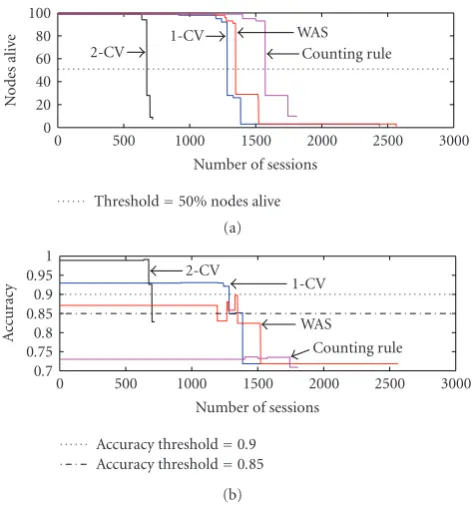
Each time a node dies due to the loss of battery power, the initial setup is required to be re-executed to obtain a new tree topology with the remaining nodes. The plot of the number of nodes alive with respect to number of sessions of operation for various data fusion schemes is shown inFigure 10(a).
A threshold at 50% of the nodes alive is shown in
Figure 10(a) which defines the network lifetime NL2 for various fusion rules in terms of the number of sessions. The NL2 for various aggregation schemes is shown in the second row ofTable 1. It can be observed that 2-CV rule has approximately half the network lifetime compared to 1-CV and WAS schemes. Whereas, thecounting rule has slightly better network lifetime compared to the 1-CV and WAS because of low overhead in the initial setup. The first row inTable 1represents the network lifetime NL1, which is the time till the death of the first node in the network. This also shows the network lifetime of the counting rule to be the highest while the network lifetime of the 2-CV fusion rule to be the lowest.
As the nodes die in the network, the Bellman-Ford routing algorithm is re-executed to obtain the new tree topology. With loss of more nodes in a network, the detection accuracy is expected to decrease. Thus for any change in topology due to death of nodes, the accuracy delivered by the network is numerically recomputed. We consider all sensors to be precise with precisionp=0.65 for numerical results of
No
d
es
al
iv
e
0 20 40 60 80 100
0 500 1000 1500 2000 2500 3000
Number of sessions 2-CV
1-CV WAS
Counting rule
Threshold=50% nodes alive (a)
A
ccur
acy
0.7 0.75 0.8 0.85 0.9 0.95 1
0 500 1000 1500 2000 2500 3000
Number of sessions 2-CV
1-CV WAS
Counting rule
Accuracy threshold=0.9 Accuracy threshold=0.85
(b)
Figure 10: (a) Simulation results for network lifetime with respect to number of sessions for various aggregation schemes. (b) Numerical results of accuracy with respect to number of sessions for various aggregation schemes.
Table1: Network lifetime in the number of sessions for various aggregation schemes.
Network lifetime Fusion rule
Counting WAS 1-CV 2-CV
NL1 1400 1193 916 636
NL2 1571 1347 1283 674
NL3 with accuracy threshold 0.85 0 1194 1283 698
NL3 with accuracy threshold 0.9 0 0 1283 698
accuracy plots shown inFigure 10(b). Accuracy thresholds of 0.9 and 0.85 are shown in Figure 10which defines two different sets of network lifetimes NL3. The selection of high-accuracy thresholds (0.9 and 0.85) is to guarantee the superior performance of the schemes when the precision of the individual nodes is as low as 0.65.
The last two rows ofTable 1 show the network lifetime NL3 for various schemes by considering an accuracy thresh-olds of 0.85 and 0.9, respectively. These results indicate that the lifetime of the proposed 1-CV is the highest among all 1-bit aggregation schemes. Figure 10(b)also shows the significant improvement in accuracy for 1-CV as compared to the WAS and the counting rule as was seen in Figure 9. Further, this gain in accuracy comes without any loss in the network lifetime.
Averaged accuracy plots of 2-CV for different actual precisions
A
ccur
acy
0.75 0.8 0.85 0.9 0.95 1
0.55 0.6 0.65 0.7 0.75 0.8 0.85 0.9 0.95 Assumed precision of sensors
Actualp=0.65 Actualp=0.625 Actualp=0.6
Actualp=0.575 Actualp=0.55
Figure11: Perturbation analysis: numerically computed accuracy plot with respect to assumed precision of sensors. Different plots are for different values of actual precisionp.
improvement in detection accuracy as compared to 1-CV fusion rule.
5.3. Perturbation analysis
The proposedq-CV fusion rule requires knowledge of the performance indices of the observation made by each node. Results of the proposed q-CV presented in Figures 8, 9, and10assumed correct knowledge of the precision pof all the sensors. In this subsection, we study the performance sensitivity of q-CV to incorrect knowledge of precision p. It should be noted here that the majority-based aggregation scheme does not need the knowledge of p. Figure 11
shows the numerically computed accuracy of the proposed q-CV fusion rule for various values of actual precision p with respect to an assumed (incorrect) precision used for decision making. A negligible variation in accuracy is observed even when the precision assumed for decision making was significantly different from the actual precision of the nodes. It can be inferred that the proposed q-CV fusion rule is robust to inaccuracy in the knowledge of the performance indices of nodes. One possible explanation for this robustness is that with an incorrect value of the precision p, the calculated performance indices for all the sensors have similar perturbation from their true value. Since the decision in a node depends only on the relative value of the performance indices of its children, the decision is robust against error in the assumed value ofp.
6. CONCLUSION
The problem of distributed data fusion in wireless sensor networks with tree topology was considered in the context of binary event detection. An efficient multibit (q-bit) decision fusion rule (q-CV) for tree topology had been proposed in the current work. This scheme achieves a significant gain
in detection accuracy for q > 1. However, with increasing q, the network lifetime decreases due to more transmission per aggregation session. This significant improvement in accuracy at the cost of network lifetime with increasing q offers a good tradeoff between accuracy and network lifetime.
ACKNOWLEDGMENTS
This work was partially supported by a grant from Ministry of Communication and Information Technology (Depart-ment of Information Technology) Govern(Depart-ment of India under the project “AgriSens: Design and Development of Wireless Sensor Networks for Real-Time Monitoring.” The authors are grateful to the anonymous referees for their detailed comments toward improving the quality of the paper.
REFERENCES
[1] I. F. Akyildiz, W. Su, Y. Sankarasubramaniam, and E. Cayirci, “A survey on sensor networks,”IEEE Communications Maga-zine, vol. 40, no. 8, pp. 102–105, 2002.
[2] S. Borbash,Design consideration in wireless sensor networks, Ph.D. dissertation, Institute for System Research (ISR), Uni-versity of Maryland, College Park, Md, USA, 2004.
[3] R. Niu and P. K. Varshney, “Distributed detection and fusion in a large wireless sensor network of random size,”EURASIP Journal on Wireless Communications and Networking, vol. 2005, no. 4, pp. 462–472, 2005.
[4] R. Viswanathan and P. K. Varshney, “Distributed detection with multiple sensors—I. Fundamentals,”Proceedings of the IEEE, vol. 85, no. 1, pp. 54–63, 1997.
[5] R. S. Blum, S. A. Kassam, and H. V. Poor, “Distributed detec-tion with multiple sensors—II. Advanced topics,”Proceedings of the IEEE, vol. 85, no. 1, pp. 64–79, 1997.
[6] B. G. Jagyasi, B. K. Dey, S. N. Merchant, and U. B. Desai, “An MMSE based weighted aggregation scheme for event detection using wireless sensor network,” inProceedings of the 14th European Signal Processing Conference (EUSIPCO ’06), Florence, Italy, September 2006.
[7] B. G. Jagyasi, B. K. Dey, S. N. Merchant, and U. B. Desai, “Weighted aggregation scheme with lifetime-accuracy tradeoff in wireless sensor network,” inProceedings of the 4th Inter-national Conference on Intelligent Sensing and Information Processing (ICISIP ’06), pp. 31–36, Bangalore, India, December 2006.
[8] S. Cui, R. Madan, S. Lall, and A. J. Goldsmith, “A joint routing, MAC, and link layer optimization in sensor networks with energy constraints,” inProceedings of the IEEE International Conference on Communications (ICC ’05), vol. 2, pp. 725–729, Seoul, Korea, May 2005.
[9] A. Sheth, K. Tejaswi, P. Mehta, et al., “Poster abstract-senslide: a sensor network based landslide prediction system,” in Proceedings of the 3rd ACM Conference on Embedded Networked Sensor Systems (SenSys ’05), San Diego, Calif, USA, November 2005.
inProceedings of the 4th International Conference on Mobile Systems, Applications and Services (MobiSys ’06), pp. 28–41, Uppsala, Sweden, June 2006.
[11] G. Werner-Allen, J. Johnson, M. Ruiz, J. Lees, and M. Welsh, “Monitoring volcanic eruptions with a wireless sensor network,” in Proceedings of the 2nd European Workshop on Wireless Sensor Networks (EWSN ’05), pp. 108–120, Istanbul, Turkey, January-Febuary 2005.
[12] G. Werner-Allen, K. Lorincz, M. Welsh, et al., “Deploying a wireless sensor network on an active volcano,”IEEE Internet Computing, vol. 10, no. 2, pp. 18–25, 2006.
[13] J. N. Tsitsiklis, “Decentralized detection,” in Advances in Statistical Signal Processing, H. V. Poor and J. B. Thomas, Eds., vol. 2, pp. 297–344, JAI Press, Greenwich, Conn, USA, 1993. [14] Z. Chair and P. K. Varshney, “Optimal data fusion in multiple
sensor detection systems,”IEEE Transactions on Aerospace and Electronic Systems, vol. 22, no. 1, pp. 98–101, 1986.
[15] Z. Chair and P. K. Varshney, “Distributed Bayesian hypothesis testing with distributed data fusion,” IEEE Transactions on Systems, Man and Cybernetics, vol. 18, no. 5, pp. 695–699, 1988.
[16] B. Chen, R. Jiang, T. Kasetkasem, and P. K. Varshney, “Channel aware decision fusion in wireless sensor networks,” IEEE Transactions on Signal Processing, vol. 52, no. 12, pp. 3454– 3458, 2004.
[17] R. Niu, P. K. Varshney, M. Moore, and D. Klamer, “Decision fusion in a wireless sensor network with a large number of sensors,” in Proceedings of the 7th International Conference on Information Fusion (FUSION ’04), vol. 1, pp. 21–27, Stockholm, Sweden, June-July 2004.
[18] Y. Lin, B. Chen, and P. K. Varshney, “Decision fusion rules in multi-hop wireless sensor networks,”IEEE Transactions on Aerospace and Electronic Systems, vol. 41, no. 2, pp. 475–488, 2005.
[19] W. B. Heinzelman, A. P. Chandrakasan, and H. Balakrishnan, “An application-specific protocol architecture for wireless microsensor networks,” IEEE Transactions on Wireless Com-munications, vol. 1, no. 4, pp. 660–670, 2002.
[20] G. Ferrari and M. Martal ´o, “Extending the lifetime of sensor networks through adaptive reclustering,”EURASIP Journal on Wireless Communications and Networking, vol. 2007, Article ID 31809, 20 pages, 2007.
[21] H. L. V. Trees,Detection Estimation and Modulation Theory, vol. 1, John Wiley & Sons, New York, NY, USA, 1969. [22] E. Lehmann,Testing Statistical Hypotheses, John Wiley & Sons,