R E S E A R C H
Open Access
Optimized cross-layer forward error correction
coding for H.264 AVC video transmission over
wireless channels
Ali Talari
1*, Sunil Kumar
2, Nazanin Rahnavard
1, Seethal Paluri
2and John D Matyjas
3Abstract
Forward error correction (FEC) codes that can provideunequal error protection(UEP) have been used recently for video transmission over wireless channels. These video transmission schemes may also benefit from the use of FEC codes both at theapplication layer(AL) and thephysical layer(PL). However, the interaction and optimal setup of UEP FEC codes at the AL and the PL have not been previously investigated. In this paper, we study the cross-layer design of FEC codes at both layers for H.264 video transmission over wireless channels. In our scheme, UEPLuby transform codesare employed at the AL andrate-compatible punctured convolutionalcodes at the PL. In the proposed scheme, video slices are first prioritized based on their contribution to video quality. Next, we investigate the four combinations of
cross-layer FEC schemes at both layers and concurrently optimize their parameters to minimize the video distortion and maximize the peak signal-to-noise ratio. We evaluate the performance of these schemes on four test H.264 video streams and show the superiority of optimized cross-layer FEC design.
Keywords: Video transmission; Forward error correction; LT codes; RCPC codes; Cross-layer; Wireless channels; Video coding; H.264
1 Introduction
Multimedia applications such as video streaming, which are delay sensitive and bandwidth intensive, are grow-ing rapidly over wireless networks. However, existgrow-ing wireless networks provide only limited bandwidth and time-varying quality of service (QoS) support for these applications. Due to limited wireless bandwidth, the video is compressed using sophisticated compression tech-niques such as H.264 AVC, which is the state-of-the-art video compression standard jointly developed by the ITU and ISO [1]. The compressed video is vulnerable to chan-nel impairments as the corrupted packets induce different levels of quality degradation due to temporal and spa-tial dependencies in the compressed bitstream. The most important problem that affects video quality is error prop-agation where an error in a reference frame is propagated by the decoder to all future reconstructed frames, which are predicted from the corrupted reference frame. This
*Correspondence: [email protected]
1Department of Electrical and Computer Engineering, Oklahoma State University, Stillwater, OK 74078, USA
Full list of author information is available at the end of the article
problem has led to the design of error-resiliency fea-tures, such asflexible macroblock ordering(FMO) [2], data partitioning, and error concealment schemes in H.264 [1,3,4]. Recent research has demonstrated the promise of cross-layer protocols for supporting the QoS demands of multimedia applications over wireless networks [5-7]. For example, van der Schaar and Shankar [6] showed the benefits of the joint APP-MAC-PHY approach for transmitting video over wireless networks.
Forward error correction (FEC) schemes are used to
protect the video data against channel errors in order to improve the successful data transmission probability and to eliminate the costly retransmissions. However, the maximum throughput does not guarantee the minimum video distortion at the receiver for the following rea-sons.First, unlike data packets, loss of H.264 compressed video slices induces different amounts of distortion in the received video. Therefore, the FEC code rates should be adaptive to the slice priority.Second, video data are delay sensitive; therefore, the retransmission of corrupted slices may not be feasible. Third, a video stream can tolerate
loss of some slices because the lost slices can be error-concealed. This is true especially for the low-priority slices, which introduce low distortion in the received video and result in graceful quality degradation. In this paper, we consider H.264 AVC streams with fixed slice sizes, where each slice can be independently decoded. The video slices are classified intofourpriority classes based on the distortion contributed by their loss to the received video quality.
An FEC code that provides unequal error protection
(UEP), i.e., a higher (lower) protection to high (low)-priority video slices, can achieve considerable quality
improvement compared to the equal error protection
(EEP) FEC codes [8,9]. Note that the UEP FEC codes may be employed both at theapplication layer(AL) and physi-cal layer(PL). Recently, some schemes [5,10,11] have con-sidered the precise tuning of EEP FEC schemes at the AL and the PL. However, to the best of our knowledge, exist-ing schemes have not investigated the cross-layer design of UEPFEC codes at the AL and the PL for prioritized video transmission. Employing FEC codes at both layers introduces two interesting trade-offs that we investigate in this paper.First, both FEC codes share a common channel bandwidth to add their redundancy and the optimal ratio of overhead added by each needs to be determined for a given channel signal-to-noise ratio (SNR) and bandwidth. Second, since UEP can be provided at both layers, we need to find the optimal UEP/EEP FEC setup to maximize the video peak SNR (PSNR). To tackle these trade-offs, we
concurrently tune the parameters of two FEC codes at
both layers.
We useUEP Luby transform (LT) codes [12,13] at the AL andrate-compatible punctured convolutional(RCPC) codes [14] at the PL. LT codes [15] are modern and effi-cient FEC codes that are specifically suitable for packet-level coding at the AL. These codes arerateless[12,13,15,16] in the sense that they can generate unlimited encoded information from a finite-length source information.
Next, we carry out a cross-layer optimization to find the optimal parameters of both FEC codes by considering the relative priorities of video packets. For a known channel SNR (i.e., Es
N0), we address the problem of assigning opti-mal FEC code rates at the AL and the PL to the individual priority slices within the channel bit-rate limitations. The information about the channel conditions can be obtained from the receiver in the form of channel side information [5-7,17,18].
The scheme provides higher transmission reliability to high-priority slices at the expense of the higher loss rates for low-priority slices and, whenever necessary, also dis-cards some low-priority slices to meet the channel bit-rate limitations. We show that adapting the FEC code rates to the slice priority reduces the overall expected video distortion at the receiver. Our scheme does not assume
retransmission of lost slices. The preliminary results of this paper appeared in [8].
This paper is organized as follows: Section 2 provides an overview of the related work on FEC coding for video streams. Section 3 provides a brief background on the LT and RCPC FEC codes. Section 4 describes the video slice priority assignment, design of LT and RCPC codes, and layer FEC schemes. Section 5 presents the cross-layer optimization and performance of the proposed FEC schemes. The simulation results of the proposed cross-layer FEC schemes on sample H.264 videos are presented in Section 6, followed by conclusions in Section 7.
2 Related work
LT codes have recently become popular in video trans-mission schemes due to their good performance and low complexity [15]. Kushwaha et al. [19] used LT codes to encode group of pictures (GOP) of each layer of H.264 SVC video for transmission over cognitive radio wireless networks. Ahmad et al. [17] took advantage of the rateless-ness of LT codes and proposed an adaptive FEC scheme for video transmission over the Internet by employing feedback from receivers in the form of acknowledgement. Cataldi et al. [18] proposed a novel LT code, called sliding-window Raptor codes, with a higher efficiency than reg-ular LT codes. They used these codes to provide UEP for a two-layer H.264 SVC scalable video. LT codes were also used in [20-25] to design streaming schemes with lower complexity.
Stockhammer et al. [5] defined the protocol stack, including the FEC coding at the AL and the PL, for the
multimedia broadcast multicast service(MBMS)
down-load and streaming in universal mobile telecommunica-tion system (UMTS). In [5], a Raptor code [16] is used at the AL and a turbo code at the PL. Gomez-Barquero and Bria [10] suggested employing the Raptor codes as the AL FEC in DVB-H systems for mobile terminals and demonstrated its advantages over conventional
multipro-tocol encapsulation(MPE) FEC. Conventional MPE FEC
employs the Reed-Solomon codes to encode the video stream; hence, it lacks the flexibility of LT coding at the AL. Courtade and Wesel [11] considered a setup with LT coding at the AL and turbo coding at the PL, and showed that the available channel bandwidth should be optimally split between the AL and PL FEC codes to improve the system performance.
FEC coding may guarantee the ratio of satisfied users who are receiving the video stream. Afzal et al. [28] investi-gated the overall system performance when the AL FEC codes are used in video streaming in UMTS and packet radio services. Alexiou et al. [29] studied the power con-trol of streaming overhigh-speed downlink packet access systems when the AL FEC is employed. Munaretto et al. [30] proposed an interesting optimization of the AL FEC coding, video source coding, and the PL rate selection to improve the PSNR of delivered video on cellular networks. The authors in [31] also considered employing the Raptor codes at the AL to improve the quality of service for video
in MBMS in long-term evolution (LTE) networks. They
investigated the benefits of the AL FEC to multicast multi-media contents and examined how much FEC redundancy should be used under different packet loss patterns.
In [8], we investigated UEP rateless coding at the AL and assumed an ideal PL coding. We found the optimal param-eters of a UEP rateless code that maximizes the video quality at the receiver for known channel bandwidth. In this paper, we extend the results of [8] and consider the interaction of the AL coding with the PL coding in video transmission schemes.
3 Background
In this section, we briefly review LT and RCPC FEC codes that will be used at the AL and the PL, respectively, in our proposed cross-layer FEC scheme.
3.1 LT codes
Recently, a new class of FEC codes called rateless (Foun-tain) codes has been invented. LT codes [15] and Raptor codes [16] are examples of such codes. Unlike other FEC codes, such as LDPC codes [32], rateless codes can adapt to any erasure channel with unknown or varying charac-teristics as they do not impose any code rate constraint. Fountain codes are especially very desirable for packet-level coding at the application layer, where the underlying channel can be modeled as a packet erasure channel.
LT codes can generate a limitless number of output
symbolsfromNsinput symbolsbased on a degree distri-bution{1,2,. . .,Ns}, whereiis the probability that
an output symbol has degreei, and Ns
i=1i = 1. This probability distribution can also be shown by its genera-tor polynomial(x) = Ns
i=1ixi. In LT coding, first an output symbol degree d is randomly chosen from (.). Next,dinput symbols are chosenuniformlyandrandomly fromNs input symbols and are bit-wiseXORed together to generate an output symbol.(.)is usually fine-tuned such that theNsinput symbols can be decoded from any γrNsoutput symbols, forγr slightly greater than 1. Here, γr is the received coding overhead. LT decoding is per-formediteratively. At each iteration, an output symbol is
found such that the value of all but one of its neighbor-ing input symbols is known. The value of the unknown input symbol is computed by a simple XOR. This step is applied iteratively until no more such output symbols can be found.
Robust-Soliton degree distribution was designed by Luby for LT codes [15]. LT coding with Robust-Soliton distribution results in asymptotically capacity-achieving codes with the encoding complexity of O(NslogNs). To reduce the coding complexity to linear (at the cost of a slight performance loss), new degree distributions for LT codes have been introduced such as [16]
(x)=0.00797x+0.49357x2+0.16622x3 +0.07265x4+0.08256x5
+0.05606x8+0.03723x9+0.05559x19 +0.02502x65+0.00314x66.
(1)
In this paper, we use (1) as the degree distribution of LT codes.
Interestingly, it has been shown that LT codes can eas-ily provide UEP property with a slight change in the encoding process. In [12,13], the authors proposed UEP LT codes by modifying the source symbol selection from
uniform to non-uniform. In UEP LT codes, Ns source
symbols are partitioned intor sets,s1,s2,. . .,sr of sizes τ1Ns,τ2Ns,. . .,τrNs, such thatrj=1τj = 1. Letpjbe the probability that a source symbol from setsjis chosen to form an encoded symbol. Consequently, we define the protection level of priorityi group as ki = piNs, where
r
j=1kjτj = 1. Further, letyl,j be the probability that a source symbol insj is not recovered afterlLT decoding iterations at the receiver. Forj=1,. . .,rwe have [12,13]
yl,j=δj(1−β(1− r
m=1
pmτmNsyl−1,m)),l≥1, (2)
wherey0,j=1,β(x)=(x)/ (1),andδj(x)=eNspj (1)γ
r(x−1).
It can be shown that sequences{yl,j}l,∀jconverge to a fixed pointyj[12,13], whereyjis the final decoding error rate of symbols in setj ∈ {1, 2,. . .,r}for a UEP LT code with the parameters{(x),γr,τ1,τ2,. . .,τr,p1,p2,. . .,pr}. For EEP LT coding, we havekj=1,j∈ {1, 2,. . .,r}; hence, ∀j ∈ {1, 2,. . .,r},yj = y. Note that (2) has been derived from tree-graph approximation of LT codes and provides yj’s for asymptotic case (Ns→ ∞) [12,13,16].
3.2 RCPC codes
punc-turing patterns to obtain various code rates. The RCPC decoder employs aViterbidecoder. The bit error ratePb of the Viterbi decoder is upper bounded by [14]
Pb≤
where df is the free distance of the convolutional code, Pis the puncturing period, andcdis the total number of error bits produced by the incorrect paths and is known as thedistance spectrum[14]. Finally,Pdis the probability of selecting a wrong path in Viterbi decoding with Hamming distanced, which depends on the modulation and channel characteristics. For an RCPC code with rateR, using the additive white Gaussian noise (AWGN) channel, binary phase shift keying (BPSK) modulation, and the symbol to noise power ratio ES
N0 = R
Eb
N0, the value ofPd (using soft Viterbi decoding) is given by [14]
Pd=
4 Cross-layer FEC coding for H.264 video bitstream
In this section, we discuss a priority assignment scheme for H.264 AVC video slices, design of LT and RCPC codes, and our proposed cross-layer FEC scheme. We consider a unicast video transmission from a source node (at the transmitter) to a destination node (at the receiver) in a single-hop wireless network and ignore the intermediate network layers, i.e., transport layer (TL), network layer (NL), and link layer (LL). This allows our algorithm to be employed with different existing network protocols stacks.
4.1 Priority assignment for H.264 video slices
In H.264 AVC, the video frames are grouped into GOPs, and each GOP is encoded as a unit. For the sake of simplic-ity, we use a GOP length of 30 frames which corresponds to a duration of 1 s. We encode each GOP independently by employing FEC codes. We have used a fixed slice size configuration where macroblocks of a frame are aggre-gated to form a fixed slice size. Let Ns be the average number of slices in 1 s of the video. More details of the video encoding parameters are given in Section 6.
H.264 slices can be prioritized based on theirdistortion contribution to the received video quality [9,33-37]. In this paper, the total distortion of a slice loss is computed using
the cumulative mean square error(CMSE), which takes
into consideration the error propagation within the entire GOP [9,34]. Let the original uncompressed video frame at timetbef(t), the decoded frame without the slice loss
befˆ(t), and the decoded frame with the slice loss bef˜(t). Assuming that each frame consists ofN×Mpixels, the MSE introduced by the loss of a slice in the video frame is computed by
The loss of a slice in a reference frame can also introduce error propagation in the current and subsequent frames until the end of GOP. The CMSE contributed by the loss of the slice is thus computed as the sum of MSE over the current and all the subsequent frames in the GOP. Note that computation of slice CMSE requires decoding of the entire GOP for every slice loss, which introduces computational overhead. This overhead can be avoided by predicting the slice CMSE using a low-complexity scheme recently proposed by us in [9]. This slice CMSE prediction scheme uses certain parameters from the current encoded frame alone without using the future frames in the GOP.
We use the CMSE metric to determine the slice prior-ity. All slices in a GOP are distributed intor =4 priority classes ofequal sizebased on their CMSE value. The pri-ority 1 slices induce the highest distortion whereas the priority 4 slices induce the least distortion to received video quality. Note that using more than four slice pri-orities would result in a more accurate and flexible UEP coding at the cost of higher complexity due to a larger number of design parameters. In fact, using Ns priority levels would achieve the best performance where each slice is separately protected based on its CMSE. On the other hand, using fewer than four priority levels would limit the flexibility of our scheme and hence decrease its performance.
Let CMSEi denote theaverageCMSE of all slices in a priority classi. Therefore, we have CMSE1> CMSE2 >
CMSE3 > CMSE4. Since CMSEi may vary considerably for various videos depending on their content, we use
the normalized CMSEi, CMSEi = 4CMSEi
j=1CMSEj to
repre-sent the relative importance of a priority class. We show CMSEi for six H.264 test video sequences in Table 1. These video sequences have widely different spatial and temporal content.
Table 1 Normalized CMSE, CMSEi, for slices in different
priorities of sample videos
Sequence CMSE1 CMSE2 CMSE3 CMSE4
Coastguard 0.61 0.22 0.12 0.05
Foreman 0.63 0.21 0.11 0.05
Bus 0.64 0.21 0.10 0.04
Football 0.65 0.21 0.10 0.04
Silent 0.68 0.2 0.09 0.03
Akiyo 0.85 0.12 0.03 0.01
We choose the CMSEivalues of Bus, which are similar to most other videos discussed above, to tune our pro-posed cross-layer scheme for all videos in Section 5. Since the CMSEivalues of Akiyo are different, we also study the performance of the proposed cross-layer FEC scheme for Akiyo by using its own CMSEi values and compare it to the performance of the scheme designed using the CMSEi values of Bus in Section 6.
4.2 Design of LT codes at the AL
The video slices may be either directly passed to the PL or encoded using an EEP/UEP LT code before passing to the PL. Therefore, the AL frames contain either uncoded or LT-coded video slices. When no LT coding is performed at the AL, each video slice forms an AL frame and theNsAL frames are given to the lower network layers. When the LT coding is performed at the AL,γtNsAL frames, con-taining LT-coded output symbols, are generated fromNs video slices, whereγt≥1 denotes the LT coding overhead at thetransmitter. Note that the size of each LT-coded AL frame is still 150 bytes, i.e., the same as input video slice size, whereas the number of AL frames increases toγtNs fromNs. We emphasize that the transmitted LT overheadγtshould not be confused with the received LT coding overhead γr. Generally, γr = γt since some AL frames may not be correctly delivered to the receiver due to channel-induced losses.
The parameters of the UEP LT code at the AL areki,i∈ {1,. . ., 4}andγt, which need to be optimized while con-sidering the FEC at the PL in the cross-layer setup. Since all r = 4 priority levels have equal size, we haveτ1 =
τ2=τ3=τ4= 14(see Section 3.1). For EEP/UEP LT
cod-ing, we use the standard degree distribution given by (1) [12,13,16].
When UEP rateless codes designed in [12,13] are used at the AL, allγtNsLT-coded symbols have equal impor-tance. In other words, while more emphasis is given on the higher priority video slices, compared with the lower priority slices, in generating each encoded symbol, the UEP property is embedded in all the encoded symbols equally. Therefore, when UEP rateless codes designed in [12,13] are used, only EEP FEC coding should be
performed at the PL. On the other hand, when video slices are passed to the lower layers without the AL FEC coding, the UEP FEC coding can be performed at the PL based on the slice priority. However, the rateless codes discussed in [21,25] are capable of encoded symbols with unequal importance.
4.3 Design of RCPC codes at the PL
At the PL,cyclic redundancy check(CRC) bits are added to each AL frame to detect any RCPC decoding errors. We use the industry-standard CRC-8 defined by the polyno-mial 1+x2+x4+x6+x7+x8[38]. Next, each AL frame is encoded using a UEP/EEP RCPC code. As mentioned earlier, we employ an RCPC code designed in [14] with
the mother code rate ofR = 13 and memory ofM = 6.
Based on the AL frame priority level, the RCPC codes may be punctured to get appropriate higher rates. For four
pri-ority groups of AL frames, we have R1 ≤ R2 ≤ R3 ≤
R4andRi ∈ 8
8,89,108,128,148,168,188,208,228,248
, whereRi represents the RCPC code rate of priorityi AL frames. Therefore, the parameters that need to be tuned at the
PL are R1 through R4. For EEP RCPC codes, we have
R1= R2= R3 = R4. We refer to a frame encoded by the
RCPC code as a PL frame.
For the sake of simplicity and without the loss of gen-erality, we assume that each transmitted packet contains one PL frame. Note that the number of PL frames in a packet does not affect the optimal cross-layer setup of FEC codes in our scheme. We have used a conven-tional BPSK modulation and a simple AWGN channel. Our model can be easily extended to the more complex channel models by using an appropriatePd in (4) from [14]. To obtain the packet error rates at the PL on the receiver side, we first employ (4) to obtain the bit error rate of the received bitstream. Next, we employ Monte Carlo method to obtain the packet error rate at the receiver. We perform numerical RCPC encoding and CRC calculations and simulate the transmission. Finally, we find the ratio of correctly received packets by taking average over 103 packet transmissions in 103iterations.
4.4 System model at transmitter
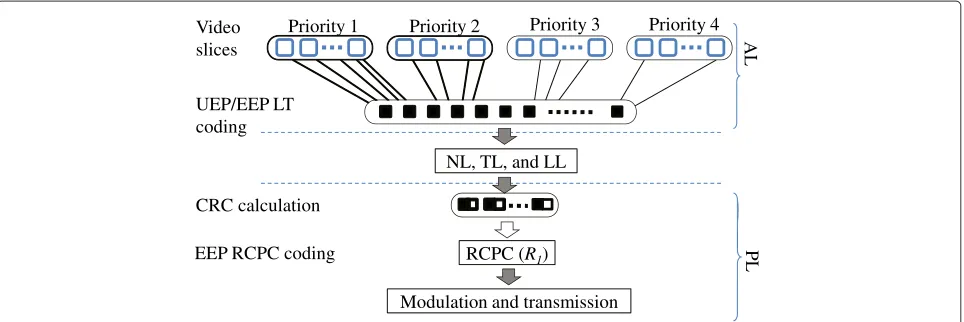
Based on our discussions so far, we can use four com-binations of cross-layer FEC coding schemes at the AL and the PL (summarized in Table 2). Note that the FEC coding is necessary at the PL but optional at the AL. We illustrate the layout of cross-layer FEC schemes in Figure 1
Table 2 Various combinations of cross-layer FEC coding schemes
Model S-I S-II S-III S-IV
AL FEC No FEC No FEC EEP UEP
Video slices
Priority 1 Priority 2 Priority 3 Priority 4
NL, TL, and LL
AL
RCPC (R1) CRC
calculation
RCPC (R2) RCPC (R3) RCPC (R4) PL UEP/EEP
RCPC coding
Modulation and transmission
Figure 1The proposed S-I and S-II cross-layer FEC schemes.In these schemes, the video slices are prioritized at the AL and UEP/EEP FEC coding is performed only at the PL. In S-I, we haveR1=R2=R3=R4. Here, TL, NL, and LL represent the transport, network, and link layers, respectively.
for S-I and S-II schemes and in Figure 2 for S-III and S-IV schemes. The cross-layer optimization of these FEC schemes is discussed in Section 5.
In S-I and S-II, FEC coding is applied only at the PL. In S-I, the equal protection (i.e., EEP RCPC coding) is provided to all frames regardless of their importance. In S-II, the video slices are protected at the PL with vari-ous protection levels based on their priority by using the UEP RCPC coding. We expect this scheme to have a con-siderably improved performance compared to S-I. Note that the priority of each AL frame is conveyed to the PL by using the cross-layer communication. This setup represents the schemes proposed in [36,39-45].
In S-III and S-IV, FEC coding is applied at both the AL and the PL in a cross-layer fashion. In S-III scheme, we add the FEC coding at the AL by using regular EEP LT codes to the base I setup. As we will see later, S-III cannot outperform S-I for all channel conditions since LT codes require extra coding overhead. However, this scheme has the ratelessness property, meaning that it can
tolerate loss of the AL frames and still recover the orig-inal video slices after LT decoding. This is in contrast to S-I and S-II where the corrupted frames are considered lost. This setup represents the cross-layer FEC schemes proposed in [5,10,11,26-31,46].
In the proposed S-IV scheme, we apply the UEP LT codes where different slices are protected according to their priority. This scheme benefits both from ratelessness and UEP property. We expect this scheme to achieve the best performance. When LT coding is applied at the AL, the rateless coded symbols are uniformly generated and all the encoded AL frames have equal importance. As a result, using UEP FEC coding at the PL would not be ben-eficial. This is why we have used EEP FEC coding at the PL in the cross-layer S-III and S-IV schemes.
4.5 Decoding at receiver
Let PERidenote the packet error rate of AL frames of pri-orityiat the receiver after RCPC decoding and before LT decoding at the AL. PERican be computed using (3).
Video slices
Priority 1 Priority 2 Priority 3 Priority 4
UEP/EEP LT coding
NL, TL, and LL
AL
RCPC (R1)
CRC calculation
PL
EEP RCPC coding
Modulation and transmission
Figure 2The proposed S-III and S-IV cross-layer FEC schemes.In these schemes, the video slices are prioritized at the AL and two layers of FEC coding at the AL and the PL are performed. We perform UEP/EEP LT coding at the AL and EEP RCPC coding at the PL. In S-III, we have
In S-I and S-II schemes, each AL frame consists of an uncoded video slice (i.e., LT coding is not performed at the AL). Therefore, the video slice loss rate (VSLR) of slices in priority i is VSLRi = PERi. In S-III and S-IV schemes, on the other hand, the LT decoding should also be performed, and the decoding error rate of LT codes should be considered in VSLRi. In S-III and S-IV schemes, the EEP RCPC code is used at the PL; hence, we have PER1=PER2=PER3=PER4=PER. In this case, we
employ (2) with γr = γtNs(1 −PER), degree distribu-tion (1), and a given set of ki,i ∈ {1,. . ., 4} to find the final LT decoding symbol error rates yi,i ∈ {1,. . ., 4} for each priority at the receiver (see Section 3.1). If the symbol decoding error rate of priority i is yi, then VSLRi=yi.
5 Cross-layer optimization of the proposed FEC schemes
In our cross-layer FEC schemes, we consider the follow-ing issues.First, the AL and PL FEC codes share the same available channel bandwidth to add their coding redun-dancy. As the channel Es
N0 increases, the RCPC code rate at the PL can be increased. Thus, more channel band-width becomes available for improving the LT coding at the AL. For low values of Es
N0, assigning a higher portion of the available redundancy to LT codes at the AL may not improve the delivered video quality since almost all PL frames would be corrupted during transmission. There-fore, a stronger RCPC code rate should be used at the PL. This consumes a larger portion of the channel bandwidth allowing only a weaker LT code at the AL.Second, UEP FEC may be used either at the AL or the PL. We study how using UEP relates to varying Es
N0 and the bandwidth por-tions assigned to each FEC code.Third, the optimal FEC code rates for one scheme in Table 2 may be substantially different from another scheme.
To find the optimal parameters for both the FEC schemes and the portion of channel bandwidth they share, we discuss below the cross-layer optimization for the four schemes given in Table 2.
5.1 Formulation of optimization problem
The goal of cross-layer optimization in our scheme is to deliver a video with the highest possible PSNR for a given channel bandwidthCand SNR. Since computing the video PSNR requires decoding the video at the receiver, it is not feasible to use PSNR directly as the optimiza-tion metric due to its heavy computaoptimiza-tional complexity. The PSNR of a compressed video stream depends on sev-eral factors, including the video characteristics, bit rate, the percentage of lost slices, and their CMSE values [9,34]. Therefore, we define a function ‘normalizedF,’ denoted by F, which represents the weighted distortion contributed
by the slice loss rates and their corresponding normalized CMSE values, as
tuned so that F can correctly capture the behavior of
PSNR. For a compressed video whose PSNR for error-free transmission is already known, minimizingFresults in minimizing the decrease in its PSNR. Selecting the optimalαis discussed in the next section.
To minimizeF, we tune the parameters of the FEC codes at the AL and the PL. In the S-I scheme, the optimization function finds the optimal RCPC code rateRfor a given channel data rateCas
argmin
In S-II, the optimization parameters areR1throughR4,
such that R1 ≤ R2 ≤ R3 ≤ R4. For this scheme, the
optimization function can be written as
argmin
The optimization parameters for S-III areγtandR. In S-III, we havek1=k2=k3=k4=1 since EEP LT coding
is used at the AL. The channel data rate is shared among the two FEC codes and needs to be tuned by selecting an appropriateγt. The optimization function is
argmin {γt,R}
F= {γt∗,R∗}
s.t.γtNs(S+1)R−1≤C.
(8)
In S-IV, the UEP LT codes are used and optimization parameters arek1throughk3, along withγtandR. Here, the value of k4can be determined based on k1 through
Table 3 PSNR of Bus video sequence for various values of
αand ES
N0with optimizedFfor S-II ES
N0 1 dB 2 dB 3 dB 4 dB
α 1,2 3 1,2 3 1 2,3 1 2,3
PSNR 18.2 16.85 22.3 19.8 25.8 20.6 29.69 29
Table 4 Optimal cross-layer parameters for S-I scheme withC=1.4 Mbps
Es/N0 1 dB 1.25 dB 1.5 dB 1.75 dB 2 dB 2.25 dB 2.5 dB 2.75 dB 3 dB 4 dB 5 dB
F 0.998 0.988 0.949 0.852 0.694 0.503 0.328 0.197 0.11 0.008 0
FBus 443.4 438.9 421.6 378.5 307.9 223.5 145.7 87.5 48.9 3.1 0
FForeman 214.7 212.5 204.1 183.3 149.1 108.2 70.6 42.4 23.7 1.5 0
FCoastguard 179.8 178.0 171.0 153.5 124.9 90.6 59.1 35.5 19.8 1.3 0
R 128 128 128 128 128 128 128 128 128 128 128
VSLRi,∀i 0.998 0.988 0.949 0.852 0.693 0.503 0.328 0.197 0.11 0.007 0
k3sincerj=1kjτj = 1 (see Section 3.1). As a result, the optimization function is
argmin {k1,k2,k3,γt,R}
F= {k1∗,k2∗,k3∗,γt∗,R∗}
s.t.γtNs(S+1)R−1≤C.
(9)
The optimization of the LT code’s parameters involves employing (2) for various priority levels. Since (2) has a recursive form, it may not be represented by a lin-ear function. Furthermore, the concatenation of two FEC codes presents a non-linear optimization problem, which cannot be solved using linear programming techniques. Therefore, we use thegenetic algorithms(GA) to perform optimizations [47,48]. Although GA are computationally complex, they can give solutions which are close to the global optimum [47-49]. There are numerous implemen-tations of GA. We used the GA toolbox available in Matlab [50]. We have provided a brief review on GA in the Appendix.
5.2 Optimal value ofα
In Table 1, the normalized CMSE values (CMSEi) of the video sequences, except Akiyo, were similar. Therefore,
the optimal parameters computed for the Bus video would
be almost optimal for the other four video sequences
generated by the same encoding parameters. We
there-fore use the CMSEi of the Bus video with data rate
of 840 kbps to perform our optimizations, followed by the Akiyo sequence. We implement our cross-layer FEC setup including LT coding at the AL and RCPC coding at the PL for S-I through S-IV (see Table 2) in Matlab environment.
We find the optimal value ofαsuch that minimizingF maximizes the PSNR of the decoded video. For this, we perform the optimization to minimizeFfor various val-ues ofαand also compute the corresponding video PSNR. Note that the value of α has no effect on a cross-layer scheme with EEP FEC code since all VSLRi’s are equal in this case. Therefore, we perform our optimization for S-II, which is the simplest UEP FEC scheme. Table 3 reports the PSNR of the Bus video for three values ofαand ES
N0 for C = 1.4 Mbps whenFis minimized in S-II. The value of αthat concurrently maximizes the PSNR of the video for all values of ES
N0 isα = 1. Although not shown in Table 3, the non-integer values ofα andα < 1 were also consid-ered in optimization.α = 1 also gave the best results for Akiyo.
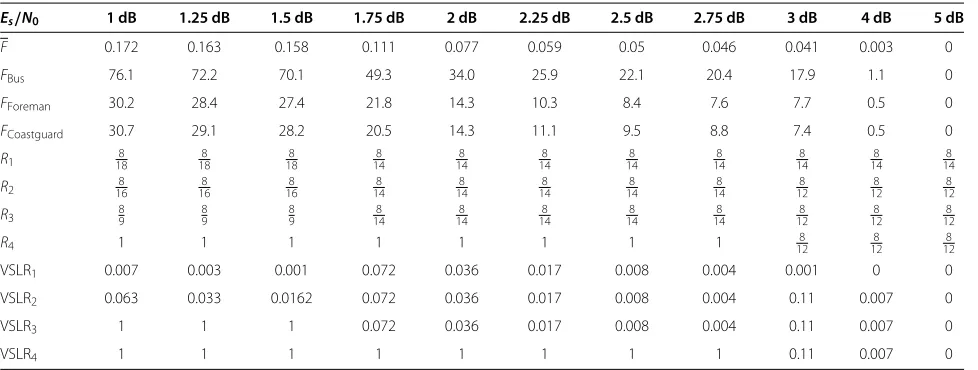
Table 5 Optimal cross-layer parameters for S-II scheme withC=1.4 Mbps
Es/N0 1 dB 1.25 dB 1.5 dB 1.75 dB 2 dB 2.25 dB 2.5 dB 2.75 dB 3 dB 4 dB 5 dB
F 0.172 0.163 0.158 0.111 0.077 0.059 0.05 0.046 0.041 0.003 0
FBus 76.1 72.2 70.1 49.3 34.0 25.9 22.1 20.4 17.9 1.1 0
FForeman 30.2 28.4 27.4 21.8 14.3 10.3 8.4 7.6 7.7 0.5 0
FCoastguard 30.7 29.1 28.2 20.5 14.3 11.1 9.5 8.8 7.4 0.5 0
R1 188 188 188 148 148 148 148 148 148 148 148
R2 168 168 168 148 148 148 148 148 128 128 128
R3 89 89 89 148 148 148 148 148 128 128 128
R4 1 1 1 1 1 1 1 1 128 128 128
VSLR1 0.007 0.003 0.001 0.072 0.036 0.017 0.008 0.004 0.001 0 0
VSLR2 0.063 0.033 0.0162 0.072 0.036 0.017 0.008 0.004 0.11 0.007 0
VSLR3 1 1 1 0.072 0.036 0.017 0.008 0.004 0.11 0.007 0
Table 6 Optimal cross-layer parameters for S-III scheme withC=1.4 Mbps
Es/N0 1.75 dB 2 dB 2.25 dB 2.5 dB 2.75 dB 3 dB 4 dB 5 dB
F 1 0.972 0.268 0.022 0.021 0.017 0.007 0.006
FBus 444.3 431.9 119.2 9.8 9.3 5.3 2.1 0.8
FForeman 215.1 209.1 57.7 4.7 4.5 2.6 1.0 0.4
FCoastguard 180.2 175.2 48.3 4.0 3.8 2.1 0.8 0.3
R 128 128 128 128 128 108 108 89
γt 1.05 1.05 1.05 1.05 1.05 1.25 1.25 1.4
VSLRi,∀i 1 0.972 0.268 0.022 0.021 0.012 0.005 0.002
5.3 Discussion of cross-layer optimization results
We report the cross-layer optimization results, including the FEC parameters (e.g., Ri, γt, and ki), VSLRi, nor-malizedF, and non-normalized F for the CMSEi values of the Bus video. Note that F is calculated by replacing the CMSEi by the actual average CMSEi for the video sequence under consideration. The results of all four FEC schemes for three video sequences (Bus, Foreman, and Coastguard) are reported in Tables 4, 5, 6, and 7 for
chan-nel bit rate C = 1.4 Mbps. The results for Akiyo are
discussed in Section 6.
From Tables 4 and 5, we observe that the use of UEP RCPC coding at the PL in the S-II scheme achieves much better performance (i.e., lowerFBus) than the use of EEP
RCPC coding in the S-I scheme. Both schemes do not use FEC coding at the AL.
Since the RCPC code rate of 128 at the PL is not strong enough forNoEs ≤2 dB, the value ofFBusin the S-I scheme
is high (FBus > 300 in Table 4) because many packet are
corrupted due to high channel errors. For a successful decoding in LT, the number of error-free packets received
should be above a threshold. As a result, the S-III scheme (which also uses RCPC with the same code rate as in S-I) achieves a lower performance (higher value ofFBus) than
S-I forNoEs ≤2 dB (see Tables 4 and 6). However, the S-III scheme achieves much better performance (FBus < 10)
than S-I for NoEs ≥ 2.5 dB because fewer packets are now corrupted at the PL and the LT coding becomes effective. From Tables 6 and 7, we observe that the proposed S-IV scheme achieves much lower values ofFBusthan S-III at all
values ofNoEs. This demonstrates that using UEP LT codes at the AL along with EEP RCPC codes at the PL gives a far superior performance than using EEP codes at both layers. From Table 7 for the S-IV scheme, we observe an inter-esting trade-off between the code rates assigned to FEC codes at the AL and the PL. For lower values ofNoEs, a larger portion of the bit budget is assigned to RCPC codes at the PL rather than LT codes at the AL because the LT coding cannot be effective when a large number of packets are corrupted due to channel errors. Furthermore, a stronger UEP (i.e., higher value ofkito higher priority video slices) is provided at the AL. For higher values of NoEs, the RCPC
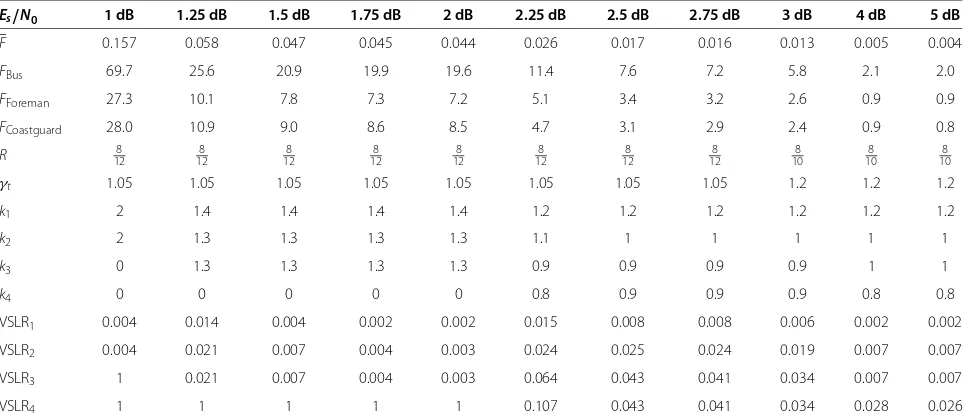
Table 7 Optimal cross-layer parameters for S-IV scheme withC=1.4 Mbps
Es/N0 1 dB 1.25 dB 1.5 dB 1.75 dB 2 dB 2.25 dB 2.5 dB 2.75 dB 3 dB 4 dB 5 dB
F 0.157 0.058 0.047 0.045 0.044 0.026 0.017 0.016 0.013 0.005 0.004
FBus 69.7 25.6 20.9 19.9 19.6 11.4 7.6 7.2 5.8 2.1 2.0
FForeman 27.3 10.1 7.8 7.3 7.2 5.1 3.4 3.2 2.6 0.9 0.9
FCoastguard 28.0 10.9 9.0 8.6 8.5 4.7 3.1 2.9 2.4 0.9 0.8
R 128 128 128 128 128 128 128 128 108 108 108
γt 1.05 1.05 1.05 1.05 1.05 1.05 1.05 1.05 1.2 1.2 1.2
k1 2 1.4 1.4 1.4 1.4 1.2 1.2 1.2 1.2 1.2 1.2
k2 2 1.3 1.3 1.3 1.3 1.1 1 1 1 1 1
k3 0 1.3 1.3 1.3 1.3 0.9 0.9 0.9 0.9 1 1
k4 0 0 0 0 0 0.8 0.9 0.9 0.9 0.8 0.8
VSLR1 0.004 0.014 0.004 0.002 0.002 0.015 0.008 0.008 0.006 0.002 0.002
VSLR2 0.004 0.021 0.007 0.004 0.003 0.024 0.025 0.024 0.019 0.007 0.007
VSLR3 1 0.021 0.007 0.004 0.003 0.064 0.043 0.041 0.034 0.007 0.007
code rate is relatively high and more protection is pro-vided to LT codes at the AL. Also, the UEP (i.e., value of ki) at the AL is relatively less strong now.
Overall, the proposed S-IV scheme achieves the best performance at different channel SNRs, followed by the S-II scheme for NoEs ≤ 2.5 dB. S-III outperforms S-II for other higher channel SNRs. We observe similar results for Foreman and Coastguard videos. Therefore, we can gen-erally conclude that it is optimal to provide UEP at the AL and EEP at the PL using a cross-layer design.
Note that the optimization is performed only once for a given set of CMSEi values, a GOP structure, and a set of channel SNRs, and need not be run separately for each GOP. The same set of optimized parameters can be used for any video stream with similar properties. Further, we should note that similar performance improvement is also observed for the 1.8-Mbps channel bit rate.
6 Performance evaluation of FEC schemes for test videos
In this section, we evaluate the performance of our opti-mized cross-layer FEC schemes for four CIF (352×288 pixels) video sequences: Bus, Foreman, Coastguard, and Akiyo. These sequences were encoded using H.264/AVC JM 14.2 reference software [51] at 840 kbps and 150 bytes slice size, for a GOP length of 30 frames with GOP struc-ture IDR B P B. . .P B at 30 frames/s. The slices were formed using dispersed-mode FMO with two slice groups per frame. Two reference frames were used for predicting thePandBframes, with error concealment enabled using temporal concealment and spatial interpolation. We have used a channel transmission rate ofC =1.4 to study the performance over AWGN channels.
We used the slice loss rates reported in Tables 4 through 7 to evaluate the average PSNR of three video sequences (Bus, Foreman, and Coastguard) in Figures 3, 4, and 5. Figures 3, 4, and 5 confirm that our proposed cross-layer S-IV scheme, with UEP FEC coding at the AL and
1 1.5 2 2.5 3 3.5 4 4.5 5
Figure 3Average PSNR of Bus video for different channel SNRs
atC=1.4 Mbps.The PSNR for the error-free channel is 30.26 dB.
1 1.5 2 2.5 3 3.5 4 4.5 5
Figure 4Average PSNR of Foreman video for different channel
SNRs atC=1.4 Mbps.The PSNR for the error-free channel is 36.9 dB.
EEP FEC coding at the PL, achieves considerable improve-ment in average video PSNR, especially at low values of
Es
N0. It outperforms the S-II scheme, which uses UEP RCPC code at the PL, by about 2∼ 7 dB for Es
N0 ≤3.5 dB. Only S-III has a comparable performance at Es
N0 ≥2.5 dB. How-ever, at low values of Es
N0, the S-IV scheme considerably outperforms S-III.
Although our cross-layer FEC parameters were opti-mized for Bus sequences, the average PSNR performance is similar to that of the other two test video sequences, i.e., Foreman and Coastguard. As mentioned earlier, both sequences have different characteristics compared to the Bus sequence.
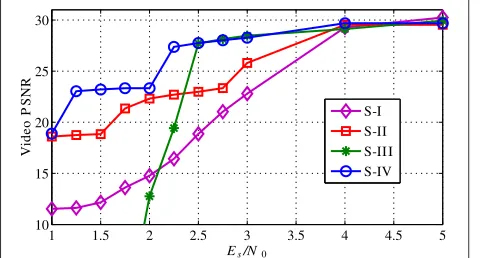
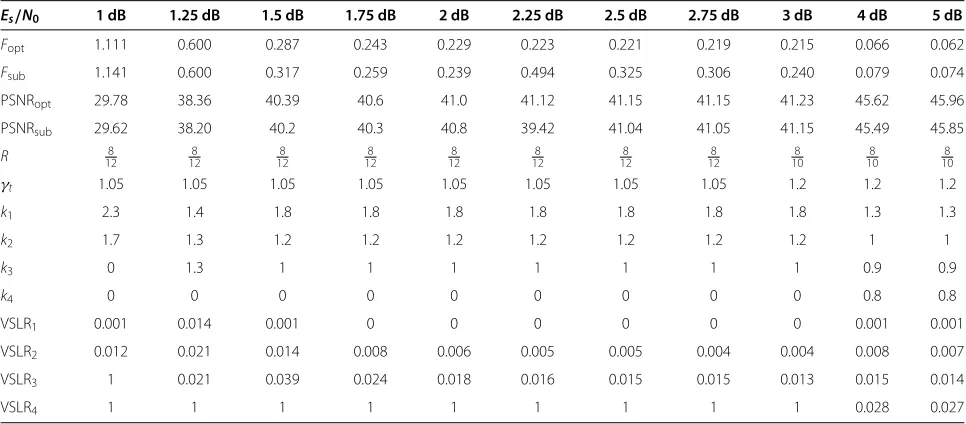
Since Akiyo has considerably different values of CMSEi, the proposed S-IV scheme designed by using Bus video’s CMSEi values would be suboptimal for Akiyo. In order to study the effect of these CMSE variations, we also designed the S-IV scheme by using the CMSEivalues of Akiyo and compare its performance with its suboptimal version. The optimization results are reported in Table 8. In this table, we also included the suboptimal values of
1 1.5 2 2.5 3 3.5 4 4.5 5
Figure 5Average PSNR of Coastguard video for different channel
Table 8 Optimal cross-layer parameters for S-IV atC=1.4 Mbps for Akiyo video sequence
Es/N0 1 dB 1.25 dB 1.5 dB 1.75 dB 2 dB 2.25 dB 2.5 dB 2.75 dB 3 dB 4 dB 5 dB
Fopt 1.111 0.600 0.287 0.243 0.229 0.223 0.221 0.219 0.215 0.066 0.062
Fsub 1.141 0.600 0.317 0.259 0.239 0.494 0.325 0.306 0.240 0.079 0.074
PSNRopt 29.78 38.36 40.39 40.6 41.0 41.12 41.15 41.15 41.23 45.62 45.96
PSNRsub 29.62 38.20 40.2 40.3 40.8 39.42 41.04 41.05 41.15 45.49 45.85
R 128 128 128 128 128 128 128 128 108 108 108
γt 1.05 1.05 1.05 1.05 1.05 1.05 1.05 1.05 1.2 1.2 1.2
k1 2.3 1.4 1.8 1.8 1.8 1.8 1.8 1.8 1.8 1.3 1.3
k2 1.7 1.3 1.2 1.2 1.2 1.2 1.2 1.2 1.2 1 1
k3 0 1.3 1 1 1 1 1 1 1 0.9 0.9
k4 0 0 0 0 0 0 0 0 0 0.8 0.8
VSLR1 0.001 0.014 0.001 0 0 0 0 0 0 0.001 0.001
VSLR2 0.012 0.021 0.014 0.008 0.006 0.005 0.005 0.004 0.004 0.008 0.007
VSLR3 1 0.021 0.039 0.024 0.018 0.016 0.015 0.015 0.013 0.015 0.014
VSLR4 1 1 1 1 1 1 1 1 1 0.028 0.027
Fsuband PSNRsub, which were obtained by using the
opti-mized parameters of the Bus video from Table 7. The values of PSNRoptand PSNRsubare also shown in Figure 6.
In Table 8 (for optimal scheme) and Table 7 (for subop-timal scheme), the LT code overhead (i.e.,γt) and RCPC code strength (R) are the same for both schemes, whereas the values of LT code protection levelkifor each priority class vary slightly (e.g.,k1is higher for the optimal scheme
compared to the suboptimal scheme). Similarly, the values of VSLRi for higher priority slices (which have the most impact onFand PSNR) are similar in both tables, except for channel SNRs of 2.25, 2.5, and 2.75 dB in the decreas-ing order of the difference in values. The maximum PSNR degradation of the suboptimal scheme compared to the optimal scheme is 1.7 dB at the channel SNR of 2.25, with only about 0.1 to 0.3 dB PSNR degradation at other channel SNRs. We can, therefore, conclude that the
per-Figure 6Average PSNR performance of the optimal and suboptimal cross-layer FEC schemes for Akiyo video sequence.
formance of the proposed cross-layer FEC scheme is not very sensitive to the precise values of normalized CMSE.
7 Conclusion
Previously, EEP and UEP FEC coding schemes have been used for video transmission over lossy channels. How-ever, the joint optimization of cross-layer UEP FEC codes at the AL and the PL for robust video transmission has never been considered. In this paper, we used UEP LT coding at the AL and RCPC coding at the PL for robust H.264 video transmission over wireless channels. H.264 video slices were prioritized based on their contribution to video quality. We performed cross-layer optimization to concurrently tune the FEC code parameters at both lay-ers, to minimize the video distortion, and to maximize the PSNR. We observed that our cross-layer FEC scheme out-performed other FEC schemes that use either UEP coding at the PL alone or EEP FEC schemes at the AL as well as the PL. Further, we showed that our optimization works well for different H.264-encoded video sequences, which have widely different characteristics.
Appendix
Introduction to genetic algorithms
and k decision variables, respectively. Let F(w) denote the objective function that we need to optimize (mini-mize/maximize). In conventional genetic algorithms, each wi is translated to a binary format. The steps to find the optimum answer are as follows:
1. Generate a random initial population of sizei each includingk memberswj,j= {1, 2,. . .,k}.
2. Translate the generated population from real numbers to a binary format considering desired precision.
3. Concatenate the translated version ofk decision variables together to generatei binary population members.
4. Evaluatei fitnessesF(wj,j∈ {1, 2,. . .,i}) of the current population.
5. Select two parents randomly, assigning higher probability of selection to the parents with a better fitness value.
6. Performcrossover and mutation [47] on the parents to generate two offsprings. For crossover, cut two parents from a random location and exchange second parts to generate offsprings. For mutation, with a small probability, flip a random bit in the offsprings’ bit streams.
7. Go to step 5 untili−2offsprings are generated. 8. Keep two parents with the best fitness values and
replace the resti−2with the new offsprings. 9. If maximum iterations are not reached, go to 4;
otherwise, translate the member of population with the best fitness value from a binary to real format and report it as the final answer.
The above algorithm is an overall view of conventional genetic algorithms. However, many variations have been proposed since genetic algorithms were first introduced. For instance, the translation from real to binary and vice versa is no more performed, and the algorithm and the crossover and mutation are all performed in real numbers. More detailed explanation of genetic algorithms is out of the scope of this paper. We refer the interested readers for performance evaluations of genetic algorithm methods to [48,52] a and the numerous available surveys.
Competing interests
The authors declare that they have no competing interests.
Acknowledgements
This material is based upon work supported by the National Science Foundation under grants ECCS-1056065 and CCF-0915994, and by the Air Force Research Laboratory under award FA8750-11-1-0048.
Disclaimer
Any opinions, findings, and conclusions or recommendations expressed in this material are those of the author(s) and do not necessarily reflect the views of the US Air Force Research Laboratory.
Author details
1Department of Electrical and Computer Engineering, Oklahoma State University, Stillwater, OK 74078, USA.2Department of Electrical and Computer Engineering, San Diego State University, San Diego, CA 92182, USA.3Air Force Research Laboratory, Rome, NY 13441, USA.
Received: 16 November 2012 Accepted: 9 July 2013 Published: 13 August 2013
References
1. T Wiegand, GJ Sullivan, G Bjntegaard, A Luthra, Overview of the H.264/AVC video coding standard. IEEE Trans. Circuits Syst. Video Technol.
13(7), 560–576 (2003)
2. T Wiegand, G Sullivan,ITU-T, JVT, T Rec: H.264/IEC 14496-10 AVC 2003 Draft ITU-T Recommendation and Final Draft International Standard of Joint Video Specification(International Telecommunication Union, Geneva, 2002) 3. S Kumar, L Xu, MK Mandal, S Panchanathan, Error resiliency schemes in
H.264/AVC standard,. Elsevier J. Vis. Commun. Image Representation Spec. Issue Emerg. H.264/AVC Video Coding Stand.17(2), 183–185 (2006) 4. T Stockhammer, M Hannuksela, T Wiegand, H.264/AVC in wireless
environments. IEEE Trans. Circuits Syst. Video Technol.13(7), 657–673 (2003)
5. T Stockhammer, A Shokrollahi, M Watson, M Luby, T Gasiba, Application layer forward error correction for mobile multimedia broadcasting, in
Handbook of Mobile Broadcasting: DVB-H, DMB, ISDB-T and MEDIAFLO
(Taylor & Francis, Boca Raton, 2008), pp. 239–280
6. M van der Schaar, S Shankar, Cross-layer wireless multimedia transmission: challenges, principles, and new paradigms. IEEE Wireless Commun.12(4), 50–58 (2005)
7. E Setton, T Yoo, X Zhu, A Goldsmith, B Girod, Cross-layer design of ad hoc networks for real-time video streaming. IEEE Wireless Commun.12(4), 59–65 (2005)
8. A Talari, N Rahnavard, Unequal error protection rateless coding for efficient MPEG video transmission, inIEEE Military Communications Conference(IEEE, Piscataway, 2009), pp. 1–7
9. S Paluri, K Kambhatla, S Kumar, B Bailey, P Cosman, JD Matyjas, Predicting slice loss distortion in H.264/AVC video for low complexity data prioritization, inIEEE Int. Conf. Image Processing Proceedings (ICIP 2012),
(Orlando, 30 Sept–3 Oct 2012)
10. D Gomez-Barquero, A Bria, Application layer FEC for improved mobile reception of DVB-H streaming services, inIEEE 64th Vehicular Technology Conference, VTC-2006 Fall(IEEE, Piscataway, 2006), pp. 1–5
11. T Courtade, R Wesel, A cross-layer perspective on rateless coding for wireless channels, inIEEE International Conference on Communications, ICC
(IEEE, Piscataway, 2009), pp. 1–6
12. N Rahnavard, B Vellambi, F Fekri, Rateless codes with unequal error protection property. IEEE Trans. Inf. Theory.53(4), 1521–1532 (2007) 13. N Rahnavard, F Fekri, Generalization of rateless codes for unequal error
protection and recovery time: asymptotic analysis, inIEEE Int. Symp. Inf. Theory(IEEE, Piscataway, 2006), pp. 523–527
14. J Hagenauer, Rate-compatible punctured convolutional codes (RCPC codes) and their applications. IEEE Trans. Commun.36(4), 389–400 (1988) 15. M Luby, LT codes, inThe 43rd Annual IEEE Symposium on Foundations of
Computer Science(IEEE, Piscataway, 2002), pp. 271–280
16. A Shokrollahi, Raptor codes. IEEE Trans. Inf. Theory.52(6), 2551–2567 (2006)
17. S Ahmad, R Hamzaoui, M Al-Akaidi, Adaptive unicast video streaming with rateless codes and feedback. IEEE Trans. Circuits Syst. Video Technol.
20(2), 275–285 (2010)
18. P Cataldi, M Grangetto, T Tillo, E Magli, G Olmo, Sliding-window raptor codes for efficient scalable wireless video broadcasting with unequal loss protection. IEEE Trans. Image Process.19(6), 1491–1503 (2010) 19. H Kushwaha, Y Xing, R Chandramouli, H Heffes, Reliable multimedia
transmission over cognitive radio networks using fountain codes. Proc. IEEE.96, 155–165 (2008)
20. C Hellge, T Schierl, T Wiegand, Receiver driven layered multicast with layer-aware forward error correction, in15th IEEE International Conference on Image Processing, ICIP(IEEE, Piscataway, 2008), pp. 2304–2307 21. D Vukobratovic, V Stankovic, D Sejdinovic, L Stankovic, Z Xiong, Expanding
Conference on Multimedia and Expo(IEEE, Piscataway, 2008), pp. 77–80 22. AS Tan, A Aksay, C Bilen, GB Akar, E Arikan, Rate-distortion optimized
layered stereoscopic video streaming with raptor codes, inPacket Video
(IEEE, Piscataway, 2007), pp. 98–104
23. H Jenkac, T Stockhammer, Asynchronous media streaming over wireless broadcast channels, inIEEE International Conference on Multimedia and Expo(IEEE, Piscataway, 2005), pp. 1318–1321
24. S Ahmad, R Hamzaoui, M Al-Akaidi, Robust live unicast video streaming with rateless codes, inPacket Video(IEEE, Piscataway, 2007), pp. 78–84 25. D Vukobratovic, V Stankovic, D Sejdinovic, L Stankovic, Z Xiong, Scalable
video multicast using expanding window fountain codes. IEEE Trans. Multimedia.11(6), 1094–1104 (2009)
26. M Luby, M Watson, T Gasiba, T Stockhammer, Mobile data broadcasting over MBMS tradeoffs in forward error correction, inProceedings of the 5th International Conference on Mobile and Ubiquitous Multimedia(ACM, New York, 2006), p. 10
27. T Stockhammer, G Liebl, On practical crosslayer aspects in 3GPP video services, inProceedings of the International Workshop on Workshop on Mobile Video(ACM, New York, 2007), pp. 7–12
28. J Afzal, T Stockhammer, T Gasiba, W Xu, Video streaming over MBMS: a system design approach. J. Multimedia.1(5), 25–35 (2006)
29. A Alexiou, C Bouras, A Papazois, A study of forward error correction for mobile multicast. Int. J. Commun. Syst.24(5), 607–627 (2011) 30. D Munaretto, D Jurca, J Widmer, Broadcast video streaming in cellular
networks: an adaptation framework for channel, video and AL-FEC rates allocation, in2010 The 5th Annual ICST Wireless Internet Conference (WICON)
(IEEE, Piscataway, 2010), pp. 1–9
31. C Bouras, V Kokkinos, A Papazois, Application layer forward error correction for multicast streaming over LTE networks. Int. J. Commun. Syst (2012). http://onlinelibrary.wiley.com/doi/10.1002/dac.2321/abstract 32. R Gallager, Low-density parity-check codes. Inf. Theory IRE Trans.8, 21–28
(1962)
33. N Thomos, S Argyropoulos, N Boulgouris, M Strintzis, Robust transmission of H. 264/AVC streams using adaptive group slicing and unequal error protection. EURASIP J. Appl. Signal Process.2006, 120–120 (2006) 34. K Kambhatla, S Kumar, P Cosman, Wireless H.264 video quality
enhancement through optimal prioritized packet fragmentation. IEEE Trans. Multimedia.14(5), 1480–1495 (2012)
35. S Kumar, A Janarthanan, MM Shakeel, S Maroo, JD Matyjas, M Medley, Robust H.264/AVC video coding with priority classification, adaptive NALU size and fragmentation, inIEEE MILCOM Proceedings, 2009,(Boston, 18) 36. E Baccaglini, T Tillo, G Olmo, Slice sorting for unequal loss protection of
video streams. IEEE Signal Process. Lett.15, 581–584 (2008) 37. S Argyropoulos, A Tan, N Thomos, E Arikan, M Strintzis, Robust
transmission of multi-view video streams using flexible macroblock ordering and systematic LT codes, in3DTV Conference, 2007(IEEE, Piscataway, 2007), pp. 1–4
38. P Koopman, T Chakravarty, Cyclic redundancy code (CRC) polynomial selection for embedded networks, inInternational Conference on Dependable Systems and Networks(IEEE, Piscataway, 2004), pp. 145–154 39. A Bouabdallah, J Lacan, Dependency-aware unequal erasure protection
codes. J. Zhejiang Univ. Sci. A.7, 27–33 (2006)
40. E Maani, A Katsaggelos, Unequal error protection for robust streaming of scalable video over packet lossy networks. IEEE Trans. Circuits Syst. Video Technol.20(3), 407–416 (2010)
41. W Xiang, C Zhu, CK Siew, Y Xu, M Liu, Forward error correction-based 2-D layered multiple description coding for error-resilient H.264 SVC video transmission. IEEE Trans. Circuits Syst. Video Technol.19(12), 1730–1738 (2009)
42. H Ha, C Yim, Layer-weighted unequal error protection for scalable video coding extension of H.264/AVC. IEEE Trans. Consum. Electron.54(2), 736–744 (2008)
43. Y Liu, S Yu, Adaptive unequal loss protection for scalable video streaming over IP networks. IEEE Trans. Consum. Electron.51(4), 1277–1282 (2005) 44. S Yingbo Shi, W Chengke Wu, D Jianchao Du, A novel unequal loss
protection approach for scalable video streaming over wireless networks. IEEE Trans. Consum. Electron.53(2), 363–368 (2007)
45. XJ Zhang, XH Peng, R Haywood, T Porter, Robust video transmission over lossy network by exploiting H.264/AVC data partitioning, in5th International Conference on Broadband Communications, Networks and Systems, BROADNETS(IEEE, Piscataway, 2008), pp. 307–314
46. T Gasiba, W Xu, T Stockhammer, Enhanced system design for download and streaming services using Raptor codes. European Trans.
Telecommun.20(2), 159–173 (2009)
47. J Holland,Adaptation in Natural and Artificial Systems(MIT Press, Cambridge, 1992)
48. JR Koza, Survey of genetic algorithms and genetic programming, in
WESCON/’95. Conference Record(IEEE, Piscataway, 1995), p. 589 49. D Coley,An Introduction to Genetic Algorithms for Scientists and Engineers
(World Scientific, Singapore, 1999)
50. MathWorks,Global Optimization Toolbox: User’s Guide (R2011b)
(MathWorks, Natick, 2011)
51. JVT, H.264/AVC Reference Software JM14.2. ISO/IEC Std. http://iphome. hhi.de/suehring/tml/download/. Accessed 12 Feb 2012
52. K Deb, A Pratap, S Agarwal, T Meyarivan, A fast and elitist multiobjective genetic algorithm: NSGA-II. IEEE Trans. Evol. Comput.6(2), 182–197 (2002)
doi:10.1186/1687-1499-2013-206
Cite this article as:Talariet al.:Optimized cross-layer forward error cor-rection coding for H.264 AVC video transmission over wireless channels.
EURASIP Journal on Wireless Communications and Networking20132013:206.
Submit your manuscript to a
journal and benefi t from:
7 Convenient online submission 7 Rigorous peer review
7 Immediate publication on acceptance 7 Open access: articles freely available online 7 High visibility within the fi eld
7 Retaining the copyright to your article