Volume 2010, Article ID 914934,10pages doi:10.1155/2010/914934
Research Article
Performance Analysis of the 3GPP-LTE Physical Control Channels
S. J. Thiruvengadam
1, 2and Louay M. A. Jalloul
31Smart Antenna Research Group, Department of Electrical Engineering, Stanford University, USA 2TIFAC CORE in Wireless Technologies, Thiagarajar College of Engineering, Madurai 625015, India 3Beceem Communications Inc., Santa Clara, CA 95054, USA
Correspondence should be addressed to Louay M. A. Jalloul,[email protected]
Received 8 May 2010; Revised 24 September 2010; Accepted 11 November 2010
Academic Editor: Ashish Pandharipande
Copyright © 2010 S. J. Thiruvengadam and L. M. A. Jalloul. This is an open access article distributed under the Creative Commons Attribution License, which permits unrestricted use, distribution, and reproduction in any medium, provided the original work is properly cited.
Maximum likelihood-based (ML) receiver structures are derived for the decoding of the downlink control channels in the new long-term evolution (LTE) standard based on multiple-input and multiple-output (MIMO) antennas and orthogonal frequency division multiplexing (OFDM). The performance of the proposed receiver structures for the physical control format indicator channel (PCFICH) and the physical hybrid-ARQ indicator channel (PHICH) is analyzed for various fading-channel models and MIMO schemes including space frequency block codes (SFBC). Analytical expressions for the average probability of error are derived for each of these physical channels. The impact of channel-estimation error on the orthogonality of the spreading codes applied to users in a PHICH group is investigated, and an expression for the signal-to-self interference plus noise ratio is derived for Single Input Multiple Output (SIMO) systems. Finally, a matched filter bound on the probability of error for the PHICH in a multipath fading channel is derived. The analytical results are validated against computer simulations.
1. Introduction
A new standard for broadband wireless communications has emerged as an evolution to the Third Generation Part-nership Project (3GPP) wideband code-division multiple access (CDMA) Universal Mobile Telecommunication Sys-tem (UMTS), termed long term evolution or LTE (3GPP-release 8). The main difference between LTE and its prede-cessors is the use of scalable OFDM (orthogonal frequency division multiplexing, used on the downlink with channel bandwidth of 1.4 all the way up to 20 MHz.) together with MIMO (multiple input multiple output, configurations of up to 4 transmit antennas at the base station and 2 receive antennas at the user equipment.) antenna technology as shown inTable 1. Compared to the use of CDMA in releases 4–7, the LTE system separates users in both the time and frequency domain. OFDM is bandwidth scalable, the symbol structure is resistant to multipath delay spread without the need for equalization, and is more suitable for MIMO transmission and reception. Depending on the antenna configuration, modulation, coding and user category, LTE supports both frequency-division duplexing (FDD) as well
as time-division duplexing (TDD) with peak data rates of 300 Mbps on the downlink and 75 Mbps on the uplink [1–
3]. In this paper, the FDD frame structure is analyzed, but the results also reflect the performance of TDD frame structure. Another fundamental deviation in LTE specification relative to previous standard releases is the control channel design and structure to support the capacity enhancing fea-tures such as link adaptation, physical layer hybrid automatic repeat request (ARQ), and MIMO. Correct detection of the control channel is needed before the payload information data can be successfully decoded. Thus, the overall link and system performance are dependent on the successful decoding of these control channels.
Table1: System numerology.
Channel bandwidth (MHz) (W)
1.4 3.0 5.0 10.0 15.0 20.0
Number of physical resource blocks (NDL
RB)
6 15 25 50 75 100
FFT size (N) 128 256 512 1024 1536 1024 Sampling
frequency (Msps) (fs)
1.92 3.84 7.68 15.36 23.04 30.72
physical hybrid ARQ indicator channel (PHICH) in the presence of additive white Gaussian noise, frequency selective fading channel with different transmit and receive antenna configurations, and space-frequency block codes (SFBC). These analyses provide insight into system performance and can be used to study sensitivity to design parameters, for example, channel models and algorithm designs. Further, it would serve as a reference tool for fixed-point computer simulation models that are developed for hardware design.
The rest of the paper is organized as follows. A brief description of the LTE control channel specification is given in Section 2. The BER analyses of the physical channels PCFICH and PHICH are given in Sections 3 and 4, respectively. Section 5 contains some concluding remarks.
Notation. ◦,∗, and H denote element by element product, complex conjugate, and conjugate transpose, respectively.
x,y = ixiyi∗ is the inner product of the vectorsx and
y.⊗denotes the convolution operator.
2. Brief Description of the 3GPP-LTE Standard
The downlink physical channels carry information from the higher layers to the user equipment. The physical downlink shared channel (PDSCH) carries the payload-information data, physical broadcast channel (PBCH) broadcasts cell specific information for the entire cell-coverage area, physical multicast channel (PMCH) is for multicasting and broad-casting information from multiple cells, physical downlink control channel (PDCCH) carries scheduling information, physical control format indicator channel (PCFICH) conveys the number of OFDM symbols used for PDCCH and physical hybrid ARQ indicator Channel (PHICH) transmits the HARQ acknowledgment from the base station (BS). BS in 3GPP-LTE is typically referred to as eNodeB. Downlink control signaling occupies up to 4 OFDM symbols of the first slot of each subframe, followed by data transmission that starts at the next OFDM symbol as the control signaling ends. This enables support for microsleep which provides battery-life savings and reduced buffering and latency [4]. Reference signals transmitted by the BS are used by UE for channel estimation, timing and frequency synchronization, and cell identification.
Table2: Power delay profiles for pedestrian B and ITU channel models.
Ped-B channel model TU channel model Delay (nsec)Average power (dB) Delay (μsec) Average power (dB)
0 0 0 1.000
200 −0.9 0.813 0.669 800 −4.9 1.626 0.448 1200 −8.0 2.439 0.300 2300 −7.8 3.252 0.200 3700 −23.9 4.056 0.134
The downlink OFDM FDD radio frame of 10 ms duration is equally divided into 10 subframes where each subframe consists of two 0.5 ms slots. Each slot has 7 or 6 OFDM symbols depending on the cyclic prefix (CP) duration. Two CP durations are supported: normal and extended. The entire time-frequency grid is divided into physical resource blocks (PRB), wherein each PRB contains 12 resource elements (subcarriers). PRBs are used to describe the mapping of physical channels to resource elements. Resource element groups (REG) are used for defining the control channels to resource element mapping. The size of the REG varies depending on the OFDM symbol number and antenna configuration [1]. The PCFICH is always mapped into the first OFDM symbol of the first slot of each subframe. For the normal CP duration, the PHICH is also mapped into the first OFDM symbol of the first slot of each subframe. On the other hand, for the extended CP duration, the PHICH is mapped to the first 3 OFDM symbols of the first slot of each subframe. All control channels are organized as symbol-quadruplets before being mapped to a single REG. In the first OFDM symbol, two REGs per PRB are available. In the third OFDM, there are 3 REGs per PRB. In the second OFDM symbol, the number of REGs available per PRB will be 2 for single- or two-transmit antennas, and 3 for four-transmit antennas.
This paper focuses on the performance analyses of the PCFICH and PHICH between the UE and the BS in three types of channels: (1) static (additive white Gaussian noise (AWGN)), (2) frequency flat-fading, and (3) ITU frequency selective channel models. The power-delay profiles of the ITU models, used in the analyses, are given inTable 2.
3. Physical Control Format Indicator Channel
The two CFI bits are encoded using a (32,2) block code as shown inTable 3. The 32 encoded bits are QPSK modulated, layer mapped, and, finally, are resource element mapped.
3.1. PCFICH with SIMO Processing. The received signal is processed as follows: the cyclic prefix is removed, then the FFT is taken, followed by resource-element demapping. The complex-valued output at the k-th receive antenna is modeled as
Table3: CFI (32,2) Block code [2].
received subcarrier vector,d(n)is the 16×1 complex QPSK
symbol vector corresponding to the 32-bit CFI codewords, 1≤n≤3,hkis 16×1 complex channel frequency response,
and uk represents the contribution of thermal noise and
interference, modeled as zero-mean circularly symmetric complex Gaussian with covarianceE[ukuHk]=σu2I. Modeling
the interference as Gaussian is justified, since in a multicell multisector system such as LTE, there are typically between 3 to 6 dominant interferers. These interferers are uncorrelated due to independent large-scale propagation, short-term fading, and uncorrelated scrambling sequences. Therefore, their sum can be well approximated as a Gaussian random variable. Conditioned on hk, yk is a complex Gaussian
random variable. Maximizing the log-likelihood function of
ykgivenhk, results in the following ML decision rule:
CFI= min
which simplifies to
CFI=arg max
m=1,2,3
z(m), (3)
where the soft outputs are given by
z(m)=
i . Without loss of generality, it
is assumed that the first CFI codeword is used, that isn=1, thus we have
c(1,m)=
as per the predefined CFI codewords in [1]. Then, the probability of error is well approximated by the union bound as
probability (PEP). In the case of a static AWGN channel with
hi,k=h, ∀i,k, and single-receive antenna, letx=z1(1)−z
The union bound can be tightened further, by improving the evaluation of the PEP using the joint probability of error due to CFI=2 and CFI=3. Then, the union bound becomes
probability term can be written as,
1
For flat-fading channels, the average pair-wise probability of error, averaged over the channel|h|2
distribution, is given by
Pb(CFI)=E|h|2
P(CFI)b
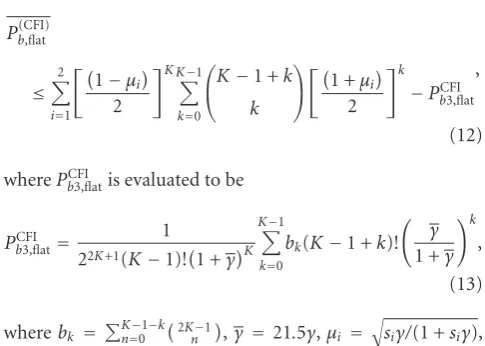
For a Rayleigh fading channel, (11) reduces to [5]
wherePCFI
b3,flatis evaluated to be
PbCFI3,flat=
uis the SNR per tone per antenna and the scaling
factorss1=11 ands2=10.5.
3.2. Analysis of CFI with Repetition Coding. In this section, we compare the performance of the (32,2) block code of
Table 3 used for CFI encoding with a simple rate 1/16 repetition code. The repetition code for CFI = 1 is represented by a 32-bit-length vector [0 1· · ·0 1], CFI=2 by [1 0 · · · 1 0], and CFI = 3 by [1 1· · · 1 1]. When CFI = 1 or CFI = 2, the Hamming distance between the other codewords are 32 and 16, otherwise, the Hamming distance is 16. Since the CFI assumes the value between 1 and 3, in an equiprobable manner, the probability of error, in the static AWGN channel, is given by
Pb(CFI),repetition≤1
3.3. PCFICH with Transmit Diversity Processing. Transmit diversity with two-transmit antennas or four-transmit anten-nas, is achieved using space frequency block code (SFBC) in combination with layer mapping [1]. Assume that there are two transmit antennas at the BS transmitter and K receive antennas at the UE. The received signal is processed as follows. The output at thelth layer (two consecutive tones), is given by
yl,k=Hl,kd(ln)+ul,k 0≤l≤Msymblayer −1, 1≤k≤K,
(15)
whereMsymblayer = Msymb/2 = 8,yl,kis a 2×1 received-signal
vector at thekth receive antenna for thelth layer,d(ln)is 2×1 transmit signal vector corresponds ton, where 1≤n≤3, at thelth layer, andul,kdenotes 2×1 thermal-noise vector. The
h(kl,)mis the complex channel frequency response betweenmth
transmit antenna and kth receive antenna, at lth symbol layer. The maximal ratio combiner (MRC) output is given as
Without loss of generality, it is assumed that the first CFI codeword is used, that isn=1, where
c(1,m)=
Substituting forHkin (19), it becomes
z(m)=
union bound is evaluated to be
For the MISO flat-fading channel, the average probability of error, averaged over the channel|h|2
distribution, is given by (13) withμi =
0.5siγ/(1 + 0.5siγ). For MIMO (2×2)
flat-fading channel, the diversity order L = 4 and the average probability of error is given by
Pb(CFI)
The PCFICH performance in the presence of AWGN is shown inFigure 1. It is seen that the Union Bound approx-imation closely matches with the Monte Carlo simulation results. It is observed that the predefined codes for CFI yields approximately 0.5 dB SNR improvement compared to a repetition code, at the block-error rate (BLER) of 10−2.
Currently, the fourth CFI codeword inTable 3is reserved for future expansion. When all the four codewords are used to convey the CFI, an additional term is introduced in the error probability given as (1/2) erfc(
10.5|h|2/σ2
u) and the
Union Bound becomes
Pb(CFI)≤1
Thus, it requires an additional 0.45 dB (approximately) to achieve the BLER of 10−2, compared to using the first three
codewords. The PCFICH performance in the presence of Rayleigh fading channels is shown inFigure 2.
4. Physical Hybrid ARQ Indicator Channel
The PHICH carries physical hybrid ARQ ACK/NAK indica-tor (HI). Data arrives to the coding unit in form of indicaindica-tors for HARQ acknowledgement. Figure 3 shows the PHICH transport channel and physical channel processing on hybrid ARQ data,wnis the spreading code fornth user in a PHICH
group, obtained from an orthogonal set of codes [1]. In LTE,
10−3 10−2 10−1 100
SNR per-tone per-antenna (dB)
BLER
PCFICH detection in AWGN
SISO simulation SISO Rep.code analytical
−14 −12 −10 −8 −6 −4 −2
Figure1: PCFICH performance in AWGN.
10−3 10−2 10−1 100
SNR per-tone per-antenna (dB)
BLER
PCFICH: performance in flat fading channels
Figure2: PCFICH performance in flat-fading channel.
2Mspreading sequences are used in a PHICH group, where
M = 4 for normal CP and 2 for extended CP. The first set ofMspreading sequences are formed byM×MHadamard matrix, and the second set ofMspreading sequences are in quadrature to the first set.
R=1/3 repetition
coding
Wj ×4
1 bit 12 sub-carriers
BPSK
Figure3: PHICH transmit processing.
output that represents the ith resource-element group and
kth receiver antenna is given by
yi,k=hi,k◦
the power levels of theMorthogonal codes (for the normal CP case),xn ∈ (1,−1) is the data bit value of thenth user
HI, andxnandhi,k is anM×1 complex channel frequency
response vector. Without loss of generality, it is assumed that the desired HI channel to be decoded uses the first orthogonal code denoted asw1. The second and third terms
in (26) denote the remaining 2M−1 spreading codes used for the other HI channels within a PHICH group (in this analytical model, we treat the general case of the normal CP. The extended CP is easily handled as shown in the final error-rate formulas.) The termui,kdenotes the thermal
noise, which is modeled as circularly symmetric zero-mean complex Gaussian with covarianceE[ui,kuiH,k]=σu2I.
The ML decoding is given by
z= K
k=1
zk, (27)
whereKis the number of antennas at the UE receiver and
zk=
where the estimated channel frequency responseh)i,kis given
by )hi,k = hi,k + ei,k, ei,k is the estimation error which is
uncorrelated withhi,kand zero-mean complex Gaussian with
covarianceσ2
eI. By expanding (29), we get that
For ideal channel estimation, then due to the orthogonality property of the spreading codes, no interference is intro-duced tow1 from the other HI channels within a PHICH
group. However, in the presence of channel-estimation error, self-interference and cochannel interference are introduced as seen in the second and third terms, respectively, in (31). Since|x$1|2=1 and|x1|2=1, the signal to interference plus
noise ratio (SINR) of the decision statisticzis thus given by
−8
−7
−6
−5
−4
−3
−2
−1
Desired-to-interference power ratio (dB)
S
N
Rl
o
ss(
d
B
)
σ2 e=0.125
σ2
e=0.25
σ2
e=0.5
−10 −8 −6 −4 −2 0 2 4
Figure4: Effect of channel estimation error in PHICH.
In the case of a static AWGN channel with a single antenna at the UE receiver, that is,h(i,mk)=h,∀i,m,k, the SINR is simply
given by
γnon-idealCE
z =
PGP1|h|4
0.5σ2
e
P1+P$1
|h|2
+σ2
u|h|2+σu2σe2
, (33)
wherePG =12 in (33) is the processing gain obtained from
the spreading code of length 4, and (3,1) repetition code in the case of normal CP [1,2]. In case of extended CP, a maximum of 4 HI channels are allowed in a PHICH group, and hence a spreading code of length 2 is used for each HI channel, which results inPG=6.
For ideal channel estimation,σ2
e =0 and the SNR of the
decision statisticzis thus given by
γidealCE
z =
PGP1|h|2
σ2
u
. (34)
The average loss in SNR due to channel-estimation error is given by
L=1−γnon-idealCEz
γidealCE
z
=1− 1
0.5σ2
e/σu2
P1+P$1
+ 1 +σ2
e
.
(35)
L is plotted inFigure 4 as a function of the ratio between the desired power to the interfering signal power (P1/P$1), for
σ2
e/σu2= −3 dB,σe2/σu2= −6 dB, andσe2/σu2=−9 dB.Figure 4
shows that ifP1 =P$1, that is, 0 dB, withσe2=0.5σu2, results
in a 3 dB loss in the SNR.
The probability of error in the AWGN case with a single-receive antenna is simplyPb(HI) =(1/2)P(z <0 |HI=0) +
(1/2)P(z >0|HI=1)=(1/2) erfc(PGγ),γis the per tone
10−3 10−2 10−1 100
SNR per-tone per-antenna (dB)
BER
PHICH: SISO, SIMO AWGN and flat fading
SISO AWGN analytical SISO AWGN simulation SIMO AWGN analytical SIMO AWGN simulation
SISO flat analytical SISO flat simulation SIMO flat analytical SIMO flat simulation
−15 −10 −5 0 5 10
Figure5: PHICH performance in SISO and SIMO systems.
per antenna SNR as shown in (33) and (34). The probability of error averaged over the channel realization is given by
Pb(HI)=Eβ
Pb(HI)
, (36)
whereβ =3
i=1
4
m=1|h
(m)
i,k |
2
. For a frequency-flat Rayleigh fading channel, (36) reduces to [5]
Pb(HI)= 1−μ
2
K K−1
k=0
⎛
⎝K−1 +k
k ⎞
⎠ 1 +μ
2
k
, (37)
whereμ=PGγ/(1 +PGγ).
The PHICH performance for static AWGN and frequency-flat Rayleigh fading channels is shown inFigure 5, for ideal channel estimation.
4.2. PHICH with Transmit Diversity Processing. The received signal is processed as follows. The cyclic prefix is removed, then the FFT is taken, followed by resource-element demap-ping. The output at the lth layer (consecutive two tones) on thekth receive antenna andith resource element group (REG) is given by
yl(,ik)=H(i) l,kd
(i)
l +u
(i)
l,k 0≤l≤M
layer
symb−1, 1≤k≤K,
i=1, 2, 3, (38)
whereMlayersymb= Msymb/(3×2) =2,yl(,ik) is a 2×1
received-signal vector, d(li) is 2×1 transmit-signal vector, and u(l,ik)
denotes 2×1 thermal-noise vector, and each of its elements is modeled as circularly symmetric zero-mean complex Gaussian with covariance E[u(l,ik)ul(,ik)H] = σ2
matrixH(i)
between mth transmit antenna andkth receive antenna, at
lth symbol layer inith REG. The transmit-signal vectord(i)is
generated by layer mapping and precoding the HI data vector
xinith REG. The 4×1 vectorxis given by
codes. The soft output from each layer is given by
z(i)
The ML decision statistic, is given by
z=
statisticzis given by,
z=
The instantaneous SNR ofzis evaluated to be
SNRz=
In the case of a static AWGN channel with a single antenna at the UE receiver, that is,hi,k =h,∀i,k, the SNR is given by
SNR per-tone per-antenna (dB)
BER
PHICH: MIMO AWGN, flat fading
MISO AWGN analytical MISO AWGN simulation MIMO AWGN analytical MIMO AWGN simulation
MISO flat analytical MISO flat simulation MIMO flat analytical MIMO flat simulation
−14 −12 −10 −8 −6 −4 −2 0 2 4
Figure6: PHICH performance in MIMO systems.
For the MISO Rayleigh flat-fading channel, the average prob-ability of error, averaged over the channel|h|2
distribution,
SNR per antenna.
For a MIMO (2 ×2) flat-fading channel, the average probability of error is given by
Pb(HI)=
where the diversity orderL=4.
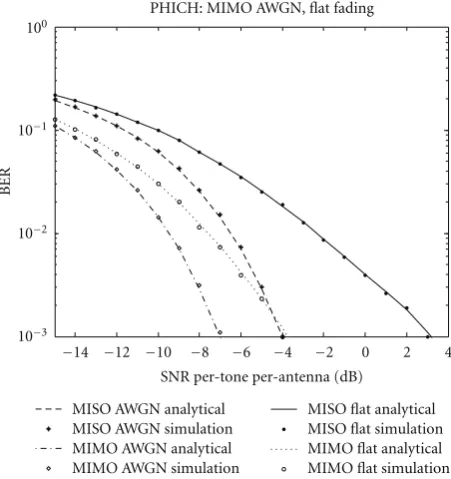
Figure 6 shows the PHICH performance in MIMO systems in the presence of AWGN and Rayleigh flat-fading channels. The analytical results match well with the computer simulations.
4.3. Matched Filter Bound for ITU Channel Models. The objective of this section is to analyze the performance of the LTE downlink control channel PHICH, in general, using matched filter bounds for various practical channel models. The base band channel impulse response can be represented as
unit-variance complex Gaussian random variable, g(t) =
sin(2πWt)/πt, andW is the system bandwidth. Let$hbe a
N×1 complex vector that containsNRnonzero taps which
depends on the sampling frequency, and its corresponding system bandwidth is as shown in Table 1. The channel frequency response is given by,
h(k)=G(k)
m∈T
αmzme−j(2π/N)mk k=0, 1,. . .,N−1, (51)
whereTisNR×1 tap-locations vector ofh$at which the tap
coefficient is nonzero.
The decision statistic SNR or matched filter bound (MFB) of PHICH is a function of β =
K
k=1
3
i=1
4
m=1|h
(m)
i,k |
2
= hehHe, wherehe = [h(1)1,1· · ·h (4) 1,1
· · ·h(1)3,1· · ·h (4) 3,1h
(1) 1,2· · ·h
(4) 3,2· · ·h
(1) 1,K· · ·h
(4)
3,K]. Thus, the
MFB is a function of 12Kindependent chi-square distributed random variables with 2 degrees of freedom. For single-receive antenna
β=
12
p=1
NR
n=1
λp,nxp,n, (52)
where xp,n is independent chi-square distributed random
variable with 2 degrees of freedom andλp,n is the average
power ofpth element ofhe. Sinceλp,nis constant with respect
topfor the given PDP, MFB can be simply written as
β=12
NR
n=1
λnxn. (53)
The characteristics function ofβis given by
Eeivβ=
NR
-n=1
1
1−jvλn. (54)
Asλn’s are distinct, the probability density function is given
by
pβ=
NR
n=1
kne −β/λn
λn , (55)
where kn =
.NR
j=1,j /=i(1/(1−(λj/λi))). Then, the bit-error
probability for the matched-filter outputs is given byPe(γ|
β) = (1/2) erfc(γβ) [5]. The average probability of error,
Pe=
/∞
0 Pe(γ|β)p(β)dβis given by
Pe=
NR
n=1
kn
2
1−
12λnγ
1 + 12λnγ
. (56)
In case of transmit diversity using SFBC, MFB of PHICH is
the function ofβ= K
k=1
2
m=1
3
i=1
Mlayersymb
l=1 |h
(l)(m)
i,k |
2
. For a MIMO system, the channels are assumed to be independent and have the same statistical behavior [7]. For single-receive antenna, the MFB is a function of 12 independent chi-square distributed random variables with 2 degrees of freedom, and it is written asβ=12NR
n=1λnxnas in (54).
10−3 10−2 10−1 100
SNR per-tone per-antenna (dB)
BER
PHICH: TU channelNDL RB=6
MISO simulation MIMO simulation
MISO MFB MISO MFB
−14 −12 −10 −8 −6 −4 −2 0 2
Figure7: PHICH performance in TU channel.
SNR per-tone per-antenna (dB)
BER
PHICH: MISO Ped-B channel
MFBNDL RB =50
NDL
RB=50, simulation
NDL
RB=6, simulation MFBNDL
RB =6 10−3
10−2 10−1 100
−15 −10 −5 0 5
Figure8: PHICH performance in Ped-B channel.
It is observed that in TU channel, all the six paths are resolvable for the system bandwidths specified inTable 1, and in a Ped-B channel, only 4 paths are resolvable forNDL
RB =6,
corresponds to the system bandwidth of 1.4 MHz, where
NRBDLis the number of PRBs used for downlink transmission.
For NRBDL = 6, the average powers of resolvable taps of
each channel coefficient are [0.1883, 0.1849, 0.1197, 0.1806, 0.1131, 0.1741] for a TU channel and [0.3298, 0.0643, 0.0673, 0.0017] for a Ped-B channel. The average powers of resolvable taps forNDL
RB = 50, and in a Ped-B channel
are [0.4057, 0.3665, 0.1269, 0.0663, 0.0688, 0.0017]. The performances of PHICH for a TU channel with NDL
for MISO and MIMO systems and a Ped-B channel with
NRBDL = 50 and NRBDL = 6 are shown in Figures 7 and 8,
respectively. It is also observed that the performance of Ped-B channels atNDL
RB =50 has approximately 4.7 dB SNR gain
withNDL
RB =6, at the BER of 10−3, and a TU channel has 3 dB
SNR gain.
5. Conclusion
In this paper, the performance of maximum-likelihood-method-based receiver structures for PCFICH and PHICH was evaluated for different types of fading channels and antenna configurations. The effect of channel-estimation error on the orthogonality of spreading codes used in a PHICH group was studied. These analytical results provide a bound on the channel-estimation-error variance and thus, ultimately decide the channel-estimation algorithm and parameters needed to meet such a performance bound.
References
[1] 3GPP TS 36.211, “Evolved Universal Terrestrial Radio Access (E-UTRA); Physical Channels and Modulation (Release 8)”. [2] 3GPP TS 36.212, “Evolved Universal Terrestrial Radio Access
(E-UTRA); Multiplexing and Channel Coding (Release 8)”. [3] 3GPP TS 36.306, “Evolved Universal Terrestrial Radio Access
(E-UTRA); User Equipment (UE) radio access capabilities (Release 8)”.
[4] R. Love, R. Kuchibhotla, A. Ghosh et al., “Downlink control channel design for 3GPP LTE,” inProceedings of IEEE Wireless Communications and Networking Conference (WCNC ’08), pp. 813–818, Las Vegas, Nev, USA, April 2008.
[5] J. Proakis, Digital Communications, McGraw-Hill, Boston, Mass, USA, 3rd edition, 1995.
[6] F. Ling, “Matched filter-bound for time-discrete multipath Rayleigh fading channels,” IEEE Transactions on Communica-tions, vol. 43, no. 2, pp. 710–713, 1995.