R E S E A R C H
Open Access
The calculation of discriminating kernel
based on viability kernel and reachability
Yanli Han
1,2and Yan Gao
1* Full list of author information is available at the end of the articleAbstract
We discuss the calculation of discriminating kernel for the discrete-time dynamic game and continuous-time dynamic game (namely differential game) using the viability kernel and reachable set. For the discrete-time dynamic game, we give an approximation of the viability kernel by the maximal reachable set. Then, based on the relationship between viability and discriminating kernels, we propose an algorithm of the discriminating kernel. For the differential game, we compute an underapproximation of the viability kernel by the backward reachable set from a closed target. Then, we put forward an algorithm of the discriminating kernel using the relationship of the discriminating and viability kernels. This means that the victory domain can be computed because it is computed by the discriminating kernel. The novelty is that we give two algorithms of the discriminating kernel for a dynamic game that contains two control variables, not one control variable as in differential inclusion.
Keywords: dynamic game; viability kernel; discriminating kernel; nonsmooth analysis; reachability
1 Introduction
As an important part of control theory, game theory pours attention into economics, so-cial, political science, and other behavioral sciences. Game theory aims to help us under-stand situations in which decision makers interact. A dynamic game usually consists of two players, the pursuer and the evader, with conflicting goals. Each player attempts to con-trol the states of the system so as to achieve his goal. Although dynamic games are closely related to optimal control problems, there is a little difference between the two: there is a single control inputu(t) and a single criterion to be optimized in an optimal control prob-lem, and dynamic game theory generalizes this to two control inputsu(t),v(t) and two criteria. In [], quantitative and qualitative differential game problems are discussed using set-valued analysis and viability theory. In the case of a two-player differential game, the value function is computed by determining the discriminating kernel for the game. In [], a two-player zero-sum differential game with incomplete information on the initial state is investigated. In [], a two-player zero-sum differential game with infinitely many ini-tial positions and without Isaacs condition is proposed. By optimal transportation theory and stochastic control, there exists a value of the game with such random strategies. In [], a bounded discriminating domain for linear pursuit-evasion differential game is
ied. For a constraint setK, the discriminating kernelDisc(K) is the largest subset of the discriminating domainK.
Viability theory is used to study stability, reachability, and dynamic games. The research of such questions for differential inclusions has started with the pioneering works of Aubin []. A presentation of viability kernels and capture basins of a target viable in a constrained subset satisfying tangential conditions or duality and normal conditions is provided in []. In [], a method to construct viability kernels is given. In [], an algorithm suited to the identification of specific trajectories or to the computation of viability kernels associated with delayed dynamics is proposed. In [], based on the proximal normal cone, the method to verify the viability of approximate viable set for continuous-time and discrete-time lin-ear systems is given. The problem of viable controller design is formulated as a problem of linear inequalities. In [], an algorithm that computes the approximating viability kernel of a discrete-time system is proposed. In [], it is shown that determining the viability of a polytopic set expressed by a convex hull of finitely many points can be transformed into verifying the viability criteria at vertices without the assumption that the input set is a polytope, which is needed in the existing criteria.
Reachability analysis is an essential problem of control systems. The goal of reachabil-ity analysis is to compute the set of reachable states in the state space for a given model and a set of initial states. In [], the notions of maximal and minimal reachability are introduced. The reachability analysis of a linear control system is discussed in []. The main contribution is that its sets of initial states and inputs are given by arbitrary convex compact sets represented by their support functions. In [], an efficient and scalable max-imal reachability technique to compute the continual reachable set is introduced. At the same time, an approximation of this set based on ellipsoidal techniques is presented. In [], a method to compute overapproximations of the reachable set for nonlinear dynamic systems using trajectory piecewise linearized models is proposed. The method makes it possible to analyze high-order nonlinear dynamic systems based on existing methods for reachability analysis of linear dynamic systems.
Reachability analysis and viability theory provide solid frameworks for control system of constrained dynamical systems in a set-valued fashion [, ]. In [], the computation of viability kernels using Lagrangian methods is discussed. In [], an algorithm for com-puting the set of reachable states of a continuous dynamic game is discussed. There is a close relationship between constrained reachability [] and viability theory []. The re-lationship is often discussed in the context of optimal control theory by formulating both viability problems and reachability in terms of the Hamilton-Jacobi equations [].
The paper is organized as follows. In Section , we introduce some basic concepts and notation of reachability and game theory. In Section , we discuss the discriminating ker-nel of a discrete differential game. In Section , we study the discriminating kerker-nel of a continuous differential game.
2 Preliminaries
Consider the following two-target two-player dynamic game:
⎧
where the timetranges over a time domainT, which can be either discrete or continuous, the state variablesx∈X⊂Rn, the control variablesu∈U,d∈W, andU,W⊂Rm. LetS⊂
Rnbe a closed target for player one, acting byu, and letL⊂Rnbe an open target for player
two, acting byd. Player one wants the state either to avoidLtotally or to reachSbefore reachingL. Player two wants the state to reachLin finite time without first reachingS. WhenTis a discrete time domain, system () is a discrete-time dynamic game; whenTis a continuous time domain, system () is a continuous differential game.
In the following, we review some preliminaries; for detailed discussions, see the mono-graphs [, –] and the references therein.
Definition Letxbe a point of a closed set S⊂Rn. A proximal normal toSat xis a
Definition A set-valued mapF: Rn→Rnis called Marchaud if it is upper
semicontin-uous with convex compact nonempty values and has a linear growth, which means that there exists a constantc> such that
sup |g||g∈F(x)≤c|x|+ for allx∈Rn.
A mapf :X×U×W→Xdescribes a control system. Iff is continuous with linear growth,U,W are nonempty and compact, and for allx∈X,F(x) =uG(x,u) is convex, whereG(x,u) =df(x,u,d), thenFis a Marchaud map.
Proposition Suppose that F is Marchaud.Then the differential game()is viable on a closed set S⊂Rnif and only if,for arbitrary x∈S,we have
Proposition A closed set S⊂Rnis a discriminating domain of ()if and only if S is
viable for the set-valued mapping x⇒u∈UG(x,u).
From Propositions and we get the following conclusion.
IfFis Marchaud, then the closed setD⊂Rnis a discriminating domain of () if and only
if, for arbitraryx∈D, we have
In the following, we discuss the discriminating kernels of the discrete-time dynamic and of the differential game.
3 Discriminating kernel of a discrete system Consider the following discrete-time system:
wise, it has an infinite horizon.
Now, we discuss the viability kernelViabf(x,u,W) using the maximal reachable set. The
maximal reachable set at timetis the set of all initial statesxfor which there exists an
inputu(t)∈U such that, for arbitraryd(t)∈W, the trajectories emanating from those states reachSexactly at timet, that is,
Reachmt (S) = x∈S|∀d(t)∈W,∃u(t)∈U, s.t.xux(t)∈S
According to [], the viability kernel for discrete-time systems can be computed using Saint-Pierre’s viability kernel algorithm via the following recursive formula, whichgives the finite horizon viability kernelSk=Viab[,k]∩Z+(S):
⎧ ⎨ ⎩
S=S,
Sk+={x∈Sk|Sk∩F(x)=∅}, k= , . . . ,n.
()
Theorem The sequence of finite-horizon viability kernels Skcan be computed recursively
in terms of reach sets as
⎧ ⎨ ⎩
S=S,
Sk+=S∩Reachm(Sk), k= , . . . ,n,
()
where F(x) =uG(x,u),G(x,u) =df(x,u,d),andReachm(·)is the unit time-step maxi-mal reachable set.
Proof The constrained difference system () can be written as the difference inclusion x(t+ )∈F(x(t)), whereF(x) ={f(x,u,d)|u∈U,d∈W}. Next, we will prove thatx∈Sk+
is equal tox∈Sk∩Reachm(Sk). By the definition ofSk+, whenx∈Sk+, we havex∈Sk
andSk∩F(x)= ∅.Sk∩F(x)=∅means that there existsysuch thaty∈Skandy∈F(x).
Moreover,F(x) =uG(x,u), whereG(x,u) =df(x,u,d), and thus there existsu∈Usuch thaty=f(x,u,d) for alld∈W. So, there existsu∈Usuch thatf(x,u,d)∈Skfor alld∈W.
By (),x∈Reachm (Sk), and sincex∈Sk, we have thatx∈Sk∩Reachm(Sk).
This means that Sk+ =Sk ∩Reachm(Sk). In the following, we will prove that Sk ∩
Reachm(Sk) =S∩Reachm(Sk) by induction.
() FromSk+=Sk∩Reachm(Sk) we haveS=S∩Reachm(S) andS=S∩Reachm(S).
SinceS⊂S, we get
S=S∩Reachm(S)
=S∩Reachm(S)∩Reachm(S)
=S∩Reachm(S),
which means thatS∩Reachm(S) =S∩Reachm(S).
() Suppose thatSl=S∩Reachm(Sl–) is established fork=l. Then
Sl+=Sl∩Reachm(Sl)
=S∩Reachm(Sl–)∩Reachm(Sl)
=S∩Reachm(Sl),
that is,Sk∩Reachm(Sk) =S∩Reachm(Sk),k= , . . . ,n. This completes the proof of the
theorem.
Proposition The sequence of closed sets Skdefined by()converges toDiscf(S),that is,
Discf(S) =
k
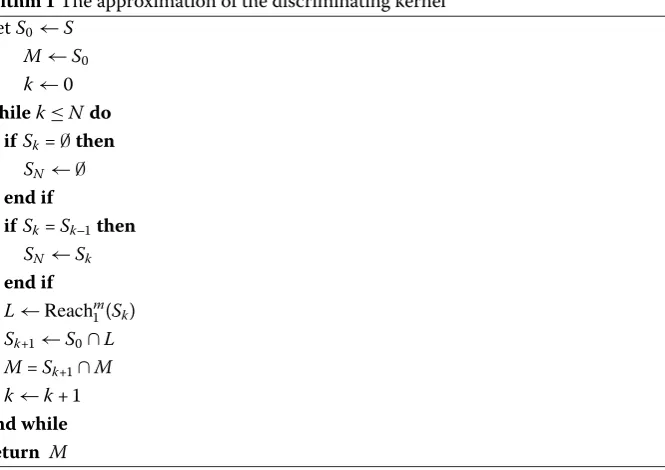
Algorithm The approximation of the discriminating kernel
The proof of Proposition can seen from the proof of [, Proposition .] or [, The-orem ].
In the following, we propose an algorithm of the discriminating kernel and give an ex-ample to illustrate the algorithm (see Algorithm ).
Example An example of a finite point set aboutU:
⎧
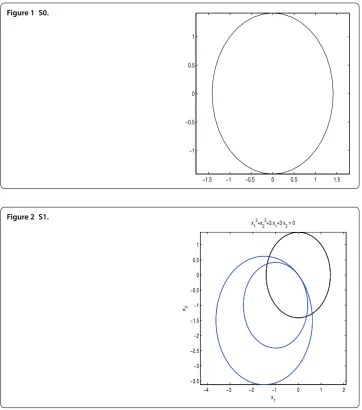
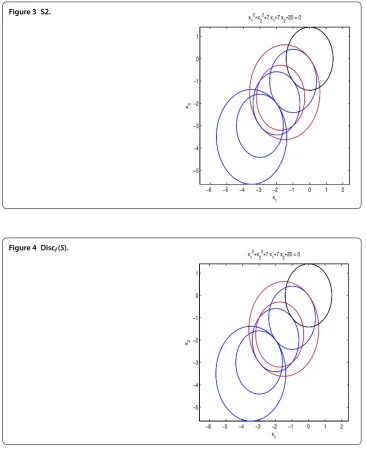
Now, we have the figures of the process of computing the discriminating kernel. Figure shows thatS is the boundary and interior of the circle. In Figure ,S is the intersection of the three circles.S is the intersection of the seven circles in Figure . In Figure ,S isDiscf(S). We find that the intersection of the seven circles is empty, that is,
S =∅, soDiscf(S) =∅.
Figure 1 S0.
Figure 2 S1.
where the timet∈[,τ]⊂R+. Ifτ<∞, then this problem has a finite horizon; otherwise,
this problem has an infinite horizon. To guarantee the existence and uniqueness of the solutions to the initial value problem, we suppose that the functionfis sufficiently smooth. Next, we discuss the viability kernelViabf(x,u,W) using the reachability. There are two
ways to deal with the reachability problem: computing the forward reachable set and the backward reachable set. Here, we use the backward approach.
Definition The backward reachable set from the closed targetKover [,τ] is the set of all initial statesxsuch that, for alld(t)∈W,t∈[,τ], there existsu(t)∈U,t∈[,τ], for
which someϕ(τ,x,u(t),d)∈Kare reachable fromx(τ) along a trajectory satisfying (),
whereϕ(s,x,u(t),d) denotes the solution of (), that is,
Reachτ(K) = x∈K|for anyd(t)∈W,t∈[,τ], there existu(t)∈U,
t∈[,τ] such thatϕτ,x,u(t),d
∈Kalong a
Figure 3 S2.
Figure 4 Discf(S).
Definition gives the backward reachable set from the closed targetK, which consists of the terminal states over [,τ] with finite horizonτ.
Definition The vector functionf : Rm+n→Rnis bounded byM> onSin the norm · : Rn→R+if for allx∈S,u∈U, andd∈W, we havef(x,u,d) ≤M; · -distance of
a pointx∈Rnfrom a nonempty setS⊂Rnisdist
·(x,S) =infs∈Sx–s.
Suppose that f is bounded by M> on S in the norm · . Given a discretization time intervalδ, defining an underapproximation of the viability constraint setSδ={x∈ S|dist·(x,Sc)≥δM}, we underapproximateSby the distanceδMbecause we only con-sider the state at tk =kδ. A solutionx(t) of () att∈[tk,tk+] can travel the distance x(tk) –x(t) ≤
t
underap-proximation is recursively defined as
Proof The proof is similar to that of [, Theorem ]. This completes the proof of the
theorem.
Proof The proof is similar to that of [, Theorem ]. This completes the proof of the
theorem.
Algorithm Underapproximation of the discriminating kernel
actual situation. We can give an accuracyε> , and the termination condition turns into
S–Sj<ε,j<∞.
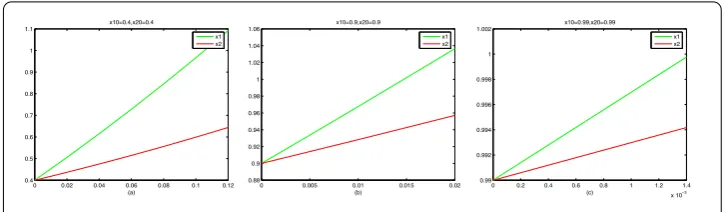
Example An example of a finite point set aboutU:
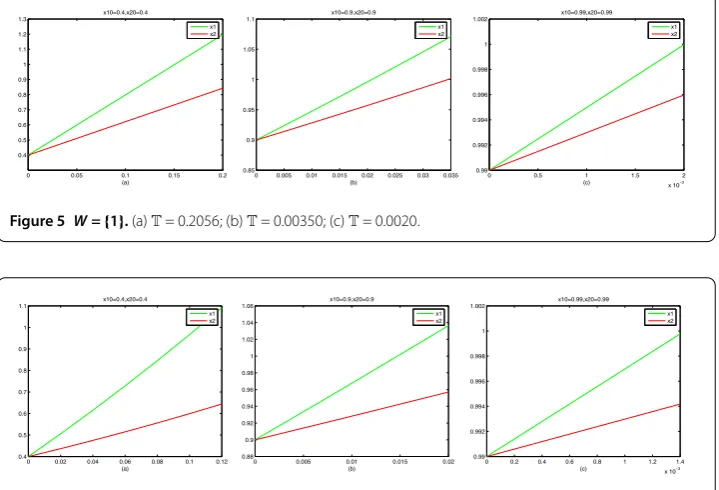
Figure 5 W={1}.(a)T= 0.2056; (b)T= 0.00350; (c)T= 0.0020.
Figure 6 W={2}.(a)T= 0.1243; (b)T= 0.0201; (c)T= 0.0014.
• WhenW={},
T= ., Discf(S) = [, .]×[, .],
T= ., Discf(S) = [, .]×[, .],
T= ., Discf(S) = [, .]×[, .].
• WhenW={},
T= ., Discf(S) = [, .]×[, .], T= ., Discf(S) = [, .]×[, .],
T= ., Discf(S) = [, .]×[, .].
• WhenW={, },
T= ., Discf(S) = [, .]×[, .],
T= ., Discf(S) = [, .]×[, .],
T= ., Discf(S) = [, .]×[, .].
In the following, we Figures , , and of the discriminating kernel.
Remark(Alternative Theorem) LetS= Rn\. Iff(x,u,d) is a continuous function in all variables and a Lipschitz function inx, we have:
Figure 7 W={1, 2}.(a)T= 0.1243; (b)T= 0.0201; (c)T= 0.0014.
If we can computeDiscf(S), we can get the victory domains of player and player using
Alternative Theorem.
5 Conclusions
In this paper, we discussed the discriminating kernel of the dynamic game with two targets and two players. On the one hand, we discussed the discriminating kernel of a discrete-time dynamic game. Using set-valued analysis and viability theory, we computed an ap-proximation of the viability kernel by the maximal reachable set. Then, we proposed an al-gorithm of the discriminating kernel. On the other hand, we discussed the discriminating kernel of a differential game. We computed an underapproximation of the viability kernel by the backward reachable set from a closed target. Using the relationship of discriminat-ing kernel and viability kernel, we proposed an algorithm of the discriminatdiscriminat-ing kernel. In the future work, we will consider the calculation of the kernels of a convex polytope, an ellipsoid, and so on.
Acknowledgements
This work was supported by National Science Foundation of China (11171221), Doctoral Program Foundation of Institutions of Higher Education of China (20123120110004), Natural Science Foundation of Shanghai (14ZR1429200), Innovation Program of Shanghai Municipal Education Commission (15ZZ073), and Key Research Project Plan of Institutions of Higher of Henan Province(17A120010). The authors would like to thank the anonymous referees for their useful comments.
Competing interests
The authors declare that they have no competing interests.
Authors’ contributions
Both authors contributed equally to the manuscript, read, and approved the final manuscript.
Author details
1School of Management, University of Shanghai for Science and Technology, 516 Jungong Road, Shanghai, 200093,
China.2School of Mathematics and Information Science, Henan Polytechnic University, Jiaozuo, 454000, China.
Publisher’s Note
Springer Nature remains neutral with regard to jurisdictional claims in published maps and institutional affiliations.
Received: 7 June 2017 Accepted: 17 November 2017
References
1. Cardaliaguet, P, Quincampoix, M, Pierre, PS: Set-valued numerical analysis for optimal control and differential games. Ann. Internat. Soc. Dynam. Games4, 177-247 (1999)
2. Cardaliaguet, P, Jimenez, C, Quincampoix, M: Pure and random strategies in differential game with incomplete informations. J. Dyn. Games1, 363-375 (2014)
3. Jimenez, C, Quincampoix, M, Xu, Y: Differential games with incomplete information on a continuum of initial positions and without Isaacs condition. Dyn. Games Appl.6, 1-15 (2016)
5. Aubin, JP: Viability Theory, pp. 1-72. Springer, Berlin (2011)
6. Aubin, JP: Viability kernels and capture basins of sets under differential inclusions. SIAM J. Control Optim.40, 853-881 (2001)
7. Turriff, J, Broucke, ME: A method to construct viability kernels for nonlinear control systems. In: American Control Conference, pp. 3983-3988 (2009)
8. Bonneuil, N: Computing the viability kernel in large state dimension. J. Math. Anal. Appl.323, 1444-1454 (2006) 9. Chen, Z, Gao, Y: Computation of approximate viable sets for linear systems. Control Theory Appl.30, 1473-1478
(2013) (in Chinese)
10. Chen, Z, Gao, Y: Approximating viability kernel for control systems. Oper. Res. Trans.17, 24-32 (2013) (in Chinese) 11. Gao, Y: Determining viability of polytopic set for linear control system. Control Decis.31, 1720-1722 (2016) (in
Chinese)
12. Mitchell, IM: Comparing forward and backward reachability as tools for safety analysis. In: Hybrid Systems: Computation and Control. LNCS, vol. 4416, pp. 428-443 (2007)
13. Le Girard, C Girard, A: Reachability analysis of linear systems using support functions. Nonlinear Anal. Hybrid Syst.4, 250-262 (2010)
14. Kaynama, S, Oishi, M, Mitchell, IM, Dumont, GA: The continual reachability set and its computation using maximal reachability techniques. In: 50th IEEE Conference on Decision and Control and European Control Conference, pp. 6110-6115 (2011)
15. Han, Z, Krogh, BH: Reachability analysis of nonlinear systems using trajectory piecewise linearized models. American Control Conference, pp. 1505-1510 (2006)
16. Blanchini, F, Miani, S: Set-Theoretic Methods in Control. Birkhäuser, Boston (2008)
17. Mitchell, IM, Bayen, AM, Tomlin, CJ: A time-dependent Hamilton-Jacobi formulation of reachable sets for continuous dynamic games. IEEE Trans. Autom. Control50, 947-957 (2005)
18. Kurzhanski, AB, Varaiya, P: Dynamic optimization for reachability problems. J. Optim. Theory Appl.108, 227-251 (2001) 19. Aubin, JP, Bayen, AM, Pierre, PS: Viability Theory: New Directions, 2nd ed. Springer, New York (2011)
20. Lygeros, J: On reachability and minimum cost optimal control. Automatica40, 917-927 (2004)
21. Maidens, JN, Kaynama, S, Mitchell, IM, Oishic, MMK, Dumonta, GA: Lagrangian methods for approximating the viability kernel in high-dimensional systems. Automatica49, 2017-2029 (2013)
22. Cardaliaguet, P: A differential game with two players and one target. SIAM J. Control Optim.34, 1441-1460 (1996) 23. Aubin, JP, Lggeros, J, Quincampoix, M, Sastry, S, Seube, N: Impulse differential inclusions: a viability approach to
hybrid systems. IEEE Trans. Autom. Control47, 2-20 (2002)
24. Clark, FH, Ledyaev, YS, Stern, RJ, Wolenski, PR: Nonsmooth Analysis and Control Theory. Springer, New York (1998) 25. Pierre, PS: Approximation of the viability kernel. Appl. Math. Optim.29, 187-209 (1994)
26. Gao, Y, Lggeros, J, Quincampoix, M: On the reachability problem of uncertain hybrid systems. IEEE Trans. Autom. Control52, 1572-1586 (2007)