ACCEPTED MANUSCRIPT
1
Non-holistic coding of objects in lateral occipital complex with and
without attention
Matthias Guggenmos1,2, Volker Thoma3, Radoslaw Martin Cichy4, John-Dylan Haynes1, Philipp Sterzer1,2† & Alan Richardson-Klavehn5,6†
1
Bernstein Center for Computational Neuroscience, Berlin, Germany
2
Visual Perception Laboratory, Charité Universitätsmedizin, Berlin, Germany
3
School of Psychology, University of East London, London, UK
4
Computer Science and Artificial Intelligence Laboratory, Massachusetts Institute of Technology, Cambridge, USA
5
Department of Neurology, Otto von Guericke University, Magdeburg, Germany
6
Leibniz Institute for Neurobiology, Magdeburg, Germany
†
contributed equally
Corresponding author:
Matthias Guggenmos
Bernstein Center for Computational Neuroscience, Philippstraße 13, Haus 6, 10115 Berlin Phone: +49 (0) 30 450 517131
ACCEPTED MANUSCRIPT
2
Abstract
A fundamental issue in visual cognition is whether high-level visual areas code objects in a part-based or a view-based (holistic) format. By examining the viewpoint invariance of object recognition, previous behavioral and neuroimaging studies have yielded ambiguous results, supporting both types of representational formats. A critical factor distinguishing the two formats could be the availability of attentional resources, as a number of studies have found greater viewpoint invariance for attended compared to unattended objects. It has therefore been suggested that attention is necessary to enable part-based representations, whereas holistic representations are automatically activated irrespective of attention. In this functional magnetic resonance imaging study we used a multivariate approach to probe the format of object representations in human lateral occipital complex (LOC) and its dependence on attention. We presented human
participants with intact and half-split versions of objects that were either attended or
unattended. Cross-classifying between intact and split objects, we found that the
object-related information coded in activation patterns of intact objects is fully preserved in the
patterns of split objects and vice versa. Importantly, the generalization between intact and
split objects did not depend on attention. Our findings demonstrate that LOC codes objects in
a non-holistic format, both in the presence and absence of attention.
ACCEPTED MANUSCRIPT
3
1.
Introduction
A hallmark of human object perception is the recognition of objects despite variations in their
exact appearance. Accordingly, object representations in high-level visual brain areas have to
be abletogeneralize across changes in size, position or orientation (Eger et al., 2008;
Grill-Spector et al., 1999). Yet, the specific representational code realizing such invariant
representations is still largely unknown. One central question is whether an object is coded as
a collection of parts (Hummel and Biederman, 1992; Marr and Nishihara, 1978) or in a
view-based format (Edelman and Bülthoff, 1992; Poggio and Edelman, 1990; Tarr and Pinker,
1989).
Part-based models propose that objects are encoded in terms of their constituent parts, the
representations of which are independent of each other and dynamically bound together.
Neurons that are tuned to a particular object part could therefore respond to the object part
appearing in different configurations or views, allowing for robust object recognition across
various manipulations, such as translation across the visual field, size changes and left-right
reflection (Hummel and Biederman, 1992; Hummel, 2001). By contrast, view-based models
propose that objects are recognized by matching the incoming sensory information to stored
views (Edelman and Bülthoff, 1992; Poggio and Edelman, 1990; Tarr and Pinker, 1989).
View-based representations are holistic, as the parts of an object are not represented
independent of each other and have fixed relative positions (static binding). Under a
view-based scheme neurons respond most strongly if objects are presented in learned views or
configurations. Nevertheless, recognition of objects in varying orientations is thought
ACCEPTED MANUSCRIPT
4
1993; Poggio and Edelman, 1990; Tarr and Gauthier, 1998; Tarr, 1995; Ullman, 1998),
interpolating across these views (Logothetis et al., 1994; Poggio and Edelman, 1990; Ullman,
1989) or by a distributed neural representation across view-tuned neurons (Perrett et al.,
1998).
Behavioral evidence on the format of object representations is equivocal, supporting
both view-based (Edelman and Bülthoff, 1992; Murray, 1999; Tarr and Pinker, 1989) and
part-based representations (Biederman and Cooper, 1991; Biederman and Gerhardstein,
1993). Neuroimaging research, too, has sought to establish which format of representation
underlies object recognition. Studies using functional magnetic resonance imaging (fMRI)
show that blood oxygen level-dependent (BOLD) signals in various ventral visual stream
regions, such as in lateral occipital and inferior temporal cortices, tend to decrease when an
object is shown repeatedly and found that this repetition suppression (Grill-Spector et al.,
2006) is greatest when the repeated view of an object is identical to the original orientation,
but decreases with the amount of view change (Andresen et al., 2009; Ewbank et al., 2005;
Gauthier et al., 2002). However, in support for part-based representations, other fMRI studies
have shown that the ventral stream is largely insensitive to the deletion of local image
features or changes in image format (grayscale image vs. line drawing), as long as the
individual object parts are present (Hayworth and Biederman, 2006; Kourtzi and Kanwisher,
2000).
Importantly, the representational format might be dependent on the absence or
presence of attention. Attended visual objects exhibit robust repetition-priming effects even
when their mirror-reflected (Stankiewicz et al., 1998) or half-split (Thoma and Henson, 2011;
ACCEPTED MANUSCRIPT
5
representation. However, when the same prime objects are unattended, visual priming is still
found for objects presented in the same view, but completely abolished after view changes
(see Thoma and Davidoff, 2007, for a brief review). Hummel (2001) therefore proposed a hybrid model, in which part-based representations are established with attention, whereas view-based representations are automatically activated irrespective of attention.
Inspired by these previous studies and theoretical considerations, the present
functional magnetic resonance imaging (fMRI) study examined the representational format of
objects in high-level visual cortex and its dependence on attention. Objects were presented in
either an intact or a split configuration (Fig. 1B) and were either attended or unattended. The
half-split manipulation, while preserving the constituent object parts, distorted the holistic
image in a way that cannot be recovered by the aligning processes of view-based models
(Hayward et al., 2010; Thoma et al., 2004). To prevent verbalization of the attended object as a confounding factor we used a non-semantic attention task, in which participants detected brightness changes on either the object (attended condition) or a
contralaterally presented noise stimulus (unattended condition). We reasoned that only if objects are coded as part-based, non-holistic representations, should activation patterns of
split objects be informative about those of intact objects. Moreover, if attention was necessary
for part-based representations, this configural invariance of object representations should
only be observed for attended, but not for unattended objects.
ACCEPTED MANUSCRIPT
6
objects and tested its predictive capacity for activation patterns of split objects and vice versa. The rationale was that successful generalization between activation patterns of intact and split objects is indicative of a non-holistic format of object representations. Our multivariate approach represents a critical advance compared with previous
repetition suppression studies, because of mounting evidence that high-level visual areas code objects in a distributed fashion across multiple neuronal populations (Haxby et al., 2001; Rice et al., 2014). Importantly, different configurations of an object might activate identical neuronal populations and the difference between configurations only emerges at the pattern level as a distinct weighting of each population. Multivariate methods are able to pick up on these object- or view-specific multivoxel fingerprints, whereas
ACCEPTED MANUSCRIPT
7
2.
Materials and methods
2.1. Participants
Eighteen healthy participants (11 female, mean age ± SEM, 23.4 ± 0.8 years) participated in
the experiment for payment after giving written informed consent. The study was conducted
according to the declaration of Helsinki, and approved by the local ethics committee.
2.2. Experimental design
The experimental design comprised the factors configuration (intact, split) and attention (attended, unattended) as factors of interest as well as object (camera,
watering can, chair) and side of presentation (left, right) as factors of no interest. Within each of 8 experimental runs, an object appeared in 4 trials in each attention conditions (in 2 trials per side of presentation). The order of presentation was randomized across the 48 trials of each run.
2.3. Experimental procedures
A trial (Fig. 1A) started with a blank fixation screen for 3300ms ± 2000ms, after which one
half of a central black fixation diamond turned red, indicating the side to which attention
should be directed. After a fixed interval (250ms), four repetitions of the stimulus-response
phase appeared. Each stimulus-response phase lasted 1500ms and comprised the presentation
of the stimulus screen (500ms), a pattern mask (133ms) and the default screen (867ms). An
intact or split object appeared on one side of the fixation cross (offset 3.84 degrees of visual
angle) and a noise stimulus at the same offset on the other side of the stimulus screen. Intact
ACCEPTED MANUSCRIPT
8
brightness change occurred 283ms after stimulus onset simultaneously on both the object and
the noise stimulus, such that they became independently and randomly either r darker or
lighter. Participants were instructed to press a button on the response box when the stimulus
on the cued side became darker. The cued stimulus could either be an intact or split image
version of an object (attendedcondition) or the noise stimulus (unattendedcondition).
Responses were counted as valid within a time window of 1000ms after stimulus offset. In each repetition of the stimulus-response phase, the same object was shown at the same position. The noise stimulus, while also presented at the same position, was randomly generated for each repetition.
<Fig. 1 approximately here>
To independently identify object-responsive regions of lateral occipital complex (LOC)
in each participant (Malach et al., 1995), we conducted a localizer run with 5 blocks of intact
objects, 5 blocks of split objects and 10 blocks of grid-scrambled versions of the objects in
randomized order. Blocks lasted for 15.8s during which 20 images were presented for 600ms
each, followed by 200ms blank screen. Pairs of identical objects were shown left and right of
fixation, equaling the configuration of the main experiment in eccentricity and size.
Participants performed a one-back task, in which they had to indicate via button press
whenever the same stimulus display appeared twice in a row
2.4. Stimuli
Stimuli were generated with Psychophysics Toolbox 3 (Brainard, 1997; Pelli, 1997) and
projected with a Sanyo LCD projector at 60 Hz. The stimulus set consisted of three grayscale
ACCEPTED MANUSCRIPT
9
either intact or half-split (Fig. 1B). The objects were selected for representing
non-overlapping man-made categories to increase the discriminability of evoked neuronal
activation patterns. Split versions were generated by relocating the two halves of an original
image to the opposite side of the canvas. The noise stimuli matched the objects in terms of
spatial extent and complexity to ensure that there would be no performance difference. They
were randomly generated for each trial by sampling a 9 by 9 random binary matrix, scaling
the matrix to 216 by 216 pixels, applying a low-pass filter with a cut-off frequency of
0.02/pixel and cropping pixels outside a circle of 216 pixels diameter. This procedure resulted
in circular grayscale stimuli with randomly distributed smooth patches. Both the objects and
the noise stimuli were scaled to grayscale RGB values between 50 and 205. To generate
brightness changes, the underlying RGB histograms were shifted up or down by 50 (the
image background remained constant with an RGB value of 200). The pattern masks were
generated for each trial by sampling an 18 by 18 random binary matrix and scaling the matrix
to 216 by 216 pixels.
2.5. Eyetracking
Eyetracking data were successfully collected in 16 of 18 subjects using an infrared video
eyetracking system (iView XTM MRI 50Hz, SensoMotoric Instruments, Teltow, Germany).
As a measure of fixation reliability, we computed the percentage of recorded eye gaze
positions within a 1.93° visual angle circle around the center of the fixation cross. This radius
corresponded to the eccentricity of the inner edges of the two stimulus-containing boxes (see
ACCEPTED MANUSCRIPT
10
2.6. FMRI data acquisition and preprocessing
FMRI data were acquired on a 3-Tesla Siemens Trio (Erlangen, Germany) scanner using a
gradient echo planar imaging (EPI) sequence and a 12-channel head-coil. We recorded 8
experimental runs of 214 whole-brain volumes each (TR = 2s, echo time (TE) 25 ms, flip
angle 78°, 33 slices, 3mm isotropic resolution, interslice gap 0.75mm). The LOC localizer
comprised 242 volumes. In addition, a high-resolution T1-weighted image was acquired (TR
= 1.9s, echo time (TE) 2.51 ms, flip angle 9°, 192 slices, resolution 1mm isotropic).
Preprocessing was performed using SPM8 (Wellcome Department of Imaging Neuroscience,
Institute of Neurology, London) and included realignment and smoothing with an 8mm
Gaussian kernel. All main analyses were performed in native subject space.
2.7. Region of interest procedures
Our main region of interest (ROI) was LOC. To anatomically constrain LOC, which stretches
from lateral occipital cortex to posterior fusiform gyrus (Grill-Spector et al., 1999), we
generated a bilateral composite mask of the inferior occipital cortex, middle occipital cortex
and the posterior half of the fusiform gyrus (derived from the AAL Atlas, Tzourio-Mazoyer et
al., 2002).The LOC ROI was defined as the intersection of the anatomical mask and the
functional localizer based on the group-level T-contrast intact + split > scrambled at a
significance level of p<0.05 (family-wise error (FWE) corrected at the whole-brain level).
Additionally we created separate ROIs for two subregions of LOC, lateral occipital cortex
(LO; corresponding to the inferior and middle occipital anatomical masks) and posterior
fusiform gyrus (pFus; posterior fusiform gyrus mask), based on previous reports regarding a
ACCEPTED MANUSCRIPT
11
2001). The V1 ROI was defined as the intersection of Brodmann Area 17 (derived from the
SPM Anatomy toolbox; Eickhoff et al., 2005) and the functional localizer based on the
group-level T-contrast intact + split + scrambled > implicit baseline at a significance level of
pFWE<0.05. The V1 ROI was based on a mask for Brodmann Area 17 derived from the SPM
Anatomy toolbox (Eickhoff et al., 2005). All ROIs were reverse-normalized to native subject
space.
2.8. FMRI data analysis
2.8.1.First-level general linear models (GLMs)
For each participant we estimated a GLM with separate experimental regressors for the
factors configuration (split, intact), attention (attended, unattended), object (camera, watering
can, chair) and side of presentation (left, right). Onsets of the experimental regressors were
set to the beginning of the stimulus-response phase, and they were modeled as stick functions
and convolved with a canonical hemodynamic response function. Further, six motion
parameters from the realignment preprocessing step were included as
regressors-of-no-interest.
The GLM for the functional localizer comprised regressors for intact objects, split
objects and scrambled objects and six motion parameters. The experimental regressors were
modeled as boxcar functions with durations equal to the block lengths (15.8s) and convolved
with a canonical hemodynamic response function.
2.8.2.Multivariate analyses
ACCEPTED MANUSCRIPT
12
classification. SVM classification was performed using The Decoding Toolbox (Görgen et al.,
2012) with a linear C-SVM and a fixed cost parameter (c=1).
We first performed a searchlight analysis (Kriegeskorte et al., 2006), in which a
sphere with a radius of 4 voxels was centered at each voxel of the brain and decoding was
based on the voxels within each sphere. A leave-one-run-out cross-validation procedure was
used, such that in each fold the classifier was trained on the beta maps of seven runs and
tested on the left out eighth run. The resulting decoding accuracies were assigned to the
center voxel. We performed decoding separately between the three pairs of objects
(camera-can, camera-chair, can-chair) in each of the four experimental conditions (intact attended,
intact unattended, split attended, split unattended) and both sides of presentation (left, right).
After averaging across object pairs and sides, we obtained information maps for each subject
and experimental condition, which were subsequently normalized to a common template for
group-level statistical inference.
The main analyses were based on ROI decoding (Haynes and Rees, 2005; Kamitani
and Tong, 2005), in which the voxels of a given ROI in native space were used for
classification. ROI decoding followed the same cross-validation procedure as detailed for the
searchlight analysis. In addition, we used a nested feature selection procedure in order to select the most stimulus-responsive voxels. Thus, for each of the seven runs within a fold of the cross-validation procedure, voxels were ranked according to the magnitude (beta value) of the stimulus-related responses in the respective six other runs. Stimulus-related responses were derived from the T-contrast all conditions > implicit baseline.
ACCEPTED MANUSCRIPT
13
same configuration (e.g. training on intact objects, testing on intact objects) as
within-configuration decoding. In the cross-configuration analysis we trained the classifier to
discriminate between intact object categories and tested on split object categories and vice
versa, and then averaged across train-test directions. In the cross-attention analysis the
classifier was trained to discriminate between attended object categories and tested on
unattended object categories and vice versa. We performed cross-attention classification both
under the within- and the cross-configuration decoding scheme as described above.
For statistical inference we performed two-sided t-tests and repeated-measures
ANOVAs. Two-tailed t-tests for decoding accuracies were tested against the null hypothesis
ACCEPTED MANUSCRIPT
14
3.
Results
3.1. Behavioral results and fixation control
Participants detected and reported brightness changes of the objects and the noise stimuli
highly accurately (performance > 98%), indicating that they focused their attention on the
correct stimulus in each condition. On average, 98.3±0.8% of recorded eye gaze positions
were within the fixation area, demonstrating that the participants maintained fixation
throughout the experiment.
3.2. Decoding of objects
Initially, we performed a searchlight analysis to identify brain areas that processed
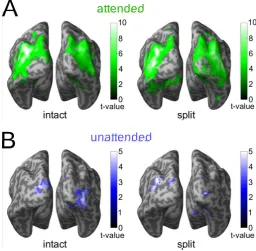
information about object categories (Fig. 2). We found above-chance classification for split
and intact object in both the attended and the unattended condition in areas overlapping with
the three a priori defined ROIs (LO, pFus,V1; peaks in the three ROIs were significant for all
conditions at p<0.01, FWE-corrected for small volumes). We did not observe significant
above-chance decoding beyond the predefined ROIs. We therefore performed all subsequent
analyses in those ROIs. Further, since we did not find any differences between pFus and LO
in any of the following analyses, we present the results for a composite mask of pFus and LO
(LOC ROI).
<Fig. 2 approximately here>
ROI decoding accuracies were significantly above chance in all conditions in LOC
and V1 (Table 1). Repeated-measures ANOVA (rmANOVA) with the factors attention and
ACCEPTED MANUSCRIPT
15
V1 (F(1,17)=2.0, p=0.17). The strong main effect of attention demonstrates the effectiveness
of the attentional manipulation. No other main effects or interactions were significant in
either ROI (all p>0.1).
<Table 1 approximately here>
3.3. Generalization between intact and split object representations
The critical test for distinguishing formats of object representations in LOC was whether the classifier generalized between intact and split objects. For this we conducted a
cross-configuration analysis, training the classifier on intact objects and testing on split objects, and
vice versa. In LOC, cross-configuration decoding of objects was significant in both the
attended (67.3% accuracy, t(17)=8.9, p<0.001) and unattended condition (55.5% accuracy,
t(17)=3.7, p=0.002; see Fig. 3A). This generalization clearly suggests a non-holistic format of
object representations in LOC.
To assess how cross-configuration decoding compared with within-configuration
decoding, we conducted an rmANOVA with factors decoding scheme and attention. There
was a main effect of attention (F(1,17) = 43.1, p<0.001), but neither a main effect of decoding
scheme (F(1,17) = 0.01, p=0.91) nor an attention-by-decoding scheme interaction
(F(1,17)=0.1, p=0.70). Thus the classifier could equally well predict intact and split objects,
irrespective of whether it was trained on intact or split objects (configural invariance).
In V1, by contrast, we found a main effect of decoding scheme (F(1,17)=71.8,
p<0.001), such that within-configuration decoding was superior to cross-configuration
ACCEPTED MANUSCRIPT
16
attention-by-decoding scheme interaction (F(1,17) = 3.6, p=0.08). An rmANOVA with the
additional factor region revealed a region-by-decoding scheme interaction (F(1, 17) = 32.0,
p<0.001), showing that the observed configural invariance was present in LOC, but not V1
(Fig 3A). The post-hoc probability to detect a main effect of decoding scheme in LOC of the
same effect size as in V1 was 0.978.
<Fig. 3 approximately here>
To test whether the generalization between intact and split objects in LOC would also
hold if they were presented in different hemifields, we repeated the above analyses in a
cross-hemifield decoding scheme. The classifier was trained on stimuli in one cross-hemifield and tested
on stimuli in the other hemifield, both under a within- and cross-configuration scheme. As
shown in Supplementary Fig. S1A <Insert Supplementary Figure S1 here>,
cross-configuration decoding was significant for attended objects (54.8% accuracy, t(17)=5.1,
p<0.001) and at the same level as within-configuration decoding (54.6% accuracy, t(17)=5.6,
p<0.001). The analysis demonstrates that the finding of complete cross-configuration generalization persists for high-level neuronal populations with receptive fields
encompassing an area of at least 5.7 degree visual angle left and right of fixation (11.4 degree
in total). Due to insufficient power, no statement can be made about unattended objects
(Supplementary Figure S1B).
3.4. Generalization between attended and unattended object representations
Our finding that representations of both attended and unattended objects in LOC were
insensitive to the split procedure does not preclude the possibility that LOC relies on different
ACCEPTED MANUSCRIPT
17
a cross-attention/within-configuration analysis on attended objects and tested on unattended
objects (and vice versa). The classifier was able to cross-classify activation patterns of
attended and unattended objects (57.1% accuracy, t(17)=5.9, p<0.001) in LOC (Fig. 3B),
strongly suggesting that attended and unattended objects share a common representational
basis. Furthermore, cross-attention decoding was successful even under a cross-configuration
decoding scheme (57.1% accuracy, t(17)=6.7, p<0.001; Fig. 3B), demonstrating that the
information shared between attended and unattended object representations in LOC is coded
non-retinotopically.
Cross-attention/within-configuration decoding was also successful in V1 (57.2%
accuracy, t(17)=13.2, p<0.001; Fig. 3B), while cross-attention/cross-configuration decoding
was not (48.8% accuracy, t(17)=-1.0, p=0.36). This difference was significant (t(17)=7.2,
p<0.001). Across regions (V1, LOC) there was a region-by-decoding scheme interaction
(F(1,17) = 31.9, p<0.001), consistent with the presence of configural invariance at the level of
ACCEPTED MANUSCRIPT
18
4.
Discussion
We investigated the representational format of objects in LOC and its relation to attention. We found that activation patterns of intact and split objects shared information that allowed
mutual prediction of the presented object (cross-configuration decoding). Remarkably,
cross-configuration decoding was at the same level as within-configuration classification, that is,
intact objects representations were predicted by activation patterns of split objects just as well
as by activation patterns of intact objects and vice versa. Crucially, cross-configuration decoding did not depend on attention. This pattern of results strongly suggests that the representational code of objects in LOC is based on a non-holistic format irrespective of attention.
Previous studies showed that BOLD activity in the LOC is barely affected when objects are—as in our study—coarsely scrambled (half-split and two-fold splits: Lerner et al., 2001; 8-fold: Grill-Spector et al., 1998), whereas finer scrambling leads to a strong reduction (Grill-Spector et al., 1998; Lerner et al., 2001). However, whether the activation elicited by coarsely scrambled objects still contains meaningful object-related information
remained unclear. We extended those findings by showing that the information coded in
activation patterns of intact objects is preserved in the patterns of split objects. Our results in
combination with the above reports therefore support a model in which LOC codes objects as
part-based representations.
A part-based coding scheme is in line with behavioral priming studies reporting
mirror (Biederman and Cooper, 1991), rotational (Biederman and Gerhardstein, 1993) and
ACCEPTED MANUSCRIPT
19
which posit independent encoding of object parts, correctly predict priming effects for the
range of manipulations above, because the constituent object parts are preserved between
prime and probe displays. A number of previous studies have probed the viewpoint
dependence of object representations at the neural level by examining repetition suppression
(RS). Some of those studies found evidence for viewpoint-invariant representations in
high-level visual cortex (Eger et al., 2004; James et al., 2002; Kourtzi et al., 2003), others found
tolerance only in the left hemisphere (Vuilleumier et al., 2002) or not at all (Grill-Spector et
al., 1999). While the present study cannot reconcile those reports, it introduces a new,
multivariate perspective to the longstanding question of view dependence. Our
cross-classification approach is sensitive to object-related information coded at the level of
multivoxel activation patterns, which could not be assessed by previous imaging studies
using univariate fMRI data analysis. At the level of multivoxel activation patterns we found a
striking invariance of object representations with respect to the relative dislocation of object
parts in LOC, indicative of a part-based code with all its theoretical advantages regarding
robust and flexible coding of objects under various viewing conditions (Hummel and
Biederman, 1992).
It should be noted that our finding of cross-configuration generalization is not
informative about the specific nature or complexity of object parts. For instance, since our
split manipulation only distorted the overall holistic image but not individual parts, our
results are open to the possibility that the part representations themselves are view-based.
However, our finding of relative position invariance of object parts entails important
constraints on models of object recognition. The ―chorus of fragments‖ model by Edelman
ACCEPTED MANUSCRIPT
20
(fragment) information and retinotopic position, which is at odds with relative position
invariance of object parts. Our results seem to fit however a ―bag of features‖ (Hayworth et
al., 2011) model, as for instance proposed by Ullman and colleagues (Epshtein and Ullman,
2007; Ullman, 2007).
Our second key finding is that the format of object representations in LOC was
independent of attention. We could cross-classify between intact and split objects, whether
they were attended or unattended. This finding was further corroborated by the fact that we
were able to predict the attended objects based on the activation patterns of unattended
objects (and vice versa). Thus, not only appears the LOC to adhere to a part-based format
irrespective of attention, but the underlying neural representations additionally seem to be
shared between attended and unattended objects. Importantly, we found this cross-attention
generalization also under a cross-configuration decoding scheme, demonstrating that the
activation patterns of attended and unattended objects indeed shared non-retinotopic,
high-level information. Taken together, our results do not provide evidence for a critical role of attention for part-based representations, as implicated by other empirical findings (Stankiewicz et al., 1998; Thoma and Henson, 2011; Thoma et al., 2004) and theoretical accounts (Hummel, 2001). The main difference between attended and unattended object representations in our study was of quantitative nature—superior decoding accuracy for
attended objects, likely related to neural gain (see Pratte et al., 2013)—but not qualitative in
ACCEPTED MANUSCRIPT
21
neural level, based on superior decoding accuracies for attended relative to unattended
objects. Second, we directly probed the representational format in LOC and its dependence on attention, whereas behavioral priming studies rely on indirect inference from reaction times. And third, we used a task (brightness discrimination) that attenuates the semantic
aspect of object recognition, which is arguably more pronounced in the object naming tasks
employed by many priming studies. Semantic top-down feedback from higher areas is a
potential confounding factor in these studies, since feedback might be responsible for
view-invariant priming, but might itself be dependent on attention. Future studies could investigate whether our finding of configurational invariance for both attended and unattended object representations is conditional on using a non-semantic object perception task, or whether it holds for tasks requiring object identification.
Our results also differ from a previous neuroimaging study that found evidence for a part-based format in LOC only for attended, but not for unattended, objects (Thoma and Henson, 2011). The paradigm and the analyses of Thoma and Henson deviate in a number of important aspects from those of the present study. The
ACCEPTED MANUSCRIPT
22
object format, the multiple repetitions in our study could have therefore led to the instantiation of view-based representations of (previously unfamiliar) split objects. However, the fact that we found perfect generalization between intact and split objects, despite the large number of repetitions, argues against a build-up (or prior existence) of view-based representations for split objects. On the methodological side, Thoma and Henson assessed the effects of RS, whereas we employed a cross-classification approach that utilized the full pattern information. Given that unattended objects evoke a weaker BOLD response (Murray and Wojciulik, 2004; O’Craven et al., 1999; Serences et al., 2004), it seems possible that RS was not sensitive enough to detect representational commonalities between intact and split unattended objects. Additionally, the analysis of repetition suppression effects by Thoma and Henson misses out on information coded at the pattern level, which by itself could explain the observed discrepancies for
unattended objects.
Finally, an important consideration is that the support vector machine approach in our
study is largely intransparent with respect to the particular stimulus features underlying
successful classification. A possible concern could be that between-object decoding might
have entirely been based on low-level visual features. For instance, the surface of an object
might have a certain characteristic texture, and further, the same kind of texture might even
be present at a similar retinotopic location after the splitting procedure—hence explaining the
observed cross-configuration generalization. However, for several reasons we consider a pure
low-level account of our results unlikely. First, if retinotopic low-level features were an
important source of discriminative information between objects, cross-configuration
ACCEPTED MANUSCRIPT
23
versions of our object images had very little low-level commonalities in retinotopic
coordinates as an image analysis with a biologically plausible model of visual cortex
confirmed (Supplementary Fig. S2) <Insert Supplementary Figure S2 here>. Third, the voxels entering the multivariate analysis were precisely selected for preferring complex features over low-level features. And fourth, the results of the cross-hemifield analysis show that the cross-configuration generalization holds also for high-level representations with
near-complete location invariance (Supplementary Fig. S1). Therefore, while acknowledging the
possibility that the classifier could have only picked up on low-level information, we consider
such an account highly unlikely for the reasons outlined.
In summary, our study provides novel evidence indicating that neural representations
of both attended and unattended objects in LOC rely on a non-holistic rather than view-based
format. Moreover, our data strongly suggest that attended and unattended objects rely on a
ACCEPTED MANUSCRIPT
24
Acknowledgements
This research was supported by the German Research Foundation (DFG) through the
Research Training Group GRK1589/1 (to M.G. and P.S.), and Grants STE1430/6-1 (to P.S.),
and RI1847/1-1 and SFB779TPA10N (to A.R.-K). R.C. was founded by a Feodory Lynen
Grant of the Alexander von Humboldt Foundation. We thank Guy Middleton for assistance
ACCEPTED MANUSCRIPT
25
References
Andresen, D.R., Vinberg, J., Grill-Spector, K., 2009. The representation of object viewpoint in human visual cortex. Neuroimage 45, 522–536.
Biederman, I., Cooper, E.E., 1991. Evidence for complete translational and reflectional invariance in visual object priming. Perception 20, 585–593.
Biederman, I., Gerhardstein, P.C., 1993. Recognizing Depth-Rotated Objects: Evidence and Conditions for Three-Dimensional Viewpoint In variance. J. Exp. Psychol. Hum. Percept. Perform. 19, 1162–1182.
Bisley, J.W., 2011. The neural basis of visual attention. J. Physiol. 589, 49–57.
Brainard, D.H., 1997. The Psychophysics Toolbox. Spat. Vis. 10, 433–436.
Bülthoff, H.H., Edelman, S., 1992. Psychophysical support for a two-dimensional view interpolation theory of object recognition. Proc. Natl. Acad. Sci. U. S. A. 89, 60–64.
Cichy, R.M., Sterzer, P., Heinzle, J., Elliott, L.T., Ramirez, F., Haynes, J.-D., 2013. Probing principles of large-scale object representation: category preference and location encoding. Hum. Brain Mapp. 34, 1636–1651.
Edelman, S., Bülthoff, H.H., 1992. Orientation dependence in the recognition of familiar and novel views of three-dimensional objects. Vision Res. 32, 2385–2400.
Edelman, S., Intrator, N., 2000. (Coarse coding of shape fragments) Representation of structure. Spat. Vis. 13, 255–264.
Eger, E., Ashburner, J., Haynes, J.-D., Dolan, R.J., Rees, G., 2008. fMRI activity patterns in human LOC carry information about object exemplars within category. J. Cogn. Neurosci. 20, 356–370.
Eger, E., Henson, R.N.A., Driver, J., Dolan, R.J., 2004. BOLD repetition decreases in object-responsive ventral visual areas depend on spatial attention. J. Neurophysiol. 92, 1241–1247.
Eickhoff, S.B., Stephan, K.E., Mohlberg, H., Grefkes, C., Fink, G.R., Amunts, K., Zilles, K., 2005. A new SPM toolbox for combining probabilistic cytoarchitectonic maps and functional imaging data. Neuroimage 25, 1325–1335.
ACCEPTED MANUSCRIPT
26
Ewbank, M.P., Schluppeck, D., Andrews, T.J., 2005. fMR-adaptation reveals a distributed representation of inanimate objects and places in human visual cortex. Neuroimage 28, 268– 279.
Gauthier, I., Hayward, W.G., Tarr, M.J., Anderson, A.W., Skudlarski, P., Gore, J.C., 2002. BOLD Activity during Mental Rotation and Viewpoint-Dependent Object Recognition. Neuron 34, 161–171.
Görgen, K., Hebart, M.N., Haynes, J.-D., 2012. The Decoding Toolbox (TDT): a new fMRI analysis package for SPM and MATLAB. Conf. Hum. Brain Mapp. Organ. Beijing, China.
Grill-Spector, K., Henson, R., Martin, A., Grillspector, K., 2006. Repetition and the brain: neural models of stimulus-specific effects. Trends Cogn. Sci. 10, 14–23.
Grill-Spector, K., Kourtzi, Z., Kanwisher, N., 2001. The lateral occipital complex and its role in object recognition. Vision Res. 41, 1409–1422.
Grill-Spector, K., Kushnir, T., Edelman, S., Avidan, G., Itzchak, Y., Malach, R., 1999. Differential processing of objects under various viewing conditions in the human lateral occipital complex. Neuron 24, 187–203.
Grill-Spector, K., Kushnir, T., Hendler, T., Edelman, S., Itzchak, Y., Malach, R., 1998. A sequence of object-processing stages revealed by fMRI in the human occipital lobe. Hum. Brain Mapp. 6, 316–328.
Grill-Spector, K., Kushnir, T., Hendler, T., Malach, R., 2000. The dynamics of
object-selective activation correlate with recognition performance in humans. Nat. Neurosci. 3, 837– 43.
Haxby, J. V, Gobbini, M.I., Furey, M.L., Ishai, A., Schouten, J.L., Pietrini, P., 2001. Distributed and overlapping representations of faces and objects in ventral temporal cortex. Science 293, 2425–2430.
Haynes, J.-D., Rees, G., 2005. Predicting the orientation of invisible stimuli from activity in human primary visual cortex. Nat. Neurosci. 8, 686–691.
Hayward, W.G., Zhou, G., Man, W.-F., Harris, I.M., 2010. Repetition blindness for rotated objects. J. Exp. Psychol. Hum. Percept. Perform. 36, 57–73.
Hayworth, K.J., Biederman, I., 2006. Neural evidence for intermediate representations in object recognition. Vision Res. 46, 4024–4031.
ACCEPTED MANUSCRIPT
27
Hummel, J.E., 2001. Complementary solutions to the binding problem in vision: Implications for shape perception and object recognition. Vis. cogn. 8, 489–517.
Hummel, J.E., Biederman, I., 1992. Dynamic binding in a neural network for shape recognition. Psychol. Rev. 99, 480–517.
James, T.W., Humphrey, G.K., Gati, J.S., Menon, R.S., Goodale, M.A., 2002. Differential Effects of Viewpoint on Object-Driven Activation in Dorsal and Ventral Streams. Neuron 35, 793–801.
Kamitani, Y., Tong, F., 2005. Decoding the visual and subjective contents of the human brain. Nat. Neurosci. 8, 679–685.
Kourtzi, Z., Erb, M., Grodd, W., Bülthoff, H.H., 2003. Representation of the perceived 3-D object shape in the human lateral occipital complex. Cereb. cortex 13, 911–920.
Kourtzi, Z., Kanwisher, N., 2000. Cortical regions involved in perceiving object shape. J. Neurosci. 20, 3310–3318.
Kriegeskorte, N., Goebel, R., Bandettini, P., 2006. Information-based functional brain mapping. Proc. Natl. Acad. Sci. 103, 3863–3868.
Lerner, Y., Hendler, T., Ben-Bashat, D., Harel, M., Malach, R., 2001. A hierarchical axis of object processing stages in the human visual cortex. Cereb. Cortex 11, 287–97.
Logothetis, N.K., Pauls, J., Bülthoff, H.H., Poggio, T., 1994. View-dependent object recognition by monkeys. Curr. Biol. 4, 401–414.
Malach, R., Reppas, J.B., Benson, R.R., Kwong, K.K., Jiang, H., Kennedy, W.A., Ledden, P.J., Brady, T.J., Rosen, B.R., Tootell, R.B., 1995. Object-related activity revealed by functional magnetic resonance imaging in human occipital cortex. Proc. Natl. Acad. Sci. 92, 8135–8139.
Marr, D., Nishihara, H.K., 1978. Representation and recognition of the spatial organization of three-dimensional shapes. Proc. R. Soc. London. Ser. B, Biol. Sci. 200, 269–294.
Murray, J.E., 1999. Orientation-specific effects in picture matching and naming. Mem. Cognit. 27, 878–889.
Murray, S.O., Wojciulik, E., 2004. Attention increases neural selectivity in the human lateral occipital complex. Nat. Neurosci. 7, 70–74.
ACCEPTED MANUSCRIPT
28
Olshausen, B.A., Anderson, C.H., Essen, D.C. Van, 1993. A Neurobiological Model of Visual Attention and Invariant Pattern Recognition Based on Dynamic Routing of Information. J. Neurosci. 13, 4700–4719.
Pelli, D.G., 1997. The VideoToolbox software for visual psychophysics: transforming numbers into movies. Spat. Vis. 10, 437–442.
Perrett, D.I., Oram, M.W., Ashbridge, E., 1998. Evidence accumulation in cell populations responsive to faces: an account of generalisation of recognition without mental
transformations. Cognition 67, 111–145.
Poggio, T., Edelman, S., 1990. A Network that Learns to Recognize 3D Objects. Nature 343, 263–266.
Pratte, M.S., Ling, S., Swisher, J.D., Tong, F., 2013. How attention extracts objects from noise. J. Neurophysiol. 110, 1346–1356.
Rice, G.E., Watson, D.M., Hartley, T., Andrews, T.J., 2014. Low-Level Image Properties of Visual Objects Predict Patterns of Neural Response across Category-Selective Regions of the Ventral Visual Pathway. J. Neurosci. 34, 8837–8844.
Serences, J.T., Schwarzbach, J., Courtney, S.M., Golay, X., Yantis, S., 2004. Control of object-based attention in human cortex. Cereb. cortex 14, 1346–1357.
Stankiewicz, B.J., Hummel, J.E., Cooper, E.E., 1998. The role of attention in priming for left-right reflections of object images: evidence for a dual representation of object shape. J. Exp. Psychol. Hum. Percept. Perform. 24, 732–744.
Tarr, M.J., 1995. Rotating objects to recognize them: A case study on the role of viewpoint dependency in the recognition of three-dimensional objects. Psychon. Bull. Rev. 2, 55–82.
Tarr, M.J., Gauthier, I., 1998. Do viewpoint-dependent mechanisms generalize across members of a class? Cognition 67, 73–110.
Tarr, M.J., Pinker, S., 1989. Mental rotation and orientation-dependence of shape recognition. Cogn. Psychol. 21, 233–282.
Thoma, V., Davidoff, J., 2007. Object recognition: attention and dual routes, in: Osaka, N., Rentschler, I., Biederman, I. (Eds.), Object Recognition, Attention, and Action. Springer, Tokyo, pp. 141–158.
ACCEPTED MANUSCRIPT
29
Thoma, V., Hummel, J.E., Davidoff, J., 2004. Evidence for holistic representations of ignored images and analytic representations of attended images. J. Exp. Psychol. Hum. Percept. Perform. 30, 257–267.
Tzourio-Mazoyer, N., Landeau, B., Papathanassiou, D., Crivello, F., Etard, O., Delcroix, N., Mazoyer, B., Joliot, M., 2002. Automated anatomical labeling of activations in SPM using a macroscopic anatomical parcellation of the MNI MRI single-subject brain. Neuroimage 15, 273–289.
Ullman, S., 1989. Aligning pictorial descriptions: An approach to object recognition. Cognition 32, 193–254.
Ullman, S., 1998. Three-dimensional object recognition based on the combination of views. Cognition 67, 21–44.
Ullman, S., 2007. Object recognition and segmentation by a fragment-based hierarchy. Trends Cogn. Sci. 11, 58–64.
ACCEPTED MANUSCRIPT
30
Captions
Fig. 1. Experimental procedures and stimuli. A. In each trial a cue indicated the side to which attention should be directed. Subsequently, four repetitions of the stimulus-response
phase appeared, during each of which participants had to detect a decrease in brightness of
either the object (attended condition) or the noise stimulus (unattended condition). B. The
stimulus set consisted of three objects in an intact and half-split configuration.
Fig. 2. Searchlight analysis results for intact and split objects based on a
within-configuration/between-object decoding procedure. Whole-brain information maps are
represented as T-maps indicating the statistical significance of voxel-wise decoding
accuracies against the chance-level decoding accuracy of 50%. The T-maps are thresholded at
p<0.005, uncorrected, for illustration. A. Attended objects. B. Unattended objects.
Fig. 3. Within- and cross-configuration decoding in LOC and V1. A. Within-attention
decoding scheme. B. Cross-attention decoding scheme. Error bars represent SEM. P-values
are based on two-tailed paired t-tests. Stars represent the significance of decoding accuracies
based on two-tailed t-tests against the chance-level decoding accuracy of 50%: ** p<0.01 ***
p<0.001.
ACCEPTED MANUSCRIPT
31
Tables
Table 1
accuracy t(17) p
Intact attended
LOC 66.9% 9.8 .00000002
V1 63.3% 8.9 .00000008
Split attended
LOC 67.9% 6.8 .000003
V1 62.4% 8.0 .0000004 (SVC)
Intact unattended
LOC 54.1% 2.2 .043
V1 59.3% 5.7 .00003
Split unattended
LOC 55.9% 3.6 0.002
ACCEPTED MANUSCRIPT
32
Fixation 3300 ± 2000 ms
4 repetitions
Cue 450ms
ACCEPTED MANUSCRIPT
33
A
intact split
intact split
attended
unattended
B
ACCEPTED MANUSCRIPT
34 LOC V1 *** p<0.001 within- cross-configuration *** *** n.s. d e c o d in g a c c u ra c y ( % ) within- cross-configuration 50 55 60 65 70 75 cross-co nfiguration within-configurationA
within- and cross-configuration attended unattendedwithin-configuration training testing testing training cross-co nfiguration
B
within- and cross-configuration: cross-attentionACCEPTED MANUSCRIPT
35
ACCEPTED MANUSCRIPT
36
Highlights:
Non-holistic coding of objects in LOC
Relative position invariance of object parts in LOC
No evidence for a role of attention in establishing a non-holistic code in LOC