R E S E A R C H
Open Access
Bargaining-based jammer power allocation for
dynamic eavesdropping scenario
Duan Bowen, Cai Yueming, Zheng Jianchao
*, Yang Weiwei and Yang Wendong
Abstract
This paper proposes a bargaining-based jammer power allocation scheme for multi-source multi-destination wireless network in the presence of a friendly jammer and a malicious node which eavesdrops erratically. We formulate the erratic behavior of the eavesdropper as a novel model where the eavesdropper wiretaps the message of the
legitimate sources with a certain probability in a time slot. Moreover, in order to obtain a fair and efficient solution, the jammer power allocation problem is modeled as a Nash bargaining game under the constraint of maximum transmit power of a friendly jammer, which is a convex optimization problem. Then, the closed form of the Nash bargaining solution (NBS) is derived, and a simple but effective centralized algorithm is proposed. Besides, we find that the even power allocation solution and the sum-secrecy-rate optimal solution are the special cases of the NBS, when the bargaining power is properly selected. Simulation results demonstrate that the NBS achieves a good performance in terms of both effectiveness and fairness.
Keywords: Dynamic eavesdropping; Friendly jammer; Power allocation; Nash bargaining solution
1 Introduction
The shared nature of the wireless communication chan-nel poses numerous security challenges, one of which is making wireless communications susceptible to eaves-dropping [1-4]. Privacy and security are the key aspects in wireless communication systems while the traditional encryption cannot ensure that the message of legitimate source is absolutely infeasible to be deciphered especially when the mismanagement of key occurs. Fortunately, many researches find that the physical layer of wireless communications also enables novel ways to defend against the eavesdroppers [1-5]. Therefore, physical layer security approaches are gaining extensive attention.
Friendly jamming is one of the techniques in physi-cal layer security, whose idea is to produce the artificial noise to deteriorate the eavesdropping channels to such an extent that successful decoding of the legitimate messages becomes infeasible [3-13]. The works [3-8] investigate the jammer-assisted communication system in terms of the design of transmission plan and the analysis of perfor-mance. [3] investigate the impact of the jammer’s antenna
*Correspondence: [email protected]
College of Communications Engineering, PLA University of Science and Technology, Yudao Road, Nanjing 210007, China
number on system secrecy rate, and they find that only the eavesdropper’s channel will be degraded when the jammer uses multiple antennas to generate artificial noise. More-over, Tippenhauer et al. in [4] consider the reliability of the jammer-assisted communication system and illustrate the limitation of the jammer in terms of maintaining con-fidentiality from a perspective of attacker. Besides, Tang et al. in [6] analyze the secrecy performance of the jammer-assisted communication system in the case of the discrete memoryless channels and the Guassian channels. The secrecy capacity and the achievable secrecy rate are given for both channels.
Specifically, it is pioneered by [9-13] in terms of the jammer power allocation [9] and [10] use the auction theory to design the jammer power allocation schemes. The friendly jammer and the sources act as the auction-eer and the bidders, respectively. A distributed solution is obtained, and the properties such as convergence and equilibrium are analyzed. Han et al. in [11] introduce the Stackelberg game to investigate the interaction between the source and the friendly jammers. Through exchang-ing the ‘price’ between the sources and the friendly jammer repeatedly, a distributed solution with desirable performance is obtained. In [12,13], the authors design a Stackelberg game framework to encourage terminals
to act as the jamming node by compensating them with an opportunity to access the channel of legitimate par-ties. This cooperative mechanism cannot only increase the spectral efficiency but also improve secrecy rate meaningfully.
For the works above, it is worth mentioning that the scenario they consider is the case that the eavesdropper works all the time. However, in some practical systems, the eavesdropper is likely to wiretap erratically or has different preferences to different legitimate source’s mes-sage, especially when the antenna number of the eaves-dropper is limited and its eavesdropping ability tends to be reserved for the more valuable legitimate users. In this paper, this erratic nature of eavesdropper is referred to as the dynamic nature of the eavesdropper and this kind of scenario is called dynamic eavesdropping sce-nario. Undoubtedly, one of the results that the dynamic nature of eavesdropper brings about is the change on the strategy of jammer power allocation. If the network oper-ator implements the jammer power allocation regardless of the dynamic nature of eavesdropper, it is likely that some sources experiencing securer communication link are allocated redundant jammer power while the packets of other sources endangered may be received by the eaves-dropper. To the best of our knowledge, there is no any research on the scenario where the eavesdroppers work intermittently. Therefore, a study on the model which can reflect the dynamic nature of the eavesdroppers and the corresponding optimization schemes is urgently required. In addition, the objective of the aforementioned works is to improve the secrecy rate or maximize the secrecy capacity, while seldom works consider the fairness among the sources. The works [9-13] have made progress in terms of the interaction between the sources and the jammer, but the fairness among the sources has not been taken into consideration, and thus, that kind of solution will generally suffer from severe fairness prob-lem. Although [14] has investigated the similar physical layer security scenario with consideration of fairness, the author only compared the proposed scheme with the even power allocation scheme. Thus, the effectiveness of that scheme is questionable. Fortunately, cooperative game theory often acts as a powerful tool to investigate how the sources negotiate to achieve their conflicting objectives. Specifically, the Nash bargaining solution (NBS), a core concept in the cooperative game theory, possesses the NBS fairness and Pareto optimality, and thus, it is intro-duced to increase efficiency while maintaining fairness in the jammer power allocation.
Briefly, the contributions and novelty of our work are summarized below:
• To the best of our knowledge, this is the first paper that studies the jammer power allocation in the
dynamic eavesdropping scenario. Furthermore, this novel model is a generalized physical layer security model. When the malicious node is ensured to eavesdrop all the time, the generalized model will degenerate to the classic physical layer security model [9-13].
• We take both the sum-secrecy-rate and the fairness among the sources into account by proposing a NBS-based optimization scheme. Moreover, the closed-form NBS is derived so that the iteration progress in the Stackelberg game and auction game can be replaced by a simple but effective centralized implementation.
• The impact of bargaining power on system
performance is investigated. Theoretical analysis and numerical results indicate that the even power allocation solution and the sum-secrecy-rate optimal solution are the special cases of the NBS, when the bargaining power is properly selected.
The remainder of the paper is organized as follows. The system model and utility function are presented in Section 2. In Section 3, the optimization problem in dynamic eavesdropping scenario is modeled as the NBS-based power allocation problem. The NBS is derived, and the effect of bargaining power on network performance is investigated. Section 4 presents our simulation results, and Section 5 concludes the paper.
2 System model and utility function 2.1 System model
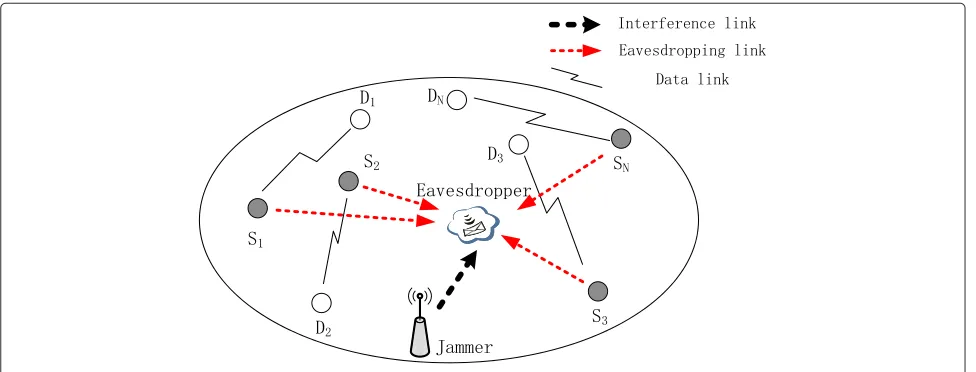
We consider a multi-source multi-destination wireless network which consists of N sources and destinations, denoted by Si andDi, i = 1,. . .,N, in the presence of
a friendly jammerJ and an eavesdropping nodeEwhich eavesdrops erratically, as illustrated in Figure 1. We denote the gain of the channel from the sourceSi to the
desti-nationDi, from the sourceSito the eavesdropping node
E and from the jammer J to the eavesdropping node E as hisd, hi
se, and hje, respectively. The available channel
bandwidth is divided equally intoNorthogonal channels, and the bandwidth of each channel is assumed to be 1. Each source occupies a free orthogonal channel, and all of the channels can be used by the jammer. Each source transmits with powerP0. Without loss of generality, the
variance of independent thermal noise for each link isσ2. We define the power the jammer contribute to helping the sourceSi asPi, andPJ stands for the total power of the
jammer.
Due to the dynamic nature of the eavesdropper, the dis-cussion on the cases whether the sourceSiis wiretapped
Figure 1Illustration of system model.S, source; D, destination.
sourceSi, the secrecy rate for the sourceSi to the
desti-nationDiwithout the help of the jammer is given as [15]
RSi,0= the jammer is close to the eavesdropper and far from the destination. Thus, the interference from the jammer to the destination is negligible when compared to the addi-tive noise. In this case, the secrecy rate for the sourceSi
to the destinationDiwith the help of the jammer can be
approximated as
Then, when eavesdropper is not wiretapping the source Si, the message sent from the sourceSiis secure, and the
secrecy rate for the sourceSito the destinationDiis given
as
For the convenience of modeling, we define the secu-rity factorsi, i,0, andi from Equations 2, 1, and 3,
respectively. The security factoriderived from Equation
2, reflecting the security performance of sourceSi’s
com-munication link, is defined as
i=
In addition, since the secrecy rate for the sourceSito the
destinationDiwithout the help of the jammer isRSi,0, the
security factori,0derived from Equation 1, is defined as
i,0=
P0 γsdi −γsei
1+Psγsei
, (5)
which will be regarded as the disagreement point in the following Nash bargaining game. When the source Si
ensures that there is no eavesdropper wiretapping its mes-sage, we defined the security factorifrom Equation 3 as
i=P0γsdi . (6)
Obviously, thei,i, andi,0represent how secure the
maximize the security performance of the network, con-sidering the requirement of sources in the static scenario is not enough, the jammer has to take the dynamic nature of the eavesdropper into account. To resolve the conflict among sources and describe the scenario more precisely, the interaction among the sources will be modeled as a Nash bargaining game and the utility function will be designed according to the whole probability formula.
2.2 Utility function
In this paper, we assume all the sources believe that the action of the eavesdropper closely depends on the impor-tance of their confidential message. We define the hap-pening of the eavesdropping action in a time slot as an eavesdropping probability θi. It reflects an evaluation of
the message security by source itself, e.g., the more impor-tant the source considers the message in this time slot, the more likely it is, the sourceSithink, to be wiretapped by
the malicious node. Given theNsources in the system, the utility vector is denoted as u = (u1u2· · ·uN). In a given
time slot, the utility function of a sourceSiis defined as the
expectation of the instantaneous security factordynamic. According to the whole probability formula, we define the sourceSi’s utility functionuirelated to the security factors
of the sourceSigiven in Equations 4 and 6, to be
The utility function represents expectation of the instantaneous security factor and is directly related to the performance of the communication security.θirepresents
the probability with which the eavesdropper will wiretap sourceSiin the given time slot. It can be seen that when
θi = 1, ∀i ∈N, the scenario will degenerate to the
clas-sic phyclas-sical layer security model. Whenθi = 0, it means
that there is no risk that the message of source Si will
be wiretapped. Moreover, since we use the mathematic expectation to study the dynamics, the channel coefficient should be averaged over time and thus, only pass loss is considered in this paper. Besides, it is clear thatui is an
increasing function ofPi. Then, we denote the
disagree-ment point as u0= u1,0u2,0· · ·uN,0
, which is defined as
ui,0i,0=
P0 γsdi −γsei
1+Psγsei
. (8)
It is the equivalent received signal-to-noise ratio of the sourceSiwithout the help of the jammer, and the u0is the
vector of the utility below which the sources will not reach
an agreement and quit the bargaining. Specifically, the dis-agreement point is the worst condition that each source expects when the eavesdropper is ensured to wiretap the source’s message and the jammer is not willing to help the source. Given the definitions of the utility function and the disagreement point, a feasible utility set U is defined as
Formally, a bargaining game is defined by a set of feasi-ble utilitiesUand a disagreement point u0 ∈ U. The set
Ucontains utility vectors u=(u1u2· · ·uN), denoting the
payoff to each source, for all possible strategies the players may implement. The disagreement point u0represents the
‘status quo’ prior to bargaining or the worst possible out-comes for the sources. In our model, although the strate-gies are the power contributed by jammer to help each source instead of the sources action, it can be interpreted as an outcome of the bargaining among the sources. In other words, sources cooperatively choose a compromise point. That is, rather than individually focusing on payoff maximization, sources jointly choose a mutually agreeable utility vector and agree to implement the strategies at the jammer.
3 NBS-based jammer power allocation 3.1 Nash bargaining game
The NBS is a core solution concept in cooperative game theory, and we choose it as the bargaining game solution among many bargaining games for the following reasons: First, since the NBS is obtained based on a certain set of axioms representing the fairness of the solution, it can improve the sources’ utility and maintain the fairness among sources at the same time. Second, the NBS has flex-ibility in bargaining power selection. This property makes it available to balance between the optimal sum-secrecy-rate and the optimal fairness among sources, which is preferred on system design perspective. Third, due to the property of the Nash bargaining game, an efficient and fair solution can be obtained readily, with no need for the iteration used for converging to the equilibrium in the noncooperative game. Thus, the pricing mechanism which will result in heavy overheads to the network can be avoided.
In the Nash bargaining game, given the disagreement point u0and the feasible utility setU, the Nash bargaining
Theorem 1.The game{N,U}is a Nash bargaining game.
Proof.The game{N,U}is a bargaining game if and only ifUis a closed and convex subset ofUN[17]. It is obvious that the utility setUis closed, we only need to check whether the convexity of setUis met, which means for any 0≤θ ≤1, ifUa= U1a,· · ·,U2a∈UandUb=
U1b,· · ·,U2b
∈U, thenθUa+(1−θ)Ub∈U.
From Equation 7, we have
ui(Pi,θi)=θi
P0
γi
sd−
γi se
1+Piγje
1+ Psγsei
1+Piγje
+(1−θi)P0γsdi , (10)
which is an increasing function ofPiand lim
Pi→∞
ui=Psγsdi. According to Equation 10, we can obtain that
Pi=
θiP0 γsdi −γsei
+(1−θi)P0γsdi 1+P0γsei
−ui 1+P0γsei
uiγje−θiP0γsdi γje−(1−θi)P0γsdi γje
. (11)
Then, the feasible utility setUcan be rewritten as
U=
uϕ(u)$iN=1Pi≤PJ, ui,0≤ui<Psγsdi , i=1,. . .,N
, (12)
where the last constraint means that 0 ≤ Pi < ∞,∀i. To make the problem solvable, we define U1
uui≥ui,0,i=1,. . .,NandU2 uϕ(u)≤PJ,ui<Psγsdi ,i=1,. . .,N
. Hence, we haveU=U1∩U2. SinceU1
is a convex set obviously, to prove the utility setUis convex, we only need to prove thatU2is a convex set.
To begin with, we need to prove thatϕ(u)is a convex function which will be applied to prove the convexity ofU2.
From the definition ofϕin Equation 12, it is obvious that the Hessian matrix ofϕ(u)is a diagonal matrix. Moreover, its ith diagonal element is
∂2ϕ (u) ∂u2i = −2
P0γsdi 1+P0γsei−"θiP0 γsdi −γsei
+(1−θi)P0γsdi 1+Psγsei
#
γje ui−Psγsdi
3 . (13)
Sinceui < Psγsdi for any finitePi, we have∂
2ϕ(u)
∂u2 i >
0 for alli = 1,. . .,N, which means the Hessian matrix ofϕ(u)
is positive definite. Therefore,ϕ(u)is a convex function and for setθU2a+(1−θ)U2b, we haveϕ(θU2a+(1−θ)U2b)≤
θϕ(U2a)+(1−θ)ϕ(U2b)≤θPJ+(1−θ)PJ =PJ, which meansθU2a+(1−θ)U2b∈U. As a result,U2is a convex set [18],
and thus, the game{N,U}is a Nash bargaining game. This completes the proof.
With the theorem above, we know the NBS is the unique point that maximizes the NP, e.g., finding the NBS results in the following optimization problem [17]:
max
P1,···PN
N
%
i=1
(ui−ui,0)βi, s.t.Pi≥0,
$N
i=1Pi≤PJ, (14)
where&Ni=1βi=1,βi ≥0,∀i.βiis the bargaining power of each source and shows the advantage of each player in the
game. Since the function of ln is monotonically increasing whenui−ui,0 ≥ 0,∀i, thus, the optimization problem in
Equation 14 is equivalent to
arg max
P1,···PN
N
$
i=1 βiln
⎧ ⎪ ⎨ ⎪ ⎩θi
P0
γi
sd−
γi se
1+Piγje
1+ P0γsei
1+Piγje
+(1−θi)P0γsdi −
P0 γsdi −γsei
1+P0γi se
⎫ ⎪ ⎬ ⎪ ⎭.
s .t.Pi≥0,
$N
i=1Pi≤PJ.
In order to find the NBS, we should solve Equation 15. The jammer power vector is defined as P[P1· · ·PN] , and
the Lagrangian function for problem in Equation 15 can be represented as
L(P,α,λ)
Here,αandλiare Lagrangian multipliers for the equality and inequality constraints, respectively. The objective
func-tion in Equafunc-tion 16 can be proved to be concave, which is omitted here because of the limitafunc-tion of the space. In addifunc-tion, since the equality and the inequality constraints are affine, the optimization problem in Equation 15 is a convex opti-mization problem [19]. Hence, its first-order Karush-Kuhn-Tucker (KKT) conditions become sufficient for the solution of Equation 15 [18], which are given as
∂L(P,α,λ)
Note that if the jammer’s total power is too small, due to the property of the KKT condition, there isPi=0 andλi>0
for some sources experiencing serious eavesdropping risk. In other words, the limited total power will be assigned to some minority sources only, in order to guarantee the optimality of the solution, regardless the requirement of others. Here, we only consider the condition that the jammer’s total power is sufficient enough to ensure that all the sources will enter the bargaining game, e.g.,Pi >0 for alli. WhenPi>0 and we haveλi=0, thus
We can see that ifαchanges from 0 to∞, the left side of Equation 20 will monotonically decrease from∞to 0. Hence, it is ensured that a unique positive solutionα exists for Equation 20, and the optimalαcan be found using bisection method. Then, the Nash bargaining solution can be obtained using Equation 19 and the optimalα.
3.2 Analysis of bargaining power
The bargaining power of the sourceSirepresents the priority of the source, which can be tuned by the jammer to achieve
a balance between the optimal global security performance and the optimal fairness among sources. In the respect of the fairness among sources, since the optimal secrecy-rate fairness, which depends on the topology of the network, is not always achievable, here, we only derive the relationship between the NBS and the optimal power fairness solution. The following theorem shows the effect of the bargaining power analytically.
Theorem 2.The Nash bargaining solution proves to be the even power allocation solution and the sum-secrecy-rate optimal solution, respectively, when
and
Proof.First, from Equation 17, we have
βi=α(
KiPi+Li) (IiPi+Ji)−Hi(IiPi+Ji)2
(KiJi−IiLi) α
qEi. (23)
Considering the even power allocation, e.g.,Pi= PNJ,∀i, the following equation holds
βi
, the NBS coincides with the even power allocation solution.
Then, in terms of global secrecy performance, the sum-secrecy-rate optimal solution is the maximizer of the following optimization problem:
Also, the optimal problem in Equation 25 is a convex optimal problem and its Lagrangian function is
LO
Correspondingly, its KKT conditions are
∂LO PO,αO,λO
and its solution is
whereαOis the Lagrangian multiplier related to the equal-ity constraint andε=(1−θi)P0γsdi . After we use bisection
method to obtain the optimalαO, we can calculate thePiO readily. Then, comparing Equation 25 with Equation 15, we have
qoi βi=
KiPOi+Li
IiPOi+Ji −Hi
+ ln 2
1+
KiPOi+Li
IiPOi+Ji
+(1−θi)P0γsdi
,.
(30)
Therefore, when
βo
i =
qoi &N
i=1qoi
, (31)
the NBS coincides with the sum-secrecy-rate optimal solution. This completes the proof.
3.3 Centralized implementation
Since the Stackelberg game and auction game require many iterations before converging to the Nash equi-librium, the exchange of information in the iteration progress will give rise to heavy overheads to the net-work. In this paper, we propose a centralized algorithm, which is simple but efficient thanks to the closed form of the NBS. Nevertheless, it requires enough computational ability and global channel state information (CSI) at the jammer.
In the centralized algorithm, we assume that the jam-mer have global and perfect CSI to compute the NBS proposed before. To get the NBS-based power allocation, each source informs the jammer of the eavesdropping probabilityθithrough backhaul communication,
accord-ing to the evaluation of the security of their message by themselves. Then, the jammer uses the bisection method to find theαthat satisfies Equation 20 and computes the NBS-based power allocation solution by using Equation 19. In this way, without any iteration and resulting heavy overheads to the network, the NBS scheme can obtain its solutions precisely.
4 Simulation results
In this section, we evaluate the performance of the NBS-based jammer power allocation by MATLAB simulations. The global security performance and the fairness among sources will be demonstrated and analyzed as the eaves-dropping probability increases. We compare the three optimization schemes (sum-secrecy-rate optimal (SSRO), even power allocation (EPA), and NBS) and evaluate the four parameters: network sum-secrecy-rate, individual achievable secrecy rate, Jain’s fairness index (JFI) of the secrecy rate and theJFIof the allocated power [20]. Note
that a largerJFIindicates a fairer solution. For all the chan-nels, the path loss coefficient is α = 4 and the static channels only with path loss is assumed due to the con-sideration of the average performance during a given time slot.
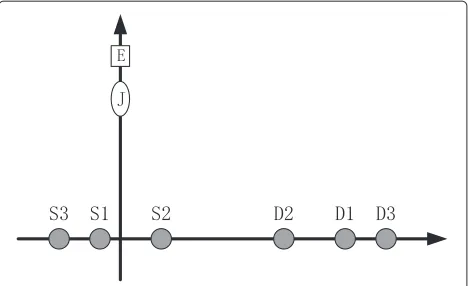
To begin with, to evaluate the performance of the NBS, we consider a three-source network. The simulation model is shown in Figure 2, and we assume the bargain-ing powers to beβi = 1/N = 1/3, ∀i ∈ N. We assume
that theycoordinates of the sources and destinations are 0. The xcoordinates of sources and destinations follow X(n) = −n(−1)nandX(n) =10−n(−1)n, respectively. The coordinates of eavesdropper and jammer are (0, 8) and (0, 6), respectively. The total power constraint of the jammerPJ is set to be 15 dB, and we assume the
eaves-dropping probability of each sourceθiis the same and is
in the range of 0 to 1.
In Figure 3, we evaluate the network sum-secrecy-rate under three different schemes. It can be seen that the sum-secrecy-rate of the NBS scheme is very nearly the same with that of the SSRO in the simulated eavesdropping probability range, while there is an increasing difference of secrecy rate between the SSRO and the EPA. When the eavesdropping probability becomes 1, the model we inves-tigate degenerates to the classical physical layer security model and the difference of security performance is the clearest.
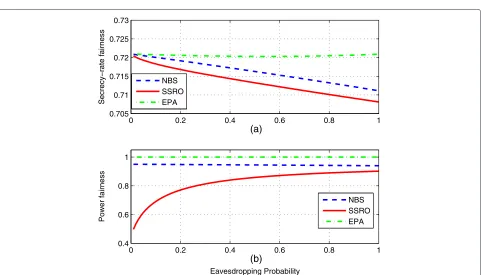
In Figure 4, we show the evolution of theJFI of secu-rity rate and allocated power versus the eavesdropping probability. In Figure 4a, we find that theJFI of security rate of NBS and SSRO is decreasing as the eavesdrop-ping probability approaching 1. That is because with the eavesdropping probability increasing, the security condi-tion of each source becomes different and the difference of secrecy rate of each source becomes large. Obviously, the NBS scheme is fairer than SSRO scheme, and the EPA is the fairest. In Figure 4b, theJFIof allocated power of NBS scheme is about 0.94 and almost remains constant with
0 0.2 0.4 0.6 0.8 1 9.4
9.5 9.6 9.7 9.8 9.9 10 10.1 10.2 10.3
Eavesdropping Probability
Network sum−secrecy−
rate
(b/s/Hz)
0.995 1 9.48
9.485 9.49
NBS SSRO EPA
Figure 3Sum-secrecy-rate versus eavesdropping probability in a three-source network.
0 0.2 0.4 0.6 0.8 1
0.705 0.71 0.715 0.72 0.725 0.73
(a)
Secrecy−rate fairness
0 0.2 0.4 0.6 0.8 1
0.4 0.6 0.8 1
(b)
Eavesdropping Probability
Power fairness
NBS SSRO EPA
NBS SSRO EPA
the eavesdropping probability growing. Besides, we find that with the eavesdropping probability is growing, the power fairness of SSRO will increase gradually. When the eavesdropping probability is low, since the source 2 is the nearest to the eavesdropper, the SSRO will allocate major jammer power to the source 2. When the eavesdropping probability is high, to keep the sum-security-rate optimal, the SSRO scheme will allocate more jammer power for other two sources than before, resulting a higher JFI of allocated power. For even power allocation, as the jammer allocates the same power to all three sources, theJFI of allocated power is 1.
To further evaluate the performance of the effect of bar-gaining power, we consider a two-source network, and the bargaining powers are assumed to be two different sets: NBS1:β1 = 0.3, β2 = 0.7; NBS2:β1 = 0.7, β2 = 0.3. The individual achievable secrecy rate of the sources (in Figure 5), network sum-secrecy-rate (in Figure 6), and the fairness among sources (in Figure 7) are compared.
In Figure 5, it is showed that, on the one hand, the net-work sum-secrecy-rate of source 2 is higher than that of source 1, for source 2 experiences a securer communica-tion links than source 1, and, on the other hand, a source with a larger bargaining power achieves a higher achiev-able secrecy rate. We should note that, in fact, the NBS1 is a source 2 prefered scheme while the NBS2 is a source 1 prefered scheme. When a higher bargaining power is assigned to source 2, and thanks to the securer communi-cation link the source 2 experiences, this kind of scheme will contribute more jammer power to help source 2 and put more emphasis on the network sum-secrecy-rate, thus giving rise to a larger difference of secrecy rate than NBS2 and vice versa.
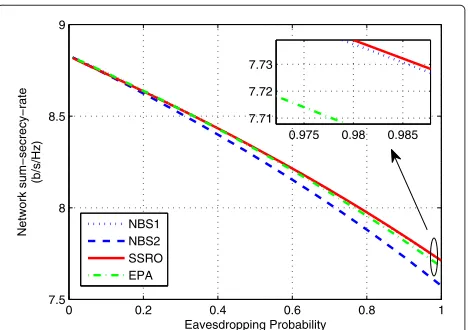
In Figure 6, we evaluate the sum-secrecy-rate under four schemes. The result in Figure 6 is closely related to that in Figure 5: the NBS1 will emphasize the network
0 0.2 0.4 0.6 0.8 1
2 2.5 3 3.5 4 4.5 5 5.5 6 6.5
Eavesdropping Probability
Achievable secrecy−rate
(b/s/Hz)
0.99850.9990.9995 1 2.2
2.205 NBS1,user1 NBS1,user2 NBS2,user1 NBS2,user2 SSRO,user1 SSRO,user2 EPA,user1 EPA,user2
Figure 5Achievable secrecy rates versus eavesdropping probability in a two-source network.
0 0.2 0.4 0.6 0.8 1
7.5 8 8.5 9
Eavesdropping Probability
Network sum−secrecy−rate
(b/s/Hz)
0.975 0.98 0.985 7.71
7.72 7.73
NBS1 NBS2 SSRO EPA
Figure 6Sum-secrecy-rates versus eavesdropping probability in a two-source network.
sum-secrecy-rate and the NBS2 will emphasize the fair-ness among sources. Thus, in Figure 6, the sum-secrecy-rate of NBS1 is closer to that of SSRO than NBS2.
In Figure 7, we compare the fairness among four schemes. In Figure 7a, we find that the NBS2 is the best and NBS1 is the worst among all four schemes in terms of secrecy-rate fairness. Although the EPA is a power-fairest scheme, which, however, cannot achieve more desirable fairness than NBS2 in the simulated eavesdropping prob-ability range. In Figure 7b, with the eavesdropping proba-bility increasing, the power fairness of NBS2 is approach-ing that of EPA (e.g., JFI = 1). Since the NBS1 more focuses on improving sum-secrecy-rate, its power fairness is the worst in high eavesdropping probability region.
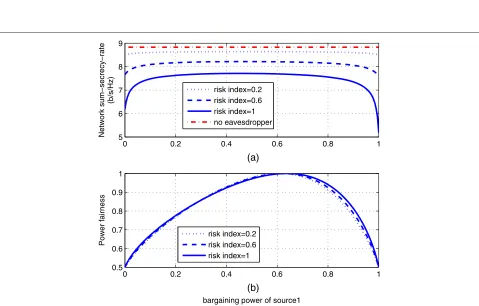
In Figure 8, to get a better understanding of the bar-gaining powers on network performance, we show the network sum-secrecy-rate and JFI of allocated power under three eavesdropping probabilities: 0.2, 0.6, and 1. The source 1’s bargaining power is increasing from 0 to 1. Whenβ1 = 1 orβ1= 0, all of the jammer power will be distributed to source 1 or source 2. For the three different eavesdropping probabilities, the network sum-secrecy-rate is maximized atβ1 = 0.485, 0.470, 0.450, respec-tively. The power fairness increases asβ1increases until optimal power-fairness is achieved. Forθi = 0.2, 0.6, 1,
the proposed NBS scheme becomes even power allocation in the range fromθi=0.6 toθi=0.63.
5 Conclusion
0 0.1 0.2 0.3 0.4 0.5 0.6 0.7 0.8 0.9 1 0.8
0.82 0.84 0.86
(a)
Secrecy−rate fairness
0 0.1 0.2 0.3 0.4 0.5 0.6 0.7 0.8 0.9 1 0.5
0.6 0.7 0.8 0.9 1
(b)
Eavesdropping Probability
Power fairness
NBS1 NBS2 SSRO EPA
NBS1 NBS2 SSRO EPA
Figure 7Secrecy-rate fairness and power fairness versus eavesdropping probability in a two-source network.(a)Secrecy-rate fairness versus eavesdropping probability.(b)Power fairness versus eavesdropping probability.
0 0.2 0.4 0.6 0.8 1
5 6 7 8 9
(a)
Network sum−secrecy−
rate
(b/s/Hz)
0 0.2 0.4 0.6 0.8 1
0.5 0.6 0.7 0.8 0.9 1
(b)
bargaining power of source1
Power fairness
risk index=0.2 risk index=0.6 risk index=1 no eavesdropper
risk index=0.2 risk index=0.6 risk index=1
both the fairness among sources and global security per-formance, the optimization problem was formulated as a Nash bargaining game, which is a convex optimiza-tion problem. The closed-form NBS was derived, and the effect of the bargaining power was investigated analyti-cally. Simulation results showed that the effectiveness and fairness of the proposed NBS-based resource allocation are desirable.
Competing interests
The authors declare that they have no competing interests.
Acknowledgements
This work is supported by the National Natural Science Foundation of China (No. 61371122 and No. 61301162) and the Jiangsu Natural Science Foundation (BK20130067).
Received: 30 May 2014 Accepted: 27 October 2014 Published: 12 November 2014
References
1. ZH Awan, A Zaidi, L Vandendorpe, Multiaccess channel with partially cooperating encoders and security constraints. IEEE Trans. Inform. Forensics Secur.8, 1243–1254 (2013)
2. ZH Awan, A Zaidi, L Vandendorpe, Secure communication over parallel relay channel. IEEE Trans. Inform. Forensics Secur.7, 359–371 (2012) 3. S Goel, R Negi, Guaranteeing secrecy in wireless networks using artificial
noise. IEEE Trans. Wireless Commun.7, 2180–2189 (2008)
4. N Tippenhauer, L Malisa, A Ranganathan, S Capkun, inIEEE Symposium on Security and Privacy (SP). On limitations of friendly jamming for confidentiality (Berkeley, CA, 2013), pp. 160–173
5. L Dong, Z Han, A Petropulu, H Poor, inProceeding of IEEE Workshop on Statistical Signal Processing (SSP). Cooperative jamming for wireless physical layer security (Cardiff, 2009), pp. 417–420
6. X Tang, R Liu, P Spasojevic, H Poor, Interference assisted secret communication. IEEE Trans. Inform. Theor.57, 3153–3167 (2011) 7. J Vilela, M Bloch, J Barros, S McLaughlin, inProceedings of the IEEE
International Conference on Communications (ICC). Friendly jamming for wireless secrecy (Cape Town, South Africa, 2010), pp. 1–6
8. J Vilela, M Bloch, J Barros, S McLaughlin, Wireless secrecy regions with friendly jamming. IEEE Trans. Inform. Forensics Secur.6, 256–266 (2011) 9. Z Han, N Marina, M Debbah, A Hjorungnes, in5th International Conference
on Mobile Ad-hoc and Sensor Networks(MSN). Improved wireless secrecy capacity using distributed auction theory (Fujian, 2009), pp. 442–447 10. R Zhang, L Song, Z Han, B Jiao, inIEEE Conference on Computer
Communications Workshops (INFOCOM WKSHPS). Improve physical layer security in cooperative wireless network using distributed auction games (Shanghai, 2011), pp. 18–23
11. Z Han, N Marina, M Debbah, A Hjorungnes, Physical layer security game: interaction between source, eavesdropper and friendly jammer. EURASIP J. Wireless Commun. Netw.2009, 452907 (2010)
12. JY Qu, YM Cai, D Wu, HL Chen, Stackelberg game based power allocation for physical layer security of device-to-device communication underlaying cellular networks. Frequenz.68(5-6), 285–295 (2014) 13. I Stanojev, A Yener, Improving secrecy rate via spectrum leasing for
friendly jamming. IEEE Trans. Wireless Commun.12, 134–145 (2013) 14. JT Yue, B Yang, XP Guan, inInternational Conference on Wireless
Communications and Signal Processing (WCSP). Fairness-guaranteed pricing and power allocation with a friendly jammer against eavesdropping (Huangshan, 2012), pp. 1-6
15. A Muthoo,Bargaining Theory with Applications. (Cambridge University Press, 1999)
16. J Suris, L DaSilva, Z Han, A MacKenzie, inProceeding of IEEE ICC. Cooperative game theory for distributed spectrum sharing (Glasgow, 2007), pp. 5282–5287
17. Z Han, D Niyato, W Saad, T Basar, A Hjorungnes,Game Theory in Wireless and Communication Networks: Theory, Models, and Applications. (Cambridge University Press, 2012)
18. R Jain, DM Chiu, W Hawe, A quantitative measure of fairness and discrimination for resource allocation in shared systems. DEC Research Report TR-301 (1984). http://arxiv.org/abs/cs.NI/9809099
19. S Boyd, L Vandenberghe,Convex Optimization. (Cambridge University Press, 2004)
20. M Andrews, K Kumaran, A Stolyar, P Whiting, R Vijayakumar, Providing quality of service over a shared wireless link. IEEE Commun. Mag.
39, 150–154 (2001)
doi:10.1186/1687-1499-2014-186
Cite this article as:Bowenet al.:Bargaining-based jammer power allocation for dynamic eavesdropping scenario.EURASIP Journal on Wireless Communications and Networking20142014:186.
Submit your manuscript to a
journal and benefi t from:
7Convenient online submission 7Rigorous peer review
7Immediate publication on acceptance 7Open access: articles freely available online 7High visibility within the fi eld
7Retaining the copyright to your article