Enhancing Web Image Search with
Multi-Attribute Assisted Re-ranking using SVM
Classification
SarikaYekule1, Anil D. Gujar2
P.G. Student, Department of Computer Engineering, TSSM’s BSCOER, Savitribai Phule Pune University, Pune, India1
Associate Professor, Department of Computer Engineering, TSSM’s BSCOER, Savitribai Phule Pune University,
Pune, India 2
ABSTRACT: In this paper, a framework is built to enhance Text Based Image Retrieval (TBIR) by using Multi-attribute learning methods. Firstly,by using visual and textual Multi-attributes,the proposed work divides relevant images into clusters,called as container. It clusters multiple relevant images in positive container whereas irrelevant images in negative container based on multi-attributes learning methods.The images in image container are labelled as positive and negative image container to train classifier for imageclassification. Further we enhance multi-attribute learning algorithm to effectively re-rank relevant images.
KEYWORDS: image retrieval, attribute-assisted, search, SVM, Multiple-instance learning, CBIR
I. INTRODUCTION
Search engine is used to search any type of query like text, image and video. Nowadays, majority of searches performed by users are the text queries. However,image content searches are increasingly become popular with users as these search services are becoming more readily available.Recently academia and industry is giving attention towards image retrieval. Many image search enginesexamples like Google and Bing matches user given query text against textual information associated with the images. But, in text-based image retrieval the associated text is incapable to appropriately describe the image content which causes to suffer from essential difficulties .visual re-ranking strains text-based search results by showing the visual information contained in the images. The existing visual re-ranking methods can be typically grouped into three categories as clustering based, classification based and graph based methods. Currently, keyword search technology is used for image search. Every image is, for example, indexed by its URL and associated text from the web page in which it appears. A search query which matches the indexed text can send the associated image as an answer, without any information from the imagemedia itself being used in querying process. There is no adequate method for determining the relevance of each indexed image for a corresponding search query. Traditional methodsdo not take into account the relevancy of the text indexed with corresponding images as well as the quality of indexed images.Semantic attributes revealed their effectiveness in number ofapplications, including face verification , object recognition , fine-grained visual categorization and image search.Semantic attributes narrow downs the semantic gap between low-level visual features and high -level semantic meanings.
The proposed system of this paper is described below:
ISSN(Online) : 2319-8753 ISSN (Print) : 2347-6710
I
nternational
J
ournal of
I
nnovative
R
esearch in
S
cience,
E
ngineering and
T
echnology
(An ISO 3297: 2007 Certified Organization)
Website: www.ijirset.com
Vol. 6, Issue 6, June 2017
2. Positive container includes very relevant multiple images whereas negative container clustered with few relevant images along with irrelevant images.
3. Finally, multi-attribute learning algorithm using SVM is used for effective re-ranking of relevant images.
II. LITERATURE SURVEY
Image search re-ranking is used to arrange the matched images according to the relevancy of an image. Recently, visual re-ranking is used to refine text-based search results by giving the visual information contained in image. The existing visual re-ranking method can be categorized into three groups like clustering based, classification based and graph based.The re-ranking method implemented by Cai and Tian is likewise every image is represented by an attribute feature which contains the responses from classifiers for all the predefined attributes. Further,a hyper graph is used to represent the relationship between images by integrating low-level visual features and attribute features and finally, hypergraph re-ranking is used to rank the images. The learning-to-re-rank paradigm,whichobtains the re-ranking function in a supervised fashion from the human-labelled training data is proposed by Yang .Wang and Yang proposed a model in which textual and visual information fromthe probabilistic perspective and express visual re-ranking as an optimization problem, called as Bayesian visual re-ranking. The method proposed for multi-attribute retrieval by Siddiquie is to specifically model the correlations present between the attributes and also utilizes other attributes in the vocabulary which are not present in the query, for ranking and retrieval. A power of semantic attributes was used in many applications, like face verification, object recognition, finegrained visual categorization and image search.
In Information Bottle based scheme, the images in the initial results are primarily categorized automatically into number of clusters. Then the re-ranked result list is created first by ordering the clusters according to the cluster conditionalprobability and next by ordering the samples within a cluster based on their cluster membership value. InIgroup , a fast and correct scheme is proposed for grouping Web image search results into semantic clusters.
In the classification based methods, visual re-ranking is designed as binary classification problem which aims to identify whether each search result is relevant or not. For example, a classifier or a ranking model is learned with the pseudo relevance feedback (PRF). To address the issue of noisy training examples, F.Schroff learned a query independent text based re-ranker. The top ranked results from the text based re-ranking are selected as positive training examples. Negative training examples are picked randomly from the other queries. A binary SVM classifier is then used to re-rank the results on the basis of visual features.
III.SYSTEM OVERVIEW
In figure1 ,the proposed framework implements the functions to handle the user search query and to give an easy access for relevant and irrelevant images. It implements a multi-attribute based image re-ranking approach. The proposed work initially divides the relevant images into clusters by using visual and textual attributes. By using multi-attributes learning we treat each cluster of images asa container and the images inside the cluster as instances.We cluster the very similar images that can have multiple relevant images in a positive container while a few relevant images may be clustered with irrelevant images in a negative container. But this is not sufficient to solve ambiguities on theimage instance labels in both positive and negative container. Therefore, we further enhance the multi-attribute learning algorithm using SVM, called ads MA-SVM, which uses the ”Multi-attributes Generation” strategy and maximum margin criterion for effective re-ranking of relevant images.
Fig 1: Proposed System Architecture
System Modules
1) Image Segregation: This module implements the function to handle the user search query and to give an easy access for relevant and irrelevant images. The module first explains the semantic concept of user given textual query and retrieves the relevant and irrelevant Web images from theimage database using the inverted file method.
2) Automatic Image Container Annotation: Automatic weak-image container annotation is an image labelling process based on the visual and textual features such as colour, shape and textures which compared with user selected image. To construct image container s, we partition the relevant imagesinto clusters using the k-means clustering method based on visual and textual features. Then, each cluster is considered as image container . The images in the image container will beannotated as positive and negative image container s to train classifiers for image classification and re-ranking. This method assume that the top-ranked image container s with higher image container ranking scores are used as pseudopositive image container s, and the same number of pseudonegative image container s is obtained by randomly sampling a few irrelevant images.
ISSN(Online) : 2319-8753 ISSN (Print) : 2347-6710
I
nternational
J
ournal of
I
nnovative
R
esearch in
S
cience,
E
ngineering and
T
echnology
(An ISO 3297: 2007 Certified Organization)
Website: www.ijirset.com
Vol. 6, Issue 6, June 2017
IV.PROPOSED ALGORITHM
The detailed steps of the proposed MA-Learning and classification process algorithm are summarized below:
Training stage:
Input: A set of labelled containers L, keyword W.
Output: Classified Images
(a) Partition the training set L into positive containers and negative containers according to the presence of W. (b) For each instance in positive containers, compute the DD value, and then select instances with the DD values larger than a threshold as instance prototypes.
(c) Apply x-means algorithm to construct the relevant and irrelevant images, and map all samples into this projection space.
(d) Train a SVM classifier on mapping data. (e) Classified Image
Predicting stage: For each test container, we will extract its project feature and use SVM classifier to predict its labelaccordingly to do the classification.
V. EXPERIMENTAL RESULTS WITH TABLES AND GRAPHS
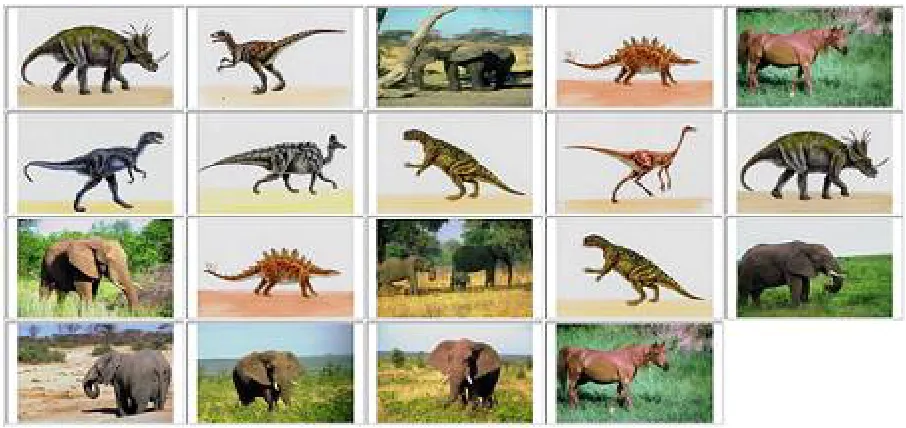
Figure 2 ,3 shows the experimental results of the traditional TBIR and the proposed MA-SVM based algorithms. Fig 2 (a) shows the result for the user query dinosaur animal with TBIR search. Fig 2 (b) shows the results with proposed MA-SVM algorithm for same query dinosaur animal.
Fig 2(a): TBIR results for query dinosaur animal
Fig 2(b):MA-SVM results for query dinosaur animal
In fig 2(b),result with MA-SVM search for user query dinosaur animal ,images are ranked according to relevancy. Query relevant images are placed at first i.e. 1st and 2nd row and irrelevant or less relevant images are placed at last i.e last row of result set .
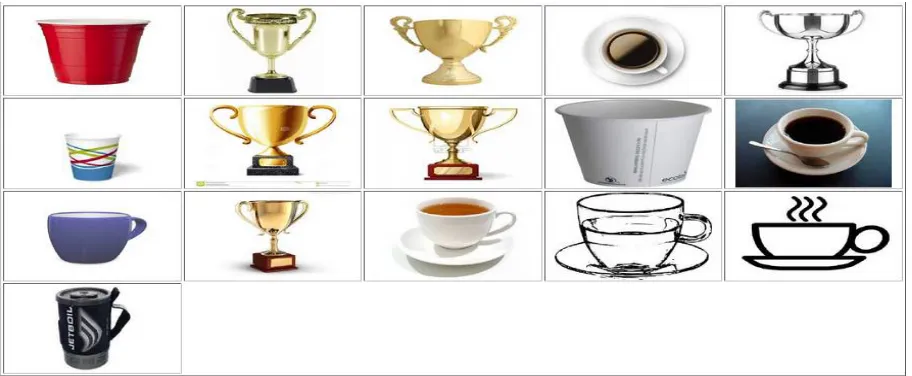
Fig 3(a): TBIR results for query paper cup
ISSN(Online) : 2319-8753 ISSN (Print) : 2347-6710
I
nternational
J
ournal of
I
nnovative
R
esearch in
S
cience,
E
ngineering and
T
echnology
(An ISO 3297: 2007 Certified Organization)
Website: www.ijirset.com
Vol. 6, Issue 6, June 2017
Fig 3(b): MA-SVM results for query paper cup
Fig3(b) shows the results with proposed MA-SVM algorithm for same query paper cup which shows highly relevant images at first i.e at 1st,2nd, 3rd position and less or irrelevant images at last .It also removes highly irrelevant images from result set which further reduces network bottleneck problem during web image search.
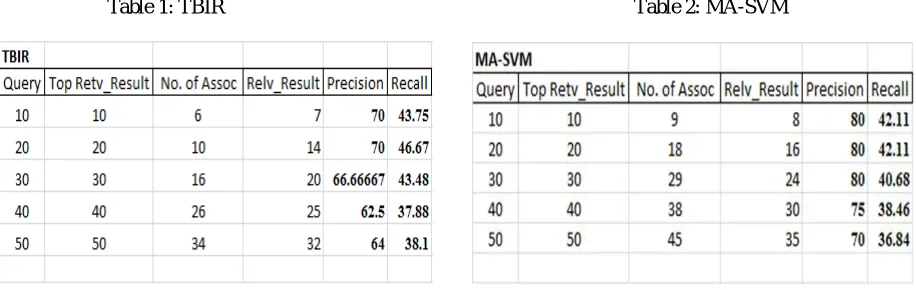
The performance measures used for the system are precision and recall. Table 1 and 2 gives the precision and recall values for TBIR and MA-SVM .
Table 1: TBIR Table 2: MA-SVM
The graphs plotted for precision and recall from above results are as shown in figure 4 and 5.
Fig 4: Precision Comparison Fig 5: Recall Comparison
Fig 4.shows graph plotted for precision comparison for n-top results of number of queries 10, 20, 30, 40, 50 on both TBIR and MA-SVM .From fig.4 ,we know that MA-SVM gives more relevant images than TBIR. Fig 5. Shows graph plotted for recall comparison for both search methods. The number of retrieved relevant images in MA-SVM is less than TBIR i.e. highly irrelevant images are removed from result set.
VI.CONCLUSION
Image search re-ranking has been studied for past few years and number of methods have been developed recently to boost the performance of text-based image search engine for queries. This paper improves the searching performance by re-ranking images as per the relevancy with user given text query.
REFERENCES
[1] Junjie Cai, Zheng-Jun Zha,Meng Wang, Shiliang Zhang, and Qi Tian,”An Attribute-Assisted Rerank ing Model for Web Image Search”IEEE Transactions On Image Processing, Vol. 24, No. 1, January 2015.
[2] L. Yang and A. Hanjalic, Supervised reranking for web image search, in Proc. Int. ACM Conf. Mul timedia, pp. 183192,2010.
[3] J. Cai, Z.-J. Zha, W. Zhou, and Q. Tian, Attribute-assisted reranking for web image retrieval, in Proc. ACM Int. Conf. Multimedia,pp. 873876,2012,
[4] W. H. Hsu, L. S. Kennedy, and S.-F. Chang, Video search reranking via information bottleneck principle, in Proc. ACM Conf. Multimedia, pp. 3544, 2006.
[5] F. Jing, C. Wang, Y. Yao, K. Deng, L. Zhang, and W.-Y. Ma, Igroup: Web image search results clustering, in Proc. 14th Annu. ACMInt. Conf.Multimedia, pp. 377384,2006.
[6] R. Yan, A. Hauptmann, and R. Jin, Multimedia search with pseudo relevance feedback, in Proc. ACM Int. Conf. Image Video Retr., pp. 238247, 2003.
[7] F. Schroff, A. Criminisi, and A. Zisserman, Harvesting image databases from the web, in Proc. IEEE Int. Conf. Comput. Vis., pp. 18,Oct. 2007. [8] A. Farhadi, I. Endres, D. Hoiem, and D. Forsyth, Describing objects by their attributes, in Proc. IEEE Conf. Comput. Vis. Pattern Recognit., pp. 17781785 ,Jun. 2009.
[9] B. Siddiquie, R. S. Feris, and L. S. Davis, Image ranking and retrieval based on multi-attribute queries, in Proc. IEEE Conf. Comput.Vis.PatternRecognit, pp. 801808, Jun. 2011.
[10]Dietterich, T., Lathrop, R., Lozano-Perez, T.: Solving the multipleinstance problem with axis- parallel rectangles. Artificial Intelligence 89(1-2) ,1997.
[11] N. Kumar, A. C. Berg, P. N. Belhumeur, and S. K. Nayar, Attribute and simile classifiers for face verification, in Proc. IEEE Int. Conf. Comput.Vis., pp. 365372, Sep./Oct. 2009.
[12] M. Wang, L. Yang, and X.-S.Hua, MSRA-MM: Bridging research and industrial societies for multi media, Tech. Rep. MSR-TR- 2009-30,2009. [13] K. Jrvelin and J. Keklinen, IR evaluation methods for retrieving highly relevant documents, in Proc. ACM SIGIR Conf. Res. Develop. Inf. Retr., pp. 4148 ,2000.
ISSN(Online) : 2319-8753 ISSN (Print) : 2347-6710
I
nternational
J
ournal of
I
nnovative
R
esearch in
S
cience,
E
ngineering and
T
echnology
(An ISO 3297: 2007 Certified Organization)
Website: www.ijirset.com
Vol. 6, Issue 6, June 2017
[15] Y. Huang, Q. Liu, S. Zhang, and D. N. Metaxas, Image retrieval via probabilistic hypergraph rank ing, in Proc. IEEE Conf. Comput.Vis.PatternRecognit., pp. 33763383,Jun. 2010.
[16] C. H. Lampert, H. Nickisch, and S. Harmeling, Learning to detect unseen object classes by between class attribute transfer, in Proc. IEEE Conf. Comput. Vis. Pattern Recognit., pp. 951958Jun. 2009.
[17] J. Yu, D. Tao, and M. Wan g, Adaptive hypergraph learning and its application in image classification, IEEE Trans. Image Process., vol. 21, no. 7, pp. 32623272, Jul. 2012.
[18] F. X. Yu, R. Ji, M.-H. Tsai, G. Ye, and S.-F. Chang, Weak attributes for large-scale image retrieval, in Proc. IEEE Conf. Comput. Vis. Pattern Recognit., pp. 29492956,Jun. 2012.
[19] D. Zhou, J. Huang, and B. Schlkopf, Learning withhypergraphs: Clustering, classification, and em bedding, in Proc. Adv. Neural Inf .Process. Syst., pp. 16011608,2006.
[20] H. Zhang, Z.-J. Zha, Y. Yang, S. Yan, Y. Gao, and T.-S. Chua, ”Attribute augmented semantic hierarchy: Towards bridging semantic gap and intention gap in image retrieval”, In Proc. ACM Conf. Multimedia, pp. 3342, 2013.
[21] DeRaedt, L., ”Attribute-value learning versus inductive logic programming: The missing links”, In: Proceedings of the 8th International Conference on Inductive Logic Programming, Springer Verlag ,1998.
[22]Schank Roger C., Janet L. Kolodner, Gerald DeJong, ”Conceptual information retrieval.” Proceed- ings of the 3rd annual ACM conference on Research and development in information retrieval, Cambridge, England,