ISSN(Online): 2319-8753 ISSN (Print): 2347-6710
I
nternational
J
ournal of
I
nnovative
R
esearch in
S
cience,
E
ngineering and
T
echnology
(A High Impact Factor, Monthly, Peer Reviewed Journal)
Visit: www.ijirset.com
Vol. 7, Issue 3, March 2018
Waste Management Using Node MCU
Dr.A.Joshi, M.E,Ph.D1, R.Shanthana Lakshmi2, G.Priyadarsini2, I.Deebika2
Professor and Head of Department, Department of Information Technology, Panimalar Institute of Technology,
Chennai, India1
Student, Department of Information Technology, Panimalar Institute of Technology, Chennai, India2
ABSTRACT: Appropriate technology should be used for waste management. Technology should be friendly to environment , affordable to user and it should be accepted by society. Evolution of IoT paved a path of managing and recycling the waste efficiently. The paper deals with waste management system with sensors and cloud. The sensors are used to identify the levels of waste in the bin. If the bin is full, notifications are sent to the truck driver by cloud and Wi-Fi. The truck driver collects the waste and transfer it to the main storage, where the decomposition of the waste is carried out using gas sensor. The location of the bin is identified. All the details are displayed remotely using the cloud. The main idea of the paper is to manage the waste and recycle the waste and use it for fertilizer.
KEYWORDS: IoT(InternetofThings),Sensors,Cloud,Wi-Fi,Gas Sensor.
I. INTRODUCTION
Safeguarding the environment using technology sources is needed at present. The key issue in the waste management is
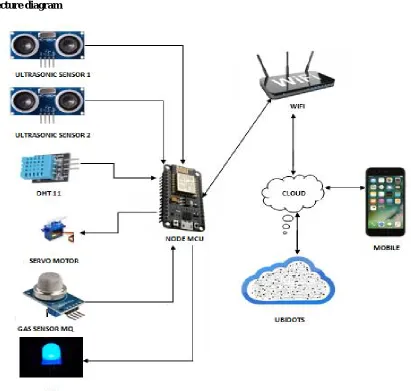
that the garbage bin at public places gets overflowed well in advance before the commencement of the next cleaning process and systems leads to environmental pollution, which in turn results in breeding of insects, animal and rodents, and giving rise to range of diseases. The traditional method includes burning of the waste causes air pollution to great extent. By disposing it by burning will causes diseases. The residue of the waste should be processed well. All the major activity are done manually. To reduce the man power and make it digital we have used IoT Technology with cloud. To overcome waste management problem we present a waste collection management solution based on providing intelligence to waste bins, using an IoT prototype with sensors, Node MCU and Ubidots cloud. The proposed system consist of sensors to monitor the level of waste in the bin, locate the bin and send notification to the in charge. All bin location are viewed using map.Servo motor and DHT sensor are used to identify the temperature and automatic close of bin top incase of rain. The decomposition level of the waste is identified using gas sensors and all the above are remotely monitored using cloud.
II. RELATED WORK
Smart Waste Management using Internet-of-Things (IoT) is proposed by Gopal Kirshna Shyam, Sunilkumar S. Manvi, Priyanka Bharti , propose the simulations are done for performing an efficiency comparison of different ways for collection of wastes: Traditional method and dynamic on-demand solution, proposed work (intelligent) for several cases.
Waikhom Reshmi,RamKumarSundaram, M.Rajeev Kumar propose the Sensor Unit for Waste Management: A Better Method for Frequent Data Updating System focus on sensors unit are used for sensing, microcontroller for controlling and GSM module used for communication .This system use solar energy for power.
ISSN(Online): 2319-8753 ISSN (Print): 2347-6710
I
nternational
J
ournal of
I
nnovative
R
esearch in
S
cience,
E
ngineering and
T
echnology
(A High Impact Factor, Monthly, Peer Reviewed Journal)
Visit: www.ijirset.com
Vol. 7, Issue 3, March 2018
Palaghat Yaswanth Sai proposed IOT Smart Garbage Monitoring System in Cities-An Effective Way to Promote Smart City focused on easy to detect the liquified waste by using waterproof sensors. Many times Garbage dust bin is overflown and many animals like dog or goat enters inside or near the dustbin. This creates a bad scene. Also some birds are also trying to take out garbage from dust bin. In this project can avoid such situations. The waterproof sensors are very much advanced and useful in detecting the level at very accurate measure.
IoT-Based Smart Garbage System for Efficient Food Waste Management proposed by Insung Hong, Sunghoi Park, Beomseok Lee, Jaekeun Lee, Daebeom Jeong, and Sehyun Park focused on IoT-based smart garbage system (SGS) is proposed to reduce the amount of food waste. In an SGS, battery-based smart garbage bins (SGBs) exchange information with each other using wireless mesh networks, and a router and server collect and analyze the information
for service provisioning.The basic system structure of a SGB is a centralized structure in which information gathered
in each bin is transferred to the server; we also designed a HSGB for improving the battery efficiency of each SGB.
III. PROPOSED WORK
In this system we are monitoring the level of bins and composition of waste using IoT and cloud. Our main goal of proposing this system is to remotely monitor the system and send quick notification to official which can reduce the overflow of bins. The level of bin is identified using ultrasonic sensor and its captured data are stored in cloud. If the bin level is filled it sends the notification from cloud to the official and the Red LED is on in the bin. If the bin is not filled, its available space is viewed using cloud and the Green LED is on in the bin. Then the waste is dumped in the main storage where it is decomposed. In the main storage, its level are analyzed using ultrasonic sensor and the sensed data are captured in cloud. The gas sensor are used to sense the gas level in the main storage if the gas level is high then the waste can be used has a fertilizer and the notification is send to official or it should be decomposed. All the data are sensed and send to cloud. The device in the bin uses Wi-Fi for sending the sensed parameters of bin level and presence of gas to the cloud. The humidity and temperature of the bin are identified using the DHT 11 sensor and the data is sensed and send to cloud.
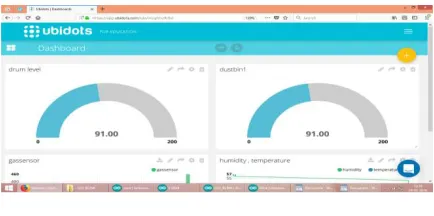
Each city has a workstation located at the municipal office, which gathers the information from the bins in that particular city. The workstation maintains a cloud storage that will hold real-time values acquired from the bins. All the details of the bin and main storage are remotely accessed using the cloud server. The cloud server will have a web interface from which we can access visualization and reports.
IV. COMPONENTS REQUIRED
NodeMCU ESP8266:
NodeMCU is an open source firmware that is used in IoT platform. Th e Development Kit based on ESP8266,
integates GPIO, PWM, IIC, 1-Wire and ADC all in one board.Hosting an application and offloading the fun ction s of Wi-Fi networking fr om anoth er application pr ocessor is done by ESP8266.
ISSN(Online): 2319-8753 ISSN (Print): 2347-6710
I
nternational
J
ournal of
I
nnovative
R
esearch in
S
cience,
E
ngineering and
T
echnology
(A High Impact Factor, Monthly, Peer Reviewed Journal)
Visit: www.ijirset.com
Vol. 7, Issue 3, March 2018
Figure no: 4.2 Ultrasonic Sensor
Methane Gas sensor
This is a simple-to-use compressed natural gas (CNG) sensor, suitable for sensing natural gas (composed of mostly Methane [CH4]) concentrations in the air. The MQ-4 can detect natural gas concentrations anywhere from 200 to 10000ppm. This sensor has a high sensitivity and fast response time. The sensor’s output is an analog resistance. The drive circuit is very simple; all you need to do is power the heater coil with 5V, add a load resistance, and connect the output to an ADC.
Figure no: 4.3 Methane Gas sensor DHT11
DHT11 is a composite Sensor contains a calibrated digital signal output of the temperature and humidity. Its specification is Supply Voltage: +5V,Temperature range :0-50°C error of ± 2°C , Humidity :20-90% RH ± 5% RH error ,Interface: Digital. The high reliability and excellent long-term stability is ensured by this technology.
Figure no: 4.4 DHT 11Sensor
Servo Motor
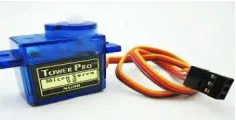
A servomotor is a actuator that can be linear or rotary actuator which is used for clear control of position, velocity and acceleration. For position feedback it has a motor that is coupled with sensor.
ISSN(Online): 2319-8753 ISSN (Print): 2347-6710
I
nternational
J
ournal of
I
nnovative
R
esearch in
S
cience,
E
ngineering and
T
echnology
(A High Impact Factor, Monthly, Peer Reviewed Journal)
Visit: www.ijirset.com
Vol. 7, Issue 3, March 2018
Ubidots
Ubidots is an Internet of Things (IoT) data analytics and visualization company. It helps to turn data from sensor into information that is used for making decisions, interactions with machine. Ubidots exists as an easy and affordable means to integrate the power of the IoT into your business or research.
Figure no: 4.6 Ubidots cloud
ISSN(Online): 2319-8753 ISSN (Print): 2347-6710
I
nternational
J
ournal of
I
nnovative
R
esearch in
S
cience,
E
ngineering and
T
echnology
(A High Impact Factor, Monthly, Peer Reviewed Journal)
Visit: www.ijirset.com
Vol. 7, Issue 3, March 2018
Monitoring the bin level
The levels of waste in the bins are identified using ultra-sonic sensors. LED bulbs are used to indicate the level of waste and the sensed data from the sensor are moved to NodeMCU. Through Wi-Fi the data are stored in cloud and available space of the bin is viewed. If the bin level is full, bin is closed using the servo motor.
Figure no: 4.8 Monitoring the bin level Notification of bin
When the bins are full, a notification or a message is sent using cloud to the staff in-charge.
Figure no: 4.9 Notification of bin
Monitoring the Main Storage
ISSN(Online): 2319-8753 ISSN (Print): 2347-6710
I
nternational
J
ournal of
I
nnovative
R
esearch in
S
cience,
E
ngineering and
T
echnology
(A High Impact Factor, Monthly, Peer Reviewed Journal)
Visit: www.ijirset.com
Vol. 7, Issue 3, March 2018
Figure no: 4.10 Monitoring the Main Storage
Humidity and Temperature detection
The bin temperature and humidity should be monitored because it may cause the waste in the bin to decompose and cause pungent smell from the bin which may cause many diseases. So that we use a DHT11 sensor to analyze the temperature and humidity of the bin. This can be visualized using cloud.
Figure no: 4.11 Humidity and Temperature detection
V. CONCLUSION
We presented an intelligent waste collection system. The system is based on IoT sensing prototype. It is responsible for measuring the waste level in the waste bins and later send this data (through Internet) to a cloud for storage and processing. This data helps to compute the amount of waste and how it is decomposed. The waste collected can also be used as a fertilizer in future.
REFERENCES
1. B. Chowdhury and M. U. Chowdhury, “RFID-based realtime smart waste management system,” in Proceedings of the Telecommunication Networks and Applications Conference, pp.175–180, December 2007.
2. Delicato F. C., Pires P. F., Batista T., Cavalcante E., Costa B., Barros T., “Towards an IoT eco-system”, In the Proceedings of the 1st ACM International Workshop on Software Engineering for Systems-of-Systems, SESoS’13, pp. 25-28, Montpellier, France, July, 2013.
3. Guerrero L. A., Maas G., Hogland W., “Solid waste management challenges for cities in develop-ing countries”, Journal of Waste Management, vol. 33 (1), pp. 220-232, January, 2013.
4. L.Mashayekhy, et al., "Incentive-compatible online mechanism for resource management",Proceedings of 7th International Conference on Cloud Computing, IEEE, Alaska, USA, 2014, pp. 56-61.
5. Marshall R. E., Farahbakhsh K., “Systems approaches to integrated solid waste management in developing countries”, Journal of Waste Management, vol. 33 (4), pp. 988-1003, April, 2013.
6. Palaghat Yaswanth Sai. proposed“IOT Smart Garbage Monitoring System in Cities-An Effective Way to Promote Smart City”,