ABSTRACT
WEI, WEI. Practical Integrity Assurance for Big Data Processing Deployed over Open Cloud. (Under the direction of Ting Yu.)
The amount of data has been exploding in the world. The capability of processing large data sets, so-called big data, is becoming a key basis of competition, underpinning new waves of productivity growth, research innovation, preventing diseases, and combating crime. Big data requires exceptional technolo-gies to efficiently process large amount of data within a reasonable time, which include distributed parallel data processing, distributed file systems, cloud computing platforms, and scalable storage sys-tems. Deploying these technologies over open cloud is a cost-effective and practical solution to small businesses and researchers who need to deal with data processing tasks over large amount of data but often lack capabilities to obtain their own powerful clusters. As parties in open cloud usually comes from different domains, and are not always trusted, several security issues arise, including confidential-ity, integrity and availabilconfidential-ity, for example how to transmit data securely through public network, how to verify the integrity of data received from other parties, how to know if a task is performed correctly, and how to detect malicious behavior during data processing. This thesis focuses on the discussion of providing practical integrity assurance while deploying these techniques over open cloud.
The first work targets at a distributed parallel data processing system - MapReduce. MapReduce has become increasingly popular as a powerful parallel data processing model. To deploy MapReduce as a data processing service over open systems such as service oriented architecture, cloud computing, and volunteer computing, we must provide necessary security mechanisms to protect the integrity of MapReduce data processing services. In this work, we present SecureMR, a practical service integrity assurance framework for MapReduce. SecureMR consists of five security components, which provide a set of practical security mechanisms that not only ensure MapReduce service integrity as well as to prevent replay and Denial of Service (DoS) attacks, but also preserve the simplicity, applicability and scalability of MapReduce. We have implemented a prototype of SecureMR based on Hadoop, an open source MapReduce implementation. Our analytical study and experimental results show that SecureMR can ensure data processing service integrity while imposing low performance overhead.
verify the integrity of data returned by BigTable. More importantly, iBigTable preserves the simplicity, applicability and scalability of BigTable, so that existing applications over BigTable can interact with iBigTable seamlessly with minimum or no change of code (depending on the mode of iBigTable). We implement a prototype of iBigTable based on HBase, an open source BigTable implementation. Our ex-perimental results show that iBigTable imposes reasonable performance overhead while providing high integrity assurance.
© Copyright 2013 by Wei Wei
Practical Integrity Assurance for Big Data Processing Deployed over Open Cloud
by Wei Wei
A dissertation submitted to the Graduate Faculty of North Carolina State University
in partial fulfillment of the requirements for the Degree of
Doctor of Philosophy
Computer Science
Raleigh, North Carolina 2013
APPROVED BY:
Peng Ning William Enck
Rudra Dutta Ting Yu
DEDICATION
BIOGRAPHY
ACKNOWLEDGEMENTS
TABLE OF CONTENTS
LIST OF TABLES . . . . vii
LIST OF FIGURES . . . . viii
Chapter 1 Introduction . . . . 1
1.1 SecureMR: A Service Integrity Assurance Framework for MapReduce . . . 2
1.2 iBigTable: Practical Data Integrity for BigTable in Public Cloud . . . 3
1.3 IAODB: Integrity Assurance for Outsourced Databases without DBMS Modification . . . 5
1.4 Summary of Contributions . . . 6
Chapter 2 SecureMR: A Service Integrity Assurance Framework for MapReduce . . . . 8
2.1 Background . . . 8
2.2 System Model . . . 9
2.2.1 MapReduce in Open Systems . . . 9
2.2.2 Assumptions and Attack Models . . . 10
2.3 System Design . . . 11
2.3.1 Design Overview . . . 11
2.3.2 Commitment Protocol . . . 13
2.3.3 Verification Protocol . . . 15
2.3.4 SecureMR Extension . . . 16
2.4 Analysis and Evaluation . . . 17
2.4.1 Security Analysis . . . 18
2.4.2 Attacker Behavior Analysis . . . 19
2.4.3 Experimental Evaluation . . . 23
Chapter 3 iBigTable: Practical Data Integrity for BigTable in Public Cloud . . . . 27
3.1 Background . . . 27
3.1.1 Cryptographic Primitives . . . 27
3.1.2 BigTable - Distributed Storage System . . . 28
3.2 System Model . . . 29
3.2.1 BigTable in Cloud . . . 29
3.2.2 Assumptions and Attack Models . . . 30
3.3 System Design . . . 30
3.3.1 Distributed Authenticated Data Structure . . . 30
3.3.2 Decentralized Integrity Verification . . . 32
3.3.3 Tablet-based Authenticated Data Structure . . . 33
3.4 Data Operations . . . 37
3.4.1 Data Access . . . 37
3.4.2 Tablet Changes . . . 40
3.5 Analysis and Evaluation . . . 44
3.5.2 Practicability Analysis . . . 44
3.5.3 Experimental Evaluation . . . 45
Chapter 4 IAODB: Integrity Assurance for Outsourced Databases without DBMS Modi-fication . . . . 52
4.1 System Model . . . 52
4.1.1 Database Outsourcing Model . . . 52
4.1.2 Assumptions and Attack Models . . . 52
4.1.3 Security Goals . . . 53
4.2 Running Example . . . 54
4.3 System Design . . . 55
4.3.1 Authenticated Data Structure . . . 55
4.3.2 Identify Authentication Data . . . 56
4.3.3 Store Authentication Data . . . 58
4.3.4 Extract Authentication Data . . . 60
4.4 Data Operations . . . 62
4.4.1 Select . . . 64
4.4.2 Update . . . 65
4.4.3 Insert . . . 66
4.4.4 Delete . . . 71
4.5 Experimental Evaluation . . . 71
Chapter 5 Related Work . . . . 82
5.1 MapReduce and Service Integrity . . . 82
5.2 BigTable and Data Integrity . . . 83
5.3 Outsourced Database Integrity . . . 84
Chapter 6 Future Work . . . . 86
6.1 Introduction . . . 86
6.2 Problem Summary . . . 87
6.3 Approaches and Challenges . . . 89
Chapter 7 Conclusion . . . . 91
LIST OF TABLES
LIST OF FIGURES
Figure 2.1 The MapReduce data processing reference model. . . 9
Figure 2.2 SecureMR Design Overview. . . 12
Figure 2.3 The Commitment Protocol. . . 13
Figure 2.4 The Verification Protocol. . . 15
Figure 2.5 SecureMR Extension for MapReduce Chain. . . 17
Figure 2.6 Detection Rate for Non-Collusion Naive Attacker. . . 20
Figure 2.7 Detection Rate for Non-Collusion Periodical Attacker. . . 21
Figure 2.8 Detection Rate for Collusion Periodical Attacker. . . 22
Figure 2.9 Misbehaving Probability vs Duplication Rate. . . 23
Figure 2.10 Response Time vs Number of Reduce Tasks. . . 24
Figure 2.11 Response Time vs Data Size. . . 25
Figure 2.12 Response time vs Duplication Rate. . . 25
Figure 2.13 Response time vs Number of Reduce Tasks. . . 26
Figure 3.1 A Merkle Hash Tree Example. . . 28
Figure 3.2 BigTable: Tablet Location Hierarchy. . . 28
Figure 3.3 Distributed Authenticated Data Structure Design. . . 31
Figure 3.4 Decentralize Integrity Verification. . . 33
Figure 3.5 SL-MBT: Single-Level Merkle B+ Tree. . . 34
Figure 3.6 ML-MBT: Multi-Level Merkle B+ Tree. . . 35
Figure 3.7 TL-MBT: Two-Level Merkle B+ Tree. . . 36
Figure 3.8 A running example. . . 38
Figure 3.9 Single Row Insert with Integrity Protection. . . 39
Figure 3.10 Split the tablet at key 45. . . 41
Figure 3.11 Tablet Merge. . . 43
Figure 3.12 Time to Receive Data from Server. . . 46
Figure 3.13 VO Size vs Number of Rows. . . 47
Figure 3.14 Write Performance Comparison between BigTable and iBigTable. . . 47
Figure 3.15 The Breakdown of iBigTable Write Cost. . . 48
Figure 3.16 Read Performance Comparison between BigTable and iBigTable. . . 48
Figure 3.17 The Breakdown of iBigTable Read Cost. . . 49
Figure 3.18 TL-MBT Update Performance in iBigTable. . . 50
Figure 3.19 Projection Query with TL-MBT Support in iBigTable. . . 50
Figure 4.1 Non-Intrusive Database Outsourcing Model. . . 53
Figure 4.2 A Relational Data Table. . . 54
Figure 4.3 Data Table to Merkle B-tree. . . 55
Figure 4.4 Radix-Path Identifier. . . 57
Figure 4.5 Authentication Data Organization. . . 57
Figure 4.6 Retrieval of Authentication Data. . . 60
Figure 4.7 Range Query with Integrity Protection. . . 63
Figure 4.9 Insert With Integrity Protection. . . 67
Figure 4.10 Height vs Fanout. . . 72
Figure 4.11 VO Size vs Fanout. . . 73
Figure 4.12 VO Retrieval Time. . . 73
Figure 4.13 Unique Select Overhead. . . 74
Figure 4.14 Range Select Response Time. . . 75
Figure 4.15 Scalability of Range Select. . . 75
Figure 4.16 Direct and Cached Update Overhead Comparison. . . 76
Figure 4.17 Number of Generated Update Statements. . . 76
Figure 4.18 Append and Insert Overhead Comparison. . . 77
Figure 4.19 Number of Generated Update Statements. . . 78
Figure 4.20 Append Overhead vs Fanout. . . 78
Figure 4.21 Number of Generated Update Statements vs Fanout. . . 79
Figure 4.22 Unique Select Overhead in Campus Network. . . 80
Chapter 1
Introduction
The amount of data has been exploding in the world. The capability of processing large data sets, so-called big data, is becoming a key basis of competition, underpinning new waves of productivity growth, research innovation, preventing diseases, and combating crime. Big data requires exceptional technolo-gies to efficiently process large amount of data within a reasonable time, which include distributed parallel data processing, distributed file systems, cloud computing platforms, and scalable storage sys-tems. Deploying these technologies over open cloud is a cost-effective and practical solution to small businesses and researchers who need to deal with data processing tasks over large amount of data but often lack capabilities to obtain their own powerful clusters. As parties in open systems usually comes from different domains, and are not always trusted, several security issues arise, including confidential-ity, integrity and availabilconfidential-ity, for example how to transmit data securely through public network, how to verify the integrity of data received from other parties, how to know if a task is preformed correctly, and how to detect malicious behavior during big data processing.
Although it presents challenges and difficulties to provide practical integrity assurance while deploying these techniques over open cloud due to the insecurity and complexity of open systems, by carefully examining their designs and protocols, they bring opportunities to design effective communication protocols, create novel schemes and simplify technique deployment to make integrity protection practical while deploying them over open systems.
resolve this issue, we started to investigate on schemes that can provide integrity assurance without re-quiring modifying existing systems. The third work is our first work toward addressing this issue, which designed schemes to address this issue for outsourced databases. The scheme proposed in the third work is promising for addressing this issue for Bigtable [20], which is one of the future work. We elaborate details of those works in Chapters 2, 3, and 4. Chapter 5 compares our work with related work. Then, we discuss possible future work in Chapter 6, and finally conclude the thesis in Chapter 7. In the following, we give our motivations of three works respectively.
1.1
SecureMR: A Service Integrity Assurance Framework for
MapReduce
MapReduce is a parallel data processing model, proposed by Google to simplify parallel data process-ing on large clusters [22]. Recently, many organizations have adopted the model of MapReduce, and developed their own implementations of MapReduce, such as Google MapReduce [22] and Yahoo’s Hadoop [6], as well as thousands of MapReduce applications. Moreover, MapReduce has been adopted by many academic researchers for data processing in different research areas, such as high end com-puting [41], data intensive scientific analysis [28], large scale semantic annotation [39] and machine learning [21].
Current data processing systems using MapReduce are mainly running on clusters belonging to a single administration domain. As open systems, such as Service-Oriented Architecture (SOA) [15, 29], Could Computing [1] and Volunteer Computing [10, 16], increasingly emerge as promising platforms for cross-domain resource and service integration, MapReduce deployed over open systems will become an attractive solution for large-scale cost-effective data processing services. As a forerunner in this area, Amazon deploys MapReduce as a web service using Amazon Elastic Compute Cloud (EC2) and Ama-zon Simple Storage Service (AmaAma-zon S3). It provides a public data processing service for researchers, data analysts, and developers to efficiently and cost-effectively process vast amounts of data [2]. How-ever, in open systems, besides communication security threats such as eavesdropping attacks, replay attacks, and Denial of Service (DoS) attacks, MapReduce faces a data processing service integrity issue since service providers in open systems may come from different administration domains that are not always trustworthy.
on sequential computations that can be broken into multiple temporal segments.
In this work, we present SecureMR, a practical service integrity assurance framework for MapRe-duce. SecureMR provides a decentralized replication-based integrity verification scheme for ensuring the integrity of MapReduce in open systems. Our scheme leverages the unique properties of the MapRe-duce system to achieve effective and practical security protection. First, MapReMapRe-duce provides natural redundant computing resources, which is amenable to replication-based techniques. Moreover, the par-allel data processing of MapReduce mitigates the performance influence of executing duplicated tasks. However, in contrast to simple monolithic systems, MapReduce often consists of many distributed com-puting tasks processing massive data sets, which presents new challenges to adopt replication-based techniques. For example, it is impractical to replicate all distributed computing tasks for consistency verification purposes. Moreover, it is not scalable to perform centralized consistency verification over massive result data sets at a single point (e.g., the master).
To address these challenges, our scheme decentralizes the integrity verification process among dif-ferent distributed computing nodes who participate in the MapReduce computation.
1.2
iBigTable: Practical Data Integrity for BigTable in Public Cloud
BigTable [20] is a distributed data storage system designed to scale into the petabyte range across hun-dreds or even thousands of commodity machines. It has been widely used in several products at Google such as Google Maps, Google Analytics and Gmail. Moreover, in recent years many organizations have adopted the data model of BigTable, and developed their own implementations of BigTable such as HBase [7] and Cassandra [3]. HBase is used to power the messages infrastructure at Facebook [12], and also used as a data storage for Hadoop [6] and MapReduce [22] to facilitate large-scale data processing. Cassandra is used in companies such as Twitter, Cisco and Netflix as a reliable and scalable storage infrastructure.
Running BigTable in a cloud managed by a third party is an economic storage solution to small businesses and researchers who need to deal with data processing tasks over large amount of data but often lack capabilities to obtain their own powerful clusters. However, it introduces several security issues. In particular, if we do not fully trust the cloud provider, we have to protect the integrity of one’s data. Specifically, when we retrieve data from BigTable, there should be a way to verify that the returned data from the cloud are indeed what we want, i.e., no data are improperly modified by the cloud, and it has returned exactly the data we request, nothing less, nothing more.
outsourced databases [55, 63, 64]. It seems that we can directly apply existing techniques for database outsourcing to BigTable in the cloud. However, though the two systems share many similarities (e.g., they both host data at an untrusted third party, and support data retrieval), and the principle ideas of integrity verification can be applied, the actual design and deployment of authentication schemes are significantly different, due to several fundamental differences between DBMSs and BigTable. In fact, such differences bring both challenges and opportunities to assure the integrity of BigTable.
For instance, on the one hand, BigTable by design distributes data among large number of nodes. As BigTable horizontally partitions data into tablets across multiple nodes, it is common to merge or split the data of multiple nodes from time to time for load balancing or to accommodate new data. How to handle authenticated data structures during data merging or splitting is not considered in past work on database outsourcing, as it is commonly assumed that data are hosted by a single database. Also, because of the distributed nature of BigTable, it is impractical to store authenticated structures for data residing in different machines into a single node, due to the limited storage capacity of a single node. It also brings scalability issues if we adopt a centralized integrity verification scheme at a single point (e.g., at a trusted third-party). On the other hand, the data model of BigTable is significantly simpler than that of traditional DMBSs. In particular, its query model (or the interface to retrieve data) is extremely simple. For example, it does not support join and other complex query operators as in DBMSs. This may allow us to design much simpler and efficient authenticated structures and protocols to verify data integrity.
Besides integrity verification and efficiency, another important consideration is to preserve the inter-face of BigTable as much as possible so that existing applications running over BigTable do not need to be re-implemented or modified significantly. Ideally, it should only involve minor change (or no change at all) at the application to enjoy integrity guarantee from BigTable.
1.3
IAODB: Integrity Assurance for Outsourced Databases without
DBMS Modification
Database outsourcing has become increasingly popular as a cost-effective solution to provide database services to clients. In this model, a data owner (DO) outsources data to a third-party database service provider (DSP), which maintains the data in a DBMS and answers queries from clients on behalf of the data owner. However, it introduces one of the most important security concerns, data integrity. Usually, DSPs are not fully trusted by data owners. Thus, data owners have to protect the integrity of their own data when outsourcing data to DSPs. Specifically, when clients retrieve data from a DSP, they should be able to verify that the returned data is what should be returned for their requests on behalf of data owners, i.e., no data is maliciously modified by DSPs and DSPs return all data clients request.
In the field of database outsourcing there are many techniques proposed to address integrity is-sues, including correctness, completeness and freshness. These techniques usually can be divided into two categories. Approaches belonging to the first category are based on authenticated data structures (ADSs) such as Merkle hash tree (MHT) [23, 40, 44] and Signature Aggregation [40, 46, 48, 50]. Ex-isting ADS-based approaches require modifying a DBMS so that it can generate a verification object (VO) when executing a query and return the VO along with the actual result to clients so that clients can verify the integrity of the query result returned. Such modification is usually costly and hard to be deployed in a third-party service provider, which hampers the adoption of database outsourcing [63]. The second category uses a probabilistic approach [55, 63, 64], which injects some fake data into out-sourced databases. Although the probabilistic approach does not require the modification of DBMSs, its integrity guarantee is significantly weaker than those based on ADSs.
In this work, we explore the feasibility of utilizing approaches of the first category to provide in-tegrity assurance without requiring any modification of DBMSs running at the server side. In existing approaches, DBMSs are modified to be ADS-aware. That is, they are enhanced with special modules (as well as special data structures other than relations) that efficiently manage ADSs and facilitate the gener-ation of VOs. Unfortunately, as mentioned above, it is often hard to convince database service providers to make such modifications to their DBMSs. In fact, up to today, to the best of our knowledge, no ex-isting cloud database services support integrity checking [51]. Thus, for clients who care about query integrity, it is desirable to have integrity assurance techniques over “vanilla” DBMSs (i.e., without any special features for integrity). The general approach is straightforward: the data owner would have to store authenticated data structures along with data in relations, and retrieve appropriate integrity verifi-cation data besides issuing queries. And all these have to be done through the generic query interface (usually SQL) of the DBMS. Though the basic idea is simple, the challenge is to make it practical: we need to design appropriate schemes to convert ADSs into relations and form efficient queries to retrieve and update authentication information, without imposing significant overhead.
integrity assurance without requiring special support from database service providers. Our scheme seri-alizes a Merkle B-tree based ADS into relations in a way, where the data in the ADS can be retrieved and updated directly and efficiently using existing functionality provided by DBMSs, that is, SQL state-ments.
Many modern relational databases also have built-in support for XML. One seemingly promising approach is to represent Merkle B-tree as XML, store the XML representation into the DBMSs, and utilize their built-in XML support to retrieve authentication data for integrity verification. However, as can be seen from the performance result presented in Section 4.5, the XML-based solutions do not provide a good performance compared with our scheme, which is mainly because the XML features are not targeting at providing efficient operations of MHT-based integrity verification. Note that although we describe our scheme based on relational DBMSs, it is not hard to see that our scheme can also be applied to Non-SQL databases such as Bigtable [20], Hbase [7].
1.4
Summary of Contributions
Our major contributions are summarized as follows:
• SecureMR: First, we propose a new decentralized replication-based integrity verification scheme for running MapReduce in open systems. Our approach achieves a set of security properties such as non-repudiation and resilience to DoS attacks and replay attacks while maintaining the data processing efficiency of MapReduce. Second, we have implemented a prototype of SecureMR based on Hadoop [6], an open source implementation of MapReduce. The prototype shows that the security components in SecureMR can be easily integrated into existing MapReduce imple-mentations. Third, we conduct security analytical study and experimental evaluation of perfor-mance overhead based on the prototype. Our analytical study and experimental results show that SecureMR can ensure the service integrity while imposing low performance overhead.
Chapter 2
SecureMR: A Service Integrity Assurance
Framework for MapReduce
2.1
Background
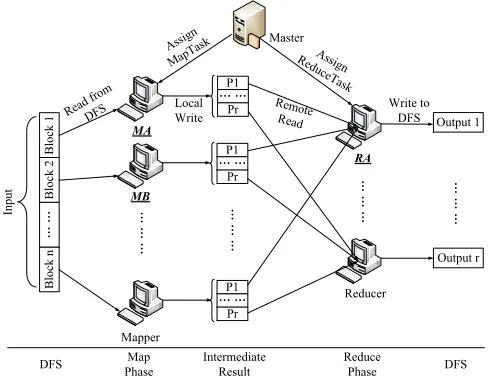
As a parallel data processing model, MapReduce is designed to run in distributed computing environ-ments. Figure 2.1 depicts the MapReduce data processing reference model in such an environment. The data processing model of MapReduce is composed of three types of entities: a distributed file system (DFS), a master and workers. The DFS provides a distributed data storage for MapReduce. The master is responsible for job management, task scheduling and load balancing among workers. Workers are hosts who contribute computation resources to execute tasks assigned by the master. The basic data processing process in MapReduce can be divided into two phases: i) a map phase where input data are distributed to different distributed hosts for parallel processing; and ii) a reduce phase where intermedi-ate results are aggregintermedi-ated together. To illustrintermedi-ate the two-phase data processing model, we use a typical example, WordCount [14] that counts how often words occur. The application is considered as a job of MapReduce submitted by a user to the master. The input text files of the job are stored in the DFS in the form of data blocks, each of which is usually 64MB. The job is divided into multiple map and reduce tasks. The number of map tasks depends on the number of data blocks that the input text files have. Each map task only takes one data block as its input.
Ă
Ă
Ă Ă
Ă Ă
Ă Ă
Ă
Ă
Ă
Ă
Ă
Ă
Ă
Ă
Ă
Ă
Ă
Ă
MA
RA
MB
Figure 2.1: The MapReduce data processing reference model.
reducer receives a reduce task, the reducer waits for notifications of map task completion events from the master. Upon notified, the reducer reads its partition from the intermediate result of each mapper who finishes its map task. For example, in Figure 2.1, RA readsP1from MA, MB and other mappers. After the reducer reads its partition from all mappers, the reducer starts to process them, and finally each reducer outputs its result to the DFS.
In fact, the MapReduce data processing model supports to combine multiple map and reduce phases into a MapReduce chain to help users accomplish complex applications that cannot be done via a single Map/Reduce job. In a MapReduce chain, mappers will read the output of reducers in the preceding reduce phase, except mappers in the first map phase, which read data from the DFS. Then, the data processing enters into the map phase with no difference from the normal map phase. Similarly, reducers will read intermediate results from mappers in the preceding map phase and generate outputs to DFS or their local disks like what mappers do, which is different from a single Map/Reduce data processing model. For reducers in the middle of data processing, they may store their results in their local disks to improve the overall system performance. Eventually, the final results go into the DFS.
2.2
System Model
2.2.1 MapReduce in Open Systems
differences:
• The entities in MapReduce come from different domains, which are not always trusted. Further-more, they may be compromised by attackers due to different vulnerabilities such as software bugs, and careless administration.
• The communications and data transferred among entities are through public networks. It is possi-ble that the communications are eavesdropped, or even tampered to launch different attacks. Therefore, before MapReduce can be deployed and operate in open systems, several security issues need to be addressed, including authenticity, confidentiality, integrity, and availability. In this work, we focus on protecting the service integrity for MapReduce. Since the data processing model of MapReduce in-cludes three types of entities and two phases, to provide the service integrity protection for MapReduce, it naturally boils down to the following three steps:
1. Provide mappers with a mechanism to examine the integrity of data blocks from the DFS.
2. Provide reducers with a mechanism to verify the authenticity and correctness of the intermediate results generated by mappers.
3. Provide users with a mechanism to check if the final result produced by reducers is authentic and correct.
The first step ensures the integrity of inputs for MapReduce in open systems. The second step provides reducers with the integrity assurance for their inputs. The third step guarantees the authenticity and correctness of the final result for users. Finally, the combination of three ensures the MapReduce data processing service integrity to users. Since the first step has been addressed by existing techniques in [17, 30], we will go through the rest of steps in the following sections.
2.2.2 Assumptions and Attack Models
Based on the above assumptions, we concentrate on the analysis of malicious behavior from bad workers. In open systems, a bad worker may cheat on a task by giving a wrong result without compu-tation [27] or tamper the intermediate result to mess up the final result. Moreover, a bad worker may launch DoS attacks against other good workers. For example, it may keep sending requests to a good worker and asking for intermediate results or it may impersonate the master to send fake task assign-ments to workers. Furthermore, it may initiate replay attacks against good workers by sending old task assignments to keep them busy. In addition, it may eavesdrop and tamper the messages exchanged be-tween two entities so that the final result generated may be compromised. Here, we classify malicious attacks into the following two models:
Non-collusive malicious behavior. Workers behave independently, which means that bad workers
do not necessarily agree or consult with each other when misbehaving. A typical example is that, when they return wrong results for the same input, they may return different wrong results.
Collusive malicious behavior. Workers’ behavior depends on the behavior of other collusive
work-ers. They may communicate, exchange information, and make an agreement with each other. For exam-ple, when they are assigned tasks by the master, they can know if their colluders receive tasks with the same input blocks. If so, they return the same results so that there is no inconsistency among collusive workers. By doing so, they try to avoid being detected even if they return wrong results.
2.3
System Design
In this section, we present the detailed design of our decentralized replication-based integrity verification scheme.
2.3.1 Design Overview
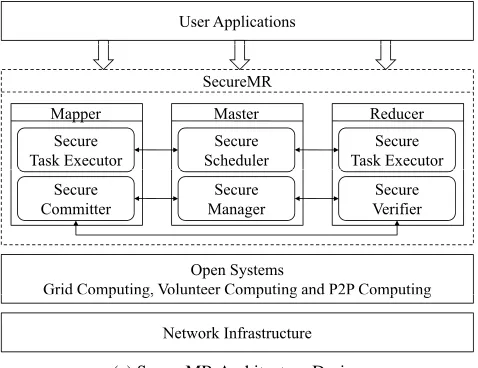
SecureMR enhances the basic MapReduce framework with a set of security components, illustrated by Figure 2.2. To validate the integrity of map/reduce tasks, our basic idea is to replicate some map/reduce tasks and assign them to different mappers/reducers. Any inconsistent intermediate results from those mappers/reducers reveal attacks. However, due to scalability and efficiency reason, though the master is trusted in our design, consistency verification should not be carried out only by the master. Instead, in our design, this responsibility is further distributed among workers. Our design must ensure properties such as non-repudiation and resilience to DoS and replay attacks, as well as efficiency. Further, our design should preserve the existing MapReduce mechanism as much as possible so that it can be easily implemented and deployed with current MapReduce systems. We introduce the design of SecureMR from two aspects: architecture and communication.
Architecture Design. Figure 2.2a shows the architecture design of SecureMR, which comprises five
User Applications SecureMR Reducer Secure Task Executor Master Secure Scheduler Mapper Secure Task Executor Secure Verifier Secure Manager Secure Committer Open Systems
Grid Computing, Volunteer Computing and P2P Computing G d Co pu g, Vo u ee Co pu g a d Co pu g
Network Infrastructure
(a) SecureMR Architecture Design.
5. Compare Master 1 as e MA … B 1
2 10. Verify
MA RA … … … B … … … … MB … B n … … Reducer Reduce Map Mapper Reducer Reduce Phase DFS Map Phase
(b) SecureMR Communication Design.
Secure Verifier. They provide a set of security mechanisms: task duplication, secure task assignment, DoS and replay attack protection, commitment-based consistency checking, data request authentication, and result verification.
Secure Manager and Secure Scheduler are deployed in a master mainly for task duplication, secure task assignment, and commitment-based consistency checking. Secure Task Executor is running in both mappers and reducers to prevent DoS and replay attacks that exploit fake or old task assignments. In mappers, Secure Committer takes the responsibility of generating commitments for the intermediate results of mappers and sending them to Secure Manager in the master to complete the commitment-based consistency checking. Secure Verifier running in a reducer collaborates with Secure Manager to verify a mapper’s intermediate result. For simplicity, we quote all components using names without Secure in the following sections, for example Manager, Scheduler, Task Executor and so on.
Communication Design. Figure 2.2b shows how the entities in SecureMR communicate with each
other to provide security protection for MapReduce. Communications among them are further organized into two protocols: Commitment protocol and Verification protocol. In Figure 2.2b, communications from 1 to 5 form the commitment protocol while communications from 6 to 10 form the verification protocol.
In the commitment protocol, to avoid checking the intermediate results directly (which is expensive), mappers only send commitments (which will be described in detail later) to the master, which can be used to detect inconsistency efficiently. However, this introduces another vulnerability. Mappers may send the master the right commitments but the wrong results to reducers. For this reason, we further ask reducers to check the consistency between the commitment and the result in the verification protocol. Note that this does not add much extra effort to the reducer as it has to retrieve the intermediate result for data processing anyway.
In the following two sections, we will discuss the details of communications between the five secu-rity components of SecureMR, which happen in the commitment and verification protocols.
2.3.2 Commitment Protocol
Map Loc sig Map P1 Ă Pr sigM
KpubM
As mentioned in Section 2.2.2, the master is a trusted entity. However, since the intermediate result is usually tremendous, it is impractical to require the master to check all intermediate results generated by different map tasks in different jobs, which will overload the master and lead to low system perfor-mance. Thus, instead of examining intermediate results directly, the master requires mappers to generate commitments for their intermediate results, and then check commitments [27].
Protocol design
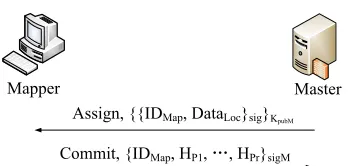
Since we assume that the DFS provides data integrity protection, we do not discuss the communications between mappers and the DFS. Figure 2.3 shows the communications between a mapper and the master in the commitment protocol. The specific steps are described as follows.
Assign. The Scheduler in the master sends the Assign message to the Task Executor in a mapper to
assign a map task to the mapper. Regarding task duplication, the Scheduler may assign the same map task to different mappers. For example, in Figure 2.2b, MA and MB are assigned the same map task. The Assign message includes a monotonically increasing identity IDM apof a map task and an input data
block locationDataLoc, which is signed by the master and encrypted using KpubM, the public key of
the mapper. After the Task Executor receives the task assignment message, the Task Executor decrypts and verifies the signature of the message. Then, the Task Executor reads an input block according to
DataLoc from the DFS. In Figure 2.2b, since MA and MB receive the same task, they both read the
same data blockB2from the DFS.
Commit. After the mapper processes the input block, the Committer of the mapper makes a
com-mitment to the master by generating a hash value for each partition of its intermediate result and signing those hash values. We use {...}sigM to denote a signed message of a mapper. When the Manager of the master receives the commitment, the Manager verifies the signature using the mapper’s public key
KpubM. If the Manager has received more than one commitments for the same map task from different
mappers, the Manager will compare new commitment with an old one to see if they are consistent with each other.
Note that in this work, we focus on expose suspicious activities. How to exactly pinpoint malicious ones is the next step and some existing techniques may be applied [67].
Protocol analysis
with each map task, which is automatically generated using timestamp or sequence number by the Scheduler. The Task Executor in the mapper records theIDM apfor the last map task that it processed.
In this way, the Task Executor can determine if a task assignment is an old one by comparing theIDM ap
with the latest recorded IDM ap. Regarding the Commit message, the integrity of the commitment is
assured since the Commit message is signed using the mapper’s private key. Moreover,IDM apis needed
so that the master knows which map task this commitment is for.
Reduce sig
M Seq Map Reduce sigR Map Data sigM
Map Data sigM M pubM Map Pi Reduce M sig
KpubR
M pubR Map Reduce sig
M pubM Map Pi Reduce M sig KpubR
Figure 2.4: The Verification Protocol.
2.3.3 Verification Protocol
In the verification protocol, reducers further help the master to verify if intermediate results generated by mappers are consistent with commitments submitted to the master. The verification protocol is built on existing MapReduce communication mechanisms. There are no additional messages introduced to MapReduce.
Protocol design
Figure 2.4 shows how the master, a mapper, and a reducer communicate with each other in the verifica-tion protocol. We illustrate each step as follows.
Assign. The master signs the Assign message and encrypts it usingKpubR, the public key of a
re-ducer. In the message,IDReduceis a monotonically increasing identity of a reduce task, andP iindicates
the partition of intermediate results that the reducer will process. When the Task Executor in the reducer receives the task assignment, the Task Executor first verifies the integrity and authenticity of the task assignment. Then, the Verifier of the reducer will wait for notifications from the Manager.
Notify. When the Manager receives the completion event with a commitment from the Committer
addressADM, the mapper’s public keyKpubM,IDM ap, the ticketT icketM for the mapper signed by
the master and the hash valueHP ifor theP ipartition committed by the Committer. The ticketT icketM
is used for data request authentication in the Request message.
Request. After the Verifier in a reducer gets notified, the Verifier sends a data request to the
Commit-ter of the mapper, which includes the ticketT icketM as evidence of an authentic data request authorized
by the master, the reducer’s public keyKpubR, a sequence numberReqSeqandP iwhich indicates which
partition is requested.
Response. After the Committer verifies the authenticity of the request by verifying the ticket from
the master and the reducer’s signature, the mapper sends a response to the Verifier, which includes
IDM ap,P i, the dataDataandHData, the hash value ofData. To verify the integrity of the response,
the Verifier first verifies the signature in the Response message, then regenerates a hash value H′
Data
for the data, and compares HData with HData′ to make sure that the data is not tampered during the
Response communication. Finally, the Verifier comparesH′
Data withHP i committed to the master to
check if any inconsistency occurs.
Report. When the Verifier detects an inconsistency, the Verifier sends two signatures as evidence to
the Manager to report the inconsistency. After the Manager receives and verifies the two signatures, the Manager can compareHDatawithHP ito confirm the reported inconsistency.
Protocol analysis
Similar to the commitment protocol, the reduce task assignment mechanism prevents both DoS and replay attacks against reducers. However, in the verification protocol, a mapper faces DoS attacks when others request data from it. To countermeasure this kind of DoS attacks, the mapper needs to authenticate data requests from reducers. The data request authentication is achieved by requiring that a reducer shows a ticket from the master. If the mapper sees a ticket at the first time, the mapper can make sure that the request must come from an authorized reducer who holds the ticket issued by the master. However, if the first attempt of data request fails somehow, attackers may get the ticket by eavesdropping the communications between the mapper and the reducer. In this case, since the mapper will record the latest request sequence number ReqSeq associated with a ticket, the mapper will check if this data
request is an old one by comparing the twoReqSeq numbers when the mapper receives another data
request with the same ticket. In this way, replay attacks can be defeated.
2.3.4 SecureMR Extension
Commit
Master Verify
Master
M R d M R d V ifi
Mapper Reducer Mapper Reducer Verifier
Figure 2.5: SecureMR Extension for MapReduce Chain.
Extension for Reducers. Similar to mappers, the Scheduler in the master may duplicate reduce
tasks and assign them to multiple reducers. Reducers assigned the same task will read the same partition of the intermediate results from mappers. However, we observe that reducers are not configured with a Secure Committer component in current architecture described in Figure 2.2a, which means they cannot make a commitment to the master. In order for reducers to make commitments, we can easily deploy a Secure Committer component for reducers. Another problem to apply the verification scheme to reduc-ers is that there are no other entities to complete the verification protocol since reducreduc-ers are in the last phase. To address this problem, we extend the MapReduce model to include an additional phase called Verify phase. In the verify phase, the master involves several workers with a Secure Verifier component, called verifiers to complete the verification protocol. Another alternative is to install a Secure Verifier component into MapReduce user applications and ask them to complete the verification protocol by themselves after their jobs are done.
Extension for MapReduce Chain. Similarly, the verification scheme can be applied to MapReduce
chain since each map and reduce share the similar procedure of data processing. Figure 2.5 shows the design overview of how SecureMR applies the verification scheme to MapReduce chain. As we can see from the figure, the design is like a Commit-Verify chain between the master, mappers and reducers. If mappers make commitments to the master, reducers will take the role of verifiers to verify the consistency between intermediate results and commitments of mappers. If reducers make commitments to the master, mappers will take the role of verifiers to verify the consistency between outputs and commitments of reducers except the last phase, Verify phase. The verify phase has been discussed in the above. In order for mappers to be able to fulfill the verification protocol, the only thing that we need to do is to plug a Secure Verifier component into each mapper.
2.4
Analysis and Evaluation
discussion for mappers due to the similarity of the analysis between mappers and reducers.
2.4.1 Security Analysis
There are two kinds of inconsistencies for mappers in MapReduce. One is an inconsistency between results returned by different mappers that are assigned the same task. The other is an inconsistency between the commitment and the result generated by a mapper. The former can only be detected by the master in the commitment protocol and the latter can only be detected by a reducer in the verification protocol. We claim that SecureMR provides the following two properties. We also provide arguments for our statement in the following.
• No False Alarm. For any inconsistency detected by SecureMR, it must happen between good and bad mappers, between bad mappers or on a bad mapper. It cannot occur between good mappers or on a good mapper.
• Non-Repudiation. For any inconsistency that can be observed by a good reducer or the master, SecureMR can detect it and present evidence to prove it.
Arguments of No False Alarm. The assumptions in Section 2.2.2 guarantee that good mappers
always produce correct and consistent results. We prove by contradiction that SecureMR provides No False Alarm property in terms of the two kinds of inconsistencies.
First, suppose that an inconsistency between two good mappers is detected by the master. In this case, the master must get two different sets of hash values from the commitments of two good mappers, which means that the two commitments the master received must be tampered somehow since two good mappers will not produce inconsistent results. However, if the master accepted a commitment of a mapper, the master must have confirmed the integrity and freshness of the commitment. Thus, the commitment is neither a bad commitment nor an old one. From the arguments, we can infer that there is no way to tamper a commitment of a mapper without being detected by the master. And the hypothesis implies that the master already accepted the commitments, which means it is impossible that the commitments that the master received have been tampered. Therefore, the hypothesis that an inconsistency between two good mappers is detected by the master is not true.
Second, suppose that an inconsistency between the commitment and the intermediate result of a good mapper is detected by a reducer. If the reducer is good, it can be inferred that the message received by the reducer must be tampered somehow. Since the reducer knowsIDM ap andP i, the reducer will
not accept the message unless the reducer confirms the integrity of the message. IDM ap can also be
which is described in Figure 2.4. And the reducer cannot forge evidence without being detected by the master. Hence, the case that an inconsistency on a good mapper is detected by a bad reducer cannot be true, either. Therefore, the hypothesis that an inconsistency on a good mapper is detected by a reducer is not true.
Arguments of Repudiation. We prove by contradiction that SecureMR provides
Non-Repudiation property in terms of the two kinds of inconsistencies. Suppose that an inconsistency is observed by the master or a good reducer. Both the master and the good reducer definitely report the inconsistency since they both tell the truth. Meanwhile, the master holds the commitments of workers, which cannot be denied, and the good reducer has the signatures of mappers. They both can present the commitments or the signatures of mappers to prove the inconsistency they detect. Thus, SecureMR provides the Non-Repudiation property in terms of the two kinds of inconsistencies.
2.4.2 Attacker Behavior Analysis
We analyze the behavior of the following attackers under the two kinds of behavior models defined in Section 2.2.2. When we analyze the collusive attacks, we consider the worst case that all malicious entities are colluding with one another.
• Periodical Attackers: they misbehave with a certain probabilitypm. Since a naive attacker is a
spe-cial case of periodical attacker withpmequal to 1. Thus, we discuss these two kinds of attacker’s
behavior together.
• Strategic Attackers: with the assumption that they know the duplication strategy, they may not behave maliciously until they definitely know that they will not be caught due to the collusion, which means that all duplicates are assigned to the collusive group.
Definition 2.4.1 (Detection Rate) We define the detection rate, denotedDrate, as the probability that
the inconsistency between results caused by the misbehavior of a mapper is detected duringljobs.
Since each map task processes one block, the duplication of a map task is the same as the duplication of a block. The following discussion may use both terms, block duplication and map task duplication exchangeably. Suppose MapReduce consists of one master and n workers, and m out of n workers
(m < n) are malicious workers. For simplicity, we assume that the input of each job has the same
number of blocks b, no two blocks are the same and each worker only processes one task in one job. The percentage of blocks that will be duplicated in each job is pb. Thus, the number of duplicated
blocks isb·pb. SecureMR randomly chooses one block from the originalbblocks to duplicate for each
1 1.2 0.8 1 R a te 0.6 ect io n R 0 2 0.4 D et e 0 0.2 0
0 0.1 0.2 0.3 0.4 0.5 0.6 0.7 0.8 0.9 1
Duplication Rate Duplication Rate
l=5 l=10 l=15
Figure 2.6: Detection Rate for Non-Collusion Naive Attacker.
Periodical attackers without collusion. For simplicity, we assume that they return different results
when they misbehave on the same input. Thus, without collusion, the detection rate of a malicious mapper is the same as the probability that the block processed by the mapper is duplicated. Therefore, the detection rate is calculated as follows:
Drate= 1−(1−(1−(1−1/b)b·pb)·pm)l (2.1)
In Equation 2.1,(1−(1−1/b)b·pb)·p
mdenotes the probability that the misbehavior of the malicious
mapper is detected during one job. Figure 2.6 shows detection rate for a naive attacker without collusion, wherebis equal to 20 andl is 5, 10 and 15. Figure 2.7 shows detection rate for a periodical attacker with0.5misbehaving probability. Both of them demonstrate that as the number of tasks that a malicious mapper processes increases, high detection rate can be achieved even if the duplication rate is only20%, which means that the chance for an attacker to cheat without being detected in the long run is very low.
Periodical attackers with collusion. With collusion, the maximum number of entities that collude
with each other ism. LetP(Bi)denote the probability that a block will be duplicateditimes andP(D)
denote the probability that the inconsistency caused by the misbehavior of a malicious mapper will be detected. In this case, the detection rate is:
Drate= 1−(1− b·pb X
i=0
P(D|Bi)·P(Bi))l
= 1−(1−
b·pb X
i=0
P(D|Bi)·
b·pb
i
! (1
b)
i
·(1−1 b)
b·pb−i)l
1 1.2 0.8 1 R a te 0.6 ect io n R 0 2 0.4 D et e 0 0.2 0
0 0.1 0.2 0.3 0.4 0.5 0.6 0.7 0.8 0.9 1
Duplication Rate Duplication Rate
l=5 l=10 l=15
Figure 2.7: Detection Rate for Non-Collusion Periodical Attacker.
where
P(D|Bi) =
0 ifi= 0,
(1− m−1
i
/ n−1
i
)·pm ifi >0andi < m,
pm ifi >=m.
In Equation 2.2, the detection rate is computed using the law of total probability. The inconsistency cannot be detected only if all duplicates for the block that the malicious mapper processes are assigned to its collusive parties. P(D|Bi) is the probability that the inconsistency is detected when the block
that the malicious mapper processes is duplicated itimes. Ifi >= m, at least one duplicate will not be assigned to its collusive parties. Figure 2.8 shows how the detection rate changes as the duplication rate and the percentage of malicious workers change given n, pm, b, l equals to 50, 0.5, 20 and 15,
respectively. From the figure, we observe that as long as the majority of workers are good,90%detection rate can be achieved with40%duplication rate.
Strategic attackers. Since the misbehavior of attackers cannot be detected, we discuss the
prob-ability P(F) that the intermediate result that reducers receive is tampered, which is the same as the misbehaving probability of a strategic attacker. In this case, we analyze the strategic attacker’s behavior in the following two steps:
1. The master assignsbinput blocks tobmappers before any duplication is made.
2. The master duplicatesb·pb input blocks after assignments for the original bblocks. For each
1 1.2 0.8 1 R a te 0.6 ect io n R 0 2 0.4 D et e 0 0.2 0
0 0.1 0.2 0.3 0.4 0.5 0.6 0.7 0.8 0.9 1
Duplication Rate Duplication Rate
m/n=0.05, m/n=0.10 m/n=0.15
Figure 2.8: Detection Rate for Collusion Periodical Attacker.
Therefore,P(F)can be calculated by the following formula:
P(F) =
x
X
i=0
P(F|Ei)·P(Ei) = x
X
i=0
P(Ai)·P(Mi)·P(Ei)
=
x
X
i=0
(i/b)b·pb·( m−i
b·pb
!
/ n−b b·pb
! )· m
i
!
· n−m
b−i
! / n b ! (2.3) where x=
m ifm < b,
b ifm >=b.
Note thatEi andP(Ei)denote the event that mappers containicollusive mappers before input block
duplication and the probability thatEi happens, respectively.P(F|Ei)denotes the probability that the
result is tampered by some mappers when Ei occurs. P(Ai) and P(Mi) denote the probability that
all duplicated blocks b·pb belong to the set of blocks that the icollusive mappers process and the
probability that all duplicated blocksb·pbare assigned to the rest ofmi’s collusive workers. Figure 2.9
shows the misbehaving probability of a strategic attacker when duplication rate and the percentage of malicious workers change, wheren, b, lequals to 50, 20 and 15, respectively. The result implies that the misbehaving probability of a strategic attacker is pretty low even if the duplication rate is only10%.
1 1.2 ty 0.8 1 o b a b il it 0.6 a v e P ro 0 2 0.4 M is b eh a 0 0.2 M 0
0 0.1 0.2 0.3 0.4 0.5 0.6 0.7 0.8 0.9 1
Duplication Rate Duplication Rate
m/n=0.05 m/n=0.10 m/n=0.15
Figure 2.9: Misbehaving Probability vs Duplication Rate.
results with the initial result. Otherwise, inconsistency will be produced, which can be detected by the master. Thus, the strategic attacker cannot misbehave because it is always possible that the misbehavior could be detected as long as there are duplicated tasks. However, intuitively, it delays the execution of duplicated tasks, which may bring down the performance of the system. In the following section, we will evaluate the performance overhead of SecureMR under both the naive task scheduling algorithm and the commitment-based task scheduling algorithm.
2.4.3 Experimental Evaluation
System Implementation. We have implemented a prototype of SecureMR based on one existing
imple-mentation of MapReduce, Hadoop [6]. In our prototype, we have implemented both naive task schedul-ing algorithm and commitment-based task schedulschedul-ing algorithm mentioned in previous sections. Re-garding consistency verification, we have implemented a non-blocking replication-based verification scheme, which means that reducers do not need to wait for all duplicates of a map task to finish and users do not need to wait for all duplicates to finish. Finally, users will be informed if an inconsistency is detected after all duplicates finish.
Experiment Setup. We run our experiments on 14 hosts provided by Virtual Computing Lab (VCL),
Table 2.1: Performance Overhead on Entities
Type Cost Estimation Estimated Time
Master 4·Tsig+ 3·TEpub+Tver 20ms
Mapper 2·Tsig+TDpub+ 3·Tver+r·Thash 14 + (r+ 1)·40ms Reducer 2·TDpub+ 3·Tver+Thash 51ms
Table 2.2: Communication Overhead between Entities
Type Cost Estimation Additional Bytes
Master-Mapper 2·Dsig+r·Dhash 256 +r∗20bytes Master-Reducer 3·Dsig+Dhash+Dpub 532bytes
Mapper-Reducer 3·Dsig+Dhash+Dpub 532bytes
Performance Analysis. First, we estimate the additional overhead introduced by SecureMR in
Ta-ble 2.1 and 2.2. TaTa-ble 2.1 shows the performance overhead of SecureMR on the master, a mapper and a reducer. Table 2.2 shows the additional bytes to be transmitted on each communication between them. Note that there are no additional messages introduced. Here,T andDdenote the time and data trans-mission cost for different secure operations such as encryption, decryption, signature, verification and hash.ris the number of reducers. The size of each partition is around 14MB. We use SHA-1 to generate hash values, and RSA to create signature or encrypt/decrypt data. The estimation shows that the cost of communication is negligible and the cost on each entity is small.
250 300
200 250
m
e (
S)
150
nse
T
im
50 100
R
es
p
o
0 50
0
20 25 30 35 40
Number of Reduce Tasks Number of Reduce Tasks
MapReduce SecureMR without duplication
Figure 2.10: Response Time vs Number of Reduce Tasks.
250 300 200 250 m e ( S) 150 nse T im 50 100 R es p o 0 50 0
200 400 600 800 1000
Data Size (M) Data Size (M)
MapReduce SecureMR without duplication
Figure 2.11: Response Time vs Data Size.
2.10 shows the response time versus the number of reduce tasks under two scenarios, MapReduce and SecureMR without duplication, where the number of map tasks is 60 and the data size is 1GB. The result shows that the overhead of SecureMR is below 10 seconds, which is small compared with the response time which is about 250 seconds. Figure 2.11 shows the response time versus the data size, where the number of map tasks is 60 and the number of reduce tasks is 25. Since the data size only affects the time to generate hash values, it shows a similar overhead in Figure 2.10.
250 300 200 250 m e ( S) 150 nse T im 50 100 R es p o 0 50 0
0 0.2 0.4 0.6 0.8
Duplication Rate Duplication Rate
MapReduce Naive SecureMR C-based SecureMR
Figure 2.12: Response time vs Duplication Rate.
non-300 350
250
m
e (
S)
150 200
nse
T
im
100
R
es
p
o
0 50
0
20 25 30 35 40
Number of Reduce Tasks Number of Reduce Tasks
MapReduce SecureMR with 40% duplication
Figure 2.13: Response time vs Number of Reduce Tasks.
Chapter 3
iBigTable: Practical Data Integrity for
BigTable in Public Cloud
3.1
Background
3.1.1 Cryptographic Primitives
One-way hash function. A one-way hash function, denoted asH(.), is a function that is easy to
com-pute an output H(m) from an input m, but hard to find the original inputm from the output H(m). MD5 [9] and SHA1 [11] are typical one-way hash functions used in many application areas. We use the terms hash, hash value and digest interchangeably.
Digital signature. A digital signature algorithm is a mathematical way to authenticate the integrity
of a message as well as its origin. A signer keeps a private key used to sign messages, and publish the corresponding pubic key for the public to verify the integrity of signed messages. The successful verification indicates that messages are not tampered and really come from the signer. RSA [53] and DSA [4] are two commonly-used signature algorithms. The terms signature and digital signature are used interchangeably.
Merkle Hash Tree. A Merkle Hash Tree (MHT) is a type of data structure, which contains hash
val-ues representing a summary information about a large piece of data, and is used to verify the authenticity of the original data. Figure 3.1 shows an example of a Merkle Hash Tree. Each leaf node is assigned a digestH(d), where His a one-way hash function. The value of each inner node is derived from its child nodes, e.g. hi = H(hl|hr) where|denotes concatenation. The value of the root node is signed,
usually by the data owner. The tree can be used to authenticate any subset of the data by generating a verification object (VO). For example, to authenticated1, the VO containsh2,h34and the root signature
sroot. The recipient first computes h1 = H(d1)and H(H(h1|h2)|h34), then checks if the latter is the
h1=H(d1)
h12=H(h1|h2) h34=H(h3|h4)
hroot=H(h12|h34)
sroot=S(hroot)
h2=H(d2) h1=H(d3) h1=H(d4)
Figure 3.1: A Merkle Hash Tree Example.
3.1.2 BigTable - Distributed Storage System
Bigtable is a distributed storage system for managing structured data. A table in BigTable is a sparse distributed, persistent, multidimensional sorted map [20]. Columns in BigTable is grouped together to form a column family. Each value in BigTable is associated with a row key, a column family, a column and a timestamp, which are combined to uniquely identify the value. The row key, column family name, column name and value can be arbitrary strings. A key-value pair is called a cell in BigTable. A row consists of a group of cells with the same row key. A tablet is a group of rows within a row range specified by a start row key and an end row key and is the basic unit for load balancing in BigTable. In BigTable, clients can insert or delete rows, retrieve a row based on a row key, iterate a set of rows similar to range queries, or only retrieve specific column families or columns over a set of rows similar to projected range queries in databases.
Root Tablet
Metadata Tablet
User Tablet User Tablet 1. Send query request
Receive metadata tablet location
Figure 3.2: BigTable: Tablet Location Hierarchy.
across tablet servers, which achieves scalability. The master is mainly responsible for assigning tablets to tablet servers. Each tablet server manages a set of tablets. Tablet servers handle read and write requests to the tablets that they serve. There are three types of tablets: root tablet, metadata tablet and user tablet. All three types of tablets share the same data structure. There is only one root tablet. The root tablet contains the locations of all metadata tablets. Each metadata tablet contains the locations of a set of user tablets. All user data are stored in user tablets. The root tablet is never split to ensure that the tablet location hierarchy has no more than three levels. Figure 3.2 shows the tablet location hierarchy and how a query is executed by traversing the tablet location hierarchy, which usually requires three network round-trips (find metadata tablet through the root table, find user tablet through a metadata tablet, and retrieve data from a user tablet) if tablet locations are not found in client-side cache.
3.2
System Model
3.2.1 BigTable in Cloud
BigTable can be deployed in either a private cloud (e.g., a large private cluster), or a public cloud, for example Amazon EC2 [1]. In a private cloud, all entities belong to a single trusted domain, and all data processing steps are executed within this domain. There is no interaction with other domains at all. Thus, security is not taken into consideration for BigTable in a private cloud. However, in a public cloud, there are three types of entities from different domains: cloud providers, data owners, and clients. Cloud providers provide public cloud services. Data owners store and manage their data in BigTable deployed in public cloud. Clients retrieve data owners’ data for analysis or further processing. This data processing model presents two significant differences:
• Cloud providers are not completely trusted by the public - data owners and clients. Furthermore, could providers may be malicious or compromised by attackers due to different vulnerabilities such as software bugs, and careless administration.
• The communications and data transmitted between the public and cloud providers are through public networks. It is possible that the communications are eavesdropped, or even tampered to launch different attacks.
Therefore, before BigTable can be safely deployed and operated in a public cloud, several security issues need to be addressed, including confidentiality, integrity, and availability. In this work, we fo-cus on protecting data integrity of BigTable deployed in a public cloud, which includes three aspects: correctness, completeness and freshness.
Correctness: it verifies if all rows in a query result are generated from the original data set without
Completeness: it verifies if all rows in a query result are generated from the original data set without
being tampered. It is generally achieved by verifying signatures or hashes that authenticate the authen-ticity of the query result.
Freshness: it verifies if queries are executed over the up-to-date data. It is challenging to provide
freshness guarantees because old data is still valid data at some past time point.
3.2.2 Assumptions and Attack Models
First, we assume that cloud providers are not necessarily trusted by data owners and clients. Second, we assume that a data owner has a public/private key pair, its public key is known to all, and it is the only party who can manage its data, including data updates and tablet split and merge. Third, we assume that all communications go through a secure channel (e.g., through SSL) between the cloud and clients. Any tampered communication can be detected by both the cloud and clients at each end immediately.
Based on the above assumptions, we concentrate on the analysis of malicious behavior from the public cloud. We do not limit the types of malicious actions a cloud provider may take. Instead, they may behave arbitrarily to compromise data integrity at its side. For example, the cloud can maliciously modify the data or return an incorrect result to users by removing or tampering some data in the result. Moreover, it could just report that certain data does not exist to save its computation and minimize the cost even if the data does exist in the cloud. Additionally, it may initiate replay attacks by returning some old data instead of using the latest data updated by the data owner.
3.3
System Design
In this section, we illustrate the major design of iBigTable, and explain the design choices we make to provide scalable integrity assurance for BigTable. One straightforward way to provide integrity assur-ance is to build a centralized authenticated data structure. However, data in BigTable is stored across multiple nodes, and may go up to the scale of petabytes. The authentication data could also go up to a very large size. Thus, it is impractical to store authentication data in a single node. Moreover, the single node will become a bottleneck for data integrity verification. To ensure performance and scalability, we propose to build a Merkle Hash Tree (MHT) based authenticated data structure for each tablet in BigTable, and implement a decentralized integrity verification scheme across multiple tablet servers to ensure data integrity of BigTable. Note that we assume that readers have certain knowledge of MHT. If readers are not familiar with MHT, please refer to Section 3.1 for details.
3.3.1 Distributed Authenticated Data Structure
dis-tributed authenticated data structure design. First, it builds a MHT-based authenticated data structure for each tablet in BigTable, including the root tablet, metadata tablets, and user tablets. Second, it stores the root hash of the authenticated data structure of a tablet along with the tablet location record in its corresponding higher level tablet (either the root tablet or a metadata tablet), as shown in Figure 3.3(a). Third, the root hash of the root tablet is stored at the data owner so that clients can always retrieve the latest root hash from the data owner for integrity verification. To improve performance, clients may not only cache the location data of tablets, but also their root hashes for efficient integrity verification.
Figure 3.3: Distributed Authenticated Data Structure Design.
This design distributes authenticated data across tablets, which are served by different tablet servers. To guarantee integrity, it only requires the data owner to store a single hash for the whole data set in BigTable. However, any data update requires authenticated data structure update to be propagated from a user tablet to a metadata tablet and from the metadata tablet to the root tablet. The update propagation process requires either the data owner or tablet servers get involved, either of which complicates the existing data update process in BigTable and downgrades the update performance. Moreover, as the root hash of the root tablet is updated, the root hashes of other tablets cached in clients to improve performance are not valid any more. Thus, clients have to retrieve the latest root hash of the root tablet, and contact tablet servers to retrieve the latest root hashes of other tablets for their requests even if the location data of the tablets stored in metadata tablets or the root tablet is not changed, which hurts read performance.