Channel Hopping Algorithm Implementation
in Mobile Ad Hoc Networks
G.Sirisha 1, D.Tejaswi 2, K.Priyanka 3
Assistant Professor, Department of Electronics and Communications Engineering, Shri Vishnu Engineering College for
Women, Bhimavaram, Andhra Pradesh, India1
Assistant Professor, Department of Electronics and Communications Engineering, Shri Vishnu Engineering College for
Women, Bhimavaram, Andhra Pradesh, India2
Assistant Professor, Department of Electronics and Communications Engineering, Shri Vishnu Engineering College for
Women, Bhimavaram, Andhra Pradesh, India3
ABSTRACT: Wireless communications had wide range of applications in day-to-day life. As a result, spectrum usage is also. To use spectrum efficiently and effectively we proposed channel hopping algorithm of CR networks and implemented this algorithm in MANETS. In this algorithm we have calculated the expected time taken by the CR user to get the free channel. The delay is reduced when this algorithm is implemented in MANETS compared to CRNs because CRNs are mainly for spectrum sensing but in MANETS, the nodes are self-configured and they can change their location during transmissions. CR users also need to sense the spectrum and vacate the channel upon the detection of the PU’s presence to protect PUs from harmful interference. Here we have presented the channel hopping algorithm which enables dynamic access to the spectrum and ensures to vacate the allocated channel if PU returns and move the CR user to some other vacant channel giving priority to PUs. Based on the PU activity on each channel, a ranking table is built to identify the channels which are available.
KEYWORDS:Cognitive radio networks, spectrum sensing, ranking table and MANETS. I. INTRODUCTION
The usage of wireless communications is highly increased now-a-days, thereby the usage of spectrum is also high. To use the spectrum in efficient way, cognitive radio has become prominent technology, which gives the dynamic access to the spectrum. The main advantage of cognitive radio is to increase the spectrum utilization and increasing the quality of communication. Cognitive radio networks (CRNs) has been recognized as a promising technology to address the problem of spectrum under-utilization. It does so by detecting the unused portions of the spectrum known as spectrum holes and uses that portion for transmission without causing any interference for the licensed users. In the context of CRNs, the owner of the licensed channel is known as Primary User (PU) and the other users of the channel are known as cognitive radio (CR) users or secondary users. Each CR user is equipped with one or morecognitive radios, which are capable of opportunistically identifying vacant portions of the spectrum and hopping between them without causing interference to the PUs of the spectrum. Cognitive radio users should vacate the channel whenever the owner of the channel returns i.e., PU to protect from harmful interferences.
II. RELATEDWORK
[2] proposed a deterministic channel rendezvous scheme which provides a bounded rendezvous time, even when each node senses different sets of available channels and nodes are not synchronized and also presented a distributed channel rendezvous scheme which finds a commonly available channel between any two nodes in a bounded time without synchronization. Kaigui Bian., et al [3] presented a systematic approach for designing channel hopping (CH) protocols for CR networks that enable rendezvous between any two nodes even if their clocks are asynchronous. Their approach is novel in that it considers degree of overlapping, clock synchronization and channel access latency issues in the design of asynchronous CH schemes.
Luiz A.Da Silva., et al [4] described about the usage of sequences which states the order where two radios visits a set of N channels of interest while attempting to rendezvous among each other. Using such sequences, they derived a expression which is in closed form for expected time to rendezvous and shows that it has an upper bound. And also they derived the expressions for the probability that rendezvous occurs in the best and worst channels and also for rendezvous occurs in each of those channels they derived TTR conditional expectation. Claudia Cormio., et al [5] proposed the AMRCC, a new Adaptive multiple rendezvous control channel aiming at the reduction of the time to rendezvous and the increase of the overall network performance compared to the classical MRCCs. Bian, Kaigui., et al [6] presented a systematic approach, based on quorum systems, for designing and analyzing channel hopping (CH) protocols that enable control channel establishment in DSA networks
III.SYSTEM MODEL
Co-existence of PUs and CR users in the same geographical area are considered. PUs are licensed to use a fixed spectrum, which can be divided into a set U= {1, 2. . . N} of N non-overlapping orthogonal channels. Here we assumed that all channels have same capacity. Licensed bands can be accessed by CR users only if they do not interfere the PU transmissions that are in progress. So, to avoid the interference to PUs from CR users, CR users should leave the channel whenever the PU returns to its own channel. As a result, a ranking table is built in which channels are ranked on the basis of PU activity. A periodic sensing of spectrum is performed by each node after a time out. This period is equal to the sum of duration of sensing and time out these sensing results are used for building the ranking table of the available channels according to the PU activity detected on each channel. Hence, PU activity influences ordering of channels. The channels are ranked from top to bottom. Towards bottom, PU occupied channels are placed whereas towards top free channels are placed
.
The process of making ranking table is summarised in Fig.3.1(a). In Fig3.1(a), we have shown that periodic sensing capable of sensing spectrum opportunities using either energy detectors, cyclo stationary feature extraction,pilot signals, or cooperative sensing is performed to get the information about the vacant channels and occupied channels. Fig3.1(b) shows the ranking table after getting results from periodic sensing.
.
have ranked channels in a ranking table, the algorithm proposed here will decide the common hopping sequence for the CR users. We have divided the ranking table into two portions and set a threshold level at channel number N/2. Below it we have assumed that the probability of PUs activity is maximum and above it CR users activity is maximum (according to ranking table). The CH sequence that CR users will follow has to take this threshold level into consideration. Then we have set another level at channel number 3N/4 and assumed that the probability of CR users activity above it is maximum and below it is minimum. These two levels and assumptions are the foundation of this channel hopping algorithm. In the next section we will discuss the algorithm.
IV.CHANNEL HOPPING ALGORITHM
Channel hopping algorithm of CR users is to get the vacant channel, for that they will use the ranking table. The threshold level is the channel number N/2 where the CR user starts hopping to get the free channel. Here the main task is whenever the PU user returns to its own channel, then the CR user should move to the threshold channel i.e; channel number N/2 and then starts hopping upward and sense the channel whether it is free or not. If the channel is not free then the CR users continues their hopping till they gets the free channel upto 3N/4 channel. If they doesn’t found any channel upto 3N/4 then they starts hopping downwards from channel number N/2 for free channel. Let the time taken to sense a channel about its occupancy is τ units, then to sense m channels the time taken is mτ units.
Based on the time taken by the CR users to get the free channel, there would be three possible cases.
(i) Best case: In this case, there is a probability that CR users get the free channel at the first instance i.e.; the threshold level channel N/2 is free then it would be assigned to the CR user and here the least possible time taken is τ0.
(ii) Average case: In this case, there is a probability that CR users will find a free channel in between the channel number N/2 and 3N/4 and the time taken to hop the m channels is m units.
(iii) Worst case: In this case there is a probability that CR user doesn’t find any free channel between N/2 and 3N/4 so they starts hopping downwards.
As there will be a high probability of PU users at the bottom, CR users again starts hopping from N/2 to upwards after the next sensing interval. Here we assumed that CR user will find the free channel between the channel number N/2 and 3N/4. In this algorithm, failure i.e. CR users will not find any free channel occurs only when channels are occupied by PUs and it is obviously the case because PUs should always be on priority over CR users
.
4.2.(a) Low primary user traffic load
As in the first step of this channel hopping algorithm, a ranking table based on the PU activity is formed. It indicates the PU traffic and the amount of occupied channels out of total N channels by PUs. Based on the ranking table, if the number of occupied channels is less than 50%, i.e. the channels starting from channel number N/2 are all free, then it will be considered as a low PU traffic load and is also the best case. In this case, the CR users hopping in search for a vacant channel, immediately, without any delay would be assigned channel number N/2 and the time taken
would be negligible, say τ0.
(b) Medium primary user traffic load
If the number of PU occupied channels is more than 50% (N/2) but below 75% (3N/4), then it would be considered as a case of medium traffic load, where in CR users hopping in search of vacant channels would come to location N/2 first
and then start hopping upwards one by one. Time taken to hop on one channel is taken as τ unit. After hopping on m
channels, if it finds a vacant channel, it would move to that vacant channel after Texp (expected time) units of time. An e.g. is shown in Fig. 5.1(b) where the dotted line indicates the hopping and as in previous example if initially CR users were on channel N-1 and if PU returns, it would start hopping from channel number N/2 upwards and move to a vacant channel. (c) High primary user traffic load
3N/4(finds no vacant channel), then the CR users will start hopping downwards from channel number N/2 as there is a probability that some channels got vacant due to communication completion between PUs. While hopping downwards if CR users finds a vacant channel, it would take it and in case if there is not any vacant channel, then CR users will have to stop hopping and this is a case of failure. While if CR users finds a vacant channel and they occupies it. In the next cycle the CR users here will again start hopping from channel number N/2 to 3N/4 in search of a vacant channel because below N/2, probability of PUs return is very high. Fig. 4.2(c) shows the case when PU traffic is very high
V. INTRODUCTION TO MANETS
A MANET is an autonomous collection of mobile users that communicate over relatively bandwidth constrained wireless links. Since the nodes are mobile, the network topology may change rapidly and unpredictably over time. The network is decentralized, where all network activity including discovering the topology and delivering messages must be executed by the nodes themselves, i.e., routing functionality will be incorporated into mobile nodes.
5.1 Implementation in MANETS
We have implemented the above discussed channel hopping algorithm in MANETS. First we created and the connected the nodes.
Fig.5.1. One-dimensional MANET model
MANET connectivity analysis is shown in Fig. 5.1; a node m can communicate directly with other node say node n, only if the distance between the nodes m and n is less than the radio range of node m. If the distance between them is more than the radio range then they can communicate using intermediate nodes. A MANET is said to be connected only if the nodes in the network communicate with each other either directly or indirectly MATLAB is used to analyse the performance of our channel hopping algorithm, focusing in particular the expected time taken to get a free channel by CR users on return of PU on its assigned channel giving immediate priority to PUs over CR users. We assumed that in ranking table, the channels above channel number 3N/4 are reserved for rendezvous for CR users, although rendezvous between CR users is not an issue of this work. The number of available channels N is set in the beginning and does not change during the simulation time. The traffic for both the PU and CR user can be obtained after having the ranking table formed after a sensing cycle.
... (5.1)
VI.SIMULATION RESULTS
MATLAB is used to analyse the performance of our channel hopping algorithm, focusing in particular the expected time taken to get a free channel by CR users on return of PU on its assigned channel giving immediate priority to PUs over CR users. We assumed that in ranking table, the channels above channel number 3N/4 are reserved for rendezvous for CR users, although rendezvous between CR users is not an issue of this work. The number of available channels C is set in the beginning and does not change during the simulation time. The traffic for both the PU and CR user can be obtained after having the ranking table formed after a sensing cycle.
... (6.1)
The channels in the ranking table are placed according to sensing results and the amount of time of being occupied. The channels which are occupied for most of the time are placed at the bottom and we will consider the probability of channels of being occupied in simulation. As we have already described there might be three possible cases depending on the PU traffic load, here we have assumed the time taken to get a vacant channel in case of low PU traffic load is negligible, say τ0. Similarly, the time taken to get a free channel can be obtained by considering the probability that a free channel is available or not. As stated for medium PU traffic load, there is a probability that CR users hopping in search of a vacant channel immediately gets a channel above channel number N/2 or a channel just below channel number 3N/4. So, the time taken for getting a free channel depends on number of hops.
Depending on the probability of channels of being occupied after a sensing cycle, we can calculate the expected time to find a vacant channel for the three cases described above by using the formula in (6.1). We have formulated the expected time to get a free channel in (6.1), taking in evidence the probability of each channel about its occupancy. Here we have taken the probability of success (getting a free channel) as p and probability of not getting a free channel as q. If channel number N/2 is free, then the expected time taken is p(N/2)τ where p(N/2) is the probability that channel number N/2 is free and τ is the time taken to hop on one channel. Similarly, if channel number N/2 is not free, then it will hop one by one in search of a vacant channel and search till channel number 3N/4.We can have expected time taken (Texp.) to get a free or vacant channel by using (6.1).
The significant parameters taken in the simulations are as follows: the duration of one hop τ = 1 unit, Number of channels N, expected time taken to get a free channel Texp. We can show the behaviour of the channel hopping
algorithm by taking an example. In the example to be followed, we have taken the total number of channels, N as 28 and we have assigned probability to each channel based on how much time it has been occupied.
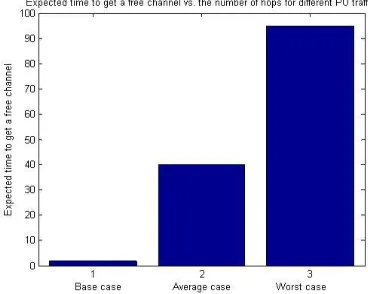
Fig.6.2 Expected time to get a free channel vs. the number of hops for different PU traffic
The relationship between expected time to get a free channel and number of hops to get a free channel for the above mentioned parameters is shown in Fig 6.1.As defined in earlier, when PU traffic is low, the time taken to get a free channel is negligible as shown in Fig. (6.1) because the CR users doesn’t need to hop in search of a vacant channel and as number of hops increases, the expected time to get a free channel increases.
There could be three possible cases as defined earlier i.e. best case when traffic is below 50%, average case when traffic is up to 75% and worst case when traffic is more than 75%. For the example we have taken, Fig. (6.2) shows the expected time to get the free channel for the three PU traffic load conditions.
For the formation of MANET we have taken the parameters as: number of nodes as 100, environment size as 100 and transmission range as 15meters. Fig 6.3 shows the formation of MANET.
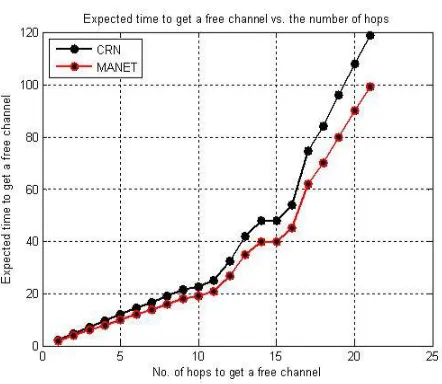
After forming the MANET network, we implemented the channel hopping algorithm in that using the same parameters defined earlier, which reduces the delay in getting the free channel as compared to CRN which is shown in Fig. 6.4
Fig. 6.4:Comparison between CRN and MANET
VII. CONCLUSIONANDFUTURESCOPE
A channel hopping algorithm for CR users is proposed, whenever the PUs returns to its assigned channel then CR users should give the priority to PUs and the CR user should move to the other free channel in a least possible time. Using this algorithm, first we calculated the expected time to get the free channel in cognitive radio networks and then implemented the same algorithm in MANETS where the delay in getting the free channel is reduced as compared to CRNs.
Future work can be carried on including a provision for rendezvous of CR users as well which simultaneously can provide flexibility to PUs.
REFERENCES
[1] Theis, Nick C., Ryan W. Thomas, and Luiz A. DaSilva. “Rendezvous for cognitive radios.” Mobile Computing, IEEE Transactions on 10.2 (2011): 216-227.
[2] Shin, Jongmin, Dongmin Yang, and Cheeha Kim. “A channel rendezvous scheme for cognitive radio networks.” Communications Letters, IEEE 14.10 (2010): 954-956.
[3] Bian, Kaigui, and Jung-Min Park. “Asynchronous channel hopping for establishing rendezvous in cognitive radio networks.” INFOCOM, 2011 Proceedings IEEE. IEEE, 2011.
[4] DaSilva, Luiz A., and Igor Guerreiro. “Sequence-based rendezvous for dynamic spectrum access.” New Frontiers in Dynamic Spectrum Access Networks, 2008. DySPAN 2008. 3rd IEEE Symposium on. IEEE, 2008.
[5] Cormio, Claudia, and Kaushik R. Chowdhury. “Common control channel design for cognitive radio wireless ad hoc networks using adaptive frequency hopping.”Ad Hoc Networks 8.4 (2010): 430-438.
[6] Bian, Kaigui, Jung-Min Park, and Ruiliang Chen. “A quorum-based framework for establishing control channels in dynamic spectrum access networks.” Proceedings of the 15th annual international conference on Mobile computing and networking. ACM, 2009.
[7] Balachandran, Krishna, and Joseph H. Kang. “Neighbor discovery with dynamic spectrum access in adhoc networks.” Vehicular Technology Conference, 2006. VTC 2006-Spring. IEEE 63rd. Vol. 2. IEEE, 2006.
[8] Lin, Zhiyong, et al. “Jump-stay based channel-hopping algorithm with guaranteed rendezvous for cognitive radio networks.” INFOCOM, 2011 Proceedings IEEE. IEEE, 2011.
[9] Chang, Guey-Yun, and Jen-Feng Huang. “A fast rendezvous channel-hopping algorithm for cognitive radio networks.” Communications Letters, IEEE 17.7 (2013): 1475-1478.
[11] Duan, Yueming, Guoliang Liu, and Zhipeng Cai. “Opportunistic channel-hopping based effective rendezvous establishment in cognitive radio networks.”Wireless Algorithms, Systems, and Applications. Springer Berlin Heidelberg, 2012. 324-336.
[12] Liu, Hai, et al. “Ring-walk based channel-hopping algorithms with guaranteed rendezvous for cognitive radio networks.” Proceedings of the 2010 IEEE/ACM Int'l Conference on Green Computing and Communications & Int'l Conference on Cyber, Physical and Social Computing. IEEE Computer Society, 2010.
[13] Akyildiz, Ian F., Won-Yeol Lee, and Kaushik R. Chowdhury. “CRAHNs: Cognitive radio ad hoc networks.” Ad Hoc Networks 7.5 (2009): 810-836.