FURTHER STUDIES OF T H E INTERRELATIONSHIPS OF CELLULAR CHARACTERS I N COLUMBIDAEl
M. R. IRWIN AND L. J. COLEa
University of Wisconsin, Madison, Wisconsin
Received January 2 , 1940
VIDENCE of the separation into distinct parts of the antigenic com-
E
plex of the erythrocytes of Pearlneck (Streptopelia chinensis) not shared with Ring dove, has been given in a previous report (IRWIN 1939).This separation was observed following backcrosses to Ring dove (St.
risoria) of their species hybrid and selected backcross hybrids. The anti- genic complex of Pearlneck has been divided by this method into a t least ten characters which have behaved as units, although it is not known with certainty whether one or more genes are acting singly or together in the production of each of these so-called unit-components. This paper presents the results of tests on the relationship of these specific components of Pearlneck with a third species, the Senegal or Palm dove (St. senegaZensis3),
and, also, other interrelationships between these three species.
MATERIALS AND METHODS
The details of the immunological methods used to demonstrate (a) the similarities and differences between species in their respective antigenic patterns, and (b) the separation of the different specific Pearlneck com- ponents in the cells of backcross hybrids, have already been described (IRWIN and COLE 1936, 1937). Essentially the same methods have been utilized throughout this experiment, for the different absorptions and for the subsequent agglutinations of the various cells with the numerous re- agents.
Hybrids have been obtained between Pearlneck and Senegal, and these in turn have produced offspring when mated to Senegal. Although the fe- male hybrids of the cross of Pearlneck and Ring dove have never produced a living squab, the offspring of backcrosses to Senegal of the hybrid be- tween Pearlneck and Senegal were all obtained from two hybrid females. This suggests a closer relationship between Pearlneck and Senegal than between Pearlneck and Ring dove.
Paper No. 254 from the Department of Genetics, Agricultural Experiment Station, Univer-
sity of Wisconsin. This investigation was supported in part by grants from The Rockefeller Foun- dation, and from the Wisconsin Alumni Research Foundation.
Much valuable technical assistance in these studies has been given by former and present
Research Assistants: WARREN G. BLACK, JOHN R. DICK, Drs. ALFRED GOLDEN and GEORGE W.
WOOLLEY.
Stigmatopelia of authors; we follow PETERS (1937).
CELLULAR CHARACTERS I N COLUMBIDAE 327
As in previous reports, the senior author has performed the immunolog- ical tests, and the junior author has supervised the matings of the birds.
ANALYSIS OF THE SHARING BY SENEGAL O F THE UNIT COM-
PONENTS SPECIFIC TO PEARLNECK (NOT IN RING DOVE)
Differences in the antigenic components of the Pearlneck and Ring dove are easily demonstrated following the absorptions of the antiserum (pro- duced in the rabbit) for either species by the cells of the other (IRWIN and COLE 1936). I t is of considerable interest, then, to determine whether the specific pattern of either of these species, as contrasted with the other, may be shared in part or in toto with still other species. Since probably the major part of the specific Pearlneck complex (not in Ring dove) has been sep- arated into its various components, following successive backcrosses to Ring dove, these cellular characters have a very pertinent use as “testers” to assay their respective presence or absence in other species. A parallel study has been reported (IRWIN 1938) on the presence or absence in both Pearlneck and Ring dove of specific components of Columba guinea as contrasted with C. livia. Although a separation has been observed of the specific constituents of Ring dove, not in Pearlneck, (IRWIN 1939), these have not been obtained in unit form and a comparable analysis for them is not possible.
The results of various tests to determine the sharing or non-sharing by Senegal of the various constituent parts of the specific Pearlneck com- ponents (not in Ring dove), are given in table I. These different component
parts, specific to Pearlneck as compared with Ring dove, are called d-I, d-2,
.
. .
d-11, the letter “d” indicating dove (IRWIN 1939).From the reactions given in table I , it will be seen that when anti-Pearl- neck serum was absorbed by Ring dove cells, it became a reagent which would agglutinate not only the cells of Pearlneck and the F1 (PearlneckX Ring dove) but also those of Senegal to practically the same end-dilution. From this result it would be anticipated that probably several of the spe- cific characters of Pearlneck are present also in Senegal, since the reaction with Senegal cells is presumably by virtue of antigens other than those which either species shares with Ring dove.
CA N m TABLE I Agglutination interactions, ?uith various absorbed sera, of the cells of Pearlneck, Ring dove, Senegal and of cells carrying one of the species-speci$c characters of Pearlneck. CELLS SPECIES UNIT-PEARLNECK SUBSTANCES ANTISERUM ABSORBED
-g
d-4P
BY CELLS OF PEARL- RING SEN- p.~, NECK DOVE EGAL FI- d-1 d-2 d-3 d-4 d-5 d-6 d-7* d-8 d-9 d-11 R.D. 4 Pearlneck Ring dove 8,9 0 7,8 7,8 394 394 0,192 394 576 394 374 324 2,394 798 Senegal Ring dove 7 0 829 7,s Senegal 7,s 0 0 7 0 0 o,+ 0 o++
o,+ o o 7,8 r Pearlneck Senegal 7,s 0 0 798CI
P
Senegal Pearlneck 0 324 8 Ring dove Pearlneck 0 798 294 Ring dove Senegal 2,4 8 0 3,4 3,4 3,4 3,4 5,6 2,3 2,3 2,3 1,2,3 374
$
UPearlneck
Ring
dove
and
0 M
CELLULAR CHARACTERS I N COLUMBIDAE 329
Senegal specific antigens (not in Ring dove), produced agglutination with nearly all of the cells carrying, respectively, one of the presumed unit- characters of Pearlneck. The same titer of serum was noted for the major- ity of these different characters, irrespective of whether the Pearlneck or Senegal reagent was used. I n fact, the d-3 character was more strongly agglutinated in the Senegal reagent than in most of the Pearlneck reagents that have been available. It would be impossible, by comparing the titers obtained in using these two reagents, to differentiate the agglutination of substances d-I, d-2, d-4, d-5, d-7, d-4.d-8 and d-9, and not surely that of d-6. The d-11 component, however, reacted very differently in these two reagents. The end-dilution a t which a reaction occurred for d-11 with the Pearlneck reagent was practically the same as that for either the Pearl- neck or F1 cells (7,
s),
while with the Senegal test fluid the titer for this Pearlneck character was no greater than that usually obtained for several other Pearlneck characters (3,4), as d-I, d-2, etc.On the basis of these results, we may conclude that Senegal shares with Pearlneck either all or a t least a major part of the different cellular charac- ters specific to Pearlneck (contrasted with Ring dove). A more adequate test of the identity or similarity of these characters in Pearlneck and Sene- gal is possible following an exhaustion of Pearlneck antiserum by the cells of both Ring dove and Senegal. If with this reagent there was no agglutina- tion of cells carrying the d-1 substance, for example, i t would be assumed that an antigen indistinguishable from d-I, and therefore presumably identical to it, was present in Senegal cells. But if the reagent agglutinated the cells, as d-6, only a part of d-6, or a substance related to d-6, can be present in Senegal cells. As shown in the table, the titer of this doubly ab- sorbed reagent, for Pearlneck cells and for the d-6 and d-11 components, is the same as that of the test fluid made by the absorption with Ring dove cells alone. But the further absorption by Senegal cells completely removed the agglutinins for the following substances: d-I, d-2, d-4, d-5, d-4.d-8and d-9, and possibly d-7. (Although d-7 is undoubtedly composed of two anti- gens (IRWIN 1939) in these tests the cells of a single individual were used and will be considered as but one). Conflicting results have been obtained in tests involving cells carrying d-3, although it is probable that a sub- stance, indistinguishable from d-3 of Pearlneck, is present in Senegal.
We may conclude from these reactions that the following specific char- acters of Pearlneck (as contrasted with Ring dove) are shared in toto by Senegal: d-I, d-2, d-4, d-5, d-4.d-8 and d-9. All, or nearly all, of substances d-3 and d-7 are likewise probably common to Senegal.
330 M. R. IRWIN AND L. J. COLE
serum, when absorbed by Ring dove cells, will react with cells carrying either of these two antigens.
What reasonable explanation, then, can be given of the relationship be- tween the d-6 and d-11 components in Pearlneck and Senegal? If it were known that each of these cellular constituents of Pearlneck was due to the action of a single gene, we would conclude that a gene in Senegal produced a similar but not identical chemical effect. On the other hand, if two or more genes on respective chromosomes produce these two characters in these backcross progeny, another explanation needs to be invoked. Assum- ing that two or more genes are concerned in either d-6 or d-11, then one or more genes in Senegal may have an effect either identical with or similar to only a part of each of these substances of Pearlneck as they now can be recognized. Parallel relationships have previously been described (IRWIN
1938) between certain unit-characters specific to C. guinea (not in C. Zivia) and related components of Pearlneck. Also, the cellular components (A and B, M and N) of humans, each admittedly caused by a single gene, ap- pear either as indistinguishable or only as related characters in some of the species of the higher apes and lower monkeys (LANDSTEINER and MILLER
1925, LANDSTEINER and WIENER 1937, WIENER 1938).
SEGREGATION OF SPECIFIC PEARLNECK CHARACTERS
FOLLOWING BACKCROSSES TO SENEGAL
According to the results presented above, Pearlneck differs from Senegal chiefly, if not entirely, in that Senegal does not contain more than a part of the (Pearlneck) cellular characters d-6 and d-11. If this be true, the cells of the hybrids between Pearlneck and Senegal should possess these two characters, and the offspring of backcrosses of the F1 to Senegal would be expected to show a segregation into the four kinds; namely, those whose corpuscles contain (I) both d-6 and d-11, (2) d-6 alone, (3) d-11 alone and (4) neither of the two. (Naturally, this analysis can include only the known constituents of Pearlneck, by which this species differs from Ring dove. Those characters, if any, which are not recognized at present may or may not be shared with Senegal, and constitute an unknown quantity in this analysis).
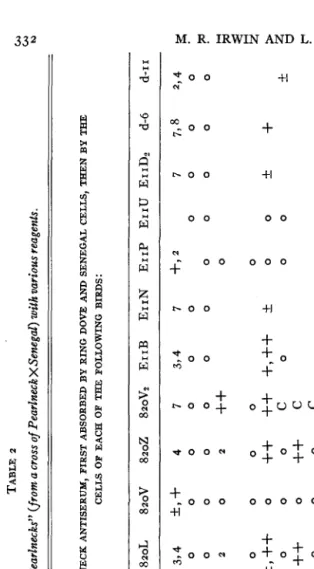
Two different backcross progenies have been obtained in matings of two hybrid females to Senegal. For each of these, the family is designated by the number, 820 and EII, and the individuals by letters, as 820H, E I I B , etc. One of these backcross hybrids (820L) produced offspring (family D967) in mating to a Senegal. The interactions of the cells of some of these backcross birds with various reagents are given in table 2 . The majority
CELLULAR CHARACTERS I N COLUMBIDAE 331
obtained a t any bleeding, thus limiting the volume of the individual re- agents.
From these interactions of table 2, it will be seen that the cells of 11 birds of the two backcross families (D820 and E I I ) gave definite agglutina- tion, and four (D820A and Vz, E I I N and Dz) gave only faint traces of agglutination, when tested with anti-Pearlneck serum absorbed by the cells of both Ring dove and Senegal (see first column of data). Following further absorptions by the cells of individual backcross hybrids, the reac- tions of the respective individual reagents with different cells, and particu- larly with the “tester cells” for substances d-6 and d-11, allow an analysis to be made of the antigens present in the cells of the different birds. Thus, if by absorption the cells of an individual bird removed the agglutinins for either or both of these specific Pearlneck components, we conclude that the particular antigen was present in the absorbing cells.
For example, when the cells of the F1 were used in this manner, no ag- glutinins remained in the absorbed fluid for any of the cells of the birds tested, except for those of Pearlneck. From this result we may say that the species hybrid in this cross probably does not possess quite all of the anti- gens of the Pearlneck parent, but that it does contain both the d-6 and d-11 antigens, as proposed above. The cells of three birds (D820V, E I I P and U)
seemingly were identical in antigenic composition with those of the F1, as shown by the reciprocal interactions (where made) of their respective cells and reagents. The cells of these three birds should then have contained both d-6 and d-11, and the results following their use in respective absorp- tions show that this was the case.
By the same process of analysis, it is seen from the reactions given in table z that the cells of 820H contained substance d-6 but not d-11, while d-11 but not d-6 was found in the cells of SzoL, Z and E I I B . Similar tests with the cells and the reagents for EII
J,
K, V and Z established the pres- ence of d-11 in these cells and their antigenic homology with 820L and Z; the details of these tests are not given in the table.I t is probable that the faint reactions noted for the cells of 820A, Vz, E I I N and
DZ
were due to one or more Pearlneck substances other than d-6 and d-11, since the reagents for the cells of these four different in- dividuals readily agglutinated both tester substances, d-6 and d-1 I. Con- versely, the reagents for d-6 and d-11 produced faint but definite aggluti- nation with each of these different cells, thus practically eliminating the possibility that there had been a fractionation of either of these characters and that a part of one or the other was responsible for the faint reactions shown for them (first column of data in table 2).G, G, N TABLE 2 Interadions ofthe cells of “quarte7-Pearlnecks” (from a cross of Pearlneck XSenegal) with various reagents. TITERS FOLLOW- ING ABSORFTION
OFPEARLNECK ANTISERUM
BY RING DOVE AND SENEGAL CELLS F1 820A 820H 820L 820V 8202 820V2 EIIB EIIN EIIP EIIU EIID~ d-6 d-11 TITERS OF PEARLNECK ANTISERUM, FIRST ABSORBED BY RING DOVE AND SENEGAL CELLS, THEN BY TEE CELLS OF EACH OF THE FOLLOWING BIRDS: CELLS
Pearlneck Ring
dove
Senegal Fl(P.N./Sen.)
820A 820H 820L 820V 8202 820V2 EIIB EIIJ EIIK EIIN EIIP EIIU EIIV EIIZ EIID~
d-11
d-6
798 0 0 7 0,
+
374 7 7 7 0,
+
798 7 7 +,2 627 7 7 7 2 273 798
*
0 0 0 0 0 0 0 0 0 0 07 0 0
++
0++
C C++
0++
C7 0 0
++
0 0 C C C 0 0 0 0 C374
+,+
0 0 0 0 2 0 0 0*,++
0 0 0++
0 0 0 0 0 0 04 0 0 2 0
++
0++
0 00
+,++
0++
0 0 0 7 374 0 0 0 0++
0++
+,++
C
0
C C 0
0 0 0
+
+,++
CO 7 7,8 2,4 0 7 +,2 0 0 0 0 0 0 0 0 0 00 0
CELLULAR CHARACTERS IN COLUMBIDAE 333
ing d-11 but not d-6, as SzoL, Z, E I IB, etc., we must ascribe to these cells of the different birds tested another property specific to Pearlneck than the two recognized (d-6 and d-1 I). As described above, those respective re- sults differ from the reciprocal tests, since the reagents for each of the backcross individuals whose cells contained d-1 I failed to agglutinate the “tester” cells for d-11. We are unable a t present to say whether or not this additional substance is a part of one of the known unit components of Pearlneck (as contrasted with Ring dove).
Exclusive of this unknown character, which is temporarily designated as the “X” constituent, the birds of the backcross offspring may be grouped in the four classes as proposed above:
Cells containing
neither d-6.d-I I d-6 d-1 I d-6 nor d-1 I
__ ___
Number of birds 3 I 7 4
These are reasonably close to the equality in numbers expected in each of the four classes, as proposed above. One bird (SzoL), whose cells contained the d-11 and not the d-6 character, produced offspring of the second back- cross generation, in mating to Senegal. The expectation would be that the progeny would consist of two classes with approximate equality: those with and those without the d-11 component. Actually, of nine birds raised, three possessed this character and six did not. And since the cells of SzoL contained the “X” substance as well as d-11, four kinds of cells would be expected in its backcross progeny. The actual findings follow:
Cells containing
d-1 I .“X” d- I I “X” d-11 nor “X” neither
-
Number of birds z (or I) I (or 2) 3 (or 4) 3 (or 2) Because of the faint reaction usually typical of the “X” substance, there was uncertainty in classifying its presence or absence in the cells of four birds, and the number in these four groups is, therefore, more or less tenta- tive.
INTERRELATIONSHIPS O F PEARLNECK, RING DOVE AND SENEGAL
Evidence has been presented above that Pearlneck and Senegal share many genetic characters (cellular) which are not found in Ring dove. If
334 M. R. IRWIN AND L. J. COLE
This relationship can be tested in agglutinations following the respective absorptions by Senegal cells of anti-Pearlneck and anti-Ring dove sera. The results from these tests are a t variance, for although the various Pearl- neck antisera, absorbed by Senegal cells, did not agglutinate Ring dove cells, Pearlneck cells are agglutinated by Ring dove antiserum when ab- sorbed by Senegal cells. These Pearlneck antisera were seemingly alike in that they each lacked the one or more agglutinins for the part of the Pearl- neck antigenic complex common to Ring dove but not common to Senegal. Utilizing the interactionswith Senegal and Ring dove cells following the absorption by Pearlneck corpuscles of antiserum for each of these two spe- cies, as given in table I , we note that Senegal and Ring dove have in com-
mon probably a minor part of their respective antigenic complexes to the exclusion of Pearlneck.
Thus in Pearlneck, in comparison with Senegal and Ring dove, a part of the antigens are found only within the species; the remainder are shared, in varying proportions, with Ring dove only (probably), with Senegal only and with both Ring dove and Senegal. A similar complex exists for both Ring dove and Senegal, since each contains antigens specific to itself, and shares other antigens with the other two species, singly and together.
If more related species were used in these comparisons, would it be found that any single species possessed antigens peculiar to itself alone; that is, not shared in any other species? Or might the antigens, as of Pearlneck, be simply a composite sample of certain of those found in several other spe- cies? Pearlneck then would differ from these other species only in being a different combination of antigens (genes), all of which were present in a group of related species. Data pertinent to this question will be considered elsewhere.
DISCUSSION
CELLULAR CHARACTERS I N COLUMBIDAE 335 The actual findings on the cells of the offspring were in accordance with the expectation. These results give added confidence that similar comparisons between species are an index of the genetic relationships between them, even though hybridization may not be possible between the species being compared.
These findings show very clearly that the characters (therefore the cau- sative genes) by which one species (Pearlneck) differs from another (Ring dove) may be shared a t least in part by still a third species (Senegal). If the cellular characters specific to Pearlneck, as contrasted with both Ring dove and Senegal, are shared with one or more other species, our concept of the genetic make-up of this species would be that it was simply a peculiar combination of genetic characters which were present in several different species. The other possibility would be that some species, perhaps all, possess genetic characters particular only to themselves. Experiments de- signed to provide an answer to this problem will be reported inother papers.
Because of the relationship shown to exist between the Pearlneck and Senegal species, and of both of these to Ring dove, another possibility in the analysis of the genetic relationships between species is indicated. If hybrids can be obtained between Senegal and Ring dove, in backcrosses to Ring dove there should eventually be produced in unit form the cellular characters specific to Senegal. Many of these should presumably be indis- tinguishable from, and, therefore, presumably identical with, the unit char- acters of Pearlneck. The questions eventually to be answered are, then, whether each unit substance of Pearlneck is also a unit-substance of Sene- gal, or whether any two or more, or parts of the respective Pearlneck char- acters behave as units in Senegal. Considerable progress has already been made in the production of the backcross progeny of this cross. Future re- ports will deal with the segregation of specific Senegal characters observed among them.
SUMMARY
All or nearly all of eight, and only a part of the remaining two of the ten specific cellular characters of Pearlneck, not in Ring dove, are indis- tinguishable from and presumably are identical with antigens present in the cells of Senegal. The expected segregation of the Pearlneck characters, not present in toto in Senegal, was observed in the offspring of backcrosses to Senegal of the species hybrid (Pearlneck X Senegal). There appeared to be still a third character, in addition to these two recognizable constitu- ents, which differentiated Pearlneck from Senegal.
LITERATURE CITED
336 M. R. IRWIN AND L. J. COLE
doves, and the separation of species-specific substances in the backcross. J. Exp. Zool. 73:
85-108.
1937 Immunogenetic studies of species and of species-hybrids in doves; the separation of
species-specific substances in the second backcross. J. Immunol. 33 : 355-373.
IRWIN, M. R. 1938 Immunogenetic studies of species relationships in Columbidae. J. Genet. 35:
351-373.
1939 A genetic analysis of species daerences in Columbidae. Genetics 24: 709-721.
LANDSTEINER, K., and MILLER, C. P., JR., 1925 Serological studies on the blood of the primates.
11. The blood groups in anthropoid apes. J. Exp. Med. 42: 853-862.
1925 Serological studies on the blood of primates. 111. Distribution of serological factors re-
lated to human isoagglutinogens in the blood of lower monkeys. J. Exp. Med. 42: 863-872.
LANDSTEINER, K., and WIENER, A. S., 1937 On the presence of M agglutinogens in the blood of
monkeys. J. Immunol. 33: 19-25.