ISSN 0975-928X
Research Article
Combining ability studies in okra (
abelmoschus esculentus
(l.) moench) for
yield and its component characters
J.P. Bhatt, K.B. Kathiria, S. S. Christianand R. R. Acharya
Main Vegetable Research Station, Anand Agricultural University, Anand-388110 (Gujarat), India Email: [email protected]
(Received:23 Nov 2014; Accepted:01 Dec 2014)
Abstract
The present experiment was conducted with 28 F1sdeveloped through diallel hybridization technique excluding reciprocals
along with eight parents in RBD with three replications. The gca and sca mean squares were significant for all the traits except gca mean square for fruit length. The ratio of gca and sca variances indicated the preponderance of non-additive gene effect for inheritance of all the traits. Genotypes AOL-09-25 and GO-2 showed good general combining ability for fruit yield appear to be worthy for exploitation of segregation and varietal development. The estimates of sca effects revealed that the cross combinations AOL-09-25 x AOL-09-26, GO-2 x AOL-09-28 and AOL-08-10 x AOL-08-2 were observed most promising for fruit yield and some of its related traits.
Key words
Abelmoschus esculentus (L.) Moench, combining ability, diallel analysis, fruit yield
Introduction:
Okra [Abelmoschus esculentus (L.) Moench] also known as ladies finger is an important vegetable crop being native of tropical Africa. One of the major problem in okra cultivation in India is lack of location specific high yielding varieties. In often cross-pollinated crops like okra, improvement in the past was based on selection in locally adapted populations. During recent past, exploitation of hybrid vigour and selection of parents on the basis of combining ability effects have opened a new line of approach in crop improvement. Application of biometrical techniques like diallel analysis has appeared to be the best and vastly useful breeding tool, which gives generalized picture of genetics of the characters under study. Understanding the nature of gene action could be helpful in predicting the effectiveness for selection in a population. Clear- cut knowledge of the type of gene action and magnitude and composition of genetic variance is of fundamental importance to a plant breeder. Furthermore, the combining ability studies are useful for the evaluation of newly developed lines for their parental usefulness and to know the gene actions involved in the inheritance of various characters. Hence, the present investigation was undertaken to study the gene action in different quantitative traits and to study the combining ability for yield and its components in okra.
Material and method
The materials for the present investigation comprised eight diverse genotypes of okra namely, AOL-08-10, AOL-09-24, AOL-08-2, AOL-09-25, AOL-09-26, AOL-09-27, GO-2 and AOL-09-28. All the genotypes were crossed in half diallel fashion during kharif 2009. Eight parents and 28
hybrids in a total of 36 genotypes were evaluated in a Randomized Block Design (RBD) with three replications at Main Vegetable Research Station, Anand Agricultural University, Anand, Gujarat during kharif 2010. Each plot consisted of 10 plants. Inter and intra raw spacing was kept 60 and 30 cm, respectively. All the recommended package of practices was adopted to raise a good crop. The observations were recorded on 5 competent plants for 12 quantitative traits viz., days to first flowering, days to first picking, plant height (cm), number of nodes per plant, length of internode (cm), number of primary branches per plant, stem girth (cm), fruit length, fruit girth (cm), fruit weight (g), number of fruits per plant and fruit yield per plant (g). Combining ability analysis was performed according to Model – I, Method – II proposed by Griffing (1956).
Result and discussion
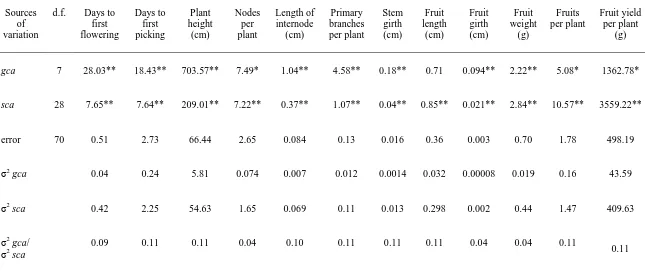
The mean squares due to gca and sca for different traits are presented in Table 1. The gca and sca
mean squares were observed significant for all the traits except gca mean square for fruit length. This indicated that both additive and non-additive gene actions played important role for the inheritance of these traits. Whereas, for fruit length only sca
mean square was observed significant indicating the importance of non-additive gene action for the expression of this trait. The sca variance component was observed to be higher than the respective gca variance component for all the traits indicating the predominance of non-additive gene action for the inheritance of all the traits. Similar findings were also obtained by Weerasekara et al.
ISSN 0975-928X
http://ejplantbreeding.com 480
flowering, primary branches per plant, fruits per plant, fruit yield per plant; Singh et al. (2009) for fruit weight; Wammanda et al. (2010) for plant height, length of internode, primary branches per plant, fruit length, fruit girth, fruits per plant, fruit yield per plant and Reddy et al. (2012) for primary branches per plant, length of internode, fruit length, fruit girth, fruit weight.
The estimates of gca effects (Table 2) revealed that none of the parents was found good general combiner simultaneously for all the traits studied. Two parents viz.; AOL-09-25 and GO-2 were observed to be good general combiners for fruit yield per plant. In addition to fruit yield, parent AOL-09-25 was also observed to be good general combiner for traits like days to first flowering, days to first picking, plant height, length of internode, fruit length and fruit girth. While, parent GO-2 was also observed to be good general combiner for traits like plant height, nodes per plant, stem girth and fruits per plant. Thus, these two parents were observed to be good combiners for fruit yield along with most of the other yield contributing traits. Thus both the parents could be considered in future breeding programme to generate more number of desirable segregants for fruit yield and its component traits. Rest of all the parents except AOL-08-10 were average combiners for fruit yield per plant. The parent AOL-08-2 was good general combiner for plant height and length of internode. While, parent AOL-09-27 found good general combiner for days to first flowering, days to first picking and fruit girth. The parent, AOL-09-26 found good general combiner for primary branches per plant and stem girth. While, parent AOL-08-10 was observed to be good general combiner for days to first flowering and fruit weight. These parents may be utilized in the component breeding programme. On the other hand, AOL-09-28 and AOL-09-24 were observed to be average or poor combiners for most of the traits.
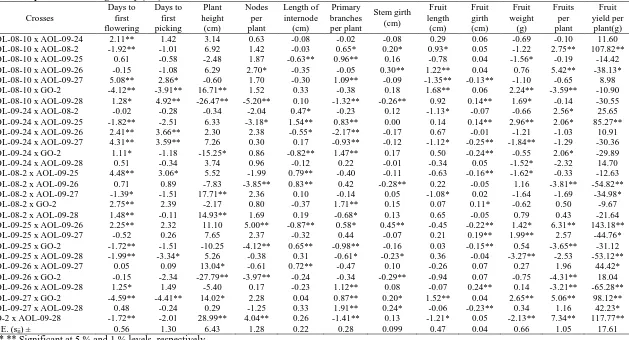
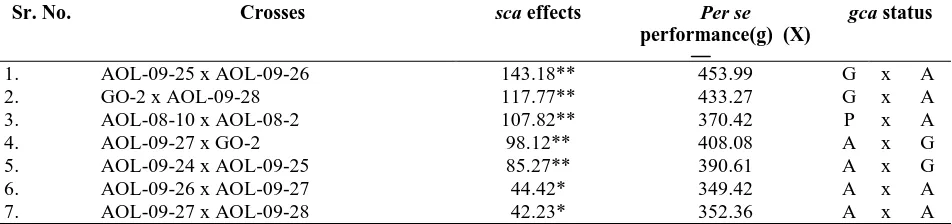
The estimates of specific combining ability effects (Table 3) indicated that none of the hybrids was found to be superior for all the traits under investigation. However, seven crosses registered significant and positive sca effects for fruit yield per plant. Of these, top three were AOL-09-25 x AOL-09-26, GO-2 x AOL-09-28 and AOL-08-10 x AOL-08-2. All the top three crosses which exhibited high sca effects for fruit yield involved at least one good general combiner (Table 4). Such type of results were also obtained by Desai (1990), Patel et al. (1990), Poshiya and Vashi (1995), Pawar et al. (1999), Prakash et al. (2002), Pal and Sabesan (2009) and Dabhi et al. (2010). These hybrids could be exploited through heterosis breeding and and may also give transgressive segregants in subsequent generations and,
therefore, it would be worthwhile to use them for improvement in fruit yield per se.
The results on per se, gca and sca effects (Table 4) revealed that the crosses with high sca effects for fruit yield involved good x average, average x good, average x average and poor x average general combiners. This indicated the role of additive and non-additive gene actions in the genetic control of these traits. The presence of additive gene action would enhance the chances for making improvement through simple selection. For exploitation of dominance and epistatic effects, it appears worthwhile to intermate the selected progenies in early segregating generations, which would result in the accumulation of favourable genes for the characters. Hence, biparental mating or few cycles of recurrent selection followed by pedigree selection may give fruitful results.
References
Dabhi, K. H., Vachhani, J. H., Poshiya, V. K., Jivani, L. L. and Kacchadia, V. H. 2010. Combining ability for fruit yield and its components over environments in okra (Abelmoschus
esculentus (L.) Moench). Res. on Crops,
11(2): 383-90.
Desai, D.T. 1990. Genetic analysis of some quantitative characters in okra (Abelmoschus esculentus
(L.) Moench). Unpublished Ph. D. thesis, M.P.K.V., Rahuri.
Griffing, B. 1956. Concept of general and specific combing ability in relation to diallel crossing system. Aust. J. Biol. Sci., 9: 463-493.
Pal, A.K. and Sabesan T. 2009. Combining ability through diallel analysis in okra
(Abelmoschus esculentus (L.) Moench).
Electron. J. Plant. Breed.,. 1 : 84-88.
Patel, S. S., Kulkarni, U.G. and Nerkar, Y.S. 1990. Gene action for green fruit yield and its components in okra. J. Maharashtra Agric. Univ., 15(3): 331-32.
Pawar, V.Y., Poshiya, V. K. and Dhaduk, H. L. 1999. Heterosis studies in okra (Abelmoschus
esculentus (L.) Moench). G.A.U. Res. J.,
25(1): 26-31.
Poshiya, V.K. and Vashi, P. S. 1995. Combining ability analysis over environments in okra
(Abelmoschus esculentus (L.) Moench).
G.A.U. Res. J.,20(2): 64-68.
Prakash, M., Kumar, M.S., Saravanan, K., Kannan, K. and Ganesan, J. 2002. Line x Tester analysis in okra. Ann. Agril. Res., 23(2): 233-37. Reddy, M.T., Kadiyala, H., Mutyala, G., Reddy, K.C.,
Begum H., Reddy, R.S.K. and Babu J.D. 2012. Genetic analysis for yield and its components in okra (Abelmoschus
esculentus (L.) Moench). Songklanakarin J.
Sci. Tech.,34 (2): 133-141.
Singh, D.R., Singh, P.K., Syamal, M.M. and Gautam, S.S. 2009. Studies on combining ability in okra. Indian J. Hort., 66 (2): 277-80. Wammanda, D.T., Kadams, A.M. and Jonah, P.M. 2010.
ISSN 0975-928X
esculentus (L.) Moench). African J. Agril.
Res., 5 (16): 2108-15.
ISSN 0975-928X
http://ejplantbreeding.com 482
Table 1 Mean square due to general and specific combining ability for yield and its component characters in okra
Sources of variation
d.f. Days to first flowering
Days to first picking
Plant height (cm)
Nodes per plant
Length of internode
(cm)
Primary branches per plant
Stem girth (cm)
Fruit length
(cm)
Fruit girth (cm)
Fruit weight
(g)
Fruits per plant
Fruit yield per plant
(g)
gca 7 28.03** 18.43** 703.57** 7.49* 1.04** 4.58** 0.18** 0.71 0.094** 2.22** 5.08* 1362.78*
sca 28 7.65** 7.64** 209.01** 7.22** 0.37** 1.07** 0.04** 0.85** 0.021** 2.84** 10.57** 3559.22**
error 70 0.51 2.73 66.44 2.65 0.084 0.13 0.016 0.36 0.003 0.70 1.78 498.19
σ2gca 0.04 0.24 5.81 0.074 0.007 0.012 0.0014 0.032 0.00008 0.019 0.16 43.59
σ2
sca 0.42 2.25 54.63 1.65 0.069 0.11 0.013 0.298 0.002 0.44 1.47 409.63
σ2gca/
σ2
sca
0.09 0.11 0.11 0.04 0.10 0.11 0.11 0.11 0.04 0.04 0.11
0.11
ISSN 0975-928X
Table 2. General combining ability (gca) effects for different characters in okra
Parents Days to first flowering
Days to first picking
Plant height
(cm)
Nodes per plant
Length of internode
(cm)
Primary branches per
plant
Stem girth (cm)
Fruit length
(cm)
Fruit girth (cm)
Fruit weight
(g)
Fruits per plant
Fruit yield per plant
(g)
AOL-08-10 -1.03** -0.61 -8.34** -0.16 -0.36** -0.83** -0.01 0.39 -0.04* 0.69* -0.39 -22.96**
AOL-09-24 0.40 -0.34 -6.68* -0.41 -0.14 0.80** -0.20** -0.27 0.10 -0.11 -0.94* -1.34
AOL-08-2 -0.23 -0.24 8.47** 0.03 0.37** 0.03 -0.13** -0.23 -0.02 -0.61* -0.73 -11.55
AOL-09-25 -2.43** -2.01** 7.34** -0.68 0.56** -0.88** -0.06 0.41* 0.07** 0.47 -0.19 14.60*
AOL-09-26 2.67** 1.82** 2.37 0.10 0.09 0.43** 0.15** 0.00 -0.08** -0.50 0.65 4.15
AOL-09-27 -1.57** -1.11* -4.51 -0.28 -0.15 -0.31** 0.03 -0.22 0.15** 0.35 0.15 3.75
GO-2 0.63** 0.66 11.30** 2.03** -0.04 -0.41** 0.20** -0.08 -0.13** 0.03 1.19** 14.59*
AOL-09-28 1.57** 1.82** -9.95** -0.61 -0.33** 0.90** 0.03 0.01 -0.05** -0.31 0.27 9.28
S. E. (gi) ± 0.23 0.55 2.72 0.54 0.09 0.12 0.04 0.20 0.02 0.28 0.44 7.44
ISSN 0975-928X
http://ejplantbreeding.com 484
Table 3. Specific combining ability (sca) effects for different characters in okra
Crosses
Days to first flowering
Days to first picking
Plant height
(cm)
Nodes per plant
Length of internode
(cm)
Primary branches per plant
Stem girth (cm)
Fruit length
(cm)
Fruit girth (cm)
Fruit weight
(g)
Fruits per plant
Fruit yield per
plant(g)
AOL-08-10 x AOL-09-24 2.11** 1.42 3.14 0.63 -0.08 -0.02 -0.08 0.29 0.06 -0.69 -0.10 11.60
AOL-08-10 x AOL-08-2 -1.92** -1.01 6.92 1.42 -0.03 0.65* 0.20* 0.93* 0.05 -1.22 2.75** 107.82** AOL-08-10 x AOL-09-25 0.61 -0.58 -2.48 1.87 -0.63** 0.96** 0.16 -0.78 0.04 -1.56* -0.19 -14.42 AOL-08-10 x AOL-09-26 -0.15 -1.08 6.29 2.70* -0.35 -0.05 0.30** 1.22** 0.04 0.76 5.42** -38.13* AOL-08-10 x AOL-09-27 5.08** 2.86* -0.60 1.70 -0.30 1.09** -0.09 -1.35** -0.13** -1.10 -0.65 8.98 AOL-08-10 x GO-2 -4.12** -3.91** 16.71** 1.52 0.33 -0.38 0.18 1.68** 0.06 2.24** -3.59** -10.90 AOL-08-10 x AOL-09-28 1.28* 4.92** -26.47** -5.20** 0.10 -1.32** -0.26** 0.92 0.14** 1.69* -0.14 -30.55 AOL-09-24 x AOL-08-2 -0.02 -0.28 -0.34 -2.04 0.47* -0.23 0.12 -1.13* -0.07 -0.66 2.56* 25.65 AOL-09-24 x AOL-09-25 -1.82** -2.51 6.33 -3.18* 1.54** 0.83** 0.00 0.14 0.14** 2.96** 2.06* 85.27** AOL-09-24 x AOL-09-26 2.41** 3.66** 2.30 2.38 -0.55* -2.17** -0.17 0.67 -0.01 -1.21 -1.03 10.91 AOL-09-24 x AOL-09-27 4.31** 3.59** 7.26 0.30 0.17 -0.93** -0.12 -1.12* -0.25** -1.84** -1.29 -30.36 AOL-09-24 x GO-2 1.11* -1.18 -15.25* 0.86 -0.82** 1.47** 0.17 0.50 -0.24** -0.55 2.06* -29.89
AOL-09-24 x AOL-09-28 0.51 -0.34 3.74 0.96 -0.12 0.22 -0.01 -0.34 0.05 -1.52* -2.32 14.70
AOL-08-2 x AOL-09-25 4.48** 3.06* 5.52 -1.99 0.79** -0.40 -0.11 -0.63 -0.16** -1.62* -0.33 -12.63 AOL-08-2 x AOL-09-26 0.71 0.89 -7.83 -3.85** 0.83** 0.42 -0.28** 0.22 -0.05 1.16 -3.81** -54.82** AOL-08-2 x AOL-09-27 -1.39* -1.51 17.71** 2.36 0.10 -0.14 0.05 -1.08* 0.02 -1.64 -1.69 -34.98*
AOL-08-2 x GO-2 2.75** 2.39 -2.17 0.80 -0.37 1.71** 0.15 0.07 0.11* -0.62 0.50 -9.67
AOL-08-2 x AOL-09-28 1.48** -0.11 14.93** 1.69 0.19 -0.68* 0.13 0.65 -0.05 0.79 0.43 -21.64
AOL-09-25 x AOL-09-26 2.25** 2.32 11.10 5.00** -0.87** 0.58* 0.45** -0.45 -0.22** 1.42* 6.31** 143.18**
AOL-09-25 x AOL-09-27 -0.52 0.26 7.65 2.37 -0.32 0.44 -0.07 0.21 0.19** 1.99** 2.57 -44.76*
AOL-09-25 x GO-2 -1.72** -1.51 -10.25 -4.12** 0.65** -0.98** -0.16 0.03 -0.15** 0.54 -3.65** -31.12 AOL-09-25 x AOL-09-28 -1.99** -3.34* 5.26 -0.38 0.31 -0.61* -0.23* 0.36 -0.04 -3.27** -2.53 -53.12**
AOL-09-26 x AOL-09-27 0.05 0.09 13.04* -0.61 0.72** -0.47 0.10 -0.26 0.07 0.27 1.96 44.42*
AOL-09-26 x GO-2 -0.15 -2.34 -27.79** -3.97** -0.24 -0.34 -0.29** -0.94 0.07 -0.75 -4.31** 18.04 AOL-09-26 x AOL-09-28 1.25* 1.49 -5.40 0.17 -0.23 1.12** 0.08 -0.07 0.24** 0.14 -3.21** -65.28** AOL-09-27 x GO-2 -4.59** -4.41** 14.02* 2.28 0.04 0.87** 0.20* 1.52** 0.04 2.65** 5.06** 98.12** AOL-09-27 x AOL-09-28 0.48 -0.24 0.29 -1.25 0.33 1.91** 0.24* -0.06 -0.23** 0.34 1.16 42.23* GO-2 x AOL-09-28 -1.72** -2.01 28.99** 4.04** 0.26 -1.41** 0.13 -1.21* 0.05 -2.13** 7.34** 117.77**
S. E. (sij) ± 0.56 1.30 6.43 1.28 0.22 0.28 0.099 0.47 0.04 0.66 1.05 17.61
ISSN 0975-928X
Table 4. Top ranking significant specific combiners for fruit yield per plant and their per se performance and its gca status of parents in okra
Sr. No. Crosses sca effects Per se
performance(g) (X)
gca status
1. AOL-09-25 x AOL-09-26 143.18** 453.99 G x A
2. GO-2 x AOL-09-28 117.77** 433.27 G x A
3. AOL-08-10 x AOL-08-2 107.82** 370.42 P x A
4. AOL-09-27 x GO-2 98.12** 408.08 A x G
5. AOL-09-24 x AOL-09-25 85.27** 390.61 A x G
6. AOL-09-26 x AOL-09-27 44.42* 349.42 A x A
7. AOL-09-27 x AOL-09-28 42.23* 352.36 A x A
*,** Significant at 5 % and 1 % levels, respectively.