Available online: https://edupediapublications.org/journals/index.php/IJR/ P a g e | 25
A Location-Based Services for Data Privacy using Grid System
A D. SIVARAM KUMAR1& KHADAR BASHA DUDEKULA 2
1ASSISTANT PROFESSOR Dept. of CSE SVR ENGINEERING COLLEGE, AYYALURU,
NANDYAL Email:- [email protected]
2PG-Scholar Dept. of CSE SVR ENGINEERING COLLEGE, AYYALURU, NANDYAL
Email: - [email protected]
Abstract.-Due to the large increasing use of Location Based Services (LBS), which require personal data of the user to provide the continuous service, protecting the privacy of these data has become a challenge. An approach to preserving a privacy is through anonymity, by hiding the identity and user location data of the mobile device from the service provider(third party) or from any unauthorized party who has access at the user’s request .Considering the challenge mentioned, in this paper gives a classification according to the Architecture, approaches and techniques used in previous works, and presents a survey of solutions to provide anonymity in LBS including the open issues or possible improvements to current solutions. All of this, in order to provide guidelines for choosing the best solution approach to a specific scenery in which anonymity is required.
Keywords: Dynamic grid system, cloaking areas, location based services, Encryption, privacy. 1. Introduction
The consumer market for location-based services (LBS) is estimated to grow from 2.9 billion dollars in 2010 to 10.4 billion dollars in
2015. While navigation applications are
currently generating the most significant revenues, locationbased advertising and local search will be driving the revenues going forward. The legal landscape, unfortunately, is unclear about what happens to a subscriber's location data. The nonexistence of regulatory controls has led to a growing concern about potential privacy violations arising out of the usage of a location-based application. While new regulations to plug the loopholes are being sought, the privacy conscious user currently feels reluctant to adopt one of the most
functional business models of the decade. Privacy and usability are two equally important requirements for successful realization of a location-based application. Privacy (location) is looselydefined as a “personally” assessed restriction on when andwhere someone’s position is deemed appropriate fordisclosure. To
begin with, this is a very dynamic
concept.Usability has a twofold meaning: a) privacy controls should beintuitive yet flexible, and b) the intended purpose of anapplication is reasonably maintained. Towards this end, priorresearch has led to the development of a number of privacycriteria, and algorithms for their optimal achievement.
Available online: https://edupediapublications.org/journals/index.php/IJR/ P a g e | 26 accuracy of a location coordinate and the
service quality from an application using those coordinates. Therefore, the question of what minimal location accuracy is required for a LBS application to function remains open. The common man‟ s question is: “how important is my position to get me to the nearest coffee
shop?” which unfortunately remains
unanswered in the scientific community. It is worth mentioning that a separate line of research in analyzing anonymous location traces has revealed that user locations are heavily correlated, and knowing a few frequently visited locations can easily identify the user behind a certain trace. The privacy breach in these cases occurs because the location to identity mapping results in a violation of user anonymity. The proposal in this work attempts to prevent the reverse mapping from user identity to user location in a user-controllable manner.
The term Location-Based Services (LBS) is a recent concept that denotes applications integrating with the general notion of services.
Examples of such applications include
emergency services, car navigation systems, tourist tour planning, or information delivery. In the modern environment each and every users has lots and lots of queries to analyze the locations in a global place, in that case the main motivate of server is to successfully serve the
response to all the requestor without any delay as well as maintain the privacy of individuals. The basic idea of every server is the concept of load balancing; here the server requires reducing the number of queries submitted by mobile clients and query load on the server. However, mobile clients suffer from longer waiting time for the server to compute valid regions.
2. Private Information Retrieval (PIR) OR Oblivious Transfer (OT).
Available online: https://edupediapublications.org/journals/index.php/IJR/ P a g e | 27 signatures in order to get the key required
response to the query. This solution is thought for LBS that require payment.
Although PIR or OT techniques do not require a third party, they incur a much higher communication overhead between the user and the service provider, requiring the transmission of much more information than the user actually needs.
3. Dynamic Grid System 3.1 Spatial Cloaking
This technique is the most commonly used for protecting user location data from the third party attackers where in this technique extracted user location is blurred before submitting into service provider server for processing The solution proposed in this area is further classified by the architectural approach.
3.2 Semi Trusted Third Party (Dynamic Grid System)
To overcome the problem of in the above architecture propose a new architecture called dynamic grid system (DGS) [4] to provide privacy- preserving snapshot and continuous LBS. The main idea is to place a semi-trusted third party, termed query server (QS), between the user and the service provider. QS only needs to be semi-trusted because it will not collect/
store or even have access to any user location information.
Fig: 1. Architecture
Available online: https://edupediapublications.org/journals/index.php/IJR/ P a g e | 28 subset of encrypted POIs whose corresponding
identifiers match any one of the encrypted identifiers initially sent by the user
Algorithm for DGS
Input: User location (x, y), POI data P Output: User's POI Query data U(P). Initialization:
i. User Select POI Type P(t), QS Query Server, SP Service Provider.
ii. User set location, defined x, y (Current exact Location).
letxu,yu∈ U,
Map.getBounds(xu,yu)
return(xb,yb), ( xt,yt) where b-
bottom, t- top
Key Derivation Function KDF() returnsk (random key)
Enc(query) = IBE(P(t), k, ( xb,yb), ( xt,yt)) // At
User side
Enc(query), User data of U fwd toQS.
Create ID for Query and fwd Enc(query) to SP
Decrpt(query) at SP,
get (xc,yc)= Map.getCenter(( xb,yb), (
xt,yt));
while data != nulll get POI P ∈ P(t), sort based on dist, create Query Set U(p). end while
return Query Set U(p) to QS At QS, fwd Query Set to User Decrpt(query set U(P)) at USer,
3.3 Identity Based Encryption (IBE)
For an effective key management system these are all requirements 2] Authenticate users and decrypt data 3] Manage keys with partners 4]
Deliver keys to trusted infrastructure
components 5] Recover keys
Adi Shamir, one of the pioneers of public key cryptography, proposed a new type of public key algorithm in 1984. While public key
systems have the inherent problem of
distributing public keys and tying those public keys to a specific receiver. The scheme has chosen cipher text security in the random oracle model assuming a variant of the computational Diffie-
Hellman problem. This system is based on bilinear maps between groups.
In this paper we propose a fully functional
identity-based encryption scheme. The
Available online: https://edupediapublications.org/journals/index.php/IJR/ P a g e | 29 4. Results
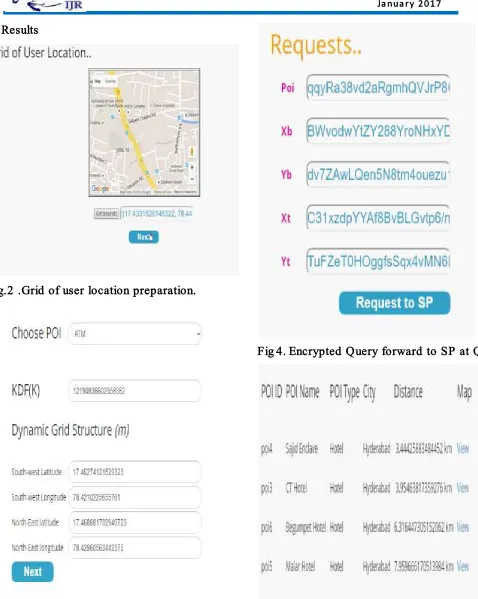
Fig.2 .Grid of user location preparation.
Fig. 3. Preparation of Query
Fig 4. Encrypted Query forward to SP at QS
Available online: https://edupediapublications.org/journals/index.php/IJR/ P a g e | 30 5. Conclusion
It is necessary to propose new models that address new threats and attack models, which seek to break user’s privacy in Location Based Services. These new models need to overcome the disadvantages of existing ones. Novel solutions approaches could combine different
proposed solutions, to compensate the
disadvantages of certain models with the advantages of others.
The job of updating or proposing a new survey will remain as an open task, as the development of new solutions to protect user’s privacy in
Location Based Services remains active;
moreover it is necessary to classify the solutions by the privacy degree they offer, the attack model(s) from which they are resilient and the type of LBS to which they can be applied.
6. REFERENCES
[1] Schiller, J. Voisard, A.: Location-Based Services. Morgan Kaufmann Publishers (2004) [2] Mohaisen, A., Hong, D., Nyang, D.: Privacy in Location based services: Primitives toward the solution. NCM (2008)
[3] C.-Y. Chow and M. F. Mokbel, “Enabling private continuous queries for revealed user
locations,” in Proc. 10th Int. Conf. Adv. Spatial Temporal Databases, 2007, pp. 258–273.
[4] B. Gedik and L. Liu, “Protecting location
privacy with personalized k-anonymity:
Architecture and algorithms,” IEEE Trans. Mobile Comput., vol. 7, no. 1, pp. 1–18, Jan. 2008.
[5] M. Gruteser and D. Grunwald, “Anonymous usage of locationbased services through spatial and temporal cloaking,” in Proc. 1st Int. Conf. Mobile Syst., Appl. Services, 2003, pp. 31–42. [6] P. Kalnis, G. Ghinita, K. Mouratidis, and D. Papadias, “Preventing location-based identity inference in anonymous spatial queries,” IEEE Trans. Knowl. Data Eng., vol. 19, no. 12, pp. 1719–1733, Dec. 2007.
[7] M. F. Mokbel, C.-Y. Chow, and W. G. Aref, “The new casper: Query processing for location services withoutcompromising privacy,” in Proc. 32nd Int. Conf. Very Large Data Bases, 2006, pp. 763–774.
[8] T. Xu and Y. Cai, “Location anonymity in continuous locationbased services,” in Proc. 15th Annu. ACM Int. Symp. Adv. Geographic Inf. Syst., 2007, pp. 39:1–39:8.
Available online: https://edupediapublications.org/journals/index.php/IJR/ P a g e | 31 [10]. Lu, H., Jensen, C.S., Yiu, M.L.: PAD:
Privacy-Area Aware. Dummy-Based Location Privacy in Mobile Services MobiDE (2008) 16– 23
[11]. Bamba, B., Liu, L., Pesti, P., Wang, T.: Supporting anonymous location queries in mobile environments with privacy grid. In: Proceedings of the International World Wide Web Conference, WWW (2008)
[12]. Gedik, B.,Liu, L.: Protecting location
privacy with personalized k-anonymity:
Architecture and algorithms. In: IEEE
Transactions on Mobile Computing, TMC (2008) 1–18
[13]. Gruteser, M., Grunwald, D.: Anonymous usage of location-based services through spatial and temporal cloaking. In: Proceedings of the
International Conference on Mobile
Systems,Applications, and Services, MobiSys (2003)
[14] Roman Schlegel, Member, IEEE, Chi-Yin Chow, Member, IEEE, Qiong Huang, Member, IEEE, and Duncan S. Wong, Member, IEEE,
“User-Defined Privacy Grid System for
Continuous Location-Based Services”, IEEE Transactions on Mobile Computing, 2015. [15]. Ardagna, C. A., Cremonini, M., Damiani, E., De Capitani di Vimercati S., Samarati, P.: Location privacy protection through obfuscation
based techniques. Data and Applications Security XXI, Volume 4602 (2007)