SF
6
N
2
Mixtures for Application in EHV
Gas Insulated Systems
Shailesh R Joshi1, Prof.S S Hadpe2
PG Student, Dept. of Electrical Engg, MCOERC, Nasik, Maharashtra, India1
Assistant Professor, Dept. of Electrical Engg, MCOERC, Nasik, Maharashtra, India2
ABSTRACT: SF6 gas insulated equipment forms a major component of growing electrical power networks all over the
world. Due to an exceptional combination of physical and chemical properties, SF6 has become an indispensable
insulation medium for electric power equipments. The global warming potential of SF6 has prompted experiments on
alternate to pure SF6.Efforts have been made to study the performance of the SF6 mixtures. At this point of time, 100%
replacement for SF6 looks unfeasible but the mixtures of SF6 with different gases can offer a realistic solution. This
paper attempts to present the design and evaluation of SF6 and SF6N2 mixtures for EHV rating GIS.
KEYWORDS: Gas mixtures, dielectric strength, Breakdown, GIS, SF6,N2
I.INTRODUCTION
Pure SF6 exhibit excellent insulating and arc quenching properties. It remains the preferred choice for the insulation medium in circuit breakers and the Gas insulated equipments. SF6 filled equipments have increased in the power networks due to increase and expansion of power demand. The rise in number of installations has also increased the release of SF6 into atmosphere due to equipment leakage and maintenance problems. Serious concerns are raised by the environmentalists about the global warming potential of SF6 which is 23900 CO2 equivalents .All the developing countries have agreed to take collective efforts to reduce carbon emissions across globe. SF6 has been included in the list of green house gases. Alternate for pure SF6 looks impossible today. However, efforts are made to investigate the insulation properties of Air and Nitrogen which are natural gases. The studies revealed that pure Nitrogen or Air could result in uneconomical designs. However, the studies on the mixtures like N2- SF6, CF4- SF6 and CO2- SF6 have shown promising results. With small amount of SF6, the mixture can offer dielectric strength and the insulation properties at par with the pure SF6.The mixtures are undergoing extensive investigations for the dielectric performance under clean and ideal conditions as well as with defects. Typical properties of these insulating gases are compared in Table I.
Table I: Typical properties of insulating gases
The selection of a gaseous dielectric depends upon the design and the application of the equipment. It is the dielectric or the insulation medium which maintains the electrical isolation between the two electrodes namely HV electrode and
Characteristics N2 CO2 CF4 SF6
Molecular
weight (g/mol) 28.01 44.01 88.00 146.06 Critical
dielectric strength [kV(cm.bar-1)]
32.9 30.1 - 89
Boiling point
(º C) -196 -79 -127.8 -64 Global
warming Potential (GWP)
the earth electrode. When external energy is not available, the gas does not carry any charge as there are no free electrons. The presence of free electron can result in an avalanche thus producing the breakdown in a dielectric. Depending upon the number of free electrons in the gas, the electric conductivity will suddenly change after a certain voltage. This drastic change of dielectrics results in drop of applied voltage which is called electrical breakdown in a gas [1].
II. SELECTION OF THE GASEOUS DIELECTRICS
The suitability of a dielectric in equipment depends upon its performance in Uniform fields and non uniform fields. The maximum dielectric strength of a gaseous dielectric is achieved when the stressed electrode configuration produces uniform field distribution in the electrode gap. However, in most cases formation of uniform field may not be possible due to the components geometry or specific requirements. The gas mixtures are evaluated on the basis of following parameters:
- Dielectric strength under product configuration - Performance during lightning and switching Impulses - Behavior of the gaseous under metallic particle impurity
To derive the characteristics, the mixtures are compared for the sparking potentials of pure SF6 [2].The sparking
potential of SF6 in uniform field can be computed as:
VSF6 = 1321(pd)0.915 (1)
Where VSF6 is in volts when the product pd is in kPa.cm P –Pressure in kPa
d- Spacing between the electrodes in cm
Based on the information, the sparking potential for mixtures of air or N2 with SF6 can be put as :
M = 38.03N0.21 (2)
Where M - sparking potential of the mixture as a percentage of sparking potential of pure SF6
N- Percentage of SF6 in the mixture by volume.
From the experiments carried out, it can be concluded that the sparking potential of SF6 mixtures can be predicted for
uniform and non uniform fields with the expression:
V=K(pd)aN bU c (3)
Where a,b and c-0.915,0.21 and 0.85 respectively for SF6-N2, SF6-air and SF6-N2O mixtures[2].
The studies on uniform field breakdown characteristics on SF6-N2, SF6-air and SF6 N2O mixtures revealed that on
addition of small amount of SF6 to the mixtures can improve the breakdown voltage significantly. The breakdown
characteristics under non uniform field showed that breakdown strength changes with gas pressure in a non linear manner. The trend is due to the corona stabilized breakdown phenomenon. The phenomenon is a function of gas mixture ratio, radius of the sharp electrode and the voltage polarity [3].
III. DESIGN AND THE EXPERIMENT
Fig 1: Schematic of GIS as coaxial geometry
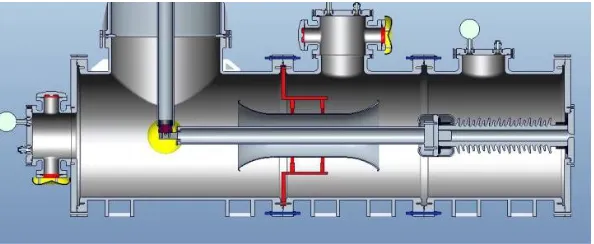
Most of the component in Gas insulated switchgears and Gas insulated lines represents concentric cylinder geometry. An experimental EHV GIS model is designed to evaluate and validate the performance of the SF6 N2 mixture.
The basic intent of the experiment is to establish the allowable stress levels for different ratios of SF6-N2 gas mixture.
The evaluation of the model will be based on two variables: - Ratios of SF6 and N2 mixtures
- Absolute pressure of mixtures
The component’s construction is designed to achieve the near-uniform field (quasi uniform field) by concentric cylinder geometry. For insulation purpose SF6 is deployed between the concentric cylinder geometry (active part and
enclosure). The filed factor is a function of diameters of concentric cylinders. The proposed model for experiment replicate the realistic geometry for 245 kV and 420 kV GIS and GIL products. The protection to the enclosure against the rise in Pressure is provided by Pressure relief device[4] . This device will operate in case the pressure increases beyond the threshold value. Support insulators are provided wherever necessary to prevent the undesired flashovers. The enclosure is provided with Gas Pressure Monitoring devices to check the uniformity of pressure in the enclosure. The gas is filled in the enclosure through the gas filling port. The thickness of the outer sheet for the enclosure is chosen as 20mm.
For evaluation purpose, an Air to SF6 bushing is connected to the enclosure. The bushing will maintain the air clearance
and the insulation during the application of power frequency voltage and the Impulse voltage.The cut section of the model is shown in fig 2
IV. EVALUATION AND RESULTS
The evaluation of the any product is carried out as per relevant National or International standards. Similarly ,the evaluation of GIS model is also carried out as per IEC 60060-1 [5],IEC 62271 [6] and IEC 60270[7].To evaluate the performance under AC power frequency voltage ,a Double shielded laboratory is used. The laboratory has High voltage source and a Partial discharge detector in the circuit. The schematic of AC test set up is shown in fig 3.
Fig 3 : Schematic of Test set up for AC test
The GIS model is subjected to AC power frequency voltage test. The evaluation was carried out for following configurations:
- 10/90 SF6/N2 mixture - 20/80 SF6/N2 mixture
- Gas pressure varied between 4-6 bar
The withstand and the breakdown value for the mixture was found after repeated breakdowns in a group of 10 voltage applications. The breakdown stress (kV/mm) is plotted Vs. Pressure. Fig 4 shows characteristics of breakdown stress for Pure SF6 as well as SF6N2 mixture.
Fig 4: Characteristics of breakdown stress for Pure SF6 as well as SF6N2 mixture.
10 12 14 16 18 20
3 5 7
B
re
ak
d
o
w
n
s
tr
e
ss
(k
V
/m
m
)
Pressure (Bar)
The partial discharge(PD) measurement in the model is carried out as per IEC 60270.The precaution and the measurement is same as adopted for GIS with Pure SF6.The voltage was slowly increase till the measurement voltage
and partial discharge value was noted. The process was repeated for the artificial contamination inside the GIS.The characteristics of the PD was found to be in line with the conventional GIS with Pure SF6. The pattern for the PD with
impurities on electrode is shown in fig 5.
Fig 5: PD pattern with impurities on the electrode
The partial discharge inception voltage with respect to Varied pressure was measured for the two gas mixtures .The characteristics of partial discharge value with increase in pressure is plotted as given in fig 6.
V. CONCLUSION
From the above experiment and the results, it can be concluded that SF6N2 mixture can offer viable solution for
application in EHV GIS. The withstand and breakdown voltages are found to be near the desirable value as pr relevant standards. The GIS with SF6 mixture can be evaluated in the same way as that of pure SF6. The characteristic of the PD
value is also same as that of pure SF6.The SF6N2 mixture can replace pure SF6 by operating at higher pressure to get the
same dielectric properties. The reduction in SF6 content will also help to address the environmental concerns.
.
200 300 400 500 600 700
2 3 4 5 6
P
D
IV
(k
V
)
Pressure(Bar)
PDIV Vs Gas Pressure
REFERENCES
[1] Denis Denissov, Heinz Rebholz, Wolfgang Köhler, Stefan Tenbohlen, “Dielectric Strength of Different Gases in GIS” ,Journal of University of Stuttgart, IEH,Germany
[2] R.S.Nema, S.V.Kulkarni and Ekram Husain,” CALCULATION OF SPARKING POTENTIALS OF SF6 AND SF6-GAS MIXTURES IN
UNIFORM AND NON-UNIFORM ELECTRIC FIELDS”, IEEE Transactions on Electrical Insulation Vol. EI-17 No.1, February 1982 [3] Prof. N.H. Malik, Prof. A.A. Al-Arainy and and Dr. M. Iqbal Qureshi ,”BREAKDOWN CHARACTERISTICS OF COMPRESSED SF6+N2
AND SF6+CO2 MIXTURES WITH DILUTED CONCENTRATION OF SF6 GAS” ,Research Report No. EE-43/26/27, September 2006
[4] Guide for SF6 mixtures:CIGRE WG23.02 report 1999.
[5] InternationalElectro technical Commission 60060-1:High voltage test techniques ( 2010) [6] International Electro technical Commission 62271(103) Gas filled equipments ( 2011)
[7] International Electro technical Commission 60270: Measurement of Partial discharge and methods (2000)
BIOGRAPHY
Shailesh R.Joshi received his BE in Electrical Engg. From Amravati University.Currently, he is pursuing his ME (PS) from Matoshri college Of Engg. and research Centre,Nasik.His area of interest are EHV and UHV equipments and Switchgear for Power System.