EFFECTS OF VARIETAL DIFFERENCES, PLANT SPACING AND WEEDING REGIMES ON WEED DENSITY AND YIELDS OF UPLAND
RICE IN UGANDA
By
Anyang Robert Tabot (HND, PGD.)
A144/22358/2011
A Thesis Submitted in Partial Fulfillment of the Requirements for the Award
of Degree of Master of Science (Agronomy) in the School of Agriculture and
Enterprise Development, Kenyatta University.
DECLARATION
I, Anyang Robert Tabot declare that this thesis is my original work and
has not been presented for award of a degree in any other university or any other
award.
Name: Anyang Robert Tabot
Reg. No.: A144/22358/2011
Signature: ………
Date: ……….
Supervisors’ Approval
We confirm that the work reported in this thesis was carried out by the
candidate under our supervision and has been submitted with our approval as
university supervisors.
Dr. Joseph Onyango Gweyi, Department of Agricultural Science and Technology, Kenyatta University
Signature ………… Date ……….
Dr. Wilson Thagana, Department of Agricultural Science and Technology, Kenyatta University
DEDICATION
This project is dedicated to smallholder rice farmers in the world trying to make a
living and to my Late Father Pa Abel Anyang alias “Abelity” that believed
nothing is never too late to achieve or do as long as you focus and believe in the
ACKNOWLEDGEMENT
First of all, I would like to thank the Almighty God for giving me the
aptitude, endurance, determination and guidance throughout the ups and downs of
life. With your light, I saw my way!
Several people have assisted me during my research work. Although it is
not possible to mention all in a few sentences I would like to thank those who
have been particularly important to my work. I feel great pleasure to express my
special thanks to my supervisors, Dr. Joseph Onyango Gweyi and Dr. Wilson
Thagana, of the Department of Agricultural Science and Technology, for their
critical and valuable comments in the course of this study. Their insightful
comments for the betterment of the whole work were appreciable. Without
unlimited support and guidance of my supervisors throughout the research work,
this thesis would not be in this format.
I would also want to acknowledge the support of Mr. Michael Dondi and
the teaching staff of postgraduate school of agriculture and enterprise
development for the valuable training, support and encouragement towards my
studies
My particular gratitude goes to the Mukono Agricultural Research
(MUZARDI ) for providing research site and staff to assist in decoding weeds
species and data collection especially to Assistant Station Manager, Mr.
My great appreciation also goes to the Amuru district farmers association
and especially Mr. Kolo Emanuel from Amuru district farmers Association for
providing me necessary information, coordination of the visits to farmers and
assistance in primary data collection. Finally, I extend my sincere thanks to host
farmer in the Pabbo parish sites for his fruitful cooperation.
I also would like to thank my wife, Adenike Olufunmilayo, for the
emotional, physical and spiritually support. Thank you for believing in me.
My sincere thanks also go to my colleagues from Kenyatta University
(James, Awa, Faith, Peter and Tom) for the good time we had during our class
and field work. Both the academic and non-academic discussions we had are very
important for me. Thank you for your understanding and friendliness.
Table of Contents
DECLARATION ... ii
DEDICATION ... iii
ACKNOWLEDGEMENT ... iv
LIST OF TABLES ... xi
LIST OF FIGURES ... xii
ABBREVIATIONS AND ACRONYMS ... xv
ABSTRACT ... xvi
CHAPTER ONE: INTRODUCTION ... 1
1.1 Background to the study ... 1
1.2 Statement of the Problem ... 8
1.3 Significance of the Study ... 10
1.4 Objectives of the Study ... 11
1.4.1 General objectives ... 11
1.4.2 Specific objectives ... 11
1.5 Hypotheses. ... 12
1.6 Conceptual and theoretical Framework ... 12
CHAPTER TWO: LITERATURE REVIEW ... 16
2.1 Introduction ... 16
2.2 Rice Production in Uganda ... 19
2.3 Rice Varietal Development for Improved Weed Control ... 21
2.4 Weeding Regimes and Rice Performance ... 25
2.5 Effects of Spacing and Weeds Management on Rice Crop Yield ... 27
2.5. 1 Influence of seed rate on weeds control in rice ... 27
2.5.2 Influence of plant spacing on weeds control in rice ... 29
CHAPTER THREE: MATERIALS AND METHODS ... 31
3.1.1 Mukono Zonal Agricultural Research and Development Institute (Mukono
ZARDI) ... 31
3.1.2 Amuru District ... 31
3.2 Experimental Design and Field Layout ... 32
3.3 Plot Layout ... 33
3.4 Plot Layout Description ... 33
3.4 Field Establishment and management Practices ... 34
3.4.1 Seedbed preparation and agronomic practices ... 34
3.4.2 Fertilizer application ... 35
3.5 Parameters Determined and Procedure ... 35
3.6 Tiller Counts ... 36
3.7 Plant Height and Growth Pattern ... 36
3.6 Leaf Area Index (LAI) ... 36
3.7 Weed Species Identification ... 37
3.8 Weed Dry Matter Determination ... 37
3.9 Yield and Yield Components of NERICA rice... 38
3.10 Relative Yield Loss (RYL) ... 38
3.11 Data Analysis ... 38
CHAPTER FOUR: RESULTS AND DISCUSSION ... 40
4.1 Composition and dominance of weed flora ... 40
4.2 Weed Density ... 43
4.2.1 Effect of weed control regimes on weed biomass ... 43
4.2.2 Effect of Spacing on Weed Biomass ... 45
4.3 Interaction Effect of Variety and Weeding Regime on Weed Biomass ... 50
4.4 Interaction Effect of Variety and Different Spacing on Weed Biomass ... 53
4.5 Combined effects of rice varieties, weeding regime and spacing on weed biomass ... 55
4.6 Plant Height ... 61
4.6.1 Effect of Weeding Regimes on Plant Height ... 61
4.6. 2 Variety and Weeding Regime Interactions on Plant Height ... 63
4.6.3 Effect of Spacing on Plant Height ... 63
4.6.4 Influence of Variety and Spacing on Plant Height ... 65
4.7 Interaction effects of variety, spacing and weeding regime on Plant Height . 65 4.8 Tillering... 68
4.8.1 Effects of Weeding Regime on Tillering ... 68
4.8.2 Influence of Variety and Weeding Regime on Tillers/m2 ... 70
4.8.3 Effects of Spacing on Tillering ... 70
4.8.4 Effect of variety on number of Tillers per m2 ... 72
4.8.5 Interaction effect of variety and spacing on Tillers/m2 ... 73
4.9 Interaction effects of varietal, spacing and weeding Regime on Tiller/m2 ... 74
4.10 Panicle per Square Meter ... 80
4.10.1 Effects of Weeding Regime on Number of Panicle/ m2 ... 80
4.10.2 Influence of Variety and Weeding Regime on Number of Panicle/m2 .. 81
4.10.3 Effects of Spacing on Number of Panicle/ M2 ... 82
4.10.4 Effect of Variety on Number of Panicle per Square Meter ... 83
4.11 Interaction effect of Spacing, Weeding and Variety on Number of Panicle
/m2 ... 86
4.12 Panicle Length ... 88
4.12.1 Effect of Weeding Regime on Panicle Length ... 88
4.12.2 Effect of Spacing on Panicle Length ... 88
4.12.3 Effect of Variety on Panicle Length (CM) ... 90
4.12.4 Influence of Variety and Weeding Regime on Panicle Length (CM) ... 90
4.12.6 Influence of Variety and Spacing on Panicle Length (cm) ... 92
4.13 Combined Effects of Varietal, Spacing and Weeding Regimes on Panicles Length (cm) ... 92
4. 14 Leaf Area Index ... 94
4.14.1 Effect of weed control, spacing and Variety on leaf area index ... 94
4.14.2 Combined effect of Variety, spacing and weeding regime on Leaf Area Index ... 94
4.15 Yield and Yield Components ... 97
4.15.1 Effect of Weeding Regimes on Number of Grains per Panicle ... 97
4.15.2 Influence of Variety and Weeding on Number of Grains per Panicle ... 97
4.15.3 Effect of Spacing on Number of Grains per Panicle ... 100
4.15.3 Influence of variety and spacing on number of grains per panicle ... 100
4.15. 4 Effect of variety on number of grains per panicle ... 100
4.16 Combined effect of spacing, weeding and variety on number grains per panicle ... 101
4.17 Effect of Weeding Regime on Weight of 1000 Grains ... 104
4.17.2 Effect of Variety on Weight of 1000 Grains ... 104
4.18 Grain Yield ... 105
4.18.1 Effect of Weed Regime on Grain Yield of Rice (Kg/ha) ... 105
4.18.2 Influence of Variety and Weeding Regime on Grain Yield of Rice ... 105
4.18.3 Effect of Variety on Grain Yield of Rice ... 106
4.18.4 Effect of Spacing on Grain Yield of Rice ... 107
4.18.4 Influence of Variety and Spacing on Grain Yield of Rice ... 107
4.18.5 Combined effect of varietal, different spacing and weeding regimes on grain yield. 109 4.19 Relative Yield Loss (RYL) ... 114
4.20 Straw Yield ... 115
4.20.1 Effect of weed control on straw yield of rice ... 115
4.20.2 Effect of Different Spacing on Straw Yield of Rice ... 116
4.20.3 Effect of Variety on Straw Yield of Rice ... 116
4.20.4 Influence of Variety and Spacing on Straw Yield of Rice ... 116
4.20.4 Effects of Variety, Spacing Differences and Weeding Regime of Rice Straw Yield ... 118
CHAPTER FIVE: CONCLUSION AND RECOMMENDATIONS ... 120
6.1 Recommendation ... 121
LIST OF TABLES
TABLE 1.0: The experimental treatments showing main plot, subplot and
sub-sub plot arrangements ... 34
TABLE 2.1: Characteristics of upland rice varieties used for trials ... 35
TABLE 3.2: Interaction effect of varietal, spacing and weeding regime on yield
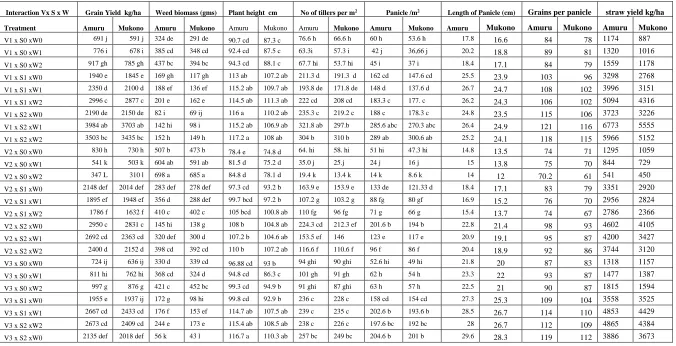
and yield components of rice in amuru and mukono ... 58
TABLE 4.4: Combined effects of rice varieties, weeding regimes and spacing on
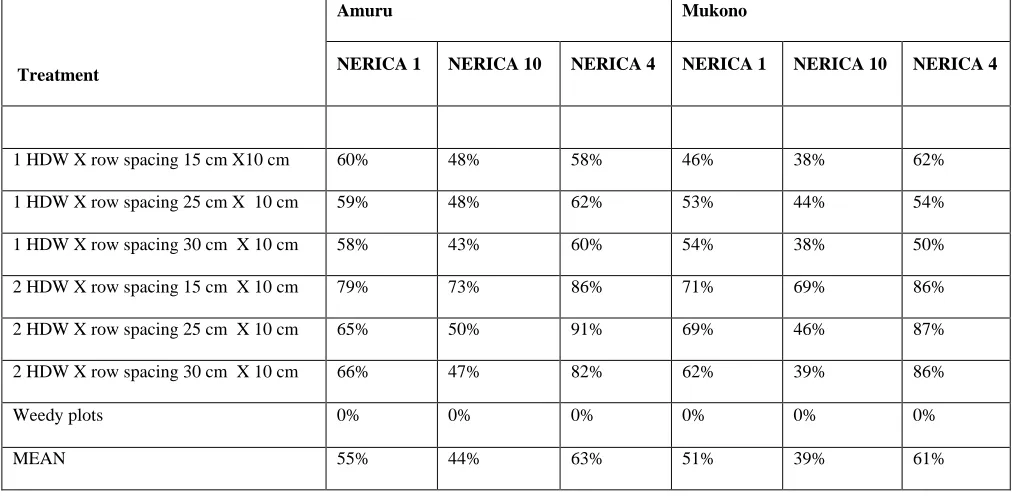
weed control efficiency in two locations (amuru and mukono districts) ... 60
TABLE 4.5: Effects of spacing, varietal influence and weeding on yield
parameters measured amuru and mukono ... 89
TABLE 4.6 Interaction effect of variety and spacing on yield and yield
contributing characters of rice in amuru and mukono ... 91
TABLE 4.7: Effect of varietal, different spacing and weeding regimes on average
leaf area index across two sites (amuru and mukono) ... 96
TABLE 4.8: Interaction effect of variety and weeding regime on yield and yield
LIST OF FIGURES
FIGURE 1.1: Conceptual framework ... 15
FIGURE 3.1: Location of experimental sites ... 32
FIGURE 4.1: Effects of weed control regimes on weed biomass/m2 in amuru and mukono sites ... 44
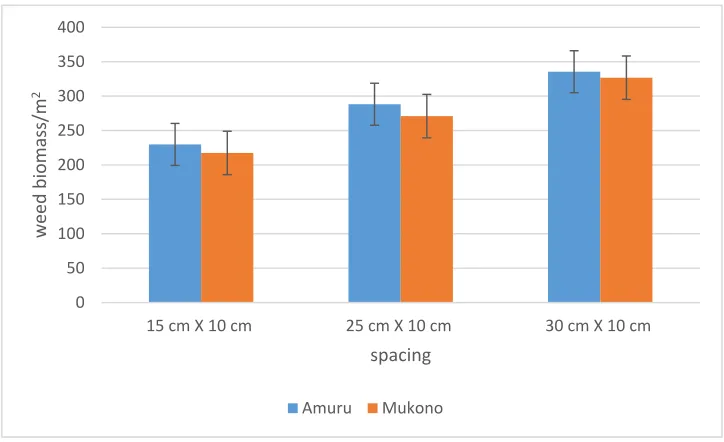
FIGURE 4.2: Effects of different spacing on weed biomass/m2 at amuru and mukono sites ... 46
FIGURE 4.3: Effect of variety on weed biomass in two different locations of amuru and mukono ... 48
FIGURE 4.4 A: Influence of weeding regime and variety on weed biomass/m2 in rice grown at amuru site ... 51
FIGURE 4.4 B. Influence of weeding regime and variety on weed biomass/m2 in rice: mukono ... 51
FIGURE 4.5 A: Influence of different spacing and variety on weed biomass/m2 in rice: amuru ... 54
FIGURE 4.5 B. Influence of different spacing and variety on weed biomass/m2 in rice: mukono ... 54
FIGURE 4.5 A: Effects of weeding regimes on plant height at amuru site ... 62
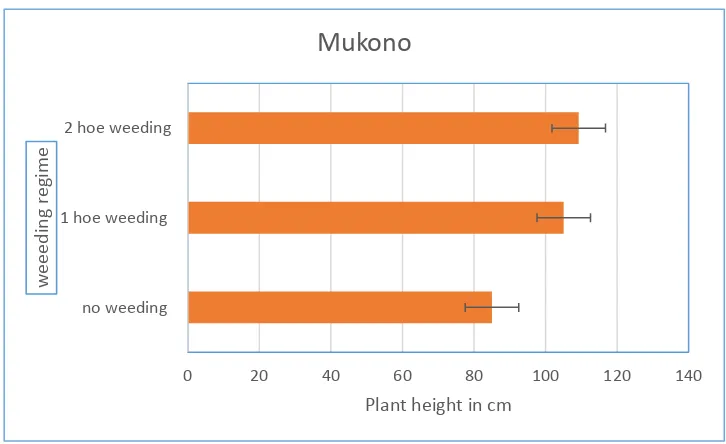
FIGURE 4.6 B: Effects of weeding regimes on plant height at mukono site ... 62
FIGURE 4.7 A: Effect of spacing on plant height in amuru site. ... 64
FIGURE 4.8: Effect of weeding regimes on number of tillers/plant ... 69
FIGURE 4.9 Influence of variety and weeding regime on tillers/m2 ... 70
FIGURE 4.10: Effect of spacing on rice tillering ability in amuru and mukono
respectively at 25das, 40 das and 60 das. ... 71
FIGURE 4.11: Effect of spacing on rice tillering ability/m2 in amuru and mukono
... 72
FIGURE 4.12: Effect of varity on tiller/m2 in amuru and mukono site respectively
... 73
FIGURE 4.13 A: Influence of variety and different spacing on tillers/m2 amuru 74
FIGURE 4.13 B. Influence of variety and different spacing on tillers/m2 mukono
... 74
FIGURE 4.14: Effects of weeding regime on number of panicle per square meter
... 80
FIGURE 4.15 A: Influence of weeding regime and varieties on number of
panicle/ m2 (amuru)... 81
FIGURE 4.15 B: Influence of weeding regime and varieties on number of panicle/
m2 (mukono) ... 82
FIGURE 4.16 Effects of spacing on number of panicle/m2 in amuru and mukono
respectively ... 83
FIGURE 4.18 A: Influence of spacing and varieties on number of panicle/ m2
(amuru) ... 85
FIGURE 4.18 B: Influence of spacing and varieties on number of panicle/ m2
(mukono) ... 85
FIGURE 4.19 A: Combined effect of varietal, different spacing and weeding
regimes on panicle/m2 in amuru ... 86
FIGURE 4.19 B: Combined effect of variety different spacing and weeding
regimes on panicle/m2 mukono ... 87
FIGURE 4.21 A. Influence of varieties and weeding regime on rice yields kg/ha
(amuru) ... 106
FIGURE 4.21 B. Influence of varieties and weeding regime on rice yields kg/ha
-1 (mukono) ... -106
FIGURE 4.22 A: Influence of variety and spacing on rice yields (kg/ha) inamuru
... 108
FIGURE 4.22 B: Influence of variety and spacing on rice yields (kg/ha) in
mukono ... 108
FIGURE 4.23 A: Combined effect of varietal, different spacing and weeding
regimes on grain yield (kg/ha) (amuru). ... 110
FIGURE 4.23 B: Combined effect of varietal, different spacing and weeding
ABBREVIATIONS AND ACRONYMS
GDI: Gross Domestic Income
NERICA: New Rice for Africa
FAO: Food and Agricultural Organization
CO2: Carbon dioxide
SSA: Sub-Saharan Africa
CPWC: Critical period of weed control
HYVs: High Yielding Varieties
ABSTRACT
Rice is relatively new to Uganda, yet consumption is outstripping production; and with a growing population, demand is likely to increase. NERICA (New Rice for Africa) rice – with high yields and ability to withstand dry conditions is being planted in most part of the country. However, weed infestation is becoming one of the biggest hindrances affecting rice production. The objective of the current work was therefore to investigate the effects of varietal differences, plant spacing and weeding regime on weed density and yields of upland rice in Uganda. A study was carried out during the 2013 cropping season in Mukono agricultural research station and a farmer’s field in Amuru District to evaluate the effects of varietal differences, plant spacing and weeding regimes on weed density and yields of upland rice. The experiment was laid in a Randomized Complete Block Design (RCBD) with Split-split plot arrangement and replicated three times. The weeding regime was the main plot treatment; row spacing constituted the sub-plot while varieties were sub–sub plot. In both sites, the average weed coverage was higher in NERICA-10 (87.8%) followed by NERICA-1 (58.2%) and lowest in NERICA -4 (22.5%). At both sites weed competition reduced rice plant height in NERICA-10 (52%) while, NERICA-1 and NERICA-4 had 27% and 15% reduction respectively. Integration of row spacing and weeding reduced weed biomass, with NERICA-4 having highest weed reduction of 89.2% under row spacing of 25cm by 10 cm and 2 hoe-weeding regime(2 and 3 weeks interval), while NERICA-1 and NERICA-10 under same treatment had weed reduction of (67%) and (48%) respectively. Weed competition significantly reduced productive tillers of rice varieties. NERICA-4 produced higher number of productive tiller (84.5%) under row spacing 30 cm by 10 cm and 2 hoe-weeding followed by NERICA-1 (68%) under 25cm and 2 hoe weeding and NERICA-10 (65%) under row spacing of 15 cm by 10 cm and 2 hoe weeding. The data showed that NERICA 4 was more tolerant to weed pressure than the other varieties. Spacing of 25 cm x 10 cm had less weed biomass though 15cm X 10 cm also reduce the weed biomass but had negative result in terms of yield. If farmers were to explore one hoe weeding to control weeds in rice; NERICA-1 should be recommend at a spacing of 30cm x 10 cm to attain an average yield of (2.93tha1) which is still above the national average of 1.7t ha-1. NERICA -4 at single hoe weeding out-yielded other varieties and its yield at two hoe weeding regimes tended to approach optimum.. Its superior yield advantage at single hoe weeding was consistent across locations and is of importance since most farmers are known to avoid a second weeding due
CHAPTER ONE: INTRODUCTION
1.1 Background to the study
Rice (Oryza sativa L. var. Indica) is the second most important
cereal crops in agriculture and economy of Uganda. Rice production in Uganda
started in 1942 mainly to feed the World War II soldiers. However, due to a
number of constraints, production remained minimal until 1974, when farmers
appealed to the government for assistance to improve its production. In response,
Government identified the Doho swamps and constructed the Doho Rice
Irrigation Scheme (DRS) with the help of Chinese experts and later Kibimba Rice
Scheme (Africa Rice Center- Africa Rice), (2008). Both schemes, which were
based on modern technologies (irrigation), changed the agronomic practices of the
people and the productivity of the area.
Despite rice production having been introduced in Uganda, many farmers
are not familiar with its cultivation or the required agronomical practices. About
80% of the rice produced is grown by small-scale farmers with acreage of less
than 2 ha, using simple technologies and little or no application of fertilizer, use
of poor quality seed with little or no irrigation and poor water management
practices among others (ADC, 2001). About 15 % of the growers are
medium-scale farmers with acreages ranging from 2 – 6 ha, applying more or less same
practices as the small-scale farmers, with a few using non-motorized tools such as
medium- and small-scale farmers is the acreage. There is also a small group of
large-scale farmers (about 5%), with land under cultivation ranging from 6 to
1,000 hectares (Kijima, Sserunkuuma and Otsuka, 2006)).
Due to government intervention in promoting domestic rice production,
Uganda’s rice production has increased significantly over the last five years. By
some accounts it has doubled and was expected to more than double by 2011
because of the new varieties which can be grown in rain-fed land instead of
swampy paddies that dominate world production (Pender, Laca, Mackill,
Fernandez and Fischer, 2004). Uganda adopted the New Rice for Africa
(NERICA) 1, 4 and 10 varieties, locally known as “Upland Rice”, in addition to
the old lowland varieties which have helped the country to improve its food
production and security. From the earlier releases of three upland rice varieties in
Uganda in 2002, farmers were able to earn about US$9 million in 2005 (UBOS,
2003). The introduction of NERICA in Uganda is one of the government’s
strategies for poverty reduction and achieving food security. The demand for the
commodity has been increasing relatively fast and gaining importance in the diet
of the urbanites (Imanywoha, 2001). Domestic rice production has not been able
to keep up with the demand, which is growing because of rapid urbanization and
changing food habits. Uganda resorts to about $90 million-rice imports (the third
Upland environments are highly variable, with climates ranging from
humid to sub-humid soils from relatively fertile to highly infertile,
and topography from flat to steeply sloping (Dingkuhn, Jones, Johnson and Sow;
1998.). The low grain yields estimated at 1,500 kg ha-1 (Imanywoha, 2001)
undermines the status of the rice as an important food security and income crop in
Uganda. Surprisingly, the actual grain yield of rice from farmers’ estimates in the
Central and Northern Uganda is much below the national average of 1,500 kgha-1.
The constraints to improved rice yields are among others, weeds and low soil
fertility which is caused by traditional production practices of the farmers.
Weeds are a major constraint to increased rice production and farmers
spend many hours hoe-weeding (Akobundu 1987); and this puts more strain on
labour which is scarce as reported by Tollens (2006). Weeds interfere with rice
growth and development by reducing the light intensity, nutrient, water, CO2 and
compete with crop for space; secrete toxic exudates into the soil that depress
growth and development of rice. In addition, they may harbor various pests and
pathogens (Moody, 1994, FAO, 1996).The longer the weed-rice association
remains, the greater the negative effects on rice productivity (Akobundu 1987,
Moody, 1994). Understanding “how long” weed-rice could associate without
damaging effect on rice is key to formulation of sustainable integrated weed
Integrated weed management is considered one of the most attractive
options for crop protection, whereby a suitable choice of compatible measures
(cultural, mechanical, biological and chemical) keeps the weed population at
manageable levels. To be effective, integrated weed management should build on
knowledge of weed biology and ecology. A lack of awareness, timely information
and knowledge of the weeds limits the actual implementation of integrated weed
management at the farmers’ level (Labrada et al 2003). Farmers in Uganda have
frequently cited notorious weeds such as Commelina benghelensis, Digitaria spp.,
and Imperatus cylindrica as some of the major constraints to increased rice
productivity (Imanywoha, 2001).
It can be hypothesized that delayed weeding per se does not decrease
yields and it may also help farmers save the scarce labor resources required for
other operations (Alou, 2012). Therefore, it is imperative to quantify rice yields
under weeding regimes that represent a range of farmers’ practices in order to
determine the optimum dates for effective weed control.
Weed control is largely based on herbicide application; however, chemical
herbicides are often toxic and cause environmental problems. Use of aggressive
cultivars can be effective cultural practice for weed growth control where growth
is substantially suppressed. According to various authors (Akobundu et al., 1987;
Africa Rice Center/FAO/SAA 2000; Diagne 2006; Kijima, 2008), the competitive
compete with weeds, reducing weed seed and biomass production. The second
possibility is having crop tolerate competition from weeds, while maintaining
high yields. An improved weed management system within the context of
integrated weed management with emphasis on the use of weed competitive rice
cultivars is therefore needed for sustainable upland rice production in smallholder
farms in Uganda.
Although some studies of cultivar differences in competitiveness of rice
exist, including attempts to relate rice traits to weed competitiveness and yield
(Fischer et al., 2001; Gibson et al., 2003; Zhao et al., 2006; Johnson et al., 1998;
Jones et al., 1996; Koarai and Morita, 2003) reported, only a limited number of
cultivars have been evaluated especially in Guinea and Sudan Savannas of West
Africa. For example the inter-specific hybrids called New Rice for Africa
“NERICAs” have not been evaluated extensively for weed competitiveness. The
use of weed competitive varieties is unlikely to be feasible as a stand-alone
technology but rather it may be a valuable component of integrated measures.
Suitable varieties should, in addition to weed competitiveness, also possess other
traits (Dingkuhn et al., 1999) like resistance or tolerance to other biotic and
abiotic stresses. Furthermore, a suitable variety needs to be well adapted to the
environment and should preferably have the specific characteristics desired by
rice cultivars into upland rice production system may be a viable option for
attaining optimum yields in smallholder farms.
All rice cultivars have an optimum seeding rate that varies, depending on
growth characteristics. The ‘‘plasticity’’ of plants with respect to the available
resources implies that there is a wide range of planting densities with more or less
constant crop yield levels (Harper, 1977; Radosevich, 1987). Increasing the plant
density within this range would in theory, only increase crop’s competitive
advantage over weeds with no concomitant negative consequences for crop yield.
This is the case with rice, and varying the plant population density is an option for
improving its competitiveness. Many reports have indicated that increased
seeding rates have been shown to be an important component for improved weed
management (Akobundu and Ahissou, 1985; Cousens, 1985; Fagade and Ojo,
1977; Kristensen et al., 2008).
Row spacing can also influence the critical period of weed control in
crops. It is hypothesized that narrow row spacing may decrease the interval of
critical weed competition periods (Chauhan and Johnson 2011). And according to
these authors, the critical weed-free periods for rice planted at the 30-cm rows
were up to 8 days longer than the other two rows spacing (15-cm and
10–20–10-cm rows). Moreover, several studies have documented the reduced competitive
ability of short-stature cultivars (Harker et al., 2009; O’Donovan et al., 2000) and
narrower row spacing (Drews et al., 2004). In general, the higher weed densities
typical in low-input and organic systems may make narrow row spacing and
higher planting density particularly attractive.
The practice of increasing crop plant density by using higher seeding rates
associated with narrower row spacing can lead to earlier canopy closure, thus
shading weeds in their early developmental stages (Vera et al. 2006). Sharma and
Angiras (1996) and Angiras and Sharma (1996) found that reduced row spacing
increased light interception by crops and reduced weed biomass, increasing crop
yield. The studies conducted on barley (Hordeum vulgare L.) have shown that
higher seeding rates using cultivars with differing competitive abilities enhanced
crop competitiveness against wild oat (Avena fatua L.) (Harker et al., 2009;
Watson et al., 2006; O’Donovan et al., 2000).
Research conducted in Louisiana (Eric 2001) indicates that cultivars
planted at the optimum seeding rate tend to be more competitive with weeds than
when planted at low seeding rates. High seeding rates can be competitive with
weeds, but intra-specific competition occurs at excessive seeding rates and yields
are reduced. Establishing a good stand of rice and providing an environment that
promotes rapid growth help to minimize weed interference. It was therefore very
necessary to investigate the available treatment of rice weed control in Uganda to
1.2 Statement of the Problem
The rice-cropping systems are rain-fed upland and irrigated lowland.
Weeds constitute a big constraint to the production of rice in the upland ecology
and rank only second to drought stress in reducing its grain yield and quality. It
also hosts insect pests and diseases, require expensive labor and energy to control,
reduce harvesting and processing efficiency, and sometimes are poisonous
(Gupta, 1983).
The limited increase in production is due to ineffective control of weeds in
upland rice, for which it is imperative that an effective weed control mechanism
and its effective adoption result in better productivity and in an increase of net
rice production. This in turn will ensure food security in the region (Pender et al.,
2004). The weed flora of rice is as variable as the conditions under which it is
grown. Many important rice weeds of the tropic and sub-tropics are present in
East Africa, including Uganda: - Echinochloa crus-gulli, E. colona, Rottboellia
exaltata and Oryza punctata are common grass weeds and some important sedges
are: Cypresus difformis, C. tuberosus (C. rotundus var tuberosus), Scirpus
maritimus, Pycreus macrostachyos and Fimbristystis littoralis (Kijima, 2008)).
Some of these are extremely competitive, especially E. crus-galli has been known
to cause yield reduction of up to 25% in seeded rice when present at a density of
11 plants /m2 (Adeosun, 2008). The occurrence of weeds as constant component
of the ecosystem in comparison to the epidemic nature of other pests makes
Ukungwu and Abo (2004) reported that weed is the greatest bottleneck to
increased yields and quality of rice. Development of competitive rice varieties as
a means of effective weed control by weed suppression have been proposed by
various authors and easy to adopt by farmers. In view of this, weed-competitive
Upland rice varieties known as NERICA (New Rice for Africa) have been
developed in West Africa for areas where herbicides are too expensive or
unavailable. Differences in competitiveness amongst varieties have long been
established. In Sierra Leone, Harding (2012) found up to 66% differences in weed
suppression among upland rice varieties. Fisher (1997) observed yield losses
ranging from 27 to 60% among Latin American irrigated rice varieties growing in
competition with Jungle rice. Gibson (2001) found that the more competitive
water-seeded rice varieties required lower herbicide rates to achieve the same
level of control of late water grass (Echinochloa oryzoides) than the less
competitive varieties. The development of competitive rice varieties requires the
identification of key plant parameters conferring competitive ability that can be
used as selection criteria by breeders (Pester, 1999). Plant traits such as tiller
number and leaf area index have shown to confer competiveness and could be
used in breeding programs to enhance competiveness of high yielding varieties
that are not competitive. The current experiment therefore aimed to address the
above pertinent issues raised regarding the weed-crop interactions, with emphasis
ultimate goal of increasing the competitive ability of the rice crop and final yield
and yield components.
1.3 Significance of the Study
Weeds compete with crops for moisture, light and nutrients. Yield losses
may be small if only a few weeds were present, but heavy infestations may cause
complete crop failures, and in some cases when perennial weeds get established,
the land cannot be used for crop production until the infestation has been
controlled. Weed species in rice exhibit highly diverse growth habits and
characteristics, and as such more than one control method is commonly applied to
maintain weed population below the economic threshold. The best methods most
often results from use of multiple practices, such as planting as early as possible
to give crops competitive edge over weeds that appear later are well known,
however the procedure alone does not provide enough weed control to allow
satisfactory crop yield.
Effective weed control in rice cannot be achieved by single method, but
requires an integrated agronomic practice. Despite considerable research, there is
much to be learnt about weed control in rice. Many trials have been site specific,
often producing results at variance with those from other locations. It was
therefore very necessary to investigate the available treatment of weed control in
Keeping these in view, a field research was be carried out to evaluate the
effects of different spacing and weeding regimes in relation to three newly
released rice varieties with a view to educating farmers on the best integrated
weed management methods to boost the rice yields using the NERICA varieties in
Central and Northern Uganda and help influence government policy on rice
production.
1.4 Objectives of the Study
1.4.1 General objectives
The study sought to assess the: Effects of varietal differences of newly
released NERICA rice varieties under different plant spacing and weeding
regimes on weed density and yields of upland rice in Central and Northern
Uganda
1.4.2 Specific objectives
The study focused on the following specific objectives:
i. To determine weed suppressive ability of popular first generation
upland NERICA varieties (NERICA 1, 4 &10).
ii. To evaluate the performance of upland NERICA cultivars under
different weeding regimes that is commonly practiced by famers in
iii. To determine the appropriate rice spacing of newly released upland
rice varieties that provides competitive ability against noxious
weeds
1.5 Hypotheses.
The following hypotheses were used to guide the study:
i. That there exists varietal abilities to suppress weed depending on
key morphological, phonological traits and growth parameters
ii. That there is optimum yield potential of a variety that significantly
depends on the number of weeding regimes
iii. It was hypothesized that narrow row spacing would significantly
decrease the interval of critical weed competition periods and
hence less yield loss.
1.6 Conceptual and theoretical Framework
The impact of weeds upon a production system can be demonstrated using
the basic concept of production function. The quantity of rice output is
determined by the quantity of fixed and variable inputs into the production
process, represented algebraically by production function; Y = f (V, F) (1) where
Y is yield, V and F are variable and fixed inputs in rice production, respectively.
The variable and fixed production inputs include such factors as rice variety, soil
type, soil fertility, rainfall, temperature, among others. Weed infestation affects
The yield loss associated with weeds can be expressed as a reduction in output
resources (excluding expenditure on weed control) to neutralize the effects of
weeds, or any combination of consequent output and revenue adjustments
between the extremes. Introducing input variables specifically for weed control
extends the production function framework as follows: Y = f (V, H, F) where H is
weed control input such as varietal ability to suppress weeds , weeding times ,
influence of spacing and population on weeds and herbicide in rice production.
Increasing the weed control input variable will reduce losses and result in a higher
level of outputs V and F.
The above framework avoids comparison of the benefits of a weed control
technology to a hypothetical and usually unattainable weed-free scenario. Crop
losses resulting from weeds (L) are defined as the losses resulting from yield
reduction due to residual weeds after control, in addition to price. It has been
conceptualized in this study that integrated weed control can be achieved by
varietal differences coupled with the appropriate spacing which can greatly
influence or improve upland rice yields. Beside varietal and appropriate spacing
yield performance of NERICA can also be improved by timely weeding when
carried out by smallholder farmers to reduce the negative influence on crop–weed
interaction. The critical period of weed control (CPWC) is an important principal
of an integrated weed management program. It is a period in the crop growth
al., 2002). Weeds that are present before or emerge after this period do not cause
significant yield loss. Studies on the critical period of weed control are important
in making weed control recommendations. The optimum time for implementing
and maintaining weed control and reduce cost of weed control practices (Hall et
al., 1992; Van Acker et al., 1993). The development of competitive crop cultivars
is an important aspect of integrated weed management and can reduce reliance on
herbicides (McDonald, 2003). The ideal weed competitive cultivars are
high-yielding under both free and weedy conditions and have strong
weed-suppressive ability. Weed-weed-suppressive ability is the ability to suppress weed
growth and reduce weed seed production and, hence, benefit weed management in
the subsequent growing season (Jannink et al., 2000; Zhao et al., 2006). An
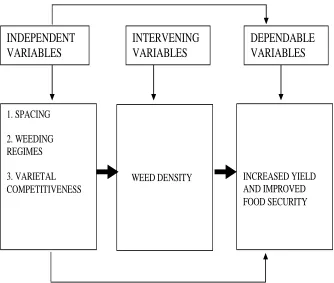
Figure 1.1: Conceptual framework INDEPENDENT
VARIABLES
INTERVENING VARIABLES
DEPENDABLE VARIABLES
1. SPACING 2. WEEDING REGIMES 3. VARIETAL COMPETITIVENESS
CHAPTER TWO: LITERATURE REVIEW
2.1 Introduction
Worldwide, weeds are estimated to account for 32% of potential and 9%
of actual yield losses in rice (Oerke & Dehne, 2004). The nature and severity of
weed problems, however, vary according to the rice ecosystem. Likewise, weed
management practices and the available options are often a function of
biophysical and socioeconomic factors which, in turn, are determined by the
agro-ecosystem. Uncontrolled weed growth is reported to cause yield losses in the
range of 28–74% in transplanted lowland rice. The economic importance of weed
competition with rice account for yield losses estimated to be at least 2.2 million
tons per year in sub-Saharan Africa, valued at $1.45 billion, and equated to
approximately half the current total imports of rice to this region (Rodenburg et
al., 2009). Throughout Africa; from Senegal to Madagascar, weeds are cited
among the main production constraints in any of the rice producing
agro-ecosystems (Adesina et al.1994; Ampong-Nyarko, 1996; Becker and Johnson,
1999a; Diallo and Johnson, 1997). Weed problem has been ranked second to
drought stress in reducing its grain yield and quality. Weeds also, host insect pests
and diseases, require expensive labor and energy to control, reduce harvesting and
processing efficiency, and sometimes are poisonous. Common agronomic factors
that contribute to weed problems are inadequate land preparation (soil tillage, soil
quality rice seeds, broadcast seeding in lowlands, use of old rice seedlings for
transplanting, inadequate water management, inadequate fertilizer management,
mono-cropping, labor shortages for hoe weeding and delayed herbicide
applications and other interventions (Becker & Johnson,1999a, 2001b; Diallo &
Johnson, 1997). Each rice production system harbors weed species well adapted
to the environment and management practices. While the weed flora of a specific
production system (e.g., lowland or upland) may be similar across different agro
ecological zones, the abundance of individual species can differ substantially
(Akobundu & Fagade, 1978). A review of the literature on weeds in rice-based
cropping systems in Africa yielded 130 different weed species (upland: 61;
hydromorphic: 31; lowland: 74), 57 of which were reported more than once
(upland: 26; hydromorphic: 13; lowland: 30), and 12 were observed in more than
one rice ecosystem (Africa Rice Center, 2008).
In rain fed rice, yield losses can reach up to 84%, depending on the weed
species, rice varieties and the soil moisture regime (Akintayo et al., 2008). Yield
losses of 40% have been reported under hydromorphic conditions (Dogbé and
Aboa, 2004) compared to 8 to 30% for transplanted rice under rain fed lowland
and irrigated conditions (WARDA, 2000). In exceptional circumstances, lack of
weed control may cause total crop loss (Johnson et al., 1997). Weed infestation
competition, allelopathy or other cultural practices and prevailing environmental
conditions (Caussanel, 1989).
Similarly, deep-water rice systems along the major rivers can be severely
affected by weeds prior to flooding as the crop is direct-seeded and farmers rely
on hoe weeding and use relatively little herbicides (Akobundu, 1987;
Ampong-Nyarko & De Datta, 1991). Some problematic weeds in rice are annuals with
short growth cycles such as Cyperus difformis and Digitaria horizontalis (40–80
days) and are able to reproduce before rice harvest even when they emerge after
the first weeding operation (Johnson, 1997). Such species, if not controlled, are
able to build up populations very rapidly. Annual weeds causing problems in
upland rice production are Euphorbia heterophylla (L.), Digitaria horizontalis
and the parasitic weeds Striga spp. (Striga hermonthica [Del.] Benth.and Striga
asiatica [L.] Kuntze) and perennials such Cyperus rotundus and Cyperus
esculentus in as addition to the annuals. In lowland rice the perennial weeds:
Cyperus rotundus, Cyperus esculentus and Oryza longistaminata and annual
weeds Sphenoclea zeylanica, Echinochloa spp. Cyperus difformis, Cyperus iria,
Fimbristylis littoralis, Ischaemum rugosum, and Oryza barthii cause serious
losses as concluded by Diagne (2006). Common weed management practices in
rice-based cropping systems include soil tillage, clearance by fire, or
hoe-weeding, herbicides, flooding, fallow and crop rotations, and these are often used
Weed populations of upland rice are reported to be more dynamic than those of
lowland rice areas (Johnson and Kent, 2002). According to these authors,
perennial species accounted for more than 45% of the weed species of lowland
rice and only 31% in the upland or hydromorphic rice ecosystems .Weed control
in upland rice involve a lot of human resource to carry out. Idem and
Showemimo (2004) reported that hoe weeding, which is the common weed
control practice among peasant farmers, can consume as many as between 250
and 780 man-days ha-1, depending on frequency of weeding, ecosystem, and
environmental conditions during cropping. For weed control technology to be
acceptable by upland rice farmers, it must be effective and economically feasible.
Economic feasibility depends upon the relative cost of weed control in relation to
yield obtained.
2.2 Rice Production in Uganda
Before New Rice for Africa (NERICA) was introduced in Uganda, upland
rice cultivation was not common in most of Central and Western regions of
Uganda, though the consumption of rice has been growing due to the rapid
urbanization (UBOS, 2003. According to Kijima and Sserunkuuma (2008) who
relied heavily national representative survey conducted in 2003, observed that the
percent of households who grew upland rice in 2004 was 6.3% and was higher in
Eastern region (12.6%) and in Central (2.2%) while on the other hoe Western
Eastern region. The NERICA rice varieties that were developed by the Africa
Rice Center (Africa Rice, ex-WARDA) and partners in Africa and have gained
popularity among African rice farmers in a relatively short period of time. The
NERICA varieties have good agronomic performance and resistance to Africa’s
harsh growth conditions, especially short growth duration, and varieties are much
appreciated by farmers (Kijima and Sserunkuuma, 2008).
These new group of high-yielding and stress-tolerant upland rice varieties
were developed in Africa for Africa so as to address the continental-wide rice
cereal challenge, poverty and food insecurity (Africa Rice Center/FAO/SAA
2008). As such, it has been described as a ‘boom’, a ‘miracle’, and a ‘revolution’;
some even believing it can become a similar locomotive in Africa’s ‘Green
Revolution’ as the new rice High Yielding Varieties (HYVs) were for Asia
(Diagne 2006; Afrol News, 2002). NERICA or the New Rice for Africa was
introduced in 2002. Since then, Uganda’s rice production has risen from 123,000
metric tons to about 180,000 metric tons to date, according to the agriculture
ministry (Fornasari, 2003). It is a cross between an ancient, hardy African rice
variety and a high-yielding Asian variety. It combines features of both resistance
to drought and pests, higher yields even with little irrigation or fertilizers, and
2.3 Rice Varietal Development for Improved Weed Control
In rice systems where farmers have scarce resources and use few external
inputs, as often found in Africa, rice varieties that suppress weeds maintain high
yields under weedy conditions and are well adapted to the local conditions, and
therefore would bring considerable advantages to resource-poor farmers (Johnson
et al., 1998a). Rice cultivar has tremendous impact on the growth and infestation
of weed in the rice field. Usually short stature cultivars face more weed
infestation than the taller ones (Sarker, 1979). So, to avoid the weed competition
and to get maximum yield from rice, appropriate cultivar should be selected.
Weed-free during the critical period of competition is essential for optimum rice
yield.
In morphological terms, weed competitive rice varieties are suggested to
be those that are tall and have a high tillering ability, a high specific leaf area
(SLA = leaf area per leaf dry weight), erect to droopy leaves and relative long
crop durations to compensate from losses suffered during early weed competition
(Asch et al., 1999; Dingkuhn et al., 1998, 1999; Fofana and Rauber, 2000).
Cultivars of the African rice species, Oryza glaberrima have shown yield
advantages under weedy conditions compared to the Asian Oryza sativa varieties
(Johnson et al., 1998a). There are possible trade-offs between various competitive
characteristics (Dingkuhn et al., 1999; Perez de Vida et al., 2006) or between
competitive traits and yield potential (Jannink et al., 2000; Jennings and Aquino,
no general phenomena (Garrity et al., 1992; Haefele et al., 2004;Pernito et al.,
1986), many desirable morphological characteristics with respect to weed
competitiveness may have negative effects on yield potential. For instance,
characteristics associated with high yielding modern varieties, such as short
stature and erect leaves, are considered to be unfavorable for weed suppression
(Johnson et al., 1998a).
Droopy leaves, on the other hoe, may shade out weeds but limit light
penetration to lower rice leaves, while tall rice plants may compete for light more
effectively than shorter plants but these may be more prone to lodging (Bastiaans
et al., 1997). While Oryza glaberrima can be competitive with weeds, they have
low yield potentials and yield losses are incurred due to lodging and grain
shattering (Dingkuhn et al., 1998; Jones et al., 1997; Koffi, 1980). Interspecific
hybrids of O. sativa and O. glaberrima were developed with higher yield
potential and without the seed shattering characteristic. Varieties derived from
these interspecific crosses were named New Rice for Africa (NERICA) and
currently comprise 18 upland and 60 lowland varieties (Rodenburg et al., 2006b),
of which 17 upland and 11 lowland varieties have been released in Sub Saharan
Africa (Akintayo) . Early observations on these varieties, developed for the
upland areas, have shown that some putative traits of the O. glaberrima parent,
contributing to yielding ability, are heritable (Dingkuhn et al., 1999; Johnson et
al., 1998a; Jones et al., 1997).
In a recent study carried out in two upland environments in Nigeria,
compared to the popular check variety ITA150 and the NERICA parents
(WAB56-104 and CG14), NERICA-1, -2, and -4 generally had slightly higher
weed infestation levels and relative yields losses due to weed competition
(Ekeleme et al., 2009). In the same study, however, all three NERICA varieties
had higher yields than CG14 and ITA150 when the crops were weeded one or two
times. Another recent study carried out in a lowland environment in Benin
showed that nine lowland varieties of NERICA (NERICA-L-6, -32, -35, -37, -42,
-53, -55, -58, and 60) had significant higher yields than both lowland NERICA
parents under weedy and weed-free conditions, and comparable yield
performances as the high yielding and weed competitive check variety, Jaya
(Rodenburg et al.,2009).
Even though varietal differences in weed competitiveness have been found in rice
(Fischer et al., 2001; Garrity et al., 1992; Zhao et al., 2006a), so far, only a limited
number of varieties are confirmed to combine superior weed competitiveness with
good adaptation to African rice ecosystems. In upland fields in Cote d’Ivoire, O.
glaberrima varieties IG10 (Fofana and Rauber, 2000), CG14, and CG20 (Jones et
al., 1996) were found to be superior in suppressing weeds but also had low yield
less yield reductions from weed competition than the semi-dwarf cultivar
ANDNY11 (Akobundu and Ahissou, 1985). In Senegal, Haefele et al. (2004)
reported that lowland rice variety Jaya was weed competitive and high yielding
compared to a range of varieties. Jaya incurred lower yield losses due to weeds
(<20%) compared to popular Sahel 108 (>40%).
Gibson et al. (2001) observed that the use of rice cultivars to suppress
weeds is an important tool in weed management in rice; however, research on
competitive cultivars of rice has been limited. They further noted that the use of
competitive cultivars in an integrated weed management program may also be a
cost-effective approach for reducing the selective pressure for resistance as
competitive cultivars allow lower herbicide rates to be used. Various authors have
observed that crop competition is one of the most important, but often one of the
overlooked tools in weed control. Cultivar weed competitiveness is a function of
weed tolerance, or the ability to maintain high yields despite weed competition,
and weed suppression ability, is the ability to reduce weed growth through
competition (Jannink et al., 2000). Haefele et al. (2004) observed rice cultivar
differences in weed competitiveness and the cultivars that compete well against
weeds are often thought to be tall, rapid early growth, droopy leaves and high
specific leaf area. Kolo (2011) also was in concurrence after observing weed
suppression ability of NERICA 1 (inter- specific) variety over the local check
Previous study shows that drooping leaves and higher tillering ability of
NERICA 1 resulted in good canopy formation which contributed to its weed
suppressing ability which translated into greater grain yield. In the East, Central
and Southern Africa (ECSA) county of Tanzania, Ageratum conyzoides,
Galinsoga pariflora, Clotalaria incana and Rottboellia cochinensis are cited
among the principal weed species encountered in the upland rice ecology (Jannink
et al., 2000). Although O. glaberrima has been shown to be competitive against
weeds (Johnson et al., 1998; Fofana and Rauber, 2000), NERICA varieties cannot
thrive in an un-weeded field.
2.4 Weeding Regimes and Rice Performance
Minimizing weed competition during the early stages of the crop, before it
has formed a closed leaf canopy, is particularly important. In upland rice, this
critical period is approximately 15-40 days after seeding, while in transplanted
rice, the crop can form a canopy more rapidly. Where a crop is exposed to
prolonged weed competition during this critical period, it is not usually able to
recover sufficiently to give a good yield
Mechanical weed control using the hoe or hoe is the most common
method used by upland rice farmers which has several disadvantages. Hoe
weeding is more complicated by the morphological similarity between rice and
use of competitive varieties, to suppress weeds might substantially reduce
herbicide use and labor costs.
When weed pressure is minimal in the field, only one weeding within 15–
21 days after sowing (DAS) is sufficient for NERICA rice plants to grow well.
But when weed pressure is high, a second weeding at panicle initiation stage
(about 42–50 DAS) have often been applied. A third weeding may be done
depending on weed situation in the field. In Uganda the trials on station at
NaCRRI showed that weeding rice thrice at 28, 56 and 84 days after emergence
increases NERICA 4 yields by 2,023 kg over weeding twice on the same dates
(JICA, 2010). To prevent weed-induced yield losses, two to three weeding
operations are required for upland and three for hydromorphic and flooded rice
(Ampong-Nyarko and De Datta, 1991).
Despite recommendations to the contrary however, weeding is frequently
inadequate or delayed, often due to labor shortages or conflicts between on- and
off-farm activities (Johnson et al., 1998a). Indeed, hoe weeding can be relatively
ineffective, particularly in controlling many of the perennial weeds (Cyperus spp.)
that have underground tubers and rhizomes from which they can rapidly
2.5 Effects of Spacing and Weeds Management on Rice Crop Yield
2.5. 1 Influence of seed rate on weeds control in rice
High seeding density of a crop develops canopy rapidly and consequently,
suppresses weeds more effectively and in contrast, reduced seeding rates result in
sparse stands and encourage weed growth (Guillermo et al.2009). Phuong et al.
(2005) reported from their study with lowland rice that, higher seeding rates favor
crop to compete with weeds and at the same time increase yield under weedy
conditions. Ottis and Talbert (2005) opined that, seeding rate higher than
recommendations can be suggested to compensate unforeseen biotic and abiotic
stresses, especially under aerobic conditions where it is often felt that there is a
higher risk of poor seedling establishment associated with lower seeding rates.
Zhao et al. (2007) emphasized on the need for combination of a weed-suppressive
rice cultivar with proper seeding rate for effective weed control in aerobic rice.
They also reported that, under aerobic condition, seeding rate as high as 500
seeds/m2 reduced weed growth and increased crop yield to some extent compared
with a low seeding rate of 300 seeds/m2. According to Kristensen et al. (2008),
increased crop density and spatial uniformity can play an important role in weed
management and a strategy based on increased crop density and spatial uniformity
can reduce or eliminate herbicide application in conventional cereal production.
Crop spatial uniformity decreases competition within the crop population early in
the growing season (Olsen and Weiner 2007) and maximizes the total shade cast
In a study in the presence of weeds, the highest yields were obtained with
high crop density and high spatial uniformity (Kristensen et al. 2008). However,
the early size advantage of the crop was the theoretical basis for the prediction of
positive effects of increased density and spatial uniformity on weed suppression
as reported by Weiner et al. (2001). Therefore, it can be concluded that increased
crop density and uniformity may not lead to effective weed suppression when
weeds have the initial size advantage (e.g., perennial weeds), or are able to catch
up in size with the crop before competition becomes intense (Kristensen et al.
2008). Moreover, one might expect the effects of high crop density and spatial
uniformity on weeds to be more pronounced at low soil nitrogen levels because
weeds grow more slowly at low fertilization levels (Blackshaw et al. 2003).
Moreover, economic benefit of using higher seeding rate should also be taken into
account because cost of extra seed may be higher than the benefits in weed
suppression (Nice et al., 2001) and therefore, high seed density should be
reconsidered within the context of economic feasibility and compatibility with
other aspects of cropping for successful rice production, timely planting,
appropriate control of vegetative growth throughout the duration of the crop,
suitable transplanting densities for optimum tillering and control of leaf growth by
controlling water, fertilizer and chemical inputs are essential for improving the
In contrast, Kirkland et al. (2000) reported from their study with different upland
crops that, crop yield and weed growth were not influenced by higher seed rates
up to 150% of recommended rate. Gibson et al. (2001) also observed no influence
of rice seeding rate on weed growth in direct -seeded lowland rice. Several studies
reveal that, high seed rate may bring about problems of mutual shading and
intra-specific competition for below-ground resources. Despite improvement in weed
management, higher seeding rate may exacerbate problems like lodging (Bond et
al., 2005), insect and disease infestation (Tan et al., 2000) and rat damage (Castin
and Moody, 1989) that harm crop yield.
2.5.2 Influence of plant spacing on weeds control in rice
Various workers (Estorninos & Moody 1976, Manuel et al 1979, Kim and
Moody 1980) have shown that, as the planting distance between hills of
transplanted rice is reduced, the crop becomes more competitive against weeds,
and yield losses due to weeds are reduced. Rao et al (1977) reported that, in
addition to reducing weed weight and weed competition, closer plant spacing
resulted in more options from which a farmer could select a suitable weed control
practice. The number of weed control treatments to ensure that the yield was not
significantly less than that from the weed-free check decreased from seven at 15-
× 15-cm spacing to three when plant spacing was 25 × 25 cm. However, Kim and
Moody (1980) concluded that even though the highest net benefits were obtained
plant at a wider spacing (20 × 20 cm) and weed chemically or by hoe because of
the greater benefit-cost ratio at the wider plant spacing. Phuong et al. (2005)
confirmed that seeding method influence of rice on weed growth and row seeding
in East-West direction resulted in lowest rice yield loss under weedy condition.
Planting uniformity also shows a positive impact on the competitive
ability of a crop (Boyd et al., 2009). Weiner et al. (2001) emphasized on the
combination of increased crop density and more uniform planting to enable crops
to compete more efficiently with weeds. Karaye and Yakubu (2006) also
confirmed planting density in terms of intra-row spacing effect of crop on weed
CHAPTER THREE: MATERIALS AND METHODS
3.1 Description of Locations
3.1.1 Mukono Zonal Agricultural Research and Development Institute (Mukono ZARDI)
Mukono Zonal Agricultural Research and Development Institute (Mukono
ZARDI) is one of the nine Public Zonal Agricultural Research and Development
Institutes (ZARDIs) which were established through the National Agricultural
research (NARS) Act of 2005. The Institute is responsible for carrying out applied
and adaptive research in the Lake Victoria Crescent Agro-ecological Zone. It
covers 21 districts of Central Uganda which include: Mubende, Mityana, Luwero,
Kyankwanzi, Mukono, Kayunga, Nakasongola, Nakaseke, Masaka, Kalangala,
Buikwe, Kalungu, Lwengo, Mpigi, Kampala, Bukomansimbi, Gomba,
Butambala, Buvuma, Wakiso and Kiboga. Mukono is located approximately 27
kilometers (17 miles), by road, East of Kampala, the capital of Uganda. The
coordinates of the district are: 00 20N, 32 45E
3.1.2 Amuru District
The second Location of the trials was in Amuru district of Northern
Uganda, average rainfall of 1150 mm with a unimodal transition to bimodal due
to breaks in June, has high variability, from about 600 mm over the north and
northeastern parts to about 1000 mm over the southern and western parts.
To the north, the two rainy seasons gradually merge into one. Dry periods
at the end of the year become longer; this restricts the range of crops that can be
grown. The rainfall in this area is less pronouncedly bimodal with about 800 mm
annually. Rainfall in the far north and north-east of the country (Kotido and
Moroto) is unimodal and too low (under 800 mm) and erratic for satisfactory crop
production.
Figure 3.2: Location of experimental Sites
3.2 Experimental Design and Field Layout
The main plot consisted of the weed management which entailed no
weeding at all, the second treatment involved one hoe weeding ( 15 days after
germination) and the third treatment involved 2 hoe weeding (15 days and 35
days after germination). The different row spacing constituted the sub-plot, where
the spacing intervals of 15 cm, 25 cm and 30 cm were applied and the cultivars
newly released cultivars in 2004 (NERICA 1, NERICA 10 and NERICA 4 were
used in the trials. The experiment was therefore laid in Randomized Complete
Block Design (RCBD) design with split-split plot arrangements and the
treatments were randomly assigned and replicated three times.
The designs had a nested blocking structure: split plots were nested within
whole plots, which were nested within blocks. Split-plot designs were originally
developed by Fisher (1925) for use in agricultural experiments. The current study
was carried out in Central and Northern Uganda in Northern Uganda in Amuru in
farmer’s field. One site was based at the Mukono agricultural research station
(NARO) in central Uganda.
3.3 Plot Layout
The trial was laid out as Randomized Complete Block Design with a
split-split plot arrangement and the treatments were randomly assigned and replicated
three times.
3.4 Plot Layout Description
The experiments was laid in a Split-split plot design with weeding (0, 2
and 3 weeks respectively after germination) as the main plot; three row spacing
were evaluated (15 cm; 25cm and 30cm and the three varieties of upland rice
Table 1.0: The experimental treatments showing main plot, subplot and sub-sub plot arrangements
DAG- Days after germination
3.4 Field Establishment and management Practices
3.4.1 Seedbed preparation and agronomic practices
The land was mechanically ploughed, harrowed and leveled. Seeds of
NERICA variety (NERICA 1, NERICA 10, and NERICA 4) were sourced from
National Crops Resources Research Institute (NaCRRI), Namulonge- Uganda.
The Three varieties were oven-dried at 420C for 48 hours to enhance uniform
seed germination by breaking seed dormancy. Sowing was carried out on May
10th 2013 in Amuru District Northern Uganda and on 25th April 2013 in Mukono
district, Central Uganda. There were no insecticides or fungicides used in the
control of weed growth process.
MAIN PLOT WEEDING REGIMES
SUB PLOT
TREATMENT SPACING
SUB-SUB PLOT – VARIETIES
WO NO WEEDING S 1 15 cm V1 NERICA 1
W1 15 DAG S2 25cm V2 NERICA 4
W3 15 AND 35 DAGS S3 30 cm V3 NERICA
Table 2.1: Characteristics of upland rice varieties used for trials
Variety Species Plant height Cycle
NERICA 1
(Interspecific) O. sativa O.
glaberrima 100 cm 95 - 100 days
NERICA10
(Interspecific) O. sativa O.
glaberrima 90 cm 85 -90 days
NERICA 4
(Interspecific) O. sativa O.
glaberrima 100 cm 95- 100 days
National Crops Resources Research Institute (NaCRRI), Namulonge- Uganda
3.4.2 Fertilizer application
The fertilizers were applied based the recommended rate of application for
upland rice by NARO. All plots were fertilized with 20 kg of TSP per acre and 50
Kg of Urea per acre as normal recommendations for fertilization of upland rice in
Uganda. Urea was applied in split doses; applied as basal, while the second doses
were applied at panicle initiation stage. Phosphorus was applied at planting. Side
placement of fertilizer between rows was used when applying the second dose of
Urea.
3.5 Parameters Determined and Procedure
Using a similar procedure by Parvez et al., (2011), several vegetative and
physiological traits along with the yield components and yield of rice in both